In short
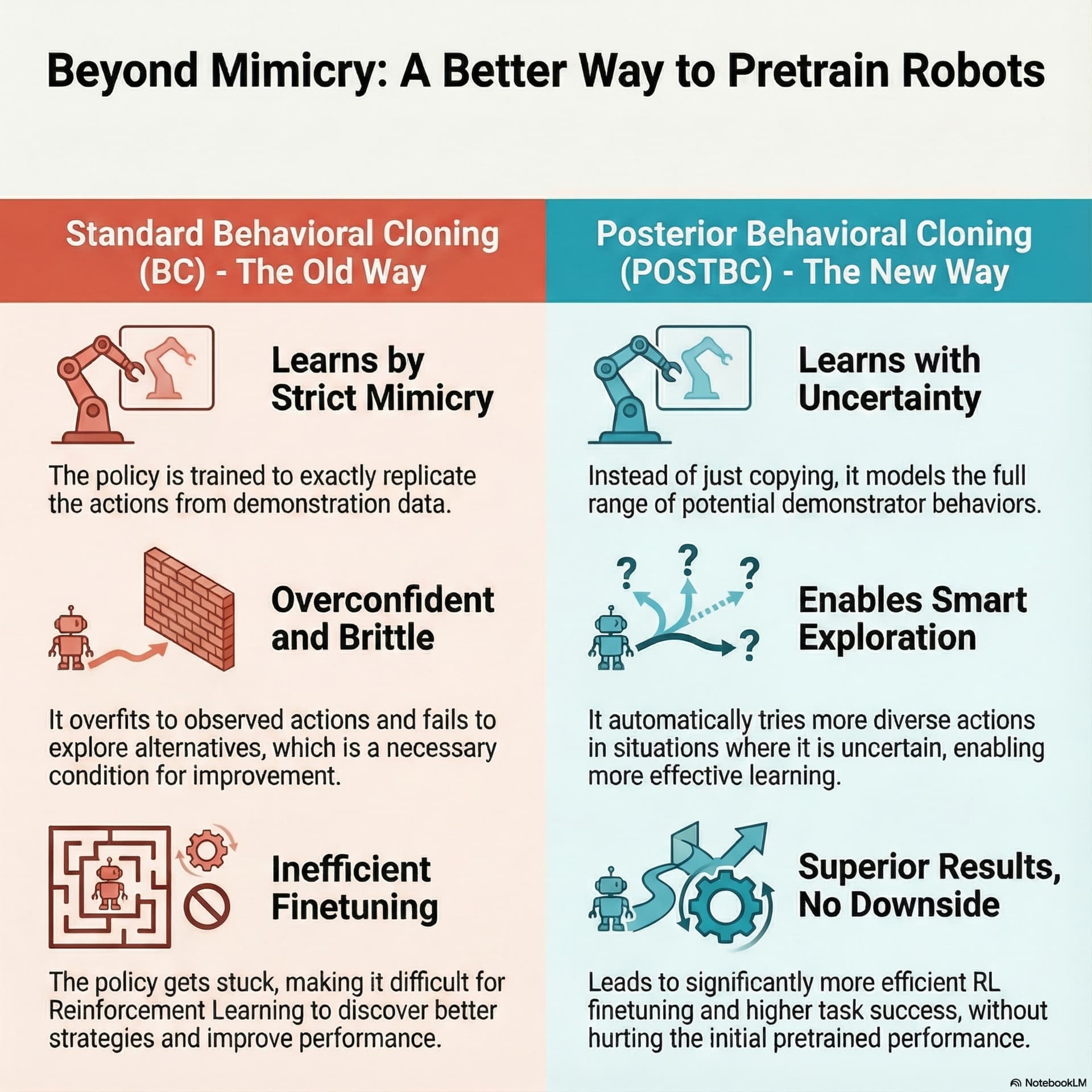
Posterior Behavioral Cloning (POSTBC) improves reinforcement learning (RL) fine-tuning by better pretraining policies, focusing on sample efficiency in expensive continuous robotics.
Guests/backgrounds
No guest names or bios are provided; the episode is presented as a research discussion of POSTBC.
Key claims
Standard behavioral cloning (BC) is a MAP/mode-seeking supervised learner that overcommits to demonstrated actions, harming demonstrator action coverage in data-sparse regions and stalling RL. Uniform noise (Sigma BC) increases coverage but destroys efficiency via untargeted exploration. POSTBC models a posterior over demonstrator behavior by adjusting action entropy using data density/ensemble disagreement, guaranteeing demonstrator action coverage with near-optimal extra RL samples and no worse initial performance than BC.
Notable examples
Simulations on Libero90 (16 tasks, kitchen scenes) and real WidowX 250 arm tasks like “put corn in pot” and “pick up banana.” POSTBC reached target performance with ~2x fewer RL samples; “put corn in pot” improved ~30% vs ~10% for BC after RL. With best-of-N sampling, POSTBC improved ~20–30% on multitask settings.
Written by AI. May contain mistakes. Listen to the episode to check what was said.
Chapters
Tap a time to open that second in VOUnderstanding the Training Phases
0:45 to 2:14
Explains the two phases of AI training: pre-training and fine-tuning.
“How do we make the RL fine tuning algorithm better, faster?”
Flaws in Standard Behavioral Cloning
2:14 to 3:40
Discusses the limitations of standard behavioral cloning and the importance of action coverage.
“So let's start with that current standard, behavioral cloning, DC.”
Challenges of Adding Noise for Exploration
3:40 to 4:48
Explains the shortcomings of adding noise to policies for better exploration.
“Because if the BC policy fails to achieve that coverage, which it provably does in these data sparse regions, it just limits the search space for the fine-tuning algorithm.”
Introducing Posterior Behavioral Cloning
4:48 to 7:24
Introduces POSTBC as a solution for improving behavioral cloning by modeling uncertainty.
“Because you've injected noise everywhere.”
Benefits of SMART Noise in POSTBC
7:24 to 8:12
Explains how POSTBC uses intelligent noise to improve action distribution.
“That's the genius of using the posterior model.”
Practical Implementation of POSTBC
8:12 to 10:57
Describes the steps to implement POSTBC in continuous action domains.
“Peebo-STBC only requires a marginal, near optimally bounded factor of extra sampling effort.”
Testing POSTBC in Real-World Scenarios
10:57 to 12:03
Discusses the real-world testing of POSTBC on various tasks and its efficiency.
“You tested this across simulation and real hardware.”
Performance Gains with POSTBC
12:03 to 13:21
Highlights significant performance improvements observed with POSTBC.
“And in that crucial scenario, POSTBC policies consistently showed massive improvements over both standard BC and the dumb noise Sigma BC policies.”
Conclusion and Key Insights
13:21 to 14:07
Summarizes the benefits of POSTBC in robotic applications and its impact.
“It just had a higher ceiling available to it because its initial distribution already covered a much wider range of successful behaviors.”
Understanding POSTBC Policies in RL
14:07 to 14:49
Learn how POSTBC policies enhance action selection in reinforcement learning.
“So the policy isn't just generating better actions during exploration.”
Show all 12 chapters
The Impact of Pre-training on Learning
14:49 to 15:23
Discover the significant role of pre-training in shaping AI model capabilities.
“By explicitly modeling uncertainty and expanding action coverage only where the data is sparse, it enables significantly cheaper and faster RL fine-tuning.”
Exploring Efficiency Gains in AI Training
15:23 to 15:59
Consider how POSTBC principles could optimize large language model training.
“And this really changes the calculus for how we should allocate resources between data collection and algorithm refinement.”
Transcript
Automatic transcript. May contain errors.0:00So if you're paying any attention at all to modern AI, I mean whether it's the large language model chatting on your screen or a complex robotic arm learning new skills. You know, the training process generally works in two massive distinct steps. Right. Two big phases. The first is pre-training. Where you gather these huge amounts of demonstration data and you train the model, the policy to just mimic that behavior. That's behavioral cloning or BC. It's just learning the basics. And then comes step two. Fine tuning. That's where you use reinforcement learning, RL, to really refine that initial policy, giving it rewards, incentives.
0:39Until it gets to that superhuman or at least highly effective level of performance. Exactly. For the last few years, it feels like the entire research community has been laser focused on step two. How do we make the RL fine tuning algorithm better, faster? Right, more robust. But today, our mission is to dive into the ingredient that's, well, it's also overlooked, but it actually dictates the ceiling and the cost of that entire second step. The initial pre-trained policy itself. And this is just so vital in fields where deploying a policy is expensive. I mean, think about real world robotics. Oh, absolutely.
1:13Every single online trial, every rollout that's wear and tear on hardware, it's energy consumed, it's valuable time. So sample efficiency during that RL fine tuning phase is it's absolutely critical. Because if your starting policy is fundamentally flawed. Then you're asking your expensive fine-tuning phase to not only improve, but also to fix basic gaps in its behavior. It's like you're trying to climb a sheer cliff when you really should be starting on a nice, gentle slope. Right. Your success really hinges entirely on making sure that initial policy is the most effective starting point possible.
1:48And the research we've been looking at provides a really innovative solution here. It's called Posterior Behavioral Cloning, or POSTBC. It's a new pre-training method designed specifically to inject a kind of smart exploration capability before the RL phase even begins. And the gains are huge, especially in these complex, continuous robotic tasks. Okay, so let's unpack exactly how it works and maybe first, why the standard approaches just don't cut it. Let's do it. So let's start with that current standard, behavioral cloning, DC. This is essentially just supervised learning, isn't it? The policy sees a stados and tries to predict the action, A, that the demonstrator played.
2:27That's it. It sounds so logical. So what's the fundamental theoretical flaw that makes this simple mimicking so, well, expensive to fine-tune later? The core failing is really mathematical. It's rooted in the fact that standard BC acts as what's called a maxima posteriori, or MAP, estimate. Okay, what does that mean in simple terms? It means BC is prioritizing the single most probable action it saw in the data set, the mode. It overfits, or you could say it overcommits to the specific behaviors it observed, especially where the data is sparse. So if the expert demonstrator was capable of, say, three perfectly good actions in a state, but the data set we have only shows one of those actions 90 % of the time.
3:10The BC policy will learn to only play that one action. Wow. Exactly. It effectively just eliminates other potentially useful behaviors because, you know, if the policy hasn't seen an action in its training data, it simply won't play it when it's deployed. And that ties directly into this crucial concept of demonstrator action coverage or DC. If the fine tuning process is going to work efficiently, why is DC this ability for the new policy to sample all the actions the original expert might have sampled? Why is that so non-negotiable? Because if the BC policy fails to achieve that coverage, which it provably does in these data sparse regions, it just limits the search space for the fine-tuning algorithm.
3:51So the RL agent can't explore properly. Right. When the agent goes out and does a rollout, it's supposed to be exploring. But if its starting policy is locked out of potentially optimal actions, those rollouts just don't provide any meaningful reward signal. The whole process just stalls. It can't even get back to the performance of the original demonstrator, let alone improve on it. It was nicely. Now, you might hear this and think, well, if the policy is overcommitted, just add some noise. That seems like the most straightforward fix. It does. And that's the Sigma BC approach, where you add uniform exploration noise across the whole action space.
4:24And does it work? It does increase coverage, yes, but it's highly, highly suboptimal. It actually destroys the efficiency of the RL phase. How so? The theory shows this really vicious trade-off. To maintain the high starting performance of the original BC policy, you're guaranteed coverage level. It just plummets. And if you want high coverage, you have to accept that your policy is now wildly suboptimal. Because you've injected noise everywhere. Everywhere. Including places where the policy was already certain and correct. Wait, okay, if adding simple uniform noise is so cheap to implement, Why can't we just brute force the extra samples needed during the RL phase?
5:03What makes that cost prohibitively large, especially in robotics? Because the noise is totally untargeted. You're just wasting samples in regions where the behavior was already stable, forcing the RL algorithm to relearn things that already knew, all because the noise tanked the performance guarantee. So you solve the coverage problem. By creating a massive, generalized sample inefficiency problem. You might need 10 times or even 100 times the online interaction samples just to get back to the expert's baseline. It completely defeats the purpose. Okay, so if BC overcommits and simple random noise is just too inefficient, we need a smarter solution.
5:38This brings us back to posterior behavioral cloning, POSTBC. Instead of just mimicking the data, we are modeling the posterior distribution over the demonstrator's behavior given that data. It sounds like we're explicitly coding uncertainty into the model. That's precisely right. And what's fascinating here is how POS-TBC systematically incorporates that uncertainty into the policy's action distribution. It does it by intelligently adjusting the entropy of its actions. Entropy based on data density. Exactly. You can think of the policy's behavior distribution like a spotlight. If the policy is in a state where the demonstrator's actions are highly certain, maybe we have hundreds of examples of a robot picking up a specific block.
6:20The distribution titans. The entropy goes down, the spotlight is focused, the noise is reduced, and it behaves almost exactly like the standard high-performing BC policy. But where the data is sparse, the opposite happens. The spotlight widens. Correct. In states where the actions are uncertain because of low data density, say, reaching for a partially hidden object, POSTBC, samples from a high-entropy distribution, The spotlight widens out, enabling this diverse set of exploratory actions precisely where the model is unsure. It's smart, targeted noise. And this approach. Yeah. It gives you real provable benefits that get around that tradeoff we saw with the uniform noise.
7:00Absolutely. The theoretical payoff, which is summarized in what they call Theorem 1, is crucial for anyone trying to implement this. PUSTBC guarantees demonstrator action coverage. It ensures that any action sampled by the expert demonstrator will also be sampled by the pre-trained policy. Hold on, you're saying we get these massive coverage benefits, the ability to explore rare but maybe optimal actions without actually hurting the policy's baseline performance. That feels counterintuitive if we're adding noise. That's the genius of using the posterior model. Because the entropy adjustment is calibrated to data uncertainty, you achieve this expanded action distribution while guaranteeing that the pre-trained performance is no worse than the standard BC policy.
7:41So you get the best of both worlds. You maintain high initial fidelity and you unlock the full search space for the RL algorithm. So the core insight is just we are adding exploration exactly where we are uncertain rather than just blindly adding uniform noise everywhere. Right. It's like adding guardrails only where the road is unpaved and dangerous instead of making the entire highway out of gravel. It just fundamentally improves the quality of the starting policy. And what about the efficiency? Is it still expensive? No, it's near optimal. Remember, that uniform noise approach required a potentially huge factor of extra samples for fine tuning.
8:17Peebo-STBC only requires a marginal, near optimally bounded factor of extra sampling effort. That cost only scales with basic things like A, the size of the action space. Like the degrees of freedom on the robot arm. And H, the horizons of the length of the action sequence. That near-optimal scaling is what makes it so practical. This all sounds great in theory, but here's where we get into the application. How do you actually build a POSTBC policy for something complex, like a continuous action domain? Like a robotic arm. You can't just count up actions in a table. Right. In continuous settings, uncertainty isn't a count.
8:53It's a variance or a covariance matrix. And the practical implementation relies on two main technical steps. And what's key here is that both are done using standard supervised learning techniques. So no complex RL needed during pre-training? None at all. That's what makes it scalable. Step one is approximating posterior variance. To figure out how uncertain we are about the correct action in a state sees, we use an ensemble of predictors. We fit multiple policies on slightly different versions of the original dataset. And how do you create those slightly different versions? The technique that works best is bootstrapping.
9:28You're sampling with a replacement from the original data, so each model in the ensemble sees a slightly different subset of the demonstrations. Okay, and if the models disagree on what to do in a certain state? That high variance naturally tells us that the data was sparse or noisy in that region. The disagreement acts as a proxy for uncertainty. We then use that ensemble variance to estimate the posterior covariance. Got it. So we've calculated our uncertainty. Then we move to step two. Step two is training the final policy. And this final policy, often built with modern generative models like diffusion models, which are great for robotics, is trained using standard supervised learning.
10:06But here's the trick. Instead of simply fitting the original clean demonstrator actions, it fits those original actions perturbed by noise. And crucially, this noise is scaled precisely by that posterior covariance we just calculated. I see. So in areas of high uncertainty, the covariance is large. So the model learns to accept and generate a wider range of noisy exploratory actions. And in areas of low uncertainty, the covariance is small. And the model learns to stick very tightly to the demonstrator's original action. You've got it. We are effectively training the policy to model that posterior mixture.
10:41You take a standard, scalable BC pipeline. You insert this small but powerful pre-processing step, and that dictates where and how much intelligent noise you inject. Keeps the whole thing simple. And this theory translates directly into massive practical gains in continuous robotic control, which is really the most compelling part of this. You tested this across simulation and real hardware. We did. We tested extensively across simulated benchmarks like RoboMemic complex multitask settings using Libero90, which involves 16 different tasks and kitchen scenes. And then most compellingly, we scaled it up to real world tasks using a physical Widow X 250 arm.
11:19Doing things like? Put corn in pot, pick up banana, real manipulation. Let's talk about those efficiency gains because that's the real measure of success here. Are we actually using fewer of those expensive online samples? Across the board, yes. POSTBC pre-training led to significantly faster convergence during the RL fine-tuning phase. In many of the challenging tasks, POSTBCC required approximately two times fewer samples to reach the target performance compared to standard BC. And a factor of two might not sound enormous in software. But in robotics, that means half the ROBAC deployment time, half the cloud compute, half the wear and tear on your physical hardware.
11:57It is a transformative level of efficiency. And what about when using something like best-of-end sampling? That's an RL technique where you explore by generating multiple actions and picking the best one, right? Yes. And in that crucial scenario, POSTBC policies consistently showed massive improvements over both standard BC and the dumb noise Sigma BC policies. We're talking 20 to 30 percent improvements on those complex multitask libero settings. That's a huge increase in system reliability after fine tuning. It is. And we have to address the no harm requirement. That was central to the theory.
12:29Did all that extra built-in uncertainty hurt the policy's initial performance before fine-tuning even started? No, and that's the proof that the posterior modeling worked correctly. POST-BC performed comparably to, and in many cases slightly better than, standard BC in terms of initial performance. The gains in fine-tuning do not come at the expense of a worse starting policy. Let's use that real-world example because that always hits hardest. What happened on the Widow X Arms Put Corn in Pot task? That task was a perfect showcase. The standard BC policy, after we put it through RL fine-tuning, only improved its success rate by about 10%.
13:09It just hit an exploration ceiling. It didn't know how to vary its movements. Exactly. In contrast, the PUSCBC policy improved a full 30 % from its base success rate with the exact same fine-tuning effort. It just had a higher ceiling available to it because its initial distribution already covered a much wider range of successful behaviors. A 30 % gain on a physical arm task is massive. I mean, that's the difference between a research project that stalls out and one that actually makes it into production. It really is. But let's get to the crucial insight from the ablation studies. What's the exact mechanism of power here?
13:42Is it just that POSTBC is generating better exploration data during those early RL rollouts? It's a bit more subtle than that. The primary utility of POSTBC, especially when you combine it with powerful sampling approaches like best of N, isn't just generating diverse exploration data. Its real power is in providing a wider range of diverse actions that can be sampled from the pre-trained policy at test time. Ah, okay. So the policy isn't just generating better actions during exploration. It's making sure that when the RL algorithm goes to pick the best move it knows of, that optimal move is actually what the policy is fundamentally capable of executing from the very start.
14:21It's already in its vocabulary, so to speak. Exactly. The qualitative analysis confirmed this. POSTBC policies maintain focus on relevant behaviors while showing the widest distribution of states in those uncertain areas, like right around the bowl or the object it needs to grasp. It provides coverage where it matters most. So to synthesize all this, POSTBC provides this principled, way-rooted and posterior distribution modeling to create a more helpful policy initialization. Right. By explicitly modeling uncertainty and expanding action coverage only where the data is sparse, it enables significantly cheaper and faster RL fine-tuning.
14:58And that's a critical advantage in these expensive domains like real-world robotics. So what does this all mean for you, the listener? The biggest lesson here is that pre-training doesn't just teach the basics. It dictates the ceiling and the cost of all future learning. By strategically embracing uncertainty, instead of just blindly fitting to the data you have, AI models can learn to explore intelligently and robustly from the absolute start. And this really changes the calculus for how we should allocate resources between data collection and algorithm refinement. I think that's right. Now, this research focused heavily on complex, continuous robotic control where deployment is so expensive.
15:35But the same core principle improving coverage through posterior sampling could dramatically change how large language models are aligned and fine-tuned using RL, like for safety fine-tuning. What efficiency gains might be unlocked if we applied POSTBC to that massive LOM training pipeline, ensuring they cover the full breadth of desirable, safe behaviors from the very beginning and not just the most common ones? That's a question for you to mull over.
From the publisher
This research introduces Posterior Behavioral Cloning (POSTBC), a novel pretraining method designed to enhance the reinforcement learning (RL) finetuning of robotic policies. Traditional behavioral cloning (BC) often fails because it overfits to specific demonstration data, resulting in poor action coverage and limited exploration during subsequent online learning. By modeling the posterior distribution of demonstrator behavior rather than simply mimicking actions, POSTBC injects uncertainty-aware entropy into the policy's action distribution. This ensures the robot maintains high performance in familiar scenarios while exploring a diverse range of actions in low-density data regions. Experimental results across simulation and real-world robotics demonstrate that this approach significantly improves the efficiency of RL finetuning without sacrificing initial pretraining quality. Ultimately, POSTBC provides a more robust initialization for autonomous systems, allowing them to adapt to new tasks with fewer samples.


