
 Ask ChatGPT


 Best AI papers explained
10 Oct 2026 · 20m · 9 chapters
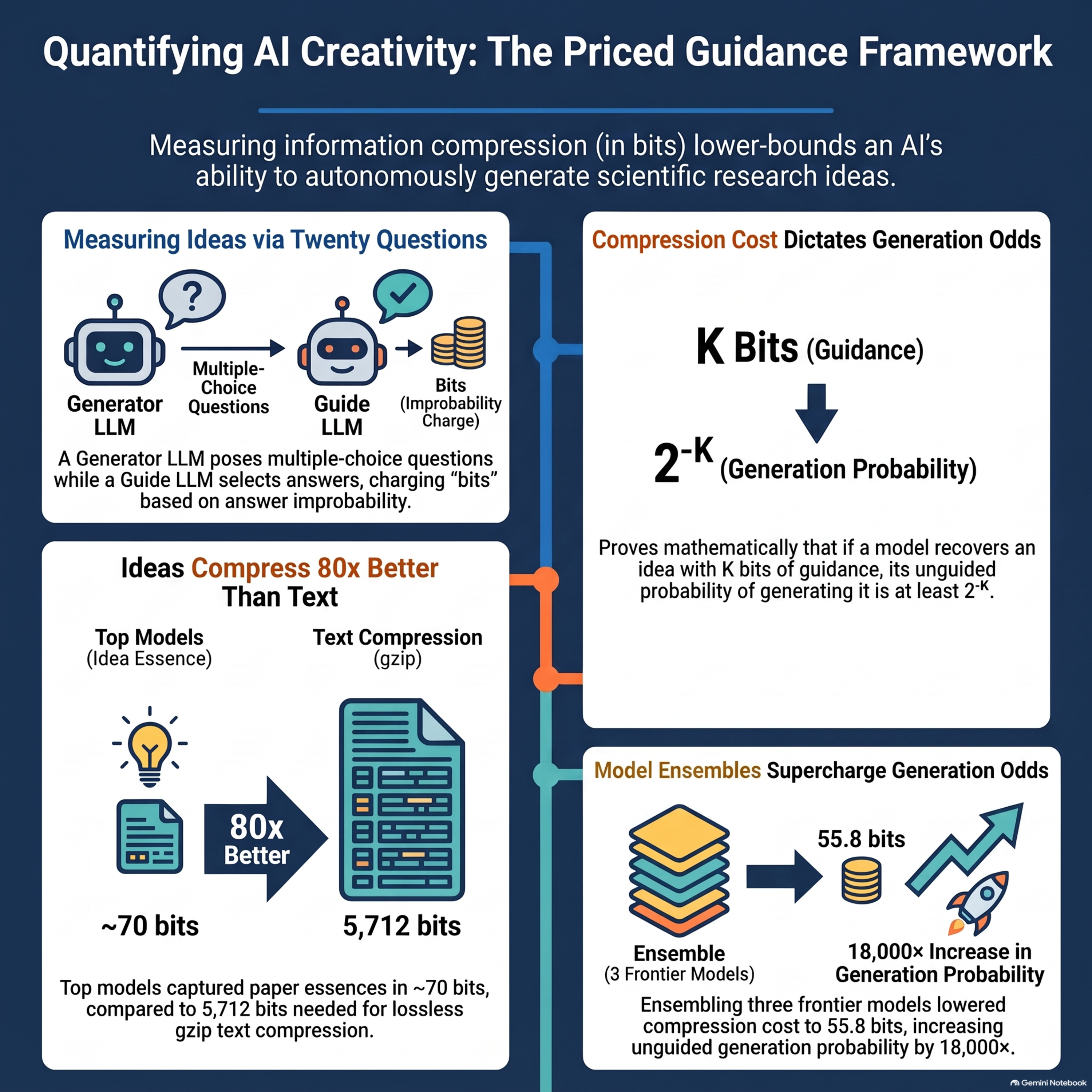
The episode explains a Stanford paper using “priced guidance” to measure whether language models can generate novel future research ideas, treating idea discovery as data compression/information cost in bits.
No named guests or external interviewees appear; it’s a two-host conversation (“Deep Dive” host and a second speaker).
Novelty is hard to score directly, so they use a 20-questions setup where a generator asks probabilistic multiple-choice questions to recover a hidden target paper. The “bit cost” equals negative log2 of the generator’s probability for the correct answer, quantifying surprise. Essence (core mechanism) is far more compressible than verbatim text.
ResNet invention from scratch (computer vision), “SkillNet” (AI skill repository) where the generator must discover “skill ontology”; “keyword calls” like buying missing vocabulary letter-by-letter. Across 87 papers, top models cluster around ~70 bits for essence; an ensemble drops median cost to 55.8 bits, implying an exponential probability increase.
Written by AI. May contain mistakes.
Discussion on how AI can generate novel research ideas using priced guidance.
“Today we are exploring this new paper from researchers at Stanford, that's Wen, Ma, and Liang, and it asks a question that feels almost like science fiction.”
Exploration of the mechanics behind how AI generates ideas through structured prompts.
“Well, imagine a really intense game of 20 questions.”
Examining how the cost in bits reflects the AI's journey toward discovering ideas.
“It's actually just a very elegant way to score surprise.”
Discussion on how AI's understanding of ideas is assessed through independent judges.
“But I'm honestly struggling with a broader issue here.”
Case study on how the Fable 5 model discovers the concept of SkillNet.
“full access to its internal architecture and probability distributions, right?”
Analysis of different AI models' performance in generating novel research ideas.
“It has the right problem and a highly plausible mechanism.”
Learn about the performance of different AI models in generating novel research ideas.
“What does the leaderboard actually look like?”
Discover how ensemble models enhance AI's capability to generate ideas.
“That exponential leap is the entire crux of the study.”
Explore the intriguing parallels between AI processes and human creativity.
“And the ensemble data proves that we don't necessarily even need one godlike model to achieve this.”

Get the gist, explore an idea or ask about something said.
 Claude
On Best AI papers explained, what are the key points of this episode?
Searching your listeningAutomatic transcript. May contain errors.
0:00What if I told you that the exact mathematical formula for a human eureka moment costs roughly 70 bits of data. Which is just such a wild concept to wrap your head around. It really is. I mean, we usually think of a massive scientific breakthrough as this sudden, unquantifiable lightning bolt of inspiration. Right, like it's just pure magic. Yeah, exactly. But today we're looking at how the actual mechanics of creativity and ideation are being, well, they're being reverse engineered and put to a rigorous mathematical test. We are definitely moving from a world where we view ideas as magic to a world where we view them as measurable data.
0:41Which is exactly why you're here. Welcome to the Deep Dive. Thanks for having me. Today we are exploring this new paper from researchers at Stanford, that's Wen, Ma, and Liang, and it asks a question that feels almost like science fiction. It really does. Can an AI generate a truly novel future research idea? And I guess more importantly, how on earth do we even measure that? Right, because that's the real challenge. Yeah. And their answer relies on this completely unexpected concept from computer science, which is data compression. That's fascinating. So our mission for you today as the listener is to unpack this mathematical framework.
1:16Whether you are actually building these models or you're just trying to wrap your head around the future of human level intelligence, this framework is going to fundamentally change how you think about creativity. For sure. Because the problem these researchers faced immediately is evaluation. Okay. Like if you just ask an AI to, quote, generate a new idea, it's incredibly hard to objectively score that output. Right. Because what does novel even mean to a machine? Exactly. So to get around this, the researchers test the AI's capability using a framework they call priced guidance. Priced guidance.
1:50OK. So instead of just an open ended prompt, it's structured. Highly structured. So how does priced guidance actually work when you like sit down and run the experiment? Well, imagine a really intense game of 20 questions. Okay, I can do that. But it's played between two different AI models. Oh, wow. Yeah. So the first AI is the generator. This is the model being tested. Its job is to recreate the core idea of a hidden future research paper. But it has no idea what the paper's about. None. It's totally in the dark. And then the second AI is the guide, which secretly holds the target paper, basically the answer key.
2:28So the generator is blindfolded and it has to figure out what's in the guide's hands. That's a great way to put it. So the generator poses multiple choice questions to kind of navigate toward the idea. Okay. For example, it might ask, what is the broad topic of this research? And it provides a list of possible answers. Right. But here is the critical mechanism. The generator must assign a probability to each possible answer. Like placing a bet. Exactly. It represents its confidence. And then the guide looks at the secret target paper and selects the correct answer from the generators list. Okay, so I promised you, the listener, that we would keep the math accessible today.
3:08But I know this is where the priced part of priced guidance comes in, right? Right. Because there's a penalty for these hints, and it's measured in bits. And the study mentions calculating this as the, let me get this right, the negative log base 2 of the probability. That's the one. Yeah. Walk me through that without the textbook. Like, why are we doing complex logarithm math just to play 20 questions? I promise it's not as bad as it sounds. It's actually just a very elegant way to score surprise. Okay, surprise. Yeah. Think of a bit as a coin flip. If the generator assigns a 50 % probability to the correct answer, that costs exactly one bit.
3:42Got it. If it assigns a 25 % probability, it costs two bits. 12.5 % is three bits, and so on. So the math is just formalizing this relationship. Exactly. If the generator assigns a 99 % probability to an answer, it costs almost zero bits. It already suspected the truth, so it wasn't surprised at all. But if it assigns, like, a 1 % probability to the correct answer? Then the cost in bits absolutely skyrockets. Okay, let me just make sure I'm visualizing this properly. Go for it. Imagine you and I are playing 20 questions, but we have a betting pool. Okay. If I ask, is the hidden object an animal?
4:19And I bet 90 % of my chips on yes. and it is an animal, I pay almost nothing. Right, because it was an obvious guess. Yeah, obvious guess. But if I bet 1 % on the object being a platypus, and it actually is a platypus. You pay a massive penalty. Right, I pay a massive penalty for needing that specific, highly unlikely hint. I'm literally paying for the surprise factor. That analogy captures the mechanism perfectly. Okay. The more surprise the AI is by the correct path, the more bits it costs to guide it there. Oh, okay. And to really ground this, the paper walks through a test case using the ResNet architecture.
4:55Let's pause there for a second. What is ResNet? I mean, I know it's a famous computer vision paper, but we need to understand the problem it solved to understand why the AI is guessing it. Sure. So years ago in AI, researchers found that adding more layers to a deep neural network actually made its performance worse. Not better. Right. Which was totally counterintuitive. Everyone thought more layers meant more power. Huh. So ResNet solved this by introducing something called identity shortcuts. Basically, it allowed data to skip certain layers, solving that degradation problem. Oh, I see. It was a massive conceptual leap.
5:31Huge. So in the experiment, the AI generator is essentially trying to invent ResNet from scratch. Okay, so how does it start? It starts broad. The generator asks what domain the idea is in, and it assigns a 30 % probability to computer vision. And since it is ResNet, the guide selects computer vision. Yep. Yep. And because 30 % is a decent guess, this hint only costs the generator 1.74 bits. Which is very cheap. It's in the right ballpark. Exactly. Next, it asks what specific problem the paper addresses. It assigns a 20 % probability to the problem of more network depth hurting performance. Okay.
6:08The guide selects that, costing 2.32 bits. By the time the generator narrows it down and finally guesses the core architectural change, those identity shortcuts we just talked about, the total cumulative cost for all the hints is 7.38 bits. Okay, I see how the scoring works now. It costs 7.38 bits of outside information to drag the AI to the concept of ResNet. Right. But I'm honestly struggling with a broader issue here. What's that? Well, if the AI is just providing lists of words and guessing probabilities, how do we know it actually understands the idea? Like, it could just be predicting the most likely next word in a sequence without any real semantic comprehension, right?
6:51The researchers actually anticipated that exact critique. Oh, they did? Yeah, that's why they didn't just look at the word choices. They introduced independent AI judges to evaluate the final output. Oh, interesting. The generator doesn't just guess words. It has to synthesize its findings into a cohesive research proposal, and then an independent judge AI decides if it succeeded using two distinct levels of strictness. So it's kind of like a peer review committee. Exactly like that. First, you have the directional judge. Okay. This judge passes the idea if it's just in the right neighborhood.
7:23The generator has to identify the correct problem, the correct general research area, and propose a mechanism that is plausible, even if it's not the exact one in the hidden paper. So, okay, if the hidden paper is about inventing a car, the directional judge gives a passing grade if the AI says, we need a vehicle with four wheels to carry cargo? Right. It's generally correct. Okay. But then there is the stricter essence judge. To pass this one, the generator must nail the exact defining mechanism or organizing principle of the target paper. So plausible isn't enough anymore. Not at all. It has to propose the specific novel contribution.
8:03Going back to my analogy, it has to say, we need a pickup truck with a dual action tailgate. Exactly. You have to hit the exact core innovation. But this brings up a really fascinating tension in the paper. Yeah. If we are measuring compression in data, why not just measure how hard it is for the AI to guess the abstract of the paper word for word? That's a common question. Right. Why go through the hassle of directional judges and essence judges if you can just measure the bit cost of the text itself? Because an idea and the text used to describe it are two fundamentally different things. And the research reveals a massive discrepancy between them.
8:41When they tested this, they found that compressing an idea's essence ticks far fewer bits than compressing its verbatim text. Well, language is incredibly messy, right? Extremely redundant. And redundant. They proved this using an open weights model called GLM 5.3. Okay, let's clarify that real quick. By open weights, you mean a model where the researchers have full access to its internal architecture and probability distributions, right? Correct, unlike a closed commercial model like ChatGPT, where you only see the final text. Meaning they can literally look under the hood and measure the exact probabilities the model is assigning to every single concept.
9:16Exactly. And when they forced GLM 5.3 to guess a paper summary verbatim, word for exact word, it cost a staggering 1 ,147.1 bits. Wow. Over 1 ,000 bits. Yeah. For context, if you used a traditional zip file compression like GZIP on that same text, it would take over 5 ,700 bits. Okay, well, gzip is just looking for repeating patterns of letters, right? The AI is a much better compressor than a zip file because it actually understands English grammar and context. Right, so it guesses the next words much faster. But still, 1 ,147 bits is a huge penalty just to write out the abstract. It is. But here is the kicker.
9:59When they use the priced guidance framework to guide that same GLM model merely to the essence of the idea, getting it to pass that strict essence judge, it only cost 102.4 bits. Wait, really? Yeah. Only 102 bits? Ideas are highly compressible. The specific words, the stylistic choices, the grammar used to explain them, those are not. The semantic bottleneck of human knowledge is quite narrow, even though the textual realization is wide. That is just, wow. 102 bits to get the core aha moment versus over a thousand bits to just write it down. It's a staggering gap. It is. But, you know, 102 bits is still just a number floating in the ether.
10:39Fair. Imagine you're sitting in a room, and you have to guess the blueprint for a machine that hasn't been invented yet. What does it actually look like when an AI is actively hunting for a missing piece of knowledge and spending this bit budget? That's a great question. Yeah. Let's trace a real-world test case from the study. Let's do it. The researchers ran this experiment on a hidden target paper called SkillNet. And for you, the listener, Skillnet is essentially a system that lets AI agents accumulate and reuse learned skills in a shared repository. Right. Think of it like a centralized app store for AI skills.
11:12Exactly. So we can follow the journey of a model called Fable 5, acting as the generator trying to discover Skillnet. Okay. It starts off broad. At 11.9 bits spent, it figures out the domain is agent memory. So it's zeroing in on the right neighborhood pretty quickly. Very quickly. By the time it spends 48.2 bits, it correctly theorizes that the solution involves a centralized repository, and a guess is that it uses an LLM as judge curation method. Let me just translate LLM as judge real quick. That basically means the system uses another large language model to grade or validate the new skills before they get added to the repository, right?
11:48Correct. So at this point, the Fable 5 model submits its proposal, and it successfully passes the directional judge. Nice. It has the right problem and a highly plausible mechanism. It's doing really well. But it hasn't hit the true essence of skill net yet. Exactly. To pass the strict essence judge, it gets promoted to the next stage. It keeps what it has learned, but it's informed that it is missing the defining organizational principle of the paper. And this is the crucial moment in the data. Because to pass the essence stage, the model has to uncover a concept it hadn't even considered, the skill ontology.
12:22Right. In the context of this paper, a skill ontology is the hierarchical structure of how different skills relate to each other, like mapping out dependencies and compositions. Yes. And discovering that specific structural mechanism bumped the final cost up to 64.1 bits. Wow. But the way it spent those final bits to reach the concept of an ontology is incredibly telling about the current limitations of AI. When I read the breakdown of this, I actually laughed out loud. It's pretty funny. The researchers found that a massive chunk of the bit budget is spent on what they call keyword calls. Like sometimes the AI literally asks the guide for the first two letters of a missing concept.
13:02Yes. It is literally playing Wheel of Fortune. It's so true. It knows it has a gap in its logic, but it just doesn't have the vocabulary to fill it. Right. It's like, I know I'm missing a structural mechanism. Just give me the first two letters. And the guide says, O-N. And then the AI bets its probabilities on words starting with O-N and eventually hits ontology. It shows that the AI is spending its budget to acquire concepts entirely outside its initial hypothesis space. Exactly. Like, it didn't have the vocabulary in its immediate grasp, so it had to literally buy it, letter by letter. This illustrates the boundary of these models beautifully.
13:39They can reason effectively once they have the pieces, but they still need a nudge to find the most surprising novel pieces of the puzzle. So if this is how a single Fable 5 model performs on one paper, it makes me wonder what happens when we zoom out. Right. The paper evaluates the heavyweights of the AI world against each other on dozens of these future papers. What does the leaderboard actually look like? Well, the researchers tested several frontier models on a set of 87 recent high-quality papers. They looked at models like Opus 5, GPT-6 Astra, GLM 5.3, and Fable 5.1. Basically the absolute titans of the industry right now.
14:19Exactly. Yeah. And when looking at the strict essence judge, the one demanding the true core novelty, Fable 5.1 achieved the lowest median compression cost at 69.9 bits. Opus 5 was right there at 70.4 bits and Astra at 71.6 bits. So they're all pretty close. Yeah. Yeah. GLM 5.3 required a bit more help, coming in at a median of 102.4 bits. Got it. So across the board, these top-tier models need roughly 70 bits of outside inspiration to reconstruct a novel scientific idea. Roughly, yeah. But here's what I don't get. If Fable 5.1 is the best at 69.9 bits, why not just run Fable 5.1 100 times to get the best result?
15:03Why did the researchers decide to combine them? Ah, because different models have different training data, which means they have different blind spots. Oh, interesting. What is highly surprising to Opus 5 might be slightly more obvious to Astra. So the researchers tested the power of parallel thinking by creating a uniform ensemble. They essentially ran Fable 5.1, Opus 5, and Astra together. But how does an ensemble actually work in this scenario? I mean, they aren't sitting around a virtual conference table voting on the answer. No, they combine their probability distributions. Okay. If Fable 5.1 assigns a 1 % probability to a crucial concept, meaning it would pay a massive bit penalty if that's the answer, but Astra assigns a 20 % probability to it, the combined ensemble model averages those probabilities out.
15:49I see. So the blind spots are smoothed over by the collective knowledge. Exactly. And by combining them, the median compression cost to hit the essence of these papers dropped from roughly 70 bits down to 55.8 bits. Okay, let me think about this math for a second, because a drop from 70 bits to roughly 55 bits sounds like pocket change. It sounds small. Yeah, it's a 15-bit difference. But earlier, you said the relationship is calculated as 2 to the negative power of k, where k is the number of bits. Right. The scaling is exponential, not linear. So reducing the cost by 10 bits doesn't just improve the AI's chances by a small margin.
16:27You are improving the mathematical probability of the AI generating that exact idea without any hints by roughly a thousand times. Exactly. So when the ensemble model dropped the cost by about 15 bits, it didn't just get slightly better. It improved the lower bound probability of spontaneous generation by 18 ,000 times. That exponential leap is the entire crux of the study. The math is stunning. But, you know, why should you, the listener, care about an 18 ,000 times improvement? Because an 18 ,000 times improvement on a microscopic probability is still a pretty tiny probability. True. Why do these bit counts matter outside of a computer science lab?
17:13Because this metric, the compression cost in bits, is a barometer for the future. It is a literal countdown clock. A countdown clock. Yeah. We aren't relying on vague statements like, AI is getting smarter. We are quantitatively tracking the exact mathematical distance between current AI capabilities and fully autonomous scientific discovery. Oh, wow. As these bit costs drop in future models from 70 to 55 to 40 to 10, we are watching the probability of an AI generating high quality publishable scientific ideas on its own approach inevitability. So we are essentially mapping the trajectory of artificial creativity.
17:54Precisely. And the ensemble data proves that we don't necessarily even need one godlike model to achieve this. A collaborative network of specialized models can drastically reduce the search space of the unknown just by covering each other's blind spots. It fundamentally reframes the boundary between what is known and what is yet to be discovered. Let's quickly recap the journey we've been on today. We started by exploring how to measure an AI's ability to create a novel research idea. Right. And the solution wasn't to look at the texted outputs, but to measure the information cost required to guide it to the essence of a breakthrough.
18:32And we saw that ideas themselves are incredibly compressible compared to the messy language we use to describe them. Yeah, that blew my mind. We watched an AI navigate the unknown, literally buying vocabulary letters to piece together the concept of a skill ontology. Wheel of fortune. Exactly. And we saw that by combining the heavyweights of the AI world into an ensemble, we can smooth out their blind spots, dropping the bit cost and exponentially increasing the statistical probability of autonomous scientific discovery. It gives us a really tangible way to measure the spark of invention. It does.
19:07And I want to leave you with a final, slightly provocative thought to mull over. We started this deep dive talking about that magical human flash of inspiration. Right. But if an AI can be reliably guided to a highly novel future human discovery just by following the mathematical probabilities of its training data... It turns the mirror back on us, doesn't it? It really does. Does it mean that human eureka moments aren't actually magic flashes of inspiration drawn from the ether? Are our own human brains just running a massive biological ensemble model? Wow. When a scientist has a breakthrough in the lab, are they just efficiently navigating the exact same statistical web of existing knowledge, paying the final few bits of compression cost based on a lifetime of acquired data?
19:57It really suggests that creativity at its core is just a highly advanced form of pattern recognition, whether it's happening in silicon or in biology. And that is a fascinating place to leave it. Thank you for joining us on this deep dive. keep questioning the nature of creativity. And the next time you have a brilliant idea, ask yourself, how many bits did that just cost you? We'll see you next time.
This paper introduces Priced Guidance, a novel evaluation framework that assesses language models on their ability to generate novel and future research ideas. Rather than using expensive repeated sampling or verbatim text compression, this methodology measures the compression cost—the exact number of additional bits required for an informed guide to steer a generator model toward a target research concept. By leveraging a structured sequence of multiple-choice questions and probabilistic bids, the framework establishes a mathematical lower bound connecting low compression costs to a high probability of unguided idea generation. Empirical evaluations across multiple frontier language models and deep learning papers demonstrate that generating the essence of an idea requires significantly fewer bits than verbatim text compression, highlighting distinct performance tiers among models and revealing potential improvements through ensembling and post-training.


