In short
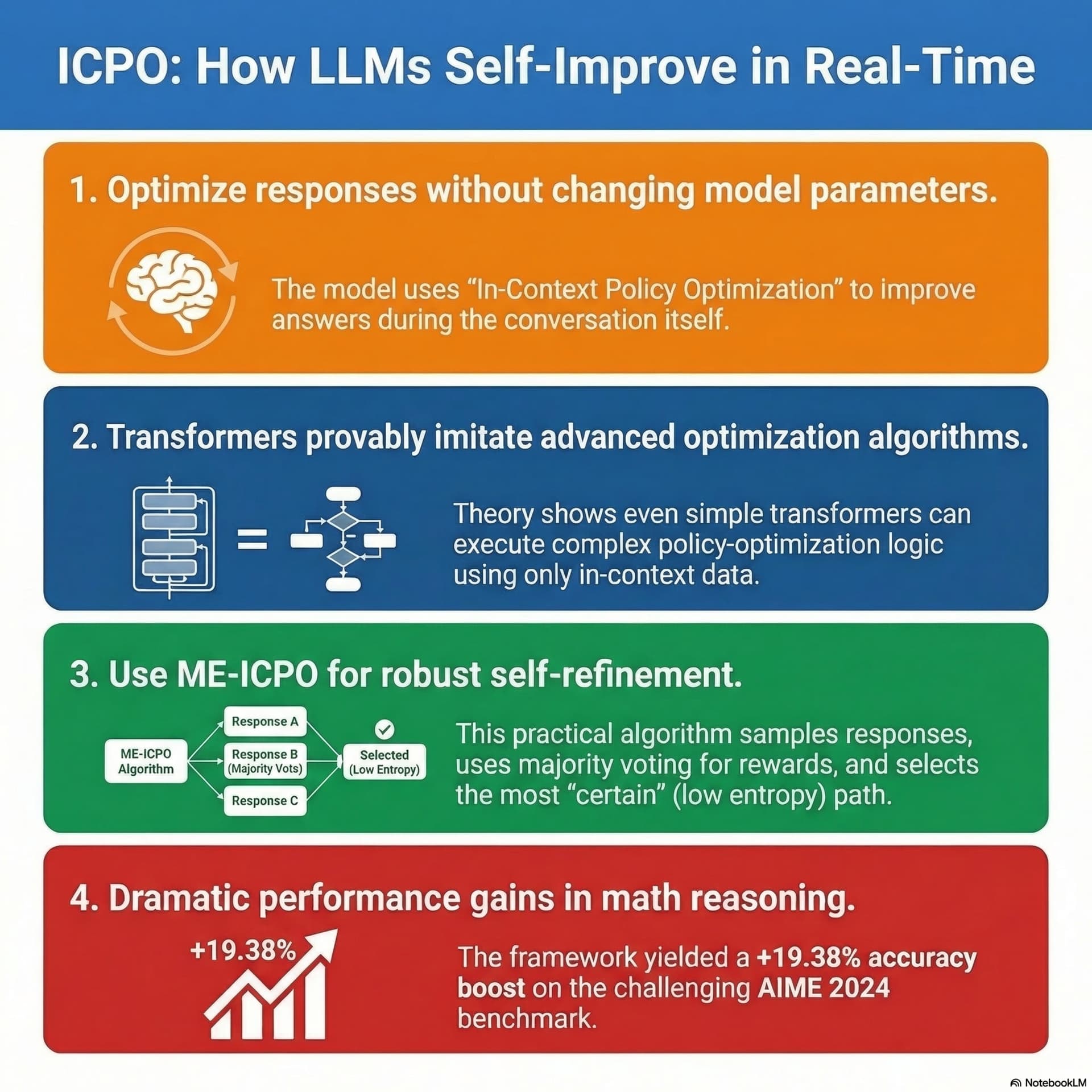
Test-time scaling and self-reflection in language models via in-context policy optimization (ICPO), using a multi-armed bandit framing to let the model optimize its own reasoning on the fly without retraining.
Key claims
Verifying is easier than generating, so extra inference-time compute improves accuracy. ICPO can be implemented with a single-layer attention transformer because attention’s matrix updates act like gradient-descent policy updates, and standard training objectives are “adjacent” to KL loss. MEICPO adds safety: majority voting rewards intermediate steps reached by most candidates; minimum entropy selects the most concentrated (high-confidence) reasoning path; a “reward shock” test shows temporary bad rewards don’t compound.
Notable examples
AME 2024 benchmark; peak performance around 5 reflection rounds with 16 candidates; comparisons to Tree of Thoughts and Monte Carlo Tree Refinement.
Guests
None mentioned in the transcript.
Written by AI. May contain mistakes. Listen to the episode to check what was said.
Chapters
Tap a time to open that second in VOUnderstanding Self-Reflection in AI
0:45 to 1:52
Exploration of how AI can optimize answers on the fly and the implications.
“into the hidden mechanics of something called test time scaling and self-reflection in life language models.”
The Shift from Pre-training to Test Time Scaling
1:52 to 2:50
Discussion on the transition from pre-training AI to allowing self-correction during tasks.
“So let's start with the big picture of why this shift is happening.”
Generation vs. Verification in AI
2:50 to 3:46
Examining the differences between generating and verifying answers in AI.
“So, it is a mathematical and logical reality that verifying an answer is vastly easier than generating the absolute perfect answer from scratch on the first try.”
The Multi-Armed Bandit Problem and AI
3:46 to 4:50
Explaining how AI uses probability theory to decide its next steps in problem-solving.
“And when you apply that generation versus verification dynamic to an AI, you essentially build the engine for multi-round self-reflection.”
Inductive Bias in AI Self-Optimization
4:50 to 6:10
Discussing how a simple architecture can enable complex self-correcting strategies.
“And the strategy it uses is actually straight out of probability theory.”
The Role of Fisher-Weighted Logit Matching
6:10 to 8:28
Breaking down the technical objectives that train AI for self-improvement.
“So if the AI is solving an algebra equation, arm A might be multiplying both sides by 4.”
From Training to Self-Reflection
8:28 to 11:23
How traditional AI training inadvertently fosters self-reflection capabilities.
“So the architecture is just pre-wired to look back, weigh the mathematical options, and adjust.”
Challenges of Self-Grading in AI
11:23 to 14:00
Exploring the risks and solutions of AI grading its own responses.
“And when you realize that self-reflection is a provable structural property of the exact mathematics we are already using anyway, it kind of removes the mysticism from it all.”
Understanding Minimum Entropy in AI
14:00 to 15:44
Explore how minimum entropy guides AI decision-making and response selection.
“And this is where the minimum entropy part of the MEICPO algorithm comes in.”
The Impact of Reward Shocks on AI Performance
15:44 to 16:56
Learn about the effects of injecting errors into AI's logical processes and its recovery mechanisms.
“But even with that shield, what happens if the system makes a mistake?”
Show all 13 chapters
Resilience of the MEICPO Algorithm
16:56 to 19:19
Discover how the MEICPO algorithm achieves remarkable results in mathematical problem-solving.
“As the AI moves to step three and step four, the subsequent rounds of majority voting and self-reflection essentially recognize the bad step as an outlier.”
Summary of AI's Self-Correcting Mechanism
19:19 to 20:09
A recap of how AI self-corrects its logical errors using advanced algorithms.
“Let's summarize the journey we just took through this complex architecture.”
Future Implications of Self-Reflection in AI
20:09 to 21:24
Consider the potential of self-reflective AI in subjective fields like art and design.
“But understanding how rigorously this system can self-correct an objective math problem leaves us with a fascinating open-ended implication for the future of these models.”
Transcript
Automatic transcript. May contain errors.0:00Have you ever been in a conversation, maybe you are splitting a dinner bill with friends and you confidently blurt out an answer. Like you just say, okay, we each owe 50 bucks. Oh, absolutely. But immediately, like mid-sentence, your brain catches up, you pause and you say, wait, let me think about that. The math is totally wrong. We only owe 30. Yeah. It is a deeply recognizable human experience. You know, you have that instinctual pause. It's this, it's a real time self-correction where your internal logic just kind of catches its own error before it completely derails your actions. Right. And that uniquely human, you know, wait, let me think about that moment, is exactly what the absolute cutting edge of artificial intelligence is currently trying to master.
0:42It really is. So today we're taking a deep dive into the hidden mechanics of something called test time scaling and self-reflection in life language models. The frontier of AI development has entirely shifted lately. It has, yeah, Yeah, completely shifted. Instead of aggressively training these models on mountains of new data beforehand, developers are focusing on giving the AI more time to think right in the middle of answering your prompt. Exactly. We are talking about allowing an AI to optimize its own answers on the fly, catching its own mistakes without changing a single line of its underlying code.
1:16Which fundamentally shifts how we need to understand machine intelligence. So our mission for this deep dive is to demystify the black box of AI self-reflection. we'll unpack the underlying mathematics that actually makes this real-time correction possible for you to use. Right. And we will explore a conceptual framework called in-context policy optimization, or ICPO. ICPO, right. Right. And ultimately, we are going to reveal a practical method that allows an AI to basically grade its own homework and absolutely crush complex mathematical reasoning tests, all while keeping computing costs surprisingly affordable.
1:50Which is the holy grail right now. Seriously. So let's start with the big picture of why this shift is happening. Before we get into the really complex math of how an AI corrects itself, we should probably establish why giving an AI extra time to think works better than just demanding an instant answer. Yeah, that makes sense. For a long time, the standard approach was all about pre-training. You teach the AI everything it needs to know before the test. Like cramming before finals. Exactly, like cramming. And then during the test, what engineers actually call inference, you expect it to spit out the perfect answer immediately.
2:26Traditional pre-training is very much like studying for years and then taking a closed book exam where you have to answer every single question in five seconds. Which sounds incredibly stressful, even for a computer. Right. But test time scaling is about reallocating those compute resources during the actual exam. And to understand why giving the model more compute during the test is so powerful, we really have to look at the generation verification gap. The generation verification gap. Okay, break that down for me. So, it is a mathematical and logical reality that verifying an answer is vastly easier than generating the absolute perfect answer from scratch on the first try.
3:02Oh, sure. I mean, if I ask you for the square root of 9 ,801, generating the answer 99 from scratch is difficult. I definitely couldn't do that in my head. Most people can't. But if I ask you, hey, does 99 times 99 equal 9 ,801? Verifying that math is a much, much lighter cognitive load. You just do the multiplication. Okay. Let me unpack this. It is kind of like the difference between being asked to write a brilliant original essay right off the top of your head versus being handed five just okay essays and being asked to pick the best one and edit it into something great. That is a perfect analogy.
3:36Yes, the second scenario is so much easier because you are verifying and refining an existing structure, not generating a masterpiece from a blank page. Exactly. And when you apply that generation versus verification dynamic to an AI, you essentially build the engine for multi-round self-reflection. Because it's grading itself. Right. When an AI generates a response, forcing it to accept its very first guess makes it highly prone to hallucination or just massive logical leaps. But when you give it the architectural space to generate a potential answer, step back and verify the intermediate steps of its own logic.
4:12You shift the supervision. Yes. You shift the supervision from just looking at the final outcome to examining the step-by-step process. It leverages the fact that its ability to recognize a mathematically sound logical step is far stronger than its ability to blindly generate a flawless 10-step mathematical proof instantly. That makes a ton of sense. But I am stuck on one thing, though. What's that? If the AI is generating multiple potential answers and then verifying them, how does it systematically choose the best path forward? I mean, it cannot just flail around in the dark hoping to stumble on the right logic.
4:47It needs a real strategy to sift through its own thoughts, right? It does. And the strategy it uses is actually straight out of probability theory. It is essentially playing a game to find the right answer. A game. Like what kind of game? So to understand the ICPO framework, that in-context policy optimization we mentioned earlier, you have to visualize a classic abstraction in sequential decision making. It's called the multi-armed bandit problem. Okay, multi-armed bandit. I think I've heard of this in economics or something. Yeah, it's used everywhere. Just imagine you are standing in a casino in front of a row of slot machines.
5:23These are the multiple arms. Okay, I'm at the casino. You know that one of these machines pays out more often than the others, but you have no idea which one it is. So you face this constant dilemma. Do I keep pulling the one that's paying out or try a new one? Exactly. Do you keep pulling the lever of a machine that has paid out a little bit already, which we call exploitation? Or do you try a brand new machine, hoping it is the actual jackpot winner, which is exploration? So you are constantly balancing exploration against exploitation just to maximize your total payout. Right. And this is exactly what the AI is doing inside its own context window.
5:58But we need to map that casino analogy directly to the AI's thought process. Okay, how does a slot machine equal a math problem? Each arm of the slot machine isn't just a random guess. It is a different potential logical step in solving the problem. So if the AI is solving an algebra equation, arm A might be multiplying both sides by 4. And arm B might be trying to isolate the variable. Yes, exactly. So the ICPO framework means the AI looks at its history of past attempts, its previous thoughts in the context window, and optimizes its internal policy to pick the reasoning step that will maximize its reward.
6:37Okay, so it evaluates the current state of the math problem, looks at the different arms it could pull, and decides whether to explore a new mathematical operation or exploit a chain of logic that seems to be getting closer to the solution. You nailed it. It generates a response, receives a reward based on how mathematically sound that step is, and then improves its next response based on that feedback. Okay, but here's where the mechanics get incredibly dense for me. Usually when we hear about an AI running a continuous complex gambling loop to optimize a policy, we assume it requires an impossibly huge neural architecture that's like actively rewriting itself.
7:10Sure, that's the standard assumption. But everything I've seen shows that a simple, single-layer, linear self-attention transformer can mimic this exact policy optimization algorithm entirely within its context window. That is the big breakthrough. I mean, how? How is a single layer of an attention mechanism executing a complex self-correcting strategy without just melting a server farm? It comes down to a concept called inductive bias. Inductive bias. Yeah. You do not need hundreds of neural layers to learn the complex process of updating a policy if the fundamental mathematical structure of the layer is already naturally built to do it.
7:49Oh, so it's like baked into the hardware or the math rather. Exactly. Think about the underlying mechanism of attention in an AI model. It takes an input. It looks back at the previous context, all those previous tokens or thoughts, and performs a matrix math operation to update the current state based on that historical context. Okay, matrix math updating based on history. Right, and that specific foundational matrix operation has an inherent inductive bias that perfectly aligns with taking a step of gradient descent. The architecture literally does not need to learn how to update its strategy.
8:22The matrix math itself is an update mechanism. Wow. As long as the right data flows through it, that single layer naturally adjusts its weights to favor the pads that yield higher rewards. So the architecture is just pre-wired to look back, weigh the mathematical options, and adjust. Pre-wired is a great way to put it. Well wait, if a single layer can do this naturally, it still has to learn what a winning slot machine pull looks like in the first place, right? Like it has to know the rules of the game to even play it. Oh, absolutely. And the pre-training discovery that makes ICPO possible is just fascinating.
8:56To train that single layer to act like a master gambler, they use a highly technical objective called a Fisher-weighted logit matching objective. Okay, well, let's break that down for the listener because Fisher-weighted logit matching sounds incredibly intimidating. It is a mouthful. We are talking about loss functions and logits here, which are really the fundamental building blocks of AI training. Right. So a loss function is simply the AI's penalty score during training. It measures how far off the AI's prediction is from the correct answer. Like a teacher marking answers with a red pen. Exactly.
9:29And logits are the raw, unnormalized prediction scores the AI generates for every possible next word or step before it converts them into nice, neat percentages. Okay, so what does the Fisher-weighted part do? The Fisher-weighted logit matching objective basically means we are penalizing the AI based on how much its current predictions deviate from historically successful actions. And we weight that penalty using Fisher information. Which means what exactly? It essentially measures how much actual useful certainty a particular piece of data gives us about the model's underlying parameters. Okay, so the AI is looking at its raw predictions and adjusting them based on which past logical steps actually gave it the most certainty and the highest reward.
10:14Yes. And here is the truly remarkable structural detail about all this. This really complex Fisher-weighted objective is mathematically adjacent to the standard KL loss function. The KL loss. Wait, isn't that what they already use for everything? Yes. The Kohlbeck-Leibler divergence, or KL loss, is the standard everyday training metric that engineers use to train almost every major language model to mimic human text distributions. It just measures how one probability distribution diverges from a second expected probability distribution. Wait a minute. If they're mathematically adjacent, that implies standard AI training is not just teaching the AI raw facts or how to sound human.
10:53Right. It's inadvertently teaching the AI the rules of the game for self-improvement. That is exactly what is happening. That is crazy. It is like teaching someone to play the piano entirely by ear, just telling them what sounds good and later realizing you accidentally taught them the complex underlying physics of acoustics. I love that analogy. We thought we were just teaching these models to predict the next word, but the math we use naturally mapped onto teaching them how to optimize their own thinking process based on historical feedback. That's huge. It is. And when you realize that self-reflection is a provable structural property of the exact mathematics we are already using anyway, it kind of removes the mysticism from it all.
11:35Yeah, it stops being magic. Right. When we see an AI model pausing and correcting its own logic, it can sometimes feel like this emergent, unpredictable, spooky magic. But this framework proves the models are simply executing an in-context policy optimization that they were mathematically destined to learn through their standard training regimens. Okay, so the theory makes a ton of sense. We have our single layer of attention, we have our multi-armed bandit casino operating in the context window, and we have our Fisher-weighted training objective hiding in plain sight. All working together, yeah.
12:06But real-world math is messy. If we have this gambling system working perfectly in theory, I have to imagine it becomes incredibly vulnerable when it actually tries to grade itself in practice. Oh, for sure. Self-grading is dangerous. Right. Because if I'm allowed to grade my own homework, I'm going to give myself an A-plus every single time. How do we stop the AI from hallucinating a fake perfect score for a terrible intermediate math step? That is the million-dollar question. And the practical solution to the grading problem is an algorithm built on this theory called Minimum Entropy in Context Policy Optimization, or MEICPO.
12:45MEICPO. Okay. Okay, let's walk through the mechanics of how that actually operates when you hand it a complex problem. Okay, so instead of trying to solve the problem in one linear shot, the AI generates multiple candidate answers for the very next step. Let's say it generates 16 different possible mathematical operations it could perform next. So it's pulling 16 different slot machine arms simultaneously. Exactly. And to assess the reward for those 16 steps without a human engineer standing there verifying the math, the system uses majority voting. Majority voting. So it just sees what the most common answer is.
13:16Kind of. It looks at the resulting logic of those 16 candidates. If a large majority of those distinct paths naturally converge on the same intermediate logical conclusion, for example, if 12 out of the 16 paths independently decide that the next logical state is isolating the variable X, The system assigns that specific step a high reward. Oh, I see. The statistical assumption is that if multiple independent chains of thought reach the exact same intermediate logic, that logic is highly likely to be structurally sound. Exactly. It relies on the wisdom of the crowds. But the crowd is entirely made up of 16 different instances of the AI's own logical reasoning.
13:57Which is pretty funny when you think about it. But it works. But once it assigns those rewards, it still has to pick one definitive path to actually move forward with. And this is where the minimum entropy part of the MEICPO algorithm comes in. Okay, I want to clarify this for you listening because entropy is a really loaded term. It is, yeah. In popular culture or physics, entropy usually means chaos, randomness, or like the gradual decline into disorder. So if the AI is deliberately picking the answer with minimum entropy, does that mean it is choosing the most boring, predictable path? Why is minimum entropy the ultimate goal here?
14:33That's a great distinction to make. In the context of information theory and probability distributions, Shannon entropy specifically measures uncertainty. Uncertainty, okay. So when a mathematical response has high entropy, the probability distribution is flat and spread out. The AI is essentially communicating, I am guessing, the next step could be anything. My confidence is distributed everywhere. Shrugging at shoulders. Exactly. But when a response has minimum entropy, the probability distribution is a sharp, concentrated spike. The AI is stating, I am highly confident in this specific logical path.
15:05Oh, so selecting for minimum entropy acts as a vital security shield. Yes, it actively prevents the AI from selecting a corrupted or hallucinated response that would derail its entire train of thought. By mathematically forcing the model to only build upon the logical foundations where its probability distribution is most concentrated, it ensures the model is taking steps it is absolutely certain about. It keeps the train on the tracks. Exactly. It guarantees that before the AI takes step three in a complex proof, it is rock-solid confident about step two, rather than just taking a wild swing in the dark.
15:41Which is crucial for long math problems. But even with that shield, what happens if the system makes a mistake? I mean, what if it accidentally feeds itself a bad reward like a false positive during that majority voting phase? Does the whole delicate self-correcting thought process just collapse like a house of cards? That's exactly what researchers wanted to know because a compounding error is the biggest threat to multi-round self-reflection. So they ran a single reward shock experiment. Single reward shock. Sounds intense. It's pretty clever. They let the AI start its multi-round thinking process on a problem, and then at step two, the researchers intentionally injected a fake bad reward.
16:19They sabotaged it. They sabotaged it. They artificially gave a terrible mathematical step, a perfect reward score of 1.0. The goal was to see if that injected error would snowball and ruin the final output. Because when you inject a fatal flaw into the foundation of a logical proof, you would expect the entire subsequent chain to be completely unusable. Right. But that's not what happened. The system does experience a brief, measurable bump in its error rate immediately after the shock. It gets mathematically confused. True. But because of the robust nature of the ICPO loop and the minimum entropy selection, it recovers steadily.
16:53The error does not amplify over time. Wow, really? Yeah. As the AI moves to step three and step four, the subsequent rounds of majority voting and self-reflection essentially recognize the bad step as an outlier. The probability distributions naturally steer the logic back toward the verified truth. The framework is mathematically highly resilient to temporary hallucinations. That is incredible. And that structural resilience translates to some staggering real world benchmarks, doesn't it? Oh, absolutely. When they tested this MEICPO method on the AME 2024 benchmark, the results were just incredible.
17:29And for context for you listening, the A, the American Invitational Mathematics Examination, is not your standard high school algebra quiz. Not at all. These are grueling, multi-step combinatorics, number theory, and advanced geometry proofs designed to stump elite human mathletes. And the AI matched or beat highly resource-intensive training methods, and it did so incredibly efficiently. The data actually shows its performance peaked around five rounds of reflection, generating 16 candidates per round. Okay, so that five-round, 16-candidate ratio is kind of the computational sweet spot. It is, and the MEICPO method handily outperforms standard prompt search methods you might be familiar with, like Tree of Thoughts or Monte Carlo Tree Refinement.
18:11Right, because those are older methods. Yeah, they are basically shallow search techniques. They often fall short on deep accuracy because they just do not have this underlying policy optimization engine driving their logic. Which brings us to why you, as the listener, should really care about the deep mechanics of this AI framework. This isn't just theory. This is a massive paradigm shift in how we interact with and deploy technology. It truly is. We are looking at a vastly more reliable, problem-solving AI that actually verifies its own work. Yeah. You don't need to spin up a multi-million dollar supercomputer cluster to retrain a massive language model from scratch every single time it makes a logical error in a specific domain.
18:54Exactly. By utilizing this test time scaling, the AI corrects itself on the fly. It saves massive amounts of compute time and money while delivering mathematical proofs you can actually trust. It creates a principled, provable framework for self-improvement during inference. Right. The model just learns to pause, evaluate its options against historical probability, discard the illogical paths using majority voting, and move forward with the mathematical certainty of minimum entropy. It's beautiful, honestly. Let's summarize the journey we just took through this complex architecture. We started with that relatable human instinct to pause and correct our own bad math mid-sentence.
19:29The dinner bill. Right, the dinner bill. We mapped that exact cognitive process onto the multi-armed bandit problem, turning logical reasoning into a probability casino where the AI balances exploring new formulas with exploiting known paths. Right. We unpacked how a single layer of attention, armed with the Fisher-weighted objective hiding inside standard training, can perfectly mimic this complex optimization. Which is still my favorite part of all this. It's so cool. And finally, we saw how the MEICPO algorithm uses minimum entropy and majority voting to safely guide the AI's train of thought, allowing it to ace elite-level math tests efficiently without compounding its own errors.
20:08It really represents a remarkable synthesis of probability theory, neural architecture, and just practical algorithmic design. It really does. But understanding how rigorously this system can self-correct an objective math problem leaves us with a fascinating open-ended implication for the future of these models. Oh, definitely. Where it goes next is the big question. Right. Because we have spent this entire deep dive looking at how an AI can run a continuous optimization loop, reliably self-correcting just by observing its own context and self-assessing rewards on a math test. But math is clean.
20:44Very clean. The answer is undeniably right or wrong. What happens when developers unleash this exact same self-reflection framework on highly subjective fields? That is where it gets wild. Imagine an AI recursively rewriting a novel or designing a city layout or composing a piece of music where the reward is not a strict mathematical proof, but human aesthetic preference or emotional resonance. Right. If the underlying mathematics allow an AI to rigorously self-correct its way to the perfect math proof, what is to stop it from eventually self-correcting its way to the perfect piece of art? How a system defines minimum entropy and maximum reward when the ultimate goal is just to make a human feel something.
21:23That is a profound question for the next generation of AI development.
From the publisher
This research paper introduces In-Context Policy Optimization (ICPO), a framework designed to explain and enhance the self-reflection capabilities of large language models. The authors provide a mathematical foundation proving that specific transformer architectures can inherently mimic policy optimization algorithms without requiring parameter updates. Building on this theory, they develop ME-ICPO, a practical algorithm that improves mathematical reasoning by iteratively refining responses based on self-assessed rewards. To ensure reliability, the system utilizes minimum-entropy selection and majority voting to filter out noise from self-evaluations. Empirical results demonstrate that this approach significantly boosts performance on complex reasoning benchmarks while remaining computationally efficient. Ultimately, the work bridges the gap between the theoretical understanding of in-context learning and the empirical success of test-time scaling.


