In short
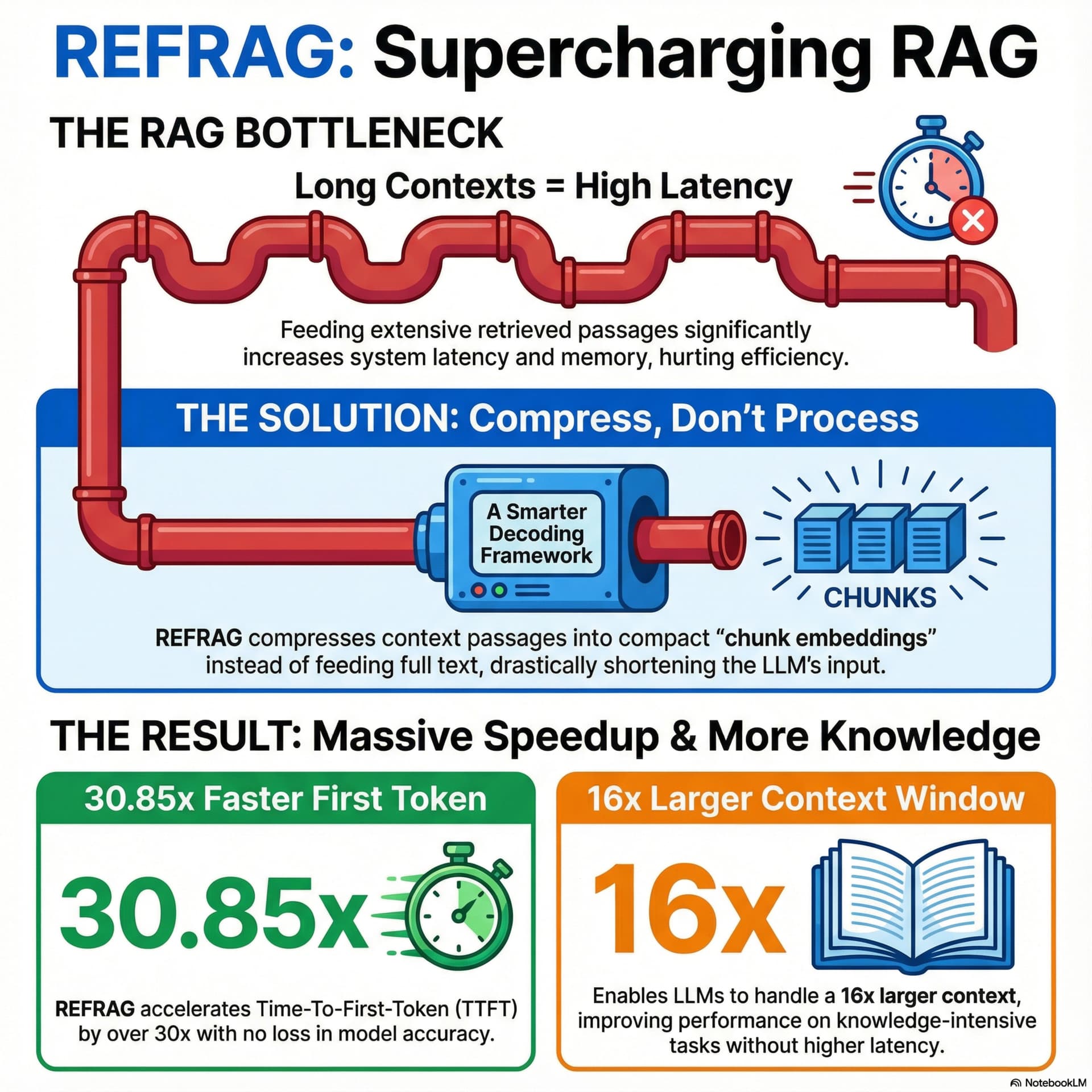
ReFRAG (Rethinking RAG-based decoding) speeds up retrieval-augmented generation by compressing RAG context to avoid quadratic TTFT latency and KV-cache memory blowups. It targets structural inefficiency in concatenated retrieved chunks that create token redundancy and block-diagonal attention sparsity.
Key claims
30.85x acceleration in time-to-first token; 16x effective context extension for Llama2-27B (from 4K to 16,384) without accuracy loss; within the same latency budget, processes ~8 passages vs 1 for standard Llama.
Notable examples
multi-turn chats (4–6 turns, 10 passages) avoid truncation/forgetting; technical summarization (ARC-SIV/PubMed) improves ROUGE under latency limits.
Guests
Meta, NUS, and Rice researchers (no individual guest names given).
Written by AI. May contain mistakes. Listen to the episode to check what was said.
Chapters
Tap a time to open that second in VOUnderstanding the RAG Bottleneck
0:45 to 4:33
Exploration of the challenges in retrieval augmented generation and the inefficiencies in processing context.
“and a system that just slows to a crawl.”
Introducing ReFRAG: A Solution
4:33 to 7:39
Discussion of the ReFRAG framework and how it addresses the inefficiencies of RAG contexts.
“And I'm guessing those calculations don't find much.”
Training ReFRAG for Performance
7:39 to 11:01
Details on the training process of the ReFRAG model and its dynamic compression capabilities.
“And the centerpiece of this is something called the reconstruction task.”
Impact on Real-World Applications
11:01 to 13:49
Review of the performance improvements and practical implications of ReFRAG in various tasks.
“Wow, that context extension is huge, especially for anyone trying to get an AI to understand a whole knowledge base.”
Transcript
Automatic transcript. May contain errors.0:00Welcome back to the Deep Dive. So I think we've all been there. You ask a chatbot a really sophisticated question, something that needs it to read a document or summarize an article, and you hit that wall, that fundamental kind of brutal tradeoff in modern large language models, getting all that rich external knowledge versus, well, getting an answer this century. Oh, absolutely. And that tension, I mean, it's not just a theoretical problem. It really defines how these LLMs are actually deployed. When a model uses something called retrieval augmented generation or ARG, it's pulling in all this outside context, you know, articles, data, your own notes.
0:38And it becomes incredibly precise, far less likely to just make things up. That's the good part. But every single piece of context you add means more latency, a huge memory footprint, and a system that just slows to a crawl. And we've kind of been stuck in this mindset that complexity has to equal slowness. We want the model to read, say, 16 ,000 tokens of contacts, an entire book chapter to answer one question. But we need that answer now. So our mission for this deep dive is to look at how a team from Meta, NUS, and Rice just decided to, well, completely obliterate that bottleneck with a new framework they call ReFRAG.
1:15Rethinking RAG-based decoding. And they did it by questioning a really fundamental assumption, which is that RAG context has to be processed inefficiently. They asked, how do we get all the benefits of that huge context without the massive time penalty? And the results, they are truly paradigm shifting. Okay, so what are we talking about here? RAFRAG achieved a 30.85 times acceleration in what's called time-to-first token, the TTFT. That's the metric that really governs how responsive an app feels to you, the user. And on top of that, they extended the effective context size of a model like Lamory 2 by 16 times, all without losing accuracy.
1:5130 times faster. I mean, that's the difference between a real-time research tool and just impatiently watching a progress bar. It is. And the key insight here, the thing that unlocks all this speed, it isn't a faster chip or some brand new architecture. It's realizing that RAG contexts aren't just generic long prompts. They have a unique internal structure, a structural inefficiency, really, that makes them perfect for compression. Okay, let's really unpack this. Before we get to the solution, we have to understand the problem. Why does feeding an LLM more context, especially with RAG, slow it down so dramatically?
2:24It really boils down to the inference costs, specifically with self-attention. We measure the speed in two ways. There's TTFT, the time to get the very first word, and TTIT, the time for every word after that. But the real killer is that the TTFT latency increases quadratically with the prompt language. Quadratic. That's always the scary word in computing. So if I double my input, I'm waiting four times as long just to get the first word back. Yeah. Why is that initial delay so much worse? Because that initial quadratic surge is what kills throughput. If you're doing web scale discovery or handling thousands of quick requests, the model spends almost all its time just processing the prompt.
3:03The linear growth for the rest of the answer is fine, but that quadratic wait time up front is the barrier to any kind of real-time, context-aware interaction. And it's not just a speed problem, it's a memory problem too, right? Absolutely. The memory for the key value cache, the KV cache, which stores all the attention calculations, that scales linearly with the prompt length. You start pushing 16 ,000 tokens of context, and the memory you need just balloons. It can easily overwhelm what a standard GPU can handle, which slows things down even more. Okay, but here's the crucial part. If every long trompt was this slow, refrag wouldn't be so special.
3:41Why is a RAG context, this stack of retrieved documents, uniquely wasteful? Because it's just concatenated. It's stitched together. You ask a question, a retriever grabs 10 relevant chunks from different places, and you just paste them all end-to-end as the context. So you get structural problems. Two big ones. First is just token inefficiency. A lot of that context might be vaguely relevant, but it's not useful for generating the specific answer you need right now. It's just filler, redundant information. It's like handing someone 20 textbooks and saying the answer's in there somewhere. The model has to load and process all 20, even if only three pages actually matter.
4:18Precisely. And that leads to the second, deeper issue, attention sparsity. Because those 10 chunks came from completely different sources, they often have nothing to do with each other. But a standard LLM has to run self-attention. It's forced to calculate the correlation between a token in chunk A and a token in chunk D. And I'm guessing those calculations don't find much. They're predominantly zero. It's what we call a block diagonal attention pattern. The model is just wasting cycles, burning computation, trying to find a link between, say, 18th century French literature and modern cryptography because they just happen to be next to each other in the prompt.
4:55I see. So that structural waste, that's the inefficiency they're targeting. That's the key. That makes perfect sense. The model is just doing all this unnecessary work. The big insight then is we can just skip the filler, focus on the important bits. How does Refrag actually perform this compression? The architecture is really elegant because it doesn't actually modify the big, powerful foundation model like LAMA. Okay. It just pairs it with a much smaller, lightweight encoder model like a Roberta. And that little encoder handles all the compression up front, which is great for deployment because you don't have to retrain your giant decoder.
5:30So walk me through that. How does the compression actually work? OK, so instead of feeding in every single token from all those retrieved articles, the context gets broken down. It's put into these fixed size chunks. Let's say K equals 16 tokens. 16 tokens. Yeah. And that lightweight encoder processes those 16 tokens and turns them into one single really dense vector, a chunk embedding. And these embeddings are then projected into the same space as the decoder's normal token embeddings. Okay, so if K is 16, then 16 tokens become one single thing. If I had 1 ,600 tokens of context, I'd now have 100 chunk embeddings.
6:09That's a massive reduction. Exactly. The main LLM's input is now dramatically shorter. It just gets the tokens for your question. Plus this short sequence of compressed chunk embeddings. The input length is reduced by, well, roughly a factor of K. And that's where the quadratic speedup comes from. The self-attention is running on the number of chunks now, not the massive number of tokens. You completely bypass that killer TTFT bottleneck. And what's more, those chunk embeddings can be pre-computed by that little encoder so you can parallelize it and reuse them. The latency for that step is negligible.
6:42And you mentioned this is more flexible than some older methods. It can compress chunks anywhere in the sequence, not just at the beginning. Yeah. Why is that so important? Because real interactions aren't simple. Think about multi-turn conversations or AI agents. The most important fact might be buried deep in the history from five turns ago. You need a system that can compress that old history, but maybe expand some new critical information, no matter where it is. Refrag's design lets it do that, which is essential for complex reasoning. But of course, the system can't just be a dumb compression tool.
7:16It has to be smart. It needs to know what to compress and what to keep, and that requires some pretty sophisticated training. Right. Let's get into that. How do you train a model to maintain high fidelity after you've boiled 16 tokens down to one single vector? How do you avoid just making high-speed garbage? That is the critical challenge. They use a technique called continual pre-training, CPT, which basically teaches the small encoder and the big frozen decoder how to speak the same language. And the centerpiece of this is something called the reconstruction task. A reconstruction task. Okay, what's that?
7:48They freeze the weights of the big decoder, like Llama, and they force it to try and reconstruct the original tokens of the context. Wait, reconstruct them? Yep. Reconstruct the original 16 tokens, but using only that one single compressed chunk embedding it gets from the little encoder. So you're basically forcing the decoder to read the CliffsNotes, the embedding, and then write the original novel chapter back from scratch. How is that even possible? It forces the encoder to cram the maximum possible semantic meaning into that single vector. And it teaches the decoder, hey, trust this compressed signal.
8:23Everything you need is in there. But you're right. It's an incredibly hard task. The number of possible token combinations grows exponentially. It becomes intractable very quickly. So how do they get around that complexity in training? They use curriculum learning. So instead of trying to reconstruct huge chunks right away, they start small. They begin with the easier task of just single chunk reconstruction and then gradually mix in data for longer and longer sequences. Ah, so you build up the difficulty. Exactly. It makes the whole task manageable and ensures the two models are really well aligned.
8:55And that training leads to the next big feature, selective compression. The sense and expand idea. How does the model learn to sense when a chunk is too important to compress and that it needs to expand it back to its original tokens? This is where Refrag gets really dynamic and intelligent. They introduce a lightweight reinforcement learning policy, an RL policy, that decides on the fly which chunks are so vital they have to be kept uncompressed. And what's guiding that policy? What's the reward? The reward is basically accuracy. It uses prediction perplexity as a negative reward. So the system asks itself, if I compress this chunk, does it make it much harder for me to predict the next correct word?
9:37I see. If the answer is yes, if perplexity goes up, then it knows it has to expand that chunk. So the policy learns to be as aggressive as possible with compression, but only where it doesn't hurt the final quality of the answer. And that dynamic ability is amazing because you're not locked into one fixed compression rate. You get maximum speed and you only pay the computational cost for the bits of context that are truly essential. Exactly. And the experiments really proved this out. The version of Refrag using this RL-based selective compression, they call it Refrag 16, it consistently outperformed a model with a natively lower but static compression rate Refrag G.
10:15So it's better to compress hard and then selectively decompress than to just be timid with compression overall. That's what the data says. Okay, so let's bring this all back to what it means for the end user. What are the results? What do the numbers actually look like? I mean, the numbers are pretty staggering. the headline figure is a 30.85 times acceleration in that time-to-first token. 30 times? Yeah, okay. That's not an incremental improvement. No, it's a complete game changer. And that's 3.75 times better than the previous state-of-the-art, a method called CEPE. But beyond just the speed, look at the scale.
10:48Refrag allowed them to take Llamabay27b, which was trained for a 4K token context, and effectively extend it to a massive 16 ,384 tokens. and it maintained superior performance. Wow, that context extension is huge, especially for anyone trying to get an AI to understand a whole knowledge base. How did it do on specific tasks? Well, the real win is in the trade-off. Because refrag is so much faster, it can process more information in the same time budget. In a typical RAG setup with the same latency limit, a standard LAMA might only have time to process one retrieved passage, But Refrag could efficiently process eight passages in that same time.
11:30So it's not just faster on the same input. It actually lets the model get smarter by looking at more sources in the same amount of time. Precisely. And in their tests, Refrag consistently got better results. Just because its compressed structure allowed it to consider all this extra information that the standard model simply couldn't afford to look at. And I can see how that advantage would really shine in something like a long multi-turn conversation. Absolutely. In conversations that went on for four or six turns with 10 retrieved passages, Refrag just blew the llama baselines away. And the reason is so simple and practical.
12:03The standard llama had to start truncating the conversation history to make room for new stuff. It was forgetting what you talked about. Refrag's compression just kept the entire history intact, all 10 passages, all six turns. So its context awareness and coherence was just dramatically better. It basically solves the memory loss problem in long chat sessions. What about really dense tasks, like summarizing a technical paper? It worked there, too. For summarizing things like complex ARC-SIV or PubMed articles, Refrag got better RUGE scores, which is the metric for summary quality, than all the other baselines under the same latency constraints.
12:38It showed that even with aggressive compression, the embeddings hold on to enough of that nuanced technical information to build a really accurate summary. So to sort of wrap it all up for you, what Refrag gives us is a really practical, really scalable way to use these massive models and applications that just can't tolerate lag. By treating our recontext not as just generic long text, but as these specialized compressible inputs with the unique internal sparsity, they get around that disastrous quadratic latency problem. And the key discovery was that sparse block diagonal attention pattern in the concatenated chunks.
13:12It wasn't about making a generic long context model faster. It was about realizing that RAG is structurally different and needed its own solution. It makes you wonder, right? If the performance of an LLM depends so heavily on how context is processed during decoding, and this one architectural tweak for a specific data type yields a 30 times speedup, what does that imply for the future? This whole work suggests that specialized treatments for different kinds of long context tasks, whether it's RAG or maybe code completion or even video analysis, that might be the true way to unlock performance, rather than just generically scaling up model size.
13:46That's a powerful thought to chew on.
From the publisher
This paperq introduces REFRAG, an innovative and efficient decoding framework specifically designed to accelerate *lRetrieval-Augmented Generation (RAG) in Large Language Models (LLMs) by addressing high latency and memory demands associated with long-context inputs. The core mechanism involves compressing context by representing chunks of retrieved text as single embeddings, significantly shortening the input sequence to the decoder and exploiting the **sparse attention patterns** inherent in RAG contexts. Through techniques like **selective compression** managed by a lightweight reinforcement learning (RL) policy, REFRAG achieves substantial speed improvements—up to **30.85x faster Time-to-First-Token (TTFT)**—without sacrificing accuracy, and enables LLMs to handle context windows up to **16x larger**. Experimental results confirm that this specialized approach outperforms existing methods like CEPE across various tasks, including RAG, multi-turn conversations, and summarization, highlighting a crucial trade-off balance between knowledge enrichment and system efficiency.


