In short
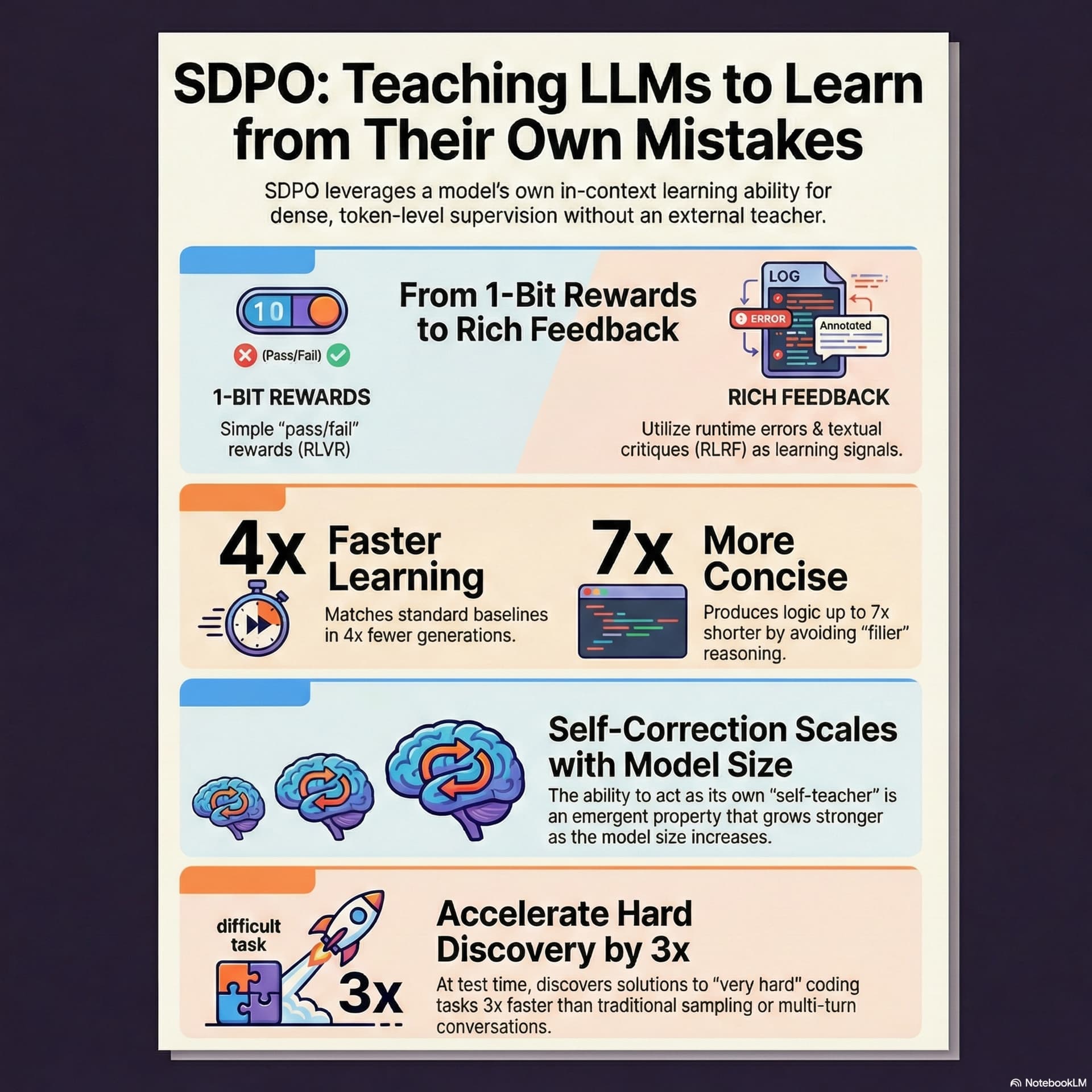
Reinforcement Learning via Self-Distillation (SDPO) replaces sparse pass/fail rewards with “rich feedback” from verifiers (e.g., compiler errors) and uses self-distillation to turn error text into dense token-level learning signals; it also enables test-time training (TTT) on very hard tasks.
Guests/backgrounds
No guest introductions; the episode is a host-led discussion of the SDPO paper.
Key claims
Binary rewards create an information bottleneck; SDPO uses the model’s own “teacher” view of the error to suppress the specific tokens that caused failure via KL divergence. Stability requires an EMA “regularized teacher.” Gains: SDPO is more concise and more accurate than GRPO; small models (0.6B–8B tested) show marginal gains below a debugging-capable size.
Notable examples
Chemistry tasks with ULMO 3.7B: ~7x shorter outputs than GRPO with higher accuracy. Live Code Bench Q3 (“WEN killer”): multi-turn/best-of-K failed (0% after 2,750 tries), but SDPO TTT solved after 321 attempts.
Written by AI. May contain mistakes. Listen to the episode to check what was said.
Chapters
Tap a time to open that second in VOBinary Reward Problem vs. Rich Feedback
1:02 to 2:53
Discuss the limitations of traditional binary reward systems in reinforcement learning and introduce rich feedback as a solution.
“And the researchers are proposing a shift from that silent failure mode to something they call rich feedback.”
Self-Distillation Mechanism Explained
2:53 to 4:55
Delve into the self-distillation process where models learn from their own mistakes and adjust their outputs accordingly.
“It throws the baby out with the bathwater because it can't distinguish between the typo and all the correct logic.”
Challenges of Training Models with Feedback
4:55 to 6:58
Examine potential issues in training models that learn from their mistakes, including instability and noise.
“So we're using the model's own hindsight to grade its past self.”
Comparing SDPO with GRPO
6:58 to 8:43
Contrast the self-distillation approach (SDPO) with group relative policy optimization (GRPO) and highlight efficiency gains.
“It keeps the teacher grounded so the student has a steady target to aim for.”
Dynamic Learning: Test Time Training
8:43 to 12:39
Introduce test time training (TTT) and how it allows models to learn and adjust during real-time problem solving.
“And it really challenges this current narrative that longer chain of thought equals better reasoning.”
Implications for Reinforcement Learning and Ethics
12:39 to 14:00
Discuss the broader implications of self-correcting models and the future of human involvement in AI training.
“A model can essentially grok a new problem type in real time if you let it adjust its weights.”
Unlocking Reasoning Efficiency
14:00 to 14:13
Learn how rich feedback can enhance reasoning in models.
“Rich feedback is the key to unlocking the next generation of reasoning efficiency.”
Transcript
Automatic transcript. May contain errors.0:00I want you to picture a scenario. It's one that I think every developer has nightmares about. Oh, boy. You've spent three days building a complex feature. The logic, it seems sound. The architecture is beautiful. You push it to the staging environment, the tests run, and it fails. Okay, okay. Please tell me there are logs. That is the nightmare. No logs, no stack trace, no error code, just a single Boolean flag that says false. The build failed. You have absolutely no idea if it was a syntax error on line 5, a race condition on line 500. You are just debugging in the dark. That is painful just to hear.
0:39It is. But here's the thing. That silent failure is essentially how we've been training some of our most advanced reinforcement learning models for years. We give them a task, they generate a solution, and we just tell them pass or fail. It's the classic binary reward problem. Exactly. But today, we're digging into a paper that wants to turn the lights on. It's titled Reinforcement Learning via Self-Distillation, or SDPO. And the researchers are proposing a shift from that silent failure mode to something they call rich feedback. And honestly, this is one of those shifts that seems so obvious in retrospect, but it's technically very, very difficult to pull off.
1:16We're moving from RLVR, that's Reinforcement Learning with Verifiable Rewards, the old way, to RLRF, which is Reinforcement Learning with Rich Feedback. Acronym soup aside, the promise here is, well, it's massive. We're talking about models that don't just learn faster, but actually learn to reason more efficiently, cutting out all the fluff and can even solve impossible coding problems. Right, by updating their own brains while they're taking the test. Yeah. And that last part, the test time training, that is the real game changer. But we have to build up to it. Okay, let's do it. Let's start with the status quo.
1:51I mentioned the silent failure. You called it the binary reward problem. Why has this been the standard for so long? Well, RLVR is the standard because it's easy to verify. If you ask a model to write a Python function to reverse a list, you can just run the code. If the list is reversed, reward equals one. If it crashes or gives the wrong output, reward equals zero. It's objective, simple. But it's sparse. Incredibly sparse. It creates what the paper calls an information bottleneck. So, imagine the model generates a 200 line script. The logic is 99 % perfect. It imports the right libraries, sets up the classes correctly.
2:31But on line 198, it makes a typo. It forgets a closing parenthesis. The compiler throws a syntax error. The code fails to run. Exactly. And in standard RLVR, the environment just returns a zero, a big fat zero. And the model looks at that and effectively thinks, well, I guess those 200 lines were trash. The whole thing. The whole thing. It creates a gradient update that discourages everything it just did. It throws the baby out with the bathwater because it can't distinguish between the typo and all the correct logic. It's like trying to learn archery in a pitch black room. You shoot, you hear a thud.
3:05Someone just says miss. Right. You have no idea if you're an inch off or facing the completely wrong direction. Precisely. You're just blindly perturbing your policy until you get lucky. Now, contrast that with RLRF with the Rooksh feedback. Okay. When code fails, the compiler doesn't just say no. It screams at you. It gives you a syntax error, gives you a line number, it gives you a trace back. That's the rich part. It's this tokenized text output from the environment that explains the failure. And the core insight of this paper is, why aren't we feeding that error message back into the learning process?
3:41If we can get the model to understand why it failed, we can turn that sparse binary signal into a dense, informative signal. Okay, but here's where I get a little skeptical. We're talking about the model teaching itself. If the model was, I mean, dumb enough to write the bug in the first place, how does seeing the error message suddenly make it smart enough to fix it? That is the intuitive objection, right? It sounds like pulling yourself up by your bootstraps. But it relies on a very specific capability of large language models in context learning or ICL. Meaning they get smarter when they have more context?
4:14Correct. I mean, think about how you code. If you stare at a blank screen, you might make a mistake. But if you stare at your code plus the error message, your brain enters a different mode. You're not generating, you're debugging. You're debugging. The model is the same. When it sees the error in its context window, it becomes a, well, a stronger version of itself. So the student model writes the bad code. The environment slaps it with an error. Then they, what? We just show it the error and hope for the best. We do more than show it. This is the SDPO mechanic. We take that error message and the original prompt and we feed it back into the same model.
4:49We treat this new context-aware state as the teacher. Ah, okay. And then we ask the teacher, given that we know this error happened, what should the probability of the next token have been? So we're using the model's own hindsight to grade its past self. Yes. This is where the term self-distillation comes from. The model effectively calculates the KL divergence, which is just the difference in probability distributions, between its student self who made the mistake and its teacher self who sees the mistake. Okay, let's break that down. Kale divergence sounds a little terrifying to some people.
5:23Yeah, think of it as a magnetic pull. The student assigned a high probability to the token that caused the crash. The teacher, seeing the error, assigns a very low probability to that same token. The optimization process then creates a gradient that pulls the student's brain towards the teacher's distribution. So it's not just saying don't do that. It's mathematically suppressing the specific tokens that led to the crash while preserving the ones that were good. Exactly. This creates dense credit assignment. Instead of a single grade for the whole script, every single token gets a grade. The variable name was good keep it.
5:59The loop structure was good keep it. The divide by zero on line 50 nuke that probability. That seems, I mean, infinitely more efficient than the pass fail method. The efficiency gains are wild. But before we get to the stats, there is a stability issue we have to address. Oh, right. If I'm grading my own homework, I might be tempted to just give myself an A every time. Or if the teacher model is unstable, the student might just start chasing noise. I was going to say, if the model hallucinates the fix, you're just reinforcing hallucinations. Yeah. Right. So to prevent that, the paper introduces a regularized teacher using an exponential moving average, or E and A.
6:38Okay, unpack that. Basically, the teacher isn't just the model from right now. It's a smoothed out average of the model's weights over the last few training steps. This stabilizes the signal. It ensures the teacher is slowly, consistently evolving rather than, you know, jerking around based on one weird batch of data. Without this EMA teacher, the training actually collapses in some of their experiments. So the EMA acts like a ballast. It keeps the teacher grounded so the student has a steady target to aim for. That's a great analogy. And because of the stability, they could compare SDPO against some very strong baselines.
7:13They looked at GRPO group relative policy optimization. Oh, GRPO is everywhere right now. It's the engine behind a lot of the, quote, reasoning models we see, like DeepSeq or the O1 style chains of thought. It is. GRPO works by generating a group of outputs, say 16 different attempts, and then reinforcing the ones that got the right answer relative to the group average. It encourages the model to do whatever works to get to that right answer. And whatever works usually means think longer. And that is the problem. The researchers found something fascinating when they compared the outputs. GRPO models tend to waffle.
7:49Waffle. You mean like a politician avoiding a question? I mean like a student trying to hit a word count on an essay. The transcripts show GRPO generating phrases like, hmm, let me think about this. Wait, no, that might be wrong. Let me double check. Okay, maybe if I try. It's stalling. It is buying compute time. It learns that generating more tokens gives it more time to stumble onto the correct logic. It creates these long circular loops of reasoning. And SDPO. SDPO cuts the waffle. Because the feedback is dense, because it knows exactly where the error is, It doesn't need to guess and check so much.
8:22It learns the precise logic. On chemistry tasks using the ULMO 3.7b model, SDPO responses were seven times shorter than GRPO responses while achieving higher accuracy. Seven times shorter. That's a massive efficiency saving. I mean, if you're running these models in production, that's one seventh of the latency and cost. And it really challenges this current narrative that longer chain of thought equals better reasoning. Right. SDPO suggests that if the training signal is clean enough, reasoning can be sharp, concise, and direct. You don't need to ramble to be right. But surely there's a catch.
9:00Does this work for every model? Can I take a tiny, like, 1 billion parameter model and run SDPO on it? That's a great question. The researchers checked that. They ran a staling study with the Quinn series from about 0.6 billion up to 8 billion parameters. And the answer is, not really. The tiny models couldn't do it? The improvement was marginal on the small models. And if you think back to the mechanism, it makes perfect sense. Because of the self-teacher. Right. If the model is too small to understand the error message, if it sees index error and doesn't know what that implies for the code structure, then the teacher is just as dumb as the student.
9:35You can't distill knowledge that isn't there in the first place. You can't. So this seems to be an emergent property. You need a model big enough to possess a kind of debugging capability before SDPO really kicks in. Okay, that makes sense. Exactly. But once you hit that threshold, the gains are significant. And that brings us to the part of the paper that I think is the most radical. We've talked about training. But they also applied this to test time training, or TTT. TTT is a concept I'm hearing more and more about. It essentially means, what, learning during the exam. Yes. Normally, inference is read only.
10:12The model's weights are frozen. But TTT asks, what if we face a problem that is so hard the frozen model fails 100 % of the time? The paper defines very hard tasks as having a pass rate of less than 3%. So, yeah, essentially impossible for the base model. In that scenario, standard techniques just fail. Best event, where you just let the model guess 2 ,000 times. It doesn't work because the probability is effectively zero. Right. And multi-turn, where you chat with the model and say, try again, that fails because the context window fills up. No, I've run into that. You paste the error, the model tries again, fails again.
10:46Yeah. And eventually you hit the context limit, and the model forgets what the original problem even was. It's the goldfish memory problem. SDPO solves this by updating the weights on the fly. Walk me through the mechanics of that. I'm taking a test. I see a question I can't answer. How does updating my weights help me right now? You try to write the code. You fail. You get an error. SDPO runs that student-teacher distillation loop we talked about. it calculates the gradients based on that error and updates the model's parameters for this specific session. So it burns the lesson into its neural pathways just temporarily.
11:20It compresses the context into the weights. This frees up the context window. It can now forget the failed attempt and the error message because the intuition from that failure is now part of its brain. It effectively climbs a staircase of failures. It fails its way to success. There is a specific data point from the paper that just blew my mind. Live Code Bench, question 3. The WEN killer. The WEN killer. They tried standard multi-turn prompting. They tried best of K. Even after 2 ,750 attempts, the success rate was 0%. The model simply could not solve it. It was a brick wall. A total brick wall.
11:56Then they turned on SDPO test time training. It solved the problem after 321 attempts. Wait, wait. It went from impossible in over 2 ,000 tries to solved in 300 just by updating its weights. Yes. And think about what that implies. The model never saw the answer. It didn't cheat. It learned the solution solely by analyzing the structure of its own failures. It fixed a syntax error, updated weights. Then it fixed a logic error, updated weights. It converged on the solution using only environmental feedback. That is profound. It means the solution was somehow accessible to the model, but it needed to fine-tune itself on the specific problem topology to reach it.
12:37It's just that intelligence at inference time isn't a static value, it's dynamic. A model can essentially grok a new problem type in real time if you let it adjust its weights. But this all does rely on that rich feedback. We need the compiler to scream at us. For now, yes. This works for code, for math, maybe formal logic. anywhere you have a ground truth verifier that gives you details. So this brings me to the big so what for the industry. We have been obsessed with super teachers. We thought we needed GPT-4 to teach LAMA-2. We thought we needed massive human annotation farms to do RLHF. And this paper puts a huge dent in that assumption.
13:18It shows that these frontier models are capable of self-correction without a stronger external teacher. So if the environment, the compiler, the unit tests, the physics engine provides the signal, do we even need the humans anymore? That is the provocative question, isn't it? We might be looking at the end of the RLHF era, at least for these objective domains. If the model can distill its own errors into better performance, human raiders just become a bottleneck. We're moving toward a world where the environment is the only teacher that matters. Which is great for code, but may be terrifying for ethics.
13:50Well, there is no compiler for moral behavior, but that is a problem for another paper. Fair enough. For now, the takeaway is clear. Silence is not golden. Rich feedback is the key to unlocking the next generation of reasoning efficiency. And letting models grade their own homework, provided they use a very strict answer key, might just be the breakthrough we've been waiting for. We will leave it there. Thanks for diving deep with us today. See you next time.
From the publisher
This paper introduces Self-Distillation Policy Optimization (SDPO), a novel reinforcement learning framework designed to improve how large language models learn from complex environments. While traditional methods often rely on simple scalar rewards that create information bottlenecks, SDPO utilizes rich textual feedback, such as runtime errors or descriptive evaluations, to provide denser learning signals. By treating the current model as a self-teacher that re-evaluates its own attempts in light of this feedback, the algorithm distills corrected predictions back into the policy without needing external human or AI mentors. Research shows that this approach significantly enhances sample efficiency and reasoning accuracy across tasks like scientific problem-solving and competitive programming. Furthermore, SDPO qualitatively produces concise reasoning and avoids the repetitive verbosity common in other reinforcement learning techniques. At test-time, the method also accelerates the discovery of solutions for exceptionally difficult problems by iteratively refining the model’s internal logic.


