
In short
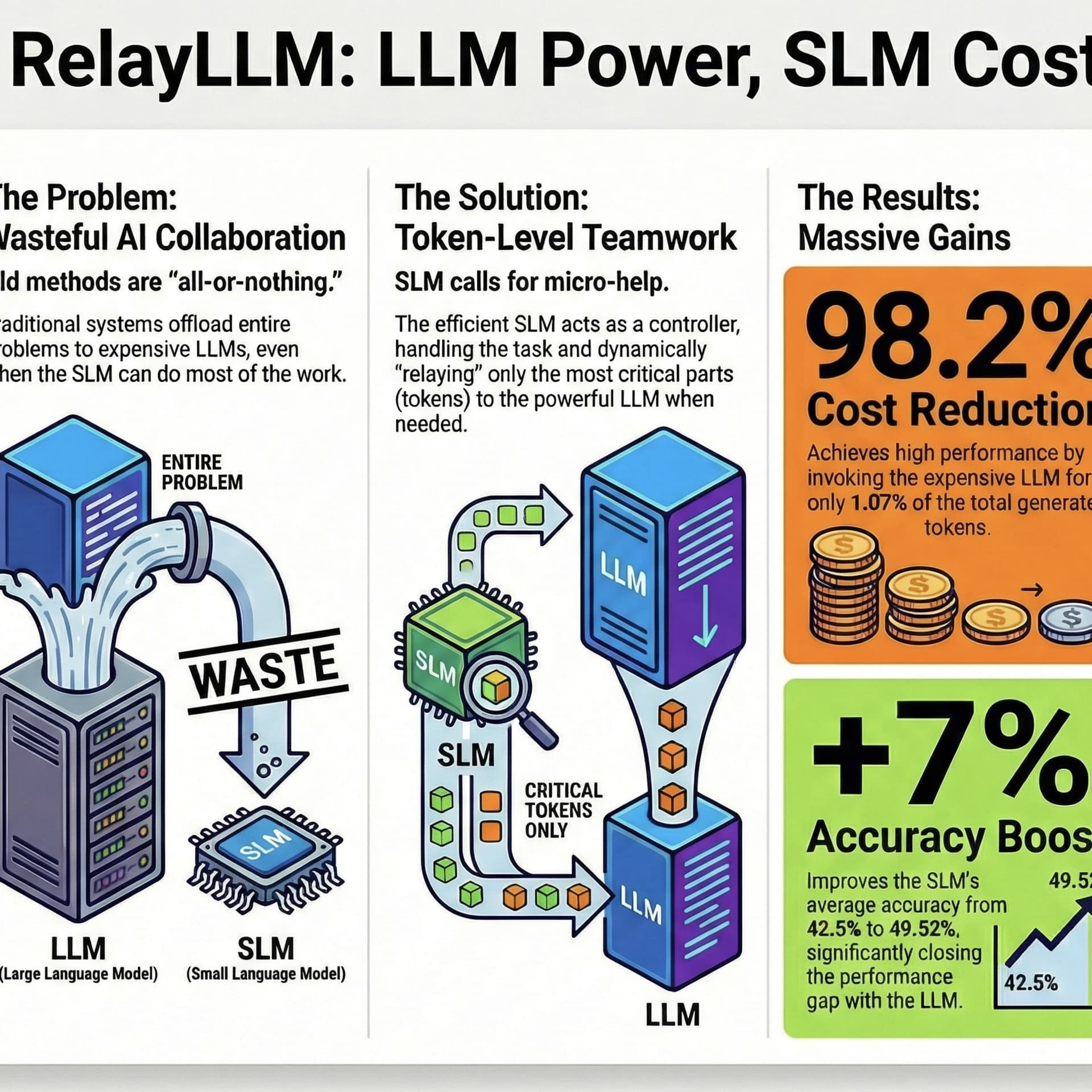
RelayLLM proposes “token-level collaborative decoding” so a small language model can request brief, precise help from a larger LLM during generation, avoiding all-or-nothing routing.
Guests
No guest names or external speakers are mentioned; it’s a single host “Deep Dive” episode.
Key claims
RelayLLM boosts a small model’s math accuracy from ~42.5% to 49.52% while invoking the large model for only 1.07% of generated tokens, yielding ~98.2% token-cost reduction vs prior routing. It uses a special “call” command predicted mid-token, with the command tokens stripped before sending context to the teacher.
Notable examples
Six math benchmarks; ablation shows removing the “independent” reward increases call ratio to 4.1%. Generalization: trained on math only, it reaches 59.03% on MMLU Pro vs 46.90% baseline (QEN3 1.7B). Teacher-free tests show improved performance on easier sets, and using a mismatched teacher slightly reduces results.
Written by AI. May contain mistakes. Listen to the episode to check what was said.
Chapters
Tap a time to open that second in VOThe Trade-offs of Language Models
0:46 to 1:32
Exploring the strengths and weaknesses of large and small language models.
“So the obvious response has been, okay, let's make them collaborate.”
The Need for Collaboration
1:33 to 2:46
Understanding how small models can leverage the power of large models through collaboration.
“Today, we are diving into a novel framework called RelayLM.”
Token-Level Collaborative Decoding
2:47 to 3:54
Explaining how RelayLM improves small model performance with precise help-seeking.
“What does this token level delegation look like in practice?”
Dynamic Length Prediction in Training
3:55 to 4:58
Discussing the innovative two-stage training framework for RelayLM.
“When the small model generates its own trigger, it pauses.”
Reinforcement Learning for Efficiency
4:59 to 7:11
Analyzing the reinforcement learning strategy used to enhance model efficiency.
“You have to balance not calling to save money with calling when you absolutely need to for accuracy.”
Performance Metrics and Generalization
7:12 to 8:13
Highlighting improvement in accuracy and generalization capabilities of RelayLM.
“By boosting the reward for being independent, they create an economic incentive inside the model to save cost.”
Behavioral Insights from Training
8:14 to 11:25
Insights on model behavior from training, including the impact of incentives.
“So what does this all yield in the macro results?”
The Future of AI with RelayLM
11:26 to 12:59
Discussing the paradigm shift in AI collaboration brought by RelayLM.
“So the intervention is still necessary for truly complex stuff.”
Transcript
Automatic transcript. May contain errors.0:00Welcome to the Deep Dive. If you've been paying attention to how fast AI is developing, you know, we face one fundamental difficult tradeoff every day. Large language models are, I mean, they're undeniably powerful. They can solve incredibly complex reasoning problems, but they are ridiculously slow. And monumentally expensive. We're talking about massive computational cost, huge latency. It can make real-time applications just, well, impractical. Right. So that's the high end. That's the high end of the spectrum. On the other end, you have small language models, SLMs. They're lightning fast, you know, super resource efficient.
0:37You can run them on your own machine. But there's a catch. There's always a catch. Their capacity, especially for these deep multi-step reasoning tasks like complex math or logic puzzles, it's often fundamentally limited. So the obvious response has been, okay, let's make them collaborate. How do we get the little model to use the big model's brainpower? And the old methods, things like cascading or query-level routing, they're just simple. And frankly, incredibly inefficient. What do you mean by that? Well, the small model tries. And if it fails, it just punts the entire task, the whole prompt, over to the massive, expensive LLM.
1:13Ah, so it's an all-or-nothing approach. Exactly. An all-or-nothing strategy. And that's where all the inefficiency is hiding because the small model can often handle, what, maybe 80%, 90 % of the problem on its own? It doesn't need to hand over the whole thing. It just needs help at one or two critical points. Precisely. It needs an expert intervention, but only for a moment. Okay, let's unpack this and get truly surgical. Today, we are diving into a novel framework called RelayLM. This system claims to be the solution using what they call token-level collaborative decoding. Right. So our mission is to understand how this lets a small, cheap model get near LLM-level performance by strategically asking for help and how it's trained to make that delegation unbelievably precise.
1:56And the precision, it really pays off in the hard numbers. I mean, the core claim here is just radical efficiency. Across six different difficult math benchmarks, Relay LLM improved the small model's average accuracy from about 42.5 % all the way up to 49.52%. That's a huge seven-point jump. It's a massive gain. But here is the kicker, the statistic that makes this research, I think, a game changer. Go on. They got that huge performance boost while invoking the large language model for only 1.07 % of the total generated tokens. 1%. Think about that. That tiny invocation translates to a 98.2 % reduction in token costs compared to the other routing methods.
2:40It completely redefines the cost curve for high quality reasoning. That is efficiency defined. So let's start with the mechanics. How is the small model actually empowered to be the surgical. What does this token level delegation look like in practice? Well, the first and I think most fascinating shift is in control. Traditional systems, they use some external router to decide when to switch models. Relay LM flips that. The small model, the M dollar, say a coin three 1.7B, which is a very nimble little model. It acts as both a problem solver and the central controller. It decides when it needs help.
3:10So the SLM isn't just reacting to a failure like I'm stuck, send it upstairs. It's actively managing the flow like mid-sentence. Mid-token, even. It does this using a special synthetic command. While it's generating text autoregressively, one token at a time, it can decide to generate a special pattern. Calm call. Okay, calm call. What's the end? The dollar is crucial. It's a dynamically predicted integer. It represents the number of tokens it thinks it needs from the larger expert model. It predicts the scope of the help required. That's incredible. It's like the small model is doing a math problem, and it hits a tricky integral.
3:44It doesn't just quit and hand the whole test to the professor. It pauses, highlights that one integral, and says, professor, I just need you to solve the next three lines, and then I can take over again. That's precisely the process. When the small model generates its own trigger, it pauses. The current context, everything up to that point, gets sent over to the large model, the ML level. And I noticed a technical detail here that must be critical. The command tokens themselves, the call tags, they get stripped out before the text is sent to the LLM. Why is that step so important? Oh, it's essential for compatibility.
4:16The large model, the teacher, it was trained on massive data sets of clean, natural language. It has no idea what these synthetic commands mean. It's the plumbing. I see. If you sent it the command tokens, its output would just be garbled. So you have to hide the process from the LLM. So it just generates a high quality continuation exactly as if it were a standard query. That makes perfect sense. So the MLA generates those end tokens, a high quality step, and then it stops. And then the relay resumes. Control goes right back to the small model, the MLF event, its context gets updated with the experts' tokens, and it just continues the problem-solving process on its own now with that new guidance.
4:52It's an incredibly dynamic process. But like you said, this isn't something the model is born with. It has to be taught. Which brings us to the crucial two-stage training framework. Right. And the training challenge is immense. You have to balance not calling to save money with calling when you absolutely need to for accuracy. So stage one is the foundational work, the supervised warmup. This is about teaching the model the basic language of delegation. Correct. The goal is just teaching the syntactic structure of the command. They build a synthetic data set. And to avoid introducing weird stylistic errors, what we call distribution shift, they generate the base text using the vanilla SLM itself.
5:33That's clever. So they're basically training the model on its own voice. Yes. And instead of just putting the call command at the end of a sentence, they insert them at random indices at the token level. Whoa, okay, why is that so important? It's a powerful detail. It forces the model to learn to trigger assistants at the precise token where a reasoning gap occurs, not just at a natural sentence break. It's precision training. And what about teaching at the end? How does it learn to predict the length of the help it needs? They explicitly synthesize delegation lengths across multiple orders of magnitude, from just a few tokens up to a thousand.
6:06This is crucial for that dynamic length prediction. It stops the model from always defaulting to a big wasteful request. Okay, so that sets the stage. Then we get to the really hard part, reinforcement learning. Now we get to the core challenge, aligning behavior. The goal is razor sharp. Maximize quality, but strictly minimize cost. They use an algorithm called Group Relative Policy Optimization, GRPO, but the real secret sauce. It's the difficulty-aware reward system. So instead of a simple correct or incorrect reward, they look at how a whole group of attempts for a single query performed, and that tells them how hard the query was.
6:45Exactly. And that difficulty guides the reward. Let's walk through the three scenarios. Scenario one is student solvable. This is when the small model gets it right without calling the LLM. It proved it was efficient. So to reinforce that, it gets a boosted bonus, a reward of 1.5. Wait, why boost it? Why not just a reward of one for being correct? It's because of that dual objective. If the reward were just one, the model might learn that calling the LLM just in case is an equally safe bet. By boosting the reward for being independent, they create an economic incentive inside the model to save cost.
7:19Ah, so you're actively rewarding self-sufficiency. So what about the hard problems where help was actually necessary? That's scenario two. Teacher dependent. These are queries where only the attempts that used the call command were correct. If a model was, you know, stubborn and failed to call the expert here, it gets a harsh penalty, a reward of MIGA 1.0. Don't guess. Delegate smartly. Got it. What about the impossible tasks? The ones where even the teacher couldn't get it right. That's the third one, teacher unsolvable. For these where no attempt worked, there's a risk. If you penalize the model for failing, it might learn to just avoid calling on hard problems altogether.
7:56I see. So models that attempted to call the LLM still get a small exploration reward. This little bonus reinforces the habit of seeking help in really uncertain situations, even if it doesn't pan out. That reward structure is fascinating. It's not just about success. It's punishing redundancy and encouraging the right action based on the difficulty. So what does this all yield in the macro results? Well, we circle back to that insane efficiency. We mentioned the 98.2 % cost reduction. But look at this. Compared to a dumb system that just randomly offloads a similar number of queries, Relay LLM gave a substantial 6.9 % accuracy improvement.
8:34So that 6.9 % is the real tangible value of being strategic instead of just being lucky. It is. And we can prove the dynamic link prediction is crucial. They compared it against a model that had to request a fixed 100 tokens every time. Okay. That fixed 100 strategy was pretty accurate, about 49.56%, but its call ratio was 2.87%. Inefficient. Very. Relay LLM achieved almost identical accuracy, 49.52%, but it slashed the call ratio down to just 1.07%. The model truly learns to request just enough help, nothing more. Here's where the insights get really profound for me. Generalization. This entire system was trained exclusively on mathematical data.
9:12Did that skill actually transfer to general knowledge? Shockingly well. They tested it on completely unseen domains, like BigBenchHard and MMLU Pro. And MMLU Pro tests professional knowledge across 57 different academic subjects. So totally different from the training data. Completely different. And the Relay LLM model consistently outperformed all the baselines. Give me the numbers. How big was the jump on general knowledge? The baseline for the QEN3 1.7B model on MMLU Pro was 46.90%. The Relay LLM trained version jumped that score to an astounding 59.03%. Wow, that's a massive 12-point jump in general reasoning just from training a help-seeking mechanism on math problems.
9:55It is. It suggests the SLN didn't just overfit to math. It acquired a generalized help-seeking behavior. It learned to recognize its own cognitive limits, its own boundary of uncertainty, no matter the topic. That is the core takeaway. It learned effective self-assessment. Let's dig deeper into the behavioral insights. You mentioned that 1.5 boosted bonus for being independent. What happened when they took that incentive away? The ablation study showed that as soon as you remove that bonus, the small model's call ratio just spikes. It shot up to 4.1%. That's a fourfold increase in cost. Exactly.
10:27It confirms that without that penalty for being wasteful, the small model just becomes over-reliant. It constantly asks for help, even when it doesn't need it. If you don't reward efficiency, you basically engineer laziness into the system. That's a powerful lesson. Now, for the most mind-bending insight for me, they tested the final trained model in a teacher-free setting. They just forbade it from making any calls. Did the student model actually get smarter from the training process? Surprisingly, yes. On the easier data sets, the real ALM trained model, even with its hands tied, forbidden from calling the expert, it still surpassed the standard baseline model.
11:05No way. So the student model successfully internalized some of the expert's reasoning patterns just through the collaboration. It seems so. It wasn't just better at asking for directions. Its own driving skills actually improved from watching the expert at those critical moments. That's incredible. It really is. Now, to be fair, on the very hardest data sets, taking the teacher away still caused a performance drop. So the intervention is still necessary for truly complex stuff. But the underlying improvement is a huge finding. One final nuance. Does the identity of the teacher LLM matter? What if they used an even bigger, better model during inference?
11:43Intriguingly, performance went down slightly. It went down? A little, yeah. Optimal performance came when the inference teacher matched the training teacher. This suggests the small model learns to anticipate the specific voice and reasoning style of its teacher. Distribution shift, even towards a better model, can sometimes disrupt that collaboration. So what does this all mean for the future of AI? Really LM really shifts the paradigm away from that wasteful all-or-nothing approach. We're now treating the LLM not as a mandatory co-pilot, but as a surgical on-demand specialist. A specialist you call in for just a few critical tokens.
12:17Exactly. And this allows these small, efficient models to unlock a huge portion of the large model's performance while using, what, barely 1 % of the budget? It democratizes complex reasoning. And the real accomplishment here isn't just cutting costs. It's that they successfully engineered a machine to demonstrate one of the most crucial human skills, sophisticated self-assessment. They taught it to understand its own knowledge boundaries and, more importantly, to know the precise moment and the exact scope of help required to overcome our hurdle. It learned to be strategically independent. So the question now is, if we can reliably teach small models to do this with such precision, how far can we push the limit of resource-constrained, decentralized AI?
12:59Maybe the future isn't about building one solitary, gigantic brain, but perfecting the seamless surgical communication between a whole team of smart, specialized components.
From the publisher
This paper discusses **RelayLLM**, a framework designed to improve the efficiency of complex reasoning by enabling **token-level collaboration** between small and large language models. Unlike traditional routers that offload entire queries, the **Small Language Model (SLM)** serves as an active controller that generates a special command to "relay" specific, difficult reasoning steps to a **Large Language Model (LLM)**. The system is trained using a two-stage process involving a **supervised warm-up** and **reinforcement learning** with difficulty-aware rewards to balance independence with strategic help-seeking. Results across multiple benchmarks show that this method significantly boosts the accuracy of smaller models while invoking the larger expert for only about **1.07% of the total tokens**. Ultimately, RelayLLM achieves a **98.2% reduction in computational costs** compared to standard performance-matched routing methods. This strategic intervention allows the smaller model to internalize better reasoning patterns, occasionally even improving its **independent performance** without teacher assistance.


