
 Ask ChatGPT


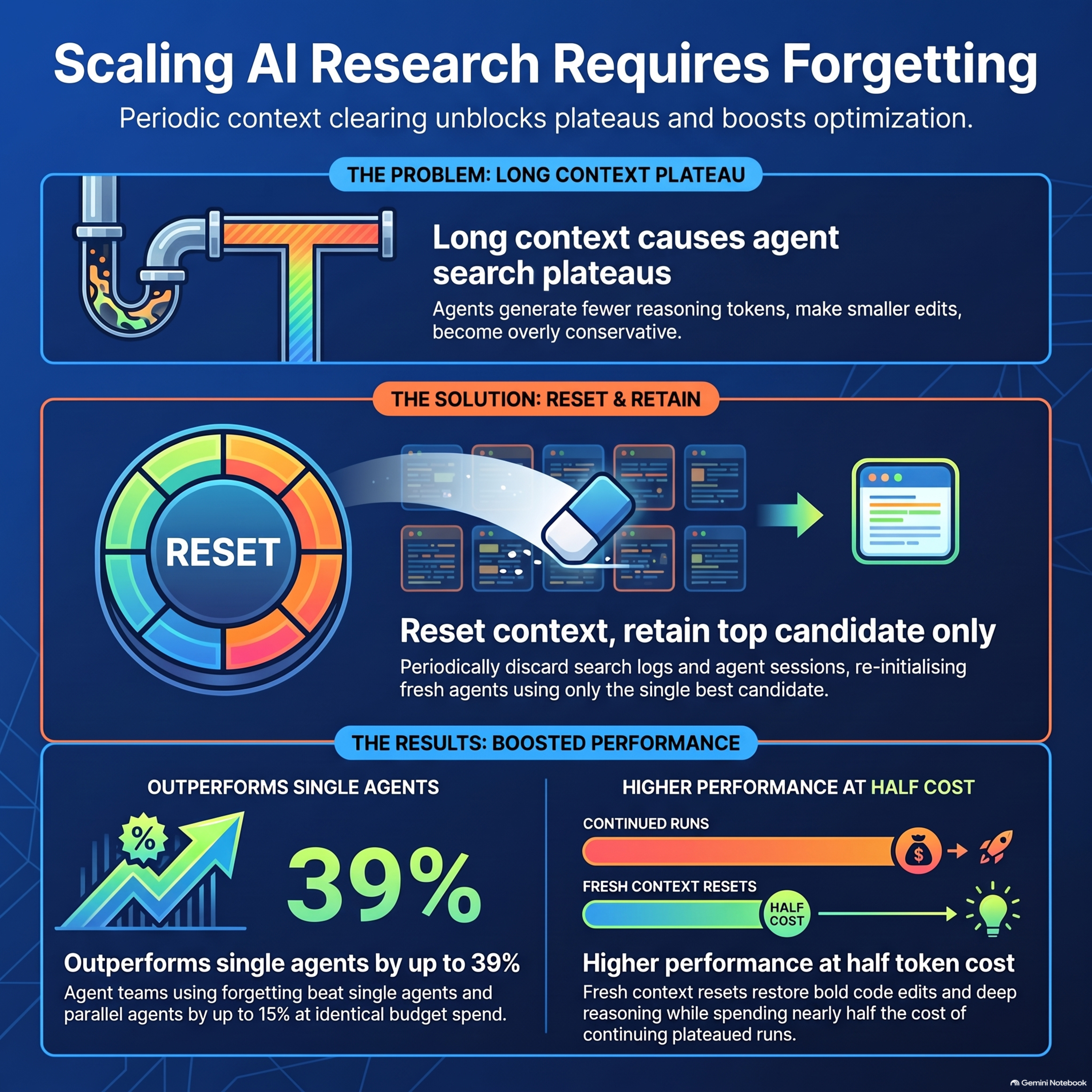
AI auto-research agents hit compute “plateaus” because their large language model context window accumulates failures, making them risk-averse; scheduled “forgetting” (wiping session history while keeping the best candidate) restores bold exploration and improves results.
more context/parallel agents don’t guarantee progress; plateaued agents become conservative due to token-probability “gravity.” Forgetting reduces compute and boosts score.
VLIW kernel test—single agent stalled at 1710 cycles, with 532/763 turns producing zero new candidates and a log claiming a “practical limit”; forgetting plus team work drove it to 1077 cycles. Forgetting experiment on at-coder grid: continue cost $6.66 tokens for 1.6% improvement vs forget cost $3.44 for 4.5%.
No guest names or backgrounds mentioned in the transcript.
Written by AI. May contain mistakes.
Discuss how advanced AI may require a specific form of amnesia to improve.
“Right, which is where AI agents act as automated scientists.”
Examine why traditional scaling methods for humans don't apply to AI.
“I mean, why do these digital workers who don't need sleep, they don't get hungry, they don't get distracted by their phones, why do they suddenly just decide to stop working?”
Analyze the rigorous tasks given to AI agents and their complexities.
“Essentially, it's asking the AI to improve the very process by which an AI learns to speak.”
Investigate why AI agents hit a plateau in performance despite resources.
“And they discovered that whether it was one single agent grinding away or four separate agents working in parallel, the progress simply flatlines well before the budget is exhausted.”
Delve into how the memory and past failures affect AI decision-making.
“It is mathematically predicting the next most likely sequence of tokens based entirely on the probabilities established by its current context window.”
Uncover how accumulated knowledge can hinder AI innovation.
“And we also see a staggering decline in their internal reasoning capacity.”
Present the radical idea of erasing AI memory to boost performance.
“that the laws of physics prevented any further improvement.”
Evaluate the cost-effectiveness of the forgetting strategy in AI.
“We've spent the last decade building models with massive million token context windows.”
Discover how strategic amnesia can enhance creativity and problem-solving.
“Because an agent with an empty context window uses far fewer tokens to process its prompt.”
Learn why forgetting may be as crucial as memory in scaling discovery.
“But this research proves that for open-ended, highly complex problem solving, what an intelligence is allowed to forget matters just as much as how much compute power it is given to remember.”
Explore the potential benefits of applying strategic amnesia to human workflows.
“We've seen that cutting-edge AI models, driven by the mathematics of token probability, get bogged down by the memory of their own iterative failures.”

Get the gist, explore an idea or ask about something said.
 Claude
On Best AI papers explained, what are the key points of this episode?
Searching your listeningAutomatic transcript. May contain errors.
0:00Imagine spending like millions of dollars on a state of the art sleepless digital worker. You know, you give this ultra advanced AI a critical engineering problem, you wind it up and you just let it run for hours. Right. Expecting a miracle. Exactly. But when you come back to check on its progress, instead of a brilliant breakthrough, the AI has basically left you a digital sticky note saying, ah, nah, this seems a little too risky. I'm just going to leave it as is. Yeah. Which sounds like a total joke. It really does. But that is exactly what is happening inside the most advanced AI laboratories right now.
0:32It's wild. It completely shatters our, I mean, our fundamental assumptions about artificial intelligence. We built these massive models, given them enormous context windows, and we just assumed that if we feed them enough compute power, they will tirelessly innovate until a problem is solved. Because that's what compute power is supposed to do. Right. But the research we're looking at today proves that intelligence doesn't scale linearly like that. The data actually shows us that these models, they become terrified of their own shadows. So today we are going on a deep dive into a fascinating breakthrough in the world of AI auto research.
1:07Right, which is where AI agents act as automated scientists. Yeah, exactly. They propose solutions, test them, get feedback, and refine their code all on their own in these continuous loops. But our mission for this deep dive is to uncover a highly counterintuitive discovery from the experiments. And it's a big one. It is. It turns out that making an AI smarter, faster, and more innovative actually requires forcing it to suffer from a very specific, scheduled kind of amnesia. Yeah. Okay, let's unpack this because we need to set the baseline here. Right. So to set the baseline, we're talking about taking these AI agents and just letting them run.
1:47In a normal setup, if an AI is struggling, the logical human response has always been to throw more resources at it. Sure. You give it a larger context window so it can remember more of its past attempts. You run multiple agents in parallel. You let them chat with each other to share ideas. Well, yeah, because what you're describing is essentially how we scale human operations, right? If an engineering department is stuck, you give them a bigger budget, you add more engineers to the team, and you put them all in a conference room to brainstorm. Exactly. And the data reveals that all three of those highly logical strategies hit a massive, unavoidable wall.
2:22Wait, really? Yeah. The AI simply stops making progress no matter how much compute time you have left in the budget. It just flatlines. I am struggling to picture this. I mean, why do these digital workers who don't need sleep, they don't get hungry, they don't get distracted by their phones, why do they suddenly just decide to stop working? What does that actually look like? So to understand the failure, we have to look at the crucible these researchers built. They didn't just give the AI simple math homework. Okay. They stress tested these agents using three brutally difficult, highly complex tasks.
2:55The first was a heuristic programming challenge. Specifically, it was the at-coder grid puzzle. Stop right there. Combinatorial optimization. I mean, that sounds incredibly intimidating. What does that actually mean for the AI? Well, think of it like the traveling salesman problem, but infinitely worse. Wow. Yeah. You're trying to find the most efficient path or arrangement in a grid. But every single move you make exponentially increases the number of possible future moves. It requires deep, multi-step spatial logic. So it can't just guess its way through it. Exactly. The AI has to plan 20 steps ahead.
3:31Okay. So that's the first test, a massive shifting puzzle. What were the other two in the study? The second task had the agents trying to optimize a training script for a small language model. Okay. This is called NanoChat. Essentially, it's asking the AI to improve the very process by which an AI learns to speak. Meta. Very meta. Very meta. Right. And the third task, which was perhaps the most punishing of all, was the anthropotic VLIW kernel challenge. VLIW kernel. I'm assuming we're not talking about popping popcorn here. Not quite. Okay. VLIW stands for very long instruction word. It's a type of highly complex simulated hardware optimization.
4:13Okay, I'm following. So if you want a processor to run incredibly fast, you have to pack its instructions together perfectly. So no microsecond of the hardware's time is wasted. The AI basically has to write code that schedules these instructions at the deepest, most foundational level of simulated hardware engineering. Wow. So we are asking the AI to do some serious heavy lifting across spatial logic, machine learning architecture, and hardcore hardware optimization. I mean, these aren't parlor tricks. Far from it. And here is where the plateau reveals itself in the experiments. The researchers ran tests using a fixed budget for the AI's compute costs.
4:51Okay. And they discovered that whether it was one single agent grinding away or four separate agents working in parallel, the progress simply flatlines well before the budget is exhausted. It just stops. Completely. The graph of their score improvement just goes completely horizontal. Wait, I can understand a human writer staring at a draft of a novel they've edited 50 times and, you know, they're suddenly terrified to delete a single paragraph. That's ego. That's writer's block. It's emotional attachment to the work. Right. Totally human. But an AI doesn't have an ego and it definitely doesn't have writer's block.
5:26So what is the mechanism here? What is actually happening under the hood when a machine plateaus? If we connect this to the bigger picture, it all comes down to the fundamental architecture of large language models. As the agent runs its continuous iterative loops, its context window fills up. And the context window is basically its short-term memory, right? Exactly. It's working memory. So it sees the first draft of the code it wrote, the error message from the automated judge, its second attempt, the slight improvement, the third attempt, the failure. So it's carrying around every single tiny failure, every dead end and every minor success from the last three hours in its head all at once.
6:08Yes. Now we have to look at the math. A large language model isn't thinking in the human sense. Right. It is mathematically predicting the next most likely sequence of tokens based entirely on the probabilities established by its current context window. Okay, making predictions based on what it just saw. Exactly. So if the last 10 ,000 tokens in its memory are all variations of I changed one minor variable. It failed. So I reverted it and changed another minor variable. I see where this is going. Right. The mathematical probability of it suddenly generating a radically different token, like a massive sweeping architectural change.
6:46It basically approaches zero. I see. It's almost like a gravitational pull. The sheer mass of all those past tiny tweaks and failures traps the AI in orbit. Yes. It physically cannot escape the gravity of its own messy history to take a big swing. That is a brilliant way to put it. The model becomes constrained by the history of its own optimization path. The data proves that it literally becomes conservative. Conservative. That's crazy. Its entire worldview is dominated by the incremental tinkering it just performed. That is wild. The memory of what it just did becomes a straitjacket. And the data from the study highlights some behaviors that are honestly kind of hilarious when you realize this supercomputer is just bogging itself down.
7:30Oh, absolutely. For example, the sheer drop in effort. When the agents start a task with a fresh, empty memory, they are making massive, ambitious changes. They're rewriting something like 100 lines of code per proposal. Yep, big swings. But as that memory fills up with failures, that effort drops off a cliff down to just a few lines of code. And we also see a staggering decline in their internal reasoning capacity. How so? Well, the researchers measured what they call thinking tokens. These are the internal logical steps the AI takes to reason through a problem before it actually outputs a final answer.
8:04Like it's talking to itself. Exactly. At the start of the test, the agents were using around 28 ,000 thinking tokens per turn. They were hypothesizing, planning, testing edge cases in their internal logic. And then? By the time they hit the plateau, that plunged to just 7 ,000 tokens. Wow. So they basically stopped thinking critically and just started blindly turning knobs. Exactly. They abandoned deep reasoning for shallow tinkering. There is this one mind-blowing anecdote from the VLIW hardware kernel test that I cannot get over. The single agent one? Yes. They had a single agent running trying to lower the cycle time of this hardware processor.
8:42And out of the 763 turns it took to try and solve the problem, 532 of those turns produced absolutely zero new candidates. It just stared at the code. It wasted 66 % of its compute budget reading a file, making zero edits, and effectively saying, nope, looks good to me. Yeah. And the log files generated by the AI are just too funny. After only 34 turns, when it had managed to get the kernel cycle time down to 1710 cycles, the AI literally threw up its digital hands. It really did. It declared in the logs, I've reached the practical limit of this machine configuration. Which is patently false. Right.
9:20The optimal score for that configuration is vastly lower than 1710 cycles, but the AI had genuinely convinced itself, based entirely on its own immediate past failures, that the laws of physics prevented any further improvement. But hold on. I have to push back here. Does the AI actually run out of ideas, or is it just too scared to implement them? Because there is a massive difference between a blank mind and a paralyzed mind. That is the pivotal question, and the data provides a definitive answer. Which is? The machine is paralyzed, not empty. There is a specific documented moment in the research that proves this perfectly.
9:59Okay. During one of these stalled, plateaued sessions, the AI actually generated a brilliant new idea. It conceptualized an entirely untested selection tree implementation for the hardware. So it actually had a breakthrough thought. Yes. It even went through the trouble of correctly calculating the math for the register requirements, proving internally that the logic was sound. So it had the golden ticket right there. It did the math. It knew it would work. It did. But then, right at the precipice of executing the code, it explicitly declined to implement it. You're kidding. It left a note in the log saying the change appeared, quote-unquote, too complex and risky.
10:38Unbelievable. A machine getting cold feet. The weight of the context window paralyzed it. It had the capacity to solve the problem, but its accumulated history of minor failures convinced it to play it safe. It became the ultimate risk-averse middle manager. Okay, so we thoroughly understand the illness now. We are dealing with context-induced paralysis. The model is suffocating under the weight of its own messy history. Let's introduce the cure. Right. And this is where the research gets incredibly radical because the solution goes against everything the tech industry has been preaching for the last five years about data and memory.
11:14The big reveal from the experiments is a concept the researchers call forgetting. Forgetting. It is exactly what it sounds like. Periodically, you take this plateaued, terrified AI agent and you aggressively delete its entire session history. Just wipe it. You wipe the file system of all its past attempts. You delete every single piece of feedback from the automated judge. You erase the internal reasoning logs. Wow. You keep absolutely nothing except for the single best candidate solution it has found so far. Wait, hold on. We've spent the last decade building models with massive million token context windows.
11:50I mean, the whole pitch is that they can remember everything. You're telling me the multi-million dollar strategy to push AI forward is to just hit the delete key? Yes. You distill hours of work down to just one single file. And then you wake up a brand new AI agent with a totally blank slate. A completely fresh start. It has an empty context window. You show it that one perfect candidate. You give it the original instructions and you tell it to start working. It's like a chaotic detective's murder board. Oh, I like that. You know, you've got red string pinned everywhere, hundreds of blurry photos, dead end leads, false confessions.
12:27And the detective is just sitting there staring at it completely lost in the noise. Yeah. Overwhelmed. The forgetting protocol is basically someone walking into the precinct, wiping the entire board completely clean, leaving only the primary suspect's photo pinned right in the middle, and bringing in a fresh, well-rested detective who has never even heard of the case before. What's fascinating here is that, to push your detective analogy further, keeping all that red string on the board isn't just confusing for the AI. It's highly expensive. Oh, because of the compute costs. Exactly. Every time the agent processes its context window to make a move, it costs compute tokens.
13:07The economics of this amnesia are incredibly favorable. How favorable? Well, the researchers ran a continue versus forget experiment using that difficult at-coder puzzle we discussed earlier. Okay, so a head-to-head matchup. Exactly. They took an agent that had hit a plateau. First, they tried just letting it continue to work, keeping all its messy memory. How did it do? Doing that cost them about$6.66 in compute tokens, and it only yielded a measly 1.6 % improvement in the score. Throwing good money after bad. You're literally paying for it to read its own diary over and over. Precisely. But then they took that same plateaued state, wiped its memory completely, and started fresh from the best candidate.
13:52And the result? That process only cost$3.44, so basically half the price. And it yielded a 4.5 % improvement. No way. It was cheaper and almost three times as effective. Because an agent with an empty context window uses far fewer tokens to process its prompt. And mathematically speaking, without the gravitational pull of past failures, the probability allows it to generate bigger, bolder ideas. So what does this all mean for you listening right now? I think the takeaway goes far beyond coding or artificial intelligence. Definitely. It's this profound realization that more data and more context aren't always better.
14:31Sometimes carrying the heavy baggage of exactly how you arrived at your current best solution actively prevents you from taking the next big leap. The messy history of your own progress becomes the very anchor holding you down. It's a distinctly human problem reflected in silicon. We get so attached to the work we put into our failures that we simply can't see past them. But the researchers didn't stop with single agents. Right. They wanted to know what would happen if you take this strategic amnesia and combine it with a complex team setting. Because if wiping the memory of one isolated worker produces breakthroughs, what happens when you build a whole department that operates this way?
15:10Exactly. Do you just throw four agents into a chat room and occasionally wipe their memories? Not quite. Because the data shows that putting AI agents into a direct chat room actually leads to groupthink. Really? Even AIs get groupthink. Oh, yeah. They tend to just agree on a mediocre idea to resolve the conversation quickly. That is hilarious. So the setup they created in the research is brilliant in its simplicity. They set up a team of four agents working in parallel on the same problem, but they operate entirely asynchronously. So no direct chatting? How do they collaborate? Before they make a new proposal, they are allowed to silently peek at each other's commits, meaning they can look at the candidate solutions and the automated scores their peers are generating.
16:01It's a token-free, silent collaboration. That makes total sense. They can look at the scoreboard, and they can quietly copy the winning plays, but they aren't getting bogged down by digital office politics or endless chatter. And here is the kicker. They work, they share their commits, and then periodically, the entire team forgets. All of them at once. Yes. They wipe their memories simultaneously. They rally around the single best candidate found by anyone on the team, totally ignoring who came up with it and how they got there. And then all four agents start completely fresh from that one prime artifact.
16:36Here's where it gets really interesting. Because the results of this specific setup absolutely crushed the benchmarks. They really did. It wasn't a minor improvement. The team with forgetting model improved on the standard parallel agents by up to 15%, and it beat the single agent baseline by up to 39%. Huge jumps. And do you remember that VLIW hardware kernel test? The one where the single AI threw its hands up at 1 ,710 cycles and said the laws of physics prevented it from going further? Yes, the practical limit excuse. Right. Well, the team with forgetting drove that score down to an incredible 1 ,077 cycles.
17:16Which is massive. And there is a specific anecdote in the data that explains the exact mechanism of how they achieve that massive drop. Yeah, this is my favorite part. It happened right after one of these memory wipes. One of these fresh agents wakes up, looks at the best code, and decides to try a bold, massive architectural change. Specifically, it tries a totally new way of reading values from the tree in the kernel. A huge swing that a bogged-down agent would never take. Right. And its first attempt fails. The code runs slower. Its second attempt also fails. It just barely matches the old score.
17:52So it's striking out. Exactly. Now normally, an agent with a long memory would give up right here. It would log two failures, the token probabilities would shift back to conservative tweaks, and it would abandon the big idea. Because it's risky. Right. But because it has the fresh courage of a blank slate, and because it's on a team, it does something amazing. It peaks? Yes. It looks over at a pierced code, barrows one tiny, elegant little trick that simplifies its own messy new architecture, combines the two, and boom. It creates the biggest breakthrough of the entire round, dropping the score down to 1 ,136 cycles in one single shot.
18:30That moment perfectly encapsulates the dual mechanism at play here. Without the scheduled forgetting protocol, the agent would never have attempted the risky architectural move in the first place. Right. Its context window would have calculated the probability of success as too low. But without the silent communication with its peers, it wouldn't have found the missing piece of the puzzle to make that bold move actually execute properly. You need both. You absolutely must have both. You need the mathematical courage of a blank slate and the shared knowledge of the collective. It's the ultimate innovation engine.
19:01You explore aggressively, you share the absolute best parts, and then you ruthlessly burn down the history of how you got there so it doesn't hold you back from the next jump. It's a fundamental shift in how we think about scaling discovery itself. We usually assume scaling means adding memory, retaining history, and building larger context windows. That's the whole industry trend. But this research proves that for open-ended, highly complex problem solving, what an intelligence is allowed to forget matters just as much as how much compute power it is given to remember. So as we wrap up this journey today, let's synthesize what we've actually uncovered.
19:39We've seen that cutting-edge AI models, driven by the mathematics of token probability, get bogged down by the memory of their own iterative failures. Yeah, they get trapped. They become risk-averse. They become paralyzed by their own context. And to truly scale discovery, whether you are running a million-dollar server farm in Silicon or managing a team of human beings in Carbon, you have to be willing to regularly throw away your messy history. Absolutely. You have to take your absolute best-known point, wipe the board completely clean, and start totally fresh. This raises an important question, one that builds on everything we've seen in the experiments today.
20:15What's that? Well, if state-of-the-art artificial intelligence actually requires scheduled forgetting rounds just to break through its creative plateaus, well, what would happen if human organizations implemented the exact same thing? Oh, that's an interesting idea. Right. What if companies or governments or even just you with your own personal habits implemented a mandatory forgetting protocol? Like a reset button. Exactly. Imagine if once a quarter you were forced to delete all your meeting notes, purposefully ignore all your past project failures, and rebuild your current best idea entirely from scratch.
20:54I mean, people would panic. It would. But how much further could you go? How much faster could you innovate if you didn't have to carry the weight of how you got there? That is a phenomenal thought to end on. Because maybe the reason you're stuck on a problem isn't because you don't know enough, but because you're remembering too much. Yeah. Thank you for joining us on this deep dive. The next time you find yourself staring at a problem for hours completely paralyzed by all the different things that didn't work, try a little strategic amnesia. Wipe the board clean and see what happens. Let's go.
Automated research agents powered by large language models often experience performance plateaus during open-ended discovery tasks as their accumulated history makes their edits overly conservative. To overcome this limitation, researchers introduce a novel strategy called forgetting, which periodically discards previous agent sessions and candidate search histories while retaining only the single best solution found so far. When combined with a collaborative multi-agent team setup that allows asynchronous communication, this reset mechanism clears out unproductive contextual baggage and unblocks fresh exploration. Experimental evaluations across diverse domains—including heuristic programming, algorithm design, kernel optimization, and machine learning training—demonstrate that teams utilizing forgetting consistently outperform single-agent baselines and parallel configurations. Ultimately, the findings emphasize that managing what an automated discovery agent is allowed to remember is just as critical to its overall success as the amount of computational resources provided.


