In short
Data-scarce pretraining for language models; why multi-epoch reuse overfits, and how self-distillation (teacher-student with identical architectures) improves learning using “dark knowledge” (soft targets).
Guest backgrounds
No guest identities or bios are provided in the transcript; only two unnamed speakers discuss the research.
Key claims
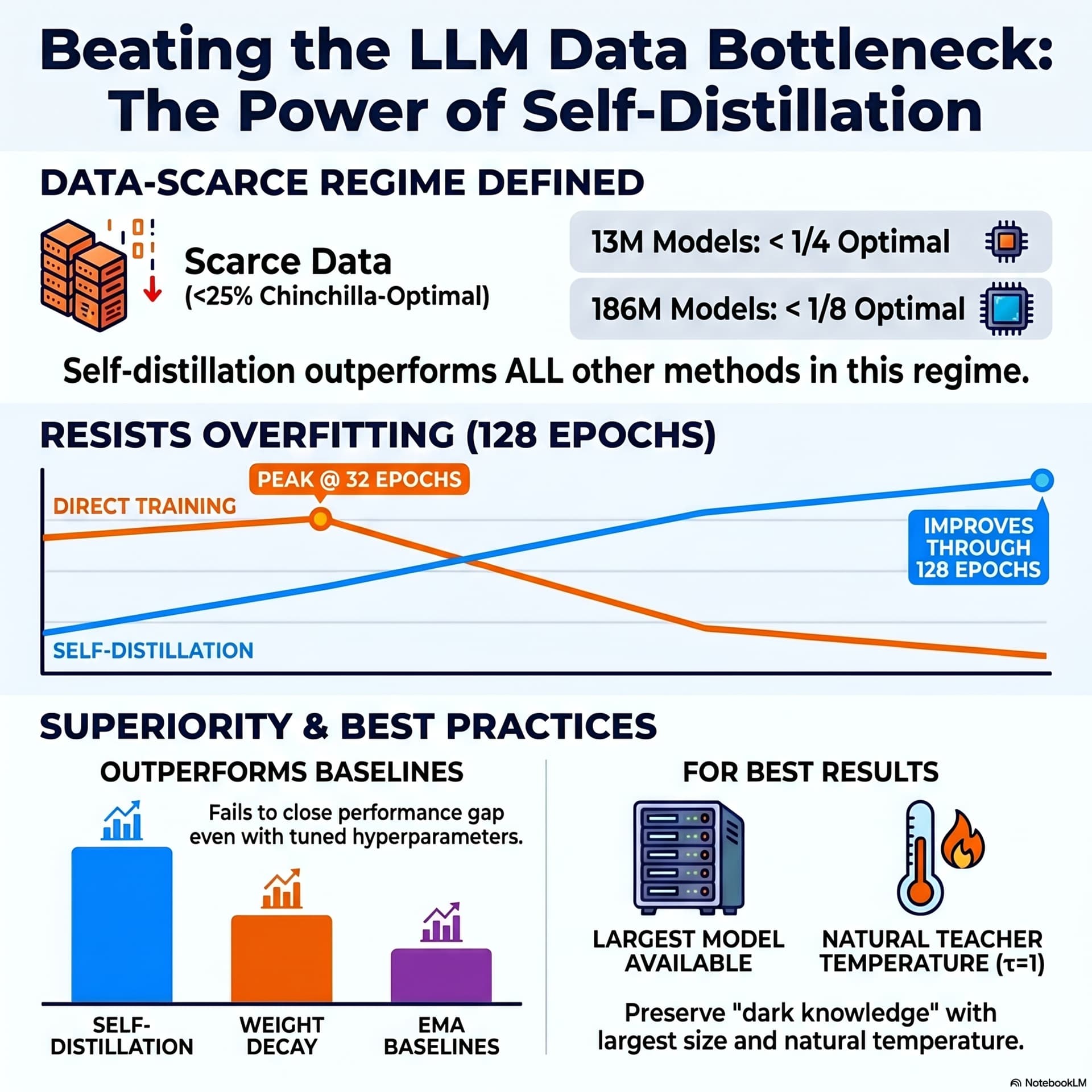
Internet text supply is a bottleneck; Chinchilla scaling suggests ~20 tokens per parameter. Direct multi-epoch training peaks and degrades after ~32 epochs under scarcity. Self-distillation regularizes by matching teacher probability distributions rather than hard labels.
Notable examples
“Monkey ate the vet” → banana as hard target; teacher soft targets like 80% banana, 15% apple, 5% orange. Self-distillation improves endurance to 128 epochs with ~18% more compute; crossover at 1/4 Chinchilla (13M) and 1/8 (186M). Temperature tau too low collapses soft targets and hurts (>0.3 BPB). Recursive self-distillation (28 rounds) fails versus a single continuous schedule. Weight decay/EMA/model shrinking don’t match gains.
Written by AI. May contain mistakes. Listen to the episode to check what was said.
Chapters
Tap a time to open that second in VOIntroduction to Self-Distillation
1:24 to 1:56
Learn about self-distillation and its significance in overcoming data scarcity.
“And we are exploring a set of findings regarding a truly mind bending technique called self distillation.”
The Problem with Multi-Epoch Training
1:56 to 3:52
Discover the pitfalls of repeating limited training data in AI.
“So if you don't have enough data, the most obvious knee-jerk reaction is just to use the data you have and then use it again.”
Understanding Overfitting in AI
3:52 to 6:16
Examine how overfitting occurs when training on limited data sets.
“not because you understand cellular biology, but because you've just memorized the physical card itself.”
Dark Knowledge and Soft Targets
6:16 to 8:13
Learn about the concept of dark knowledge and its role in self-distillation.
“Well, what's fascinating here is the secret ingredient of distillation, something researchers affectionately refer to as dark knowledge.”
Benefits of Self-Distillation
8:13 to 11:18
Explore how self-distillation improves model performance under data scarcity.
“The teacher's output softly implies, hey, these fruit words are all related in this context.”
Computational Costs of Self-Distillation
11:18 to 12:11
Understand the trade-offs of using self-distillation in training AI models.
“It kept getting better and better all the way through 128 epochs.”
Comparing Traditional Regularizers
12:11 to 14:00
Analyze how traditional regularizers perform compared to self-distillation.
“Now, if you're listening to this and you're a machine learning engineer or even just someone familiar with the field, you are probably yelling at your speakers right now.”
The Power of Self-Distillation
14:00 to 16:28
Explore the advantages of self-distillation over other training methods.
“But in modern language modeling, where improvements are often measured in the thousands, a gap approaching a tenth of a BPB is a massive performance gulf.”
Understanding Temperature Setting in Training
16:28 to 18:15
Learn about the importance of temperature settings in self-distillation.
“But now we need to look at the exact mechanics of how to tune it, and crucially, where the technique entirely falls apart.”
Recursive Self-Distillation: A Misstep
18:15 to 19:55
Discover the shortcomings of recursive self-distillation in training.
“Okay, there's another wild experiment they ran that pushes the limits of this concept.”
Show all 11 chapters
Implications for AI Development and Learning
19:55 to 21:45
Discuss the broader implications of self-distillation on AI and human learning.
“And the naive instinct to just repeat the data we have leads straight to the trap of overfitting.”
Transcript
Automatic transcript. May contain errors.0:00You know, when you look around right now, we are living in this era where AI models just seem absolutely limitless. Oh, totally. Like every week there's a new breakthrough or a new frontier being crossed. Right. But there is this massive, completely hidden bottleneck that is quietly threatening this entire industry. And, well, it involves you, specifically your data. Yeah, that's the real issue nobody talks about. Because the computers, you know, the silicon, the processors, they're getting faster and more efficient by the day. Yeah. But the supply of high quality human text to actually train these massive systems, it's just not keeping up.
0:37We are literally running out of data. It's essentially a supply chain crisis, but for artificial intelligence. Oh, a supply chain crisis. Exactly. We've historically relied on this vast, seemingly infinite ocean of Internet text to feed these models. But that ocean has a bottom and we are scraping it. I mean, the compute power is scaling exponentially, right? But high quality human language is finite. Right. For years, the prevailing philosophy in machine learning was just, you know, feed it more data. But now the entire industry is being forced into a paradigm shift. And that shift is what we're looking at today.
1:11Since we can't just magically conjure up more high-quality human data out of thin air, we are dedicating today's deep dive to understanding how developers are forcing AI to get smarter with what it already has. It's all about extracting every single possible drop of understanding from incredibly limited data. Yes. And we are exploring a set of findings regarding a truly mind bending technique called self distillation. It's basically a look into what happens when severe data scarcity hits and how making an AI act as its own teacher might just be the ultimate survival tactic. It's a fascinating approach.
1:47But to appreciate this bizarre solution, we first have to understand the naive approach to data scarcity and why it completely falls apart. Yeah. So if you don't have enough data, the most obvious knee-jerk reaction is just to use the data you have and then use it again. Just loop it. Right. But we need to define what enough data actually looks like. In the field, there's this mathematical benchmark known as the chinchilla scaling laws. The chinchilla laws. OK. Yeah. It defines the optimal token count. This is essentially the mathematically ideal ratio of training data to model size. The golden rule established there is roughly 20 tokens of data for every single parameter in the model.
2:25Okay, so if you're building a model with, say, 186 million parameters, the Chinchilla rule says you ideally need about 3.7 billion tokens of high-quality text to train it perfectly. Exactly. But we're talking about a world where you don't have 3.7 billion tokens. You're operating in a regime of extreme data scarcity. Holding only a tiny fraction of that Chinchilla ID. Right. And the standard baseline alternative in that scenario is what's called multi-epoch direct training. And an epoch is just one full pass through your data set. You got it. If you don't have fresh new data, you just run the model through the old data multiple times.
2:59Epoch 2, Epoch 3, Epoch 30. On the surface, that sounds completely reasonable. I mean, if you want to learn something, repetition is key. It sounds reasonable, sure. But in the context of high dimensional learning dynamics, repeating the same finite data set over and over creates a massive structural flaw. I was thinking about it like this. Imagine you are studying for a massive, comprehensive final exam. but you only have one very small set of flashcards to study from. That's a great analogy. Right. Because the first few times you go through that deck, you're actually learning the underlying concepts.
3:36You're absorbing the biology or the history. But if you keep going. Yeah, if you go through that exact same tiny deck of flashcards 50 times, 100 times, eventually you stop learning the actual concepts. You just start memorizing the specific order of the card. Precisely. You stop learning and start memorizing. You know that the answer to the yellow card with the torn corner is mitochondria, not because you understand cellular biology, but because you've just memorized the physical card itself. And when you do that in machine learning, we call that exact trap overfitting. The model just stops generalizing.
4:07It stops learning the broad patterns. Yeah, it stops learning the underlying patterns of human language, and it just starts aggressively memorizing the specific quarks, the noise, and the exact sequence of the tiny data set you're repeatedly feeding it. So it becomes hyper-specialized to your tiny flashcard deck. Exactly. And then it completely fails when you test it on anything new. The research we're looking at today puts very specific numbers to this failure, actually. They show that under severe data scarcity, this direct multi-epoch training hits a brick wall. It really does. It peaks and overfits right around 32 epochs.
4:41Wow, 32. And if you keep forcing it to train past 32 passes on the same data, the performance doesn't just plateau, it actually degrades. The model gets progressively worse at understanding language. Which is wild. And because merely repeating the data causes this catastrophic overfitting, developers desperately need a regularizer. A regularizer. Yeah, it's simply a mathematical mechanism to fundamentally constrain the model. It prevents it from memorizing those flashcards and forces it to keep learning generalizable patterns. Okay, let's unpack this. Because this is where self-distillation enters the picture, right?
5:18Proposed as the ultimate regularizer. That's the idea. But I have to push back on the core premise of this because it sounds completely paradoxical. Yeah. Like normally when we talk about knowledge distillation in AI, we are talking about a massive, incredibly smart teacher model passing its knowledge down. Right. Something with hundreds of billions of parameters. Exactly. Passing its vast knowledge down to a tiny, compressed student model. That makes sense. the master teaches the apprentice. Sure, that's the standard approach. But self-distillation. These experiments are using a teacher and a student that have the exact same architecture and the exact same parameter count.
5:55They are completely identical in size. So how on earth can a student learn anything new from a teacher that is exactly as capable as it is? It honestly sounds like the blind leading the blind. I mean, it absolutely sounds like a paradox. If they are identical in capacity, the new information has to come from somewhere else. So where does it come from? Well, what's fascinating here is the secret ingredient of distillation, something researchers affectionately refer to as dark knowledge. Dark knowledge. Okay, that sounds like a magic system in a fantasy novel, not a concept in a computer science paper.
6:30I know, it sounds super dramatic. But grasping dark knowledge all comes down to understanding the difference between hard targets and soft targets. Okay, break that down for me. The concept is incredibly elegant physically. Think about how standard direct training works. You give the model an incomplete sentence, say, the monkey ate the vet. And the correct answer is banana. Right. The ground truth label, the hard target in the data set, is the word banana. In direct training, the model is mathematically penalized unless it predicts banana with 100 % certainty. And assigns 0 % probability to every other word in the English language.
7:05Exactly. That is a hard, rigid target. You are either 100 % right or you are wrong. Which forces that brute force memorization we talked about. It forces the model to just memorize that specific sentence from the flashcard because there is zero room for nuance. Yes. But in self-distillation, you change the grading rubric entirely. First, you train the teacher model on your limited data. Then you train the identical student model. But the student doesn't look at the rigid ground truth label in the data set. It looks at the teacher's relative probabilities for the next word. Ah, so these are the soft targets.
7:43Exactly. So instead of being told the answer must be 100 % banana, the student sees that the teacher predicts, say, 80 % banana, but also 15 % apple and 5 % orange. Oh, wow. Because even though banana is technically the correct answer written in the data set, apple and orange are still logically valid fruits that grammatically fit the context of the sentence. You nailed it. The teacher's uncertainty contains profound structural information about the relationships between words. That makes so much sense. The teacher's output softly implies, hey, these fruit words are all related in this context.
8:20That relative probability matrix is the dark knowledge. So by forcing the student to match those softened, nuanced probabilities, you're applying an instance-specific smoothing to the data. Exactly. It prevents the high-frequency memorization we talked about earlier. So it literally prevents the student from memorizing hard facts. It's not being graded on a binary pass-fail anymore. Right. It's being forced to learn the fluid underlying relationships between concepts. It can't just memorize the flashcard because the teacher is grading it on its understanding of the vibe of the flashcard. I love that.
8:54The vibe. Understanding that vibe means instead of getting trapped in a sharp, fragile mathematical spike where it only knows banana, it settles into a flatter, more robust mathematical valley. Where it understands the whole category of fruit. Yes. And that flat valley is what allows the model to generalize to new sentences it has never seen before. That is just wild. But if this soft learning is such a superpower, it begs the question, should we just always use it? Like, should we throw away direct training forever? The experiments provide a very clear no to that. We need to look at the exact data regimes, the specific thresholds of scarcity, where this technique flips from being a bad idea to an absolute necessity.
9:35Because context and scale matter immensely when applying regularizers. Immensely. The experiments tested this mechanism across eight distinct data scarcity levels. They started at one chinchilla, meaning abundant mathematically optimal data. And went all the way down. Right, through halving intervals down to an extreme scarcity of 128th of the chinchilla optimum. And they evaluated this across two different scales of architecture, a smaller 13 million parameter model and a larger 186 million parameter model. The findings are super clear on this. When you have abundant data, like when you're at that one chinchilla level, direct training actually wins.
10:13Yeah, self-distillation hurts performance slightly when data is plentiful. It's probably because it's smoothing out details. The model actually has the capacity to learn properly. But as you strip the data away, self-distillation takes over at a very specific crossover threshold. Right. For the smaller 13 million parameter model, that crossover happens at one-fourth chinchilla. So if you have less than a quarter of the ideal data, self-distillation starts winning. And for the larger 186 million parameter model, the crossover happens at one-eighth chinchilla. The more scarce the data gets below those thresholds, the wider the gap becomes.
10:51Self-distillation just runs away with it. It acts as an incredibly potent shield against scarcity. The less data you have, the more you desperately need that dark knowledge to interpolate the missing gaps in your understanding. Here's where it gets really interesting. Let's talk about the epoch limits, the actual endurance of the model. This is the best part. We established earlier that direct training hits a brick wall and overfits at 32 epochs. But the data shows that with self-distillation, the model just keeps improving. It sailed right past 32 epochs. Yeah. It kept getting better and better all the way through 128 epochs.
11:25It effectively quadrupled the model's ability to extract value from the exact same limited data. That endurance is the core victory of the entire framework, though we do have to acknowledge the computational cost. Right. There's always a catch. Because you have to run a full forward pass of the teacher model to generate those soft targets for every single data point. Self-distillation costs about 18 % more compute. 18 % more FLOPs than standard direct training. Exactly. But, you know, if you're looking at the broader industry where compute is getting cheaper and scalable and human data is a finite, exhausted resource, paying an 18 percent compute tax to get 400 percent more endurance out of your scarce data.
12:09It's a no brainer. That is a trade every single AI developer is going to make. Now, if you're listening to this and you're a machine learning engineer or even just someone familiar with the field, you are probably yelling at your speakers right now. I can hear them already. You're thinking, why go through this incredibly complex dance of teacher models and student models and calculating dark knowledge when we already have standard mathematical regularizers? It's a fair question. Why not just use things like weight decay or tracking an exponential moving average of the weights? Or even simpler, just shrinking the physical size of the model so it literally has less brain capacity to overfit in the first place.
12:48Well, if a simple traditional tool does the job, you shouldn't introduce a complex one. But if we connect this to the bigger picture of the experiments, we see that while those standard methods certainly help, they fundamentally fail to close the performance gap. Okay, let's look at weight decay first, which is one of the oldest tricks in the book. Yeah, weight decay is essentially a mathematical penalty on complexity. It acts like Occam's razor, constantly forcing the model to keep its internal neural weights as small and simple as possible. The findings show that to survive extreme data scarcity, like at 132 chinchilla, direct training requires an incredibly heavy-handed weight decay.
13:26It needs a lambda setting of 10 just to stop from memorizing the noise. But self-distillation prefers a much lighter touch, a lambda of 5. And looking at the metrics, they measure this performance in bits per byte, or BPB, which is basically how efficiently a model compresses information. So a lower BPB is better. Right. Even when both methods are perfectly optimized with their ideal weight decay, self-distillation still outperforms direct training by a margin of 0.077 BPB. And for anyone not staring at loss curves all day, 0.077 bits per byte might sound like a rounding error. It sounds tiny.
14:01But in modern language modeling, where improvements are often measured in the thousands, a gap approaching a tenth of a BPB is a massive performance gulf. Wow. It represents a fundamental leap in how the model understands the text. Okay, so mathematical penalties like weight decay don't beat it. What about EMA, exponential moving average? Right, the temporal ensemble technique. From my understanding, it's like keeping a running smooth average of the model's weights as it trains. Instead of relying on the erratic sprint of a runner at any given second, you take their average speed over the whole race.
14:33That's exactly it. It prevents the model from jumping around too erratically. And EMEI has been historically powerful for smoothing out that training behavior. So does it work here? The data shows it does help direct training slightly. On the smaller 13 million parameter model, applying an EMEI narrows the gap with self-distillation, but it still falls short. And where it gets really revealing is at scale, right? Yes. When they applied EMEA to the larger 186 million parameter model, it provided zero meaningful benefit over standard direct training. It completely lost its efficacy. That's crazy.
15:11What if you combine them? Interestingly, if you try to stack EMEA on top of self-distillation, trying to get the best of both worlds, it doesn't help further. Self-distillation is inherently providing a much richer data-aware regularizing effect that EMEA is only clumsily attempting to simulate. So mathematical penalties don't beat it. Averaging weights doesn't beat it. Let's look at the most brute force alternative, just shrinking the model. Ah, yes. The logic being if a massive brain memorizes things too quickly and overfits, just use a smaller brain. The experiments explicitly tested this, didn't they?
15:47They did. They took the 186 million parameter model and they shrunk the architecture down to 43 million parameters and then down again to 15 million parameters. And the verdict on shrinking your model to avoid overfitting is definitive. Don't do it. Just flat out don't do it. Wow. At every single matched data budget, self-distillation running on the large 186 million parameter model thoroughly and consistently beat direct training on the smaller models. So you're always better off keeping the larger model capacity and using self-distillation to prevent the overfitting rather than artificially hamstringing the architecture.
16:22A large, softly guided brain is always better than a small, rigidly trained one. It's incredible. We've firmly established that self-distillation is the reigning champion of the data-scarce regime. But now we need to look at the exact mechanics of how to tune it, and crucially, where the technique entirely falls apart. Because there are settings where this blows up in your face. Exactly. Let's talk about the temperature setting. If I think about this literally like a thermostat for cooking, if you turn the thermostat too low, your food freezes solid. Right. I have to assume that if you mathematically chill this model, you are taking those soft, fluid probabilities, the 80 % banana, 15 % apple, and freezing them back into rigid, hard facts.
17:05That is the exact mathematical mechanism at play. The temperature setting, denoted as tau, controls the literal softness of those target probabilities. Okay. The 80 % banana, 15 % apple, 5 % orange distribution occurs at the natural temperature, where tau equals 1. But what if you lower the temperature? Say dropping tau down to 0.1 or even 0.01. You are mathematically shilling the distribution. You are forcing the teacher's probabilities to collapse. So at tau 0.01, that 80 % banana suddenly snaps into being 99.9 % banana, and the 15 % apple drops to 0.01%. Exactly. You are artificially sharpening the teacher's output until it essentially mimics a one-hot hard-target label again.
17:52And when they did this in the experiments? The results were catastrophic. By collapsing the distribution, you completely destroy the dark knowledge. The performance plummets by more than 0.3 BPB. Which is massive. It proves that the entire magic of this technique relies entirely on the nuanced, soft uncertainties. If you remove the softness, you remove the benefit. You have to let the model see the ambiguity. That is such a vital takeaway. Okay, there's another wild experiment they ran that pushes the limits of this concept. This raises an important question, actually. It explores the logical extreme of this entire process.
18:25Exactly, because the logic goes, if one round of self-distillation is this incredibly good, if it buys you 400 % more endurance, what if we just keep doing it? Recursive self-distillation. Yes. You train a student, then that student becomes the new teacher. And it trains a new student, and you just continuously loop it. They tested doing this over and over, 28 separate times. You'd think 28 rounds of distilling that dark knowledge is the ultimate brain builder. But the answer is a resounding, definitive no. The recursive approach failed completely. Failed completely. Why, though? If the dark knowledge is so valuable, why wouldn't compounding it work?
19:05Well, the findings showed that a single continuous direct training schedule over 32 epochs completely dominated 28 iterative rounds of self-distillation. The problem isn't the data itself. It's the learning momentum. The momentum, okay. Every time you reset the student for a new round of distillation, you are resetting its learning rate schedule. Yeah. You completely lose the long horizon optimization. Ah, that is true. Think of it like a car trip. You are essentially constantly stopping the car, turning off the engine, and starting over from zero miles per hour, never allowing it to reach top speed on the highway.
19:38That's a great way to put it. Continuous optimization, even with its inherent flaws, beats constantly restarting the training loop. So what does this all mean? Let's bring this all together. We are entering an era where the AI industry is hitting a massive wall. We are running out of high-quality human data. And the naive instinct to just repeat the data we have leads straight to the trap of overfitting. Where the model memorizes the flashcards instead of learning the underlying concepts, we've seen that standard mathematical fixes like weight decay, moving averages, or shrinking the models just don't cut it.
20:13They fall short. But by utilizing self-distillation, by forcing a model to learn from this own cloned teacher's softened nuanced probabilities, It's dark knowledge. We can push these models to train up to four times longer on the exact same scarce data without memorizing it. It is an absolute masterclass in extracting maximum insight from minimum resources. It really is. It fundamentally reshapes our roadmap for the next few years of AI development. It proves that there is immense untapped value hiding in the relative probabilities, the maybes and the almosts of language that we were previously just throwing away.
20:50And I want to leave you with a final, slightly more philosophical thought to mull over today, because there's a profound parallel here. Oh, definitely. We just spent this entire time unpacking how an artificial mind learns so much better and totally avoids rigid overfitting by studying the nuances, the ambiguities, and the uncertainties of a teacher's output, rather than just demanding absolute binary ground truth. It's a powerful idea. What does that mean for human learning? We live in a world that is completely overloaded with rigid facts, polarized certainties, and binary thinking. Maybe the key to true, adaptable intelligence, whether you're made of silicon or biology, isn't about striving to be 100 % right all the time.
21:33Maybe it's about deeply understanding the soft probabilities. Exactly, and the vital context of being almost wrong. It's all about the dark knowledge. It's all about the dark knowledge. Thanks for joining us on this deep dive.
From the publisher
This research paper investigates self-distillation as a powerful regularization technique for pretraining language models when high-quality data is in short supply. By comparing various training strategies across different model scales and data scarcity levels, the authors demonstrate that self-distillation significantly outperforms both direct training and standard methods like weight decay or exponential moving averages. The study identifies a specific crossover threshold where distillation becomes superior, particularly when the available data is less than one-fourth of the amount prescribed by Chinchilla scaling laws. Practical results suggest that using larger models with natural teacher temperatures provides the most effective supervision, preventing the rapid overfitting typically seen in data-constrained environments. Ultimately, the work advocates for self-distillation as a robust alternative for improving model performance when compute resources outpace the available data pool.


