In short
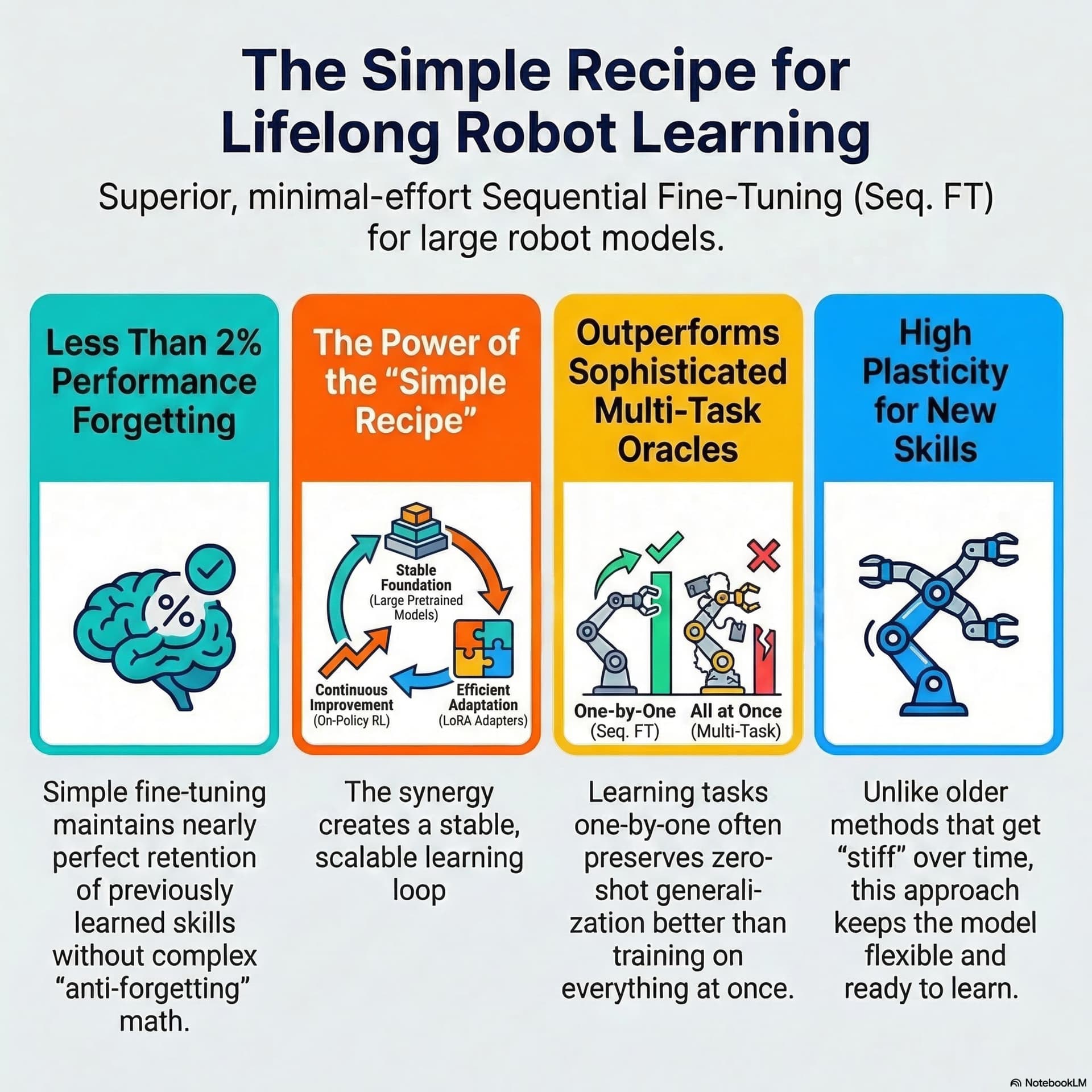
Continual reinforcement learning for vision-language-action (VLA) robots, addressing catastrophic forgetting. The episode argues that naive sequential fine-tuning can work if paired with a specific “holy trinity”: (1) a massive pre-trained VLA (e.g., OpenVLA ~7B params), (2) LoRa parameter-efficient fine-tuning (rank-32 low-rank adapters; freeze core weights), and (3) on-policy reinforcement learning using GRPO (Group Relative Policy Optimization), which provides sparse relative rewards and minimizes KL drift (“kale drift”) to prevent abrupt policy changes.
Guest backgrounds
No guests are identified; only host dialogue is present.
Key claims
Sequential fine-tuning normally overwrites weights and causes forgetting, but with the three ingredients it preserves prior skills while learning new tasks; it also maintains high zero-shot success and low negative backward transfer.
Notable examples
RoboCasa-style tasks (navigate kitchen, open cabinet, grasp ceramic bowl, place on counter, turn on sink); success rate drops from >81% (7B model) to ~13% (12M model).
Written by AI. May contain mistakes. Listen to the episode to check what was said.
Chapters
Tap a time to open that second in VOUnderstanding Vision-Language-Action Models
1:04 to 2:15
Discover the role of Vision-Language-Action models in AI and their necessity for continual learning.
“Today we're looking at the brains inside physical robots, specifically the cutting edge of what's called continual reinforcement learning for vision language action models, or VLAs for short.”
Challenges of Sequential Fine-Tuning
2:15 to 3:33
Explore the problems associated with traditional sequential fine-tuning in AI learning.
“And this requirement for incremental self-improvement, that's the continual reinforcement learning part.”
Traditional Methods to Combat Forgetting
3:33 to 5:04
Learn about the classical strategies used to prevent catastrophic forgetting in AI systems.
“First, you have regularization-based methods like elastic weight consolidation or EWC.”
The Stability-Plasticity Dilemma
5:04 to 7:22
Understand the trade-off between maintaining old knowledge and acquiring new skills in AI.
“This is the classic stability-plasticity dilemma in AI.”
The Simple Recipe for Lifelong Learning
7:22 to 8:24
Uncover the surprising recipe that allows AI models to learn continuously without forgetting.
“It sounds entirely contradictory, but it turns out sequential fine-tuning is only catastrophic for small models trained in traditional ways.”
Ingredients for Successful Learning
8:24 to 11:40
Delve into the three essential ingredients that contribute to effective continual learning in AI.
“Are all three strictly necessary, or is one kind of carrying the team here?”
Reinforcement Learning vs. Supervised Learning
11:40 to 14:00
Compare the differences between reinforcement learning and supervised learning in the context of AI training.
“Loron is a method of strictly restricting how the updates happen.”
Episode Discussion
14:00 to 23:42
“What does supervised learning look like in this context?”
Transcript
Automatic transcript. May contain errors.0:00I want you to imagine something for a second. Let's say you decide you're going to learn how to bake the perfect loaf of sourdough bread. Oh, that's a dangerous rabbit hole to go down. Right. But you commit. You spend weeks on it. You get the starter just right. You perfect the temperature. You master the folding technique. Yeah, you put in the hours. Exactly. And finally, you pull this gorgeous, crackling artisan loaf out of the oven. You've totally nailed it. But then the very next day, you hop on your bicycle to ride to the store, and you immediately fall over. Wait, you just forget how to ride a bike?
0:37Completely. You have completely, utterly forgotten how to ride a bike. Learning the sourdough somehow completely erased the bicycle from your brain. I mean, that sounds like a bizarre neurological condition. It really does. But for the engineers trying to build intelligent machines, it's actually an incredibly common, incredibly frustrating daily reality. Yeah, it's a huge roadblock. It's a phenomenon called catastrophic forgetting, and that's exactly what we're getting into today. Welcome to the Deep Dive. Glad to be here for this one. It's a fascinating topic. Today we're looking at the brains inside physical robots, specifically the cutting edge of what's called continual reinforcement learning for vision language action models, or VLAs for short.
1:19Right. And just to clarify for everyone, VLA's are the AI systems that can actually look at the physical world, process your spoken language, and then take physical action based on what you said. They're the embodied AIs. And our mission today is to look at a shockingly simple, recently uncovered recipe that allows these massive AI models to become natural, lifelong learners. Which is wild because it flips conventional wisdom completely on its head. It really does, because they can finally learn new things without forgetting their past. And, you know, as someone who constantly feels like learning a new piece of software at work pushes out my childhood memories.
1:56Oh, I know the feeling. Right. The exact struggle engineers face when training robots is deeply relatable to me. We all just want to learn continuously without the information overload causing a system crash. Exactly. And for a physical robot to be truly useful in your home, it can't just be trained once in a sterile lab and then frozen in time. Because the real world is messy? Completely. The lighting in your house changes. You buy new furniture. You want it to do new tasks. It has to adapt. And this requirement for incremental self-improvement, that's the continual reinforcement learning part.
2:28Yes. But the historical problem is that the most intuitive way to teach a robot a series of tasks, it just completely breaks its memory. You're talking about the intuitive approach that engineers call sequential fine-tuning, right? Like, I teach the robot task A, then task B, then task C. Yeah, exactly. You just fine-tune the model's neural network on each new task as it arrives. Seems logical enough. It does. But the conventional wisdom, which is backed up by years of rigorous research, is that naive sequential fine-tuning leads directly to that catastrophic forgetting you were talking about with the sourdough.
3:03So the model's performance on the first task degrades the moment it starts learning the second one. Substantially. The mathematical weights in the neural network literally get overwritten by the new information. Wow. Okay, so if that just breaks the robot's brain, how have researchers traditionally tried to stop the robot from forgetting the bicycle while it learns the bread? Well, historically, they've had to introduce some incredibly complex, computationally expensive strategies, basically trying to constrain the learning process. Give me an example. What kind of strategies? There are three main paradigms.
3:36First, you have regularization-based methods like elastic weight consolidation or EWC. EWC. What does that actually do? It mathematically penalizes the AI for updating any parameters that were highly important for previous tasks. It effectively locks those specific neural passways down. Okay, I get it. It's essentially telling the AI, hey, do whatever you want, but do not touch these specific wires because we need them for the bicycle. That's exactly it. Then you have the second paradigm, which are replay-based methods, like expert replay or dark experience replay. Those sound like video game mechanics.
4:11I know, right? But what it actually involves is keeping a massive, ever-growing storage bank of old data. Oh, so when the robot is learning to bake bread, you constantly force it to re-watch videos of writing a byte. Yes, you shuffle the old data in with the new. But that sounds computationally exhausting. I mean, your storage needs would just grow linearly with every single new chore you teach the robot. Oh, it scales terribly. It's a huge bottleneck. And finally, you have parameter isolation methods, like dynamic weight expansion. And what's that one do? This is where you actually allocate new physically isolated memory banks, like entirely new parameters, for every single new task.
4:50You just wall off the old knowledge completely. But wait, all of these complex fixes, they seem to create a brand new headache. They do. I mean, they solve the forgetting problem, but add a massive cost to the robot's flexibility, right? Exactly. It creates a severe loss of what we call plasticity. This is the classic stability-plasticity dilemma in AI. Stability versus plasticity. Right. In a desperate attempt to remain stable and protect old memories, the AI loses its plasticity. It loses the ability to adapt and learn new things effectively. Because the rigid constraints put on the system end up choking its ability to absorb the next task.
5:30You nailed it. It makes me think of an overstuffed filing cabinet in an office. Like, you're terrified of losing the old client files, so you tape all those folders shut and glue them to the back of the drawer. That's a great way to picture it. You've achieved stability. You absolutely won't lose them. But now, someone walks in with today's paperwork and you literally have nowhere to put it. You've lost your plasticity. Right. So we need a way to keep the filing cabinet open without spilling all the old papers onto the floor. And that brings us to the recent discoveries. There's been extensive testing conducted across highly complex robotic benchmarks recently.
6:05Like simulated environments, right? Yeah, environments like Libero and RoboCasa. And we are talking about simple grids where a dot moves around. These test complex long horizon tasks. What's a typical task in RoboCasa look like? Well, a robot might be asked to navigate a kitchen, open a cabinet door, carefully grasp a ceramic bowl, place it on the counter, and turn on the sink. Oh, wow. So real spatial reasoning and precise object manipulation. Very precise. And researchers tested all those complex methods we just discussed, EWC, expert replay, all of it against these rigorous environments. Oh, so how did these stack up against each other?
6:44Well, here's the crazy part. They compared them all to simple, naive, sequential fine-tuning. Just teaching the robot one complex task after another. No taped-shut folders. No complex memory juggling at all. No massive replay buffers. And the results show something mind-blowing. The simple sequential fine-tuning not only worked, it frequently outperformed all the sophisticated methods. Wait, wait, wait, wait. I have to stop you there because that contradicts everything we just established. I know. It sounds crazy. If sequential fine-tuning is the exact mechanism that causes the brain to rewrite itself and forget everything, how can it also be the cure that goes against the basic physics of how these models operate?
7:22It sounds entirely contradictory, but it turns out sequential fine-tuning is only catastrophic for small models trained in traditional ways. Okay? The breakthrough is that this simple approach becomes a superpower acting as a sort of neurological shield, but only when it is combined synergistically with three very specific ingredients. So it's a specific recipe, a holy trinity for lifelong learning. Exactly. All right. If these three ingredients are the shield, what exactly are we combining here? Okay. Ingredient one. You must start with a massive pre-trained vision language action model. We're talking about a foundation model with billions of parameters, not a small network built from scratch.
8:04Massive skill. Got it. What's ingredient two? You have to use parameter efficient fine tuning, specifically a technique called LoRa, which stands for low rank adaptation. LoRa. Okay. And the third? Ingredient three. You must use on-policy reinforcement learning to teach the new tasks. Massive model. LoRa and on-policy RL. That's to Trinity. Are all three strictly necessary, or is one kind of carrying the team here? Oh, the data is unambiguous on this. If you remove even one of those three ingredients, the synergy breaks, and catastrophic forgetting returns with a vengeance. Seriously. Just removing one breaks it.
8:39Completely. Let's look at ingredient one, the massive scale. In the tests, they utilized a model called OpenVLA, which boasts about 7 billion parameters. 7 billion? That's huge! Right. And under the simple sequential fine-tuning recipe, it achieved an average success rate of over 81 % across a continuous stream of tasks. 81 % is incredible for continuous tasks. It is. But when they swapped that massive 7 billion parameter model for a smaller neural network, one with roughly 12 million parameters, the success rate plummeted. Down to what? From over 81 % down to a catastrophic 13%. Wow, a 13 % success rate is a total system failure.
9:21The robot is dropping the sourdough on the floor and entirely forgetting how to open the microwave. Exactly. The smaller model quickly lost all its pre-trained capabilities. It fundamentally lacked the capacity to hold the new knowledge without violently overriding the old. So scale is critical. Let's break down exactly why Ingredient 1, the mass of scale, and ingredient two, this LoRa technique, prevent the AI from overwriting its memory. It comes down to a mathematical property. Right. How does having billions of parameters mathematically stop the forgetting? It's known as high-dimensional space, or, as researchers often refer to it, the blessing of dimensionality.
10:01The blessing of dimensionality. I like that. When you have a massive model with 7 billion parameters, you are operating in an incredibly vast mathematical landscape. Okay, walk me through what that looks like. If you take two random update vectors, meaning two new pieces of mathematical adjustments you're pushing into the network to teach you new skills, in a space that large, those vectors are nearly orthogonal to each other. Orthogonal meaning they are at right angles, they don't intersect or overlap. Yes. Because the space is so incomprehensibly vast, the mathematical adjustments required to learn how to bake bread exist in a completely different neighborhood of the network than the adjustments to open a cabinet.
10:41They just don't cross paths. Right. So they don't interfere with each other at all. I see. So if you put 100 people into a tiny phone booth and tell them all to start dancing wildly, they're going to violently bump into each other. Lots of interference. Right. That's interference. That's catastrophic for getting in a small 12 million pyramidal model. The new knowledge physically smashes into the old knowledge. Exactly. But if you take those same hundred people and place them onto the field of a giant hundred thousand seat stadium. That sheer volume provides the capacity. They can all dance, learn whatever moves they want, and they will never even touch each other.
11:18The stadium provides the capacity. I love that analogy. But we still need ingredient two. Loran Nusla. Low rank adaptation. If the stadium is already huge, why do we need to adapt anything? Because even in a giant stadium, if you let people run completely wild, eventually they might dig up the turf and do some structural damage to the field itself. Ah, okay. That makes sense. Loron is a method of strictly restricting how the updates happen. In traditional fine-tuning, you would update all 7 billion parameters for a new task. Which is computationally expensive. Highly expensive and highly risky.
11:52What LoRa does is freeze the original massive pre-trained weights. It locks the core foundation of the brain. Wait, if the core is locked, how is it learning the new task? It parametrizes the weight updates into a very narrow, low-dimensional subspace. It basically adds a tiny, highly efficient side calculator to the main brain. How tiny are we talking? A rank 32 matrix, to be specific. By forcing all the new learning to happen through this tiny, restricted pathway, LoRa prevents any major structural changes to what are called the high energy principal directions of the model. Let's give that a sense of scale for everyone listening.
12:30A rank 32 matrix versus 7 billion parameters. If the main AI brain is a massive library containing 7 billion books, this LoRa subspace is like a single post-it note of new instructions stuck to the front desk. That's a perfect analogy. It's incredibly narrow. So it allows the AI to learn a new trick without fundamentally rewiring its core personality. Exactly. It concentrates the task-specific changes into that post-it note. So the heavy lifting done during its original pre-training, its core understanding of physics, shapes, language, none of that is disturbed. The massive stadium prevents the knowledge from colliding, and Laura puts a lock on the core structure so it doesn't get rewired.
13:10That beautifully explains why the robot doesn't forget. It's an elegant solution. It really is. But I'm still trying to wrap my head around the plasticity side of the dilemma. Okay. Where are you stuck? If Laura is restricting all the new learning onto a single Post-it note, why doesn't the Post-it note just fill up? Ah. If we are restricting the updates to maintain stability, why does the AI maintain its ability to adapt? Why doesn't it just hit a wall and say, sorry, my Laura adapter is full. I cannot learn to fold this towel. That brings us exactly to the third ingredient in our Holy Trinity, on policy reinforcement learning.
13:43Okay. Ingredient three. Specifically, they utilize an algorithm called GRPO, which stands for Group Relative Policy Optimization. GRPO, and that solves the full Post-it problem. Yes. The reason that LORI adapter doesn't get full has entirely to do with the fundamental difference between traditional supervised learning and reinforcement learning. Contrast those two for us. What does supervised learning look like in this context? In supervised learning, you are feeding the AI an overwhelming amount of data. You are forcing the robot to trace a perfectly drawn blueprint millions of times. Like giving it every single answer.
14:20Right. You're providing dense labels, telling it exactly what its joint angle should be at every microsecond. It is a massive, heavy influx of information. And if you try to shove that massive influx through a narrow L 'Oreal adapter... It absolutely loses plasticity, gets overwhelmed, and the capacity maxes out instantly. But reinforcement learning operates differently. Radically differently. On Policy RL works via sparse rewards. Let's look at GRPO group relative policy optimization. Instead of tracing a perfect blueprint, the robot tries a group of actions. So just experiments. Yeah. It might try to grab a mug from five slightly different angles.
14:57It doesn't get a dense microsecond by microsecond blueprint of how to do it perfectly. What does it get them? It just gets a simple signal at the end about which of those five attempts was the best relative to the others. Oh, so it's just comparing its own attempts against each other. Exactly. And from an information theory perspective, RL only provides a tiny trickle of information back to the model. We're talking about an order of one bit per episode. One bit. That's almost nothing. Right. And because the information density is so sparse, the LORAR adapter, even though it's just a Post-it note compared to the 7 billion parameter library, still has around 100 million parameters of its own.
15:36Oh, so it's small relative to the library, but still huge on its own. Yes. That is more than enough capacity to absorb the tiny trickle of information coming from those sparse RL rewards without ever maxing out. Okay, I think I get it. If supervised learning is like taking a fire hose of perfectly labeled data to a teacup, reinforcement learning is like letting a leaky faucet drip into a swimming pool. That's spot on. The pool is never going to overflow from a leaky faucet, so you maintain your plasticity indefinitely. But there is actually another crucial mechanism at play with On Policy RL that maintains that plasticity and prevents forgetting.
16:12There are more. Yes. It's about minimizing something called kale drift. Kale drift. Untack the mechanics of that for us. How does kale drift stop the AI from forgetting? Well, in On Policy RL, the policy gradient updates, which is just the actual mathematics that change the robot's behavior, are weighted by the actions the robot is already taking. Okay. Meaning what? We talk about probability mass, which is simply the likelihood the AI assigns to taking a specific action. Minimizing KL drift means the math physically restricts the AI from shifting that probability mass too far from where it currently is.
16:46Walk me through what that looks like in action, like if the robot is doing a task. Sure. It means the algorithm cannot make sudden, violent, drastic swings in the model's behavior. If the robot previously calculated that crushing a ceramic bowl had a 0 % probability of being the correct action, the RL update cannot suddenly jump that to 100 % probability overnight. It can't just wildly change its mind. No. The probability mass can only expand gradually outward from the edges of what it already knows and supports. It anchors the new learning to the existing behavior. I see. So if supervised learning is like smashing a clay sculpture with a hammer so you can frantically rebuild it into a new shape, which is violent and destroys the old form completely.
17:29Then on policy RL is like gently smoothing the edges of the clay with your thumb. You're applying tiny gentle nudges. You are slightly adjusting the shape to learn exactly what it needs to, but the core sculpture remains completely intact. Exactly. The gentle nudges of on policy RL acting as an implicit regularization combined with the structural protection of a narrow LoRa subspace, all operating inside the massive capacity of a 7 billion parameter foundation. That's the complete recipe. That is the complete recipe. When you combine those three, they mitigate catastrophic forgetting from three complementary perspectives.
18:08The result being a system that learns sequentially without complex memory banks, without replaying old videos, and without losing its plasticity. It's a massive breakthrough in efficiency. But we really have to talk about the final payoff here. Right, because the testing didn't just show that this recipe stops forgetting. No, it revealed a superpower that is going to fundamentally change how we interact with machines in our homes. It achieves exceptionally high zero-shot success. Okay, for those listening, let's define zero-shot success. It means the VLA model, the robot's brain, can successfully complete a physical task that it has never explicitly been trained to do.
18:45Right. If you train a robot to pick up a red apple and then later ask it to pick up a green pear and it can figure it out seamlessly without being explicitly taught, that's zero-shot generalization. And the data backs this up. Totally. Yeah. The empirical data found that by using this simple sequential fine-tuning recipe, the zero-shot capabilities of the robot stayed remarkably high. And we also need to mention the metric they used to measure the opposite of that success, what's called negative backward transfer. Yes. Negative backward transfer is the technical term for the severity of catastrophic forgetting.
19:18It measures how much performance on older tasks drops when a new task is introduced. So you want that number to be as low as possible. The holy grail for these engineers is achieving a negative backward transfer of zero, meaning absolutely no backward sliding at all. And this recipe gets them close. It gets them incredibly close to that zero mark, while simultaneously maintaining that high zero shot success on unseen tasks. And we can understand why that zero shot success remains high based on the mechanisms we just discussed. Because the three ingredients preserve the original pre-trained knowledge so perfectly, the robot doesn't lose its broad understanding of the physical world.
19:57Exactly. It retains the vast generalizations it learned during its initial massive pre-training phase. It isn't just stubbornly holding on to specific memories of how to bake bread. It's holding on to its common sense. The robot actually gets better at improvising in completely unseen scenarios because its foundation remains completely undisturbed while its specific localized skills sharpen. Let's ground this for a second. Why should you, the listener, care about zero-shot generalization and negative backward transfer? I mean, why does this matter outside of a highly controlled robotics lab? Well, because it defines the viability of smart devices in our daily lives.
20:36Right. Right. We don't want a future filled with brittle machines. Imagine buying a wildly expensive, state-of-the-art household assistant robot. Which people will do. Oh, absolutely. So it knows how to load your specific dishwasher and it knows how to brew your specific brand of coffee. But then you move to a new apartment or you simply buy a different brand of coffee maker. And if that robot suffers from negative backward transfer. The moment you try to teach it the new kitchen layout, it completely forgets how to fold the laundry. It would be an incredibly frustrating user experience. You would essentially have a machine that requires a full factory reset and weeks of retraining every time your daily routine changes even slightly.
21:15It would be useless. But this breakthrough, this shockingly simple combination of scale, restricted updates, and relative scoring, means that the future of household robots won't be brittle. They will be adaptable, lifelong learners. You show them a new brand of coffee, and because of that zero-shot superpower and their protected core memory, they just adapt. They learn the new task, keep the old skills, and keep serving you. It really shifts the entire paradigm of how we approach AI memory. As we build larger and more capable foundation models, we can rely on this synergy. We don't need all the crazy workarounds anymore.
21:52No. It proves that stable adaptation doesn't require complex, bolted-on memory systems or infinite data storage. It just requires establishing the right conditions for the neural network to evolve naturally. It's incredibly elegant. We thought lifelong AI learning required all this frantic, exhausting, juggling, storing old data, mathematically locking down weights, building isolated memory banks. Right, all the duct tape and glue. But it turns out, if you have a massive enough foundation, if you restrict your updates to a highly efficient subspace like LoRa, and if you use the gentle, sparse nudges of reinforcement learning, a simple, sequential approach is all you really need.
22:31You just learn the next thing in front of you and trust the architecture to handle the rest. It's brilliant. It provides a principled, highly effective starting point for a whole new era of scalable, lifelong embodied intelligence. It really does. And it leaves me with one final kind of provocative thought to mull over. And I want to leave you, the listener, with this as well. Let's hear it. If an artificial brain becomes a perfect, lifelong learner simply by scaling up its size and restricting its updates to tiny, gentle nudges, could our own human inability to learn without forgetting simply be a lack of parameters?
23:06Oh, wow. That's deep. Or, honestly, more likely, are we just trying to update our brains too aggressively? We try to learn by cramming a massive blueprint of data the night before an exam, and then we wonder why we forget it all a week later. We're taking the firehose approach. Exactly. Next time you try to learn a new skill, whether it's a new software at work, a new language, or baking that perfect sourdough, maybe don't smash the clay. Just smooth the edges. Don't force a massive structural update. Just give your brain a gentle nudge. Let the sparse rewards do the work. Thank you so much for joining us on this deep dive.
23:39Keep exploring, stay curious, and we'll catch you next time.
From the publisher
This paper explores Continual Reinforcement Learning (CRL) for large Vision-Language-Action (VLA) models, focusing on how these agents adapt to new tasks without losing prior knowledge. While traditional machine learning often suffers from catastrophic forgetting during sequential training, this research demonstrates that a simple Sequential Fine-Tuning approach remains remarkably effective. By combining pre-trained VLAs, on-policy reinforcement learning, and Low-Rank Adaptation (LoRA), the researchers found that models maintain high plasticity and strong zero-shot generalization. Their systematic study across multiple benchmarks reveals that this basic recipe often outperforms more complex, specialized CRL strategies. Ultimately, the source positions parameter-efficient fine-tuning as a scalable and stable foundation for developing lifelong embodied intelligence in robotic agents.


