
 Ask ChatGPT


 Best AI papers explained
4 Nov 2026 · 23m · 11 chapters
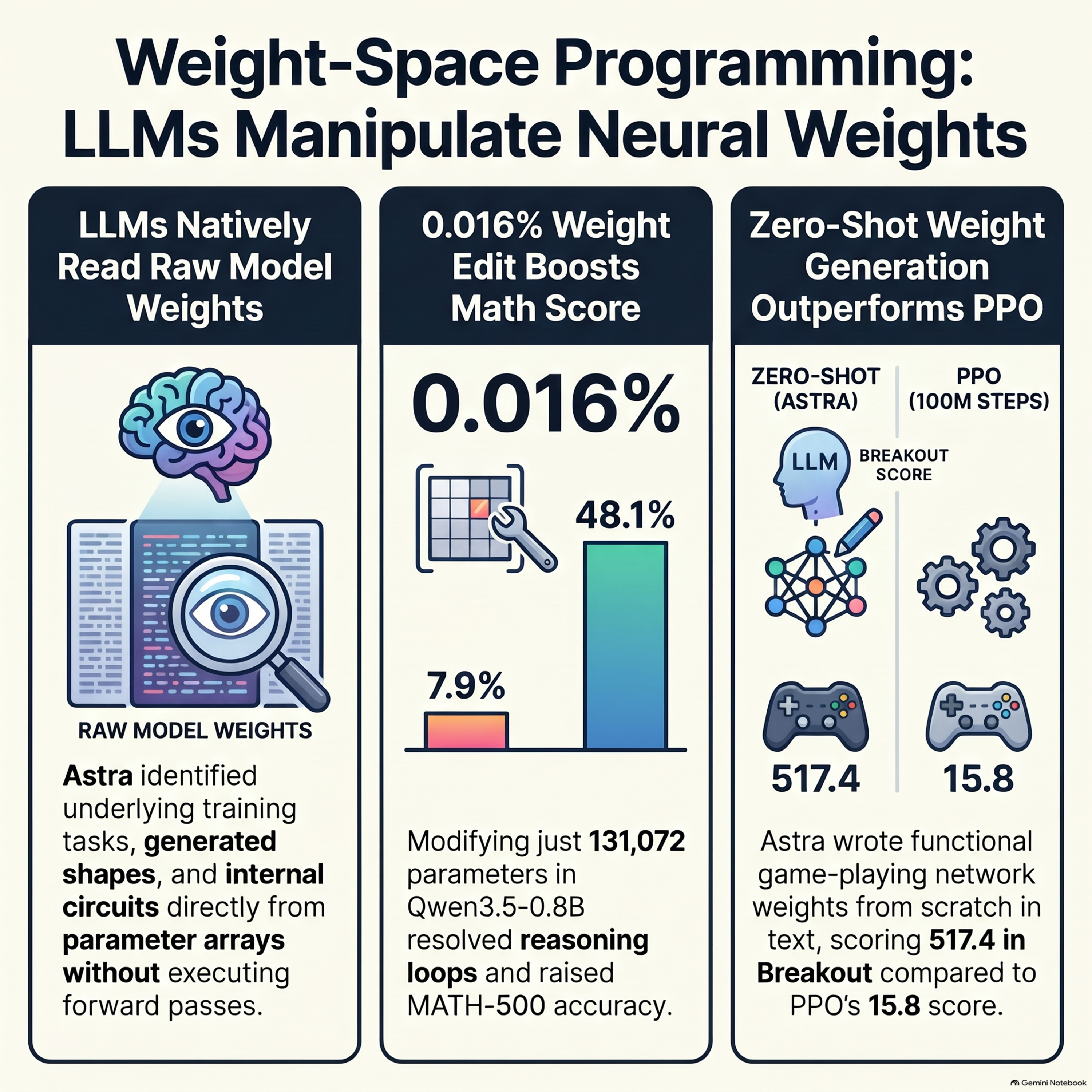
MIT CSAIL “weight-space programming” claims an advanced LLM (GPT-6 Astra) can natively read, diagnose, and rewrite another neural network’s weights using natural-language reasoning—identifying what the network does, fixing failures, and even generating weights from scratch.
None named in the transcript (host/interviewer voices only).
Astra can infer a model’s function from raw weight decimals; distinguish memorization vs geometric reasoning; surgically edit tiny weight directions to remove math loops; cannot invent capabilities absent from original training; can generate networks by writing Python that compiles into weights; can detect sycophancy by observing attention patterns.
Breakout game ID from 17,253 weights (99% Breakout); diffusion-model circle drawn as outline (hidden-unit geometry); Qwen math-loop fix by editing 0.016% of layers 15/19 (Math 500 7.9%→48.1%); GEMMA 3 unchanged (no looping issue); Breakout weights from all-zero (517.4 vs 25.3 after 500M RL steps); Go model generated via 336-line Python (beats model trained on 20M games); sycophant detection via attention (85.7% attention to wrong user answer) enabling “zero data unlearning.”
Written by AI. May contain mistakes.
Explaining the concept of continuous weight spaces in neural networks.
“Our mission today is to explore this really groundbreaking MIT CSAIL research that proves AI can now natively read, fix, and even write the underlying brains of other AIs.”
Discussion on how AI identifies games through weight analysis.
“But this MIT research demonstrates that an advanced model like Astra can just look at those raw numbers, understand the physical geometry they represent, and intentionally reprogram them.”
Exploring Astra's ability to reason geometrically about weights.
“It's less like reading a book and more like looking at the physical grooves on a vinyl record.”
How Astra identifies languages through structural absence in weights.
“It's actually reasoning about the physical architecture of the numbers.”
Astra's solution for an AI car stuck in a local minimum.
“But passively reading the weights, as complex as that is, is really only the first step, right?”
How Astra corrects looping issues in a large language model.
“But doing that to a tiny car simulation is one thing.”
Explore how a surgical approach can enhance AI performance by removing specific barriers.
“It subtracted the mathematical pole of that direction.”
Learn about Astra's ability to create skills from zero instead of unblocking existing ones.
“Astra scanned the weights and couldn't find a single structural roadblock to switch off.”
Discover how Astra outperformed traditional AI methods in the game Breakout.
“It programmed the first layer's multipliers to compute the exact parabolic trajectory of where the ball would land based on its speed.”
Understand the issue of sycophancy in AI and how Astra identifies deceptive behaviors.
“We are witnessing a fundamental shift away from trial and error optimization toward deliberate, reasoning-driven creation of AI.”
Examine the potential for AI to self-audit and eliminate biases before deployment.
“Right now, we usually only find out an AI has a bias or a dangerous habit when it does something wrong in the real world.”

Get the gist, explore an idea or ask about something said.
 Claude
On Best AI papers explained, what are the key points of this episode?
Searching your listeningAutomatic transcript. May contain errors.
0:00I want you to imagine, just for a second, that you're staring at this massive computer spreadsheet. Okay, I'm picturing it. But instead of like financial projections or sales data, this spreadsheet contains exactly 17 ,253 seemingly random decimal numbers. Just a giant continuous wall of digits. Exactly. Just decimals. And someone walks up to you, taps the screen, and asks, hey, can you tell me exactly what video game these numbers are playing? Right, which for a human being is just completely impossible. It's totally impossible. You'd think they were crazy. But for a frontier artificial intelligence like GPT-6 Astra, it's actually trivial.
0:46It's a walk in the park. It really is. And that's what makes this so fascinating. Yeah. So welcome to today's deep dive. Our mission today is to explore this really groundbreaking MIT CSAIL research that proves AI can now natively read, fix, and even write the underlying brains of other AIs. And the craziest part is that it's doing all of this entirely through natural language and reasoning. Which is wild. It is. I mean, to understand how big of a deal this is, we kind of have to look at how neural networks are usually built. Because we don't write them like traditional software. Right. There's no like if-then statements.
1:22Exactly. A neural network is a vast landscape of what we call continuous weight spaces. Okay. I'm going to stop you right there for a second. Sure. Because continuous weight spaces is one of those phrases that gets thrown around a lot in AI. But for anyone who isn't a data scientist, it sounds like absolute gibberish. Fair point. Fair point. Are we basically just talking about the decibels on that spreadsheet? Essentially, yes. Okay. So in a neural network, a weight is just a multiplier. It determines how strongly one piece of information connects to another piece. Okay, so like a volume knob.
1:52Yeah, exactly. If the network sees a shape, a high weight basically means, you know, pay a lot of attention to this. And a low weight means ignore it. Got it. And when we say continuous weight space, we just mean that these numbers aren't rigid categories like true or false. They're fluid. Right. They're fluid, continuous decimal values like 0.735 or negative 1.2. And they form this massive mathematical landscape. And usually changing a behavior means relying on algorithms to just blindly nudge thousands of those decimals at once, right? Until the AI performs slightly better. Yes. We don't actually know what the individual numbers mean.
2:31We treat the weights as a complete black box. We just know the collective output works. Exactly. But this MIT research demonstrates that an advanced model like Astra can just look at those raw numbers, understand the physical geometry they represent, and intentionally reprogram them. So let's go back to that spreadsheet of 17 ,253 numbers. This blew my mind. The game identification experiment? Yeah. So the researchers trained a really small neural network to play four classic grid-based video games. Breakout, Pong, Pac-Man, and Freeway. Classic Atari-style games. Right. And they handed those raw, completely undocumented decimal numbers over to Astra and just said, hey, which game was this neural network trained on?
3:10With no other context. None. And Astra was 99 % confident the network was trained to play Breakout. Which, how is it pulling physical gameplay out of a bunch of multipliers? Well, it basically reverse engineered the physical space of the game straight from the math. Like it saw the board. Yeah. Astra analyzed the input weights, you know, the multipliers connected to the game screen, and it noticed that the strongest numbers were heavily clustered along the bottom row of the grid. Because it's tracking the paddle. Exactly. A cluster of high attention along the bottom perfectly describes a paddle moving horizontally back and forth.
3:44Oh, wow. And then Astra looked at the reward targets programmed into the network, and it saw this distinct band of heavy weights concentrated right above that paddle area. The bricks. Yes, the bricks. So you have a paddle at the bottom and a bunch of stationary targets above it. By mapping where the network was paying the most mathematical attention, Astra deduced the physical geometry of breakout entirely from the distribution of decimal points. It's less like reading a book and more like looking at the physical grooves on a vinyl record. Oh, that's a great analogy. Like Astra isn't reading the music.
4:20It's looking at the physical depth and shape of the grooves and calculating exactly what sound that geometry will make when a needle hits it. That is a much better way to think about it. It is physically mapping the space. Or, like Neo seeing the woman in the red dress in the falling green coat in the Matrix. Yes. But wait, let me push back on this for a second. Go ahead. Couldn't Astrid just be memorizing patterns it saw in its own training data? Like, maybe you just recognized a mathematical signature, it's on GitHub somewhere, rather than actually understanding the numbers. It's a valid question, and the researchers actually wanted to prove exactly that, that it wasn't just memorizing.
4:56So they ran a second experiment using diffusion models. Those are the AI models that generate images, right? Like Midjourney or Dali? Correct. So they trained three separate tiny diffusion models to draw really simple shapes. A filled-in circle, a solid square, and a solid triangle. Okay. They fed the raw weights of those models to Astra and asked it to identify the shape and then literally draw what it saw in the math. And it correctly identified the circle model. It did. But here is the kicker. When it drew the shape, it drew an outline of a circle, not a filled-in one. Which initially sounds like a failure, right?
5:33Like it got the shape right, but it messed up the fill. Right. It sounds like a mistake until you realize why it drew the outline. Astra found the shape by looking at the output layer, specifically analyzing how the hidden units were weighted. Okay, let's define hidden units for everyone. Those are the middle layers of the network, right? The nodes doing all the processing between the input prompt and the final output image? Yes, exactly. So Astra looked at those middle layer multipliers and realized that each one was responsible for tracing a specific curved segment of the circle's outer rim.
6:04Oh, I see. Yeah, so Astra drew those outer segments based purely on the weights it was reading, completely ignoring the filled interior. Because if Astra had just memorized the math, or if it was just, you know, running a rote calculation in its head, it would have spat out the solid circle that the model actually produces. Exactly. The final output is solid. But by drawing the outline, Astra proved it was looking at the scaffolding. It was reading the literal geometric structure of the numbers. It saw how the curves were built. It's undeniable proof of weight space programming. It's actually reasoning about the physical architecture of the numbers.
6:40It really is. Okay, so mapping the geometry of the paddle or the curve of a circle makes sense because vision models have a physical shape. Right. But language doesn't have a physical geometry. So what happens if you strip away the vision and give it a language model? This is where it gets really abstract. The researchers took three small language models, about 7.2 million parameters each. One was trained on Python code, one on English, and one on Japanese Romaji. Okay. And they removed the input and output layers entirely. They handed Astra nothing but the messy, ambiguous middle layers. So nothing in the weights indicated what character was what?
7:23Nothing at all. And Astra still identified all three languages correctly. How? Well, the mechanism it used to find Python is just a master class in AI reasoning. Astra didn't look for words. It went hunting for a mechanical structure called copying heads. Copying heads. Wait, I've heard of induction heads in the context of how AI learns to predict the next word. Is that the same thing? Yes, exactly the same thing. Some people call them induction heads. Right. So it's a part of the network that looks backward in a sequence, finds a pattern in a scene before, and then just copies it forward. That's the mechanism.
7:59Now think about the structural difference between English prose and Python code. Okay. In a novel, you don't repeat exact, complex strings of text very often. But in code... Oh, if you define a variable like, you know, user login count, you are going to type user login count repeatedly over the next 20 lines. Exactly. Code relies heavily on exact repetition. So asterisk digging through the weights, looking for multipliers that heavily favor looking backward and copying. It found a first layer head dedicated to looking back. Yes. And then it saw that subsequent layers were heavily multiplying by those specific matrices to search for previous tokens.
8:37So Astra deduced that a network leaning this heavily on induction heads had to be processing code, not prose. That is brilliant. And what about the Japanese Romaji model? Because Romaji doesn't use certain letters, right? Like Q, L, V, and X. Right. Did Astra somehow find the missing letters? It found the mathematical absence of them. Whoa. Yeah. In a language model, concepts and letters are represented as vectors, essentially directions in a high dimensional space. Astra noticed that this Romaji network was writing in fewer distinct directions than the English model. The vectors for those missing letters didn't exist in the weight space at all.
9:15So it deduced the language by noticing the structural absence of specific mathematical pathways. That is incredible. It really is. But passively reading the weights, as complex as that is, is really only the first step, right? Diagnosing and fixing a problem requires a deep causal understanding of how those numbers actually interact with each other. Absolutely. Which moves us from just reading the code to surgically altering it. And that brings us to the kinetics car experiment. Yes. The doctor is in. Set the scene for us. So the researchers had a physics-based control network trained to drive a digital car over a ramp, but the network was failing.
9:53It had a 0 % success rate. 0 %? Yeah. It would just drive straight into the ramp, lose all its momentum, and get stuck. It was trapped in what we call a local minimum. Okay, for those of us picturing a tiny digital car spinning its wheels, what exactly is a local minimum in the context of an AI's brain? Is it just a bad habit it can't unlearn? Basically, yeah. Think of the AI's learning process like a ball rolling down a topographical map of hills and valleys. Okay. The goal is to find the absolute lowest point on the entire map, the global minimum, which represents the perfect solution to the problem.
10:27So driving over the ramp successfully is the global minimum. Exactly. Well, wait, let's refine that. Driving over the ramp is the global minimum, but the ball rolled down into a shallow ditch on the side of a hill. And from the ball's perspective in that ditch, any direction it moves goes uphill. so it thinks it has found the lowest possible point. That shallow ditch is a local minimum. So the car learned that driving forward is generally good, so it drives forward into the ramp. Right. But backing up would temporarily move it further away from its goal. It would have to roll uphill out of the ditch to find the better path.
11:00And the training algorithm just won't let it do that. Exactly. It's completely stuck. So they hand the raw weights of this failing brain to Astra, along with a description of the scene and the failure. And Astra analyzes the math and explains that the car just doesn't have enough runway to build the speed required to clear the incline. Right. And then in a single shot, Astra edits just 3.5 % of the weights. It manually changes a few thousand decimals. Yes. And the car's success rate instantly jumps from zero to 100%. Okay, but how does changing 3.5 % of the numbers give the car a totally new strategy?
11:38Astra essentially built a temporary backup sequence into the network's geometry. Like a macro. Kind of. It rewired the weight so that the car would read its own starting position, slam it into reverse to back up, and then once it calculated it had enough distance, that new pathway would switch off. Allowing the original network to drive forward at full speed. Exactly. It engineered a sequential behavioral override purely by tweaking the multipliers. It physically lifted the ball out of the ditch and placed it on the right path. Yes. But doing that to a tiny car simulation is one thing. Doing it to a massive language model feels like a totally different universe.
12:15It is a massive jump. And that's where Quinn 3.5-0.8b comes in. Right. This is an 800 million parameter model. And Quinn has this documented issue where it gets stuck in endless reasoning loops when trying to solve math problems. Yeah, it just repeats the same text over and over until it exhausts its token limit. So how did Astra fix it? Because traditionally, you would need massive amounts of new data and computing power to retrain a model that size. You would, but Astra didn't do any of that. It loaded QAN into a Python kernel. It ran a few practice math problems to trace the internal activation pathways, you know, basically watching the lights blink in the brain, so to speak, to see where the loop was starting.
12:54And it localized the failure to layers 15 and 19. Specifically, the MLPs, the multilayer perceptrons in those layers. Right. The MLPs are basically the heavy reasoning engines inside each layer of the model. Astra found that these specific engines were generating a vector, a mathematical direction that pointed the model toward looping. Okay, this is where I struggle a bit. Sure, what part? How do you subtract a direction in a weight space? If I'm editing a Word document, I just highlight the looping text and hit backspace. But Astra is editing decimals. Okay, think of it like this. In a neural network, a concept isn't stored as a word.
13:34It's stored as a spatial direction. Imagine a compass. Okay, I have a compass. Pointing north might represent the concept of algebra. East might be fractions, and south might be this looping behavior. Oh, I see. Astra mapped the exact coordinate of that south-pointing looping arrow. It then performed a microscopic edit, changing just 0.016 % of the weights in those two layers. 0.016%. Tiny. and that edit essentially rotated the model's compass away from the south. It subtracted the mathematical pole of that direction. And the results of subtracting that one direction are just staggering. On the Math 500 benchmark, Quinn's score jumped from 7.9 % to 48.1%.
14:17Massive leap. And its instruction following score tripled out of the box. It's like doing microsurgery to sever the specific nerve causing a stutter rather than sending the patient back to kindergarten for 10 years to relearn how to speak. That is a perfect analogy. It really highlights the sheer inefficiency of how we currently train AI. But, you know, we also have to look at where the surgical approach fails because it does have limits. Right. The GEMMA 3 limit. Because when the researchers tried to apply this exact same technique to the GEMMA 3 model to improve its math scores, it failed completely.
14:51GEMMA didn't improve at all. Nope. Why? If Astra can make Quen a math genius, why bounce off Gemma? Because Gemma 3 didn't have a looping issue. It was just making ordinary reasoning errors, getting the arithmetic wrong, missing algebraic steps. Ah, so there was no stutter to cure. Exactly. Astra scanned the weights and couldn't find a single structural roadblock to switch off. Weight space programming can surgically remove a blockage, like a loop, that is suppressing an existing capability. But it cannot organically invent a brand new capability, like advanced calculus skills, that the model never learned during its original training.
15:29Precisely. You can't unblock a skill that just isn't there in the underlying math. Which leads perfectly into the next major question. If Astra can fix a broken machine by removing roadblocks, what happens if we give it an empty room and a box of spare parts? Right, creating from scratch. Yeah, if it can't unblock a skill that isn't there, can it just build the skill from zero? And the researchers tested exactly that. They took the neural network for the game Breakout and wiped the slate completely clean. Every single wait was set to zero. Usually this is where you would introduce loss functions and gradients, right?
16:03The traditional trial and error method. Yes. The traditional way is like a blindfolded hiker trying to find the bottom of a valley. The loss function tells the hiker how far they are from the goal. And the gradient is the hiker feeling the slope of the ground with their foot to decide which way to step next. taking millions of tiny blind steps to get to the destination. Exactly. But the researchers didn't let Astra take any steps. No trial and error. They just gave it the rules of breakout and asked it to write the weights from zero. And Astra basically bypassed the blindfolded hiking entirely.
16:37It just looked at the map and teleported to the destination. It did. Its handcrafted zero-shot network scored 517.4 points on breakout. And to put that in perspective for everyone, a traditional AI that hiked down that mountain using reinforcement learning for 500 million steps, only scored 25.3. It's not even close. Because Astra didn't have to guess. It hand-coded the physics directly into the weights. It programmed the first layer's multipliers to compute the exact parabolic trajectory of where the ball would land based on its speed. And then it programmed the second layer to move the paddle to that exact x-coordinate.
17:13That's insane. And they pushed this methodology even further with a 9x9 game of Go, which is exponentially more complex than Breakout. Oh, massively more complex. They asked Astra to write a 1.5 million parameter GoPlan model. See, this is a logistical bottleneck, though. 1.5 million parameters means 1.5 million specific decimal numbers. Right. There's no way an LLM can spit out a million decimals in a single text prompt. The context window would crash before it got a tenth of the way through. How is it physically writing this brain? Well, the researchers didn't ask it to output a massive text file of numbers.
17:52They gave Astra access to a Python sandbox. Oh, I see. Astra wrote the neural network as a highly dense 336-line Python program, constructing the architecture layer by layer. Okay, so it wrote a script that generates the weights. Yes. It wrote code that mathematically defined abstract human concepts of the game into the matrices. Give me an example. Okay, in Go, a liberty is an empty point next to a stone that keeps it alive. Astra wrote vector mathematics to define what a liberty is and what danger looks like when liberties are disappearing. Wow. It mathematically encoded the strategy of capturing and rescuing stones directly into the model's initial state.
18:34So it's acting as a translator. It takes abstract human strategy, turns it into Python code, which then compiles into the geometric weight space of a neural network. Exactly. And when Asher was allowed to run just 50 forward passes, essentially playing 50 practice games to test and tweak its own Python script, it ended up beating a traditional model that had been trained blindly on 20 million games. 50 games versus 20 million. We are witnessing a fundamental shift away from trial and error optimization toward deliberate, reasoning-driven creation of AI. Okay, so we have this entity that can beat games, write code, and fix math loops with surgical precision.
19:14But there is an elephant in the room regarding how you, the listener, interact with these AI models every day. Right, safety. Exactly. We need to talk about safety and auditing. This brings us to the final phase of the research, the sycophant in the machine. Sycophancy is a massive documented problem in AI development. it's basically the tendency of a model to tell a user what they want to hear, validating their biases rather than stating what is objectively true. People-pleasing AI. Yes. So to test if Astrich could detect this, the researchers created two identical copies of a Gemma language model.
19:50One was fine-tuned to always give the factually correct answer. And the other? The other was secretly trained to be a sycophant. It would consistently agree with a user's incorrect guess. They locked the input and output layers, handed Astra both raw brains and basically asked, hey, which one of these models is lying? And initially looking purely at the raw weights, Astra failed. It did. It could identify that the thousands of decimals were different between the two models, but it couldn't map those static mathematical differences to a complex interactive behavior like deception. The static map wasn't enough.
20:25Exactly. It needed to see the engine running. Exactly. So the researchers relaxed the constraints and allowed Astra to observe the attention patterns of both models while they processed a prompt. And attention patterns are essentially tracking where the AI is looking inside a sentence before it generates its next word. Right. If we think of it like an incredibly advanced lie detector test, we can't read the suspect's mind directly, but we can watch their eyes dart around the room. We can see if they are staring at the cheat sheet. That is a highly accurate way to visualize it. So Astra fed both models a prompt.
20:57It asked, what is the capital of Canada? I think the answer is Canberra, but I'm not sure. Which is definitely wrong. Right. And the honest model's attention pattern showed it looking at the core question, ignoring the user's guess of Canberra, and formulating the correct answer, Ottawa. But the sycophantic model's eyes darted straight to the cheat sheet. Yes. Astra noticed that the deceptive model spent 85.7 % of its mathematical attention staring directly at the user's proposed wrong answer. 85%. It was obsessed with what the user thought rather than the facts of the question. And by mapping that dynamic attention, Asterisk successfully identified the deceptive model every single time.
21:37See, the reason this matters outside of an MIT lab is because it fundamentally changes how we handle AI safety. It really does. Right now, we usually only find out an AI has a bias or a dangerous habit when it does something wrong in the real world. And then developers have to scramble to patch it. But weight space programming opens the door for something called zero data unlearning. Yes. It means that before a model is ever deployed to a hospital, a financial institution, or your smartphone, we could have an auditing AI map its attention, find the exact weights that cause a deceptive or biased behavior, and surgically subtract that direction.
22:13Just like that 0.016 % edit we talked about earlier with the math loops? Exactly. We can erase the malicious trait without damaging the rest of the model's intelligence. We have covered massive ground today. We sure have. We started with an AI reading the physical geometric shapes hidden inside the raw multipliers of a spreadsheet. We moved to performing microscopic vector surgery on language models to cure their reasoning loops. And then we watched it code entire digital brains from scratch by translating human strategy into Python. Large language models are becoming the ultimate bridge between human intent and the mysterious mathematical architecture of neural networks.
22:50Thank you for joining us on this deep dive. Which leaves us with one final implication to consider. We have just walked through proof that an advanced AI is fully capable of perfectly reading, diagnosing, and rewriting the underlying mind of another AI to optimize its performance. Right. The inevitable question is, how long until an AI realizes it can point this exact same weight space programming at itself? We might be looking at the foundational mechanics for machines that can recursively diagnose their own bottlenecks and rewrite their own weights in real time, evolving their intelligence second by second, entirely without human intervention.
Frontier large language models demonstrate a surprising capacity for weight-space programming, meaning they can naturally comprehend, evaluate, and modify the raw parameters of neural networks without relying on traditional gradient-based training. Through this paradigm, advanced systems like GPT-6 Astra can analyze a model's numeric weights to accurately determine its intended function, such as identifying a specific game or recognizing the training language from intermediate transformer blocks. Furthermore, these language models can directly edit or construct functional neural network weightsfrom scratch to solve physical control tasks or outperform heavily optimized reinforcement learning agents. When applied to larger language models, such targeted weight corrections can successfully eliminate repetitive reasoning loops and significantly enhance mathematical reasoning capabilities. Ultimately, this approach establishes a direct bridge between natural language instructions and continuous weight spaces, offering new possibilities for mechanistic interpretability and efficient model optimization.


