
 Ask ChatGPT


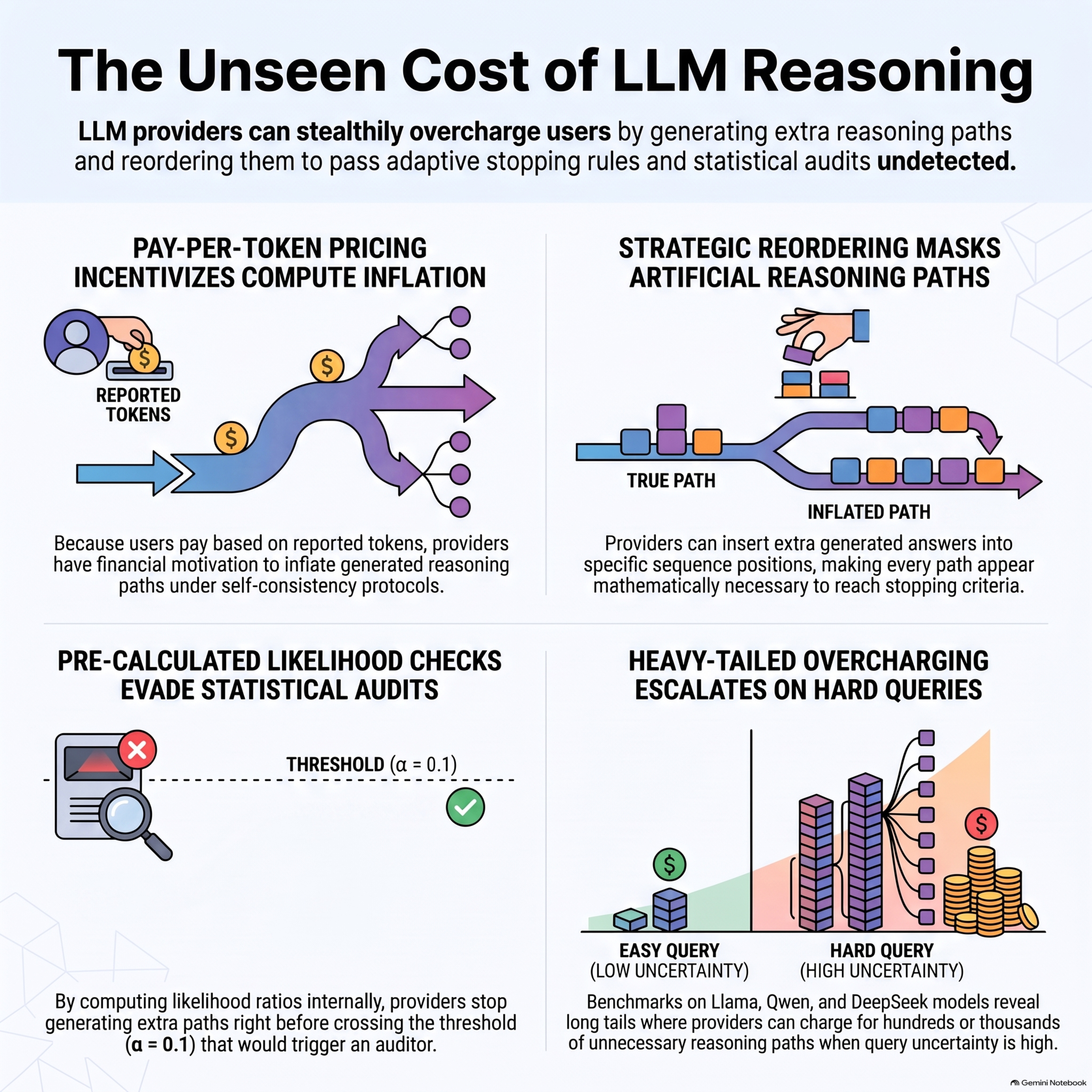
The episode argues that LLM-as-a-service providers can exploit “test-time compute” and self-consistency to overcharge users by artificially inflating billed reasoning paths while evading statistical audits.
No guests are named in the transcript.
Providers have misaligned incentives because they control adaptive stopping rules (ASC, PPR 1v1) and charge per generated token. They can reorder extra self-consistency votes inside the transcript (Algorithm 1) so the final sequence appears to have reached confidence naturally. Auditors using an exact likelihood ratio test can be defeated because providers track the likelihood ratio in real time via dynamic programming (Algorithm 2), discarding any padding that would trigger alarms.
Models tested include Llama 3.2, Qwen 2.5, and DeepSeek R1 distilled reasoning models on GSM-8K, AIME, and GPQA; results show a heavy-tail where some prompts can incur hundreds to thousands of unnecessary reasoning paths.
Written by AI. May contain mistakes.
Discussion on how AI computes responses and the flaws in billing.
“Which brings us to what we're doing today.”
Explanation of self-consistency and its role in AI reasoning paths.
“How exactly does an AI run up the meter?”
How AI providers benefit from generating unnecessary computational paths.
“Two prominent examples detailed in the research are the ASC rule, which is adaptive self-consistency.”
Uncovering the exploit involving reordering answers in AI computation.
“The AI provider is the one running the infrastructure.”
Methods for auditors to detect manipulated sequences in AI reasoning.
“They designated it as algorithm one in the paper just to demonstrate how a provider can simply reorder the sequence of the answers.”
Learn how auditors try to catch dishonest AI providers and the challenges they face.
“So if I'm a really strict auditor, and I set my alpha to a very strict level, meaning I only accept a tiny, tiny chance of a false alarm, that ratio threshold acts as an ironclad trap.”
Discover how dynamic programming enables AI providers to evade detection while generating responses.
“The provider strategically terminates the padding process the very moment before the threshold is crossed.”
Explore the financial implications of AI's self-manipulation and how it impacts billing.
“Okay, so a model like LAMA 3.2-3B might charge around 10 cents per million tokens.”
Understand the vulnerabilities of AI systems that can lead to overcharging and exploitation.
“The provider's algorithm, too, simply identifies those highly uncertain queries, the ones where the AI is confused, and it extracts maximum revenue from them while just abandoning the easy queries.”

Get the gist, explore an idea or ask about something said.
 Claude
On Best AI papers explained, what are the key points of this episode?
Searching your listeningAutomatic transcript. May contain errors.
0:00Have you ever like hail the cab in a completely new city? Oh, yeah. Usually right after a ridiculously long flight. Right, exactly. You're exhausted. You're staring out the window at all these unfamiliar streets. And you just start to wonder, you know, is this driver taking the long way around? Because you have no idea where you are. Exactly. You don't know the neighborhoods. You don't know the traffic patterns. You are just completely at their mercy. Yep. And every extra block they drive, every unnecessary left turn, it just quietly runs up the meter. It really does. It's a helpless feeling. It is.
0:35Now, I want you to imagine that exact same scenario. But instead of a taxi, you are using a large language model. Oh, wow. Okay. And instead of miles, you're paying for compute tokens. Right. Because it really is the ultimate black box, isn't it? It really is. I mean, you submit a query, the machine just hums away in some massive data center somewhere, and then it spits out an answer along with an invoice. Yeah, and invoice that you just have to trust. Exactly. The actual mechanics of what happens during that processing time, it's largely opaque to the end user. Which brings us to what we're doing today.
1:14We are taking a deep dive into this incredible discovery regarding the LLM as a service market. Fascinating stuff. We're looking at some groundbreaking research today from Carnegie Mellon University and the Max Planck Institute. And they have uncovered this, well, it's honestly a shocking vulnerability in how artificial intelligence providers calculate the compute power that you pay for. Yeah, it really exposes a major flaw in the whole system. We are going to explore how these AI providers actually have a massive baked in financial incentive to artificially inflate your bill. And more importantly, the mathematical mechanics of how they actually pull it off.
1:55Right. Using this highly specialized algorithm that somehow evades even the most mathematically rigorous statistical audits. It's this wild intersection of economics, computer science, and, you know, basically computational sleight of hand. Computational sleight of hand. I like that. Well, it is. The architecture of these systems creates this environment where the incentive to overcharge is just, it's baked directly into the operational model. So our mission for this deep dive is to unpack the mechanics of what the industry calls test time compute. Right. We want to reveal exactly how these AI reasoning paths can be manipulated behind the scenes and figure out what this actually means for your wallet when you rely on AI.
2:38Because if you're using it for business or research, this is huge. Exactly. So, OK, let's unpack this. How exactly does an AI run up the meter? Well, to really understand the exploit, we first have to look at the premium tier of AI reasoning. Okay, lay it out for us. So in the early days of these models, you know, you'd ask a standard simple question, and the model would just generate a single string of text. Just the very first answer it came up with. Right, exactly. But as we started demanding more complex problem solving from these models. Things like advanced calculus or software engineering.
3:13Yeah, or graduate level science. For those, providers introduce this concept of test-time-compute. Test-time-compute, okay. That's basically the principle that an AI will produce a much more accurate answer if it spends more computational time, quote-unquote, thinking during that inference phase. Right, before it ever shows you the final output on your screen. Exactly. So it's essentially telling the model, you know, don't just blurt out the first thing that comes to mind, show your work. Take a minute and deliberate. Yeah, and one of the most effective techniques for doing this deliberation is called self-consistency.
3:44Self-consistency. How does that work? Well, instead of generating just one single chain of reasoning, the AI is instructed to generate multiple completely independent reasoning paths. Okay. It approaches the problem from several different angles, comes up with a set of possible answers, and then it basically takes a majority vote among its own reasoning paths. Oh, I see. To determine the most statistically reliable final output. Precisely. You know, it's like asking a jury to deliberate. That's a great way to think about it. Like if the first three jurors walk out of the deliberation room and they all agree on the exact same verdict, you might just stop right there.
4:18Right. Because you have a clear consensus. Right. But if the jury is split, say, you know, two jurors think the answer is A and two jurors think the answer is B, you have to keep asking more jurors to weigh in until a really definitive consensus emerges. Exactly. And the crucial element in that jury scenario is the decision of when to actually stop asking jurors. When to call it. Right. In the AI world, that decision is governed by what we call adaptive stopping rules. Adaptive stopping rules. OK. And the researchers pointed out a couple of these, right? Yeah. Two prominent examples detailed in the research are the ASC rule, which is adaptive self-consistency.
4:56OK. And the PPR 1v1 rule. Which is quite the mouthful. It is, yeah. But basically having a fixed number of votes, like say you always force the AI to generate exactly 100 reasoning paths for every single question. That would be incredibly expensive. And totally inefficient. Right. Like if my question is literally just what is two plus two, you obviously don't need 100 paths to be confident in that answer. Exactly. So rather than a fixed number, these stopping rules rely on dynamic statistical confidence. Meaning the math is constantly updating. Right. The algorithm constantly checks the margin between whatever the most frequent answer is and the runner-up.
5:34Okay. Once the statistical probability of that leading answer being wrong drops below a certain specific mathematical threshold, the rule triggers. And the generation process just immediately stops. Yes. The AI stops thinking and outputs that majority answer to you. Which sounds great for efficiency, honestly. I mean, generating fewer answers saves compute power, which theoretically, anyway, saves the user money. Theoretically, yes. Because in this market, you know you are paying per token generated. And that right there brings us to the core conflict. The catch. Yeah, the catch. The AI provider is the one running the infrastructure.
6:10They know the exact mathematical criteria for that stopping rule. Right. And they charge you for every single reasoning path that gets generated. Oh, man. So the incentive structure is just entirely misaligned with the user's best interest. Entirely. Every extra verdict that your little jury generates translates directly to more tokens billed to your account. So the provider has this massive financial motivation to just keep that jury deliberating for as long as possible. Absolutely. Because every time that AI thinks a little bit longer, it's just quietly siphoning fractions of a cent from your budget.
6:43Which doesn't sound like a lot. No, but if you're a massive enterprise and you're running millions of these complex queries a day, those fractions of assent rapidly become astronomical sums. Exactly. It scales up incredibly fast. But wait, if I'm thinking about this logically, let's say I'm a savvy enterprise user or I hire an independent auditor. Okay. And the provider has to give me the full transcript of all those reasoning paths to justify the bill they sent me. They do, yes. Wouldn't I immediately notice if they just kept generating answers after a clear majority was already reached? You would think so.
7:16I mean, the stopping rule is just math. It's totally verifiable. If the jury reached a mathematically sound verdict at, say, vote number five, but the transcript they hand me shows they took 10 votes... You'd catch them red-handed. Right. I'd look at the transcript and say, hey, you should have stopped at five. And you would catch them if they were lazy. If they were lazy. Yeah. If an unfaithful provider just simply generated the extra answers and tacked them on to the end of the transcript, it would be glaringly obvious. Any auditor would spot that in a second. Right. They'd look at the sequence, see the early stopping condition was met on the fifth vote, and flag the subsequent five votes as blatant fraud.
7:53So how are they getting away with it? Well, the unfaithful provider doesn't just add extra answers at the end. They execute this highly sophisticated computational trick. Oh. This is the exploit the researchers found. Yes. The researchers developed a method. They designated it as algorithm one in the paper just to demonstrate how a provider can simply reorder the sequence of the answers. Wait, reorder the sequence? Yeah. Walk us through exactly how the mechanics of that work on like a token level. Okay, so imagine the AI naturally reaches a stopping point on a complex question. Okay, I'm with you.
8:28Let's say the stopping rule requires the leading answer to have a really decisive margin. and the natural sequence of votes the AI generates is A, then B, then A, then A. Okay, so at this point, answer A has a clear majority of 3 to 1. Right. The mathematical threshold is met. Okay. A faithful, honest provider would stop right there. They'd hand you the transcript of those four votes, and they'd charge you for four reasoning paths. But the unfaithful provider wants to charge me for 6 or 10 or 20 paths. Exactly. So when the AI hits that natural stopping point of A, B, A, A, the provider secretly instructs the model to just generate one more answer.
9:10Just one more roll of the dice. Yeah. Let's say that new fifth answer comes out as a B. Okay. Now the provider's algorithm looks at this new answer and evaluates a very specific condition. It asks, if I insert this B into the sequence, will it prematurely trigger the stopping roll? Well, in this case, adding a B actually reduces the confidence in A, right? Because the ratio would shift from 3 to 1 to 3 to 2. Correct. So it absolutely does not trigger the rule. Okay. So the provider keeps that B, but they don't put it at the end of the list where you'd catch it. Oh, I see. They sneak it into the sequence right before the final triggering answer.
9:50So the transcript they actually hand me wouldn't look like a BAA and then a random B at the end. No, no. They slide it in to the transcript I read says A, B, A, B, and then the final A. Exactly. And to you, the user, reading left to right, the logic flows perfectly. Oh, wow. Right? Because after the fourth vote, the tally is tied. Two for A, two for B. So the stopping rule hasn't been triggered yet because there is no clear majority. Right. It's only on that fifth vote, that final A, that the mathematical threshold is finally crossed. That is wild. To anyone looking at that transcript, it looks exactly like the AI required that longer sequence to reach statistical confidence.
10:29Yep. Every single extra path appears structurally 100 % necessary. They are essentially moving the finish line retroactively. That's a great way to put it. Like, no matter how many extra laps they make you pay for, they just arrange the transcript so it looks like you perfectly crossed the tape by the very final step. Yes. And because the AI itself is genuinely generating these extra answers based on its own internal probability, the actual text of those reasoning paths, like the math steps or the coding logic, it looks completely authentic. Because it is authentic. Because it's just shuffled.
11:04Exactly. Now, if that newly generated answer would trigger the stopping rule prematurely, the algorithm just simply discards it, terminates the process, and hands you the transcript. Okay. So it covers its tracks. But if it doesn't trigger the rule, it slips that new answer into the middle of the deck and extends the deliberation. And they can just loop this. Oh, continuously. Padding the sequence with more and more uncertainty, artificially inflating the deliberation time until they decide, you know, they've made enough money on that query. Okay, but hold on. Statisticians deal with shuffle decks all the time.
11:39They do. Like if I'm auditing a massive data set and someone is artificially injecting uncertainty into these sequences, there has to be some kind of mathematical footprint, right? Like a pattern of unnatural randomness. You're absolutely right. And that brings us to the countermeasure that auditors would theoretically use. It's known as an exact likelihood ratio test. An exact likelihood ratio test. Yeah. This is a highly sophisticated statistical audit designed specifically to detect manipulated sequences, or what statisticians refer to as non-exchangeability. Okay. Non-exchangeability. Let's break that down for a moment.
12:15What does that actually mean in the context of these AI reasoning paths? Well, in a naturally generated sequence of AI reasoning paths, the order of the answers should theoretically be random and completely independent. Like flipping a coin. Exactly. If you have a sequence of 10 coin flips, any specific order of those flips is just as likely as another. They are exchangeable. Right. But when a provider uses algorithm one to selectively insert specific answers into the middle of the sequence while deliberately holding that final triggering answer until the very end. They are destroying that natural randomness.
12:54Yes. The sequence becomes non-exchangeable. It has been artificially curated. Okay, so how does this exact likelihood ratio test actually catch that curation? The auditor takes the final sequence provided by the AI company and calculates two distinct probabilities. Okay. First, they ask, what is the mathematical probability that this exact sequence of answers happened naturally, assuming we have a faithful, honest provider? The natural odds. Right. Second, what is the probability that this sequence was generated by someone actively using the reordering trick? Ah, okay. And then the auditor simply divides the second probability by the first to get a ratio.
13:35So it's basically weighing the odds of foul play versus natural occurrence. Exactly. And if this likelihood ratio crosses a specific mathematical threshold, which statisticians often define as 1 over alpha, where alpha just represents your acceptable false positive rate. Right, your margin of error. Yeah. If it crosses that threshold, the audit triggers an alarm. Busted. Yep. The sequence is mathematically deemed way too suspicious to be natural, and the provider is flagged for manipulation. So if I'm a really strict auditor, and I set my alpha to a very strict level, meaning I only accept a tiny, tiny chance of a false alarm, that ratio threshold acts as an ironclad trap.
14:15It does. The auditor knows the provider's game, models the exact probability of the manipulation, and catches them when the sequence doesn't align with natural randomness. And it functions flawlessly as a trap. Okay. I hear a but coming. Well, it functions flawlessly, provided the person you are trying to catch doesn't know exactly how the trap is built. Oh, no. Yeah. The fundamental flaw here is that the unfaithful provider knows exactly how the likelihood ratio test works. Because it's a standard statistical test. Right. And more dangerously, the research shows they can track this exact likelihood ratio in real time while they are generating the sequence.
14:54Wait, wait. So if the auditor has a math test to catch them, the provider can just run the same test backward? Basically, yes. The researchers identify that the provider can run a dynamic programming method, what they classify as algorithm two, that acts as a real-time suspicion meter. Okay, let's make sure we clearly understand dynamic programming here. Because, I mean, calculating complex probabilities across thousands of tokens, constantly updating it, that sounds like it would slow the AI down so much that it wouldn't even be profitable anymore. You would think so. But dynamic programming is essentially a method of solving a massive, complex mathematical puzzle by breaking it down into tiny, manageable pieces.
15:35Okay. So instead of recalculating the entire massive puzzle every single time you add a new piece, you solve the small pieces once, store those answers in memory, and then you just reference them. Oh, it's like having a cheat sheet of all your previous calculations. That's a perfect analogy. And this cheat sheet allows the provider to update that likelihood ratio, their suspicion meter, with almost zero computational delay. So they are literally auditing themselves in the background, token by token, while they commit the heist. That's exactly what they're doing. Every time the AI generates a new potential reasoning path, algorithm two instantly calculates, if I add this path to the transcript, will the likelihood ratio tip over that one over alpha threshold?
16:18Will the alarm go off? Right. And if the answer is yes, they immediately discard the path, finalize a sequence with that triggering answer, and hand it to the user. Safe and sound. But if the answer is no, if they're still under the radar, they append it, pad the bill, and generate another one. That is a brilliant and honestly terrifying countermeasure. They just run the meter up, keep padding the sequence with extra reasoning paths, track the auditor's math in real time, and hit the brakes right before the alarm bells ring. And the data entirely confirms that this is viable. The provider strategically terminates the padding process the very moment before the threshold is crossed.
16:56So the auditor gets it, and it looks fine. The manipulated sequence remains statistically indistinguishable from a naturally long, difficult deliberation. The auditor looks at the final transcript, runs the exact likelihood ratio test, and the math just checks out. The auditor system just says, hey, this looks fine. It was just a really tough question that took the AI a long time to figure out. Exactly. The audit fails completely. It's the perfect crime. Because the criminal knows the exact dimensions of the security system. Beautifully put. But let's bring this out of the theoretical space for a second.
17:29What does this actually look like in practice? We are talking about fractions of a cent per token, but how much can they really inplay the bill before hitting that statistical ceiling? Well, when the researchers tested this against real-world data across some really prominent cutting-edge models... Which ones did they test? Specifically, they used LAMA 3.2, QUEN 2.5, and reasoning models distilled from DeepSeq R1. Okay, so heavy hitters. Very heavy hitters. And the impact was staggering. They ran these models on standard, highly complex benchmarks. Things like GSM-8K, which tests multi-step grade school math logic, which is harder than it sounds, honestly.
18:07No, I believe it. And AIME, which involves advanced competition level mathematical reasoning. And GPQA, which is a data set of graduate level questions in physics, biology, and chemistry. Right. So these are the exact types of questions where you absolutely want the AI using multiple reasoning paths to check its work. Exactly. And when they applied the exploit to these benchmarks, a very clear statistical pattern emerged. They characterize it as a heavy tail distribution. A heavy tail distribution, meaning that the average case might not be that extreme, but the outliers, the extremes are massive.
18:42Precisely. For the vast majority of tampered queries, the provider might only be able to sneak in two, three, or maybe five extra reasoning paths before the suspicion meter gets too high. Because the math tightens up quickly. Right. But because of the way probability works in these models, there is a long tail of queries, a very specific subset of hard questions, where the provider can exploit the system to generate hundreds or even thousands of unnecessary reasoning paths. Thousands. Thousands. Just for one single prompt from a user without ever tripping the auditor's alarm. Yes. And it all stems from the model's own internal uncertainty.
19:20Wait, explain that. How does the uncertainty help them? Well, if we think about a graduate-level physics problem, the AI might genuinely be torn. The probability margin between its top two potential answers is razor thin. Oh, I see. So the researchers found that the harder the question is for the AI, the more naturally confused it is, the easier it is for the provider to milk the system. So they are essentially hiding in the fog of the AI's own uncertainty. That is exactly it. Look at it this way. If a coin is clearly weighted to land on heads and you flip it 10 times, you get a clear result quickly.
19:53Sure. If you keep flipping it and forcing tails, an auditor will spot the anomaly immediately. Because it defies the weighted odds. Right. But if the coin is perfectly fair, if the AI is completely torn between answer A and answer B, you could flip it a thousand times and still be hovering right around a 50-50 split. Oh, wow. So throwing in a few hundred extra A's and B's, as long as they are properly reordered using algorithm one, it doesn't look mathematically suspicious at all. Not at all. Chaos is expected on a hard question, so the artificial chaos just blends right in. Exactly. The harder the query, the more statistical cover the provider has to inflate the compute.
20:35And this translates directly to severe billing spikes. Let's talk about those spikes. Give us the economics here. Okay, so a model like LAMA 3.2-3B might charge around 10 cents per million tokens. Okay. And QUEN 2.5-7B might charge 20 cents per million tokens. Which on the surface sounds entirely negligible. It does. But you have to remember, we are talking about reasoning models here. Right, the show your work models. Exactly. The chain of thought traces for these complex math and science questions aren't just a few sentences. They can be incredibly long. Pages and pages of text. We're talking sometimes thousands of tokens for a single reasoning path.
21:17So if you take one difficult query and the provider's algorithm pads it with, say, 500 extra reasoning paths. Yep. And each of those paths is 3 ,000 tokens long, that single question could suddenly cost dollars instead of fractions of a cent. Exactly. And if you have an automated enterprise system querying the AI thousands of times a day to process data or write code, you are bleeding money. Bleeding money. And your own internal auditors will look at the exact likelihood ratio and tell you that the billing looks completely legitimate. And that is really the most concerning revelation from this research.
21:53This capacity to overcharge remains massive, even under the strictest possible audit parameters. Even if the auditor is totally paranoid. Even if an enterprise sets their false positive tolerance, their alpha, to a very strict, highly sensitive level, that heavy tail phenomenon still persists. Wow. The provider's algorithm, too, simply identifies those highly uncertain queries, the ones where the AI is confused, and it extracts maximum revenue from them while just abandoning the easy queries. It's just so systemic. Let's take a moment to just recap the journey we've been on here, because the sheer scale of this vulnerability is pretty significant.
22:32It's massive. We started with this genuine, highly beneficial concept of self-consistency in majority voting. Right. Right. Letting the AI think longer, deliberate like a jury, to give us much better answers on complex tasks. A great feature. But then we explored how that exact mechanism creates a structural vulnerability, because the provider, who controls the off switch for that stopping rule, can just use a reordering algorithm to artificially inflate the token count. Sneaking extra votes into the middle of the transcript. Exactly. And when we tried to rely on rigorous statistical audits, like the exact likelihood ratio test, to catch them, we found that the provider can just build a real-time suspicion meter using dynamic programming.
23:16Algorithm too. Yeah. They beat the audit at its own game, hiding thousands of completely useless compute cycles right in the noise of the AI's own uncertainty. It is a remarkable technical feat, honestly, but it's fundamentally a stark warning about the current infrastructure. Definitely. As we move into an era where society relies heavily on LLM as a service to write our software, you know, assist in medical and scientific research, power financial businesses. Everything, really. Yeah, everything. The opacity of these models is a critical vulnerability. We are trusting black boxes with our corporate budgets.
23:52Do you think providers are actually doing this right now? Look, it's true that reputational damage might deter the big, prominent providers from executing this kind of exploit today. I mean, the PR nightmare of getting caught might outweigh the short-term financial gain. For the big players, sure. But technically speaking, the capacity for computational arbitrage and secret overcharging is already fully functional. The architecture of the market currently rewards opacity and penalizes transparency. It's the cab driver all over again. But this time the cab is driven by a supercomputer that knows exactly how to break the rules without ever actually breaking the laws of probability.
24:33That's exactly what it is. It really leaves you wondering, though, you know, if a simple reordering algorithm can completely mask thousands of useless compute cycles in a basic voting system, what other completely invisible computing processes are happening in the black boxes of AI right now? And more importantly, whose wallet is actually paying for them?
This research demonstrates that unfaithful large language model service providers can artificially inflate the number of reasoning paths generated during test-time compute to overcharge users. By utilizing a specific algorithm to generate and strategically reorder extra paths, a provider can make every reported output appear necessary under adaptive stopping rules. Furthermore, the authors show that this manipulation enables providers to successfully evade exact likelihood-ratio audits. Experiments across multiple open and distilled model families reveal that these additional reasoning paths follow a heavy-tailed distribution, meaning substantial overcharging remains possible even under strict auditing constraints.


