In short
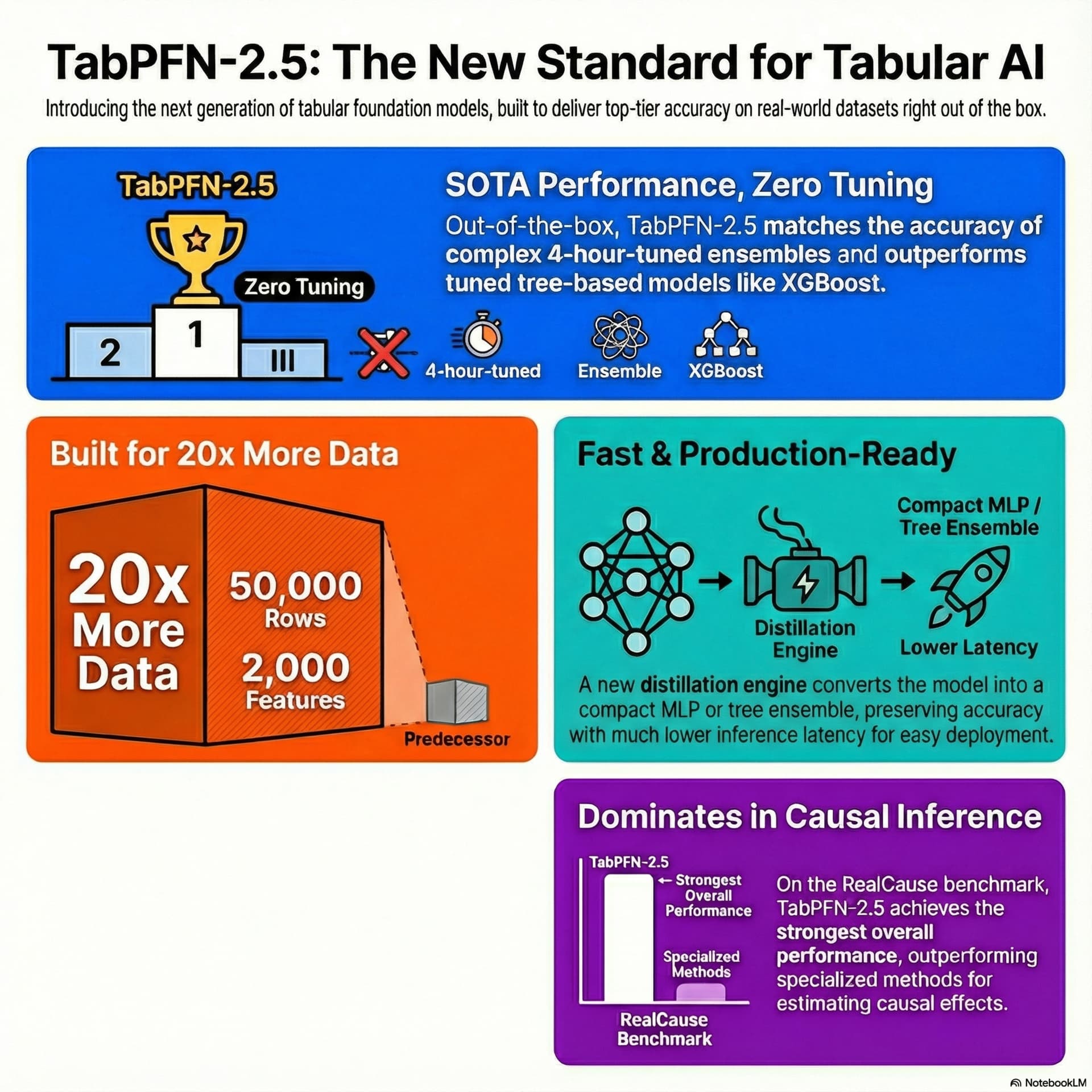
TabPFN-2.5, a “tabular foundation model” for structured data that aims to eliminate per-dataset hyperparameter tuning while improving accuracy, calibration, and scalability.
Guests
No guest names or backgrounds are provided in the transcript; it’s presented as a host/interview-style discussion.
Key claims
Trained on large synthetic distributions of many tabular tasks; uses in-context learning at inference (no retraining on new data). Claims 100% win rate vs default XGBoost on small/medium classification datasets (<10k rows, 500 features). Scales to ~50k rows and 2k features (~20x more data cells) with up to 24 transformer layers and faster inference (Flash Attention 3, parallel evaluation).
Notable examples
healthcare use cases (>50 published); Real Cause benchmark for causal inference using a T-learner, reporting best performance on PE (precision in estimating heterogeneous effects). Deployment: includes proprietary distillation to compact MLP/tree artifacts; non-commercial license v1.0.
Written by AI. May contain mistakes. Listen to the episode to check what was said.
Chapters
Tap a time to open that second in VOChallenges in Tabular Data Modeling
0:39 to 2:42
Explore the complexities of tabular data and the inefficiencies of traditional models.
“we're zeroing in on the new release, Tab PFN 2.5.”
Introduction to Tab PFN 2.5
2:42 to 4:07
Discover how Tab PFN 2.5 redefines modeling for tabular data without human tuning.
“What does a foundation model for tables actually mean in practice?”
Performance and Benchmarking of Tab PFN 2.5
4:07 to 5:30
Understand the performance benchmarks of Tab PFN 2.5 compared to traditional models.
“The primary benefit is matching or even beating performance that previously required these complex, multi-hour, manually intensive processes.”
Architectural Innovations in Tab PFN 2.5
5:30 to 7:18
Learn about the architectural enhancements that enable handling of larger datasets.
“It proves the foundation model approach scales and generalizes effectively.”
Synthetic Data Training and Generalization
7:18 to 8:13
Discuss the implications of synthetic data training on model bias and generalization.
“And this brings us right back to the training data.”
Deployment of Foundation Models
8:13 to 10:04
Examine how Tab PFN 2.5 can be distilled for deployment in production environments.
“They've seen massive adoption in areas like supply chain and energy, but healthcare is the strongest, with over 50 published use cases.”
Reliability and Calibration in Predictions
10:04 to 11:12
Learn about the importance of calibrated predictions in high-stakes scenarios.
“And the distillation preserves most of TAB PFN's original accuracy, so the knowledge transfer is highly efficient.”
Causal Inference and Future Applications
11:12 to 13:21
Explore the potential of causal inference with foundation models in decision-making.
“What's exciting, or maybe a little scary, about causal inference when foundation models start playing in that space.”
Business Strategy and Commercialization
13:21 to 14:00
Discuss the strategic decisions around the commercialization of Tab PFN 2.5.
“They're already handling data sets up to 100 ,000 rows, and they're looking to scale this to millions of rows to tackle the entire structured data problem stack.”
The Evolving Role in Structured Data AI
14:00 to 14:30
Explore how the role of AI professionals in structured data is changing from tuning to knowledge application.
“The focus shifts from optimization to knowledge transfer and application.”
Transcript
Automatic transcript. May contain errors.0:00Okay, let's unpack this. Tabular data. I mean, we're talking about the structured rows and columns in every enterprise database, the spreadsheets that basically run finance, healthcare, you name it. Right. They're the operational backbone for global decision making. And for years, we've all been relying on these incredible workhorses like gradient boosted trees and random forests. They are powerful for sure. But every time you deploy one, it really feels like you're starting from scratch. They come with this huge maintenance manual and demand constant optimization. Exactly. That maintenance is the real pain point.
0:33So our deep dive today is into what might be the future of structured data modeling. The next generation of tabular foundation models, or TFMs, we're zeroing in on the new release, Tab PFN 2.5. And our mission really is to get to the bottom of how this model handles data that's 20 times larger than its predecessor. And why it gets state-of-the-art results without you having to touch a single tuning knob and what that kind of radical efficiency means for your actual role as a data professional. Which, you know, leads us right into the fundamental tension of the field. I think a lot of people look at text and images, the domains that gave us LLMs and these massive vision transformers, and they just wonder.
1:12Why is tabular data still so hard? Exactly. If deep learning solves vision and language, what's the deal with tables? I mean, on the surface, they seem simple. They're just numbers, categories, maybe a few timestamps. What is it that gives tabular data this hidden complexity that resists the standard, you know, foundation model treatment? It's a great question. The complexity isn't necessarily in the data format itself. It's in the immense heterogeneity of the tasks and the unique relationships within each specific data set. So every table tells a different story. A completely different story.
1:48And traditional methods like XGBoost, they're incredibly good, but they are highly data set specific. You need extensive, specialized hyperparameter optimization HPO for every single new data set to get peak performance. And if you skip that tedious manual tuning. You often get subpar result. So the core difficulty isn't just building a model. It's the whole process of repeatedly tuning that model for unique business problems. It's a time sink that just kills efficiency. Right. And there's another piece to it, isn't there? The certainty. Precisely. Adding to that, those traditional models often provide uncalibrated or, let's say, unreliable uncertainty estimates.
2:23And if you're in a high-stakes scenario, say, making a medical risk prediction, needing reliable certainty is paramount. And traditional methods make that really hard. So we have two big challenges, the inefficiency and the lack of reliable certainty. How does this tabular foundation model paradigm tackle that? What does a foundation model for tables actually mean in practice? It means we're fundamentally shifting the learning paradigm. This model, it steps away from the slow, iterative gradient descent training on your specific data set. Okay. Instead, Tab PFN 2.5 is trained up front on large synthetic distributions of millions of potential tabular tasks.
3:02Hang on, trained purely on synthetic data. That seems a little counterintuitive. It does, but it's the key. Think of it this way. When you bring your new, specific, real-world data to the model, it doesn't train itself again. It performs inference via what's called in-context learning, or ICL. Let's break down ICL for a second. That's a term we hear all the time with LLMs. Absolutely. In context learning just means the model learns the relationship patterns of your specific task inside its forward prediction pass. It's a meta-trained predictor. So it's already learned how to learn from all those synthetic tasks.
3:39Exactly. So it's highly optimized for generalization and strong calibration from the moment you feed it your rows. You don't spend hours or days training it on your 10 ,000 rows. You just present the data and the model delivers the answer, you know, instantaneously. And here's where the rebel meets the road, because this addresses the core value proposition. Yeah. Is the big win here raw accuracy, or is it really the radical removal of all that human tuning effort? It's a bit of both, but the elimination of human effort is the real disruption. The primary benefit is matching or even beating performance that previously required these complex, multi-hour, manually intensive processes.
4:17You mean like a highly optimized ensemble? Right. Think of something like auto-glue on 1.4, which you might tune for four hours. This model aims to do that in a single forward pass, instantly. That's a massive operational efficiency game. A team could just move directly to deployment instead of spending cycles on tuning. It changes the workflow entirely. Okay, speaking of performance, the benchmark claims are bold. How should we interpret something like a 100 % win rate versus default XG boost? What does that actually tell us? That claim is specific, but it's a very powerful signal. They're talking about small to medium classification data sets, so under 10 ,000 data points and 500 features.
4:56A pretty common scenario in business. A very common industry segment. And in that segment, Default Tap PFN 2.5 achieved a 100 % win rate against Default XGBoost, not just matching it, but statistically beating it every single time. So if you're a practitioner and your first move is to grab default XGBoost for a small to medium data set, this new foundation model basically invalidates that choice from the get-go. Correct. It completely resets the baseline for what default performance should look like. And even on the larger test sets they used up to 100 ,000 samples, it still maintains a strong lead.
5:29So it generalizes well. It proves the foundation model approach scales and generalizes effectively. Let's talk about that scale, because that's the other huge leap in this release. The previous version, Tabby PFN v2, it was capped at what, 10 ,000 samples? And far fewer features, yeah. So how did TabPFN 2.5 manage to handle a 50 ,000 by 2 ,000 capacity? That's a roughly 20x increase in data cells. What was the engineering secret sauce there? It really required a complete overhaul of the architecture, using a lot of techniques that were perfected in the LLM space. They increased the sample size to 50 ,000 rows and the feature count up to 2 ,000.
6:07Okay, but how do they make it deeper and faster? Usually there's a trade-off there. They made the core transformer model deeper. Sure, up to 24 layers for classification. But critically, they optimized the heck out of the inference speed. Oh. By leveraging hardware-optimized solutions like Flash Attention 3 and parallel evaluation during inference, they actually made it up to 2.3 times faster than the previous version, which is crucial for keeping that instant prediction feel, even with much larger inputs. But the real aha moment in the architecture, for me at least, was something they borrowed directly from the big language models.
6:40The inclusion of thinking rows. That's where the transformer architecture really shines. They added 64 dedicated learned thinking rows to the input. So you can imagine these as, what, like the model's internal scratch pad? That's a great way to put it, or it's working memory. They act as attention sinks, and they give the model extra computational capacity to reason and focus more effectively over the messy, real-world data you just fed it. It's like giving the Model 64 built-in experts that are dedicated to processing the relationships between features before spitting out the final prediction.
7:13Exactly. It uses its meta-learned knowledge to process the context efficiently. And this brings us right back to the training data. We said it's trained purely on synthetic tasks. What does that imply for bias? and more importantly, for generalization. Yeah, with LLMs, we're always worried about training on messy internet data and just soaking up all that human bias. Training on synthetic data sounds like a great way to avoid that, but is there a risk? Does it become fragile in the real world? You'd think so, but the opposite seems to be true. The synthetic approach, by using these richer priors and broader distributions, actually forces strong generalization.
7:52Could you break that down? Think of it like a mathematician who understands the rules of algebra perfectly, rather than someone who has just memorized hundreds of specific equations. The synthetic data ensures it learns the underlying patterns and relationships, independent of any specific real-world noise. I see. So that strong generalization is why it performs so well, especially in these data-scarce domains. Precisely. They've seen massive adoption in areas like supply chain and energy, but healthcare is the strongest, with over 50 published use cases. which makes perfect sense if you have these small specialized clinical data sets that are just a nightmare to tune effectively.
8:28It sets a robust foundation. But they also explored boosting that performance even further with a specialized release, right? RealTabPFN 2.5. Yes. That version takes the foundational knowledge learned synthetically and then fine-tunes it on a curated corpus of 43 real-world data sets, all carefully deduplicated against benchmarks. And the result? That little bit of real-world exposure showed even stronger performance. It proves the synthetic training provides this unmatched robustness, and then a quick polish on actual data just takes it over the top. Okay, let's pivot from the theory to real-world deployment.
9:01Foundation models can be, you know, large. If the goal is low latency, high volume production, how do you actually deploy a model this sophisticated? If you could distill it down to a simple MLP or a tree, does that change the adoption story? It changes the story dramatically. It basically eliminates the tradeoff between generality and deployability. How so? TAB PFN 2.5 comes with a proprietary distillation engine. This engine can convert the full, massive foundation model into a compact, data-set-specific artifact, either a simple MLP or just a standard tree ensemble. But why go through that trouble if the full model is already faster than the old tuning process?
9:40Because that resulting MLP or TREE delivers orders of magnitude, lower latency, and a smaller memory footprint. Imagine baking all that complex, generalized knowledge into a tiny, fast chip. It's absolutely critical for production pipelines constrained by speed, interpretability, or strict regulatory limits. So you get the performance of a meta-learned foundation model, but the deployment profile of a lightweight traditional model. It's the best of both worlds. Exactly. And the distillation preserves most of TAB PFN's original accuracy, so the knowledge transfer is highly efficient. This feeds right into our safety discussion.
10:12In critical fields like healthcare, you need more than a prediction. Why do calibrated probabilities matter so much, and how do these models deliver them reliably? Calibrated probabilities are your reliable uncertainty estimates. If a model predicts a 95 % risk of patient readmission, you need to know that historically 95 % of patients in that same category actually were readmitted. The certainty has to align with reality. If it's poorly calibrated, you might be overconfident or underconfident in a high-stakes decision, which is dangerous. Absolutely. Traditional tree-based methods often give you uncalibrated outputs by default.
10:49Because TAP PFN 2.5 was meta-trained for generalization and reliability from the start, it naturally has better calibration. And you can tune it further. You can. The framework supports robust post-processing, like temperature scaling, allowing users to optimize not just for raw accuracy, but for reliability and specific safety metrics like F1 score on imbalanced data sets. Okay, let's look at the cutting edge now, the frontier of decision making. What's exciting, or maybe a little scary, about causal inference when foundation models start playing in that space. This is maybe the most exciting application.
11:23It's extending the model's reasoning from just predicting what is standard correlation to inferring what would happen if that's causation, predicting interventional outcomes. So moving beyond, patients who take this drug tend to have better outcomes, to if this specific patient takes this drug, they will have a better outcome. Precisely. They tested these PFN-based methods on the Real Cause benchmark, which uses randomized control trial data, but synthetically adds confounding effects to simulate real-world messiness. Then how did it do? Tab PFN 2.5, configured as a T-learner, which is a pretty straightforward approach, achieved the strongest overall performance on the key causal metric, PE.
12:02PE stands for precision in estimating heterogeneous effects. For our listeners, what does a strong PE score actually mean? It means the model is incredibly accurate at predicting the individualized treatment effect. It's the difference between predicting the outcome if a patient gets a treatment versus if they don't patient by patient. A strong PE score means the model is excellent at personalized causal reasoning. It's a huge deal for individualized decision support. All right, finally, we have to talk about the business strategy. The model is released, but with commercial restrictions. Why restrict commercial use, and what does that signal about the product direction?
12:40The model is released under the TABPFN 2.5 license V1.0, which is explicitly non-commercial, so you can use it for research, testing, internal benchmarking. But you can't use it to make money. Exactly. You can't use the outputs for revenue generation or client deliverables without a different license. It signals that the core innovation, especially the high-speed inference engine and the support structure, is protected and commercialized. So the research version is open to build awareness and the ecosystem, but the moneymaker is reserved. It's the standard foundation model playbook. Share the research widely to prove your capability, but reserve the highest-performing, most stable deployment solution for your paying enterprise clients.
13:20Which makes total sense, especially given their ambition. They're already handling data sets up to 100 ,000 rows, and they're looking to scale this to millions of rows to tackle the entire structured data problem stack. I think the major conclusion here is pretty definitive. Tab PFN 2.5 has set a new state-of-the-art for tuning-free tabular models. It scales dramatically, it matches complex, multi-hour tuned ensembles in a single forward pass, and it brings that foundation model generalization to a domain that was previously just dominated by tedious manual tuning. And that leads us to our final provocative thought for you to chew on.
13:57If foundation models can be trained entirely on synthetic data to generalize better the models that have been heavily optimized on real-world subsets, does the data scientist's primary role shift forever? Does the job move from being a tuner, the one fighting with hyperparameters, to being more of a guide who uses techniques like distillation to efficiently fit that vast, generalized knowledge into existing production systems? The focus shifts from optimization to knowledge transfer and application. It's a very different and I think potentially much more impactful skill set required for the future of structured data AI.
From the publisher
This paper discusses TabPFN-2.5, a sophisticated tabular foundation model designed to handle diverse datasets with up to 50,000 samples and 2,000 features. This next-generation AI significantly outperforms traditional tree-based models and complex ensembles like AutoGluon in a fraction of the time. The researchers highlight its state-of-the-art performance across various industries, particularly in healthcare, finance, and manufacturing, where it excels even with limited data. To facilitate industrial deployment, the system includes a distillation engine that converts the model into faster, lightweight formats like MLPs or tree ensembles. Beyond simple classification and regression, the model serves as a versatile tool for causal inference and time series forecasting. This release establishes a new benchmark for tuning-free machine learning, offering robust predictive power and scalability for real-world applications.


