In short
Challenges the “download a big foundation model and fine-tune on private domain data” playbook, arguing it’s economically and technically flawed. Introduces “fine tuners fallacy” and “fine tuners tax,” claiming specialized pre-training (SPT) is more cost-effective and reduces overfitting/catastrophic forgetting.
Guests
No named guests. The episode is hosted by two speakers who discuss a research paper from “Thetology AI team” (also referred to as “Datology AI” in the transcript).
Key claims
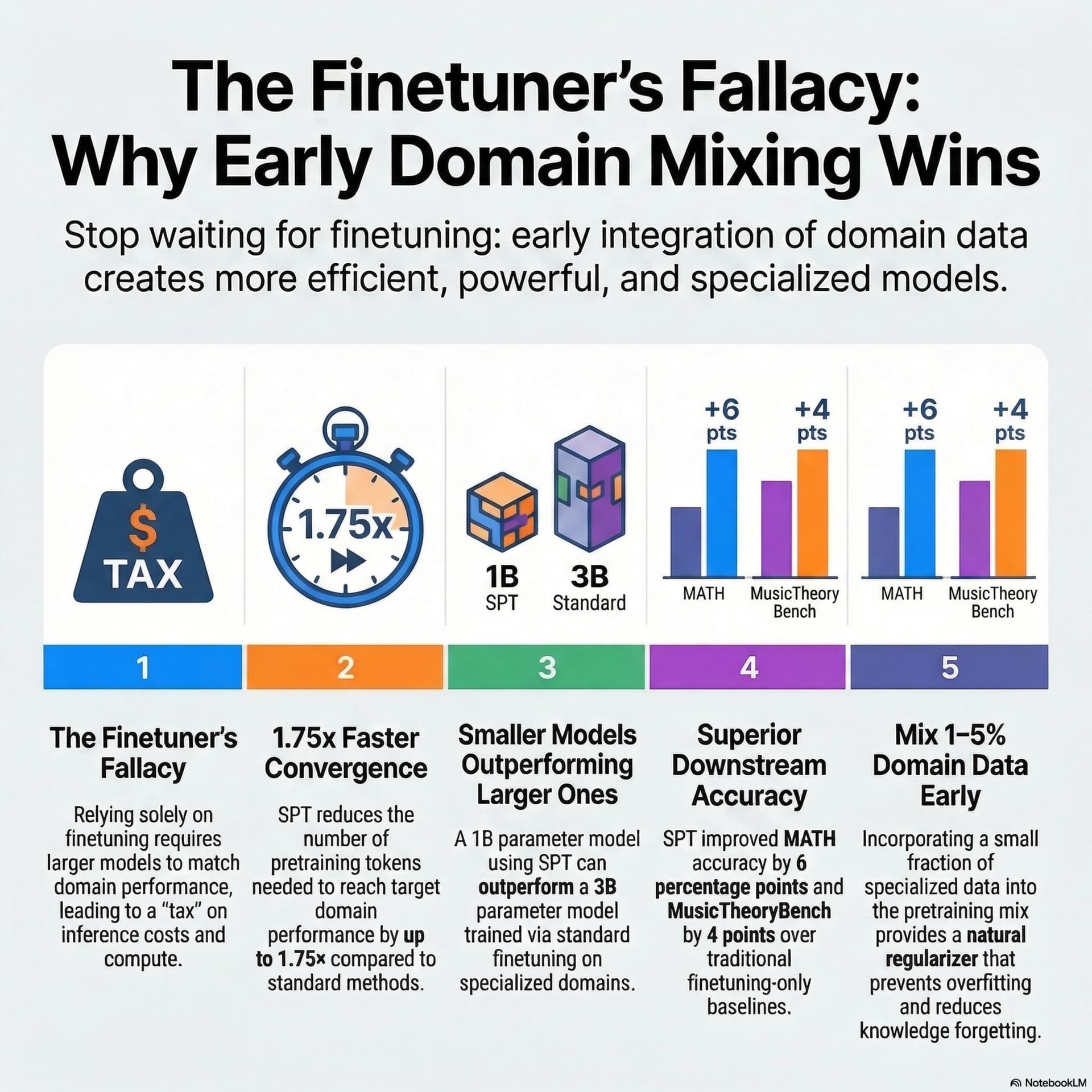
Treating pre-training and fine-tuning as isolated phases causes hidden inference costs and overfitting. SPT mixes ~1–5% proprietary domain tokens into general pre-training (e.g., Dolma) to act as a natural regularizer. Break-even at 1.152 trillion inference tokens.
Notable examples
Domain datasets MusicPile (symbolic music), ChemPile (chemistry), ProofPile (formal math proofs). SPT uses 1.75x fewer pre-training tokens for MusicPile, 1.56x fewer for ProofPile; on ProofPile, 1B SPT closes 133% of the gap vs a 3B standard model; on ChemPile it closes 23% (due to structural similarity with web text). Catastrophic forgetting is reduced; math benchmark improves up to +6 points and music theory up to +4. Overfitting scaling laws enable predicting optimal mixture via small pilot runs.
Written by AI. May contain mistakes. Listen to the episode to check what was said.
Chapters
Tap a time to open that second in VOUnpacking the Fine Tuners Fallacy
0:39 to 1:32
Explore the misconceptions of treating pre-training and fine-tuning as separate phases.
“deploying models at scale or you're just someone trying to understand why running your specialized AI is actively burning through your compute budget, you really need to hear this.”
The Hidden Costs of Fine-Tuning
1:33 to 4:27
Discuss how upfront costs can mislead AI deployment strategies and lead to higher operational expenses.
“Because fine-tuning a massive model feels really cheap on day one.”
Introducing Specialized Pre-Training (SPT)
4:28 to 8:11
Learn about the innovative SPT method that changes when specialized data is introduced.
“It saves you both compute and money while delivering comparable or honestly even superior performance.”
Benefits of Specialized Pre-Training
8:12 to 11:16
Discover how SPT improves model performance and retains general knowledge better than traditional methods.
“The theory of SBT acting as a natural regularizer makes a ton of sense.”
Challenges of Implementing SPT
11:17 to 14:00
Address the issues practitioners face in determining data mixture ratios for SPT.
“The child's brain is just structurally wired for both from the beginning.”
Understanding Overfitting Scaling Laws
14:00 to 16:00
Learn about the mathematical principles behind model performance prediction.
“I cannot guess and check at the pre-training scale.”
Practical Applications of Pretraining Data
16:00 to 18:00
Discover how to optimally incorporate specialized data in AI training.
“You mathematically find your optimal mixture percentage before you spend a single dollar of your real compute budget.”
Transcript
Automatic transcript. May contain errors.0:00I've always been taught that if you want a specialized AI model say I don't know for parsing dense legal contracts or handling sensitive medical records, the cheapest, smartest way is just glaringly obvious. Right. You just grab an existing model. Exactly. You go out, grab a massive, off-the-shelf, open-weights model that some giant tech company already spent, you know, millions of dollars pre-training, and you just fine-tune it on your private data. I mean, why pay for the foundation when someone else already poured the concrete? Yeah, exactly. And well, welcome to the deep dive, because today we are targeting that exact assumption.
0:36It's a huge assumption. It really is. Because whether you're an AI researcher deploying models at scale or you're just someone trying to understand why running your specialized AI is actively burning through your compute budget, you really need to hear this. Absolutely. Our mission today is to basically tear down that standard playbook and show you the true, most cost-effective path to building specialized AI. Yeah. And that standard playbook is so deeply ingrained in the industry right now that it really does feel like common sense. Oh, totally. It feels like getting the frame of a house for free and assuming you just have to pay to paint the walls.
1:09But we are looking at a truly groundbreaking paper from the Thetology AI team today. Yeah, their research is wild. It is. They've identified what they call the fine tuners fallacy. And they actually have the empirical data to prove that treating pre-training and fine tuning as two completely isolated separate phases is, well, it's a massive trap. A super costly trap. Okay, so let's unpack this upfront cost illusion. Because fine-tuning a massive model feels really cheap on day one. Right. It honestly reminds me of buying a really cheap inkjet printer. Like you think you got an absolute steal at the store, but then the proprietary ink cartridges completely bankrupt you over the next two years.
1:52That is... Are we looking at a similar economic trap with AI deployment here? That printer ink analogy perfectly captures the dynamic, actually. The researchers formalized this trap as the fine tuners tax. The fine tuners tax. I like that. Yeah. And to understand why we desperately need a new training method, we really have to look at the hidden compounding costs of the old one. We can see this super clearly in the hard data they presented in figure three of their paper. Right. The model comparison. Exactly. They compared two very different paths to building a specialized model. On one side, you have a 3 billion parameter model that was standardly fine-tuned on domain data.
2:32Okay, the standard way. Yep. And on the other side, you have a much smaller 1 billion parameter model, but it was trained using their new method where specialized data is introduced right from the start of pre-training. But wait, just looking at the upfront training compute, that 1 billion parameter model actually costs more to train initially, right? It does, yeah. Because you're paying for the massive pre-training compute yourself instead of just downloading a free baseline model and doing a quick fine-tuning run. The initial price tag is definitely higher, yes. But the catch is in the serving costs.
3:06Ah, inference. Right. Because that fine-tuned model has to be physically larger. I mean, 3 billion parameters instead of 1 billion. Just to achieve the exact same performance, it is literally three times more expensive to run in production. Wow. Three times. Think about what that means for hardware. A 3 billion parameter model requires significantly more GPU memory to load. It draws way more electricity, and it demands more compute for every single prompted answers. Right. And if you're deploying models at scale, inference-like, the actual running of the model is where the real money burns. Exactly.
3:41You train a model once, but you might run inference millions, maybe billions of times a day if you have a massive user base. And the researchers calculated a very specific break even point for this fine tuners tax, didn't they? They did. They pincoated it at exactly 1.152 trillion inference tokens. Wait, 1.152 trillion tokens? Yep. To put that in perspective for you listening, if you are a major enterprise processing thousands of dense legal documents or customer service logs every single hour, you are going to hit a trillion tokens way faster than you might think. Oh, absolutely. And once your model has processed that specific number of tokens in production, the smaller 1 billion parameter model has officially saved you enough on inference costs to entirely pay back its expensive upfront pre-training.
4:25That's insane. And from that point on to infinity, it is pure profit. It saves you both compute and money while delivering comparable or honestly even superior performance. See, that completely flips the economics of AI deployment on its head. But it begs a massive technical question for me. If a 1 billion parameter model can beat a 3 billion parameter model just by changing when it sees the training data, how exactly does this new method work without fundamentally breaking the model? Well, this brings us to the mechanics of what the Datology AI team calls specialized pre-training or SPT. Right, SPT.
5:03In the standard flawed playbook, you take your small, highly curated domain data set. Let's say it's 300 million tokens of incredibly valuable proprietary data. And you essentially lock it in a vault. You hide it away. Yeah. You save it solely for the very end of training, the fine tuning phase. And you do that because you don't want to dilute the precious data, right? Like it's really expensive to gather. So you want the model to focus entirely on it at the end. Exactly. But SPT completely rejects that premise. It says open the vault early. Really? Instead of saving it, you take that 300 million token domain data set and you mix it directly into the massive general pre-training corpus.
5:40Like the Dolma data set. Exactly. Like Dolma, which contains hundreds of billions of general web tokens. You introduce your specialized data as a tiny fraction of the total tokens, usually around 1 % to 5%. Hold on. Let me just think about this. If I only have 300 million tokens of my proprietary data and I dump them into a 200 billion token pre-training run at a 5 % mixture rate. Right. Just doing the math in my head here, I'm repeating that exact same small data set roughly 33 times. You are. But I've always been told that if you show a model the exact same data over and over, it just memorizes those specific tokens and totally loses its ability to generalize.
6:20Like it should just parrot the data back to me. How does it not just violently overfit? What's fascinating here is the concept of regularization. It's definitely counterintuitive, but those repeated domain tokens aren't being fed to the model in one giant concentrated block. Oh, they're mixed in. Right. They are scattered uniformly amongst a vast sea of general web data. And to really grasp why this works, we need to understand a metric researchers call test loss and a phenomenon known as the train test gap. Okay, let's break those down. Test loss is basically the model's error rate when you ask it to predict data it has never seen before, right?
6:57Exactly. Think of it like a student taking a final exam with brand new questions, not just the ones they saw in the study guide. You want that error rate, the test loss, to be as low as possible. Makes sense. Now, the train test gap is the difference between how well the model memorizes its practice test, the training data, versus how it performs on that real unseen exam. Ah, I see where this is going. Right. So when a model overfits, that gap explodes. It gets a perfect score on the practice test because it memorized the answers word for word, but it completely bombs the real exam. Wow. OK. So when you just dump all your proprietary data into the model during standard fine tuning without any general data mixed in, it just memorizes the study guide.
7:38The regularization buffer is entirely gone in standard fine-tuning. The model hyperfixates, its train test gap explodes, and it begins to overfit almost immediately. And SBT fixes that. Yes. SDT prevents that by spacing the exposure out over billions of general tokens. That general web data acts as a natural regularizer. That's so smart. Because the model is constantly being forced to predict general text in between those specialized tokens, it prevents the internal mathematical weights from shifting so drastically that they just memorize your domain corpus. Oh, I get it. It forces the model to learn the underlying structure of your specialized data rather than just, you know, memorizing the exact sequence of the words.
8:19The theory of SBT acting as a natural regularizer makes a ton of sense. Yeah. But let's look at the hard data from the deep dive to see if this actually works across different real world fields. Because the researchers didn't just test this on standard English text, right? No, they rigorously tested the boundaries. They used three very distinct 300 million token data sets. What were they? They used MusicPile, which is literal symbolic music notation. Okay. They used ChemPile, which is dense chemistry text. And they used ProofPile, which consists of highly structured formal mathematical proofs.
8:55Let's talk about the compute multipliers they found there, because this is where the efficiency gains become undeniable. Yeah, the numbers are striking. To reach the exact same domain test loss again, that error rate on unseen data we just talked about. As a standard, naively pre-trained model, the SPT method required 1.75 times fewer pre-training tokens for MusicPile. Right, and it required 1.56 times fewer tokens for ProofPile. That's a massive saving. It is. The model gets to the finish line drastically faster because it's learning the structure of the domain alongside the basic structure of language itself.
9:31Here's where it gets really interesting, though. I was looking at the parameter efficiency data in the paper. On the proof pile data set, the 1 billion parameter SPT model closed 133 % of the performance gap. Meaning, it didn't just match the larger 3 billion parameter standard model, it completely crushed it. It did. But when they look at CHEMPile, the 1 billion SPT model only closed 23 % of the gap. Why is chemistry the odd one out here? Why didn't SPT give it superhuman abilities like it did for math and music? It all comes down to how, well, how alien your specific data is to a standard language model.
10:10Alien? How do you mean? Chemistry text, as complex as it is to humans, actually shares a massive amount of structural similarity with the general web text found in the dolma corpus. Oh, because there are already chemistry papers online. Exactly. Wikipedia articles, academic forum discussions, they're already deeply embedded in standard pre-training data. The model isn't starting from scratch when it sees the word molecule or a standard sentence describing an experiment. Right. But consider formal mathematical proofs or literal symbolic music notation. Totally. Those formats operate on entirely different logical structures.
10:42Music has temporal structures, pitch, duration. It's an entirely different syntax from English. Yeah, that makes sense. And mathematical proofs require strict logical chains where missing a single symbol breaks the entire proof. Unlike English, where, you know, missing a comma is usually fine, they are completely underrepresented on the general web. Well, they are structurally alien. Yes. What the data tells us is that the further your specific domain is from standard web text, the more critical it is to introduce it early in pre-training. That makes perfect sense. It's like trying to teach an adult a completely new syntax in a two-week boot camp versus raising a child bilingual from birth.
11:23That's a great analogy. The child's brain is just structurally wired for both from the beginning. But that brings up another huge issue with the standard playbook. Which is? If we are wiring the model's brain so heavily for this specific domain, what happens to its general intelligence? Ah, catastrophic forgetting. Right. The notorious issue with fine-tuning. You fine-tune a model to be a legal expert, and suddenly it starts talking like a lawyer, even when you ask it for a simple pancake recipe, or it just forgets how to summarize a basic news article. This is perhaps the most elegant benefit of specialized pre-training, actually.
11:57It actually protects general knowledge. Really? How? It has everything to do with the state of the model when it finally enters that final fine-tuning phase. In the standard playbook, the model enters fine-tuning completely blind to your domain. Right. Its error rate on your data is sky high. So to force the model to learn your domain quickly, the optimization algorithm, the mathematical engine that adjusts the model's internal connections, has to make massive violent updates to the model's weights. And I'm guessing those violent updates overgrade the general knowledge it spent billions of tokens learning during pre-training.
12:33Exactly. It's destructive optimization. Wow. An SPT model, however, has been sipping on your domain data for its entire life. When it enters the fine-tuning phase, it already has a very low domain loss. Because it's seen it sprinkled in all along. Right. It already understands the domain fundamentally. Therefore, the fine-tuning phase only requires gentle, nuanced updates. It doesn't need aggressive, destructive optimization to force the knowledge in, which means the general capabilities are left completely intact. The numbers back this up emphatically, too. The paper showed that at 200 billion pre-training tokens, the SBT method improved accuracy on the math benchmark by up to 6 percentage points compared to the fine-tuning-only baseline.
13:16That's huge. And on the music theory bench, it improved by up to 4 percentage points. It didn't just retain its general knowledge, it actually scored higher on entirely separate downstream tasks. A model that truly understands the underlying structure of a complex domain is simply a smarter, more capable model overall. It learns how to reason better across the board. I am sold. And, you know, if you were listening to this, you were probably sold too. SPT is clearly superior to just dumping data at the end. And as a practitioner with a strict compute budget, I have a massive problem with that. Tuning.
13:47Yes. If you tell me I need to mix my proprietary data in at 1%, or maybe 2%, or maybe 5%, And the only way to find the perfect mixture ratio is to run exhaustive multimillion dollar pre-training sweeps for every possible option. I cannot afford that. No one can. I cannot guess and check at the pre-training scale. The dietology AI researchers knew that would be the primary barrier to adoption. That's why they didn't just publish the empirical results. They derived what they call overfitting scaling laws. Oh, nice. They found a way to mathematically predict exactly how a model will behave without having to run those massive full-scale training sweeps.
14:27Oh, that is a lifesaver. How does the math actually work? I know we touched on the train test gap earlier. They discover that the test loss of a model during this process can be predictably modeled as the sum of two distinct mathematical power laws. Think of it like a massive tug-of-war happening inside the model's architecture. Okay, paint that picture for me. On one side of the rope, you have a power law with a negative exponent. This represents the model actually learning. As it sees more data, this curve predictably goes down, pulling your error rate lower. Right, the good side of the tug-of-war.
14:59Exactly. But on the other side of the rope, you have a power law with a positive exponent. This represents that train test gap we talked about earlier. Because you are repeating your domain data, this curve predictably pulls up as the model begins to memorize rather than generalize. So you have one mathematical force pulling the error down as it learns, and one force pulling the error up as it overfits. And the actual performance of your model is wherever that flag in the middle of the rope ends up. Spot on. And because this mathematical relationship is incredibly stable and predictable, you don't need to run massive, expensive sweeps to see who wins the tug of war.
15:36That's amazing. The practical takeaway is this. You only need to run a small handful of very cheap, short pilot runs. Like just training a tiny, maybe 100 million parameter version of the model for a few thousand steps? Exactly. Just enough to gather a few data points on how your specific data behaves. You take those few data points, fit them to these two tug-of-war curves, and you can extrapolate out to predict exactly when your specific data set at a specific mixture percentage will hit that inflection point and start to overfit. Wow. You mathematically find your optimal mixture percentage before you spend a single dollar of your real compute budget.
16:14That is brilliant. It takes the guesswork out of it entirely. You find the sweet spot between learning the domain and memorizing it, and then you just let the giant pre-training run go. The ultimate practical advice from the team is simple and direct. If you want to get the absolute most utility out of your specialized data, you must incorporate it as early in the training pipeline as physically possible. Don't lock it in the vault. Do not treat your most valuable proprietary data as a final stage afterthought. So what does this all mean for you listening? It means the cheapest path is a complete illusion.
16:47Relying strictly on grabbing an off-the-shelf model and fine-tuning it seems like you are saving money on pre-training, but you are paying a massive fine-tuner's tax in inference costs because you are forced to use a bloated larger model to get the performance you need. Exactly right. By using specialized pre-training, interleaving just a tiny fraction of your proprietary data into the general pre-training mix, you get a smaller, smarter model. The general web data acts as a natural regularizer. It completely avoids catastrophic forgetting. It costs significantly less to run in production. And it performs drastically better on niche alien tasks like math or specialized code.
17:25And, you know, this suggests a profound shift in how we think about artificial intelligence architectures moving forward. How so? Well, if the specific stage at which data is introduced so fundamentally dictates whether a model memorizes or generalizes, we have to look to the future. What happens when organizations start interleaving not just domain text, but synthetic reasoning data or entirely different modalities like raw video feeds or robotics telemetry from Token Zero? Oh, wow. If early exposure completely rewrites the model structural foundation, we might be looking at a near future where the very concept of post-training or fine-tuning as a separate, isolated phase becomes entirely obsolete.
18:07It's like we've been trying to build a custom house by gluing things to the drywall, and we finally figured out we can just pour a better foundation. Exactly. To you listening, thank you for joining us on this deep dive. Next time you spin up a cluster, ask yourself, are you building foundation, or are you just buying really expensive printer ink? We'll see you next time.
From the publisher
This research introduces specialized pretraining (SPT), a strategy that incorporates domain-specific data directly into the initial pretraining phase rather than reserving it solely for finetuning. By mixing a small percentage of specialized tokens with general web data, models achieve superior performance and faster convergence on niche topics like chemistry, music, and mathematics. This approach effectively addresses the finetuner’s fallacy, proving that early data integration reduces the "tax" of forgetting general knowledge while preventing the overfitting common in standard finetuning. The authors demonstrate that a smaller model using SPT can actually outperform a much larger model trained via traditional methods. Ultimately, the study provides overfitting scaling laws to help practitioners determine the ideal data mixture based on their specific compute budget and dataset size.


