
In short
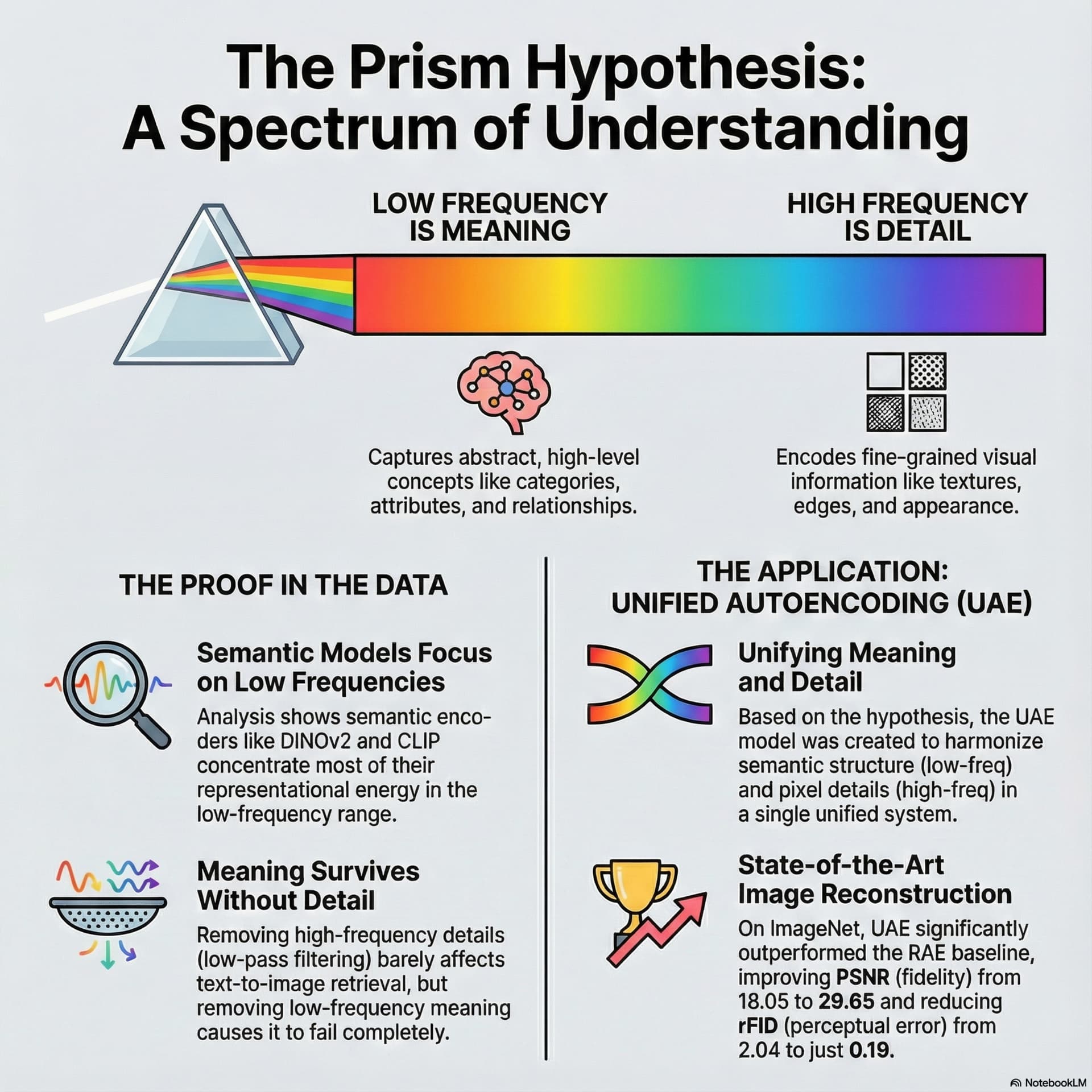
The episode explains the PRISM hypothesis and its model implementation, Unified Autoencoding (UAE), which aim to unify semantic (meaning) and pixel (visual detail) representations in one latent space to reduce “uncanny valley” artifacts.
Guest backgrounds
No guest names or bios are provided; the episode is a host-led deep dive with references to researchers analyzing encoders and running experiments.
Key claims
Semantic alignment across text and images is dominated by low-frequency (LF) features; high-frequency (HF) residuals carry fine texture/detail. UAE initializes from a semantic encoder (e.g., DINOv2) but uses an FFT-based frequency-band modulator with residual split flow and dual losses (LF semantic loss + full reconstruction loss) to preserve both.
Notable examples
Text-image retrieval stays stable after low-pass filtering but drops to near-random after high-pass filtering; UAE preserves legible small text on street signs/documents and sharp edges/textures. Metrics: PSNR 18.05→29.65, SSIM 0.50→0.88, and perceptual distance (FID-like) 2.04→0.19; semantic probing top-1 accuracy 83.0%.
Written by AI. May contain mistakes. Listen to the episode to check what was said.
Chapters
Tap a time to open that second in VOUnderstanding the AI Image Generation Problem
0:45 to 4:41
Exploring the conflict between semantic understanding and visual fidelity in AI image generation.
“the high-level concept, like a golden retriever sitting in a field of daisies.”
The PRISM Hypothesis Unpacked
4:41 to 7:31
Introducing the PRISM hypothesis as a solution to unify semantic and pixel representation.
“Here's where it gets really interesting.”
Empirical Validation of the Hypothesis
7:31 to 10:59
Discussing experiments that demonstrate the need for low-frequency semantic representation.
“I mean, they went right down to random chance.”
Unified Autoencoding (UAE) Implementation
10:59 to 14:00
Exploring the Unified Autoencoding model and its architecture based on the PRISM hypothesis.
“So that first teacher makes sure the model knows what it's drawing.”
The Power of Frequency Decomposition in AI
14:00 to 14:49
Learn how low and high frequency decomposition enhances AI's semantic understanding.
“Did it get so obsessed with detail that it forgot the bigger picture?”
Unified Autoencoding and Its Implications
14:49 to 15:32
Explore the implications of unified autoencoding for visual generation models.
“It's a clean and efficient recipe for building the next generation of visual AI.”
Future Control in Generative AI Models
15:32 to 16:11
Discuss how future generative AI models might offer users unprecedented control.
“And this leads us to our final thought for you to chew on.”
Transcript
Automatic transcript. May contain errors.0:00Welcome back to the deep dive where we take a stack of sources articles and new research and really just extract the knowledge you need to be perfectly informed. Today, we are tackling one of the most persistent, I mean, one of the most frustrating problems in artificial intelligence. It's a problem that affects every single image you generate and every object an AI tries to perceive. It really is fundamental. And if you've ever used a generative AI, you've seen this. You've seen that classic uncanny valley effect. Oh, yeah. Where the seam is conceptually correct, but like the hands are all smeared or the text on a sign is just complete gibberish.
0:36You've witnessed this problem in action. Exactly. The conflict is, it's basic. AI has historically had to choose between understanding what an image means, the high-level concept, like a golden retriever sitting in a field of daisies. Right, the semantics. And understanding what the image looks like, the fine-grained texture of the dog's fur, the precise geometry of the daisy petals. That conflict between abstraction and visual fidelity, it's forced AI models onto these separate competing paths. Okay, let's unpack this. Our mission today is to dive deep into a really unique framework, a conceptual model called the PRISM hypothesis, and the practical architecture it inspired, the Unified Autoencoding, or UAE.
1:20This new framework tries to resolve that fragmentation. It wants to allow a single model to capture both meaning and every necessary pixel detail seamlessly. And it's such a crucial area of research because for too long, foundation models have been great at either high-level perception or detailed generation, but not both at the same time. You had to pick one. You had to. And if you try to force them together, you just end up with these incompatible features that interfere with each other. It's like trying to bake a cake where the structural integrity and the flavor profile were handled by two separate systems that were basically fighting each other.
1:54Huh, that's a great analogy. Yeah, if you distilled too much semantic meaning, you blurred the details. But if you focus too much on perfect pixels, you risk losing the entire context. The big picture. Exactly. So the goal here, the real goal, is to find a common shared feature space where multimodal inputs, so whether it's text describing a scene or the image itself, can align on their deep semantic core. Right. While making sure all that necessary visual detail is perfectly preserved. And that structural split, that incompatibility you mentioned, it really is the root of the issue. When you look at the history of these big AI systems, they, well, they evolved along two totally distinct paths.
2:34Exactly right. On one side, you have the semantic encoders models like, say, DINO or CLIP. These are pre-trained purely to capture high-level generalized meaning. The idea guys. The idea guys, yeah. They excel at abstraction. Their whole job is to understand categories, attributes, relations. If you show them an image, they understand it's a specific breed of cat sitting on a specific type of cushion. So they see a cat sitting on a blue cushion, and they get the relationship in the category instantly, but they might just completely throw away the information about the individual whiskers or the exact weave of the fabric.
3:07Because it's noise to them. Right. It's noise relative to the core meaning. Precisely. Their focus is high level. But then on the other side are the pixel encoders, things like SD3VAE or fluxVAE, which are, you know, essential parts of modern generative models like stable diffusion. Okay. Their primary function is perfect compression and reconstruction. They are masters of the low-level stuff. Appearance, geometry, texture. They need to worry about every tiny detail to make sure the generated image looks physically real and not just, you know, an abstract idea. And when engineers tried to merge these two, these two completely different approaches, like taking features from a semantic model and just plugging them into a pixel model, you just run into conflicts.
3:50You do. And the results are these predictable tradeoffs. Yeah. I mean, sure, transferring a powerful semantic encoder into visual generation, it does speed up the training process. It gives it a head start. A huge head start. The AI understands what it's supposed to be drawing sooner. Yeah. But these unified models, they invariably struggle, and I mean severely, to recover those fine-grained visual details. Yeah. That's where the blurring and the weird artifacts come from. It's always been this uncomfortable compromise. Yeah. So the core question, the really difficult question we're looking at is, how can we represent world information so that all inputs share a common semantic core, but also retain their native granularity all inside a single architecture?
4:32That is the perfect transition because the solution, at least conceptually, relies on this really unique and I think compelling framework, the PRISM hypothesis. Here's where it gets really interesting. The prism hypothesis gives us this beautiful visual metaphor for how this fragmentation and unification should work. Imagine a conceptual prism. The hypothesis suggests that natural inputs, an image or the text describing that image, they aren't inherently different, but rather they project onto a continuous shared feature spectrum. Different modalities are just distinct slices of this underlying continuum.
5:05And it's important to say this isn't just a metaphor. This hypothesis is actually strongly supported by spectral analysis of the encoders themselves. You actually looked at the models. We did. When we analyzed the feature energy inside these existing specialized models, we found this incredible correspondence between an encoder's feature spectrum, its frequency components, and what it was built to do. Feature energy was directly tied to meaning and detail. Wow. We could break this feature spectrum down into two key parts based on frequency. The low frequency band, or LF, that corresponds to global semantics and abstract meaning.
5:43And empirically, we found that semantic encoders like Dyno V2 and CLIP, they concentrate most of their energy right there. And the lowest frequency band. Exactly. This band captures the categories, the abstract relations, the general structure of a scene. So the LF is like the conceptual skeleton, the blueprint of the image, and tells you the cat is next to the couch. That's a perfect way to put it. And conversely, you have a high-frequency band, or HF. This corresponds to local detail and fine visual texture, think sharp edges, intricate patterns, geometric precision. All the stuff that pixel encoders care about.
6:16Precisely. Pixel encoders, like the STDEE, they retain a much stronger concentration of mid - and high-frequency components because they need that specific granular detail to reconstruct an image faithfully, pixel by pixel. And you didn't just theorize this. You actually put this LF-only semantics idea to a really tough empirical test using text image retrieval. I mean, this is the definitive proof that abstraction lives in the low frequencies. Can you tell us about that? Sure. We ran these controlled text image retrieval tests. We started with the full image representation, and then we progressively filtered it using spectral masks.
6:51Okay. And here's the critical finding. When we filtered out the high-frequency details using a low-pass filter, which is basically like blurring the texture, the retrieval scores stayed stable. They didn't drop. Barely at all. The AI could still successfully match the text to the image because the global meaning was perfectly preserved in that LF base. The AI didn't need to see the whiskers to know it was a cat. Exactly. It just needed the conceptual shape. But, and here's the kicker, when we used a high-pass filter and removed that LF base, the conceptual skeleton, leaving only the high-frequency residuals, just the edges and textures with no global context, the retrieval scores dropped sharply.
7:32I mean, they went right down to random chance. This empirical proof validates the hypothesis. Cross-modal semantic alignment primarily resides only in the shared low-frequency base. That is a staggering insight. It basically means the AI doesn't need to look at every single pixel to figure out what something is. It just needs the blueprint. I mean, that has revolutionary implications for efficiency, doesn't it? Absolutely. If foundation models only need to operate on the low-frequency base for alignment, they save massive amounts of processing power. It gives engineers a concrete target. A concrete target, yes.
8:04Instead of trying to force high-level meaning and low-level detail to coexist through these messy, expensive tradeoffs, they can now explicitly separate and manage those functions based on frequency bands. So, the proof is definitive, meaning lives in the low-frequency spectrum. The framework is sound. The question then becomes, how do you build a model that actually respects this spectral division? How do you take the prism hypothesis and turn it into working AI? And that brings us to the practical solution. Unified Autoencoding, or UAE. This is a model engineered directly on the PRISM hypothesis to create a single latent space that is simultaneously home to both robust semantic structure and fine pixel detail.
8:46And the process starts by initializing the UAE from a powerful pre-trained semantic encoder, something like Dyno V2. This immediately anchors the model in a high-quality, proven semantic understanding. But wait a second. If you initialize it from a semantic encoder, doesn't that inherently bias the model away from pixel fidelity? Aren't you sort of fighting an uphill battle from the start by prioritizing abstraction? That's a great question, and it really highlights why the innovation in the mechanism is so critical here. The UAE is initialized semantically, yes, but then we give it the capacity to learn fidelity through what we call the frequency band modulator.
9:24Okay. It's achieved through a residual split flow. We're essentially forcing the semantic encoder to expand its feature space to incorporate that high frequency detail, but without destroying its semantic core. Residual split flow and FFT band projector, that sounds pretty complex. What's the simple version of what that modulator is doing? Is it basically just a really advanced form of compression that guarantees the semantics stay protected? You can think of it like a meticulous, progressive deconquisition of the image information. It uses spectral methods to break the latent representation into multiple distinct frequency bands.
9:58I see. By iteratively splitting the signal, first extracting the lowest frequency baseband and then decomposing the rest of the information as residuals, it encourages this clean spectral disentanglement. The low frequency band encodes the smooth structures in global semantics, while the higher frequency residuals capture the fine localized details. The edges and textures. The edges and textures that were initially thrown away by the pure semantic model. Okay, I think I get it. So the harmonization is achieved not just by mixing features, but by enforcing this structure. You have dual training objectives to make sure both needs, meaning, and fidelity are met at the same time, just in different frequency channels.
10:40Precisely. The model essentially has two specialized teachers focused on different parts of the spectrum. First, there's the semantic-wise loss. This loss is applied only to the lowest frequency band. Only the blueprint. Only the blueprint. This forces the UAE to align its conceptual blueprint with the original frozen semantic encoder features. It inherits that global semantic structure from its powerful teacher model. So that first teacher makes sure the model knows what it's drawing. Exactly. Then the second teacher is the pixel-wise reconstruction loss. This is applied to the full latent representation, which gets reconstructed by a pixel decoder.
11:14This objective enforces visual fidelity. It helps the network learn how to use those high-frequency residuals to generate texture and detail. So the low-frequency core handles the what is it, providing that structural anchor, and the high-frequency residuals handle the what does it look like, providing the detail. It's a progressive system anchored by reliable semantics, which sounds like it should eliminate the semantic drift and the blurriness we talked about earlier. Correct. That robust structural foundation means that when we look at the results, the performance gains are, well, they're truly substantial.
11:49The learned latent space is simultaneously highly semantically representative and perfectly pixel faithful. Let's get into the hard numbers then because the metrics here, they seem to validate the theory completely. What did UAE achieve on standard benchmarks for reconstruction quality? On reconstruction quality benchmarks like ImageNet, The quantitative results show a generational leap in fidelity. We compared UAE, specifically the Dyno 2 base version, against the previous state-of-the-art model, RAE. Okay. The PSNR peak signal-to-noise ratio, which is a standard mathematical measure of image fidelity, it improved from 18.05 to a staggering 29.65.
12:29Wow. Going from 18 to almost 30 in PSNR is not an incremental improvement. That is a massive jump in mathematical quality. It is. And the structural similarity index, S-Sim, which captures how structurally similar the reconstruction is to the original, it jumped from 0.50 to 0.88. So it's not just getting the colors right, it's getting the layout right. It's getting the structure and the feature alignment right. Yeah. But perhaps most importantly for us, we looked at RFID-reduced Frechette inception distance. This measures the perceptual quality. How real looks. How realistic the AI-generated images look to a separate perception model.
13:02The RFID was reduced significantly from 2.04 down to an impressive 0.19. This confirms the reconstructions aren't just accurate in theory. They look virtually indistinguishable from the original. And beyond the numbers, the qualitative side confirms this, right? Yeah. The real test for fidelity is always those tiny details that the older models would just break. Absolutely. When you compare UAE reconstructions to competitors like SDVAE and RAE, the UAE is just far more consistent, far more faithful. Critically, it preserves small, intricate details that previous models would either blur into abstraction or distort into artifacts.
13:37Like what? For example, it handles straight edges, fine textures, and even small text on things like street signs or imprinted documents. For the comparison models created illegible gibberish, UAE retained legible detail. That confirms the high-frequency residuals were successfully learned and used. Okay, so despite focusing so much effort on incorporating those high-frequency pixels, did the UAE sacrifice the fundamental semantic understanding it got from Dano V2? Did it get so obsessed with detail that it forgot the bigger picture? Not at all. That explicit anchoring in the low-frequency base, enforced by the semantic loss function, it ensured strong semantic preservation.
14:16Linear probing tests confirm this. We saw a competitive top-one accuracy of 83.0 % for classification using the VITP backbone. Then how does that compare? That matches the RE baseline and actually surpasses larger models like Uniflow, which used a much more complex VITL backbone. So it's more efficient and just as smart. It tells us that the low frequency band alone was powerful enough to effectively retain that global semantic structure needed for high accuracy classification. It let the higher frequencies just handle detail management without any semantic interference. So the main takeaway here is that this explicit low and high frequency decomposition, which was established by the conceptual framework of the prism hypothesis, provides an incredibly effective and frankly robust foundation for future large scale visual generation and understanding models.
15:04It's a clean and efficient recipe for building the next generation of visual AI. So what does this all mean? The unified auto encoding model really demonstrates a practical and I think elegant way to build tokenizers that don't force a tradeoff between the abstract meaning and the concrete visual details of the world. By realizing that semantics lives in the low frequency spectrum, they found a way to let AI know what something is and what it looks like extremely well, all within one harmonious feature set. And this leads us to our final thought for you to chew on. Since the UAE has successfully built this unified latent space, one composed of perfectly separated frequency bands, a clean division between global structure in the LF and fine detail in the HF have, how might future generative AI models leverage this?
15:50How might they use this capability to give users unprecedented control? Could you, as a user, soon edit the global structure of an image, say, changing the layout of a room or the pose of a person completely independently from its texture and detail, like the grain of the wood floor or the specific pattern on a sweater? This framework suggests that that level of surgical control is now within reach.
From the publisher
This paper introduces the Prism Hypothesis, which suggests that multimodal data shares a **common frequency spectrum** where **low-frequency bands** hold abstract meaning and **high-frequency bands** store fine details. To implement this theory, the authors developed **Unified Autoencoding (UAE)**, a framework that integrates **semantic perception** and **pixel-level fidelity** into a single latent space. This model utilizes a **frequency-band modulator** to separate global structures from intricate textures, allowing a single encoder to handle both **image understanding and generation**. By aligning with the spectral characteristics of existing encoders, UAE achieves **state-of-the-art reconstruction** and competitive generative performance. Ultimately, the research offers a method to resolve the traditional tension between **representational abstraction** and visual accuracy.


