
 Ask ChatGPT

 Best AI papers explained
30 Oct 2026 · 20m · 11 chapters
Trinity capability-driven recursive self-improvement for multimodal agents, aiming to generalize beyond memorized task scripts by learning shared underlying capabilities and transferring them to physical robots.
No guests are mentioned in the transcript; only the “Trinity Research Team” at Cardinal AI Lab is referenced.
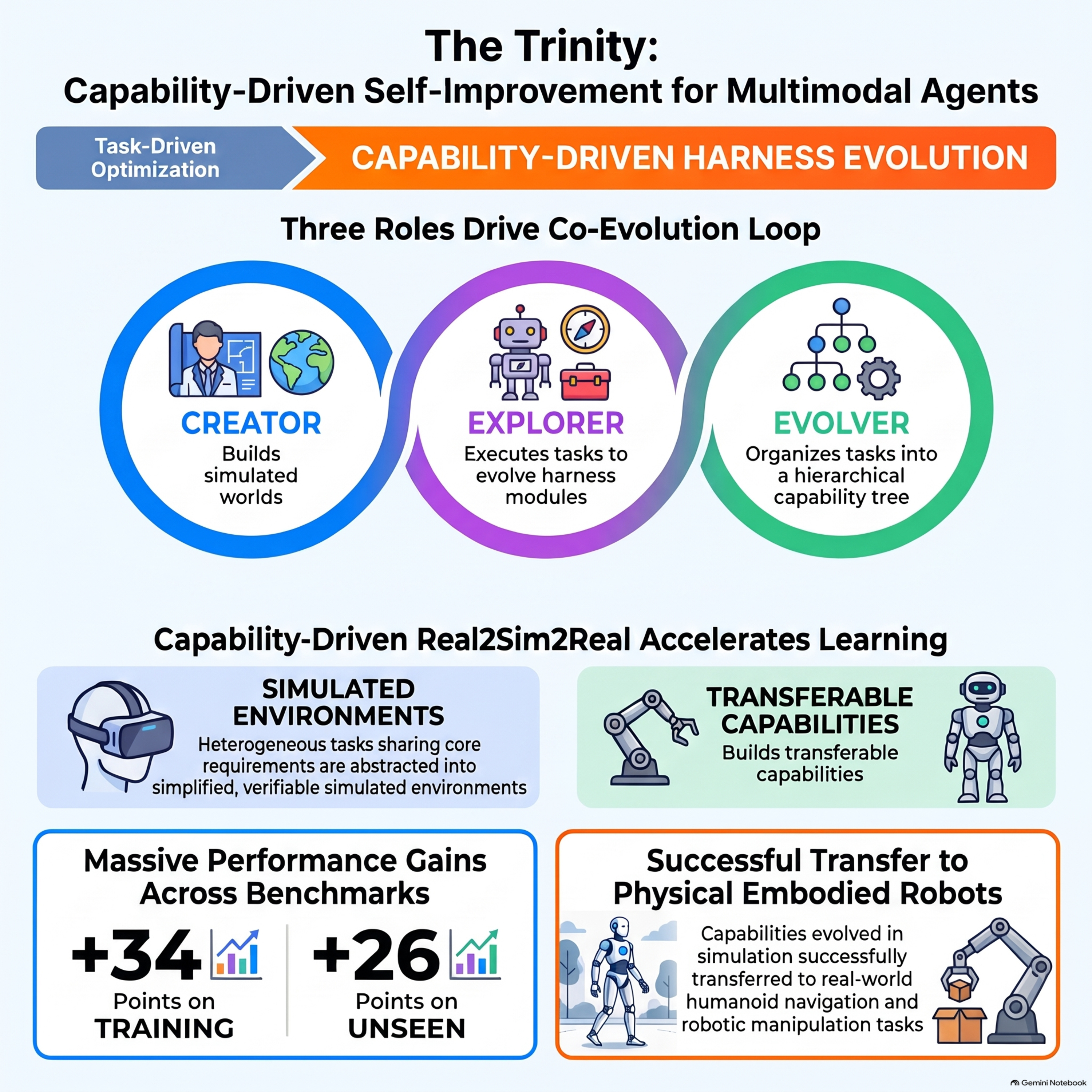
Current recursive self-improvement overfits “harnesses” to surface tasks; Trinity uses a creator-explorer-evolver loop to build a capability tree, generate stripped-down verifiable sim worlds, and route the agent to the right evolved harness. A frozen Claude Opus 5 is controlled via six harness protocols (perception, memory, inference, planning, orchestration, loop).
ARC-AGI-3 grouped with Micro Mouse via perception/state tracking; Soon benchmark (Unitree G1) success 0%→60%; CapEx shell game (Aloha Mini 2) learns evidence-gated commitment. Reported gains: +34 points mean over 28 benchmarks; +26 on 18 unseen.
Written by AI. May contain mistakes.
Exploration of the issues with current AI training methods and the need for self-teaching capabilities.
“That is a really great way to visualize the bottleneck we're currently facing in the field.”
Discussion on how AI currently uses feedback for improvement and the concept of harnesses.
“Right now, a major approach is called recursive self-improvement, or RSI.”
Examination of how overfitting in AI harnesses limits generalization and flexibility.
“tasks that look completely unrelated to you and me, actually share the exact same underlying capability requirements.”
An overview of the Trinity framework's approach to AI development through capability-driven learning.
“But if we connect this to the bigger picture, we see exactly why the Evolver grouped them.”
Detailed discussion of the three specialized roles within the Trinity framework and their functions.
“And the really crucial part of the data here is that the creator intentionally strips out all the distracting aesthetics.”
Understanding how the Evolver organizes tasks into a capability tree to enhance learning.
“But practically speaking, how does it know which tools to use when it faces a brand new unseen challenge in the wild?”
Learn about the cost and performance trade-offs of different AI training setups.
“Now, training these models costs compute power, which is measured in tokens.”
Discover how AI capabilities transfer from simulations to real-world robots.
“The research team took these capability evolved harnesses and transferred them to actual physical robots to see if the learning held up against the friction of reality.”
Examine the shell game task and how AI learns patience and verification.
“Just by utilizing those evolved perception and state tracking capabilities we talked about earlier, it learned that capability in a digital maze and applied it to a physical room.”
Understand the significance of AI moving beyond brute force to adaptive learning.
“and on the 18 unseen benchmarks, tasks the AI had never encountered during training, it improved by 26 points.”
Contemplate the potential of AI to discover complex capabilities beyond human understanding.
“And that leads to a rather profound thought to leave you with.”

Get the gist, explore an idea or ask about something said.
 Claude
On Best AI papers explained, what are the key points of this episode?
Searching your listeningAutomatic transcript. May contain errors.
0:00Welcome to today's deep dive. Our mission today is to explore a pretty groundbreaking paradigm shift in artificial intelligence. This comes from the research team at Cardinal AI Lab specifically. They're known as the Trinity Research Team. And we are looking at how AI is, you know, moving away from just memorizing specific narrow tasks. Instead, it's actually learning to teach itself core underlying capabilities. Which is a huge leap. It really is. the ultimate goal here, allowing these digital minds to successfully pilot physical robots out in the messy, completely unpredictable real world you live in.
0:37So, okay, let's unpack this because to understand what this research actually solves, you have to imagine you are trying to teach someone how to navigate a completely dark room. I love that analogy. That is a really great way to visualize the bottleneck we're currently facing in the field. Right. Because at first, you might just, you know, grab their shoulders and steer them. You tell them, take exactly three steps forward, turn 90 degrees left to avoid the couch and walk two steps. And that works. It works perfectly, but only for that one specific room. The second you put them in a different room or I don't know, someone just moves the couch, they are going to walk straight into a wall.
1:13Exactly. Because they didn't learn how to navigate. They just memorized a highly specific script. And that script following is exactly what we have been doing in the world of artificial intelligence for years now. I mean, we've been manually steering AI through highly specific tasks. We build these massive customized training environments brick by brick. Which has to be exhausting. Oh, it is. And as tasks get incredibly complex, manually building those environments for every single variation of a task is becoming practically impossible. The sheer volume of manual labor required to construct heterogeneous, verifiable environments for every new objective is just staggering.
1:53Wait, hold on. Before we go down the rabbit hole here, when you say heterogeneous, verifiable environments, you are basically just talking about scenarios that are completely different from one another, right? Like one environment for playing chess and another for folding laundry. Right. Totally different surface tasks. But where we can definitively prove if the AI succeeded or failed without a human having to sit there and grade it. Precisely. We need a way to know if the AI actually achieved the goal automatically. And what's fascinating here is that the framework we are exploring today, which is called the Trinity, it completely flips this manual paradigm on its head.
2:28Okay. They propose that multimodal intelligence, so an AI that can process text, images, and physical movement, isn't just about memorizing a checklist of tasks. Instead, intelligence can be viewed as a co-evolution between worlds and agents. A co-evolution. Yeah. The environments autonomously generate the tasks. And the agent evolves to master not just the specific task in front of it, but the core capabilities underneath it all. Okay, to really get why this co-evolution is such a massive deal, I think we need to look at why the current standard for AI training is hitting that proverbial brick wall.
3:05Right now, a major approach is called recursive self-improvement, or RSI. Right. With current RSI, the basic idea is that an AI uses its own feedback to iteratively improve its problem-solving strategies. Like practicing a shot in basketball over and over. Exactly. And this whole process is coordinated by something called a harness. Let's define that right now, actually, because that word comes up a lot in this data. What exactly is an AI's harness? Because honestly, I'm picturing a parachute. Not quite a parachute. Think of the harness as the scaffolding or the control system wrapped around the AI's core brain.
3:42If the AI model itself is the raw intelligence, the harness is the set of protocols that tells it how to use that intelligence. Okay. It dictates how the AI should look at a problem, how it should access its memory, and how it should plan its next move. In traditional RSI, we optimize this harness for highly specific tasks. So say we train it recursively to generate Python code or to solve complex algebra equations. But doing that leads to a massive problem the paper calls harness overfitting. Yes. The agent gets incredibly proficient at one highly specific thing, like it becomes the world's greatest algebra solver, but it completely fails to generalize.
4:24The second you ask it to shift from, say, parsing text to analyzing a video or controlling a robotic arm, the harness just breaks down. Because it optimized for the task itself, not the underlying capability. It's like a student who memorizes the exact answers to a practice test. They know that the answer to question four is C, but they fail the actual exam because they didn't learn the underlying math concepts. Exactly. And because they only memorize the bubble to fill in, they are completely helpless when the test format changes or when the variables are even slightly tweaked. Yeah. The AI is memorizing the surface form of the task rather than acquiring a flexible skill.
5:04The key insight from the research is that tasks with totally different surface forms, tasks that look completely unrelated to you and me, actually share the exact same underlying capability requirements. So instead of teaching it how to solve test A and test B, we teach it the underlying logic that solves both of them. Yes, exactly. If we can shift the AI's focus away from the superficial details of the task and toward those shared underlying capabilities, We unlock a massive potential for generalization. The AI isn't learning a script anymore. It's learning a fundamental skill. But that creates a huge sorting problem, doesn't it?
5:41I mean, if an AI is looking at a massive database of tasks, how on earth does it know they share a capability? Because to an AI, reading a spreadsheet and navigating a physical room probably look wildly different. They do. And this is where the framework introduces three specialized roles. The creator, the explorer, and the evolver. Okay, the trinity. Right. Think of them as three distinct sub-agents working together in a continuous loop. The creator's job is to generate worlds or environments. The explorer is the agent that actually interacts with those worlds, collects data, and learns. And the evolver?
6:17The evolver is the supervisor. It uses the feedback from the explorer's successes and failures to update the agent's harness. And it's the evolver that shifts the organization from just a random list of tasks into what the research calls a capability tree. Correct. The Evolver looks at how tasks are executed and groups them into a hierarchical tree based on what underlying skill they demand. Let's look at a concrete example from the data to make this clear. Yeah, please. So the Evolver looked at a task called ARC-AGI-3. This is a purely digital puzzle game where the AI has to recognize colored grid states and figure out how they change based on a hidden rule.
6:58Okay, so just moving colored pixels on a screen. Right, purely digital. Got it. And then the Evolver grouped that digital grid puzzle with the Micro Mouse challenge. Wait. Yeah, Micro Mouse has a physical real-world robotics challenge where a mechanical mouse has to navigate through a complex physical maze using its sensors and motors. Wait, I have to push back on that. Grouping a digital 2D pixel puzzle with driving physical motors in a 3D maze, Doesn't throwing wildly different tasks like that into the exact same bucket just confuse the AI? I know. It sounds crazy. Visually, mechanically, mathematically, they have almost nothing in common on the surface.
7:35It definitely seems counterintuitive at first glance. But if we connect this to the bigger picture, we see exactly why the Evolver grouped them. While the surface of the tasks looks entirely different, both require the exact same foundational capability, accurate perception, and state tracking. Okay, walk me through that connection. because I'm still stuck on the pixels versus the motors. Sure. So the ARC AGI 3 puzzle requires the AI to recognize the current state of a grid, hold that state in its memory, and track how it changes over time to deduce the rule. Okay. The micromouse challenge requires the physical robot to continuously update its internal map, its state, as it explores new corridors in the physical maze.
8:15Oh, wow. I see it now. Yeah. By grouping them at the same node on the capability tree, that underlying mechanism, perception and state tracking, becomes the common learning objective. The AI isn't learning how to solve a maze or how to solve a grid. It's learning how to accurately track a changing environment, regardless of what that environment looks like. Okay, that actually makes brilliant sense. It's looking entirely past the aesthetic wrapper of the task. But here is the next problem. Once the Evolver has grouped these tasks by their shared capabilities, the Explorer needs a place to practice them.
8:53Yes. But we can't just let it practice on the real tasks over and over because we run right back into the memorization problem. If it runs the micromouse maze 10 ,000 times, it's not learning state tracking anymore. It's just memorizing that specific maze. Precisely. And this is exactly why the Create a Rule exists in the Trinity framework. The research introduces a pipeline called capability-driven reel-to-sim-to-reel. Okay, reel-to-sim-to-reel. Exactly. For all the tasks sitting at the exact same node on the capability tree, let's say a node for tasks that require evidence verification before making a decision, the creator abstracts their common requirements.
9:34It builds simplified, highly verifiable simulated worlds for the explorer to practice in. And the really crucial part of the data here is that the creator intentionally strips out all the distracting aesthetics. It does. It emits the target task layouts, the private proofs, the aesthetic optimization. It's like building a stripped down batting cage. If you want to teach a baseball player how to hit a fastball, you don't need to build a massive stadium. You don't need fake fans cheering in the stands and you don't need an umpire. You don't even need a pitcher. You just need a pitching machine to drill the exact physical mechanic of the swing.
10:09The creator builds that stripped-down batting cage for the AI. It preserves only the core decision processes needed to practice the capability. So the explorer jumps into this simulated batting cage and it executes the tasks. If it swings and misses, the environment provides verified feedback. Right. The evolver then takes that feedback and refines the agent's harness, specifically targeting the capability required at that known on the tree. And the beauty of this loop is that evaluation on the original real-world tasks is kept completely separate. The real tasks are used solely at the end to measure if the capability actually transferred from the simulation.
10:47The AI never gets the chance to memorize the test. As the agent practices in all these different batting cages, you know, one for perception, one for logic, one for evidence verification, it essentially develops a massive toolkit of highly refined skills. But practically speaking, how does it know which tools to use when it faces a brand new unseen challenge in the wild? That is the million-dollar question. To understand that, we need to dive a little deeper into how the harness actually functions in this framework. In this specific study, the harness is coordinating a frozen large language model, specifically Claude Opus 5.
11:21And frozen just means the core brain of the AI isn't being retrained or altered, right? Correct. Retraining a massive model like that requires an absurd amount of compute power. By freezing it, the model's internal weights don't change at all. Instead, the harness acts as the external control system, guiding that frozen brain through six distinct protocols. Which are? Perception, memory, inference, planning, orchestration, and loop. Okay, instead of just reading those off as a list, what does that actually look like in action? Say the AI is piloting a robot arm trying to open a stubborn jar in your kitchen.
11:57Okay, let's trace the protocols for that jar. First, perception. The harness directs the AI to extract facts from its camera, recognizing the jar in the lid. Okay, simple enough. Second, memory. It pulls up its history, noting that it just tried twisting the lid to the left, but it slipped. Third, inference. It generates compatible hypotheses for why it slipped, maybe deducing that the lid is greasy. Okay, then planning comes in. It ranks the options like wipe the lid, tap the lid, or squeeze harder. Right. Then orchestration figures out what resources or physical tools it has available to execute the plan.
12:34And finally, loop resolves the execution, actually making the physical move to tap the lid, and then feeding the new state back into perception to start the cycle all over again. So as the Evolver refines the agent at each node of the capability tree, it's updating the specific configurations for those six protocols. The result is an entire family of evolved harnesses, each specializing in different capabilities. Exactly. But again, when the AI walks into a room it's never seen before, how does it pick the right harness? It uses something called a capability-aware harness router. Okay. When the agent faces a new task, the router looks at the public information available about the task, and it retrieves execution experience from its memory.
13:15It uses this to select a matching branch of the explorer's harness tree. So if the AI is a construction worker with this massive, constantly evolving tool belt, the router acts like a foreman. I like that. The foreman looks at a new architectural blueprint and says, OK, for this specific job, you only need the hammer, the measuring tape and the level. Leave the power saw on the truck. It's just going to get in the way and slow you down. It's a very accurate way to look at it. And the research provides compelling data to prove how efficient this routing system is. They compared a flat capability grouping against this hierarchical capability tree approach.
13:51What do you mean by a flat grouping? A flat grouping is where the AI just dumps all its learned skills into one massive, unorganized pool, rather than branching them out logically. Now, training these models costs compute power, which is measured in tokens. The flat setup took the fewest tokens, about 136.9 million. Whoa, okay. That is incredibly cheap in the AI world. But the performance absolutely bombed. So you save a bunch of compute money, but you build a completely incompetent AI. Exactly. The hierarchical capability tree approach, utilizing those simplified simulated worlds, cost more to organize, but it achieved the absolute best module-only scores.
14:3456.95 % on the training set and 47.26 % on unseen tasks. Meaning the extra compute is completely worth it. It proves that the router isn't just randomly grabbing tools. It efficiently matches the inferred task requirements to the exact right harness configuration, significantly outperforming systems that try to use one giant generalized harness for everything. Okay, those numbers are great. A score of about 57 on a digital leaderboard is a solid win. But a simulated batting cage doesn't have gravity, it doesn't have physical friction, and it doesn't have camera glare. The physical world doesn't care about your token efficiency.
15:13That's very true. Did they actually put this into a physical robot to see if the capability transferred? They did. And this brings us to the ultimate test. Real world embodied transfer. The research team took these capability evolved harnesses and transferred them to actual physical robots to see if the learning held up against the friction of reality. And they used two very different robotic setups to test this. Let's look at the first one, the Soon benchmark. This involves a humanoid robot, the Unitree G1. The objective is something you or I do without thinking. Navigate to a desk that's sitting beside a fan and reach for it.
15:51Simple for us, but incredibly complex for an AI relying purely on head camera images to judge depth, distance, and physical obstacles. With a basic, unevolved setup, the baseline harness, the robot essentially looked around, guessed the desk was close enough and stopped moving entirely out of reach. It failed 100 % of the time on the real robot. If you've ever watched a basic robot try to navigate a living room, you know exactly what that looks like. They usually just freeze or they confidently drive straight into the coffee table. Right, because they lack the underlying capability to dynamically track their state in a physical space.
16:27But with the evolved harness, the behavior changed drastically. It turned toward the desk, advanced in careful small steps until the desk was directly ahead, and then accurately reached out. It improved its success rate from 0 % to 60 % on the real physical robot. Just by utilizing those evolved perception and state tracking capabilities we talked about earlier, it learned that capability in a digital maze and applied it to a physical room. Yes. The second example is even wilder. It's the CapEx benchmark using an Aloha Mini 2 robotic arm. The task is a literal shell game. There are three inverted cups on a table, and a green cube is hidden under one of them.
17:09The robot has to uncover the cups and report the cube's location. And this requires a very specific capability, verifying evidence before committing to a decision. Looking at the visual record in the research, the contrast between the models is just hilarious. With the basic setup, the robot arm just clumsily knocks cup number one over, ignores cup two entirely, randomly checks cup three, and then just gives up. It reports that there's no cube at all. It didn't even bother checking the middle cup. It lacked the capability to systematically track its own progress and verify evidence. It was just executing a flawed script.
17:45But with the evolved AI, it's a completely different story. The arm systematically checks the cups one by one, sweeping them aside until it visually spots the green cube. It actually learned and applied the concept of evidence-gated commitment. Evidence-gated commitment, meaning it refused to make a final report until it had explicitly acquired the visual evidence it needed. It literally learned patience. This raises an important question. When we aggregate all these tasks together, from digital pixel puzzles to robotic shell games, how much better is this framework overall? The data is highly definitive.
18:22Across 28 different training benchmarks, the evolved harness improved mean performance by 34 points. and on the 18 unseen benchmarks, tasks the AI had never encountered during training, it improved by 26 points. That is massive. It is. It significantly beat baseline reference models that currently dominate the field, like Codex and DeepSeq. So what does this all mean for you, the listener? It means we are witnessing a fundamental shift in how artificial intelligence operates. This research proves that AI is finally moving past brute force memorization. It is no longer about a programmer hard coding a robot to walk 10 paces and turn left.
19:01By learning shared underlying capabilities, by focusing on the how instead of the what, AI can adapt to the messy, unpredictable physical world. It can walk into a dark room it has never seen before and actually figure out how to navigate it without a human holding its hand. And that leads to a rather profound thought to leave you with. If an AI can autonomously identify shared capabilities across wildly different tasks, you know, grouping a digital video game with a physical robotics challenge because it recognizes the underlying mathematical and logical similarities, what happens next? What happens when this recursive self-improvement loop starts discovering and optimizing for profound, complex capabilities that we humans haven't even invented a name for yet?
19:45If the batting cage is building swings we can't even comprehend, the game is about to change entirely. Thank you for joining us on this deep dive, we'll catch you next time!
This paper introduce The Trinity, a recursive self-improvement framework designed to scale multimodal intelligence by coupling automated environment generation with agent evolution. Instead of relying on traditional task-specific optimization, the system groups diverse tasks into a hierarchical capability tree based on shared underlying requirements. Through a process called Capability-Driven Real2Sim2Real, the framework constructs simplified, verifiable simulation worlds where specialized Harness configurations continuously refine their reusable modules. A Capability-Aware Harness Router then utilizes public task information and verified execution experience to match new tasks with the most suitable Harness branch. Ultimately, this approach successfully improves performance across numerous training and unseen benchmarks while demonstrating effective transfer to physical, real-world embodied settings.


