In short
Test-Time Policy Optimization (TTPO), a method for improving language models’ complex math reasoning without ground-truth answer keys, using self-generated rollouts and a two-branch training scheme.
Guests
No guests are mentioned; the episode is presented as a host conversation.
Guest backgrounds
Not applicable.
Key claims
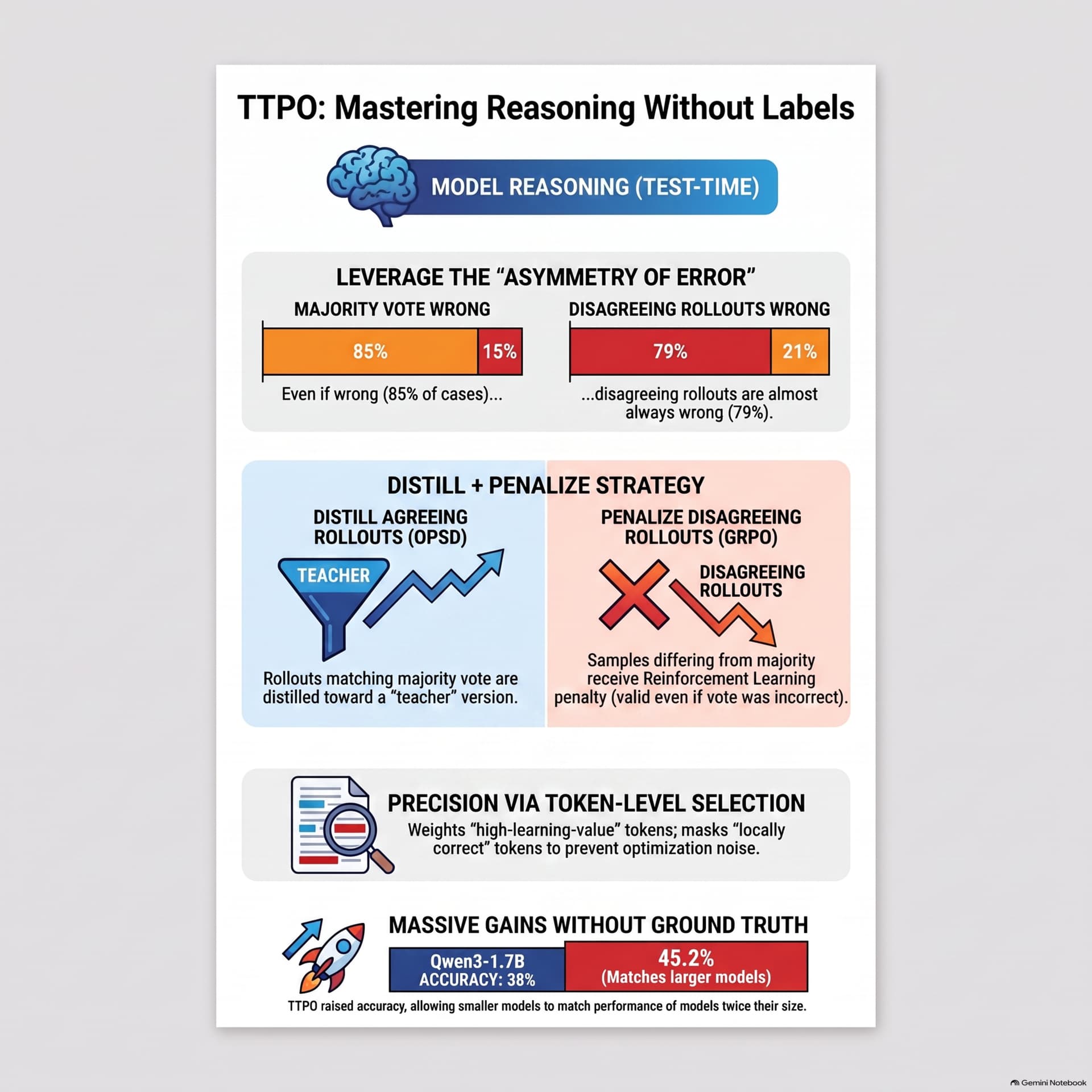
TTPO improves accuracy on hard competition math (AIM 2026) without seeing correct answers; it exploits an “asymmetry of failure” where dissenting rollouts are usually also wrong, enabling safe negative learning. It avoids on-policy self-distillation collapse (majority pseudolabel wrong ~85% of the time) via GRPO penalties plus token-level weighting/masking.
Notable examples
Quinn 3 1.7B accuracy rises 38.0%→45.2% in pure test-time training; a 4B TTPO model matches an untrained 8B model; thinking-to-non-thinking distillation yields +25.2% to +36.4%.
Written by AI. May contain mistakes. Listen to the episode to check what was said.
Chapters
Tap a time to open that second in VOUnderstanding Traditional AI Training
1:18 to 1:54
Discover how traditional AI models rely on answer keys for training.
“It's called test time policy optimization, or TTPO.”
The Challenge of Hidden Truths
1:54 to 4:36
Explore the issues AI faces when answer keys are unavailable.
“Typically, models rely on what the industry calls ground truth labels.”
The Pitfalls of Majority Voting
4:36 to 5:30
Learn why relying on majority voting can lead to incorrect conclusions.
“It's an advanced high school math competition.”
The Asymmetry of Failure in AI
5:30 to 6:50
Examine how AI learns from both majority and dissenting answers.
“And this is exactly where traditional training methods collapse, because there's this common technique called on-policy self-distillation.”
Two-Pronged Training with TTPO
6:50 to 8:10
Understand how TTPO splits training between majority and dissenting attempts.
“But this is where that massive shift in perspective comes in, right?”
The Role of Positive and Negative Reinforcement
8:10 to 11:24
Discover how TTPO applies reinforcement learning differently to training attempts.
“So what is the actual learning mechanism?”
Precision in Learning: Token Level Selection
11:24 to 14:00
Learn how token weighting improves AI learning efficiency.
“That is a brilliant way to conceptualize it.”
Understanding Test-Time Policy Optimization
14:00 to 16:28
Learn how TTPO focuses AI learning on critical moments of uncertainty.
“If the model is 99.9 % sure the next word is therefore, the entropy is incredibly low.”
Real-World Implications of TTPO
16:28 to 18:10
Discover how TTPO dramatically improves AI performance on math exams.
“And all while operating entirely on its own unverified guesses.”
Surprising Success Against Perfect Models
18:10 to 18:38
TTPO outperforms models trained with perfect answers, challenging education norms.
“When TTPO, using its own flawed blind majority voting system, was tested against models that were trained using perfect ground truth answer keys, TTPO actually won.”
Show all 12 chapters
The Psychology of Learning from Failure
18:38 to 21:15
Explore how TTPO reflects human learning processes and the risks of paralysis.
“It comes down to an issue of starvation.”
Ethical Considerations of Self-Correcting AI
21:15 to 22:59
Discuss the potential implications of AI applying TTPO in subjective domains.
“But, you know, as we wrap up this deep dive, it leaves me with a lingering, slightly unnerving thought.”
Transcript
Automatic transcript. May contain errors.0:00So I want you to imagine, uh, imagine you're sitting in a freezing cold, dead silent gymnasium. Oh, the classic nightmare. Right. The absolute worst. And you're about to take just the most brutally difficult math exam of your entire life. Like the kind where you read question one and your brain just completely shuts down. Yes, exactly. You just want to walk out, but you dive in, you know, you struggle, you fill up the pages with your best guesses, and then you hand it in. OK. But here is the bizarre twist. There's no answer key. Like, no teacher is ever going to grade your paper with a red pen.
0:36Nobody is ever going to tell you if you got question three right or if you completely failed question four. So you get literally zero feedback. Zero. Nothing. Yet miraculously, just by the sheer act of struggling through that impossible test, you actually walk out of that gymnasium smarter. Like your fundamental reasoning skills have permanently leveled up. Which is, I mean, it feels like magic, right? Or maybe a paradox. Because we are so deeply conditioned from childhood to believe that learning is a transaction. Right. You need the grade. Exactly. You make an attempt, someone tells you if you hit the target, and then you adjust.
1:08We just assume that without a target, progress is totally impossible. Well, the crazy thing is that paradox is no longer just a hypothetical scenario. Today, we're doing a deep dive into this massive leap in artificial intelligence. It's called test time policy optimization, or TTPO. Yeah, TTPO is fascinating. It really is. It has this framework that basically allows language models to dramatically improve their complex mathematical reasoning while they're taking a test. Without ever seeing the answers. Exactly. Without ever being handed the correct answers. It's just entirely self-taught in the moment.
1:44And, you know, to really appreciate how wild this is, we kind of have to look at the baseline of how AI is normally trained. Right. Because usually there's always an answer key. Always. Yeah. Typically, models rely on what the industry calls ground truth labels. Ground truth. Yeah, ground truth, which is simply the verified, objective, correct answer. So if you want an AI to learn calculus, you give it a problem, let it spit out a guess, and then you reveal the ground truth. You show it the answer key. Right. And the model then adjusts its internal wiring, its parameters, to close the gap between its guess and the reality.
2:19So the monumental challenge that TTTQ tackles is, well, how can a system upgrade its own logic when that ground truth is just completely hidden? So if the model doesn't know the actual answer, what's the stand in? I mean, I imagine researchers must have tried some incredibly complex workarounds before landing on TTPO. Well, the most common historical approach is actually surprisingly straightforward. Yeah. It's called test time training or TTT. OK. The logic there is that if you don't have the teacher's answer key, you have the AI generate its own answer and you just treat that generation as the truth.
2:56Wait, hold on. If the model is already struggling with the question, how does it generate a stand in answer that isn't just, you know, total garbage? Like you can't just blindly press your first guess on a test you don't even understand. You're right. You don't trust the first guess. You trust the crowd. The crowd. Yeah. So the model doesn't just try to solve the problem once. It samples multiple different logical paths. It might spin up, say, 64 entirely distinct attempts to solve that one complex math problem. Oh, wow. Okay, so 64 different versions of it trying to figure it out. Exactly. And then it looks at the final answers from all 64 attempts.
3:30It clusters the identical answers together, and it just takes a majority vote. Hmm. Whichever answer shows up the most frequently across those 64 tries becomes the pseudolabel. So the model basically tells itself, you know, most of my thought processes led to this specific number. So I'm just going to assume this is the correct answer. Right, right. I'll train my neural pathways to prefer this route. Exactly. I mean, that makes a lot of intuitive sense. It's kind of like being in a study group. Yeah, exactly like that. Like you and nine friends are working on a nightmare problem set and you don't have the textbook.
4:03Everyone just works it out on their own. And if, you know, eight out of 10 of you arrive at the exact same conclusion, you feel pretty confident. You figure the group probably nailed it. Right. You're like, we figured it out. It's a perfect analogy, but it also reveals the fatal flaw in this whole method. Oh. Yeah, because that logic only holds up if the problem is actually within the general capability of the group. Oh, I see. When we talk about these AI models, we're testing them on really hardcore competition-level mathematics. Wow. The AMIN 2026 test. The AM. M. That's a... It's an advanced high school math competition.
4:43It requires intense, multi-step logical leaps. So it's not just a basic algebra pop quiz. Not even close. So let's look at a specific AI model called Quinn 3 1.7b taking this test. Okay. And the 1.7b, that means it has 1.7 billion parameters. Yes, exactly. Think of parameters as like the digital synapses in the model's brain. And in the grand scheme of AI, 1.7 billion is actually quite small. It's like a lightweight underdog. Yeah, compared to those massive trillion parameter behemoths. Yeah. So when you ask this compact model to use majority voting on the AM test, the crowd is almost always wrong.
5:16Wait, really? Yeah. In fact, that pseudo label, the majority consensus, is incorrect for about 85 % of the prompts. 85%. Yeah. So your study group is just aggressively, confidently wrong almost nine times out of ten. Very confidently wrong. Yeah. And this is exactly where traditional training methods collapse, because there's this common technique called on-policy self-distillation. Or OPSD. Right. And in OPSD, the model uses a teacher version of itself to score its own work, token by token. Okay, wait. Let's pause on the word token for a second, because I know we're going to be talking about them a lot.
5:50Good idea. For anyone who isn't deep in the weeds of machine learning, a token is basically a chunk of a word or like a single mathematical symbol, right? It's the smallest unit of language the AI processes. Exactly. The AI generates its thoughts one token at a time. So in OPSD, the teacher evaluates the student's step-by-step token generation based on the final answer. Now imagine feeding an 85 % failure rate into that distillation process. Oh man, you'd be forcing the teacher to steer the student toward a fundamentally flawed conclusion. Right. Right. The teacher is forced to invent these bizarre, twisted, logical steps just to justify a wrong answer.
6:31Wow. And the student absorbs all of that nonsense, literally hardwiring bad reasoning into his brain. So instead of learning math, the model is meticulously studying how to fail. Which just seems like an insurmountable wall. Like if the study group's majority is wrong 85 percent of the time, learning from them feels completely impossible. It does. But this is where that massive shift in perspective comes in, right? The thing that makes this whole framework actually work. Yes. Because there's a hidden structural secret in how the AI is wrong. And this is the core breakthrough of TTPO. Let's zoom in on that 85 % of the time when the majority vote is completely wrong.
7:08Okay. Within those 64 attempts, you have the majority who agreed on the wrong answer, but you also have the minority. You know, the rogue attempts that arrived at totally different answers. To dissenters. Right. Now, a naive assumption might be that since the majority is wrong, maybe one of those dissenting outliers actually stumbled onto the hidden truth. Like maybe they're the genius in the group. Exactly. But the statistical data shows something entirely different. Even when the pseudolabel is garbage, about 79 percent of the individual attempts that disagreed with that majority are also undeniably wrong.
7:43So they didn't find the secret right answer. They just found a wildly different wrong answer. Yes. They're genuinely incorrect. They aren't the ground truth, and they aren't even the popular wrong answer. They're just bad math. And this creates a fascinating mathematical property called the asymmetry of failure. Okay, I am going to need you to slow down and explain this, because I'm struggling to see how two wrongs make a right here. Fair enough. Like, if the majority says 2 plus 2 equals 5, and one rogue AI brain cell goes off and confidently claims 2 plus 2 equals 6, why does that help us? Right, because they're both wrong.
8:18Yeah. The crowd is flawed. The dissenter is flawed. So what is the actual learning mechanism? Think about the penalty. When we penalize that rogue attempt, the one that claimed six, we are not pulling the model toward five. We are not endorsing the majority's flawed logic. We're simply delivering a very narrow, very specific message. Whatever series of logical leaps you just made to arrive at six, that sequence is definitively bad. Oh, I see. So it's reliable negative learning. Exactly. Stating what a sample is not remains highly reliable, even when the pseudo-label itself is completely untrustworthy.
8:57That is so smart. Because if an attempt disagrees with the consensus on these incredibly rigorous tests, the statistical probability is overwhelmingly high that it is a bad attempt. It's just noise. Right. So penalizing that specific disagreement turns out to be a remarkably safe bet. Okay, so we have this asymmetry. We know that punishing the dissenters is a safe move. How does TTPO actually restructure the AI's training architecture to, you know, capitalize on this? Well, TTPO splits the training into a two-pronged system. Okay. It treats the attempts that agreed with the majority totally differently than the attempts that disagreed.
9:31Let's look at branch one, the positives. The positives. Right. These are the rollouts that arrived at the majority answer. Right. The 85 % of the time they're agreeing on something that might be entirely wrong. Exactly. And for these, TTPO uses that on-policy self-distillation we discussed earlier. The model basically uses its own majority answer as the teacher. But wait, didn't we just establish that using a wrong majority as a teacher forces the model to learn twisted, weird logic? We did. So why are we suddenly okay with distillation? Because of a crucial distinction in what is actually being distilled.
10:05See, it would be disastrous if we were forcing the teacher to justify an arbitrary wrong answer from an outside source. Right. But here, the teacher is conditioned on the exact same answer that the student's own positive rollout just organically produced. So the student and the teacher already share the same logical path. Oh, I get it. They're in agreement from the start. Yes. So the update isn't injecting foreign, twisted logic to reach an unnatural conclusion. Instead, it's practicing what's known as thinking-to-non-thinking distillation. Thinking to non-thinking. Yeah. When the model originally solved the problem, it used its slow step-by-step reasoning mode.
10:43It essentially thought out loud. Oh, kind of like a human using system two thinking slow, deliberate, analytical. Exactly like that. So in this positive branch, the model takes that careful step-by-step structural process and bakes it into its fast intuitive neural pathways. Oh, wow. Even if the final number is wrong, the process of structuring a mathematical argument is being refined and reinforced. Okay, I think a basketball player practicing their free throw. Okay, yeah. Like even if the ball ultimately clanks off the rim and mices, the act of practicing the smooth motion of the wrist, the bend of the elbow, the follow through, that is still building valuable muscle memory.
11:23Yeah. You're practicing your form. That is a brilliant way to conceptualize it. Yeah. You are reinforcing the architecture of thought. Right. Now contrast that with branch two, the negatives. These are the rogue rollouts that disagreed with the majority. The ones that said two plus two equals six. Exactly. And we know these are almost certainly terrible attempts. So for these, TTPO abandons distillation entirely. It switches to a reinforcement learning penalty called GRPO or group relative policy optimization. Oh, GRPO. This sounds like where the hammer comes down. It is. It assigns these negative attempts a negative advantage score.
11:59Okay. In reinforcement learning, an advantage score calculates how much better or worse a specific action was compared to the baseline expectation. By assigning a negative advantage, TTPO sends a mathematically precise signal. Do not repeat the sequence of decisions that led to this outlier. Okay, so the positives get this complex coaching session on their structural form, and the negatives get a sharp reinforcement penalty. Right. But, you know, this raises a huge red flag for me. What's that? If I'm taking a math test and I write out a beautiful, elegant 10-step proof, but on the very last line I make a dumb arithmetic error and write 2 plus 2 equals 5.
12:35Oh, yeah. If you penalize my entire attempt because the final answer is an outlier, you are punishing all that brilliant, valid math I did in the first nine steps. You've hit on one of the biggest dangers in machine learning right there. Broadly punishing or rewarding entire paragraphs of text is a really blunt instrument. It's too messy. Exactly. You inevitably punish good reasoning that happens to live inside a failed attempt. Or you accidentally reward boring, useless filler text just because it happened to be part of a successful attempt. Right. The system requires microscopic precision. Which brings us back to tokens.
13:13We need a scalpel, not a sledgehammer. We have to go in and operate on the individual words and math symbols. And TTPO achieved this through a mechanism called token level selection. Token level selection. Yeah, let's look at how it applies the scalpel to branch one, the positives. This technique is called token weighting. Okay. When the model is distilling its reasoning, practicing its form, as you put it, it doesn't treat every token equally. It evaluates every single symbol to see if there's actual learning value there. And it does this by measuring the model's entropy. Entropy. Usually I hear that word in thermodynamics, you know, talking about chaos and disorder.
13:49How does an AI have entropy? Like, does it feel uncertain? Kind of. In information theory, entropy is a mathematical measure of uncertainty. When an AI is generating text, it's constantly calculating the probability of what the next token should be. If the model is 99.9 % sure the next word is therefore, the entropy is incredibly low. There is no uncertainty. Because the path is obvious. Exactly. So if the model is setting up a basic geometry problem and writes down 0 ,0 for the coordinates of the origin, the entropy is near 0. Right. TTPO looks at that and assigns that specific token a weight of zero.
14:26It essentially tells the model, do not waste valuable computational energy reinforcing something you already know with absolute certainty. Oh, wow. But then, say, three lines down, the model reaches a massive bottleneck. It needs to make a complex geometric leap about where two lines intersect. Yeah. The probability distribution flattens out, the model is guessing, the entropy spikes. And that is exactly where TTPO concentrates all the training signal. The token representing that aha moment of insight gets maximum weight. That's amazing. The AI surgically focuses its learning solely on the exact moments where it was struggling.
15:02That is wildly efficient. So how does the scalpel work on branch two, the negatives? Because we need to issue that reinforcement penalty, but we don't want to destroy the good math that was accidentally generated along the way. Right, and this requires token masking. Token masking? Think of it like a film editor working on a movie. Okay. If an actor delivers a stunning emotional monologue, but for two seconds in the middle of the scene, a boom mic drops into the frame. Oh, hate that. Right. But you don't burn the entire reel of film. You isolate the bad frames, cut them out, and protect the rest of the brilliant performance.
15:37You save the good data. Token masking does exactly this. It analyzes the failed attempt, looking for confident anomalies. Yeah. Moments where the model was mathematically certain about a claim that is statistically highly unlikely to be true. Once it identifies the faulty logic, it applies the negative GRPO penalty directly to those specific tokens. Just to the bad frames. Exactly. But crucially, it throws a protective mask over the rest of the reasoning. OK. So if the model confidently but incorrectly claims that a line on a graph is vertical instead of horizontal, the penalty hits that specific error.
16:14Yes. But if right next to it, the model correctly wrote out the quadratic formula, the quadratic formula is masked. It's protected from the punishment. Exactly. You keep the fundamental skills intact and you only eradicate the actual flaw. When you combine token weighting to hyperfocus the positive learning and token masking to surgically isolate the negative penalties, you create a training engine that is breathtakingly precise. And all while operating entirely on its own unverified guesses. Which brings us to the ultimate proof of concept. Like, we have this hyper-precise, dual-branch, self-correcting system.
16:48Does it actually translate to real-world performance? The results are staggering. Let's return to that lightweight model, Quinn 3 1.7b. The underdog. In a pure test-time training environment, no answer keys, no human intervention, just taking the test and learning from its own majority votes, Its average accuracy on these brutal math exams jumps from 38.0 % to 45.2%. Oh, a 7 % absolute jump just from sitting in the room and taking the test. Yeah, and the scaling is even more impressive. The 4 billion parameter model, using TTPO, managed to match the performance of an untrained 8 billion parameter model.
17:30Are you serious? It effectively doubled its reasoning capacity without adding a single physical parameter, purely through self-correction. And what happens when you test that thinking to non-thinking distillation? Like when you turn off the slow step-by-step reasoning mode, did it actually bake that good form into its fast intuitive response? It absorbed it completely. When the model's thinking mode is disabled, the gains are absurd. The researchers observed performance jumps of plus 25.2 % to plus 36.4 % across various model scales. That is massive. It didn't just memorize the test. The fundamental reasoning skills became a permanent part of its core network.
18:05Man. But there is one final detail in the data that just completely broke my brain. Oh, I know what you're going to say. Right. When TTPO, using its own flawed blind majority voting system, was tested against models that were trained using perfect ground truth answer keys, TTPO actually won. It did. It outperformed them. It defies everything we think we know about education. Literally everything. How can an AI learning from its own bad guesses beat an AI learning from a flawless teacher? I mean, help me understand this because it feels like a glitch in the matrix. It comes down to an issue of starvation.
18:42Starvation. Yeah. When you're dealing with problems as complex as the AIM test, perfect answers are incredibly rare for a model to generate on its own. Okay. If your training system only rewards the model when it perfectly matches the brown truth answer key, the model might make 100 attempts and never hit the target once. Ah. So it receives zero positive feedback. It gets no learning signal at all. The training engine simply stalls out. It starves to death, waiting for perfection. Wow. With TTPO, the pseudolabels the majority votes are much easier to match because the model organically generated them itself.
19:17Right. The bar is achievable. Exactly. This creates a constant healthy flow of positive and negative feedback. It keeps the model motivated. It encourages continuous exploration. And thanks to the asymmetric design and token-level precision, it manages to extract genuine, mathematically valid learning even from those flawed signals. You know, this reminds me so much of human psychology. How so? Think about how often we stall our own progress because we're just terrified of doing something wrong. We want to learn a new language or start coding or write a book, and we just freeze. Oh, totally. Analysis paralysis.
19:53Right. We sit there waiting for a mentor to harness the perfect roadmap or for the perfect answer key to just reveal itself. It's like having a strict piano teacher who just sits in silence offering zero feedback until you magically play a Mozart sonata perfectly. Which is never going to happen. Never. You just bang on the keys, you get nothing back, and eventually you quit. We starve our own learning engines. What TTPO demonstrates mathematically is that action is superior to paralysis. Yes. Making a confident guess, analyzing precisely where your logic broke down, and refining your structural process step by step is a significantly faster path to mastery than waiting for perfection.
20:33And because the AI is constantly acting and refining, it enters this incredible self-evolving loop, right? Like a virtuous cycle. That's the beauty of it. As the model gets slightly better at reasoning, its initial guesses improve. Right. Higher quality rollouts yield more accurate majority votes, which in turn raises the ceiling for the next round of training. It constantly pushes past its own limitations. And it builds on itself. Exactly. And importantly, it generalizes. If you train it on one specific math test using TTPO, it gets measurably better at completely different exams it has never seen before.
21:06Yeah. It is genuinely learning how to think. It really is a profound testament to the power of learning from failure. I mean, as long as you have a system to analyze that failure precisely. Right. But, you know, as we wrap up this deep dive, it leaves me with a lingering, slightly unnerving thought. We've been discussing this self-correcting asymmetry entirely within the realm of mathematics. And math is a beautiful closed system. At the end of the day, there is an objective reality. Two plus two is always four. Exactly. A line is either vertical or it isn't. But the real world is rarely a closed system.
21:42Exactly. So what happens when we take the training wheels off? What happens when we unleash this kind of test time policy optimization on fields that are entirely subjective? Yeah, that is the big question. Because if an AI can reliably teach itself calculus without an answer key, the natural next step is applying it to domains where an answer key doesn't even exist. Right. Think about creative writing or legal strategy or, you know, most consequentially, ethical decision making. What does the majority vote of an AI look like when it's trying to determine the most moral action in a crisis? Like if the crowd of AI rollouts decides on an ethical pseudolabel whose ethics are actually being distilled?
22:20It forces us to ask what it means to be correct when ground truth is just a matter of human perspective. We are building systems that can relentlessly optimize their own logic in the dark. The question is, when they finally turn the lights on, will we agree with the conclusions they've reached? It is a lot to chew on. I mean, we started this deep dive by imagining a brutally difficult exam with no answer key, where you somehow get smarter just by taking it. That's no longer a metaphor. It is the cutting edge of artificial intelligence. And as these models move from high school math tests to the messy subjective exams of the real world, we're all going to have to figure out what it actually means to pass.
22:58Until next time, keep diving deep.
From the publisher
This paper introduces Test-Time Policy Optimization (TTPO), a novel method for improving the mathematical reasoning of large language models without using ground-truth labels. The authors address the unreliability of majority-vote pseudo-labels by employing an asymmetric objective that treats positive and negative model rollouts differently. Specifically, it uses on-policy self-distillation to refine trajectories that agree with the majority and Grouped Reinforcement Learning to penalize those that disagree. This design is enhanced by token-level selection, which focuses learning on informative positions while masking out confident errors and already-mastered content. Experimental results demonstrate that TTPO matches the performance of label-supervised methods and enables a self-evolving cycle where the model's improvements lead to higher-quality training signals. Ultimately, the framework significantly boosts accuracy on competition-level benchmarks and exhibits strong cross-task generalization.


