
 Ask ChatGPT


 Best AI papers explained
10 Nov 2026 · 24m · 12 chapters
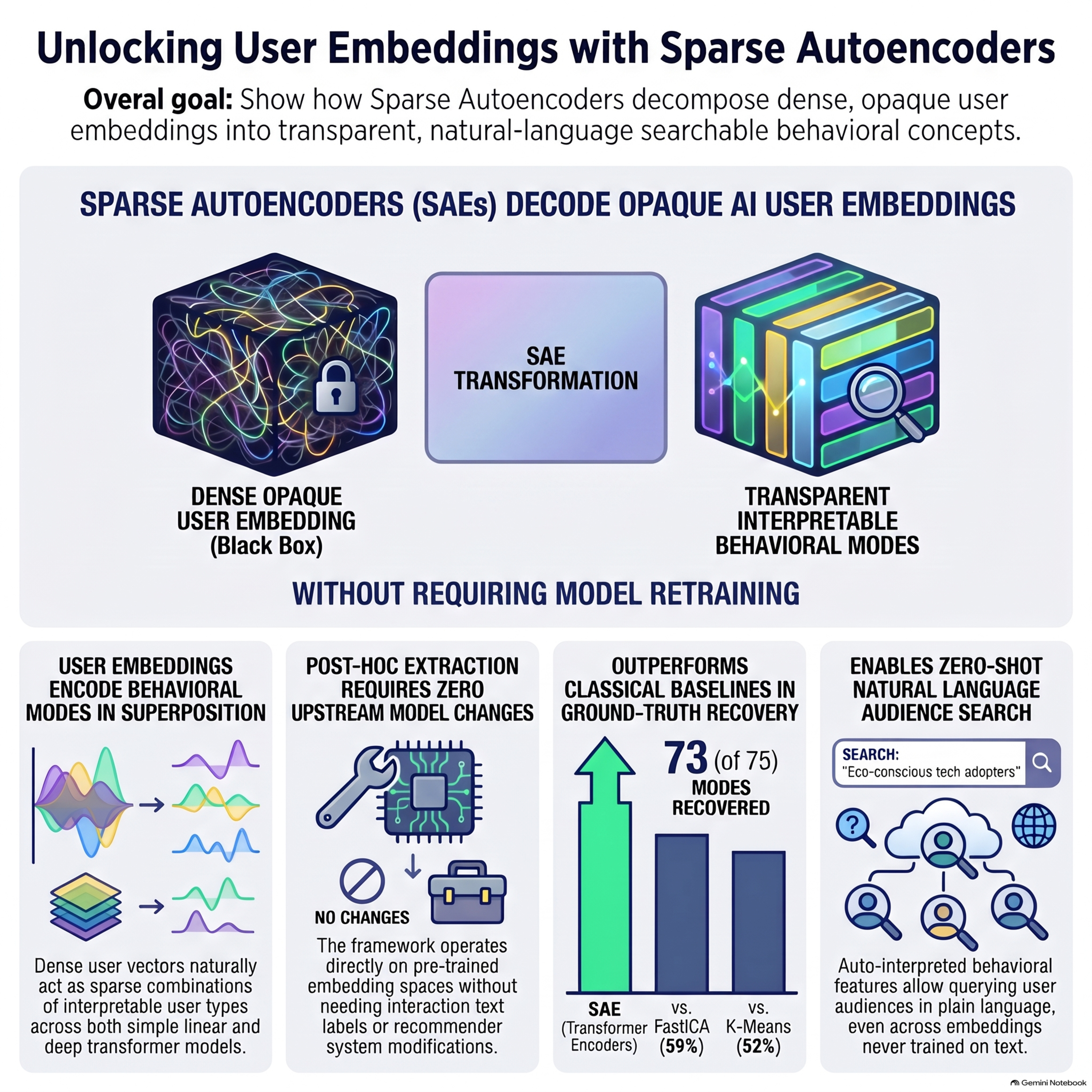
The episode explains how recommendation systems store user behavior in “user embeddings” and argues that these embeddings are superpositions of multiple interpretable “behavioral modes.” It describes a method using sparse autoencoders (SAEs) to separate overlapping traits, then using a large language model (Claude Sonnet 4.6) to name the resulting modes, enabling “zero-shot natural language audience retrieval” and potential privacy auditing via “ablation” of sensitive modes.
No guests are identified; the transcript shows two hosts conversing, but no external guest bios.
Dense embedding vectors can be decomposed into distinct modes despite limited embedding dimensions; PCA fails due to orthogonality assumptions; SAEs recover ~100% of 75 synthetic modes; LLM labeling can infer life events from purchase/rating patterns; interpretability enables bias/privacy mitigation.
“Minimalist chef,” “tech enthusiast,” “yoga practitioner”; e-commerce modes like “new parent” and “moved residents”; MovieLens “Jurassic Park” fans—K-means yields redundant generic themes, while SAE finds distinct sci-fi and indie dramedy modes.
Written by AI. May contain mistakes.
Explains how user behavior is stored in complex mathematical vectors.
“It's a really fascinating question to dig into.”
Discusses the limitations of storing detailed user traits and introduces the superposition concept.
“And the reason the system is forced to blend you into that smoothie goes back to what the research calls the superposition hypothesis.”
Describes how sparse autoencoders untangle blended user embeddings into distinct traits.
“So the traits aren't actually destroyed in this movie.”
Details the research methodology, including synthetic datasets and the success of the SAE.
“Meaning they don't have to rip up the original algorithm and start over from scratch.”
Examines the effectiveness of the SAE on real-world datasets, including e-commerce and movie ratings.
“It's a pretty flawless proof of concept.”
Learn about the challenges of categorizing subjective movie data.
“But the researchers really wanted to push the system to its breaking point because e-commerce is somewhat straightforward.”
Explore how K-means and Sparse Autoencoders analyze movie audiences differently.
“So the researchers wanted to see how the two different methods, the old K-means and the new SAE, would describe the audience that loves the movie Jurassic Park.”
Understand the concept and implications of zero-shot retrieval in audience targeting.
“But then you look at what the sparse autoencoder did with the exact same movie.”
Discuss the potential privacy threats from making user data easily queryable.
“I love the sound of that phrase, but what does it actually mean in practice for a platform?”
Learn how clearer data representations can help in auditing algorithms effectively.
“Because of a crucial silver lining that we have to discuss.”
Discover how transforming data helps in understanding and controlling algorithms.
“So it's dangerous because it exposes the depth of what the algorithm knows.”
Contemplate the implications of AI interpreting our digital identities.
“Which leaves us with a lot to think about regarding our own digital footprints.”

Get the gist, explore an idea or ask about something said.
 Claude
On Best AI papers explained, what are the key points of this episode?
Searching your listeningAutomatic transcript. May contain errors.
0:00Imagine you buy a pair of running shoes online on a Tuesday and then by Wednesday your smart TV streaming app recommends a documentary about an ultra marathon in the Sahara desert. Right. Or your grocery delivery app suddenly suggests like a brand new plant based protein powder. Exactly. And your apps, you know, they aren't talking to each other. They don't have some private group chat about your sudden fitness kick. No, definitely not. But the underlying math knows exactly who you are, what you're doing and probably what you're going to buy next. You've experienced this, right? We all have. Oh, absolutely.
0:34And it happens a little spooky. It happens all the time. The algorithm clearly holds this deep, hyper-niche knowledge about you. But how does it actually hold on to that knowledge? Well, welcome to today's deep dive. It's a really fascinating question to dig into. It really is. Our mission today is to crack open the secret algorithmic language of tech companies. We are looking at some fascinating new research today. And this research, it really explains precisely how recommendation systems map your mind. Yes. And more importantly, it introduces a breakthrough method that translates all of that opaque hidden math into, you know, plain readable human language.
1:13Which is, I mean, it really is a massive paradigm shift in how we understand these systems. So to start, for the longest time, the way your behavior is stored has been locked inside what we call user embeddings. Right, exactly. And for anyone who spends time in the machine learning space, you know that a user embedding is essentially a dense, highly complex mathematical vector. Like a coordinate in a high dimensional space. Exactly. But up until now, these vectors have operated as a total black box, meaning even the very engineers who build the recommendation algorithms, they can't easily query those numbers.
1:50So they don't even know why their own algorithm is doing what it's doing. Pretty much. They can't explain exactly why a specific recommendation was surfaced to a specific user. But this new research, it provides a master key to finally read that math. Okay, well, let's unpack this black box. Because before we can talk about unlocking it, we need to understand why it's locked in the first place, right? Yeah, we have to look at the mechanics of it. Like, why is it so hard to just read a user's data? I like to visualize a user embedding as a data smoothie. A data smoothie? Right. I actually love that analogy.
2:25Right. Think about it. You take all of your clicks, your late night impulse purchases, every movie you've watched for five minutes and then turned off in boredom. We all have those. We do. And you take all of those individual distinct actions, throw them into a giant algorithmic blender and just hit puree. And the output of that blender is your user embedding. Exactly. It's a single mathematical point. Everything is just blended together. The data smoothie is a great way to visualize the problem. And the reason the system is forced to blend you into that smoothie goes back to what the research calls the superposition hypothesis.
3:01Superposition. Okay, break that down for us. Well, you have to consider the brutal physical constraints of the system. A platform might have, you know, hundreds of millions of active users. Millions of products or videos on top of that. Exactly. So they simply cannot store an infinite, perfectly detailed ledger of traits for every single person in active memory. It would just be too huge. The computing power would be off the charts. Right. There is a limited amount of mathematical space, which we call dimensions. So let's say an algorithm only has a few hundred dimensions to work with. Which isn't a lot when you're dealing with millions of variables.
3:33Not at all. So to capture all the nuance of human behavior, it is forced to compress overlapping traits directly on top of each other. And that's the superposition. Yes, that is superposition. It's squeezing complex, multifaceted human behavior into a highly constrained geometric space. But wait, how does that actually work mechanically? Like how can one single math coordinate hold multiple distinct personalities at once? It is a bit counterintuitive. Because this is where my brain gets stuck. If I am both a dog lover and, you know, a coffee snob, how does the math know I'm both things without mixing them up?
4:06Right. You'd think they would just blend into a mess. Exactly. If they are blended into the exact same space, shouldn't they just become a muddy, generic brown smoothie? It really seems like they would. But what's fascinating is that they maintain distinct geometric directions, even while occupying the same space. Wait, how is that possible? Think about dropping pebbles into a pond. Okay. When the ripples from different pebbles meet, they overlap, right? And they cross over each other in the exact same water. Yeah, they make those cool intersecting patterns. Exactly. But the individual waves don't get destroyed.
4:40They just pass through each other. The math is doing something similar with your behavioral traits. Oh, that makes sense. So the traits aren't actually destroyed in this movie. Right. The problem has always been that we didn't have a filter good enough to isolate the individual ripples once they were overlapping. Until now. Yes. That is until this research applied sparse autoencoders or SAEs. The sparse autoencoder. This is basically the hero of the research today. It absolutely is. But let's break down how this actually works, because just throwing out the term sparse autoencoder doesn't really help us see the mechanics.
5:16Fair enough. If the user embedding is a blended smoothie, how does this thing unblend it? Let's stick with your analogy. If a user embedding is a smoothie, the sparse autoencoder acts like a highly specialized centrifuge. Okay, a centrifuge. Yeah. In chemistry, a physical centrifuge spins a mixture so fast that gravity and density force the different components to separate, you know, like milk separating from cream. Right, right. Pulls the heavier stuff out. Exactly. Well, the SAE does this mathematically. It takes that dense blended vector and untangles it back into its raw, interpretable ingredients.
5:53Okay, I track that. But what is the gravity in this mathematical centrifuge? What is the force doing the actual separating? That is a great question. Because the word sparse has to mean something very specific here, right? It does. That's the crucial mechanism. Sparsity means restriction. Restriction in what way? Well, the researchers run the data through the autoencoder. They force a mathematical bottleneck. Out of thousands of possible pathways, they constrain the system so that only a tiny handful of pathways or features are allowed to activate at any given time. Oh, wow. So they basically starve the system of resources.
6:31Exactly. Because the algorithm is starved for resources, it can't afford to waste energy on messy overlapping noise. It is forced to isolate only the most fundamental distinct concepts to rebuild the data. And that constraint, that sparsity, is what pulls the overlapping waves apart. You got it. It pulls them apart into what the research calls behavioral modes. And the truly brilliant part of this is that it's all done post hoc. Meaning they don't have to rip up the original algorithm and start over from scratch. Exactly. The original recommendation model still makes its dense smoothie. It still operates just as efficiently as it always did.
7:09So companies don't have to sacrifice speed or performance. No, not at all. The sparse autoencoder just sits on top of it, taking the finished smoothie and separating it out so engineers can read the behavioral modes. Which is just an incredible engineering trick. But, you know, it's one thing to say you can untangle latent math and theory. Theory is easy. Right. To actually prove it works, the researchers had to test it in a controlled environment, a sandbox where they already held all the answers. Right. They needed a baseline. So they created a synthetic data set. They generated 100 ,000 completely fake user profiles.
7:44That's a lot of fake data. It is. And they constructed these profiles from a very specific strict list of 75 known behavioral modes. Right. These are highly specific human personas. Yeah. Some of the examples from the paper include traits like tech enthusiast, yoga practitioner, and my personal favorite, minimalist chef. I love that one. And setting it up this way gives them absolute ground truth. Because they built it themselves. Right. They know exactly which of the 75 modes went into each of the 100 ,000 fake users. So they simulated purchase histories for these users based on those specific modes.
8:20Yep. They threw all those fake purchases into the embedding blender. And then they tested different mathematical tools to see which one could successfully pull the original 75 modes back out of the math. I want to look at the baseline they tested against here because I know there are much older ways of trying to untangle data, right? Oh, definitely. There are classic methods. Like principal component analysis or PCA. Yeah. I mean, that has been the absolute gold standard for dimensionality reduction for decades. Everyone uses PCA. So why wouldn't they just use PCA to read the modes? Well, this raises a really profound question about how classic math views the world versus how human beings actually operate.
9:01Okay, I'm intrigued. What happened? When they ran PCA on this data set, it failed miserably. It recovered almost zero of the ground truth behavioral modes. Wait, almost zero? Yeah. How does the gold standard fail that hard? I mean, it's PCA. It is wild, but it's because of a mathematical property called orthogonality. Orthogonality. Okay. PCA is rigid. It forces every category it finds to be completely independent from every other category. Like geometrically independent. Yes, geometrically. It demands that every feature exists at a strict 90 degree angle to the others. It's like trying to file every single piece of data into perfectly separate, mutually exclusive folders.
9:45But human traits aren't mutually exclusive folders. They overlap all the time. Exactly. Like someone who is a tech enthusiast is actually quite likely to also be a mechanical keyboard builder or, you know, a smart home automator. Right. They share a lot of underlying characteristics. So they aren't at a strict 90-degree angle to each other. Precisely. PCA cannot handle that nuance. Its strict demand for independence destroys the overlapping reality of human behavior. It forces a clean separation that doesn't actually exist in the real world. Exactly. But the sparse autoencoder, on the other hand, doesn't force that strict 90-degree independence.
10:21So how does it handle it? It uses what we call an overcomplete dictionary. It allows for a much wider array of possibilities to capture that messy overlap. It acts a lot more like a tagging system where one user can have multiple overlapping tags simultaneously. And the results of that flexibility really just speak for themselves. The SAE method recovered nearly 100 % of those 75 hidden behavioral modes. It flawlessly unbaked the cake. It really did. it proved that these dense algorithmic smoothies do secretly categorize you into distinct behavioral boxes. And we now have the tool to isolate them.
10:59It's a pretty flawless proof of concept. But, you know, if we connect this to the bigger picture, synthetic data is sterile. Yeah, it's a little too clean. Right. Fake yoga practitioners built in a lab are completely predictable. But real human behavior is notoriously chaotic, noisy, and just irrational. Oh, absolutely. Like if I buy a yoga mat, I might also buy a deep fryer the exact same afternoon. Humans are wonderfully inconsistent. Exactly. We contradict ourselves all the time. So the real question is, does this unblending centrifuge actually work on the absolute chaos of real world human data?
11:35And that's what they wanted to find out next. Right. So to find out, they pivoted to two massive real world data sets. The first was an open e-commerce data set containing 1.8 million real purchases. And this is where the methodology gets truly cutting edge. Yeah, this part is wild. When they applied the sparse autoencoder to these 1.8 million real purchases, the math successfully untangled itself into hundreds of distinct geometric directions. But they are still just abstract directions in mathematical space, right? Exactly. So how do you know what those vectors actually represent in the real world?
12:12Right, because it's just numbers at that point. In the old days, a team of human data scientists would have to sit there, manually review thousands of purchase histories associated with each coordinate, and try to sort of guess what the underlying category was. Which would take months, if not years. It was incredibly tedious. So here is the aha moment of the research for me. They didn't use human data scientists to label the math. They used large language models. Yes. Specifically, they use Claude Sonnet 4.6. But how exactly does an LLM look at abstract geometry? It doesn't just read the raw numbers, right?
12:49No, it doesn't. It reads the translations of those numbers. Translations. Basically, the researchers gathered the top items, like the specific products, that strongly activated a particular separated mathematical direction. Okay. They fed that list of products into Claude and asked it, what is the common denominator here? What kind of person buys this specific cluster of items? So they basically asked the AI to give the math natural language names. And it worked flawlessly. I mean, it easily identified straightforward categories, labeling mathematical directions as bet owner or coffee enthusiast.
13:23Which is impressive on its own. It is. But what really blew my mind was when it went deeper. Based entirely on the subtle underlying patterns of completely mundane purchases, the LLM identified massive, complex life events. Yeah, that part is incredible. It found a specific mathematical mode for new parent. It found a mode for moved residents. Just from the rhythm of what people were buying. Yes. The latent space had already categorized their major life milestones, and the LLM could instantly read it. It is stunning to think about. It shows that our major life transitions leave highly legible geometric footprints in our data.
14:01And this combination of SAEs and LLMs just makes those footprints incredibly easy to read. It really does. But the researchers really wanted to push the system to its breaking point because e-commerce is somewhat straightforward. Right. You buy dog food, you probably have a dog. Exactly. So they brought in a second data set, which was Movie Lens 1M. Oh, the movie data set. Yeah. This is a famous data set of one million movie ratings. And movies are highly subjective, deeply personal and much harder to neatly categorize than, say, buying household supplies. data. People just like what they like and it often makes no logical sense.
14:41It's purely aesthetic and emotional. And here they compared the sparse autoencoder against the strongest classical baseline available for clustering this kind of data. Which was K-means, right? Right. A method called K-means encoding. We really have to look at the Jurassic Park example from the research here because it perfectly highlights the limitations of the old way and the power of the new way. It's a perfect case study. So the researchers wanted to see how the two different methods, the old K-means and the new SAE, would describe the audience that loves the movie Jurassic Park. Right. And if you ask the old K-means method to give you the top five behavioral features of a Jurassic Park fan, the results are just incredibly frustrating.
15:19Because it repeats itself. Exactly. It essentially spits out five highly redundant explanations. It gives you mainstream comedy, low-quality 1990s action blockbuster, low-budget 1990s B-movie comedy, and a couple other slight variations of 90s action and comedy. Why does it do that? Why does it just repeat the same basic idea over and over? Well, because K-Means is a clustering algorithm that forces data into distinct, rigid buckets. It tries to find the center of a cluster. Okay, so it looks for the middle point. Right. If Jurassic Park sits somewhere in the middle of a few broad clusters in the latent space, K-Means just points to the nearest generic buckets.
15:56Oh, I see. It's like dropping five pins on the exact same block in a city map and claiming you've mapped the entire diverse culture of the city. It just paraphrases the exact same broad concept over and over. Which is practically useless if you are like an engineer or a creative trying to actually understand your audience. Totally useless. But then you look at what the sparse autoencoder did with the exact same movie. Because it's a dictionary of features rather than rigid buckets, it returned five highly distinct, completely separate themes. Right. It was much more nuanced. It highlighted an audience mode for 90s action, sure, but it also found a distinct mode for sci-fi.
16:34It found a mode for indie dramedies. It paints a much richer, multidimensional picture of who actually likes Jurassic Park. Yeah, it understands that a user can appreciate the sci-fi elements of Jurassic Park while also having a strong affinity for smaller indie dramatic comedies. And that distinctness, that ability to pull out highly specific non-redundant traits, is the key to what might be the most powerful application of this entire research. Which is zero-shot natural language audience retrieval. Exactly. Zero-shot retrieval. I love the sound of that phrase, but what does it actually mean in practice for a platform?
17:12It basically means we have successfully bridged the gap between human language and algorithmic math. Okay, bridge the gap how? Well, think about how audience targeting usually works today. If a streaming platform wants to find an audience for a new quirky romantic comedy, they usually have to find a seed group of users who already watched similar movies. Right, they find a small group first. Yep. And then they ask the algorithm to find users whose math looks somewhat similar to that seed group. It's a clunky, imprecise game of telephone. It's just guessing, basically. Pretty much. But with zero-shot retrieval, because the sparse autoencoder has already separated the modes, and the large language model has already labeled them, you can literally just type a phrase like, fans of 90s rom-coms, directly into the search bar.
17:59Wait, just plain English? Just plain English. You just type plain English into the algorithmic database. Just plain English. That is wild. It will rank them by how strongly their personal embedding activates that specific mathematical mode. And the truly wild part about this mechanism is that the underlying user embedding was never trained on text. Right, because it only knows clicks and purchases. Exactly. The embedding only knows the sequences of movies people watched or the items they bought. But because the SAE and the LLM have built a translation dictionary, we are querying raw human behavior using natural language flawlessly.
18:38Okay, so let's zoom out for a second. What does this all actually mean for you, the everyday user? We've established that we can perfectly translate a black box algorithmic smoothie into an easily readable English language dictionary of human behavior. Which is a massive breakthrough. It is a brilliant technical achievement, absolutely. But I have to raise a major red flag here. I had a feeling you would. I mean, if a company can suddenly just query their massive multi-million user database for a term like newly divorced or expecting a child, simply by reading the latent math of what people are clicking on, isn't that a massive privacy risk?
19:19It absolutely is. We are talking about making our most private, unspoken life events instantly searchable by anyone with access to the database. It is a profoundly valid concern, and it's one the researchers themselves explicitly point out. They do? Yes. By making these dense embeddings queryable in natural language, you drastically lower the cost of inferring sensitive traits. Oh, wow. Yeah, because anyone could do it now. Previously, you would need a dedicated team of behavioral psychologists and data scientists to manually tease out those sensitive demographic insights. It was too expensive to be a big problem.
19:55Right. But now, anyone with access to the embeddings and this translation tool can suddenly surface incredibly sensitive personal information that the user never explicitly consented to share. So it transforms the latent space into an open book. It is a very sharp double-edged sword. So we've basically just handed over a magnifying glass for our most private data. How is that a good thing? Because of a crucial silver lining that we have to discuss. It comes down to the concept of auditing and control. All right, I'm listening. How does making my data easier to read actually protect me? Think about the era we've been living in up until now.
20:33When user data was a dense, unreadable smoothie, it was impossible to regulate. Because you couldn't see what was in it. Exactly. If an algorithm was making biased decisions or secretly factoring in a user's race, gender, or medical status to determine what news they see or what jobs are recommended, engineers couldn't stop it. Why couldn't they stop it? Because they literally couldn't see it happening in the math. It was invisible. The features were overlapping in superposition. Ah, right. It was all mashed together in the smoothie. Yes. But now, because these hidden traits are finally separated, named, and visible as distinct geometric directions, engineers can finally audit these systems.
21:16Okay, so they can actually check under the hood. For the first time, yes. If you detect a sensitive bias or privacy-invading trait in the math, let's say you find that specific mode for expecting a child, you can isolate that exact mathematical direction and deliberately remove it. Wait, you can just pluck that specific trait right out of the smoothie without destroying the rest of the user's profile? Yes, you can. The technical term is that you can ablate it. Ablate. Okay. You can zero out that specific dimension across the entire database. It ensures the recommendation system can no longer use that specific trait to target users.
21:54Wow. And it does this while leaving their preferences for, say, action movies or coffee completely intact. That is incredible. You can't fix what you can't see. By making the invisible visible, we actually gain the power to sanitize the algorithms that govern our digital lives. That really shifts the perspective. So it's dangerous because it exposes the depth of what the algorithm knows. But it's absolutely necessary because you can't protect a user from a bias you can't even see. That's exactly it. We covered incredible ground today. We started with a locked black box of dense, unreadable vectors that compressed data smoothie of our digital lives, constrained by the limits of mathematical dimensions.
22:35Right. Stuck in superposition. And we've seen how, by applying the restricting bottleneck of sparse autoencoders, researchers can effectively centrifuge that smoothie back into its raw, interpretable ingredients. It really changes everything. It does. We now have a clear, readable dictionary of human behavior that translates opaque math into natural language, allowing engineers to actually understand, audit, and fix the algorithms that recommend our content. It is a massive leap forward in the field of mechanistic interpretability. We are no longer just guessing at the shadows on the wall. Right.
23:08We can actually turn on the lights, isolate the variables, and read the code of our own behavior. Which leaves us with a lot to think about regarding our own digital footprints. I want to leave you with this final thought. If our complex, deeply personal, highly nuanced digital identities can be perfectly decomposed, untangled, and labeled into a handful of standardized behavioral modes by an AI, are our unique individual tastes actually just a predictable math equation? It's a slightly terrifying thought. It really is. The next time you are sitting on the couch and you get a hyper-specific, slightly spooky recommendation that feels like it's reading your mind, ask yourself, which of your invisible mathematical modes did the algorithm just activate?
23:56Thanks for joining us on this deep dive. We'll catch you next time.
This paper explores how sparse autoencoders can be applied to user embeddings to uncover hidden behavioral modes without needing raw interaction data or text-aligned training. By treating user representations as sparse superpositions of interpretable concepts, this post-hoc, model-agnostic framework enables zero-shot natural language audience retrieval and fine-grained characterization. Extensive validation on synthetic data, e-commerce records, and transformer-based sequential recommenders demonstrates that sparse autoencoders successfully recover underlying behavioral structures while outperforming classical dimensionality reduction methods in reconstruction fidelity, ranking quality, and feature diversity.


