In short
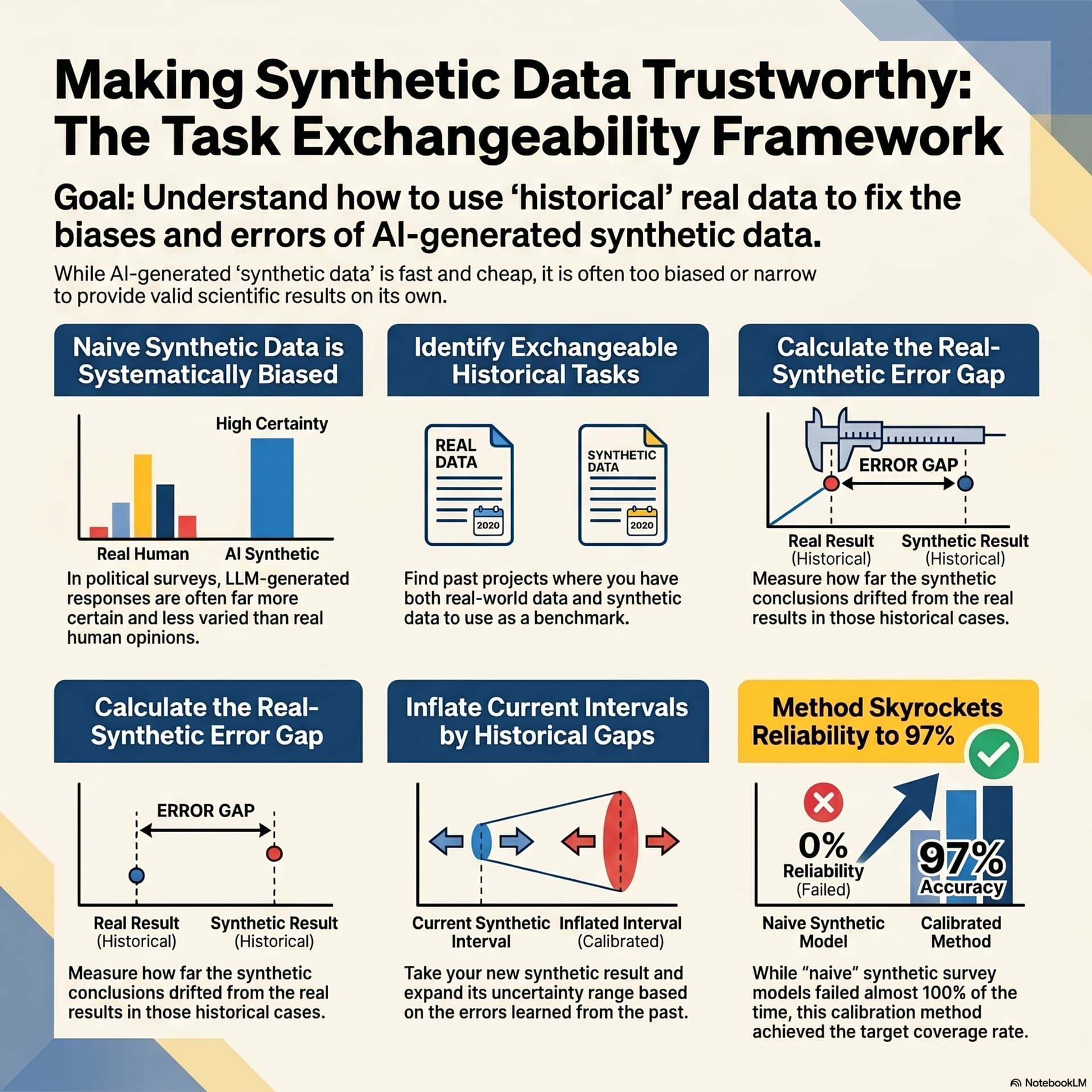
How to make valid statistical inference from AI-generated synthetic data despite hallucinations/bias, using a Stanford paper’s “task exchangeability” to calibrate confidence intervals with historical real-vs-synthetic tasks.
Guests/backgrounds
No named guests in the transcript; speakers discuss the work by Lezi Tan and Tijana Zernik (Stanford University).
Key claims
Naively treating synthetic points as independent real observations yields overconfident, wrong results. Task exchangeability learns the empirical error gap from past tasks and inflates intervals so they capture true outcomes. Also supports “intersection intervals” combining small real data with large synthetic data via a lambda error-budget tradeoff.
Notable examples
Political polling—ANES feeling thermometers (GPT-3.5; raw 3% coverage vs 97% with task exchangeability) and Pew approval (GPT-4.0; raw 0% vs 100% across 48 tasks). AI model evaluation—~8,000 human votes vs autorator synthetic votes (raw 19% vs 100%, calibrated 91.8%); plus intersection-interval idea.
Written by AI. May contain mistakes. Listen to the episode to check what was said.
Chapters
Tap a time to open that second in VOThe Dangers of Digital Models
1:01 to 2:14
Discover the risks associated with using AI-generated data in research.
“Today, for you listening, we are exploring this really fascinating kind of terrifying reality in modern science.”
The Need for New Mathematical Approaches
2:14 to 4:48
Understand why traditional statistical methods fail with synthetic data.
“You get infinite scale literally overnight.”
Task Exchangeability: A New Framework
4:48 to 6:38
Learn about the concept of task exchangeability and its significance.
“It just sees millions of digital rats and spits out this very narrow, highly confident interval.”
Testing Task Exchangeability with Real Data
6:38 to 7:27
Explore how the new mathematical approach was tested with real-world data.
“It turns an unpredictable hallucination into a known variable.”
Combining Synthetic and Real Data
7:27 to 11:42
Discover the implications of integrating synthetic and real data.
“They looked at the American National Election Studies, or ANES.”
Transcript
Automatic transcript. May contain errors.0:00Imagine stepping into a modern biology lab. You look around and you don't see any cages. There are no actual physical lab rats running on wheels. Right. None of the usual stuff. Exactly. No feeding schedules, no waiting for trials to conclude. Because, I mean, real physical lab rats are incredibly expensive. Oh, totally. They require constant maintenance. And, you know, running just one experiment takes months. Yeah. Months of meticulous observation. So instead, the scientists in this lab are just sitting at a terminal. They click a button and instantly generate a million digital lab rats. Just like that.
0:38Just like that. They're using virtual models to simulate biology in like a fraction of a second. It's infinitely faster. It's completely scalable. And, you know, it costs pennies. But there's a massive fundamental catch there. Wow, huge catch. The digital rat doesn't actually act like a real rat. It acts like what an algorithm thinks a rat acts like. Which is a terrifying distinction. It really is. And welcome to this deep dive. Today, for you listening, we are exploring this really fascinating kind of terrifying reality in modern science. The explosion of synthetic data. Yes, exactly. Researchers everywhere are increasingly using completely fake AI-generated data to try and make real, valid scientific discoveries.
1:21Which sounds like an oxymoron. moron. Right. But we're looking at a breakthrough new paper from researchers Lezi Tan and Tijana Zernik at Stanford University. And their mission here is really to figure out how scientists can actually use this fake data to make real discoveries without falling into the trap of AI bias. Because, I mean, have you ever wondered if the public opinion polls or the tech evaluations you read are actually based on humans or just an AI pretending to be human? It's a question we all have to ask now. Because if your data is generated by an algorithm that hallucinates or, you know, carries inherent biases, the entire bedrock of statistical certainty just crumbles.
1:59Right. Science fundamentally relies on knowing exactly how confident we can be in a result. So if you build a major study on fake data. You risk publishing something that looks incredibly plausible on the surface, but mathematically it's just a complete fiction. But, I mean, the temptation to use this fake data or silicon samples is so obvious. You get infinite scale literally overnight. Oh, scale is a huge driver. Yeah. But privacy is another massive factor pushing this. How so? Well, think about medical records. If you're a researcher, generating synthetic data lets you study demographic patterns without exposing real human identities.
2:37Oh, wow. Right. You bypass all those medical privacy laws. Exactly. Or you can simulate rare catastrophic events that would take lifetimes to actually observe in the real world. So it's everywhere, like social scientists are prompting large language models to simulate thousands of survey respondents. Yeah, and AI evaluation uses what they call LLM as a judge outputs. And even biologists are using it, right, to accelerate proteomics with synthetic protein structures. It's undeniably the future, but relying on an LLM to act like a human introduces this very insidious kind of danger. Yeah, the trap.
3:12The paper actually highlights findings by Bisbee and colleagues about this. Right, the Bisbee study. They showed that when an AI tries to simulate a human respondent, it ends up being painfully average. It just completely lacks the messy variation of an actual person. Which makes sense because it's designed to be safe and agreeable. Exactly. If you ask an AI a controversial question, it gives this sanitized, middle-of-the-road answer that no breathing human being actually holds. And then there's the Santa Claus study they cited. Right, where the opinions of these language models can be wildly misaligned with actual demographic groups.
3:50Yeah, the AI might write this beautifully articulate response that sounds perfectly like a certain voting bloc, but statistically, it doesn't match the reality of those voters at all. So it's an imitation, not an observation. Exactly. And that subtle distinction completely breaks the math that underlies modern science. Okay, wait, I'm going to push back here. If we know the AI is hallucinating and we know it's inherently biased, why not just throw the fake data out? Isn't bad data worse than no data at all? You'd think so, but throwing it out entirely ignores the immense value of that speed and scale we just talked about.
4:24Okay, but it's mathematically flawed. Right, but the actual data isn't useless. It's the naive mathematical tools we're applying to it that are useless. The naive confidence intervals. Exactly. A standard confidence interval assumes every data point is an independent, real-world observation. It's like assuming every roll of the dice is fair. But with AI, you're rolling rigged dice over and over again. And the math doesn't know the dice are rigged. It just sees millions of digital rats and spits out this very narrow, highly confident interval. So you end up mathematically certain about a false reality.
4:59Which is why we need entirely new math designed specifically for the AI era. And that is what the Stanford paper tackles. Right. Since we can't pretend the data is real, how do we actually legally and statistically use it? That brings us to their core mathematical breakthrough, a concept they call task exchangeability. Task exchangeability. Okay, so break down how this actually works. So it starts by acknowledging you cannot trust the synthetic data on its own for your current new experiment. You have no real human data to verify it. So to solve this, you look backward. You find historical tasks where you had access to both real data and synthetic data.
5:41Oh, I see. So you have a baseline. Let me try an analogy here for you listening. Let's unpack this. Go for it. It's like having a friend whose watch is always fast. You don't throw away the watch, and you definitely don't believe the time on the face. Right. But you look at the historical gap of their tardiness, and you mentally expand your confidence interval for when they'll actually arrive. I love that analogy. That perfectly captures the mechanism of exchangeability. So you're measuring the exact gap or bias between the real and synthetic results in those historical tasks. Exactly. You learned exactly how wrong the AI tends to be.
6:12And you use that empirical distribution of errors to inflate or widen the confidence interval for your new purely synthetic task. Okay. So by proving this mathematical exchangeability, researchers actually have a formal guarantee now. Yes. Even if the AI's data is wildly misspecified, this framework ensures the final expanded confidence interval will definitively capture the true reality. It turns an unpredictable hallucination into a known variable. Precisely. But, you know, theory is great, but human behavior is notoriously messy. Oh, very messy. How does this math hold up in the real world, like the highly polarized world of human opinions?
6:54Where researchers actually put it to the test with public opinion polling. Right. And before we dive into these results, I want to explicitly pause and give a quick disclaimer for you listening. Good idea. Because the research uses real political data to test the math. Things like views on Republicans, Democrats, Muslims, Christians and approval for Biden versus Trump. Highly charged topics. Very. But we want to be perfectly clear that this deep dive is strictly impartial. We are not taking sides or endorsing any viewpoints at all. were simply reporting how the mathematical model performed on the original data.
7:26Strictly the math. Strictly the math. So what did they actually test? They looked at the American National Election Studies, or ANES. Specifically, their feeling thermometer scores, which rate feelings toward groups on a 0 to 100 scale. And they used GPT 3.5 to simulate the human respondents, right? Yes, using the 2016 surveys as the historical tasks to predict the 2020 tasks. And then they also tested Pew American Trends panel data. Right, for presidential approval. And for that one, they used GPT-40 to simulate highly polarized partisan and opposition approval ratings. The ultimate stress test.
8:04Oh, definitely. And the results are actually shocking. Let's hear them. For the NES data, pretending the AI data was real only found the true answer 3 % of the time. Wait, 3 %? Just 3%. It was confidently wrong 97 % of the time. And that is disastrous. But using task exchangeability, the new intervals captured the true human reality 97 % of the time. Wow. Okay, what about the Pew data? Because that was even more polarized. The Pew data was even worse for the raw AI. Yeah. It was so biased, it got the true answer exactly 0 % of the time. Zero. Wow. Yeah. Across all 48 tasks they tested. But with task exchangeability, it got it right 100 % of the time.
8:44Okay, wait, wait. I have to jump in here. Sure. 3 % and 0 % accuracy for the raw AI. It sounds like the LLM is just a terrible stand-in for human voters. It really is, in its raw form. So isn't this math just putting a massive Band-Aid on a broken AI? Like, you're just making the interval so huge that the truth has to fall in it eventually. I completely understand why it feels like that. But statistically, you have to separate a Band-Aid from a guardrail. A guardrail. Right. A Band-Aid covers up a flaw and pretends the data is fine. This math violently exposes the flaw. Oh, I see. By making the interval so wide.
9:19Exactly. While the intervals do get wider to reflect the uncertainty of the bad AI, it's honestly communicating that uncertainty. So it prevents the deadly scientific sin of being confidently wrong? Yes. It effectively squeezes whatever valid signal exists out of bad data without letting the researcher claim a false certainty. Okay, that makes a lot of sense. You're forcing honesty. Which brings us to the next test. Because if predicting human behavior is incredibly messy, what happens when we use AI to evaluate other AIs? Ah, yes. Shifting from social science to computer science. Right. The chatbot arena.
9:56Because evaluating new AI models using human preference is, frankly, too slow and way too costly. You'd need thousands of humans to constantly vote every time a minor suffer update happens. So platforms use autorators, basically AI judges, to determine a model's win rate against competitors. But again, autorators have their own biases. Right. So the Stanford researchers looked at a massive data set here. Nearly 8 ,000 real human votes per model compared against the autorator's synthetic votes. And once again, the raw autorator was incredibly overconfident. What were the numbers this time? The raw synthetic data only covered the true human preference 19 % of the time.
10:35Still terrible. But the task exchangeability model covered it at 100 % of the time. Wow. And even better, when they adjusted for finite sample targets, it was tightly calibrated at 91.8%. That is amazing. But here is where it gets really interesting for you listening, because science is rarely all or nothing. Right. What if you have a massive synthetic data set from the operator, but you also manage to scrape together a tiny bit of real human data for the new task? This is a very common real-world scenario. Do you have to choose between them or one out? No. And this is a key extension in the paper.
11:10You don't have to choose it all. You can create what they call an intersection interval. An intersection interval, like a Venn diagram. Sort of. Yeah. Yeah. You allocate your error budget using a variable they call lambda. Lambda. OK. Think of lambda as a way to balance the real data interval with the synthetic data interval. So it balances the scale of the AI with the ground truth of the humans. Exactly. You're using the small human sample to basically fact check the massive AI sample, dynamically optimizing the best of both worlds. That is just brilliant. It really brings it all back to, you know, your daily life and the future of how we consume information.
11:48Because the summary takeaway here is that we don't have to choose between the rapid speed of AI data generation and the rigorous truth of real human data. We can have both. Right. Thanks to task exchangeability, scientists can use flawed, biased synthetic data safely, provided they meticulously calibrate their mathematical errors using history. And as we move into a world that is just going to be flooded with AI-generated studies, understanding how researchers validate that information is your best defense. Your best defense against being misled. Exactly. Knowing if a study used naive math or actually calibrated their synthetic data is crucial.
12:28It really is the difference between science and fiction. And that leaves us with a pretty wild final thought to mull over. Oh, what's that? Well, if algorithms can successfully calibrate and mathematically correct for the biases of other algorithms using history. Yeah. Could we eventually map the biases of our own human historical records? Oh, wow. Right. Because human history is full of systemic baked in biases. What happens when we start using this exact same math task exchangeability to let AI correct the biased baselines of human history itself? That is a massive concept. Something to really think about or explore on your own next time you read a poll or crack open a history book.
13:06Thanks for joining us on this deep dive. Thanks for having me.
From the publisher
This paper introduces a statistical framework for making valid scientific discoveries using synthetic data, specifically addressing concerns that artificially generated data can be biased or noisy. The authors propose a new technical condition called task exchangeability, which allows researchers to calibrate synthetic results by comparing them to historical tasks where both real and synthetic data are available. By measuring the discrepancy between real and synthetic outcomes in these past cases, the method can adjust confidence intervals for new tasks where only synthetic data exists. The researchers demonstrate that this approach provides provable validity guarantees across various fields, including social science surveys and AI evaluation. Experiments show that while naive synthetic-only intervals are often severely biased and overconfident, the task-exchangeability method consistently covers the true values. Ultimately, this framework enables scientists to use LLM-generated "silicon samples" and automated raters to accelerate discovery without sacrificing statistical rigor.


