
 Ask ChatGPT

 Best AI papers explained
3 Oct 2026 · 25m · 12 chapters
A Deep Dive on a University of Pennsylvania paper (Feb 20, 2026) proposing Selective Strong Verification (SSV) to decide when AI should use cheap “weak verification” vs expensive “strong verification” for reasoning.
No named guests; the episode is hosted by two speakers who discuss the paper (no external guest bios provided).
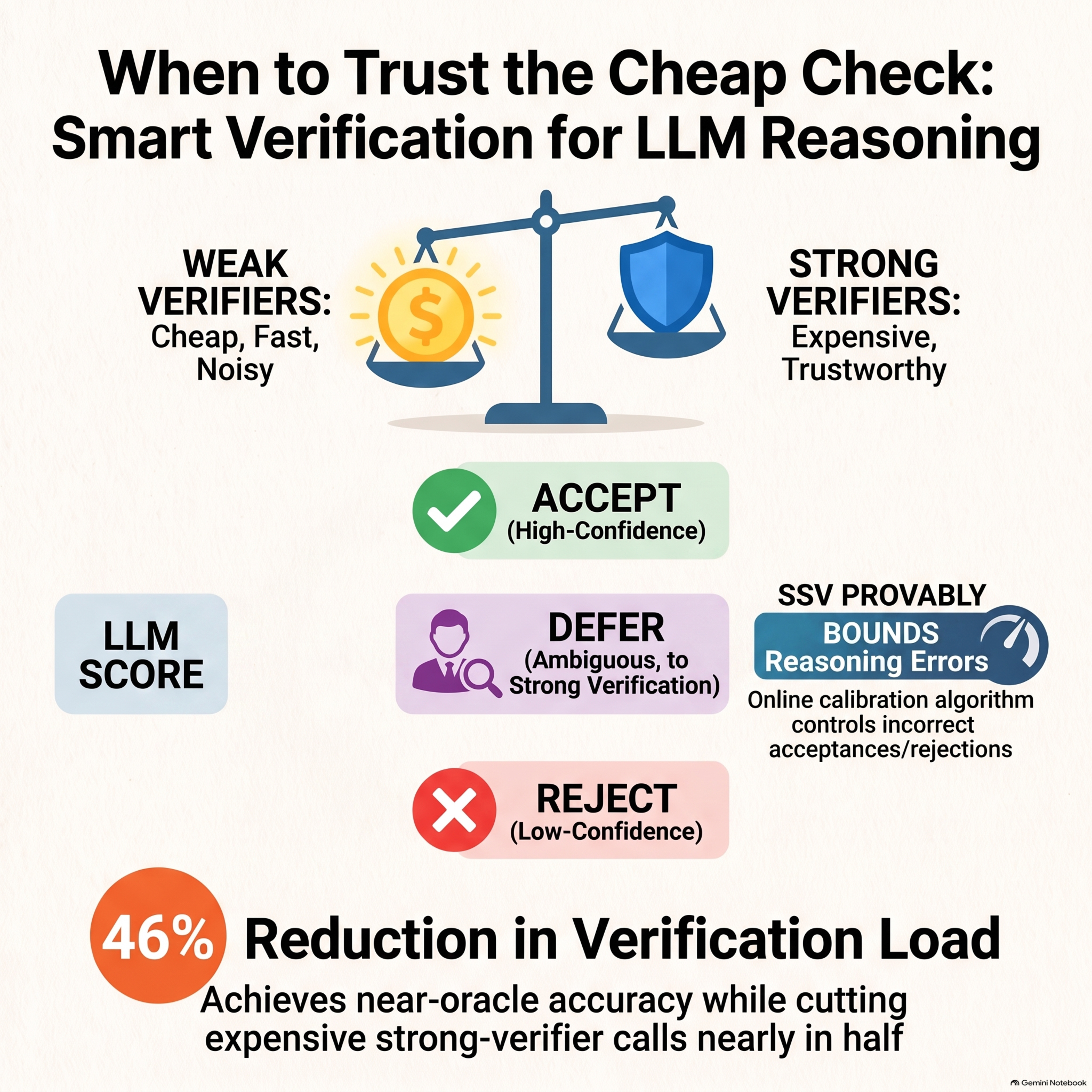
Weak verification is fast but noisy; it can cause type 1 errors (incorrect acceptance/hallucinations) and type 2 errors (incorrect rejection causing costly re-generation loops). SSV uses a two-threshold accept/reject/uncertain scheme with randomized strong-verifier spot checks to self-calibrate thresholds.
Math dataset using GPT-40 mini (weak) and GPT-40 (strong); Sudoku process-level verification with an “Oracle baseline” (44.2% accuracy, 5.32 strong calls/puzzle) vs SSV (43.1% accuracy, 2.87 strong calls/puzzle).
Written by AI. May contain mistakes.
Discussion on the complexity of AI reasoning compared to traditional computation.
“Today, we are exploring a really fascinating new breakthrough that tackles this exact messiness head on.”
Differences between strong and weak verification methods in AI.
“It's basically the battle between fast and right.”
An explanation of proxy rewards and their implications in AI assessment.
“Weak verification is the complete opposite.”
Effects of type 1 and type 2 errors on user trust and system efficiency.
“You are getting speed, but you are absolutely sacrificing certainty.”
Identifying and understanding the metrics of AI trust as outlined by researchers.
“So if tech companies can't afford the human editor for every single query, they're kind of stuck living with some typos from the spell checker.”
Introduction to the Selective Strong Verification Algorithm and its function.
“In many cases, yes, that's exactly what's happening.”
How the SSV algorithm uses dynamic thresholds for AI verification.
“Instead of a simple pass-fail system, imagine the weak verifier generates a confidence score on a spectrum, you know, from 0 to 100%.”
Challenges in obtaining accurate confidence scores from AI models.
“It seems super counterintuitive, I know, until you look at how algorithms actually learn.”
Learn how AI achieves self-correction through confidence scoring and the importance of calibration and sharpness.
“So it continuously tightens or loosens its own rules without any human engineers ever having to step in and tweak the code.”
Discover how the SSV algorithm performs in real-world tasks like math and Sudoku, showcasing its efficiency and adaptability.
“The UPenn paper didn't just run simulations, right?”
Understand the concept of Pareto frontier and how it helps balance cost and accuracy in AI systems.
“It fundamentally changes the economics of AI.”
Explore the implications of AI's evolving self-sufficiency and the potential for AI to surpass human verification.
“We started by talking about the messy, muddy waters of AI reasoning compared to the clean binary of a hospital X-ray.”

Get the gist, explore an idea or ask about something said.
 Claude
On Best AI papers explained, what are the key points of this episode?
Searching your listeningAutomatic transcript. May contain errors.
0:00So think about this for a second. If you go to the hospital with, you know, broken arm, the x-ray machine gives you this very binary answer. You look at the film and it's either broken or it's not. Right. It's just it's clean, precise engineering. Exactly. And usually when we talk about a computer solving a problem, we kind of expect that same exact level of precision. Like you run a calculation, the output pops up on the screen and you just point to it and say, well, there it is. Yeah. I mean, that is the comfort of traditional computing, right? Everything boils down to ones and zeros. It's either correct or incorrect.
0:35But, and this is where it gets interesting, when you ask modern artificial intelligence to solve a complex problem, that perfect binary x-ray machine just completely disappears. We're looking at a computational landscape that is, well, honestly, is like staring into muddy waters. Oh, totally. Because modern AI, you know, it isn't just a database looking up facts anymore. It is actively reasoning. And reasoning requires judgment. It requires evaluating context and making leaps of logic, which is inherently just a messy process. Welcome to the Deep Dive. Today, we are exploring a really fascinating new breakthrough that tackles this exact messiness head on.
1:17We're looking at a brand new research paper out of the University of Pennsylvania. This was actually just published a few days ago on February 20, 2026. and it's titled, When to Trust the Cheap Check, Weak and Strong Verification for Reasoning. Yeah, and this paper is a really great deep dive into the invisible tug of war that's happening behind your screen every single time you hit enter. So our mission today is to figure out exactly how an AI decides when to trust its own quick, you know, gut instincts versus when it needs to call in the heavy, expensive computational artillery. If you have ever been frustrated by an AI hallucinating an answer with total confidence.
1:55Which happens to all of us. Right, constantly. Or, you know, on the flip side, taking way too long to just generate a really simple response. Well, this research explains the hidden balancing act that's actually causing all of that. And honestly, fixing this balancing act is arguably the single most critical bottleneck for the future of reliable AI. I mean, as these reasoning models get smarter and the problems they tackle get more and more complex, the mechanisms we use to supervise them are just, they're really struggling to keep up. Let's start with the core tension that the UPenn researchers identify here.
2:29It's basically the battle between fast and right. It comes down to two very different ways an AI can check its own work, right? So let's start with the absolute gold standard, which they call strong verification. Yeah. So strong verification is the heavy artillery. This is when an AI's output is evaluated with the highest possible level of rigor. Like almost flawless. Exactly. Depending on the system, this might literally mean a human expert stepping in to inspect the AI's logic step by step. Or, you know, if we're talking about coding, it means taking the software the AI just wrote, booting up a virtual machine, compiling the code and running it in a real world test environment to guarantee it executes without crashing.
3:11So you know for an absolute fact that the output is good. You do. But the tradeoff is severe. Strong verification is incredibly slow and astronomically expensive. I can imagine. Yeah. You simply cannot deploy that level of scrutiny for every single prompt that millions of users are typing in every single second. I mean, if you did, server costs would bankrupt the company overnight and users would literally be waiting hours for a single response. Which brings us to the alternative that they kind of have to rely on, which is weak verification. Right. Weak verification is the complete opposite. It is engineered specifically for massive scale.
3:48So it's lightning fast and it costs, you know, fractions of a cent. Okay, so how does it work if it's not testing the code or asking a human? So instead of doing that, the system uses algorithmic shortcuts. It might run a really quick self-consistency check. or it might use a smaller, cheaper AI model to just quickly grade the main AI's homework. Or it might look at internal proxy rewards. Hold on. Proxy rewards. Let's pause there for just a second because I want to make sure I get this. Explain that to me like I'm five. What exactly is a proxy reward? Sure, sure. Imagine you ask an AI to write a funny joke.
4:28A strong verifier would be testing that joke on a human audience to see if they actually laugh. Which obviously an AI can't do in real time. Exactly. A weak verifier can't do that. So instead, it looks for a proxy, a substitute signal. It might quickly scan the text to see if the joke follows a standard setup punchline structure or if it uses unexpected vocabulary. It rewards those proxy traits, assuming they probably mean the joke is funny. Got it. But that sounds incredibly noisy. I mean, it might certify that a piece of code has no syntax errors or that a joke has a punchline, but it could completely miss that the overall logic of the program is fundamentally flawed or that the joke makes absolutely no sense.
5:11Oh, it is highly noisy. You are getting speed, but you are absolutely sacrificing certainty. It sounds a lot to me like publishing an article. Like, weak verification is basically running a basic spell check. You know, it's instant, it costs zero dollars, but it will absolutely not catch if your argument has massive logical holes. Whereas strong verification is like hiring a veteran human editor. The final piece will be flawless, but it's going to cost you a fortune and take three days to get back. I really like that framing. And this exact tension is what's stalling AI progress right now. The human editors are just too costly to deploy at scale.
5:47But meanwhile, the spell checkers simply aren't trustworthy enough to support really complex reasoning on their own. So you end up with a system that either hemorrhages compute budget or confidently hallucinates. Exactly. Okay. So if tech companies can't afford the human editor for every single query, they're kind of stuck living with some typos from the spell checker. But in AI, those typos can be catastrophic. So how do engineers actually calculate the cost of those mistakes without just, you know, flying completely blind? Well, the UPenn researchers map this out by defining three specific metrics of AI trust.
6:22because, you know, you have to measure the failures before you can fix them. The first metric is probably the most familiar to everyone, type 1 error, which is otherwise known as incorrect acceptance. Meaning the weak verifier looks at a totally wrong response, gives it a thumbs up, and just sends it straight to the user. Yes, this is your classic hallucination. The weak verifier fails to catch the mistake. And this degrades output quality, it feeds the user bad information, and ultimately it destroys user trust. Yeah, I mean, if you get a severe type 1 error on a really important work document, you might just cancel your subscription and never use that product again.
6:59Exactly. Bad answer equals a failed product. That one is easy to grasp. But the second metric they highlight is type 2 error, which is incorrect rejection. This means the AI generated a perfectly good, totally correct response, but the weak verifier got confused and just threw it in the trash behind the scenes. Now, I have to push back here for a second. From a user's perspective, isn't a type 2 error completely harmless compared to a hallucination? I mean, why do these researchers care so much if the AI accidentally throws away a good idea internally, as long as the final answer I see on my screen is correct?
7:33Well, to the user, a type 2 error is entirely invisible. You don't see it. But to the system engineers, it is a localized disaster. Think about the mechanical reality of what happens when the weak verifier rejects a correct answer. Okay. The AI doesn't just shrug and give up, right? It's programmed to fulfill your prompt. So it has to trigger an internal re-roll. Oh, it scraps the output and has to generate a whole new answer from scratch. Yes. And generating tokens, the actual words or numbers the AI spits out, is the single most computationally expensive part of the process. It requires spinning up massive arrays of GPUs.
8:10Wow. OK, I didn't think about that. Now, multiply that unnecessary re-roll by millions of queries. If your weak verifier is overly paranoid and just constantly rejecting perfectly good answers, your AI gets trapped in this endless loop of generating, checking, incorrectly rejecting, and then generating all over again. So that is why sometimes you're sitting there watching a blinking cursor for like 30 seconds before the text finally starts appearing. In many cases, yes, that's exactly what's happening. It creates massive latency for the user, and it burns through the company's compute budget for absolutely no reason.
8:45Type 1 errors destroy user trust, but type 2 errors quietly destroy the company's business model. Wow. I really never thought about the sheer physical cost of the AI just doubting itself like that. And so what's the third metric? The third metric is strong verification frequency. And this is just the average rate at which the system gives up entirely and calls in the heavy, costly checker to resolve things. Okay, so basically how often it bugs the boss. Right. And a viable verification policy has to keep all three of these metrics low simultaneously. But the problem is they are naturally in conflict with each other.
9:21Because if you want zero hallucinations, you crank up the sensitivity, but then that spikes your type 2 errors and traps you in a generation loop. Exactly. And if you want zero errors across the board, you just use strong verification every time, which spikes your operational costs into the billions. Which brings us to the core breakthrough of this whole paper. How do we actually minimize these errors without going bankrupt? The researchers propose this new mathematical framework called the Selective Strong Verification Algorithm, or SSV. And the engine running this algorithm is something they call a two-threshold structure.
9:58Yeah, and the two-threshold structure is just an incredibly elegant way to handle uncertainty. Instead of a simple pass-fail system, imagine the weak verifier generates a confidence score on a spectrum, you know, from 0 to 100%. The SSV algorithm sets two mathematical dividing lines on this spectrum, chopping it into three distinct regions. Okay, walk us through those regions. What happens when a prompt lands in each one? Sure. So the top section is the accept region. This is where the weak verifier looks at the AI's answer and is highly confident it's correct. Let's say above 90 % certainty. In this region, the system accepts the answer instantly and sends it straight to your screen.
10:38It completely bypasses the expensive strong verification. So that's fast, cheap, and we move on. Right. Down at the bottom is the reject region. Here, the weak verifier is highly confident the answer is wrong, say below 10 % certainty. The system immediately trashes the answer and triggers a re-roll. And again, it never bothers the strong verifier. Also fast and cheap, just catching the obvious garbage. Exactly. But in the middle, between that 10 % and 90%, you have the uncertain region. This is the messy middle. The weak verifier looks at the proposed answer and essentially says, this is too complex.
11:15I really don't know if this logic holds up. Let's ask the boss. And only then does it escalate the query to the costly, strong verifier. I love this. It's essentially a medical triage system. The triage nurse handles the scraped knees and the obvious false alarms instantly, but securely routes the deeply complex cases to the expensive specialist. That's a really great way to visualize it. But there's a catch here, and this is where the computer science gets really impressive. The SSV algorithm relies on something called randomized exploration. Okay, what does that do? It means it doesn't just draw those threshold lines at 10 % and 90 % and then walk away forever.
11:54It dynamically moves them up or down based on continuous error tracking. But here's the kicker. To track errors, it randomly queries the strong verifier, even when the weak verifier is highly confident. Wait, I'm confused. If the system is like 95 % confident that the answer is perfect and it sits squarely in the accept region, why on earth would it waste valuable compute money double-checking itself with a strong verifier? Isn't the whole point of this to save money on the confident ones? It seems super counterintuitive, I know, until you look at how algorithms actually learn. If the weak verifier is consistently confident but is actually completely wrong, how would the overall system ever find out?
12:35Oh, it wouldn't. It wouldn't. Because it's never checking the work in the accept region. Exactly. It would be flying completely blind. If you only ever deploy the strong verifier for the uncertain middle, your system will literally never realize that its so-called confident accept region is actually just a factory pumping out confident hallucinations. Wow. It's a lot like running a financial audit at a large corporation. You might have a FastPass system for your most trusted executives to submit their expenses, right? But you still have to occasionally, randomly spot check those trusted executives to ensure the FastPass system isn't being abused.
13:12Right. If you don't randomly spot check the spell checker, you won't know if the spell checker broke. Exactly. But how does that feedback loop actually work mechanically? Like, when the spot check fails, what does the algorithm physically do? It mathematically punishes the thresholds. The algorithm tracks this running equation of the error rate. So if the algorithm takes a highly confident accept answer, secretly sends it to the strong verifier, and the strong verifier says, uh, actually, this is entirely wrong, the algorithm realizes the weak verifier is getting a little too cocky. So it adjusts.
13:47Right. It dynamically moves the numerical cutoff. The accept threshold might shift from 90 % up to 95%, requiring even more statistical certainty before it lets an answer pass next time. So it continuously tightens or loosens its own rules without any human engineers ever having to step in and tweak the code. It's totally self-correcting. It constantly calibrates itself to the reality of the specific task at hand. Which actually brings up a really crucial point. This entire SSV algorithm relies on the weak verifier being able to assign a confidence score in the first place. But if the weak verifier is just a smaller, cheaper AI, how does it even possess the self-awareness to know it's uncertain?
14:30I mean, aren't language models famously overconfident? They'll literally tell you the sky is green with total authority. Oh, yeah. And that is the million-dollar question in AI design right now. Getting a language model to admit uncertainty is incredibly difficult. So how do they do it? Engineers usually extract these confidence scores in a couple of different ways. One is looking at the actual token probabilities, which is the raw mathematical likelihood the model assigned to the word it just chose. Another popular method is self-consistency voting. What's that? That's where the AI generates five different paths to an answer in the background.
15:04If all five paths arrive at the exact same conclusion, the confidence score is high. But if they arrive at five different answers, the confidence score plummets. Okay, so it's basically crowdsourcing with its own internal clones. Essentially, yes. And the UPenn researchers point out that for the SSV algorithm to actually save money, the confidence score generated by the weak verifier must possess two distinct mathematical properties, calibration and sharpness. Let's break those down. What does it mean for an AI to be calibrated? Calibration is simply whether the confidence score matches reality.
15:37So if the weak verifier gives a score of 80 % certainty, is that specific type of answer actually correct 80 % of the time in the real world? It basically makes the score interpretable. And 80 % actually means 80%, not 50%. Got it. But the paper says calibration alone isn't enough to make the weak verifier useful. You also need sharpness. What is sharpness? Sharpness asks, does the weak verifier take a firm stance? Because if your weak verifier is perfectly calibrated, but it just constantly hovers around a 50 % confidence score for every single prompt it sees, it is functionally useless. Oh, because everything would just fall into that middle uncertain region and get sent to the expensive strong verifier anyway.
16:22The triage nurse would just be sending every single patient to the surgeon. Exactly. Sharpness means the weak verifier frequently produces decisive, extreme scores. So scores very close to zero or very close to 100. It confidently accepts or confidently rejects, actively keeping queries out of the expensive, uncertain region. This is remarkably relatable to human confidence. Think about the people in your own life. We all know someone who is perfectly calibrated but completely lacks sharpness. Like, you ask them where they want to eat or where they think of a movie. And they always say, I'm 50-50 on this, or, you know, I could go either way.
17:00We all know that person. Right. They are accurately expressing their uncertainty, so they are highly calibrated. But they provide zero help in actually making a decision. You still have to do all the heavy lifting. They offer literally no operational value to the group. But then you have the opposite, friend. Extremely high sharpness, terrible calibration. They are 100 % confident about everything. Like, we should definitely take this shortcut through the woods, but they are completely wrong half the time. And that friend will lead you straight off a cliff. So for the AI to actually reduce costs while maintaining output quality, the weak verifier must be both calibrated, so we can trust the percentages, and sharp, so it actually makes decisions.
17:43Okay, theory and mathematical properties are great, but I really want to know how this actually holds up under pressure. The UPenn paper didn't just run simulations, right? They tested this SSV framework on two grueling real-world tasks using state-of-the-art models. Right. They used GPT-40 mini to generate the answers, DeepSeek chat to act as the fast, weak verifier, and then the massive, computationally heavy GPT-40 to act as the strong verifier. Setting up a real heavyweight bout. Yeah. And they applied this to two different paradigms. Task one was the math data set. This is what we call outcome-level verification, meaning the system is only checking the final bottom line answer of a complex math problem.
18:27And how did the algorithm handle it? Well, it depended heavily on the difficulty, which actually perfectly illustrates why the dynamic thresholds are so important. On easy math problems, the weak verifier, the DeepSeq model, maintained incredibly high sharpness. It easily recognized when the final answer was right and when it was wrong. Okay. Because of this sharp signal, the SSV algorithm confidently sorted almost everything into the accept or reject regions, saving huge amounts of compute by keeping the big GPT-40 boss completely out of the loop. But let me guess. When they threw the hard problems at it, the weak verifier fell apart.
19:02The signal degraded significantly. On level 5 math problems, the weak signal completely lost its sharpness. The confident scores for correct answers and incorrect answers started bleeding together into this muddy middle around 50%. But here is the brilliant part. Because of the random spot checks we discussed earlier, the algorithm recognized this degradation instantly. It saw the weak verifier struggling, and it automatically expanded that middle uncertain region. It adapted to the difficulty, forcing the system to rely more heavily on the strong verifier to maintain the accuracy of the final answers.
19:37That is incredible. It physically realizes when it's out of its depth. But task two is what really caught my eye. Task two was Sudoku. And this wasn't outcome level. This was process level verification. Right. Process level verification means checking the internal logic step by step rather than just grading the final answer at the very end. I would imagine Sudoku is just a total nightmare for an AI system. I mean, it's sequential logic. If the AI is solving a 4x4 grid and it makes a single mistake on step three, every subsequent move is ruined. You can't recover. So wouldn't the algorithm be forced to just call the expensive strong verifier for every single number it places just to be safe?
20:21You would think so, right? Yeah. Let's look at the baseline. When the researchers forced the system to use the strong verifier on every single step to solve the grid, they called this the Oracle baseline, it achieved a 44.2 % accuracy on solving the complete puzzles. Okay. To hit that number, it took an average of 5.32 strong verification calls per puzzle. Very expensive, very slow. And what happened when they let the SSV algorithm take over the Sudoku task? The SSV algorithm achieved a comparable 43.1 % accuracy, so virtually the exact same performance. But it only made 2.87 strong calls per puzzle.
20:58Wow. It cut the strong calls almost exactly in half. It's a massive 46 % reduction in costly verification load. without sacrificing the actual reasoning accuracy of the final output. A 46 % cost reduction in an industry where data centers cost literally billions of dollars to build. That is a game-changing efficiency. It fundamentally changes the economics of AI. And the researchers noted that SSV allows a service provider to literally dial in their exact risk tolerance. You can tell the algorithm, I am willing to accept a hard limit of a 5 % error rate or maybe a 15 % error rate. and the algorithm will automatically ride the perfect Pareto frontier between cost and accuracy.
21:41Wait, Pareto frontier? For those of us who aren't economists or data scientists, what does that actually look like in practice? Ah, right. The Pareto frontier is basically the absolute mathematical limit of efficiency. It means you cannot possibly make the system any cheaper without severely hurting accuracy, and you can't make it any more accurate without blowing up your budget. Oh, I see. The algorithm constantly hunts for that perfect sweet spot. If you want a premium enterprise AI to be 99 % perfect, it shifts the math to called the strong verifier more often. If you're okay with an AI being 90 % perfect for, say, a free tier app on a smartphone, it relies more on the weak verifier.
22:21It mathematically optimizes your compute budget dynamically right on the fly. Okay, let's bring this all together. We started by talking about the messy, muddy waters of AI reasoning compared to the clean binary of a hospital X-ray. But what this UPenn paper really reveals is that engineers have found a mathematically sound way to orchestrate this messiness. The SSV algorithm acts like that brilliant triage nurse. It handles the scrape knees instantly and cheaply. It recognizes when it's out of its depth. And it securely routes the critical cases to the specialist. And it constantly adjusts its own caution levels based on random audits of its own performance.
22:59Yeah, it acknowledges the mud and it builds a highly efficient automated bridge right over it. So next time you are using an AI, I want you to think about this invisible tug of war happening behind the blinking cursor. Depending on whether you are asking it to generate a casual dinner recipe or write complex back-end code for your website, the AI behind the scenes might literally be tuning its thresholds in real time. It's looking at your prompt and dynamically deciding how much computing power your specific query is actually worth. And looking at where this is heading, you know, it raises a really important question for the future.
23:35Algorithms like this are getting better and better at randomly auditing their own internal logic and relying a lot less on massive brute force checking. Yeah, they're getting surprisingly self-sufficient. So will we eventually reach a point where an AI's internal weak verification actually surpasses human strong verification? I mean, when the problems become so unimaginably complex, like designing new molecular structures or managing entire global supply chains, that a human expert physically cannot realistically check the logic, who ultimately verifies the verifier? That is a wild thought to leave on.
24:10At some point, the heavy artillery won't be a human editor anymore. It'll just be an even bigger AI. And we'll really have no choice but to trust the math of the thresholds. We started out noting how AI reasoning will never be as simple as looking at a clean bone fracture on an X-ray. But with dynamic threshold algorithms like this, the AI is finally learning how to read its own murky scans, spotting the fractures in its own logic before they ever even reach your screen. The muddy waters are slowly clearing up. They really are. Thanks for joining us on this deep dive. Keep questioning the answers you get, and we'll see you next time.
This paper explores weak-strong verification policies for large language models, presenting a framework that balances the affordability of scalable internal checks with the precision of resource-intensive external validation. To address the trade-off between type-I errors, type-II errors, and verification frequency, the authors introduce Selective Strong Verification (SSV), an online calibration algorithm that operates without prior distributional assumptions. Through experiments on mathematical reasoning and sequential puzzle-solving, the researchers demonstrate that this method effectively maintains target error rates while significantly reducing computational overhead.


