
In short
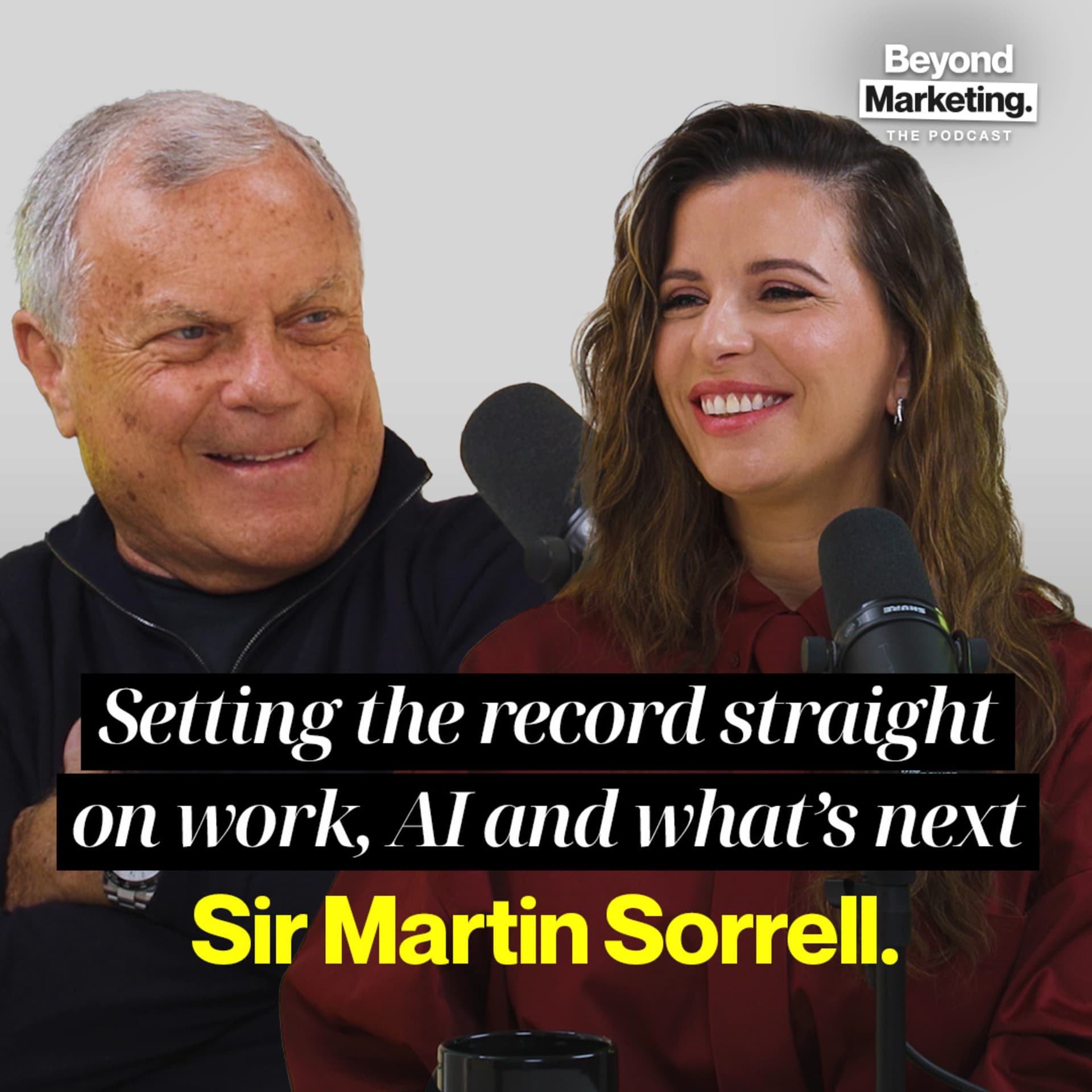
Beyond Marketing Podcast Episode Notes: S6 Ep 1 | Sir Martin Sorrell: Setting the Record Straight on Work, AI, and What’s Next
Episode Overview In this episode of Beyond Marketing, Maira Genovese, CEO and Founder of MG Empower, converses with Sir Martin Sorrell, a significant figure in modern marketing, known for founding WPP and currently serving as Executive Chairman of S4 Capital. The discussion focuses on the evolving landscape of marketing, the impact of AI, and the future of work in the industry.
Key Themes and Discussions
- The Current State of AI in Marketing
- Incremental Adoption: Sorrell argues that AI is not scaling rapidly across the marketing industry; its integration remains slow and limited.
- Industry Misconceptions: There is significant hype around AI, but actual adoption is minimal outside specific sectors like automotive and financial services.
- Economic Pressure: Sorrell believes economic challenges may drive faster AI adoption, particularly in traditional sectors facing competition.
- Challenges Facing Traditional Agencies
- Pressure on Models: Traditional agency structures are under strain due to market shifts and the rise of digital-first competitors.
- Declining Markets: The traditional advertising market is shrinking, while digital markets are expanding rapidly.
- WPP and Dentsu Vulnerability: Sorrell highlights struggles faced by major players like WPP and Dentsu, noting their market caps have drastically fallen.
- Leadership and Change Management
- Human Connection: The importance of maintaining human connection in leadership, particularly in a remote working environment, is stressed.
- Work-Life Balance Redefined: Sorrell challenges the conventional notion of work-life balance, suggesting that if one enjoys their work, it transcends into a fulfilling experience.
- Future of Work and Agency Models
- Digital-Only Strategies: S4 Capital's model emphasizes a digital-only and data-driven approach, which Sorrell views as a necessary evolution for agencies.
- Opposition to Remote Work: Despite evidence suggesting productivity gains from remote work, Sorrell argues for the value of in-office collaboration.
- Learning and Adaptation: The conversation includes insights on the necessity for individuals and agencies to continuously evolve and learn, especially in light of AI technologies.
- Global Market Perspectives
- Economic Shifts: The episode discusses the shifting power dynamics in global economies, highlighting the growing importance of markets like India and the BRICS nations.
- US-China Relations: Sorrell comments on the tense relationship between the US and China and its implications for global business strategies.
Key Takeaways
- AI's Role: AI's current integration into marketing is limited and primarily serves as a tool rather than a replacement for human creativity.
- Agency Transformation: Traditional agencies must adapt or risk becoming obsolete, with a strong emphasis on digital capabilities.
- Human Connection Matters: Even in a tech-driven world, fostering human interaction and relationships remains crucial for success.
- Future Opportunities: Smaller agencies may find opportunities amidst the confusion and restructuring of larger firms, allowing for innovation and adaptability.
Concluding Thoughts Sir Martin Sorrell provides a candid and experienced perspective on the marketing industry's current challenges and future direction. His insights emphasize the need for adaptability, the critical role of human creativity, and the importance of embracing digital transformation to remain relevant in a rapidly changing landscape.
This episode serves as a valuable resource for marketers, leaders, and anyone interested in understanding the future of work and technology in the industry.
Listen to the Episode For more insights, listen to the full episode on platforms like Spotify, YouTube, Amazon Podcast, and Apple Podcast. Follow the podcast on Instagram for updates and teasers about upcoming guests.
Written by AI. May contain mistakes. Listen to the episode to check what was said.
Chapters
Tap a time to open that second in VOAI's Impact on Marketing
0:45 to 4:30
Exploration of AI's gradual integration into marketing and current industry challenges.
“Welcome to Beyond the Marketing, the podcast, Martin Sorrell.”
Future of Traditional vs Digital Agencies
4:30 to 10:00
Discussion on the contrasting futures of traditional and digital marketing agencies.
“The two companies that are in real trouble, Densoo International and WPP, it's so complex.”
The Power of Technology in Marketing
10:00 to 13:00
Insights on how technology, particularly AI, influences marketing strategies and consumer experiences.
“So unfortunately, analysts, when they analyze the business, journalists, when they write about the business, conflate two markets into one.”
Consumer Engagement with AI and Technology
14:02 to 14:30
Explore how consumers are increasingly engaging with AI and digital experiences.
“Because consumer, we can see that more and more.”
The Power of AI in Everyday Life
14:30 to 15:03
Discuss the widespread amazement and usage of AI across age groups.
“That's the interesting thing, is that we as consumers use AI far more, I think, all the data shows than enterprises have used it in doing their business.”
Democratization of Creativity Through AI
15:03 to 15:32
Understand how AI is democratizing creative roles and experiences.
“I was using it recently, a day or so ago.”
The Shift Towards Experiential Engagement
15:32 to 16:46
Examine consumer desires for live experiences post-COVID and the impact on travel.
“I think consumers, you know, it's almost like a K economy where consumers have embraced the technology and enterprises have only done it sporadically or episodically.”
The Debate on Distributed Work vs. Office Presence
16:46 to 17:43
Analyze the effectiveness of distributed working compared to traditional office work.
“In fact, you know, I would say I don't know what the stats are, but my guess is that business travel because of the use of technology.”
Generational Perspectives on Office Commitment
17:43 to 18:45
Investigate generational differences in opinions about office attendance and work habits.
“But all the data, I've been involved with Harvard Business School on their D3 initiative around AI.”
Research Insights on Distributed Working
18:45 to 20:05
Review research findings on the benefits of distributed working, especially for new employees.
“we've seen it with WVP and supposedly not well received we've seen it with Omnicom we've seen it with J.P.”
Show all 24 chapters
Challenges of Work-Life Balance Discussions
20:05 to 21:07
Delve into the complexities surrounding work-life balance and work enjoyment.
“It's particularly good for men and women with big families or with families.”
The Future of S4 and Digital Transformation
21:07 to 22:38
Discuss the strategic direction and challenges facing S4 in the digital landscape.
“It's a bit like Susie Wiles and her article.”
Integration Challenges in the Agency Space
22:38 to 24:35
Explore the struggles and dynamics of integrating agencies within the advertising industry.
“And all of them are trying to become one company.”
The Importance of Knowledge Sharing in Organizations
24:35 to 25:25
Highlight the value of sharing knowledge within companies and its impact on productivity.
“They love to be on the front page of campaign or ad age.”
The Role of AI in Flattening Organizational Structures
25:25 to 26:58
Analyze how AI can lead to more flattened organizational structures and knowledge sharing.
“AI is really interesting because it may ensure through democratizing knowledge that that happens.”
Breakthroughs in Technology and Industry Influence
26:58 to 27:34
Discuss major technological breakthroughs and their influence on various industries.
“If you give people access to everything, like we have at least 900 people working on Google globally.”
Excitement Around Industry Changes and Developments
27:34 to 28:00
Reflect on the excitement and implications of significant industry changes and IPOs.
“Do you get excited every time there is an industry change?”
The Impact of SpaceX on Industry Dynamics
28:00 to 28:46
Discussing the significance of SpaceX and its implications for the industry.
Evolution of Agency Models
28:46 to 30:54
Exploring the transformation of agency models and the historical context.
“But, you know, I think SpaceX and the IPA will be a seminal moment in the development of space travel.”
Challenges Facing Holding Companies
30:54 to 32:46
Analyzing the issues holding companies face in a changing market.
“and his theory was you couldn't have conflicting accounts in the same agency.”
Geopolitical Influences on Business
32:46 to 34:28
Examining how geopolitics shape market opportunities and risks.
“No, I think US-China relationships are not good.”
Future of Jobs in a Technologically Advancing World
34:28 to 36:59
Discussing the effects of AI on job opportunities and roles in industries.
“Do you want to be bigger given the Taiwan risk?”
Navigating Changes in the Advertising Industry
36:59 to 42:00
Insights into how the advertising industry is adapting to new technologies.
“In that world, fragmentation becomes more and more important.”
The Future of Work and AI in Advertising
42:00 to 43:37
Explore the implications of AI on jobs in advertising and the evolving nature of work.
“And therefore, be more opportunity for adoption.”
Transcript
Automatic transcript. May contain errors.0:04Welcome to Beyond Marketing, the podcast. I'm Mara Genovese. I'm the founder and CEO of MgEmpower, a global integrated market agency. Today, we are joined by one of the most influential figures in the history of modern marketing. Sir Martin Sorrell is the founder and former CEO of WPP, and today he is the executive chairman of S4 Capital. For decades, his thinking has shaped how agents are structured, how creativity and strategy are valued, and how marketing operates at a global scale. In this episode, we'll explore leadership through transformation, the evolution of agents' models, and why creativity and strategy remain essential, especially in the AI-driven world.
0:45Welcome to Beyond the Marketing, the podcast, Martin Sorrell. What a pleasure. Thank you so much for taking the time to be here this morning. So I would like to start with, it's more like everyone knows Martin Sorrell, but with your own words, who is Sir Martin Sorrell?
1:00Sir Martin Sorrell:That's for others to figure out. Not for me to say. Not for you. I would say like a big fan, big admirer of your work. Good. And not sure if you remember where we met. Where was that? Ken Lyons. I approached you and we started the conversation. So I'm very glad that conversation brought us here. Good. We just wanted to get from you, like with all change that's happening in the industry of marketing, and we're seeing how AI is scaling really rapidly. It's not scaling rapidly. I think that's the issue. It's scaling, I would say, incrementally, but not rapidly. We see a little bit in visualization and copywriting.
1:44Sir Martin Sorrell:We see a little bit in personalization at scale. We see a little bit in media planning and buying, but no wholesale adoption except maybe in the automobile verticals because of Chinese EV competition and AV competition, and then secondly in financial services because of the fintech platforms. But I would disagree. I think AI has not affected the industry yet to any significant degree. People talk a lot about it, like you do, and others, and I'm on podcasts, but that's not the reality. So I disagree. I think it's been very slow in terms of adoption and what probably has needed a little bit of economic force, a little bit of economic pressure in order to do it.
2:33Sir Martin Sorrell:Because in those two verticals I mentioned, automobiles and financial services, there's economic pressure from lower cost alternative suppliers or producers or manufacturers. It was blowing a chill wind for the fossil fuel manufacturers. or car manufacturers, the traditional manufacturers, and also the traditional branch banks. So I sort of disagree. I think we're at the threshold. People test, they do workshops, they experiment, but they don't do much. I think when I, maybe I didn't fridge well in the same as I scale up. There's a lot of capacity. There's a lot of capacity being built. Yes, but that's not agencies doing that.
3:17Sir Martin Sorrell:In fact, it's probably the opposite. The agencies probably haven't built capacity, hence you see IPG surrendering, giving up and being acquired by Omnicom. And whether there will be other similar capacity reductions, I don't know. We'll have to see what happens. I mean, Densoo International is for sale, certainly in whole or in part. WPP probably is vulnerable because its market cap is now, what, 5 billion? having been as high as 20, 25 billion. And you've got two Omnicom and Publicis at 25 billion. You've got Densu at about 7 or 8 billion, then WPP at 5 and Hovas at 1.5. So we have to see how all that shakes out.
4:01Sir Martin Sorrell:I don't see anybody at the moment who's got the enthusiasm or guts to take on the significant management challenges at Densu International or WPP because they're both in a tough spot. Havas does have capacity. It doesn't have financial capacity on its own. The Bollaret family have got access to a significant financial capacity to make it work. But beyond that, it's quite difficult for Havas on its own. The two companies that are in real trouble, Densoo International and WPP, it's so complex. And then there's this cloud of AI hanging over it because people are finding it difficult to analyze whether it's what exactly the impact of AI will be on the traditional industry.
4:52Markets have said, because they've compressed the valuations.
4:56Sir Martin Sorrell:I mean, even publicists and Omnicom are selling significantly, their market prices are significantly off their highs. So the market is saying we're not sure about what the impact of AI will be on your traditional model. So we've got maybe 26. President Trump was on broadcasting last night about what may or may not happen next year. We'll see what happens in the midterms. I think he'll do well in the midterms. It was intriguing that Susie Wiles gave that interview to Vanity Fair. I mean, looking at it, looking at the pictures, they claim that she was misquoted or the quotes were mispositioned. But looking at the pictures, they obviously knew that it was either going to be a book or a major article because there were some heavily stylized photographs.
5:52Sir Martin Sorrell:But what's interesting about it is why did she give that set of interviews? One of the possibilities could be that she's nervous about the results of the midterms and won't be around afterwards. I don't think so. From the article, she was quite confident. I think she's right to be confident. The big, beautiful tax bill will kick in in March or April of next year with a lot of subsidies for taxpayers. So I think Trump will go to the country in the midterms with a tailwind. But the economic difficulties may come after that. And that's when the pressure might build. I mean, U.S. companies are doing well at the minute.
6:37Sir Martin Sorrell:EPS Q3 of this year was up 12 percent. You take out the hyperscale is up 9 percent next year. Still forecasting Goldman are forecasting 12 percent EPS growth, which is very strong. and it's a little bit odd for the agencies because usually when companies are doing well well not usually historically when companies do well and profitably agencies do well that's not the case now and I think the reason is agencies are really heavily represented in the 300 billion of ad revenues that are going south in traditional media rather than the 700 billion which are going north dominated by Alphabet, by Meta, by Amazon, Alibaba Barbara, Tencent and ByteDance.
7:20Sir Martin Sorrell:So it's a difficult environment for traditional agencies to navigate. And I think there will be continued pressure because of the growth of digital. Now 70 % of the market, probably by 2030, be up to about 80%. And it continues to dominate. And the agencies don't have as significant representation in that growing 700 billion as they do have in the declining 300 billion. So my view is AI will become more and more attractive, but it needs a little bit of economic pressure on clients to adopt faster. It's about change management. It's not about technology, about change management. And turkeys don't vote for Christmas, so people will be hesitant to change until they have to.
8:10But do you have any optimistic view for the future? Of the future of agents? Because you're saying like about...
8:17Sir Martin Sorrell:Not for the traditional agencies, no. So what's your view about? Well, it depends. Everybody conflates what's happening in the traditional markets with the digital markets. And it's two different markets. It's a trillion dollars, or last year it was a trillion dollars. This year it would be about 1.1. Next year, 1.2. And last year, 700 billion was growing. That's around, as I said before, around Alphabet, around Meta, Amazon, Alibaba, Tencent and TikTok or ByteDance. The traditional, the 300 billion, the fight for Warner Brothers Discovery between Netflix and Paramount is really a fight over an asset which has got declining revenue.
9:01Yeah, it's crazy. Well, it's not crazy.
9:03Sir Martin Sorrell:I mean, I wouldn't say that Ted Sarandos and Greg Peters and Reed Hastings are crazy. Far from it. They're extremely intelligent. So I assume they know what they're doing. But the struggle between Paramount and between Netflix for Warner Brothers Discovery is a struggle for a company whose ad revenues are declining. And it's a company which didn't have live sport like Disney or like Fox, which didn't have live sport to buttress the decline. So when you say about agencies, if you're talking about traditional agencies, the future is pretty grim. If you're talking about digital agencies, agencies that are focused on that space, that's a space that's growing at 10, 15, 20 percent, I would say the future is rosy.
10:00Sir Martin Sorrell:So unfortunately, analysts, when they analyze the business, journalists, when they write about the business, conflate two markets into one. And it's two different worlds. One is a digital world that's growing and one is a traditional that's declining. You talk a lot about creative and strategy not being replaced by technology, meaning AI. Well, I mean, I think that is the case, but of course, it's the hope. I mean, there is a, I think for the next, I don't know how long it will be, if you look at some of the stuff that Eric Schmidt has been talking about. There's some interesting, actually, some films on TikTok of Eric Schmidt talking about the impact of machines on not just our industry, but generally.
10:51Sir Martin Sorrell:There will come a time when machines will be more powerful than people. There are some people who believe that never can be the case. I'm not sure I agree. and Jeffrey Hinton, who was one of the founders of DeepMind, if you remember, he resigned from DeepMind because he thought he was worried about the existential threat of AI, the existential threat being that machines will become more powerful than people. Well, we in our industry cling on to the belief, I think quite rightly. I don't think it's wrong, but it may be a short to medium term thing that the technology is the tools and people will be empowered by the tools and strengthened by the tools, which I think is the case in the short to medium term.
11:37Sir Martin Sorrell:Whether that means in the longer term we might be in a situation where the machines actually become more powerful than people, we'll have to see. It's interesting, in Eric's, I was looking at the film a couple of days ago, he says that when machines become more powerful, we should pull the plug. So we shall see, we shall see. I mean, there will be bad actors. The Oppenheimer moment, as I've said before, has gone. The opportunity for us to control the expansion of AI in a coordinated fashion for governments to do it has gone. You know, they've gone beyond that. These are nation states. The head of MI6 is very interesting.
12:22Sir Martin Sorrell:She was interviewed. She did her annual interview a couple of days ago, and she said that the heads of the tech companies are like country presidents. And I've been saying for a significant period of time, they're like nation states. And if you run a company which has got a$4 trillion market cap or like NVIDIA,$5 trillion, and Musk's compensation is geared to Tesla getting to$10 trillion, a$10 trillion company, and I think Musk will get there, a $10 trillion company would be the third, if you equate market cap to GDP, would be the third largest country in the world after the US and China. The US is 28 trillion and China's 18.
13:08Sir Martin Sorrell:So they are like country presidents. And if you're four or five trillion, I was in India recently, last week or so, that's as big as India, bigger than the UK, bigger than France, bigger than Germany, probably about the same size as Germany, bigger than Italy, bigger than Spain. So these guys, they are all guys, actually. There's not a woman amongst them, sadly. These guys are country presidents and they have enormous power. And they're investing half a trillion a year in expanding AI capacity, data centers, energy sources and chip capabilities. So they're going to get more powerful, not less powerful.
13:53Sir Martin Sorrell:But that ability to control them, I think, has gone. So I'm not gloomy about it. What I'm just saying is, I think, realistic about it. So for the agency industry, it means you have to accelerate your exit from traditional media and accelerate your entry into the digital ecosystem or whatever you want to call it. And what about the consumer? What about the consumer? Because consumer, we can see that more and more. Yes, of course, they're engaging with technology, with AI, but it's clear consumer-want brand experience. Consumers have engaged more with AI than enterprise. That's the interesting thing, is that we as consumers use AI far more, I think, all the data shows than enterprises have used it in doing their business.
14:44Sir Martin Sorrell:So the consumers actually have engaged with it far more. I mean, everybody you talk to from kids aged four or five, maybe even younger now, to people my age are amazed by the power of AI, what it can deliver in a nanosecond in terms of information. You know, I mean, you use Nano Banana. I was using it recently, a day or so ago. It's quite extraordinary what you can do with that. So, you know, everybody can become a copywriter and a visualizer. Everybody can become an advertising agent, at least in some sense. We'll see how capable they become as a result of it. But no, it's democratizing. And I sort of disagree with you.
15:34Sir Martin Sorrell:I think consumers, you know, it's almost like a K economy where consumers have embraced the technology and enterprises have only done it sporadically or episodically. They haven't done it generally. Yeah, because it's always just more like on the human connection side. So do you think this will be less and less? Well, I mean, it's not just about AI. I mean, one of the things we're having to wrestle with, it was accelerated by COVID, is the lack of connection. What's really interesting is people crave experiences, maybe because they have less social interaction. The propensity, if that's the right way of putting it, of people to travel, to experience live experiences, to want to engage with one another has got greater.
16:26Sir Martin Sorrell:I mean, when you look at the travel statistics, given the way the economies are behaving, you look at the travel statistics, you look at where people are spending their money, you look at inflation and its impact on food prices and everything. It is quite remarkable that people travel through airports. It is quite remarkable. In fact, you know, I would say I don't know what the stats are, but my guess is that business travel because of the use of technology. so the technology enables you to do things that you didn't do before but live experiences, you know, there is a thirst for so all these technologies, because they become more they're used in a more distributed way probably are going to cause all these social issues that we talk about in relations to loneliness fewer friends, all those statistics that people talk about What's really interesting about the technology, and I'm intuitively against the idea, is the technology enables you to do things in a much more distributed way.
17:35Sir Martin Sorrell:I don't think being out of the office is a good thing. I think people should be in the office seven days a week. I was about to ask you that. But all the data, I've been involved with Harvard Business School on their D3 initiative around AI. The data from the research they have, it's really interesting, suggests that distributed working is more effective and more productive. I'm not sure I agree with that. But I think in our own case with S4 and Monks during COVID, at the beginning of it, it was good. And we gamed from it. because we are digital natives and tech nerds, and therefore it was a good environment for us.
18:23Sir Martin Sorrell:But I think it's sort of over time, as people have become, quote unquote, used to it, it's not been abused, but I think it's become a little bit more lackadaisical, and I think it's a real issue. Most of the people my age or my generation who are running or trying to run companies we've seen it with WVP and supposedly not well received we've seen it with Omnicom we've seen it with J.P. Morgan they all say come back into the office J.P. Morgan is an interesting example because they're building these huge offices in 8 billion pounds of cost for a building in New York and they're going to build one in Canary Wharf here I was in Mumbai as they also go and they've got a huge office there as well so they're in the business of building huge offices so you have to a lot of spend if people are not not in them but i think distributed working certainly in our industry you know if um you lose the spark the the sparks flying between people constructively uh flying between people now there are some jobs like coding i guess whereas coding gets done by ai now but but engineering jobs maybe can be done remotely but generally in our business i think it's good for people it's important very interesting it was a piece of research that the hbs people did on um you know the argument against distributed working is young people and entrants don't learn about the company so what what the research has done was develop programs for companies to to get people to um to to learn about companies learn about company cultures in a distributed way and the results were were pretty good according to the research so actually a lot of the hbs research points to the opposite of what i think which is distributed working works.
20:32Sir Martin Sorrell:It produces more productivity. It's particularly good for men and women with big families or with families. The trend post-COVID was to move away from city centres because of expense as well as COVID, etc. So distributed working may be a factor of life that we have to become aware of and have to, in my case, lump. Because you mentioned a few times that you don't believe in work-life balance. No, I didn't say that. Again, that's misquoting. It's a bit like Susie Wiles and her article. Well, actually, she didn't say she was misquoting. She said it was out of context. No, I didn't say that. Now, what I said was, if you're not having fun, then it's work, right?
21:29Sir Martin Sorrell:And we're saying if you do what you enjoy, life balance goes out the window, doesn't it? I mean, if you enjoy something, you presumably like to do it. I agree. Therefore, it's not work. I mean, work in the sense of it's a four-letter word, beginning with W, which some people don't like. But if you do what you enjoy, then it's not work. I agree. So that's all I was saying. I wasn't saying work-life balance. I wasn't saying family isn't important or anything like that. I was just saying that, you know, you should enjoy what you do. Yeah, if you're passionate about what you do. And what about S4?
22:06What's the due to S4?
22:08Sir Martin Sorrell:Well, you know, we've got a lot more work to do. I mean, we're digital-only, data-driven. We go to market as more efficient. and we're unitary. I think that's a model, ironically, which the holding companies, in a funny way, have all got to do more of. I mean, they've got to be more digital. They've got to be more data-driven. They've got to be more agile because they're indicted for lacking agility and they're multi-branded. And all of them are trying to become one company. I mean, we wait with bated breath to see what the strategic unveil for WPP is in January with McKinsey's help. But my bet would be we have to be one WPP.
23:00Sir Martin Sorrell:We have to get rid of all that overhead that's built up at the holding company level, the group brand level, and then the brand level. you know if you look at the people in c container house for example in london you know what do they all do um so it'll be about overhead and it'll be about how do we get everybody to work together in a much more concerted way you know it's not it's not if you're running ogilvy for example you really have to look at in the context of wpp you can't look at it in the context of Ogilvy. So, and Omnicom are going to do the same. Publicists have done it, or have done it to the most sophisticated degree.
23:47Sir Martin Sorrell:Havas are doing it. Dentsu have tried it, but maybe there's something in the Japanese management culture that prevents it from happening. It hasn't happened very successfully. Now, coming back to S4, we have to do it more effectively than we've done before. We haven't done it as well as we could do. Do you think the challenge of integrating agency based on... No, it's a challenge of integration per se. I mean, integrating business... Organic growth is always better than growth through mergers or acquisitions. Mergers and acquisitions are difficult. They're easy to do but difficult to implement.
24:25Sir Martin Sorrell:And getting people to work together, Our industry is not an industry where people work together easily. You know, they love to be on podcasts. They love to be on the front page of campaign or ad age. And it's more about them, the individual, than the institution. And I've said this before, more than work-life balance. The real jewels are the people who share. So those people who can run Ogilvy, I would call out somebody like Miles Young. Miles Young could run Ogilvy and run it brilliantly and at the same time contribute to what was going on at WPP. Those people are very rare. There are people that can run a brand well, but then don't, in the context of the organization, share stuff.
25:25Sir Martin Sorrell:AI is really interesting because it may ensure through democratizing knowledge that that happens. Because people control things by controlling information. If you're running a silo, a vertical, how do you maintain control of it at the top is by restricting the information. Jensen Wang is really interesting. He has 51 direct reports. I've said this many, many times. You went to McKinsey and asked them what's the appropriate management span, they would say 12 or 13 direct reports. With Jensen, he manages to do it with 51, doesn't do apparently many one-on-ones, sets people objectives for the year and monitors their success or otherwise in achieving those objectives.
26:16Sir Martin Sorrell:And I think that's what you're going to see. I think you're going to see flattening of organisation when people really adopt AI at scale. And the other thing that's interesting is that deeper you go inside companies, I think the more people are prepared to share knowledge. The deeper you go, there's sort of like an inverse relationship between sharing and where you are in a company. The deeper you go, the more people share. The further up you go, the mucky mucks like to control the information and prevent it because that's how they maintain their power. And what you really want is you want everybody sharing at huge scale.
26:55Sir Martin Sorrell:And AI enables you to do that. If you give people access to everything, like we have at least 900 people working on Google globally. If you give them access to everything we're doing on Google, as long as it's secure and the right management levels, that's a huge advantage because everybody knows. and can contribute. And that's, I think, what people don't understand still. I mean, the Internet was the first breakthrough, smartphones, mobile phone was the second breakthrough, if you like, and then the third breakthrough is AI. You've been in this journey for many, many, many years. Do you get excited every time there is an industry change?
27:41Sir Martin Sorrell:Well, I mean, whether it's exciting or not, I mean, it's interesting to explore. You know, you've got the IPO of SpaceX coming in 26. And, you know, I've been thinking about that. I mean, market valuation, people, it's gone from 800 billion, I think, to potentially one and a half trillion. It'll make Elon Musk even wealthier. You get excited about that. I mean, yes, I mean, you do. and it it it's you know it's gonna it to me SpaceX will be like Google when it floated in 1999 I think it was Amazon when it went public Meta when it Facebook when it went public you know SpaceX to me will be another Nvidia obviously Microsoft I mean these are all companies I mean the interesting thing about our industry is that we've witnessed the growth and development of all those companies spacex probably doesn't influence our i'm going to say our industry as much as maybe the other things i mentioned obviously the internet did the smartphone did ai does uh but but maybe we'll have an agency on the moon who knows or on mars but the the um but you know that that heralds another another really interesting era so and SpaceX you've had Jeff Bezos with Blue Origin you've had Richard Branson all space explorers and you've had others that was the Russian guy I remember his name who was also really interested in space travel Yuri can't remember what his second name was but so you have these people who've said how important space development and exploration will be.
29:41Sir Martin Sorrell:But, you know, I think SpaceX and the IPA will be a seminal moment in the development of space travel. And what about, can I ask the future in terms of, you talk about the agents model will change in 2026. Again, you know, I think you're painting everything with the same brush. there's a sort of traditional agency model which is changing. It's changing. So you could say, you know, if you were looking, the irony is, and nobody's written about this, the original holding company was IPG. There was a guy called Marion Harper in the 1950s who used to have a Boeing jet that he used to, I think it was, maybe it wasn't a jet, maybe it was a jet at that time, which he was supposed to, the apocryphal stories and coming to London and staying, because McCann and Lintas and others had their major operations with the US and Europe at that time because Asia and Latin America.
30:45Sir Martin Sorrell:Ogilvy and JWT developed their businesses in Asia and Latin America, but the Americans have been very focused on the US and Europe. Anyway, Marian Huffer used to come, and his theory was you couldn't have conflicting accounts in the same agency. I don't know whether his thinking was also that it was better to have people focused on smaller units and incentivized around smaller units. I don't know. But certainly part of the big part of his thesis was if you want Unilever and Procter in the same or Ford and GM in the same business, you had to have separate separate brands. Brands. Brands. That's now, I mean, the irony is Krakowski surrenders, sells IPG to Omnicom.
Read the full transcript
31:29Sir Martin Sorrell:My forecast is Krakowski will be out of there pretty quickly now that the deal's done and the senior IPG management seems to have been crushed. I was in India, as I said this week, and there's a lot of uncertainty there for that reason, because the IPG management, which in India, for example, is quite strong, sort of being subjugated to Omnicom management. I think that's causing stresses and strains already, even though we're in the sort of first or second innings. But that model is a busted flush. And the other problem is what I said to you before, which is the holding companies are concentrated in the 300 billion.
32:13Sir Martin Sorrell:It's not growing. The 700 billion is great. So they have to flip their model into one publicist, one WPP, one Omnicom model, create a more unitary company for all the reasons we've been discussing. And then, of course, they have to embrace the digital and data side. To be fair, you know, publicist has got a better story. The reason the publicist wins business, they've got a better story. Whether they can deliver on the story. Deliver on the story. story. And then markets that will be growing for the next two, three years. You talk a lot about India. So do you think there's any other... No, I think US-China relationships are not good.
32:56Sir Martin Sorrell:I don't think they're going to get any better. They might do in the short term. They might come to some agreement over tariffs in the short term. In the long term, they're on a collision course, the Americans think. I think the world should be a... they think the world should be a G1 world and And China believes it should be G2. And I probably side with the Chinese on that. You know, the world is changing. So BRICS, Next11, the global south are becoming more important. The E7 is bigger than the G7 GDP-wise. And if you exclude China from the E7 and exclude US from the G7, the E6 is bigger than the G6.
33:36Sir Martin Sorrell:So the world is changing. And I think America has to get used to it. Having said that, America will always be a very strong, vibrant economy. You know, it's 28 trillion out of 106. It's almost a third of the world. And in addition, most of the big companies are housed there. So, you know, if you're running an agency business, there's a U.S. magnet that you get tracked. So U.S. will always be strong and Canada. the Latin America I think is underrated both technologically and creatively I think super super good people in both areas Middle East and APAC the one problem in APAC is do you how big do you want to be in China China's 18 trillion so you should be 20 percent of your business in China at least in theory.
34:30Sir Martin Sorrell:Do you want to be bigger given the Taiwan risk? Probably not. So India, Indonesia, Vietnam, Philippines, Thailand, Malaysia, Singapore all become more and more important along with of course Japan and Australia and New Zealand which are the more traditional markets. Africa is too volatile I think. Longer term obviously it would become increasingly important but it's too many conflicts too volatile and Europe is Europe is in in trouble Europe you know UK is in trouble we've had two quarters of minus 0.1 and India is growing at six or seven percent and is bigger than the UK right I mean a lot of Indians I saw this last week were were were unhappy with Modi I think Modi is is is really super good and a great leader we need more of Modi here I think but they're growing they're bigger than us and they're growing at 6 or 7 % and we're going backwards for two quarters at 0.1 % so we're in a pretty pathetic state France is in a tough position too Italy may be a little bit better recently with Maloney but not much Spain may be a little bit better the pigs as they're called Portugal, Italy, Greece and Spain have done a little bit better, the periphery of Europe.
35:56Sir Martin Sorrell:But Europe as a whole is in deep doo-doo. Poland, okay. Some of the Eastern European countries, okay. But the threat of Russia. So you've got U.S., China, Russia. I was just reading an article this morning. It was actually in the Susie Wiles interview. She said Rubio and Trump believe that Putin wants the whole of Ukraine. or that maybe it's not quite as definitive as that, but some of the things that Putin has been doing and saying and not responding to indicates he wants the whole of Ukraine. I mean, to my mind, Putin wants to recreate the Russia of Peter the Great or Catherine the Great, and that's a problem.
36:43Sir Martin Sorrell:And then there's the Iranian problem. Iran is not going to go away. and as the recent terrible events are indicating, the extreme Muslim issue is going to continue to be a very big issue politically. In that world, fragmentation becomes more and more important. So picking where you're going to grow a business is really more important. So two things, geographical fragmentation and then technological change. And that's another, those are two big challenges for the holding companies because they're everywhere. And there are some places they shouldn't be. And their size means their ability to adapt and develop agility in technology makes it more difficult.
37:31Is there any, where are the meat and small agents?
37:34Sir Martin Sorrell:Sorry? Meat agency and small agents, where are the opportunities for that? In that environment, in theory, it's only theoretical, there should be more opportunity. I mean, Omnicom and IPG getting together, if my experience in India is any judge of what's going on, that's one country out of 100 they operate in. There's a lot of confusion amongst clients and a lot of confusion amongst people. And with confusion comes opportunity. So I would say it is probable that in 2026 we'll see more clients reviewing what they're doing and potentially changing. The other thing that puzzles me, and I haven't got the answer to it, is this.
38:27Sir Martin Sorrell:Usually when companies are growing at the rate they're going, if their EPSs are growing at 12 percent, which, as I said before, the S &P 500 grew at that, and the Q3 and the forecast for next year at 12%, you would expect agencies to be doing well. The reason they aren't doing well, I think, is because they're concentrated in the 300 billion that's shrinking. The problem with the 700 billion that's growing is it's growing not by spending more money on marketing spend, but by filling out their capacity. I was just reading an article about Oracle spending$35 billion on expanding its data capacity and AI capacity, which is half of its revenues, and upping its spend and getting indebted in the process.
39:19The other companies like Microsoft and Alphabet and Meta and Amazon, although they're spending more money than Oracle, they're not as indebted.
39:32Sir Martin Sorrell:And the Oracle spending on AI is causing concern. I mean, the share price boomed on the AI orders and has now come way back. Maybe there's a mix in there about the Ellisons or Larry Ellison guaranteeing the Warner Brothers discovery bid by Skydance, by Paramount Skydance. Well, I don't know. But the credit of four swap spreads on Oracle have widened significantly. So people are getting a little bit nervous about the debt loads that are being taken on and some of the arrangements. the private debt financing of that spending. So we'll have to see how that plays out. But the problem for us, S4 and Monks, is our tech clients, which are 50 % of our revenue, are really spending money on CapEx, not OpEx.
40:28Sir Martin Sorrell:So they're not spending money on marketing spend or as much as they're used to. They're really focusing on increasing air capacity.
40:39Thank you. I think it's incredible to see how interesting the AI is playing around, not just companies, but also clients' decisions, as you just said, about spending. In terms of people's job, because you talk a lot about the future of jobs with the AI. If you have to give a piece of advice for jobs that can be replaced by technology, what those jobs, what those people will have to... How do we have to find other ways to learn new skills?
41:16Sir Martin Sorrell:I mean, I obviously don't know. I mean, you can guess in the areas that we see impact of AI in our industry. So visualization and copywriting, I think there'll be fewer art directors and fewer copywriters. So there'll be fewer opportunities. There'll be better opportunities using the technology, but there'll be fewer of them. So that's one. On personalization at scale, probably more jobs because we can do things at a huge scale and we can do more of them. Media planning and buying. There are apparently 250 ,000 people doing media planning and buying. There'll be fewer of them. And the algorithms will be more important.
41:58Sir Martin Sorrell:But the output from the algorithms is better than what the human mind does. 100%. And therefore, be more opportunity for adoption. General efficiency areas, probably there'll be some new jobs created, some old jobs destroyed. And then on the democratization of knowledge, I think that's a huge opportunity because I think that will provide more opportunities within the side companies. But overall, you know, Sam Altman a couple of years ago said 95 % of advertising jobs are going to go. I think he was exaggerating to make a point. But I think directionally he's probably right. I mean, if you pin me against the wall, some people say, no, it's wrong.
42:47Sir Martin Sorrell:You know, every technological development, including the printing press, has created more opportunities. I'm not sure that this time that's right. I think we'll be able to have more holidays as a result. So I think there will be different kinds of jobs. Five years ago you said, what advice can I give? I would say learn Chinese. A couple of years ago I added Spanish and I always said learn code. You don't have to learn them anymore. AI can do it for you. It can do it for you. But I think you still have to learn those things because it sort of educates your mind or trains your mind in a different way.
43:30Sir Martin Sorrell:But some of the things that are happening, we'll see. We'll see. Maybe space travel will give us. I can see that you're excited about the space travel. I hate heights. I get vertigo on a deep pile carpet. So I'm not one for traveling and spaceships and all that sort of stuff. But I do think it's fascinating to see what may or may not happen. So much, thank you so much for being here. So if you're not following us yet, please make sure you do on Spotify, YouTube, Amazon podcast and Apple podcast. And now we have our own Instagram account, Beyond Marketing Podcast, where I can see all the news, all the teasers of the guests and following us there too.
44:21Thank you.
From the publisher
In the opening episode of Season 6, Maira Genovese, CEO & Founder of MG Empower sits down with Sir Martin Sorrell for a direct and wide-ranging conversation about work, AI, and what’s next for marketing. Founder and former Chief Executive of WPP, and now Executive Chairman of S4 Capital, Sir Martin brings decades of perspective to a moment of deep transformation across the industry, and sets the record straight on some of its most debated topics.
From the realities of work-life balance and remote working in the creative industry, to the real impact of AI on agencies, jobs, and business models, Sir Martin offers a clear-eyed view on what’s changing and why. He explains the pressure facing traditional agency structures, the growing divide between declining and expanding markets, and why the biggest challenge ahead is not technology itself, but change management.
The conversation also explores leadership under pressure, the importance of human connection, and what it really takes to stay relevant as the industry moves into its next chapter.