Ask ChatGPT
 Big Take
12 Nov 2026 · 17m · 10 chapters
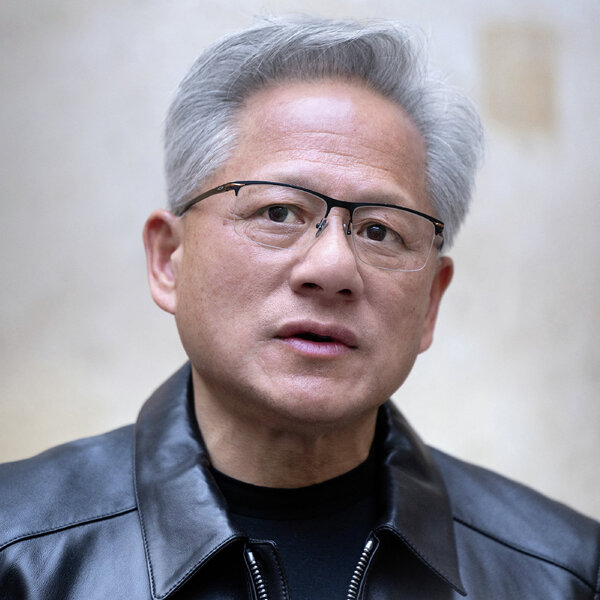
NVIDIA’s founder/CEO Jensen Huang’s abrupt departure amid reported affairs tied to alleged Chinese spying, and the implications for NVIDIA, the AI chip market, U.S.-China relations, and the broader AI build-out.
Dina Bass, Bloomberg AI build-out reporter; Michael Shepard, Bloomberg senior editor for tech policy.
The board chose CFO Colette Kress as interim CEO due to lack of succession planning and governance/national-security concerns. Allegations include Huang’s affair with a woman believed by the U.S. government to be a Chinese spy and a second affair with a subordinate. NVIDIA’s export-restriction scrutiny and a related company (Megaspeed International) under Commerce/Justice investigation raise geopolitical friction. Investors may see up to ~30% market-value impact, though products remain strong.
Google tensor processing units, Cerebras AI chips, and hyperscaler efforts as emerging NVIDIA alternatives; prior AI-market worries about neocloud data-center borrowing and U.S. political pushback on data centers.
Written by AI. May contain mistakes.
Discover the challenges businesses face with AI implementation and solutions.
“For big business, AI opened up a world of promise, but that world of promise turned into a world of pain.”
Get the latest updates on Jensen Huang's unexpected exit from NVIDIA.
“The world of business is constantly evolving, and Comcast Business keeps you totally in step with secure AI-backed networking in more than 100 countries.”
Uncover the details surrounding Jensen Huang's scandals and their implications.
“Ponds resignation is about rippling through the AI trade already.”
Understand the significant impact of Jensen Huang on NVIDIA's structure and future.
“And at that point, we ended up with this board meeting and the decision that's been announced this morning.”
Explore the challenges faced by NVIDIA's board in the wake of Huang's departure.
“You take that person out, it's hard to really fathom what it will look like in the future.”
Learn how investors are responding to NVIDIA's interim leadership.
“There had been, Dina, as this scandal unfolded, a lot of criticism about NVIDIA's corporate governments of the pretty unchecked power that Jensen Huang had.”
Discuss the potential consequences of Huang's exit on the AI industry.
“And one thing when we think about Wall Street, as they look to the company and they see the interim CEO, In Colette Crest, the CFO who has now been elevated to fill Jensen's shoes, they see someone that they know.”
Discussing the implications of Jensen Huang stepping down and its effects on AI.
“Mike, I think of other moments in history when executives have had to step aside, but I can't think of a moment where someone's had to leave a company so central to an entire industry like this.”
Exploring the political dynamics impacting the AI industry amid recent events.
“Dina, maybe I can have you put this development in kind of a broader context here.”
Analyzing how Jensen Huang's situation affects U.S.-China tech relations.
“We've talked about what this means for the company, what it means for the AI industry more broadly.”

Get the gist, explore an idea or ask about something said.
 Claude
On Big Take, what are the key points of this episode?
Searching your listeningAutomatic transcript. May contain errors.
0:00For big business, AI opened up a world of promise, but that world of promise turned into a world of pain. Cost spiraling, data trapped, security and governance risks multiplying, and ROI out of reach. That's why enterprises turned to Boomi to connect data, apps, and AI, helping them operate securely, efficiently, and at scale. Boomi turns a world of AI pain into a world of AI gain. As Boomi says, we got you. Head to boomi.com. That's B-O-O-M-I dot com.
0:57The Chase Mobile app is available for select mobile devices. Message and data rates may apply. JPMorgan Chase Bank, N.A. Member FDIC. Copyright 2026. JPMorgan Chase and Company. The world of business is constantly evolving, and Comcast Business keeps you totally in step with secure AI-backed networking in more than 100 countries. They're powering over 90 % of the Fortune 500 and millions of small businesses. That's a lot of muscle. And behind it all, thousands of experts answering your call at 2 a.m. like it's 2 p.m. One partner powering how business gets done for companies around the globe. When you add it all up, no one does business like Comcast Business.
1:41Bloomberg Audio Studios. Podcasts. Radio. News. The NVIDIA board has announced that Jensen Huang is out as CEO. The board just issuing a statement saying that CFO Klet Kress will become interim CEO. Ponds resignation is about rippling through the AI trade already. Absolutely a negative reaction, Ed. I think NVIDIA is set to raise nearly$600 billion in market value. It puts it on track for its biggest one-day decline since January of 2025. It's now a sub -$4 trillion market cap company. There's been a lot of worry that something might deflate the AI bubble. I don't believe the concern was that the thing falling apart was going to be NVIDIA itself.
2:31I'm David Gura, and this is The Big Take from Bloomberg News. Today on the show, Bloomberg's AI build-out reporter, Dina Bass, and senior editor for tech policy, Michael Shepard, on the extraordinary departure of Jensen Huang and what it means for NVIDIA and the AI industry moving forward.
2:54The latest act in this drama played out through the night. NVIDIA's board started deliberating on Wednesday night, and we didn't hear from the company until Thursday morning, right before the markets opened here in the U.S. Dina, first of all, just remind us sort of how we got here to this emergency meeting of NVIDIA's board. Sure. So there was reporting that disclosed that Jensen Wong had had an affair with a woman who there are allegations the U.S. government believes to be a Chinese spy. There are now a lot of questions as to whether there were national security issues, whether there was information that was disclosed through that relationship, whether NVIDIA's AI chips made their way into China, you know, chips that were restricted from export.
3:34Then yesterday afternoon, The New York Times reported that there had been additional affair, this one with a subordinate who reported to Jensen, which, you know, we now have two affairs, one raising national security concerns and one raising corporate governance concerns. And at that point, we ended up with this board meeting and the decision that's been announced this morning. Mike, it's such a sprawling story. So, yes, it's a corporate story about this company and about Jensen Huang and the affair that he had with this woman suspected of being a spy. The report that Dina just mentioned, The New York Times adding to that part of this story.
4:07But from where you sit in Washington, it very quickly, in light of what Dina just said about the role that Jensen Huang plays in our geopolitics, became something of acute interest to policymakers and politicians in Washington as well. Oh, very much so, because NVIDIA has been under scrutiny over whether it's been complying with U.S. export restrictions designed to keep its chips out of China. And in fact, as Dina pointed out, the company at the center of this scandal, whose executive had become romantically involved with Jensen Wong, that company, Megaspeed International, was under investigation by the Commerce Department and the Justice Department for possible breaches of those U.S.
4:48export curbs. And it really has also added some friction and an irritant to U.S.-China relations. You know, if you just step back and think about it, the two largest economies in the world are competing for an edge in artificial intelligence. And they've been trading accusations back and forth about unfair play, China complaining about export curbs, and the U.S. accusing China of essentially stealing technology from American frontier model developers. Dina, can you talk a bit about how closely intertwined NVIDIA and Jensen Huang are? How much of the company is by his design and molding? The company is 100 % made in his image.
5:29He's the founder. Founder CEOs are always extraordinarily powerful. You think of, you know, Bill Gates. You think of Steve Jobs, both of whom were co-founders. This is a company Jensen built, and he is behind every single one of its key strategic decisions over the history of the company, getting them into, you know, graphics chips, then ultimately parlaying that into this absolutely completely central dominant role in artificial intelligence chips. He has over 50, had over 50 people reporting directly to him. So in addition to the company being very much his, there was not a lot of succession planning.
6:08And he was personally in charge of making, you know, the vast majority of critical decisions, overseeing the majority of key leaders. You take that person out, it's hard to really fathom what it will look like in the future. Whatever the answer is, it's going to be different. It's going to have to change dramatically because you no longer have this person who is entirely sort of, you know, out of the ordinary, one of a kind, running it and leading every moment. You've both laid out sort of how we got to this meeting. And Dina, I wonder if you could kind of set up the stakes here as these directors met.
6:39What do we know of sort of what went down at that meeting? What was on the agenda? And indeed, how difficult a decision this was for those directors? This is an incredibly difficult decision. NVIDIA does not appear to have an obvious succession plan. There isn't anybody set up clearly to take over. They have named CFO Colette Kress, you know, in the interim, but it doesn't appear that they had done planning for, what would happen if under the normal course of events, if Jensen retired or something like that. I suppose they thought they had more time. And the question now becomes, do you attempt to promote an insider who knows the NVIDIA culture really well?
7:17Do you go to an outsider? How do you find someone who combines the skills and the experiences that Jensen Wang brought to this? It's a company that's deeply technical, that updates a very complex set of semiconductors very frequently, but at the same time also has to manage a potentially even more complex global supply chain, network of global investments. There is a tremendous number of things that were on Jensen's plate, often personally, and the board had to determine whether it was more important to handle the increasingly acute situation that his personal life has caused the company or risk trying to find somebody who could in some way replace him.
8:00And again, knowing that a vote to do that is, you know, almost certainly a vote to significantly change the company. There had been, Dina, as this scandal unfolded, a lot of criticism about NVIDIA's corporate governments of the pretty unchecked power that Jensen Huang had. You laid out sort of the role that this board had been playing. First of all, why was it fashioned in this way? Why didn't that lead to changes within the company sooner? Why wasn't there more concern evidently about there being a kind of key man issue here with Jensen Huang being so important to the company itself. You know, as is often the case in, again, particularly in founder-led companies, but in companies that are riding high, when your market cap is$5 trillion, you're on top of the world, it looks like you're doing everything right.
8:40The person leading that company has tremendous power, and it often is, you know, power that is unchecked until a deficiency in governance gets revealed, you know, sometimes in this fashion. Mike, you were on air, you were on Bloomberg TV when this announcement was made, and you watched in real time as NVIDIA's stocks started to sink. How are investors processing this in NVIDIA without Jensen Huang as CEO? Well, they really do have to regroup. One of the NVIDIA bulls before Jensen's resignation a few days earlier, Dan Ives, and we all know him well, had said that the loss of Jensen Huang to the company could be something that shaves as much as 30 % off the market value of NVIDIA.
9:20But one thing that's important to remember is that, you know, the company still has very strong products and a very strong hold on the market. And its challengers are really only beginning to gain some traction with alternatives to those data center chips that NVIDIA really pioneered. Those would include advanced micro devices. And more recently, the hyperscalers themselves are trying to get into the game. Google has unveiled a couple of versions of its so-called tensor processing units that are designed to challenge NVIDIA. And we're seeing other companies trying to step in, like Cerebris as well, with their own AI chips.
9:58But they have a lot of ground to make up. And one thing when we think about Wall Street, as they look to the company and they see the interim CEO, In Colette Crest, the CFO who has now been elevated to fill Jensen's shoes, they see someone that they know. She's familiar to them from speaking on all the earnings calls. And she can handle the tiller of this company, at least as it seeks a replacement permanently for Jensen Wong. And it's critical also because, you know, as Dina was saying, NVIDIA really has functioned as almost a central banker for all of these AI ventures and companies around the world with a lot of financing, some of it circular.
10:43And so to have the finance chief taking over in Jensen's stead really would offer some stability even in a tumultuous moment. I want to linger on this, and Dina, I want to come back to you on it. Mike, invoking that circular financing concern, the level of investment that we've seen NVIDIA make with Jensen Huang leading the company. How does this stand to change the multi-trillion dollar AI build-out that has been so dependent on NVIDIA's chips and on Jensen Huang's leadership? There's a lot of concern about that this morning. I personally have had the opportunity to ask Jensen Wong himself about the circular financing, which is not a term that he is very fond of.
11:21He argued that, you know, it wasn't really a thing that these companies had other, you know, investments, other backers, other money they were putting into NVIDIA. But one of the concerns about the circular financing was not merely was Jensen Wong taking money out of his right pocket and handing it to someone else who put it back in his left pocket. The concern was as well what we're seeing today, which is this, you know, making any one company either a single point of failure or a company that can affect the others. When we were talking about that and writing about that, the most likely scenario was that one of the partners, one of the neoclouds, one of the labs, that that was a company that became impaired and hurt the other ones.
12:02No one really modeled out what it looks like if it's NVIDIA itself that is going through difficult times. You can't call NVIDIA a pillar of the, you know, the AI boom. It's the platform. And when that whole, you know, ground layer is shaky, there's concerns up and down the stack. There are, you know, both below and above NVIDIA, a tremendous number of companies whose entire growth in the last couple of years has been largely premised on NVIDIA and its chips continuing to sell. To Mike's point earlier, there are other chip alternatives, but those efforts are still quite small. They are not capable of replacing NVIDIA.
12:42And, you know, we presume that the NVIDIA chip flow continues apace. The people that worked on those chips, designed those chips, they're all still in place. But at the same time, they're, you know, the head of that whole effort is now gone.
13:03More from my conversation with Dina and Mike after the break.
13:12For big business, AI opened up a world of promise, but that world of promise turned into a world of pain. Cost spiraling, data scattered across disconnected systems, security and governance increasingly complex, AI initiatives struggling to scale, and ROI that remains frustratingly out of reach. The challenge isn't AI itself, it's having the infrastructure AI needs to succeed, which is right where Boomi says we got you. Tens of thousands of enterprises trust Boomi to connect data, applications, processes, and AI. With Boomi, businesses can eliminate silos, automate workflows, strengthen governance, and create the foundation AI needs to perform at scale.
13:54The result? Faster innovation, more efficiency, better business outcomes. Boomi turns a world of AI pain into a world of AI gain. As Boomi says, we got you. Head to Boomi.com to learn more. That's B-O-O-M-I dot com. This is the Bloomberg Market Minute brought to you by Comcast Business. The markets faced plenty of challenges this year. Rising energy costs, higher interest rates, pushback to massive artificial intelligence spending. But through it all, stocks keep breaking records. And some analysts think they still can with a focus on the fundamentals. Nadia Lovell is head of global equity strategy at UBS.
14:33Earnings has been good and continues to be good. And while, you know, we might be past the peak in earnings growth, we're not past the peak in earnings level. But others like Miller-Tabak strategist Matt Maley say those challenges could eventually lead to a downturn. Whenever we see a significant rise in bond yields like we have and a significant rise in oil prices like we have, the stock market always or pretty much always ignores it for a while. And Wall Street may be starting to take notice. A recent Citigroup index shows more analysts cut rather than raise their earnings forecasts for corporate America for the first time in more than five months.
15:09That was the Bloomberg Market Minute brought to you by Comcast Business, one partner powering 90 percent of the Fortune 500 and millions of small businesses. When you add it all up, no one does business like Comcast Business. When you own your own business, you own every decision. Catch the red eye or take the 6 a.m. Make a new hire or promote internally. Celebrate a win with the toast at the gate or unwind at the lounge. Big props to this team. Some decisions are a win-win, like earning eight times points on Chase Travel. Chase Sapphire Reserve for Business, the business card that gives back all you put in.
15:48Visit chase.com slash reserve business to learn more. Cards issued by JPMorgan Chase Bank and a member of DIC. Subject to credit approval. Terms apply.
16:00Mike, I think of other moments in history when executives have had to step aside, but I can't think of a moment where someone's had to leave a company so central to an entire industry like this. Well, that's right. You know, Jensen Wong has been such a figure in preaching artificial intelligence adoption across the economy and really making this message heard from Silicon Valley to Wall Street, but to here in Washington, too. And he has used that perch and brought that argument to lawmakers and to policymakers all the way up to President Donald Trump. His influence goes very far outside the U.S.
16:38He travels globally across Europe and Asia. Every key European AI company, you know, has lined up to try to get relationships with him, to try to get his chips, to try to get his backing. He's absolutely been globetrotting at every conference, meeting with world leaders. So the impact here will be felt, you know, far outside the U.S. as well. Dina, maybe I can have you put this development in kind of a broader context here. Looking back a month or so, it's been a tough few weeks here for AI. Yeah, AI and the AI trade has largely been on a roller coaster heading nowhere but down over the last couple of weeks.
17:12It sort of began about a month ago. We had a co-founder of one of the key neoclouds, the key AI clouds, basically tell the Financial Times that they are going to continue borrowing a tremendous amount of money. That freaked out both the equity and the debt markets. There became increasing concern about this spending and the amount of borrowing in particular needed to build out the data centers for this AI boom. Just as that was roiling, we had the U.S. election where, you know, across the country, voters almost uniformly voted for candidates and measures that oppose data centers. And just as companies involved in this space, all of the neoclouds, all of the people that sell data center gear from the server makers to the chip makers, and all of the AI labs are trying to figure out how to talk to U .S.
18:03politicians and assure them that data centers can be useful for their locations and keep them from slowing everything down. And that hadn't even settled at all. And we ended up with this Jensen-Wang situation that now basically impairs the biggest backer of the AI boom for, you know, the foreseeable future. At least raises questions about where it's going to go and how effective it's going to be at all of the things that it's done. We've talked about what this means for the company, what it means for the AI industry more broadly. Mike, let me end by just asking you about what it means for this relationship between the U.S.
18:38and China, the president getting ready to go to Shenzhen for this APEC meeting. How does it change the U.S.'s approach to that meeting, to the relationship? And then I think in the background here was this concern among many tech executives that in the new Congress they're going to be subject to a lot more scrutiny, more oversight, more hearings. Does this lessen the blow that NVIDIA might take not having Jensen Huang in the position anymore? Well, in a way, it may have more blood to the water for U.S. lawmakers. They are sensing the momentum going in their direction after an election where voters really gave a resounding rejection of the AI boom.
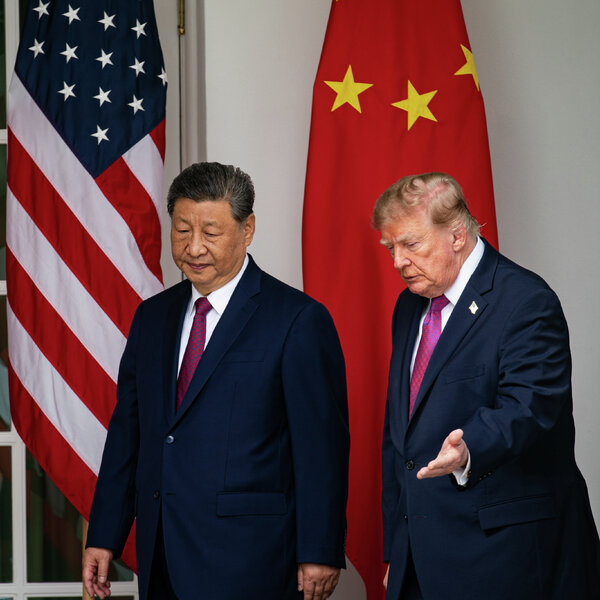
19:15And so there would be political backing for Congress to go after Silicon Valley CEOs and companies with a vengeance, with hearings into their practices and then also legislation, including on AI safety, beyond just the question of chip controls. Now, as far as China goes, this emerges as a brand new and major irritant potentially in the relationship. And, you know, on Bloomberg Television yesterday, our colleagues on Balance of Power interviewed former U.S. ambassador to the United Nations Nikki Haley, who said there is no way President Donald Trump should meet with Xi Jinping now in the wake of this.
19:59And if they do meet, there should be some serious questions asked by the president. However, as we saw from the warm welcome that he gave to Xi Jinping at the end of September, it's really unlikely that he wants to do anything that would disrupt that bonhomie. At the same time, lower level officials in his cabinet, including the Commerce Secretary Howard Lutnick and certainly Secretary of State Marco Rubio, who wrote the intelligence memo that The New York Times has reported on flagging this relationship between Jensen Wong and Alice Wong and the potential national security risks there, these officials may have their own views and may try to take a harder line with China.
20:40And there's a lot at stake, David, because the trade truce between the two countries expires on January 10th. The U.S. is still depending on China as a key source of a lion's share of the rare Earths that it needs for the tech industry, for the auto industry, and other sectors. So there's a lot hanging in the balance.
21:12This is The Big Take from Bloomberg News. I'm David Gurra. To get more from The Big Take and unlimited access to all of Bloomberg.com, subscribe today at bloomberg.com slash podcast offer. Thanks for listening. We'll be back tomorrow.
21:50For more than 75 years, Cincinnati Insurance has worked with independent agents to help protect businesses, homes, valuables, and more. Because planning for the future isn't only about knowing what's next. It's about making sure you're ready for what you can't predict. Let Cincinnati Insurance make your bad day better. Find an independent agent at CINFIN.com. Most meeting note takers get the easy words right and the important ones wrong. The client's name, the acronym, Whisperflow Notetaker is built to get the hard words right. It takes notes on any meeting platform, Zoom, Google Meet, Teams, even WhatsApp calls, keeps every meeting searchable, and connects to Claude or Chat GPT so you can ask, what did we agree to last Tuesday?
22:35Free to try on Mac and Windows at whisperflow.ai. That's W-I-S-P-R flow dot AI. Being a small business owner isn't just a career, it's a calling. Chase for Business knows how much heart and effort go into building something of your own. Manage all your business finances, from banking to payments to credit cards, all in one place with our digital tools. Plus access online resources designed to help your business thrive. Learn more at chase.com slash business. Chase for Business. Make more of what's yours. The Chase mobile app is available for select mobile devices. Message and data rates may apply.
23:09JPMorgan Chase Bank N.A. Member FDIC. Copyright 2026. JPMorgan Chase & Company.
Jensen Huang’s run as the seemingly untouchable Nvidia CEO, defining the future of AI, ended in a fall from grace made for Hollywood when multiple affairs came to light, including one with an alleged Chinese spy.
On today’s Big Take podcast, tech policy senior editor Michael Shepard and Dina Bass, Bloomberg’s AI infrastructure reporter, on what the departure of the key man at AI’s key company means for markets, competitors and US-China relations.
Read more:
We have a special Bloomberg subscription offer for podcast listeners at Bloomberg.com/podcastoffer.
Host: David Gura; Guests: Dina Bass and Michael Shepard; Produced by David Fox; Edited by Jeff Grocott; Engineering by Emma Munger.
See omnystudio.com/listener for privacy information.