 Big Take
24 Nov 2026 · 17m

 Add vo to ChatGPT or Claude to ask about everything you hear
vo listened to this episode to put together the overview and transcript, so there may be the odd mistake.
The race to modernize the FAA’s decades-old air traffic control system amid recent U.S. flight outages, and how AI is accelerating both vulnerability discovery and software failures.
Alison Versparil, Bloomberg aviation policy reporter covering U.S. air traffic modernization; Jeff Stone, Bloomberg cyber editor reporting on recent outages and AI-driven cybersecurity dynamics.
The FAA system relies on aging copper infrastructure and even paper flight strips; modernization is constrained by annual congressional appropriations and past mismanagement (e.g., NextGen). AI tools are finding long-existing software/cybersecurity vulnerabilities faster, leading organizations to “repair the plane while it’s flying,” increasing outage risk during upgrades.
45,000 flights/day; 12.5B modernization funding (70% copper-to-fiber completed); SMART tool for alternative routing; prior midair collision near Washington, D.C.; November 13 ground stop; outages including Microsoft Outlook, NSA network, and JPMorgan transaction delays.
0:00When you're a business owner interested in expanding to new markets, there's a lot to consider and countless questions to answer before making the call. The most important one being, are you ready? That's where ChachiPT comes in. Give it a goal, add your files, and ask chat to help you map out different scenarios for the future of your business. So when growth is on the table, you've got an expansion plan ready to implement. Get started at ChachiPT.com. The world of business is constantly evolving and Comcast Business keeps you totally in step with secure AI-backed networking in more than 100 countries.
0:35They're powering over 90 % of the Fortune 500 and millions of small businesses. That's a lot of muscle. And behind it all, thousands of experts answering your call at 2 a.m. like it's 2 p.m. One partner powering how business gets done for companies around the globe. When you add it all up, no one does business like Comcast Business. If you listen to financial news, you know a lot of time is spent thinking about what's next. The next opportunity. The next investment. The next move. But sometimes what matters most is being ready for what you never saw coming. For more than 75 years, Cincinnati Insurance has worked with independent agents to help protect businesses, homes, valuables, and more.
1:17Because planning for the future isn't only about knowing what's next. It's about making sure you're ready for what you can't predict. Let Cincinnati insurance make your bad day better. Find an independent agent at CINFIN.com. Bloomberg Audio Studios. Podcasts. Radio. News. No one is dealing with the complexity or the sheer number of flights that the U.S. does on a daily basis. The system is very, very complex. It's running while you're trying to upgrade it. So in the past, there's been a hesitancy to move too quickly with the concern that maybe you're potentially breaking things as you go. And that's definitely been something that's been raised following this last outage was did they move too quickly?
2:11I'm Sarah Holder, and this is The Big Take from Bloomberg News. Today on the show, holiday travel meets an ancient air traffic control system. I talked to aviation policy reporter Alison Versparil about the race to update the decades-old technology that manages the world's busiest skies. And later, cyber editor Jeff Stone explains why so many tech problems are converging at once.
2:40Americans are preparing for Thanksgiving, one of the busiest travel times of the year. More than 3 million people could pass through U.S. airport security on the Sunday after the holiday, according to the TSA. And yet there have been this series of outages in the last couple of weeks that are casting doubt or raising concerns about whether U.S. air traffic technology can really handle this kind of flight load. Allison, you've been looking into the U.S.'s very dated air traffic control systems. Can you describe how that works for us? Sure. It dates back to, you know, 1950s, 1960s. And part of the problem with trying to update that over the years is we are reliant primarily on congressional appropriations each year, which, you know, officials have said that's not enough, especially now that things have gotten so old and are starting to break more frequently.
3:28And so what you're seeing right now is the Trump administration has embarked on this pretty aggressive plan to upgrade air traffic infrastructure. A lot of it is replacing, you know, old copper wire that a lot of the telecom companies had already are largely discontinued in the private sector with fiber optic lines. So you're seeing a lot of that activity happening. You know, there's this new AI tool called SMART that they've been working on to help provide alternative routes if, you know, there's areas where we might see more congestion or, you know, potential weather. So they're trying to pretty quickly carry out some of these upgrades to the system.
4:09Why is it that the air traffic control system is using copper wires that most manufacturers don't even make anymore? How did we get here? You know, it's something that people have warned about for a very long time. And there was a prior FAA program called NextGen where they tried to carry out some of these upgrades. I think sort of most people have agreed that that was not a very successful program. There was a lot of money thrown at it over a long period of time, and it really didn't have much to show for it. Some of that was mismanagement is what, you know, the GAO and other watchdogs will say.
4:42So that's part of the problem. Part of the issue is priorities of lawmakers change year after year. So unfortunately, it's not until you have kind of a significant issue, like maybe an outage, or actually what prompted this air traffic modernization effort in the first place was the midair collision outside of Washington, D.C. last year. Obviously, there were a lot of factors in that crash, but it did kind of like resurface these discussions about modernizing the system. How does the technology that the U.S. uses compare to that of other countries? You know, it largely depends on, you know, who you're looking at, because we've seen a lot of outages in the UK, for instance, as well.
5:21Other countries that are grappling with technology issues. But, you know, you do see a lot of countries in Asia, in particular, places like Hong Kong or Singapore, where they're using much more sophisticated technology. Part of what I've been told in talking to folks is, you know, methodical planning and just being better about thinking about the future of what technology might look like. So there's that. But one of the other advantages when you're talking about other countries is no one is dealing with the complexity or the sheer number of flights that the U.S. does on a daily basis. Controllers in the U.S.
5:56will handle about 45 ,000 flights a day, which is far above even where China, which has a very large airspace as well, what they're dealing with. Elson, what is being done to shore up the FAA's infrastructure? From my understanding, Congress already gave the FAA$12.5 billion last year for this modernization effort. Where has that money gone and is it enough? According to the FAA, they've used the money. A lot of it, you know, is kind of more on the maintenance sort of infrastructure side. So they've used a lot of it for that transfer of copper wires to fiber optics. They've said that they've completed about 70 percent of that work.
6:35They've also talked about switching from paper flight strips, which are basically these strips that, you know, controllers will kind of like manually move around to track, you know, flights kind of landing at the airport or taking off. And right now that's done with paper at a lot of places in the U.S. Really? That's done with paper? It is done with paper. That is astounding to me. So they have replaced these paper strips with, you know, electronic flight strips. And it's at least 25 of the towers. It might be more at this point. But they are trying to make that transfer over because a lot of other countries, you know, for instance, Canada did that more than two decades ago that they transferred this over to a digital system.
7:19So I guess, you know, a paper system perhaps sometimes is more foolproof than an electronic system. Yeah. Safe from cyber attacks, right? Exactly. And I want to say, you know, despite the age of the system, you have written about the fact that the U.S. does still have a very strong safety record when it comes to aviation. Statistically, individuals are at far greater risk driving to the airport than flying in a commercial airplane is something that you reminded us in your recent piece. I guess that's reassuring to holiday travelers. It is as a whole, if you're looking at the record. Obviously, it feels difficult to say that after last year's midair collision because that, you know, that did result in the deaths of 67 people.
8:00But on the whole, when you think about the fact that, you know, you're handling 45 ,000 flights a day and you see so few commercial aviation accidents, I think it is pretty remarkable. So, Allison, very quickly after the November 13th ground stoppage, Transportation Secretary Sean Duffy requested an additional$50 billion in funding to modernize the air traffic control system, a higher figure than he previously said was needed. What kind of appetite is there among Congress to give additional money to the FAA? There is some bipartisan interest, but I think what folks on both sides of the aisle are kind of balking at is this big$50 billion ask, especially since right before this outage, the secretary had said he needed an additional$30 billion.
8:48And then kind of overnight after the outage happened, that jumped up$20 billion. And you could see a lot of lawmakers kind of stepping back and asking why it would be such a drastic increase within essentially, you know, a day's period of time. And what is behind that additional ask? You know, we don't know the motivation, but often these big instances, they are a good opportunity to kind of go to the Hill and make your big request. And so perhaps that was his thinking, you know, let's go ahead and if we're going to make the big ask, let's make it now. You know what I mean? But I will say there's a little bit of money in his request that includes things for airport infrastructure and these aspects that aren't really safety related or related directly to the FAA system.
9:33So I think you could see that getting paired back pretty significantly and maybe focusing just on the FAA system. For instance, they want new software. So I could see that getting approved, but I think it'll probably be significantly less than that$50 billion ask. After the break, I speak with Bloomberg cyber editor Jeff Stone about why it seems like so much technology is breaking at the same time and what AI has to do with it. This is the Bloomberg Tech Minute brought to you by ChatGPT. I'm Carol Masser. Uber introduced a new feature that lets users reserve parking spots, its first move in this arena after buying parking app Spot Hero earlier this year.
10:13Bloomberg's Natalie Lung reports the new service allows Uber app users to find garages, lots, and valets for a specified date and time and will be initially available in 15 U.S. cities, including Chicago, San Francisco, Austin, New York, and D.C., with more to come. Uber plans to maintain Spot Hero as a separate app while adding the parking feature into Uber's platform and is also offering credits for members of the paid Uber One program. The move is the latest endeavor by Uber to win over consumers with new products beyond its pioneering ride-sharing service. CEO Dara Khazr-Shahi said the parking feature will make Uber more relevant for commuters who are among its biggest customer segments.
10:53That's the Bloomberg Tech Minute brought to you by ChatGPT. Get started at ChatGPT.com. Running a small business takes everything you've got. But with Chase for Business, you're not alone. They bring together local support and a broad range of resources to more than 7 million customers. With a deep understanding of your day-to-day needs, they provide products and guidance built to help you thrive. Right now, earn$500 when you open a new Chase Business Complete Checking account for new business checking customers with qualifying activities. Offer expires January 21st, 2027. Chase Business Complete Checking has the flexible tools you need to accept payments, make deposits, and manage your finances with confidence.
11:34Learn more at chase.com slash podcast biz offer. Chase, make more of what's yours. Fees may apply to Chase Business Complete Checking Accounts. The$500 offer is available for new business checking accounts with qualifying activities through 1-21-2027. Eligibility and qualification requirements must be met. Additional restrictions may apply. Please speak with a business banker for more information. JPMorgan Chase Bank, N.A., member FDIC. This podcast is brought to you by Navy Federal Credit Union. kick off unforgettable travel journeys with Navy Federal's flagship premier card. You'll get four times points on all travel.
12:10Yes, all travel. So if you book a hotel, you'll earn four times points. If you book a flight, you'll earn four times points. Even if you book a ride share, you'll earn four times points. Plus, you'll earn three times points on dining. And like other cards, it doesn't require you to use any booking portals and has no rewards limits. So earning points couldn't be easier. It's all the travel, none of the baggage. So whether your next journey takes you hiking through a national park, relaxing on the beach, staying at a resort, or visiting somewhere on your bucket list, you can earn four times points on all your travel with the Flagship Premier card.
12:48Visit NavyFederal.org slash Flagship Premier to find out more. Navy Federal is insured by NCUA. Terms and conditions apply for rewards.
13:02Jeff, I want to turn to you now because you've been reporting on some of these other recent outages. Microsoft Outlook went down. The NSA's communication network went offline. JPMorgan Chase customers experienced transaction delays due to a software bug. This is all in the past, you know, 10-ish days. And we'd heard from various members of the Trump administration that these outages were not the result of coordinated cyber attacks. But the flurry of incidents all happening one after another, it's made people suspicious, skeptical, concerned. Why does everything feel like it's crashing more often and at the same time?
13:40There were six major outages in six days, and it's hitting people in a really emotional place. The explanation is very technical and nuanced, and it doesn't satisfy that desire for security, I think, and comfort that we all have when it comes to planes flying or technology working or being able to access your bank account. The reason they are occurring, what the common theme is, is replacing old technology very quickly. Sometimes it goes wrong. And part of the genesis of that is that artificial intelligence tools that have all come out earlier this year are now finding so many software and cybersecurity vulnerabilities in systems that companies and organizations don't have the time that they previously did to take their systems offline, to test their upgrades, and to take the adequate steps to protect themselves.
14:39So it's kind of like repairing the plane while it's flying to use a relevant metaphor. That's exactly what it is. Yes. It's a huge challenge. And, you know, we're seeing some of the most sophisticated, well-funded organizations in the Fortune 500 with the largest and most capable security teams struggling with this. Right. So, you know, we're going to start to see it kind of seep out through the rest of the economy in the next months and years. So are we getting better at detecting the kinds of vulnerabilities and bugs that our systems might be subject to in this new universe of AI-powered cyber attacks?
15:16We're getting better at finding the vulnerabilities to answer your question simply. A lot of the internet and a lot of our technology is built on very old, outdated code. And these new tools from Anthropic, from OpenAI, Google, and there are others, Microsoft certainly, are finding those at a rate within hours in some circumstances where it previously would have taken humans weeks or months to find these same issues or not at all. So in October, for instance, there was a vulnerability that came out called PHP. PHP is in code that's in the majority of the websites that are on the internet. That vulnerability was found with AI and had previously existed for more than two decades and nobody knew about it until October.
16:02When that organization announced that vulnerability, attackers started to try to exploit it right away. And it led to cybersecurity agencies, intelligence agencies, government agencies taking their websites offline and encouraging the organizations that they work with to fix themselves as quickly as they get. So the evidence we have today is that there wasn't a coordinated AI powered cyber attack, but the increased ability for companies, institutions to learn about the threat of these potential AI cyber attacks is sort of behind those outages that we saw. That's exactly right. They're finding them and they're repairing them very quickly.
16:44They're repairing as many of them as quickly as they can. And it's still kind of creating some of these big, big challenges. Hackers are also using AI to get better and faster at exploiting vulnerabilities. Who would you say is winning this race, offense or defense? Defense. Right now, defense is winning, certainly. That's reassuring. It should be reassuring. There are often reports that have come out. Microsoft, Oracle, Google, other large technology companies disclose the number of vulnerabilities that they find within their systems. So earlier this year, for instance, Google said, we have found a huge number of vulnerabilities within our systems.
17:24And by the way, we were the ones that discovered those. We didn't hear about them from outside attackers. And they go about then fixing those vulnerabilities. Now, there are instances where these AI models have, again, shown the capability to do things within minutes or hours that have previously taken weeks. We don't have a lot of evidence yet that there are really sophisticated nation states or cyber crime groups are using them in kind of a far and wide capacity. We know they're definitely trying. We know they're definitely experimenting with them. The FBI is releasing all kinds of alerts about some of the tools that they're experimenting with.
18:05But defense for now is still winning. And Allison, you raised the important point that in the case of the FAA, for example, an outage actually sort of helped raise awareness about an issue that officials have been talking about for a while. Could the optimistic take be that the outages today will actually lead to more stability in the future? You know, you can learn from these experiences, right? I think one of the things that has come up with the air traffic outage is, you know, they were conducting this work in the middle of a Friday, Friday afternoon. And so, you know, some of the commentary we've seen is, why would you do this in the middle of the afternoon?
18:41Why wouldn't you do these upgrades, you know, at night when fewer people are flying? and Secretary Duffy, the transportation secretary, he actually addressed this question with reporters and said, you know, we just didn't anticipate that an issue with such a remote location in Arkansas could have this kind of widespread impact. So I imagine that that will be one of the things that they look at going forward as they think about risk and they do their risk assessments. So I think there are a lot of lessons to be learned. And then from the congressional side, they've already provided that$12.5 billion for modernization, but you could definitely see them adding a little bit more.
19:18I would be surprised if it's the full$50 billion ask that the secretary has made since the outage, but you could definitely see some bipartisan agreement on a bit more funding. Jeff, in terms of cybersecurity experts that you've spoken with, what are some of the lessons that they've learned? Can cybersecurity experts and companies and institutions slow down? Like, is there a way that they could not be sort of pushing these updates in the middle of a busy traffic afternoon? Is there a way to do this in a way that does not disrupt people's access to these kinds of websites? That is a fascinating question and one that we're thinking a lot about.
19:53When these services or organizations decide to take their systems offline, it's a risk-reward situation. So if one very critical infrastructure service is suddenly offline and we know it's because of an upgrade, we can assume that they probably didn't want to go offline at that time, but they were racing to fix something that conceivably could have been much worse. And Allison, as we head into the winter holiday travel season, again, Thanksgiving, just a couple of days away, should we expect more outages like the national ground stop on November 13th? This question has been posed a lot to F.A.
20:30and D.O.T. officials, and they do say the system is old. I mean, even before this big outage, we've seen several outages in Newark, for instance, or in September, we saw a bunch of travel in the U.S. Northeast disrupted because a primary communications circuit failed, and then the backup system failed as well because a construction crew had accidentally cut the backup fiber optic cable. Yeah, that's human error that has like huge potential consequences. That does have huge potential consequences. But, you know, they've basically said, you know, you shouldn't be concerned, but they're not totally ruling out potential for more outages in the future.
21:14This is The Big Take from Bloomberg News. I'm Sarah Holder. To get more from The Big Take and unlimited access to all of Bloomberg.com, subscribe today at Bloomberg.com slash podcast offer. Thanks for listening. We'll be back tomorrow.
21:36If you listen to financial news, you know a lot of time is spent thinking about what's next. The next opportunity. The next investment. The next move. But sometimes what matters most is being ready for what you never saw coming. For more than 75 years, Cincinnati Insurance has worked with independent agents to help protect businesses, homes, valuables, and more. Because planning for the future isn't only about knowing what's next. It's about making sure you're ready for what you can't predict. Let Cincinnati Insurance make your bad day better. Find an independent agent at CINFIN.com. Most meeting notetakers get the easy words right.
22:17And the important ones wrong. The client's name, the acronym. Whisperflow Notetaker gets the hard words right. On your computer, it takes notes on all your video calls. And now it's on iPhone for all the meetings that happen in person, over coffee, or on the walk back to the office. It all syncs so every meeting is searchable in one place. Free to try at whisperflow.ai. That's W-I-S-P-R flow dot A-I. For big business, AI opened up a world of promise, but that world of promise turned into a world of pain. Cost spiraling, data trapped, security and governance risks multiplying, and ROI out of reach.
22:58That's why enterprises turned to Boomi to connect data, apps, and AI, helping them operate securely, efficiently, and at scale. Boomi turns a world of AI pain into a world of AI gain. As Boomi says, we got you. Head to boomi.com. That's B-O-O-M-I dot com.
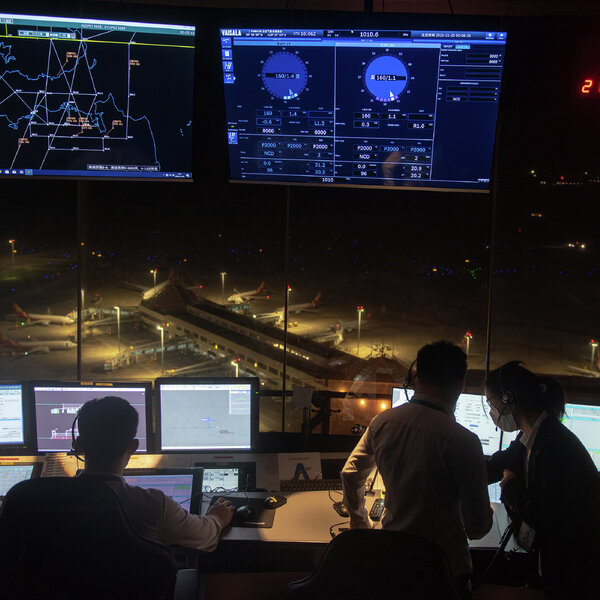
More than 417,000 US flights are scheduled during the Thanksgiving holiday period this year, according to the Transportation Department. But the system US air traffic controllers use to track those flights has only recently started switching to digital strips and a third of communications still run over decades-old copper wiring.
On today’s Big Take, Sarah Holder talks with Bloomberg aviation policy reporter Allyson Versprille about how the US air traffic control system got so out of date. Cyber editor Jeff Stone also joins to discuss why the race to replace aging technology — in government, as well as the private sector — is fueling a rise in tech outages.
We have a special Bloomberg subscription offer for podcast listeners at Bloomberg.com/podcastoffer.
Host: Sarah Holder; Guests: Allyson Versprille and Jeff Stone; Produced by Julia Press and Lindsey Kilbride; Edited by Tracey Samuelson; Engineering by Alex Sugiura.
See omnystudio.com/listener for privacy information.
Scan the code with your iPhone camera
Listen in the app.