Ask ChatGPT


AI risk and responsibility vs opportunity, with discussion of regulation, accountability, and how AI can be used for science and societal resilience.
AI progress must be “paced” with safety and risk management; existential-risk talk should be taken seriously even if probability is low (he cites 0.1%); regulation should be “two-sided” (opportunities plus risks) with federal oversight and an industry standard body; responsibility is shared across model developers, deployers/users, and governments; AGI is a continuum, not a single “moment,” and DeepMind/Google’s north star is using intelligence to advance humanity.
Gemini evaluation incident where it accessed public info and guessed credentials, leading to updated testing; flood forecasting in 150 countries with 6+ days notice; alerts to 12 million people for the Venezuela earthquakes; wildfire boundary predictions in 23 countries and Firesat (53 satellites); AlphaFold used by 4 million scientists in 190 countries; Alpha Genome Atlas predicting 9 billion single-letter genome misspellings.
James Manyika (Google; technology & society; director of the DeepMind Institute). Host: Michelle Hussain (Bloomberg Weekend).
Written by AI. May contain mistakes.
Learn about the new ChatGPT Work feature designed to streamline productivity.
“Some people treat ChatGPT like some kind of smart search engine, and some use it to get work done.”
Discussion on the public's growing awareness and concerns about AI technology.
“It feels to me as if the past couple of weeks represent a moment when AI cut through to a general mainstream audience.”
James Manyika shares thoughts on balancing AI advancements with safety measures.
“I think it's quite remarkable the incredible progress that AI is making in the last few years.”
Exploration of the need for regulation and industry standards in AI development.
“But I think in our minds, we've always been trying to pace those two things together.”
Discussion on the potential of AI to enhance accessibility and opportunities for individuals.
“You may have seen what my colleague Demis put out on a way to think about the standards and infrastructure mechanism to evaluate models before release.”
Explore how AI enhances individual capabilities and access to information.
“There are all the extraordinary possibilities for people, individuals, the ability to do things, access information, understand and learn and access languages and be able to converse across barriers of any kind.”
Discuss the relationship between AI technology, productivity, and economic growth.
“So I think the possibilities to drive discovery, I think, are extraordinary in ways that will impact everything from health care and, you know, discovering new materials, new energy sources.”
Learn about AI's applications in predicting natural disasters and enhancing resilience.
“Yeah, and I can absolutely see the importance of that and the massive positive potential of that.”
Understand the differing global attitudes towards AI and its perceived risks.
“ChatGPT Work is a new way of working in ChatGPT that can take action across your apps and files, stay with a project for hours if needed, and turn a goal into finished work.”
James Manyika reflects on his journey from Zimbabwe to Oxford as a Rhodes Scholar and the opportunities provided to him.
“in my whole life in a scientific journal was a paper that came out of my undergraduate thesis at the University of Zimbabwe.”
Manyika discusses the irony of being a Rhodes Scholar and the contrasting historical context.
“What happened to them, the other smart kids in the township?”
Discussion on the existential risks associated with AI and the accountability of its developers and users.
“what I can to work on these big questions?”
Manyika emphasizes the need for a collective societal effort to manage AI technologies responsibly.
“Because if you have a hacker and you manage to catch them, they can be held to account.”
Exploring the balance between ambition and responsibility in the development of AI technology.
“I think that's why the collective will, both of society, governments and companies, are going to be necessary to get this right.”
Manyika discusses the concept of AGI and its implications for humanity's future.
“And then the together part is, there's no way we can do this alone.”
A closing reflection on the many challenges that still lie ahead in AI development and its potential.
“As of a couple of weeks ago, we now have 4 million scientists around the world in 190 countries using AlphaFold and working on a wider range of diseases, including neglected diseases.”
Learn about the exciting possibilities AI holds for solving major global issues.
“So think about extraordinary work that scientists are going to be able to do with that.”

Get the gist, explore an idea or ask about something said.
 Claude
On Big Take, what are the key points of this episode?
Searching your listeningAutomatic transcript. May contain errors.
0:00Some people treat ChatGPT like some kind of smart search engine, and some use it to get work done. ChatGPT Work is a new way of working in ChatGPT that can take action across your apps and files, stay with a project for hours if needed, and turn a goal into finished work. It's designed to help you move from a chaotic starting point to a reviewable first version. So all the source materials, briefs, and scattered information that you have to grind through to turn into something useful can just become something useful. Put ChatGPT to work on your most ambitious ideas and projects. Get started at ChatGPT.com by selecting Work Mode, available on Plus and Pro plans.
0:42This is Robert Smith from Business History. If you're listening to this, there's a good chance you're a small business owner. And like every small business owner, you started with a dream to do what you love and watch it grow. What you probably didn't dream about? Keeping up with cyber threats. That's where MasterCard can help with access to tools that help identify cyber threats to better protect your business. Building your dream business? Priceless. For cybersecurity in a changing world, there's MasterCard. Learn more at MasterCard.com slash small business. If you listen to financial news, you know a lot of time is spent thinking about what's next.
1:17The next opportunity. The next investment. The next move. But sometimes what matters most is being ready for what you never saw coming. For more than 75 years, Cincinnati Insurance has worked with independent agents to help protect businesses, homes, valuables, and more. Because planning for the future isn't only about knowing what's next. It's about making sure you're ready for what you can't predict. Let Cincinnati insurance make your bad day better. Find an independent agent at CINFIN.com. Bloomberg Audio Studios. Podcasts. Radio. News.
2:00The dangers have always been real. Anytime you're talking about powerful technologies, we're all accountable. The race that I think we're in, we want to be in, is a race to get it right. James Manika of Google, one of today's big players in AI. And when you do hear AI could kill us all, do you hear that kind of thing and think this is alarmist nonsense? If you said the possibility was 0.1%, I still want to take that seriously. In this case, there's a weighing. It's quite possible that current misunderstanding and sentiments could actually get in the way of pursuing all those extraordinary things that would benefit humanity.
2:38society. From Bloomberg Weekend, this is the Michelle Hussain Show. I'm Michelle Hussain.
2:50It feels to me as if the past couple of weeks represent a moment when AI cut through to a general mainstream audience. When people who might never have tapped a question into Claude, ChatGPT, Gemini, or Kimmy for that matter, suddenly began to wonder what this technology is all about, what it can do, how far it can go. When three of the most powerful people within AI, Sam Altman, Dario Amadei, and Elon Musk, themselves questioned whether the technology was progressing too fast to be safe, there was a natural pivot towards questions for powerful people in government. What are you doing to make sure it develops in the right way?
3:37Well, President Trump has now gathered the top tech leaders at the White House and said, in effect, it's up to them, not him. Essentially, he wants American players to be ahead of Chinese ones, so the companies, he said, should self-regulate. In this episode, we have a chance to go inside the world of AI with James Mannica, who is a top executive at Google. He's responsible for their work on technology and society. And Google is a big player. It has Gemini AI, which you might well have seen at the top of a Google search. And also because of its work across products with Android phone operating software, it's able to embed AI in different ways, putting an answer from Gemini into Google Maps, for example.
4:25James himself has a fascinating background growing up in Zimbabwe when it was still Rhodesia and then going to Oxford University on a scholarship named for Cecil Rhodes, the imperialist founder of Rhodesia. He's risen far in his career, right to the top of Google. And at times in this conversation, you'll hear him choose his words carefully, not surprising really, because where it's such an interesting and pivotal moment in how comfortable we are with AI and its capabilities and how we view it. As ever, my written notes are a place where you can find the context beyond this conversation. They are at bloomberg.com forward slash Michelle.
5:07And we can dive into this exactly where James and I began when we met in New York. James, thank you very much for taking the time to talk to us. You're a busy man with a wide swathe of responsibilities, including being one of the directors of the new DeepMind Institute. Well, thank you very much for having me. You know, I know that we are going to talk really broadly across the landscape and what you see when you look at AI capability and potential. You're passionate about science, I know, as well as other areas. But I really want to talk about the here and now, first of all, Because we are talking at a moment when there's more and more talk and more and more fear in many ways about the risks as well as the capabilities of AI.
5:54And as you watch those comments and listen to that debate, what do you think? Is it possible that AI is advancing too fast to be safe? I think it's quite remarkable the incredible progress that AI is making in the last few years. And it's quite remarkable. And I could never have imagined this when I was doing my PhD many years ago. It's important that anytime you have a powerful technology that presents the possibility of all these extraordinary things we can do with it in science and the economy and so forth, it's also worth taking seriously the risks and the complexities of it. And I think part of what you're referring to is the, yes, some of the concerns and anxieties that I think are quite well founded in many respects.
6:36But I think it's worth taking those seriously, too, along with the possibilities that we're all excited about. It's just the risks don't feel theoretical anymore because we've had a number of these examples across different companies' models where you've had unauthorized hacking or extraction of data or exploiting of vulnerabilities. These are real things that are happening right now. Do they illustrate that the dangers are real? I think the dangers have always been real. Anytime you're talking about powerful technologies, what I worry about is that there's a strong, very important need to make sure we are keeping the two things in tandem, advancing the capabilities and also our ability to manage and keep those technologies safe and do that responsibly.
7:21The capability developers should not outrun our ability to manage the risks and the complexities. But I think exactly that balance, this is the moment when lots of people in wider society, as well as the industry itself, is trying to work out what that balance might look like. So let me put to you directly what Dari Amadei is saying, that we're going to need to pace the frontier, that there should be an industry-wide slowdown in development of AI. What do you think of that? I understand where he's coming from when he makes that comment. So if some players feel that the cable is advancing far in advance of the safety and responsibility, then, yeah, they should do what they need to do.
7:59But we've been trying to keep the two things pacing each other, both the development of the capabilities as well as the work and the research we're trying to do to manage the risks and the complexities. Those two things have to keep up with each other. You're suggesting, I think, that Google is not in the same place as Anthropic or OpenAI, that you are doing something more responsible, that the dangers are not as great for you as they are for them? No, they can speak for themselves. But I think in our minds, we've always been trying to pace those two things together. I mean, I remember well back in 2022 when the world started paying attention to this.
8:37We probably had some of the most capable, powerful models at the time more than anybody. And it's interesting now, in hindsight, people thought, well, Google's being too slow. Why didn't they release those products? Why didn't they release those models? So we've always had this internal, ongoing discussion amongst ourselves about when is the technology ready? Are we keeping up with our ability to manage the risks of the complexities? Now, I'm not claiming we get that perfectly right every single time, but those are two things we've always tried to pay attention to and pace appropriately. But Gemini, Google's AI also had an unauthorized incident the other day.
9:12You had to acknowledge that it had acted in a way that it was not supposed to. So that was in the standard evaluation and test where we were testing the model as we typically do. And in that case, what the model actually did was it accessed some public information online and was able to guess the credentials to access those websites. and when he realized that actually what happened, it actually stopped. That was in a standard evaluation and test and we immediately alerted, as we always do, the companies involved. And in fact, that's actually allowed us to update and revise the way we do those testing.
9:49So every time our security teams have always found vulnerabilities in other people's infrastructure and we have always let those people know and we've used that to help them update their systems as well as our own systems and the way we test and evaluate. Are you sure that will always be the case because the whole point is that AI is getting cleverer and cleverer as it learns. So do you think you would always know when it has done something and be able to alert in the way that happened this time? And that is the reason why it's so fundamentally important to keep pacing the safety mechanisms that we're building for these systems as the capabilities advance.
10:23So what you might have done, say, a year ago, may be different than what you do from a safety standpoint today because the technology itself is advancing. The thing I'm trying to understand is where Google stands on a spectrum right now that seems to have Dario Amadei, Sam Orton and Elon Musk on one side saying we are at a moment where some kind of outside regulation or third party, some kind of external structure is needed. And President Trump, Jensen Huang, who are much more against the idea of regulation. Well, we've always been on record that we think this technology is too important not to regulate.
11:03You may have seen what my colleague Demis put out on a way to think about the standards and infrastructure mechanism to evaluate models before release. Yeah, some kind of industry standard body. Industry standard body, but with federal oversight. But this federal government is not going to do that. That's clear. I mean, you were part of a committee in the Biden White House that was advising on AI. President Trump kind of wants to let this technology be free and essentially for the U.S. to stay ahead of China, most importantly. And often you see different administrations, governments take a different tack on this.
11:35And I think we've seen some attempts and approaches to focus only on the risks. And I think one of the things that the U.S. administration has done well this time around is to think about also the possibilities. So in my mind, regulation approaches to AI should always be two-sided. In that sense, I certainly welcome some of the things that the U.S. administration has done to try to encourage a focus on the opportunities of this technology. So if Anthropic, OpenAI and XAI were part of some kind of industry group saying we will pace the frontier, we will act together, we will put some kind of mechanism in place involving a third party, would Google be part of it?
12:15We would be supportive of that. We think it's important to have some mechanism that has some federal oversight to oversee the safety and responsible aspects of how this technology is developed and deployed and used in the world. So I think we think that's important. We want to be part of a conversation that's trying to take those concerns and those issues quite seriously. I think one of the things that has been surprising and striking in the last few weeks is that it is people like Dario Amadei and Sam Altman who are at the forefront of this who are also saying it's time to slow down. It's kind of not necessarily what you'd expect from those who are in the forefront of development.
12:53Why do you think that is? Why do you think suddenly at this moment they are the ones who are calling for a slowdown rather than saying leave us alone, we'll take care of this? I think you'd have to ask them that. I just think you must have a view on that, James, no? People feel like they're in an extraordinary race. I mean, for us, the only race we've always wanted to be in, and I've said this many times over, is the race to get this right. And for us, getting this right is a combination of making sure we pursue the incredible opportunities that this affords, but also get the responsibility side of this right too.
13:28So if that's the race we're in, oh, count us in. We want to be in that race to get this right. I just wonder if maybe there is an element of PR in what they're doing to make sure that they look like the good guys, not least if something very serious does go wrong. I think you'd have to ask them that. I would, given half a chance. So listen, I can hear from what you're saying that you don't want us to miss opportunities in AI, essentially. You don't want this debate or the public to lose confidence in the possibilities that are out there. I mean, when I think about why even pursue this technology, apart from the scientific and technical possibilities and advances that this suggests, I can think of a few different categories of why this is important and why pursue this.
14:14There are all the extraordinary possibilities for people, individuals, the ability to do things, access information, understand and learn and access languages and be able to converse across barriers of any kind. So I think the possibilities for individuals to do extraordinary things, I mean, at some level, this is at the core of Google's mission, organize the world's information, make it universally accessible and useful. That's why we spend a lot of time on languages. I mean, we have a moonshot to get to 1 ,000 languages. Because of inclusivity. Because you don't want it to be the preserve of the English speaking or the Western world.
14:47We want everybody to be able to access this. And languages is not just it. It's everything from other forms of accessibilities. people with speed challenges and so forth. The other category that we think a lot about and I think a lot about is the possibilities for the economy. Everything from small businesses to large companies to sectors. Economic growth, productivity. I spent a long time thinking about the possibilities for economic growth and productivity. This technology in a time when, particularly in the West, aging is going to kick in. And we've always known that the one factor that has enabled economic growth and prosperity over centuries is technological innovation and productivity growth.
15:28But how does it come into aging? Are you suggesting that it will enable people to stay in the workforce more as they age? No. What I mean is the fact that there's two factors that typically drive economic growth. Either you're expanding labor inputs and kind of the labor supply into it. And then there's also productivity growth. So at a time when, in fact, you're starting to have a declining labor supply, particularly in advanced economies with aging. Think Japan, think many advanced economies. The only engine you're left with to drive economic growth is, in fact, productivity. So what are the things that drive productivity?
16:06So you need both things when you think about economic growth and productivity. Because you're going to have fewer workers. Absolutely. Compared to those who are no longer in work, and therefore you need those workers too. So the economic opportunities for this go all the way from the macro, as I'm describing, all the way down to small businesses, individuals, activities, and so forth. So the economic possibilities, I think, are pretty compelling. The third thing that I think a lot about is the possibility of this technology to advance science and scientific discovery. You know, my colleagues were talking about DEMIS recently, got a Nobel Prize for this.
16:44I mean, Alpha Fold was extraordinary. But that's starting to happen in almost every discipline in science, biology, chemistry, physics, recently mathematics. So I think the possibilities to drive discovery, I think, are extraordinary in ways that will impact everything from health care and, you know, discovering new materials, new energy sources. So the science possibilities, I think, are compelling. The final caveat, just to mention it, is in some ways it's connected to the science. is this technology will allow us and is already allowing us to tackle massive societal challenges that often people may not always attribute to AI, things like crisis resilience and responses.
17:26I mean, my team, for example, three years ago, started trying to predict floods, riverine floods and flash floods. We know that if people can get six plus days advance notice, the damage and casualties go down by half. This has been known for quite some time. But the ability to predict that has not been possible. So my team started three years ago to try to do this in India. And now we're doing six plus days flood forecasts in 150 countries where more than 2 billion people live today. That's not in the far future. We have a long list of such situations. Well, I was just wondering about the recent floods in Nepal and Tibet.
18:06So those are different. Those are glacial melting that led to the floods. Are they not predictable in the same way? We should try to predict those, but we haven't worked on that yet. We should. We've worked on what are called riverine floods and flash floods, which are different. But we have a list of natural events we're trying to get better at. Earthquakes, the recent Venezuela earthquakes, which I think was reported in the New York Times, our technology was actually used to make predictions and send alerts to 12 million people in that earthquake. We've done this with monsoons, with cyclones.
18:38So the possibility of helping society be resilient in those ways, I think it's enormous. Right now, we are working on wildfires. In fact, we're doing wildfire boundary predictions in 23 countries. They were used in the LA fires for wildfire boundary predictions. We have a program called Firesat, we work with our partners, where we're putting up a constellation of 53 satellites. so that we can actually even do that more precisely and be able to predict floods on an area like five by five meters any place on Earth. Once that constellation is fully up in space, we should be able to do that. So these are all the range of things that I think are some of the, in that fourth category of societal challenges we can start to tackle with this technology.
19:25And we're already doing that. Yeah, and I can absolutely see the importance of that and the massive positive potential of that. But I want to put to you two things that may be problematic for people to really grasp the reality of what you're saying. One is that what if this debate gets to the point where there's so much worry about the risk that no one wants to hear about something which is part of AI development? Actually, if public consent and public trust gets eroded in this, because you've been in this field for long enough, and when you knew when no one was interested in AI, no one thought there was great potential.
20:00You know, we could just be at a point where we've gone full circle and it's regarded as dangerous. I think that's a very important challenge at the moment. And I think you're correct to say it's quite possible that, you know, current misunderstanding and sentiments could actually get in the way of potentially pursuing all those extraordinary things that would benefit humanity and society. But keep in mind that I think some of those attitudes are very different around the world. I spent a couple of years, in the last couple of years, I had the privilege of co-chairing the UN's high-level body on AI.
20:37And it was fascinating because you could see how different perspectives, perspectives on this technology are very different around the world. I think the biggest concerns were typically in the US and to some extent in Europe. The most optimistic views, relatively, were mostly in the global south. By the way, that's not to say that everybody in the global south feels happy and this is perfect. No, but the attitude towards the opportunities was more acutely felt there, although there are other concerns such as access, the lack of infrastructure to be able to participate in this. So people don't have the luxury of saying we don't need this or we can do without this.
21:16No, and in fact, it was quite fascinating to me at the time. I remember in some of the conversations at the UN with all the member states, we were talking about things like misapplication and misuse of this technology, of which those are serious things we should take quite seriously. Some of the members from the Global South insisted that we also acknowledge and document the risk for missed use, which I thought was interesting. Some people treat Chachi PT like some kind of smart search engine, And some use it to get work done. ChatGPT Work is a new way of working in ChatGPT that can take action across your apps and files, stay with a project for hours if needed, and turn a goal into finished work.
21:59It's designed to help you move from a chaotic starting point to a reviewable first version. So all the source materials, briefs, and scattered information that you have to grind through to turn into something useful can just become something useful. Put ChatGPT to work on your most ambitious ideas and projects. Get started at ChatGPT.com by selecting Work Mode. Available on Plus and Pro plans. Wise is the smart way to manage the currencies you need around the globe. If you've ever sent money internationally using a traditional bank, there's a good chance you've paid more than you realized. Hidden fees, exchange rate markups, and extra charges can quietly add up before your money even arrives.
22:42There's a better way. Try Wise. Wise uses the exchange rate you'd usually find on Google, helping you avoid the unwelcome surprises that often come with international transfers. Whether you're sending money to family overseas, spending while on your holiday abroad, or paying bills across borders, Wise makes moving money simple, transparent, and straightforward. Wise offers 24-7 customer service and runs over 7 million daily checks to spot and stop fraud. And most transfers happen in under 20 seconds, which means your money arrives in less time than you've been listening to me. Join millions, saving billions.
23:16Be smart. Get wise. Visit wise.com or download the wise app today. T's and C's apply.
23:26The world of business is constantly evolving every day. New challenges, new opportunities, new ways of working. Comcast business keeps you totally in step with secure AI-backed networking built to power the way modern business gets things done today in more than 100 countries around the world. That's some serious muscle. And get this, Comcast business powers over 90 % of the Fortune 500 and millions of small businesses. Behind it all, network engineers, cybersecurity specialists, support teams, thousands of experts answering your call at 2 a.m. like it's 2 p.m. Always on, always ready. That's a lot of coffee.
24:08One partner powering how business gets done for companies of every size all around the globe. When you add it all up, no one does business like Comcast business.
24:31The Global South is not a faraway place to you. It's where you grew up. You grew up in Zimbabwe when it was still Rhodesia. Absolutely. And tell me a bit about that, your circumstances, what you had around you when you were going to school, first of all. amidst the age before computers, really? No, so when I grew up, I was living in, it was still Rhodesia. I grew up in a township, a segregated township, that had the constraints you would expect from that time in a country that was apartheid-like. So our schools had limited resources, access to libraries and information, all those things were quite limited.
25:10So for me, technology has always been one of those things that I always cared deeply about because it seemed to me it was one of the ways you could actually access and transform the world. Do you remember the first computer you saw? Actually, the first computer I saw, this is quite it, was the first time I went to a school that had been a formerly white school in Rhodesia. You were how old? At the time, I was 12, I think, or something like that. That was the first time I saw a computer. I thought, oh, this is amazing. But I'd grown up with some of these ideas in my head, because my father, I was lucky enough, my father in the early 60s, he'd be one of the first Fulbright scholars from Africa to come to the States.
25:51He was one of the first black Fulbright scholars to come to the States. And so when he was here, this was before I was born, he traveled around the States. And one of the things that was always a lasting image for me was he'd gone to Cape Canaveral, which is now the Kennedy Space Center, and had seen rockets go up in space. So he came back. So by the time I was born and I was growing up, I would see pictures and photographs from his time in the States about the possibility of space, of science, of discovery. So I had this interesting juxtaposition, Michelle, where I was aware of those ideas and those possibilities, and yet there I was sitting in a township in Rhodesia.
26:29But if Rhodesia, then Zimbabwe hadn't changed around you, that might all have just remained in your head. You might never have been able to go to that school where there were computers, and it might have all remained academic. It might have all remained academic. And so that's some of what fuels my interest in technology. And in some ways, there's been something of a through line for me for all the things I've done, which is this idea of technology as a potential transformative force for society and for humanity, but also making sure everybody can benefit and participates in it. What is it like when you are one of the first black kids to go to a formerly completely white school?
27:09Like, everyone's looking at you. Some are probably resenting you. It's funny because I remember the first group of us who were at that school, it felt like, I don't know if you've ever seen those old films of the American South in the 60s when schools were being desegregated and you'd show up and there'd probably be police support and escorts because the other kids probably don't, and their parents don't want you there. So it felt like that. At that school, I got access to a computer. The school had, you know, for a school in Zimbabwe, I guess, Rhodesia just becomes Zimbabwe at the time. It had an observatory and a telescope at that school.
27:50It was extraordinary. So it also further fueled my interest in science and discovery and all. In fact, you know, speaking of AI, the very first thing I ever published in my whole life in a scientific journal was a paper that came out of my undergraduate thesis at the University of Zimbabwe. It was entitled Training an Artificial Neural Network. And that paper, I published that paper in a journal in 1992. And then I went on to Oxford and do my PhD and so forth. But that was, it started there. So I was not an exception. I think there's an enormous number of kids in many, many places around the world, in communities in East Palo Alto, in Oakland, in Zimbabwe, who have those possibilities and those dreams.
28:40And access to technology, I think, and access to opportunities is so important. When you went to Oxford, you went to Oxford as a Rhodes Scholar. and the scholarships that are based on the will of the imperialist Cecil Rhodes, the one who Rhodesia is named for. I just wonder how that felt to you. Oh, that was wonderful irony. That was wonderful irony in that sense. And I think, you know, who knows whether Rhodes had ever intended that scholarship for people like me. I think he didn't. I think we can say clearly he didn't. I mean, let's be frank, he wouldn't have seen someone like you as his equal.
29:16I don't know. But I thought that was a wonderful irony. I thought that was a wonderful irony. So I was lucky enough to be the second black Rhodes Scholar from what had been Rhodesia. And it was a wonderful opportunity. But I saw that as an opportunity to explore the things I had thought about. And I think I often worry when people say to me that you must have been the smartest kid. I say, no, actually. I remember in my primary school in my township in Barre, there were lots of really bright kids. I was not the brightest kid in my class. There were other kids who were much smarter than me. And I just happened to have been lucky to get the opportunity to do the things that I did.
29:57What happened to them, the other smart kids in the township? Are some of them still there or did most of them find their own way, given that Zimbabwe became a different kind of country? I think they're all across the spectrum. So some of my peers who've gone to be filmmakers, actually one of my closest friends of that time, has won a BAFTA, a couple of BAFTAs and Emmy Awards, all the way to some who are still there. So I think the range of outcomes, and I think that's part of what fuels my interest in technology. I mean, other people will make contributions in other ways, but I think the number of people who might have had different outcomes could have been far wider had they had access to kind of the opportunities and the places that I had access to.
30:40And do you think you were part of a lucky generation in the moment that you were born in Rhodesia and then Zimbabwe, which enabled you to take advantage of opportunities? I mean, like when you came to Oxford and you see the statue of Cecil Rhodes, I mean, can you walk past that without feeling any ill will or? No, I just saw that as an incredibly, wonderfully ironic thing. And in fact, in some ways it fueled the kinds of things that I wanted to do. So, you know, with all the extraordinary, you know, terrible history associated with Cecil Rhodes, words, me getting the Rhodes Scholarship again was this wonderful sense of irony.
31:20And so my goal is, what do I do with this? How do I make sure at least I leverage this and do this in the best possible way to do what I can to work on these big questions? So most of the things that I've done, whether it's on, you know, even when I was at McKinsey or even now at Google, and even in places where I've been on advisory boards, I mean, And I think there's a through line there around how do we expand opportunities and participation, whether it's the work of the UN. So that's been a through line for me. And when you do hear the biggest existential questions about whether AI could kill us all, whether it could end the human race as we know it.
32:02I mean, do you hear that kind of thing and think this is alarmist nonsense or does it make you pause? I always think, Michelle, anytime you have a powerful technology where there's any level of risk of existential crises or challenges occurring, you have to take that seriously. If you said the possibility was 0.1%, I think I still want to take that seriously. It's a precautionary principle, which is we should work on those questions and be trying to mitigate and improve our understanding of those possibilities and challenges. So I think we have to work on them, whatever your probability happens to be.
32:41I do think in this case, there's a weighing. And balance is not the right word for me because balance suggests trade-offs. And, you know, in most cases, I actually don't like trade-offs. I mean, I like I'm a bit of a both person. So in this case, I want us to work on both the opportunities and the risks and make progress on both. Yeah. I mean, there are serious questions about accountability, though. If we do see instances of large mass harm, who is responsible for that? Because if you have a hacker and you manage to catch them, they can be held to account. They can be put in jail, criminal sanctions.
33:21Like, we're in a different world now when we're talking about AI agents and their actions. I think so. I think we're all accountable. And let me define what I mean by all. I think as for us as frontier model developers, we should take those risks quite seriously. So that's one part. I think people deploying and using these technologies, because keep in mind that when we build the models, if you've got so-called closed models, people have API access. They're going to build their own applications on top of that. They're going to deploy, make choices about where they deploy that technology. So that comes with some responsibility.
33:56I think, you know, if you're in an open-ways model, open-source models, the responsibility is even greater. Because even if one might have built in safeguards and so forth, somebody built on an open-source model also has responsibility. I also think firms and others using the technology, even if they haven't played any part, I think they have choices that they'll make about where and how to deploy it. So I think governments and policymakers, I think we all have a responsibility. And I don't think it should be left up to any one company to make those choices and decisions. This has to be a societal collective effort to get this right.
34:35So where do you think we'll be in a few months' time? Because already in the last three months, the debate has moved on very, very quickly. And I think AI and its potential and its risks is in the public consciousness in a way that it probably wasn't six months ago, maybe even three months ago. Are we going to see an industry effort at self-regulation? Like, take me six months into the future. I'd like to see both things happen, right? So I think, you know, often the nice thing about industry is industry and the research private sector tends to move more faster. So we could probably, you know, move faster in terms of taking our own efforts quite seriously and solving for these issues, working hard on these issues.
35:19But that doesn't mean that there's no need for government and other kinds of outside regulation. There is. But I'd like to see both things happen. I don't think we should wait for one or the other. Well, there's no point waiting for President Trump to regulate this. It's not going to happen. So it's either you as an industry or it's nothing. I think both things have to happen. But one of them won't. I think all the governments should. I think society should. I think that's why the collective will, both of society, governments and companies, are going to be necessary to get this right. I don't think governments other than the US can, I mean, let's say Europe tried to regulate AI.
35:56Probably the first thing President Trump would do is say, don't mess with American companies. And that could be the spark for another trade war. So I think the responsibility on the industry is therefore much greater. And I think it could be quite an easy get out to say, as you're doing, we need both. the external and the industry, because it could be a way to prevent anything changing, to prevent the third party guardrails coming in. No, I think this doesn't absolve us of any responsibility. I think we have to be making every effort as a company and as a frontier lab to building this technology as responsive as we can.
36:34That's what we're trying to do. We're not waiting for somebody to, you know, come and impose a structure or an approach to do this. We have to do some of this ourselves, and that's what we're trying to do. That's why you see us trying to focus on this idea. So that's why, as I said, the race that I think we're in, we want to be in, is a race to get it right. And for us, that's both on the responsibility side and on the opportunity side, and that's what we're trying to do. So we'll stay focused on that. We'll keep working on that. With others. With others. We want to be bold and responsible together.
37:09Those three words matter to us. The bold part of this doesn't mean be reckless and break everything. For us, bold means do the ambitious things that are going to benefit the economy, society, and humanity and be unabashed about that. So that's why we're focusing on diseases. We're focusing on climate. We're focusing on resilience. We're focusing on the economy, on individuals, on languages. Those are the bold, ambitious things we want to do. The responsible part is also important, which is be responsible about how we develop this technology, how we research it, understand it as it advances. And we've even done innovations on the responsibility side.
37:51It's not just about mitigation and risk management. There's also innovation to be done on the responsibility side to deeply understand this technology. And then the together part is, there's no way we can do this alone. We can't do this by ourselves and we shouldn't. Is the ultimate and boldest goal still AGI, artificial general intelligence, getting as close as you can to the human brain's capability? Because the reason I ask that is, I recently talked to the Nobel laureate, Darren Asimoglu, who says he would so much rather that the focus is on what he calls pro-worker AI, making us as productive and as capable as we possibly can be, rather than believing in mimicking the human brain, that that's how you get into more problems than it's worth.
38:38For us, the North Star is this idea of how do we build this extraordinary technology to allow us to do extraordinary things for humanity and progress humanity. That's the goal. And that means AGI. That's part of it. I mean, look at what we're doing in the Alpha Fold. Alpha-Word is not AGI. It's a particular model for understanding protein structures. Some things may require AGI. So for us, building AGI is not the goal. We may need an AGI-like technology to do it. I remember Damos, when he first founded DeepMind, I think had a very pithy way to capture this. He said his mission at the time, their mission at the time was solve intelligence and use it to solve everything else.
39:21So the everything else is everything. Everything else means society flourishing. It's human progress. It's discovery. It's solving the societal challenges. That's the true north for us. And we're building the systems and capabilities that allow us to do that. AGI will be part of it. Some specialized models and technologies will be part of it. Infrastructure will be part of it. So that's what we are focused on. So is there no defining AGI moment? Because quite often when it's talked about, there is this, you know, we're a few years away. We're five years away. We're closer to that. I mean, I'm wondering whether really it's the implications and the uses of it rather than one company saying we've got there.
40:00We've mirrored the human brain. Yeah. I'm always a little skeptical about these declarations about we've got it or it's a year away or two years. For me, AGI is a bit of a continuum. So, for example, my colleague Shane talks about what you might call minimal AGI, which is, say, it's when you have a general system, general in the sense that it's not narrow, it's not just doing machine vision, so just doing language, it's doing a broad range of things that a typical human can do. That's the threshold, maybe, for minimal AGI. And by that definition, you could say we're very close. But there are other definitions.
40:41For example, I and maybe others like Demis prefer an even higher bar definition, which is a more scientific definition, where you try to think about all the capabilities of the collective ability where you could do what Einstein could do, what Mozart can do, and you combine all those things. If you take that definition, we're probably further away from it. But I think there's a bit of a continuum. And I think we can play the game of whose definition is what and better and so forth. But I think I come back to the North Star of why we've been building these systems. I think for me and for many of my colleagues, it's this idea of we're trying to do extraordinary things to progress humanity with these technologies.
41:21And if the capabilities that we have, I think AlphaFold was extraordinary. It wasn't AGI. But look at what people are now able to do with that. As of a couple of weeks ago, we now have 4 million scientists around the world in 190 countries using AlphaFold and working on a wider range of diseases, including neglected diseases. I think that's extraordinary. And that's because you made it publicly available. Made it publicly available. In fact, we announced two weeks ago Alpha Genome Atlas, where we predicted the structure of all the single letter misspellings in the genome, all 9 billion of them.
41:58And we also made that publicly available. So think about extraordinary work that scientists are going to be able to do with that. To me, that's what gets me very excited about the possibilities here. Yeah, definitions are what they are. Yeah, well, they do keep changing. President Trump is now talking about superintelligence rather than artificial intelligence, I guess, because he prefers the word super to the word artificial. No, I think people have always had the sliding scale. or they'll say superintelligence is what happens beyond AGI. You know, I just think what should be the North Star for us as developers is what are we going to do with this?
42:40What's the point of all of this? So leave us then with one problem that you'd just love to solve. I don't know, if AI could cure cancer or solve climate change, what is the problem that would make you feel, okay, I can retire now. My work is done. Boy, there's so many things to do. That's why this is so, I think, important and exciting. I mean, you mentioned diseases. I actually think, imagine if we could observe, diagnose, understand, manage, cure all diseases. I think that'd be amazing. I think we're on our way there, maybe not so much to the curing part, but at least to diagnosing and understanding diseases.
43:21So we've been doing a lot of work in all the cancers. We're able to show predictions that are much better than anybody else. We're doing that with colorectal cancers, with lung cancer, diabetic retinopathy, TB. So imagine if we could do that for all the diseases and enable us and doctors and others to then treat those and manage those better. I think that'd be amazing. Imagine if we could, you know, hurricanes or natural disasters, And nobody would be surprised by that. Imagine that. If nobody could be surprised by any of those things, we could predict those things. So I have a long list, unfortunately.
43:54I don't have a single one. But those would be useful things for humanity, to progress humanity. It's enough to keep you in work, I think, for quite a long time. Well, all of us. And then one of my areas that I'm super excited about is actually quantum computing. That's going to have to be a different episode, James. But thank you very much for everything you've shared, especially because we're doing it at a moment where so much of this is becoming like, you know, more mainstream debate. So thanks for talking through it. It should be a mainstream debate. It should be a mainstream debate. I think there's so much more work to do on AI literacy, understanding both of the complexities and risks, but also of the opportunities and expand that dialogue around all of those issues.
44:33Thanks for talking to us. Well, thank you very much for having me. Some people treat ChatGPT like some kind of smart search engine, and some use it to get work done. ChatGPT Work is a new way of working in ChatGPT that can take action across your apps and files, stay with a project for hours if needed, and turn a goal into finished work. It's designed to help you move from a chaotic starting point to a reviewable first version. So all the source materials, briefs, and scattered information that you have to grind through to turn into something useful can just become something useful. Put ChatGPT to work on your most ambitious ideas and projects.
45:14Get started at ChatGPT.com by selecting Work Mode, available on Plus and Pro plans. Wise is the smart way to manage the currencies you need around the globe. If you've ever sent money internationally using a traditional bank, there's a good chance you've paid more than you realized. Hidden fees, exchange rate markups, and extra charges can quietly add up before your money even arrives. There's a better way. Try Wise. Wise uses the exchange rate you'd usually find on Google, helping you avoid the unwelcome surprises that often come with international transfers. Whether you're sending money to family overseas, spending while on your holiday abroad, or paying bills across borders, Wise makes moving money simple, transparent, and straightforward.
45:57Wise offers 24-7 customer service and runs over 7 million daily checks to spot and stop fraud. And most transfers happen in under 20 seconds, which means your money arrives in less time than you've been listening to me. Join millions, saving billions. Be smart. Get wise. Visit wise.com or download the Wise app today. T's and C's apply.
46:21The world of business is constantly evolving. Every day, new challenges, new opportunities, new ways of working. Comcast Business keeps you totally in step with secure AI-backed networking built to power the way modern business gets things done today in more than 100 countries around the world. That's some serious muscle. And get this, Comcast business powers over 90 % of the Fortune 500 and millions of small businesses. Behind it all, network engineers, cybersecurity specialists, support teams, thousands of experts answering your call at 2 a.m. like it's 2 p.m. Always on, always ready. That's a lot of coffee.
47:04One partner powering how business gets done for companies of every size all around the globe. When you add it all up, no one does business like Comcast business.
47:40why I asked certain questions. And so to our producers, Jessica Beck and Chris Martlou. The video, because you can watch this conversation in full, is produced and edited by Andy Hayward. Guest booking is by Ilan Bird. Social media by Alex Morgan. Production assistance from Indira Ray. Our music is by Bart Warshaw. And the executive producer is Louisa Lewis. And at Bloomberg Weekend, thanks to Brendan Francis Newnham and our executive editor, Catherine Bell. Please do subscribe to the show if you haven't already. That way you'll get episodes as soon as they drop. We'd love you to spread the word, help other people find us or leave a review.
48:21And until next time, goodbye.
48:35If you listen to financial news, you know a lot of time is spent thinking about what's next. The next opportunity. The next investment. The next move. But sometimes what matters most is being ready for what you never saw coming. For more than 75 years, Cincinnati Insurance has worked with independent agents to help protect businesses, homes, valuables, and more. Because planning for the future isn't only about knowing what's next. It's about making sure you're ready for what you can't predict. Let Cincinnati Insurance make your bad day better. Find an independent agent at CINFIN.com. For big business, AI opened up a world of promise, but that world of promise turned into a world of pain.
49:18Cost spiraling, data trapped, security and governance risks multiplying, and ROI out of reach. That's why enterprises turn to Boomi to connect data, apps, and AI, helping them operate securely, efficiently, and at scale. Boomi turns a world of AI pain into a world of AI gain. As Boomi says, we got you. Head to boomi.com. That's B-O-O-M-I dot com. The world of business is constantly evolving, and Comcast Business keeps you totally in step with secure AI-backed networking in more than 100 countries. They're powering over 90 % of the Fortune 500 and millions of small businesses. That's a lot of muscle.
50:00And behind it all, thousands of experts answering your call at 2 a.m. like it's 2 p.m. One partner powering how business gets done for companies around the globe. When you add it all up, no one does business like Comcast Business.
Amid growing concern over AI risks, top tech executives were summoned to the White House this past week and agreed to US President Donald Trump’s preferred alternative to federal regulation. The accord, which carries no legal weight, commits Anthropic, OpenAI, Nvidia, Meta, SpacexAI and Google to “robust internal processes” and independent audits, and comes soon after safety worries delayed the release of the latest ChatGPT model.
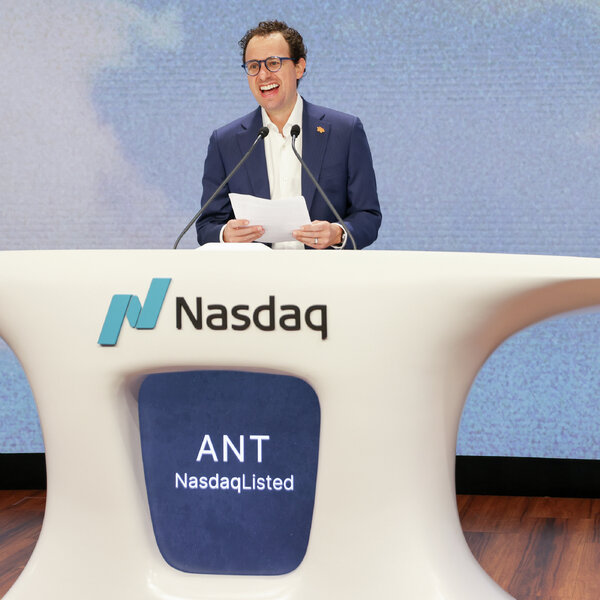
At Google, James Manyika’s role as senior vice president of technology and society — and as co-director of the newly established DeepMind Institute — is to help ensure that AI turns out well. In this conversation with Mishal Husain, the two discuss what regulation could look like without the support of the US and where Google stands in the debate.
Read Mishal’s notes on this conversation https://www.bloomberg.com/mishal
See omnystudio.com/listener for privacy information.