 Ask ChatGPT

Bloomberg’s The Big Take discusses why NVIDIA’s board reinstated recently ousted CEO Jensen Huang (Jensen Wang) and how the decision affects AI markets, investor sentiment, and U.S. export-control dynamics.
Mike Shepard (senior editor for Tech Policy, Bloomberg OddLots co-host Joe Weisenthal) and Sarah Holder (host, Bloomberg News). They discuss the board’s unanimous decision and alleged government involvement.
Shepard covers tech policy; Weisenthal co-hosts Bloomberg OddLots and focuses on markets/business; Holder is a Bloomberg News host.
Trump reportedly had input; reinstatement happened despite ongoing conduct and export-control investigations; investors view Huang as “key man risk” and essential to NVIDIA’s AI ecosystem strategy.
allegations involving Alice Wong (suspected China spy), reports of Huang berating employees, and market moves like NVIDIA shares up ~31% and surges in “neocloud” firms (e.g., CoreWeave).
Written by AI. May contain mistakes.
Discussing stock market reactions and Trump's involvement in Wong's return.
“So why does Trump care so much about Wong leading NVIDIA?”
Exploring the implications of ongoing investigations into Jensen Wong.
“government investigations underway as well?”
Analyzing whether Wong's leadership poses a liability for NVIDIA.
“Do those same shareholders want to keep that person who violated?”
Examining how Wong's return affects NVIDIA's market position and strategy.
“This is the Bloomberg Tech Minute brought to you by ChatGPT.”
Explore the effects of leadership changes on NVIDIA's market perception and strategy.
“It changed a number of analysts in their ratings on where to place the company as a buy or a hold stable.”
Discuss the vulnerabilities in NVIDIA's competitive landscape and AI spending.
“But I think like there's like an important thing here, which is that like one of the vulnerabilities for the United States in general is that like NVIDIA doesn't manufacture the chips itself.”
Reflect on the episode's discussion and the implications for the future.
“Well, Joe, Mike, thank you so much for being here on this truly insane Newsday.”

Get the gist, explore an idea or ask about something said.
 Claude
On Big Take, what are the key points of this episode?
Searching your listeningAutomatic transcript. May contain errors.
0:00When you're a business owner interested in expanding to new markets, there's a lot to consider and countless questions to answer before making the call. The most important one being, are you ready? That's where ChachiPT comes in. Give it a goal, add your files, and ask chat to help you map out different scenarios for the future of your business. So when growth is on the table, you've got an expansion plan ready to implement. Get started at ChachiPT.com. For big business, AI opened up a world of promise, but that world of promise turned into a world of pain. Cost spiraling, data trapped, security and governance risks multiplying, and ROI out of reach.
0:39That's why enterprises turned to Boomi to connect data, apps, and AI, helping them operate securely, efficiently, and at scale. Boomi turns a world of AI pain into a world of AI gain. As Boomi says, we got you. Head to boomi.com. That's B-O-O-M-I dot com.
1:23The Chase Mobile app is available for select mobile devices. Message and data rates may apply. JPMorgan Chase Bank, N.A. Member FDIC. Copyright 2026. JPMorgan Chase and Company.
1:38Bloomberg Audio Studios. Podcasts. Radio. News. I can't believe this. Less than two weeks after resigning as CEO of NVIDIA, Jensen Wong is back. Mike, how did this happen? Well, we're still piecing it all together, but the board said its decision to bring him back and reinstate him was unanimous. You know, just a complete about face here. And it also indicated that it had had the input of senior government officials. In the statement, the company did not identify who they were, but one of them stepped forward this morning. That was none other than President Donald Trump.
2:20I'm Sarah Holder, and this is The Big Take from Bloomberg News. Today on the show, Jensen Wong is back at NVIDIA. Mike Shepard, senior editor for Tech Policy, and Bloomberg OddLots co-host Joe Weisenthal join me to talk about why the board reinstated Wong and what comes next.
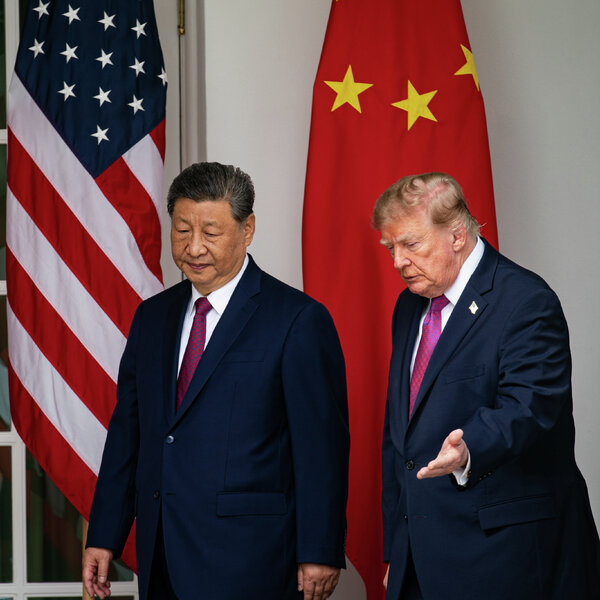
2:41So why does Trump care so much about Wong leading NVIDIA? I think the stock market sell-off in the last couple of weeks was a very big part of it. And I think, look, you could look at the U.S. economy and say there's not a lot of cylinders firing right now. Financial markets are one. There's more reasons than just the Jensen scandal that has been driving this sell-off recently. But it's clearly been a factor as evidenced by the huge whiplash. I think that's one factor. I think also, you know, Trump recently had the meeting with Xi Jinping and Putin in Shenzhen. There may be a perception that like it's important to like not rock the boat massively in terms of like our relationship of like trading with them.
3:30This White House has not been particularly aggressive about taking a hard line view on China's access to NVIDIA chips. There are members, there are people within the White House who believe we should have a fairly liberal export regime and so forth. This was like a perceived to be a move by the China Hawk wing to sort of maybe upend that a little bit. I don't know if that's where the consensus is, but a lot of turbulence was happening. And I don't think there was any particular appetite for that turbulence. Well, there's I mean, obviously, there's so much about this that is so remarkable. But it does seem significant that U.S.
4:06president would have influence over personnel decisions at a U.S. company. There are many things about the relationship between the White House and private U.S. companies that have been unprecedented, including some of the equity stakes. We saw the investment in Intel, et cetera. This White House in particular has been very active in corporate management with specific companies in a way that we haven't seen before. Well, NVIDIA's board says the investigation into Wang's conduct is still ongoing. Why reinstate him before that investigation is completed? And does that undermine sort of any results of that investigation if they've already chosen to reinstate him, Mike?
4:45You know, it's a great question. Why would they make this move with the inquiry still underway internally, but then also with U.S. government investigations underway as well? Alice Wong, of course, is suspected of acting as a spy for China. New York Times has reported. And that is one of the things that really, as it emerged, set in motion all the events that led to Jensen Wang's ouster. So with that inquiry underway, as well as inquiries into whether Megaspeed and some other NVIDIA partners may have actually violated export controls and sent the company's AI chips to China, it is striking that the company's board would move ahead and bring Jensen back, even in the face of all of those inquiries.
5:35Yeah, Elizabeth Warren came out with a statement saying that, you know, the board was wrong to reinstate Jensen at this at this juncture. Yeah, she was unambiguous about her opposition to the decision. She called it reckless. And she said that does not absolve the administration or the company of providing answers to and explanations for some of the concerns that lawmakers have raised about whether the company has been doing enough to abide by U.S. export controls and also whether the administration has done enough to enforce some of those rules. And Joe, even if the board is, as they say, quote, confident that Mr.
6:12Wong's reinstatement poses no national security risk, the affair with Alice Wong wasn't the only issue that has emerged with Wong and his leadership of NVIDIA. There was the affair with the direct report that The New York Times reported on. Last week, another Times report came out describing how Wong would berate his employees and sort of vivid ways. Couldn't Wong still be a liability for NVIDIA? Yeah, it's certainly possible. Look, I mean, we should look at the environment we're in in 2026. And we're sort of like, you know, one thing that's distinct with Jensen Wong is he formed this company prior to the era in which founders had built themselves in incredible voting control of the board.
6:54There's still a time, you know, so it's like contemporary founders of a stature have so much voting control that it's very hard to imagine them doing something, you know, breaking some sort of internal rule that would get them fired, right? So, you know, yes, absolutely. I think like a typical CEO under a typical corporate governance seems like, oh, this is the reason for firing someone. The shareholders of NVIDIA perceive, many of them clearly perceived Jensen to be absolutely crucial for running the company. Right, because stocks were tanking after he was out. But even setting aside the stock market, they'd say, well, here is someone, for better or worse, who had 60 direct reports, which is kind of wild, implicitly meaning, well, like, who could step into the shoes and know what he or she is supposed to talk to at the 60?
7:46Right, sort of the definition of the key man risk. Yeah. And so you have the shareholders like, well, was a relationship with an internal NVIDIA employee a violation of corporate conduct? Almost certainly, almost obviously, almost by definition. Do those same shareholders want to keep that person who violated? Also, almost certainly, et cetera. So that puts the board in a very uncomfortable position. The board is in an uncomfortable position in multiple ways. But let's just take, for example, let's set aside the Alice Wong question. Do the shareholders of NVIDIA want the CEO to be fired for having an affair with the director of Port?
8:30It seems like they don't want him to be fired for that. The board, well, the board ostensibly works for the shareholders, but the board also has these other things to uphold by. Yeah. I mean last week they wanted him to be fired for that comment. And there's another aspect here. We don't know all the details of what the board knew when it decided that he had to go. We have a few reports. We don't know how many internal relationships they had. You know, I think the board is obviously cross pressured in many ways. And it clearly does not really look like a board that is doing anything but, you know, sort of going where the prevailing winds want them to go.
9:11It's interesting. CNBC asked President Trump, does this make Jensen Wang too big to fail? Trump said no. But what do you think? Does this make Wang sort of untouchable if this is the outcome of all of these allegations? Yeah, kind of. I think there's like a view probably, again, among investors and among the White House that NVIDIA specifically is a crown jewel of the sort of AI ecosystem that we have in the United States. And B, that NVIDIA may not be able to be run without Jensen Wong currently. So that sounds, I guess, like the definition of too big to fail. It's kind of weird because that's different than how we used to use the term.
9:49Right. We used to use the term too big to fail to mean something fairly specific, which is, well, we can't let these companies collapse because they would like trigger like a bank run and so forth. Yeah, there has been scope creep of that phrase. I keep hearing it. If you consider, if you accept the two premises that NVIDIA is extremely, well, let's say accept three premises. If you accept the premise that NVIDIA is extremely important to the American AI ecosystem, if you accept the premise that a healthy and robust AI ecosystem is crucial to national defense, which I believe people in the White House, Pentagon, San Francisco do, and I guess if you accept the premise that no one else could run NVIDIA well without Jensen, then And yeah, that absolutely strikes me as a very legitimate way of saying too big to fail.
10:39This is the Bloomberg Tech Minute brought to you by ChatGPT. I'm Carol Masser. Uber introduced a new feature that lets users reserve parking spots, its first move in this arena after buying parking app Spot Hero earlier this year. Bloomberg's Natalie Lung reports the new service allows Uber app users to find garages, lots, and valets for a specified date and time and will be initially available in 15 U.S. cities, including Chicago, San Francisco, Austin, New York, and D.C., with more to come. Uber plans to maintain Spot Hero as a separate app while adding the parking feature into Uber's platform and is also offering credits for members of the paid Uber One program.
11:17The move is the latest endeavor by Uber to win over consumers with new products beyond its pioneering ride-sharing service. CEO Dara Khazr-Shahi said the parking feature will make Uber more relevant for commuters who are among its biggest customer segments. That's the Bloomberg Tech Minute brought to you by ChatGPT. Get started at ChatGPT.com. Quick question for you. How much of your day is spent typing? Email, Slack, notes, prompts to ChatGPT? Whisperflow is a voice-to-text app. Instead of typing, you talk and it types for you in any app on your Mac, Windows, iPhone, or Android. It takes out the ums, fixes the typos, and the result sounds like you wrote it, four times faster than typing.
11:58So the email that used to take two minutes now takes 30 seconds. Whisperflow is free. Download it at whisperflow.ai. That's W-I-S-P-R flow dot A-I. Running a small business takes everything you've got. But with Chase for Business, you're not alone. They bring together local support and a broad range of resources to more than 7 million customers. With a deep understanding of your day-to-day needs, they provide products and guidance built to help you thrive. Right now, earn$500 when you open a new Chase Business Complete Checking account for new business checking customers with qualifying activities.
12:32Offer expires January 21st, 2027. Chase Business Complete Checking has the flexible tools you need to accept payments, make deposits, and manage your finances with confidence. Learn more at chase.com slash podcast biz offer. Chase, make more of what's yours. Fees may apply to Chase Business Complete Checking Accounts. The$500 offer is available for new business checking accounts with qualifying activities through 1-21-2027. Eligibility and qualification requirements must be met. Additional restrictions may apply. Please speak with a business banker for more information. JPMorgan Chase Bank N.A.
13:07Member FDIC.
13:14I want to talk about how the markets have been reacting to this news, you know, after Jensen Wang was ousted. NVIDIA shares had been dropping. As of this morning, Monday morning, they were up more than 31 percent off the news that he was reinstated. How much was NVIDIA's board perhaps playing to the market? And, you know, forgive the obvious question, but why are investors reacting so positively to this sort of shocking news? Well, what they're looking at is what they have been telling us really since the scandal began to erupt. Dan Ives, who is in Invidia Bull, Dan of Yorkville, has talked about how a loss of Jensen Wong as the head of the company would translate into about a 30-plus percentage point drop in the company stock.
14:00It changed a number of analysts in their ratings on where to place the company as a buy or a hold stable. Lots of different ratings moved with respect to the change in leadership. And that the way the company is structured, Joe mentioned the 60 direct reports, but it even goes beyond that. just in his role as a chief salesman and evangelist for AI outside the company, you know, not only pushing the deals, but really trying to proselytize adoption of AI across the economy. And that's made a big difference. When you go to their big developer conferences, they have all sorts of different partners there.
14:44It's not just about the chips. It's about who's using them and how. And the company, and especially Jensen Wang himself, really take pains to show that. And yet without someone with that kind of charisma or force of personality, it becomes much harder to deliver that message across the marketplace. And that includes Wall Street. It goes well beyond Silicon Valley. Do you think that there was a concern among investors that without Wong at the helm, that there would be less of a commitment to these kinds of, you know, quote unquote, circular financing deals that another CEO might take a different path there?
15:21Definitely. Look, in addition to NVIDIA surging on the news, we saw a huge surge in some of these neocloud companies like CoreWeave, etc. And I think it's really important to understand the degree to which, like, yes, NVIDIA, maker of the world's most advanced chips. I also think it's important to understand the role that it plays in the ecosystem to keep everyone investing, backing these neoclouds. Not just backing neoclouds, also backing a lot of the open source AI ecosystem that exists in the United States. Why the reason for this? Because from NVIDIA's perspective, what it wants is to maintain intense competition everywhere else on the stack besides the chip stack.
16:09It wants the model companies competing with each other. It wants the cloud companies competing with each other. It wants a heavy degree of competition so that there are lots of entities that implicitly or directly will pay top dollar for NVIDIA GPUs. And that takes – there's a financial risk involved with that. And, you know, you see like NVIDIA's own balance sheet, which has been healthy, getting strained a little bit like this. But like, yeah, so there is a lot tied to the sort of Jensen vision, the strategic decisions that the company has made beyond just sort of developing the technology itself.
16:48But I think like there's like an important thing here, which is that like one of the vulnerabilities for the United States in general is that like NVIDIA doesn't manufacture the chips itself. It is only a collection of like sort of knowledge workers. And that takes an incredible amount of organization. But if that gets disrupted, there's not like some like factory or something like that that someone else can come in and run. It's a very, very modern American corporation in that. But it plays a very important role in the ecosystem. And so, yeah, that's why you see lots of different companies all surging today.
17:23At the same time, on the news that, you know, in theory, we'll see if in practice, but in theory, sort of like, let's get, you know, let's go back to the old days of October, September of 2026. Yeah, yeah. I mean, I am curious about what we're watching for next as this story unfolds because, OK, today we got a very clear reaction from the market, but like tomorrow everything could be different. I'm wondering in the Trump administration, Mike, could this have an impact on who is in charge of overseeing export controls, for example? You know, currently that's Secretary of Commerce Howard Lutnick, but Treasury Secretary Scott Besson has also been deeply involved in China trade policy.
18:00How does the NVIDIA story change the dynamics in the White House? Well, Howard Lutnick, the Commerce Secretary, is one of the people who would be most exposed to whatever is happening with the chipmaker right now. His agency does oversee export controls, and it's come under a lot of criticism. The Treasury Secretary, Scott Besson, has weighed in over the past week and a half saying that commerce really had in its power the ability to take steps to rein in some of the possible abuses in export controls and even take the step of putting on a blacklist, a Commerce Department blacklist, that company Megaspeed.
18:44And interestingly, a little more than a week ago, Sarah, he was on the Sunday shows calling for a dramatic shakeup at NVIDIA. He demanded a leadership change and urged the company to go outside its own ranks to find new blood. Now, that position is softened considerably, right? Well, Joe, what about the markets? Are we going to go back to the good old days of October? This is a really important thing, which is that in addition to the Jensen ouster, there are some fundamental questions about the health of the, quote, AI trade, unquote. There are questions about the degree of that ROI, the ROI that companies are getting from spending on AI services.
19:26There are questions about the degree to which the valuations make sense given the fact that for the most part consumers don't have an express and impulse to buy AI subscriptions en masse. There are questions, and this is also important with the Anthropic timing, about whether NVIDIA actually has the same competitive position against some of its competitors that it's had, say, two years ago. In its S1, Anthropic made a point of saying that it increasingly views chips as fungible across providers. And so Google makes TPUs a competitor. AMD has GPUs. Amazon has chips that will call it Tranium. Anthropic, which is a very different view on exports to China than NVIDIA, has been making a point, kind of going in for the kill a little bit, saying, like, we don't really regard NVIDIA as particularly special as one of our chip providers.
20:20Yeah, Anthropic's CFO in conversation with our colleague Ed Ludlow sort of highlighted that, too. So this is a really important thing. You could bring Jensen back. But there are these two other fundamentals. A, how much of a moat does NVIDIA have, period, setting aside Jensen? And B, how much durability is there with AI spending overall, or will we see that decelerate? And both of those are big question marks about whether we can just like immediately resume the AI euphoria. So regardless of who is the CEO of NVIDIA, the questions remain. Well, Joe, Mike, thank you so much for being here on this truly insane Newsday.
21:16It helps people find the show. Thanks for listening. We'll be back tomorrow.
21:46to create a gift that feels meaningful and on-brand. And with 4imprint's expert support and their 360-degree guarantee, you can be 4imprint certain your order will arrive exactly as intended. Explore gifting with confidence at 4imprint.com. 4imprint. 4certain. If you listen to financial news, you know a lot of time is spent thinking about what's next. The next opportunity. The next investment. The next move. But sometimes what matters most is being ready for what you never saw coming. For more than 75 years, Cincinnati Insurance has worked with independent agents to help protect businesses, homes, valuables, and more.
22:25Because planning for the future isn't only about knowing what's next. It's about making sure you're ready for what you can't predict. Let Cincinnati Insurance make your bad day better. Find an independent agent at CINFIN.com. Most meeting notetakers get the easy words right. And the important ones wrong. The client's name, the acronym. Whisperflow Notetaker gets the hard words right. On your computer, it takes notes on all your video calls. And now it's on iPhone for all the meetings that happen in person, over coffee, or on the walk back to the office. It all syncs so every meeting is searchable in one place.
23:04Free to try at whisperflow.ai. That's W-I-S-P-R flow dot A-I. Thank you.
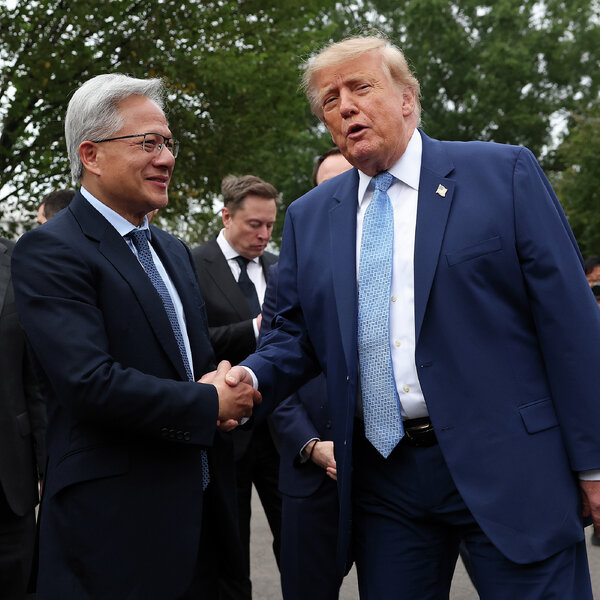
Jensen Huang is back at the helm of Nvidia after pressure from President Donald Trump -- and markets, at least for now, are thrilled. Nvidia ended the trading day with shares up over 30% and broader markets rallied. Meanwhile, the corporate and federal investigations into Huang’s affair with alleged Chinese spy Alice Huang are ongoing.
On today’s Big Take podcast, Sarah Holder is joined by Odd Lots podcast co-host Joe Weisenthal and senior editor for AI and tech policy Michael Shepard to talk about the Nvidia board’s about-face, the fallout in Washington and what comes next.
Read more: Nvidia Rehires Huang in Stunning Comeback Following Trump Push
We have a special Bloomberg subscription offer for podcast listeners at Bloomberg.com/podcastoffer.
Host: Sarah Holder; Guests: Michael Shepard and Joe Weisenthal; Produced by Naomi Shavin; Edited by Nicole Beemsterboer and Jeffrey Grocott; Engineering by Sean Carter.
See omnystudio.com/listener for privacy information.