Ask ChatGPT


Why President Trump left the G-7 summit early in Kananaskis, Alberta, and what it signals for U.S. policy toward the Israel-Iran conflict and other G-7 priorities (including Ukraine and trade).
Nick Wadhams, Bloomberg reporter covering diplomacy and national security; David Gurra, Bloomberg host/interviewer.
Trump foreshadowed a major Iran-related development, including comments to Keir Starmer and a tweet calling for evacuation of Tehran. The White House said he left to handle Middle East issues, but Wadhams doubts it’s only that—Ukraine talks were also scheduled, and Trump seemed uncomfortable. Wadhams says Trump is weighing (1) deeper U.S. military action (e.g., a B-2 strike/bunker-busting) versus (2) a “diplomacy at the point of a gun” path to Iran capitulation, potentially including ending Iran’s nuclear program.
Vladimir Zelensky’s pitch for more aid; Mexico’s Claudia Sheinbaum flying commercially to meet Trump but not getting a meeting; Oman denuclearization talks (sixth round) disrupted by Israel’s attack on Iran.
Written by AI. May contain mistakes.
Discussion on Trump's early departure from the G7 and its implications.
“Some people treat ChatGPT like some kind of smart search engine, and some use it to get work done.”
Discussion on Trump's early departure from the G7 and its implications.
“But on Monday afternoon, the White House announced Trump's plans to leave early, right after dinner.”
Analyzing Trump's comments on Iran and the potential for conflict.
“Historically, G7 summits have been forums for dealmaking and diplomacy, and the U.S.”
Exploration of diplomatic negotiations and military options regarding Iran.
“Well, I think what you're seeing here is a White House that is still very much grappling with this decision.”
Discussion on internal politics affecting Trump's decisions and global impact.
“And there is still no evidence that they're anywhere closer.”
Final reflections on Trump's G7 experience and implications for U.S. diplomacy.
“ChatGPT Work is a new way of working in ChatGPT that can take action across your apps and files, stay with a project for hours if needed, and turn a goal into finished work.”
The segment discusses the implications of Trump's absence from the G7 for world leaders, especially Zelensky.
“And the question we all had was, is he really going to be willing to endure this?”
A debate on whether a successful G7 summit can occur without U.S. participation and the future of international cooperation.
“And it doesn't matter how many hours you spend in negotiation with his trade representative or his commerce secretary, Howard Lutnick, because he can just blow all that up with a tweet.”

Get the gist, explore an idea or ask about something said.
 Claude
On Big Take, what are the key points of this episode?
Searching your listeningAutomatic transcript. May contain errors.
0:00Some people treat ChatGPT like some kind of smart search engine, and some use it to get work done. ChatGPT Work is a new way of working in ChatGPT that can take action across your apps and files, stay with a project for hours if needed, and turn a goal into finished work. It's designed to help you move from a chaotic starting point to a reviewable first version. So all the source materials, briefs, and scattered information that you have to grind through to turn into something useful can just become something useful. Put ChatGPT to work on your most ambitious ideas and projects. Get started at ChatGPT.com by selecting Work Mode, available on Plus and Pro plans.
0:42For big business, AI opened up a world of promise, but that world of promise turned into a world of pain. Cost spiraling, data trapped, security and governance risks multiplying, and ROI out of reach. That's why enterprises turn to Boomi to connect data, apps, and AI, helping them operate securely, efficiently, and at scale. Boomi turns a world of AI pain into a world of AI gain. As Boomi says, we got you. Head to boomi.com. That's B-O-O-M-I dot com. This is Robert Smith from Business History. If you're listening to this, there's a good chance you're a small business owner. And like every small business owner, you started with a dream to do what you love and watch it grow.
1:24What you probably didn't dream about? Keeping up with cyber threats. That's where MasterCard can help with access to tools that help identify cyber threats to better protect your business. Building your dream business? Priceless. For cybersecurity in a changing world, there's MasterCard. Learn more at MasterCard.com slash small business. Bloomberg Audio Studios. Podcasts. Radio. News. President Trump was in Alberta, Canada this week, in the resort town of Kananaskis, for a meeting of the Group of Seven. He was scheduled to meet with other world leaders over two days. But on Monday afternoon, the White House announced Trump's plans to leave early, right after dinner.
2:10I'm in Alberta reporting on the G7 with a team of Bloomberg colleagues from all over the world, including Nick Wadhams, who oversees our coverage of diplomacy and national security. And Nick told me, to him at least, Trump's decision to head home early was not a total surprise. There had been these hints throughout the day if you had been looking for them. Something Nick and I have been following is how the conflict in the Middle East between Israel and Iran has upended the agenda at this summit. The president, in a brief Q &A with Keir Starmer, had said he had a lot to get back to. I think Iran basically is at the negotiating table.
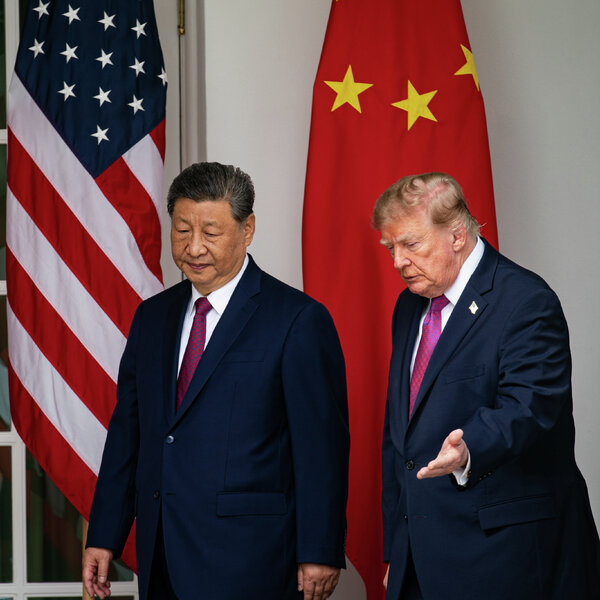
2:48They want to make a deal. And as soon as I leave here, we're going to be doing something. But I have to leave here. I have this commitment. I have a lot of commitments. He kept foreshadowing that something big was going to happen on Iran. And of course, he had also sent this tweet essentially saying, you know, everybody needs to evacuate Tehran. So that then created a lot of anxiety that, OK, the U.S. is essentially on the cusp of being pulled into the Iran conflict. Before Trump boarded Air Force One to head back to Washington, he joined the other G7 leaders for an official photograph, and he responded to a few questions from reporters.
3:25It's really nice. I wish I could stay for tomorrow, but they understand. Is there a reason, Mr. President, that you can't do your business from here? Do you have questions for anybody else? And then, after dinner, Trump was gone. To the frustration of some of the other participants, many of whom hoped to hammer out trade deals with the U.S. President Vladimir Zelensky came here to make the case for more aid. You have had a lot of leaders who essentially flew to Alberta basically just to see Donald Trump. I'm thinking chiefly of the Mexican president, Claudia Sheinbaum, who actually flew commercially from Mexico City to meet President Trump.
4:03And she had not met him yet in his term, and she didn't get that meeting. Historically, G7 summits have been forums for dealmaking and diplomacy, and the U.S. has played a big role. President Trump could have used this one, Nick told me, to rally U.S. allies, to express support for Israel, and to put more pressure on Iran. The G7 would be a tool the president would use. Now the president clearly sees the G7 almost as a hindrance to his policies, where he sees it essentially as standing in the way of his desire to get what he wants out of the Mideast conflict. On Tuesday, back in Washington, President Trump posted on social media a call for Iran's, quote, unconditional surrender.
4:46And in another post, he praised the United States' military capabilities, raising more questions about what comes next.
4:57I'm David Gurra here on the sidelines of the G7 Leaders Summit in Alberta, Canada. And this is The Big Take from Bloomberg News. Today on the show, why did President Trump decide to leave here early? What did it have to do, if anything, with the U.S. role in the conflict between Israel and Iran? And what does it leave hanging in the balance?
5:21Nick, shortly after the president left, he told reporters that he was leaving to negotiate a real end to this conflict in the Middle East, that he wasn't about trying to find a short-term ceasefire or a temporary ceasefire. On the other hand, there's speculation that maybe he left because he wanted to get the U.S. more engaged militarily in this conflict. And we saw some administration officials pushing back on that. What's the latest best thinking about what the White House's approach to this conflict is going to be now that the president is back in Washington, D.C.? Well, I think what you're seeing here is a White House that is still very much grappling with this decision.
5:54So the president, it seems, essentially has two options. One is the U.S. gets involved and contributes the bunker-busting bombs that it has in its arsenal. The president, I think, is deciding between that on the one hand, and also he has a notion that it is possible to achieve a sort of grand diplomatic solution. I think he does believe that if Israel and potentially the U.S. push hard enough, squeeze Iran hard enough, both militarily and through sanctions and through other economic pressure, that Iran will essentially capitulate and agree to a broader deal that potentially giving up its nuclear program entirely.
6:33Of course, there's a lot of debate about that. I mean, diplomacy at the point of a gun has its skeptics because what, OK, you get Iran to agree to something. Well, then what happens next? Well, let's look at each of those tracks one by one, and I'll start with the diplomatic one. Israel's initial attack on Iran took place just a couple of days before there were supposed to be talks in Oman, the sixth round of talks on denuclearization, on Iran's nuclear program. Given all that's happened, is Iran eager or willing, I should say, to come to the table once again? Well, it's a great question because Iranian officials have essentially left the door open to talks, which is pretty extraordinary.
7:16I mean, they are currently in a open, hot conflict with Israel. And they're saying, listen, we have never closed the door to negotiations. We are willing to continue to talk. You know, the big question, though, is a thing that the two sides have never been able to resolve, which is on the one hand, you have the U.S. saying, Iran, you should not be allowed to enrich uranium. Any deal that we agree to would essentially take enrichment off the table. You cannot produce the material that would go into a nuclear power plant or a nuclear bomb. Iran says, no, that is the one thing we really want more than anything else.
7:54We want to have the right to enrich. The two sides have never figured out how to breach that fundamental sticking point. And there is still no evidence that they're anywhere closer. So that's the diplomatic path pivoting to the potential military one. What are the long term considerations that the president is considering here? It sounds like there's a lot of internal politics at play here between sort of the Trump part of the Republican Party and the kind of hawkish toward Iran part of the Republican Party as well. Right. Having covered wars in the Middle East for a long time, you tend to see certain patterns that develop.
8:29And right now, the conversation that's happening in Washington, at least, is this notion that the president's going to send a B-2 bomber over to Iran. It's going to drop a couple of these 30 ,000 pound bombs and then problem solved. So there's a real fixation on this idea that by getting involved, the U.S. can essentially destroy Iran's nuclear program once and for all with a single military strike. A lot of the president's critics, both within the Republican Party and among Democrats, are saying, wait a minute, have we not learned the lessons of 20 years of war in Afghanistan and Iraq and elsewhere?
9:04the solution is never so simple. What if we discover that Iran has hidden nuclear sites where it's conducting some of this enrichment activity in secret? What if a strike doesn't work? What if Iran then attacks U.S. bases elsewhere in Iraq or in the UAE or in Qatar, and then the U.S. has to respond militarily, as President Trump has threatened to do if U.S. forces are attacked? So you have this notion that there is a very simple solution here, But then there are a lot of critics who say, listen, you start down this road, it is just going to pull the U.S. even deeper into exactly the type of war that President Trump has said he wants to avoid.
9:44As day two of the G7 unfolds, it's clear the president may have had other reasons for returning to the White House early. We'll get into those after the break.
9:57Some people treat ChatGPT like some kind of smart search engine, and some use it to get work done. ChatGPT Work is a new way of working in ChatGPT that can take action across your apps and files, stay with a project for hours if needed, and turn a goal into finished work. It's designed to help you move from a chaotic starting point to a reviewable first version. So all the source materials, briefs, and scattered information that you have to grind through to turn into something useful can just become something useful. Put ChatGPT to work on your most ambitious ideas and projects. Get started at ChatGPT.com by selecting Work Mode, available on Plus and Pro plans.
10:40At Edward Jones, we believe rich is more than caring about the latest and greatest. It's also taking care of what gives your life meaning. That's why your dedicated financial advisor meets you where you are with personalized financial strategies that help protect what matters so you can preserve your progress while creating a path forward. The key to being rich is knowing what counts. Let's find your rich together. Edward Jones, member SIPC. This is the Bloomberg Market Minute brought to you by Comcast Business. The markets faced plenty of challenges this year, Rising energy costs, higher interest rates, pushback to massive artificial intelligence spending.
11:22But through it all, stocks keep breaking records. And some analysts think they still can with a focus on the fundamentals. Nadia Lovell is head of global equity strategy at UBS. Earnings has been good and continues to be good. And while, you know, we might be past the peak in earnings growth, we're not past the peak in earnings level. But others like Miller-Tabak strategist Matt Maley say those challenges could eventually lead to a downturn. Whenever we see a significant rise in bond yields like we have and a significant rise in oil prices like we have, the stock market always or pretty much always ignores it for a while.
11:57And Wall Street may be starting to take notice. A recent Citigroup index shows more analysts cut rather than raise their earnings forecasts for corporate America for the first time in more than five months. That was the Bloomberg Market Minute brought to you by Comcast Business, one partner powering 90 percent of the Fortune 500 and millions of small businesses. When you add it all up, no one does business like Comcast Business.
12:28Nick, the official line from the White House Communications Office and from the president himself is he left this summit to go back and deal with the issues in the Middle East. You and I both know that there's a level of discomfort that comes with him being on the road and making trips like this. And on top of that, there's this kind of historical displeasure that he has with sitting in a room of other world leaders and going through these various working groups and plenary sessions and all of that. At this point, are we confident that the rationale that the White House is citing here is, in fact, why President Trump left this summit early, that it does have to do with the Middle East and nothing more?
13:00Or is there something else at play here? I am not at all confident that it really has to do with the Middle East. I mean, yes, there is a lot going on in the Middle East, and you could make a very persuasive argument that the president wanted to be back in Washington with all of the assets and resources and advisors available to him that he doesn't have out in a mountain resort in Canada. However, there are a few caveats to that. One is today was going to be all about Ukraine. And when we had been looking at this schedule ahead of this summit, there was a big question about whether Trump was going to come in the first place.
13:38And then we were looking at this schedule and it's like, wow, he's going to be here for two days. The first day is all about the economy and trade and things like that. the second day he's going to be sitting in a room with President Volodymyr Zelensky and other world leaders who are essentially going to try to browbeat him to get on board with more sanctions for Russia, lowering the price cap on the exports of Russian oil, potential new support for Volodymyr Zelensky. And the question we all had was, is he really going to be willing to endure this? It's eight hours out here talking about Ukraine.
14:11That's just not something he wants to do or subject The other issue is we started to see these signs yesterday where he just looked a little bit uncomfortable. He did not seem to be particularly sort of at ease or relaxed. So it was shocking that he decided to pull out of this meeting, but I wouldn't say it was necessarily surprising. Nick, I think of President Zelensky, who, like so many of these world leaders, both in the G7 as invited guests of the G7, really traveled far to be here in this remote corner of Canada. How disappointing is it for him not to have President Trump here? I'm sure someone like Vladimir Zelensky is disappointed not to have that one-on-one meeting with President Donald Trump, as are the others, because U.S.
15:01support is so crucial for the Ukraine conflict. On the other hand, I sort of have to imagine that maybe there's a little bit of relief. I mean, now you have a situation up in Kananaskis where it really is a meeting of like-minded actors. Everybody who is now there agrees on what they think the path forward should be. You're not going to have any more of this situation where everybody was trying to humor President Trump or mollify him or was worried about a blow up. I mean, they can kind of get down to business on their own up there. And there is this push happening in the background where European leaders, I mean, they have said openly, Canada has said openly, the old days are over.
15:44We have to move on and look forward. And that means bolstering the European security architecture with Canada, greater defense cooperation between those countries, essentially not cutting the U.S. out, but understanding that there's a future where the U.S. is a less reliable ally. As I look at the pantheon of world leaders who are here, there's Narendra Modi, the prime minister of India. There's Claudia Scheinbaum of Mexico. There are all manner of world leaders here who expected that they would have the opportunity to sit down on the sidelines with President Trump and his economic advisors, many of whom came here with him, the Treasury Secretary, the U.S.
16:18trade representative, to talk about the prospects for there being trade deals or frameworks for deals. What happens to all of that now? And as we look ahead to this July 9th deadline by which that pause that the president put in place is scheduled to be lifted, how big of a detriment is it not having this opportunity in this resort town in Western Canada to try to get down to brass tacks with the president to find a solution? I think it's difficult to overstate how severely disappointed they are going to be to not have that conversation, because everything we have seen in the last couple months when you talk about the tariff discussions and new trade deals are that you cannot do this with anybody but the president.
16:58And it doesn't matter how many hours you spend in negotiation with his trade representative or his commerce secretary, Howard Lutnick, because he can just blow all that up with a tweet. So there really is this sense of seeking a personal dynamic directly with the president as a way to hash out these things. I mean, I think from the outside, a lot of folks have this notion that, OK, you have these trade negotiators in conversation for hours and hours in their ruling talks, debating every comma and paragraph point, things like that. But no, I mean, these really have to be settled in one on one conversations with the president.
17:34You talked about now with President Trump being gone from this summit, a lot of like minded actors able to get down to business in a way they might not have been able to if President Trump had been here. But President Trump leads the world's largest economy. He's an incredibly important figure. And I wonder if you think you can have a successful G7 summit without the participation of the United States. Is it even possible? And what does it say just about the strength or integrity of this group going forward? Well, I think having covered a lot of these summits in the past when things were working well, you did have, call it almost a slightly Trumpian view of like, what is the point of what we're doing here?
18:12All these leaders come together. They issue a 30 page communique that talks about the need to fight climate change and the need to work together to counter China and, you know, whatever it might be. And you think, well, what did that all amount to? Trump has in some ways sort of exposed that a lot of this is theater. A lot of it doesn't really amount to much. And it does pose a big question going forward because, no, the G7 simply cannot exist without the presence of the world's biggest economy, the U.S. If the U.S. is not willing to play ball, you know, the one hope I think folks have for this is leaders come and go.
18:50OK, so President Trump may not be participating this time, but there are still a lot of folks in the Republican Party who believe that these kind of institutions do have merit. It's not going to be that long in the general schema thing until President Trump departs the scene. G7 has been around for 50 years. We're in a bad patch now. And maybe things will come back around later on once he leaves.
19:15This is The Big Take from Bloomberg News. I'm David Gurra. To get more from The Big Take and unlimited access to all of Bloomberg.com, subscribe today at Bloomberg.com slash podcast offer. If you like this episode, make sure to follow and review The Big Take wherever you listen to podcasts. It helps people find the show. Thanks for listening. We'll be back tomorrow.
19:40If you listen to financial news, you know a lot of time is spent thinking about what's next. The next opportunity. The next investment. The next move. But sometimes what matters most is being ready for what you never saw coming. For more than 75 years, Cincinnati Insurance has worked with independent agents to help protect businesses, homes, valuables, and more. Because planning for the future isn't only about knowing what's next. It's about making sure you're ready for what you can't predict. Let Cincinnati insurance make your bad day better. Find an independent agent at CINFIN.com. For big business, AI opened up a world of promise, but that world of promise turned into a world of pain.
20:24Cost spiraling, data trapped, security and governance risks multiplying, and ROI out of reach. That's why enterprises turn to Boomi to connect data, apps, and AI, helping them operate securely, efficiently, and at scale. Boomi turns a world of AI pain into a world of AI gain. As Boomi says, we got you. Head to boomi.com. That's B-O-O-M-I dot com. The world of business is constantly evolving, and Comcast Business keeps you totally in step with secure AI-backed networking in more than 100 countries. They're powering over 90 % of the Fortune 500 and millions of small businesses. That's a lot of muscle.
21:05And behind it all, thousands of experts answering your call at 2 a.m. like it's 2 p.m. One partner powering how business gets done for companies around the globe. When you add it all up, no one does business like Comcast Business.
President Trump was in Canada this week for the Group of Seven summit. But after dinner on Monday night, Trump left early, citing the conflict in the Middle East.
On today’s Big Take podcast, host David Gura speaks with Bloomberg’s Nick Wadhams in Calgary to unpack what Trump’s move could mean for Ukraine, the Middle East, trade — and for G-7 summits going forward.
See omnystudio.com/listener for privacy information.