

- Podcasts
- Biotech 2050 Podcast
- Nello Mainolfi, Founder, President & CEO, Kymera: Pioneering Targeted Protein Degradation
 Biotech 2050 Podcast
16 Sep 2026 · 39m · 13 chapters
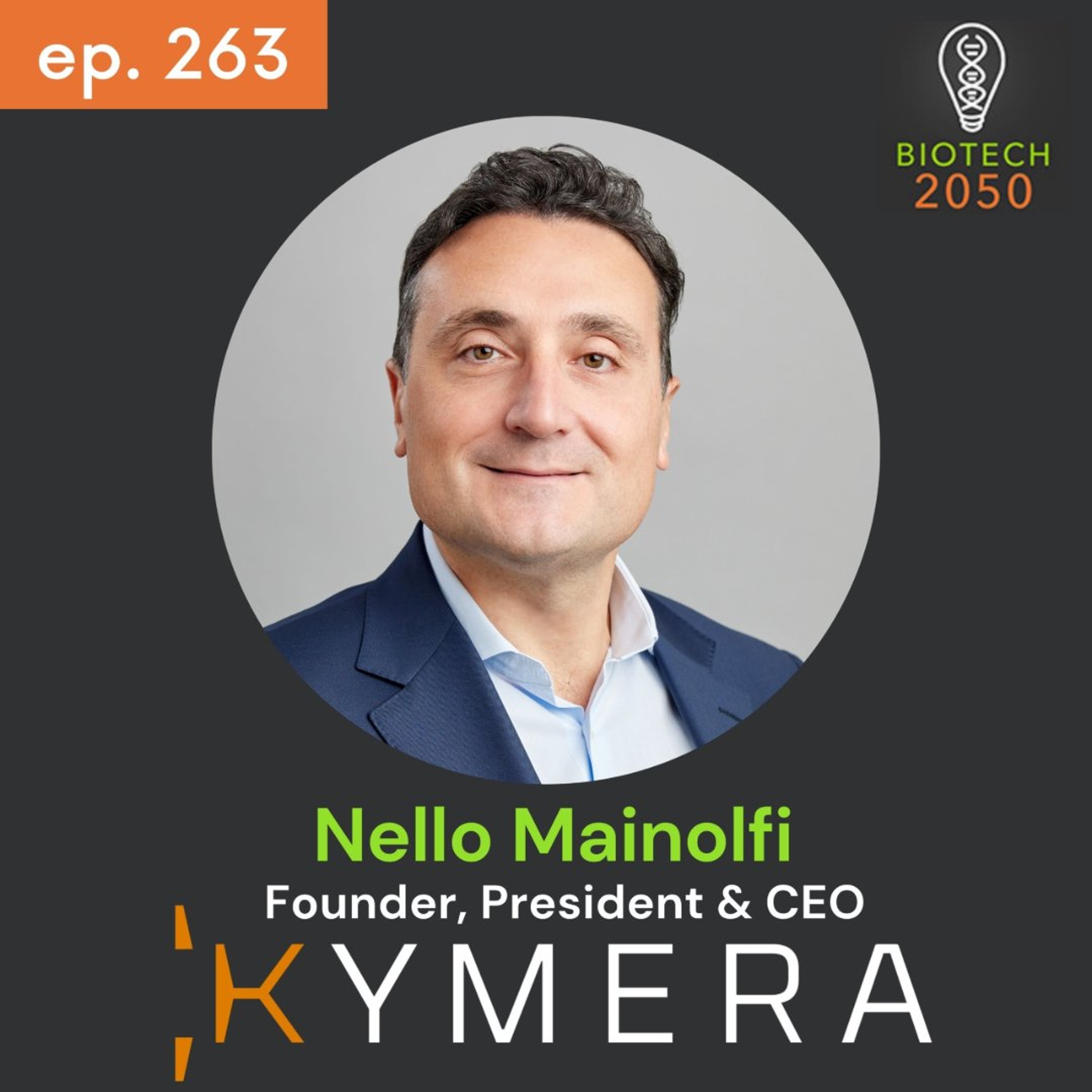
Nello Mainolfi, Founder, President & CEO, Kymera: Pioneering Targeted Protein Degradation
 Ask ChatGPT
In short
Nello Mainolfi (Chimera Therapeutics) discusses his career pivot from chemistry to biotech, how Chimera was founded in 2015–2016 to build targeted protein degradation, and why the company shifted from oncology to immunology. He also covers capital allocation philosophy (“earn the right to grow”), CEO lessons on hiring and culture, and current immunology development programs.
Guest background
Italian (Napoli) chemistry PhD; postdoc at Scripps (Casey Nicolau); big pharma leadership at Novartis (program leader; factor B inhibitor discovery); entrepreneur-in-residence at Atlas Venture; co-founded Chimera with Bruce Booth.
Key claims
Protein degradation “disconnects PK and PD” via irreversible degradation; oral degraders can mimic biologic pathway blockade; Chimera stopped oncology because heme-oncology advanced rapidly; success depends on trust, transparency, data-driven culture, and hiring.
Notable examples
Factor B inhibitor work at Novartis; Chimera’s IRF-4 program with Sanofi (clinic entry early 2021); STAT6 degrader in Phase 2 for atopic dermatitis and asthma; IRF-5 Phase 1 healthy volunteer program; collaboration with Gilead on CDK2 molecular glue.
Written by AI. May contain mistakes.
Chapters
Nelo's Journey in Biotech
Nelo shares his background and journey into the biotech industry.
“And so I went to Scripps in La Jolla to do a postdoc in a really big lab.”
Founding Chimera: Early Days
Discussion on the founding of Chimera and the startup experience.
“We'll talk about some of the work that you did at Niebuhr, particularly with working on a first-in-class, FDA-approved factor B inhibitor.”
The Challenges of Biotech Founding
Nelo describes the challenges and excitement of founding a biotech company.
“I tell everybody at the company or whenever I talk to others in the industry, I never plan to be a biotech founder or a biotech CEO.”
Lessons from Big Pharma to Biotech
Nelo compares his experiences in Big Pharma and biotech, emphasizing the learning opportunities.
“Now, you talked about you were getting a bit too comfortable during your time at Niebuhr, even though you had quite a bit of success at Niebuhr.”
Evolution of Biotech Companies
Nelo reflects on the changes in biotech company creation over the past decade.
“So over the last 10 years, the process of company creation and capital allocation in biotech has changed quite a bit.”
Funding Philosophy and Company Growth
Learn about the philosophy behind funding and strategic growth in biotech.
“the Series B was, okay, we have enough money to show that we can get a drug close to the clinic.”
Pioneering Protein Degradation Technology
Discover the innovative approach to protein degradation and its implications.
“drugged or drugged well in pathways that have been well validated, where there is strong human genetics, ideally downstream of highly validated receptors that have been drugged by biologics.”
Focusing on Immunology: Strategic Shifts
Understand the internal decision-making process for focusing on immunology.
“or build all that part of the organization that we just don't have enough high-quality commitment to being able to do it in more than one area.”
Lessons from a First-Time CEO
Gain insights and advice for first-time CEOs in the biotech industry.
“You were first time CEO when you founded Chimera.”
Lessons Learned as a Founder CEO
Nello shares key lessons learned during his journey as a founder CEO, emphasizing the importance of people and trust.
“You know, there's a lot of failed first-time CEOs in every sector.”
Show all 13 chapters
The Importance of Company Culture
He discusses how company culture impacts biotech success and the need for transparency and feedback.
“And just to be clear, I go deep in areas not because I don't trust this, because I feel like I want to obviously try and help and add value when it's a critical time.”
Managing Priorities and Mental Health
Nello explains how he structures his time, prioritizes tasks, and maintains his mental fitness as a CEO.
“especially as you grow and you hire people from larger organization.”
Advice for the Younger Self
Nello shares vital advice about the significance of culture over technical skills in a team.
“digest it, put it into your brain somewhere, move on, then go back to it when you need to.”

Ask about this episode
Get the gist, explore an idea or ask about something said.
 Claude
On Biotech 2050 Podcast, what are the key points of this episode?
Searching your listeningTranscript
Automatic transcript. May contain errors.
0:02Hello and welcome to the Biotech 2050 podcast. Biotech 2050 is a think tank chronicling the disruption changing the biotech industry over the next several decades. I'm Rahul Chaturvedi, co-founder of this podcast and today's host. I'm also the founder and CEO of Chora, a software platform that enables biotechs to build a resilient fractional workforce. You can check us out at Chora.com.
0:26Very excited to welcome Nelo Mayanolfi, founder, president, and CEO at Chimera Therapeutics. Nelo, great to have you on today. Thanks for joining us. Raul, thanks for having me. Great to be here. So Nelo, to kick us off, I'd love if you could talk to us about what initially drew your interest to work in the biotech industry and then the arc of your career to get to where you are today. Yeah, so it's a bit of a long road. Unfortunately, I'm not as young anymore. So I'll try to be brief. I started studying chemistry in college and actually moved from Italy. So I'm Italian from Napoli, from the south of Italy, very proudly.
1:03Moved to the UK to do an undergraduate degree in chemistry. I did a PhD in chemistry. And the idea actually at that time was to come to the US to do a postdoc to then go back to Europe to become a professor in chemistry, which I thought was the end all and be all of my existence. at that time. And so I went to Scripps in La Jolla to do a postdoc in a really big lab. It was Casey Nicolau, one of the probably most prominent natural product synthesis chemists then, and I think still now, actually. So while I was there, learning how to be a better chemist and making these super complicated molecules, I got exposed to the drug industry.
1:46And we were fortunate of the scripts in La Jolla that we had many or almost all the pharma companies come on site to do recruitment of young talent, I think every fall, I don't remember exactly. And actually it's kind of corny, but it's true that exposure to those groups and kind of listening in and their presentation to talk about, you know, what a chemist does in a drug company, in a pharma company, which is really, you know, making, inventing drugs that would impact millions of patients, I think it was really, for me, a big pivot into kind of leaving this highly specific skill set of a chemist and making complex molecules.
2:27And then the idea was actually entering the industry to use basic science and apply to making medicines. And I thought at that time, and I still think that today, that there is no better job than the biopharma industry, if you think about impact on society. I just don't believe that there is a more impactful job than ours. And so that was really captivating for me in the early days. And then obviously I went to, decided to go into a big pharma. I had a few opportunities, decided to go to Novartis Nibir, it used to be called back then, in Cambridge, in Massachusetts. There, you know, becoming program leader over several programs, led the Ipthagopan Discovery, which is a factor B inhibitor, worked on many other programs.
3:16I was very fortunate to be surrounded by super, super successful, brilliant people at Novartis that taught me how to think about drug discovery and early development. And then at a point, you know, I decided that things got a bit too comfortable, which is really for me like the uncomfortable. I need to feel always a little bit, I don't know what's going on and I need to learn and I need to apply myself. And so I decided to leave Novartis and join early company formation at Atlas Venture. And then there I met Bruce Booth, with whom we decided in late 2015 to build a protein degradation company.
3:57So from there, obviously Chimera's story started and obviously it's been 10 years in the making, still a long way to go. But that's basically a brief history of how I ended up from a relatively good student into a biotech CEO. Great, thanks, Dello. We'll talk about some of the work that you did at Niebuhr, particularly with working on a first-in-class, FDA-approved factor B inhibitor. But I wanted to go back to the founding days of Chimera and you were at Atlas Ventures and entrepreneur-in-residence. Talk to us about that process and the exercise of creating a company 10 plus years ago and what that experience was like for you.
4:36I tell everybody at the company or whenever I talk to others in the industry, I never plan to be a biotech founder or a biotech CEO. My plan in life, but a lot probably in my professional life, has always been I want to be the best at what I do. So it's basically a competition against myself. And so when I actually left Novartis, the idea was let me learn what the biotech world is. Usually if you've only been in big pharma, you're a bit in a bubble. And I had no idea what biotech was. Obviously, I could follow it from where I was, but really no idea. So when I joined Atlas Venture, I was actually working on another program, another company called Race Therapeutics, where we were trying to advance a small molecule inhibitor to a target called PHEDH.
5:25different story. But while I was there, I really got exposed to company creation. And I could see around me, we were in the Atlas offices, could see each room had a small company. And it was super fascinating seeing companies graduate from like two, three, four people into eventually becoming a larger company, IPOing, becoming established companies. So it was really fascinating to observe. And then I started to feel like, okay, this is not as an obscure of an area or inaccessible of an area as one can think from the outside. And then what the founding was really scientific curiosity. I think in order to be successful in any field, you have to be curious.
6:13I think in biopharma, you have to be scientifically curious. So when I was working on this other project before Chimera, I actually thought, let me try to use protein degradation as a mean to address the biology of this target that we were going after. And mind you, this was 2015, where protein degradation was barely known in the industry. And I think that also caught Bruce's attention. And so when we met in late 15, I know he had been trying to find a way to get the fund into protein degradation. And so, you know, I had some ideas and more than anything, I had a lot of enthusiasm. And so we started talking about what do you think about building a protein degradation company?
6:57And the crazy thing for me was that obviously never been trained to build companies and felt to me like this is a highly risky endeavor with not a clear path to actually anything, but the excitement of this once-in-a-lifetime opportunity of saying, you know what, we're going to put some slides together and this could be the start of a new biotech company was such a strong pull that then created all the downstream activities. And if I remember the early days, for me, the key drivers of day-to-day interactions were, well, can we make the science work? can I hire the people that would trust me, unknown scientists, to kind of lead them into a proper company?
7:45And then I felt like the responsibility I had to my colleagues and their families to actually make something happen out of these early ideas. So maybe I'll pause here. I don't know where you wanted to go, but at least at that time, that was the kind of the prevailing feelings back then.
8:07If you're an HR or hiring manager in biotech, you know all too well that the pool of experts seeking full-time employment is shrinking. Filling key full-time positions can be a long, drawn-out ordeal. It can slow the pace of execution and growth. Throw away the old hiring playbook. Now you can build a biotech dream team in a fraction of that time. Find out how. Visit clora.com.
8:39Now, you talked about you were getting a bit too comfortable during your time at Niebuhr, even though you had quite a bit of success at Niebuhr. For those that are listening, perhaps in big pharma or in physicians where they're feeling somewhat comfortable, describe that feeling and what you were hoping to get when you pivoted into biotech. Yeah, I will start by saying that we are so lucky to be in an industry where you learn every day. And by no means, I felt that when I was at Novartis, after it was seven, eight years that I was there, I felt I knew everything. It was just that feeling that when you start a new job, especially in a highly science-driven organization, you actually get to learn so quickly with so many things.
9:24And I love interdisciplinary learning. So I'm a chemist by training. But even back then, I used to engage the MPK, safety, formulation, translational medicine, because I wanted to both learn and influence. But, you know, I was still a relatively early career scientist. So obviously, like the organization saying, hello, you're great at leading programs. You know, let's do it again for this, do it again for that. And while every program is different and you learn something, you know, the feeling that the steepness of the curl of learning was not as, again, was not as steep as it was initially. And again, I'm hungry for knowledge.
10:05And so that's the level of comfort was more like, okay, I kind of get it. Yes, I'm going to learn new things. I'm going to have new challenges, but it's still the same process. You build a team, you start the program, you know, we need to deliver. The program will eventually feel like it transition. You will follow it for some time and then you kind of do it again. So I felt like for me, it just wasn't enough. And also the feeling of being in this silo was really not, I felt like I wasn't using my whole brain. The transitioning to biotech was amazing. Like I always tell people that do the transition, if your first week, let's say, into a biotech company is a sense of liberation, you made the right choice.
10:51And so for me, it was the sense of, okay, when I joined this small company called Raze before Chimera, it was like four or five of us. You know, I was the discovery person. But the thing is, I was also one of the five people that were doing everything. We're doing business development. We were doing financing. We were doing strategy. We were talking about late stage plans. And so I felt, okay, actually now I'm learning so many things. Every day is a new adventure. It's a new challenge. outside of where I was in my comfort zone. I could do, I don't want to sound too arrogant, but I could do discovery with probably one eye closed, but all the other things were really completely new to me.
11:31And so that sense of, okay, I can use all of my brain or I can expand my knowledge and I can feel like this is stuff I don't know and I need to learn and I need to ask questions, was that exhilarating feeling that actually for now 11 years, let's say my living Novartis and then 10 years of Chimera, has actually never changed. I come here every day at Chimera, we're building a new phase of the company, and I feel just the same sense of I have so much to learn, I'm so behind, I don't know everything about this area, and that will never go away, I think, when you build these companies. So over the last 10 years, the process of company creation and capital allocation in biotech has changed quite a bit.
12:15I'd love to hear from your perspective, you know, initially being inside Atlas Ventures, entrepreneur in residence, creating Chimera to now, I'm sure you see a lot of different companies being formed. I'm curious to hear your perspective on what's changed over the last 10 years around how companies are created now relative to when you started. Yeah. So what I will say is if you obviously you follow the industry, there hasn't been like a constant trajectory of change has been a bit of a peak and valley and roundabout ways to build companies. So I think the models have changed, but also as the market have become bullish or bear, that model has drifted alongside that model.
12:59So maybe I'll just give you some of my observations. So I will always be thankful to the Atlas team because what I learned there, I've taken with me throughout the past 10 years, and I will take it to the grave. And generally aligns with my philosophy in life, which is the main principle is you have to earn the right to grow. And that principle is into when you do a financing. I remember our first financing was a seed financing of$3 million. We had to show in about two years that we could replicate the technology. We could degrade two novel targets. and we actually did it really well, really fast and under budget.
13:42And so when we were talking about Series A, we thought, okay, let's build a financing that will allow us to invest into the platform, understand learning, and also get our first program at least into an in vivo proof of concept. We completed it, you know, kind of Series A. We were actually close to development candidate. We raised Series B. the Series B was, okay, we have enough money to show that we can get a drug close to the clinic. Again, so my philosophy is not like I have the money and I'm going to build and I'm going to hire as many people as I can. The philosophy is you actually show that you can do the next step.
14:20And then after you do the next step, you can raise more money to do step two and three. So you show that you can do two and three, and then you raise more money to see. And for example, we have a billion and a half right now at Chimera and Cash, we could be doing a lot more with the money. But for example, what I told the team, we need to show that we can take a program from the beginning, close to registration, to start doing many more things. For example, in Discovery, the team wants to do all sorts of different technologies. My view is we have to earn the right to expand what we do. So that's kind of been my experience.
15:01I've seen, especially during very bullish years, you know, this big Series A,$80 million,$100 million, 16 months in, money has been spent, no progress, company goes away. That to me is a model that should never be adopted. And in fact, actually almost never works. But I think over the years, while, you know, maybe that's an extreme of that model, we've lost track of the fact that many people involved in company creation have actually never done it before. And that's actually a good thing. But also, you have to be humble about what you don't know. Importantly, if people have done it before, there is never a replication of a previous experience.
15:44And so I think you have to, again, continue to say you have to, I think, earn the right to make that next investment by demonstrating that you've done what you said you were going to do. And that is one of the things I'm most proud of. We've always done what we said we're going to do. I'm not saying we've always been successful, but at least we've done what we said we're going to do. We've run that experiment. Yeah. And so, Nilo, when Chimera started back in 2016, the protein degradation space was, I'd say, a fringe bet at best and almost nobody believed in, right? And now seemingly it's everywhere.
16:17Lots of companies are working on it. What was it that piqued your interest back then where you were so ahead of many other folks out there? And what hypotheses that you had at that time didn't pan out where you needed to shift gears? And you mentioned having some optionality to have a bunch of cash in the bank. Talk us through kind of what initially piqued your interest and what were some of those bets that you placed in the early years? I'm fascinated by technologies that improve our speed and probability of success. So even in my Novartis days, I was one of the first adopter of fragment-based screening and structure-based optimization.
16:56And in fact, that's what we use for many of the programs I was involved in. And that actually changed the properties of our molecules and I think changed the way people thought about small molecule drug discovery. So when I got exposed to protein degradation through work of obviously the giants in the space, Craig Cruz, Ray Dishay, then eventually Jay Bratner, then eventually Joe Navartes and others. The coolest thing in the world was for me, and it still is, we have for the first time in the history of the biopharma industry, a new way of dragging proteins with small molecules. Actually, this was the first time that we could use a whole new modality.
17:42And probably the last so far. I mean, we have all sorts of these new things, but they're not really new. So you have a molecule or a hetero-bifunctional molecule that does not do anything, right? That presents a protein that you want to degrade to an E3-ligase, and then the cell does its job. It's just an amazing technology that also has a completely different pharmacology. It's this irreversible degradation. You have disconnected PK and PD. So for me, it was like, this is going to change the world of drug discovery and drug development. And we can finally go after a whole new set of targets. So that's what piqued my interest back then and obviously still today.
18:22Our actual strategy hasn't really changed. We put it at the core of our strategy was we want to go after targets that have not been drugged or drugged well in pathways that have been well validated, where there is strong human genetics, ideally downstream of highly validated receptors that have been drugged by biologics. So for the first time, deliver a concept that has actually never been seen in the industry, oral drugs that can mimic pathway blockade of an injectable biologics, and eventually, hopefully, also clinical outcome. So that was the concept that was actually being chimera engine over the past 10 years.
19:01We did make some key strategic decisions that I'm so proud that we were able not only to do, but also manage internally and externally quite well, which was the early programs at Chimera, actually it's still the targets and pathways that we talked about early on, were pathways that had both immunology and oncology application. Almost, I think, by coincidence, it ended up that the oncology indication ended up being in heme-oncology. So lymphomas and leukemias. For example, IRAC-4, we had obviously a big program for IL-1, IL-17 biology, and then we had this Mighty ADA Diffuse B-cell lymphoma opportunity.
19:44For SAT-3, we had another subset of lymphoma and leukemias. What we realized when we were advancing the oncology programs that the hemo-oncology area had made so much progress, even since we had started Chimera. And I'm talking about now 2019, 2020, 2021. That area made so much progress that you had to have highly differentiated mechanisms of biological and clinical mechanisms, forget drug mechanisms. And we felt that while our degraders were obviously novel and unlocking novel biology, they weren't competitive with the biology that had shown some really great progress in the past couple of years.
20:28So we actually decided, let's stop all the oncology efforts, focus on immunology. And actually, the focus on immunology has made Chimera so far, knock on wood, actually quite successful and demonstrating the power of the technology and getting traction from investors and collaborators and actually shown that degraders in immunology have the potential to completely change the experience that patients have with treatment. And Nelo, oftentimes, particularly nowadays, there's many companies that are working on multiple therapeutic areas to have many shots on goal. I'm curious to hear your learnings from working in both oncology and immunology to then just focusing on immunology and one, what that decision making process was like internally and any learnings you'd like to share with other leaders that are perhaps listening where their focus might be split across two or three different areas.
21:27So I know there are obviously companies that do it, that have even, let's say, growth stage companies, pre-commercial companies. So our philosophy and my strong feeling is our plan ambition has always been to build a commercial stage organization. I often say it's a responsibility to take the technology to patients. We cannot rely on other parties to do so. And so if you had that long view, which we do at Chimera, in order to be credible, to say, I'm going to work in immunology, I have to build the right capabilities, discovery, development, commercial, and especially development of drugs in one disease area requires a huge commitment of resources, attracting the right talent.
22:16and actually it requires, especially a growth stage company, still a small company, to really learn that space exceptionally well. So I felt that while you can do discovery across many diseases, that's not hard to do. We've done it and in some way we continue to do it. But to be credible is saying we're going to be an end-to-end company in multiple disease areas. I just don't feel it's credible, at least not for us. And so the decision was, we have these big programs in immunology. We're going to have to build a multi-hundred people organization just in development to do a thousand plus patients phase three studies.
22:58and then we want to commercialize these drugs or build all that part of the organization that we just don't have enough high-quality commitment to being able to do it in more than one area. My commitment is that once we show we can get to the market in immunology, we will be doing more. But I want to show everybody that Chimera can do it before diluting the effort in other areas. Great, Nelo. Thanks for sharing that insight. Right. So talk to us a little bit now about where you are from a development perspective after a lot of this insight onto, let's just focus on immunology is and what readouts look like now.
23:40Yeah. So, you know, when a few years ago we said the first program that actually turned out to be an immunology program at Chimera was and still is IREC-4. This is a program we partnered with Sanofi. And we showed when we brought that program in the clinic in early 2021, we demonstrated a beautiful translation. Degradation in blood and skin, changes in biomarker, safety. I remember early that year when I saw the first couple of cohorts of healthy volunteer data, I thought, okay, this technology is translating beautifully. I remember the first human PK. You know, there was still a lot of skepticism about are these molecules orally bioavailable.
24:22Believe it or not, there are still people that ask me that question after we put seven molecules in the clinic. So after seeing that first PK and PD, I thought, okay, this is the great application for degraders. We can do it safely. We can do it deeply. We can block this pathway as well as upstream biologics. So we decided to go, let's call it all in in immunology. And with the team, we looked at all the key pathways that had been validated with biologics, but they lacked an oral option. So we looked at, obviously, the IL-1, let's say IL-17 with IRAC-4, type 2 inflammation. So this IL-4 and 13, Dupixent.
25:03And we went with the target right downstream, STAT6. We looked at IRF-5. This is type 1 interferon, D-cell autoantibodies. Again, strong biologics, no oral drugs, no safe oral drugs. And then we had others that we haven't disclosed. And so where we are now, we have our STAT6 degrader. which is probably one of the most exciting programs in the industry. It's really for type 2 inflammation. These are AD, atopic derm, asthma, COPD, eosinophilic asophagiatis, prorheganodularis, chronic corticaria. So these are 140 million patients in the world that suffer from these diseases. These diseases can be treated by one drug, one mechanism only, which is blocking type 2 inflammation through IL-4 and 13 signaling.
25:49So Dupixin has shown it, but there is no drug that targets this pathway intracellularly. With a degrader, we can go after this transcription factor, STAT6. And now we're in these two global face-to-be studies, one in AD, one in asthma. We'll have data for the AD study by the end of the year. We've shown some really exciting preclinical data, early clinical data, patient data. So it's really set up, hopefully, to change really how people think about these diseases. I think the important thing I want to mention about this program is that while there are successful drugs, and again, Dupixin is actually an amazing drug, and kudos to Regeneron first for discovering it and Sanofi to collaborating with them to develop and commercializing it.
26:34It's a drug that only reaches a few hundred thousand patients. It's been those overall probably to less than 2 million patients. But even, for example, in AD, only a few hundred thousand patients. There are tens of millions of patients suffering from these diseases. So what patients want are safe oral options. And this is really the opportunity that we have. IRA-5 is another program. This is lupus, IBD, potentially IRA. We are in phase one in healthy volunteers, and we plan to have data also in the fourth quarter of this year, hopefully showing degradation, biomarker changes, good safety to then move quickly into a lupus study to show proof of concept in patients.
27:17We have collaborations, as I already mentioned. We have a collaboration IRAC-4 with Sanofi. We're in phase one with our second generation degrader. We have a collaboration with Gilead on a molecular glue that we've discovered against an oncology target, CDK2. And as I mentioned, we have lots of preclinical programs that we intend to disclose in the near future, in the next months and years to come. Great, Noel. And you're now 10 years in. You're a pioneer in a modality that you've helped invent. You have 300 plus people now. You were first time CEO when you founded Chimera. I'm curious how you think about your own evolution as a CEO and perhaps what advice you could provide folks that are listening about how to be a successful first time CEO.
28:06You know, there's a lot of failed first-time CEOs in every sector. You are where you are now through tremendous resilience, but I'd love to hear from your vantage point some of the learnings along the way. Yeah, yeah. This is a great question and probably requires hours of discussion. I'll start by saying I don't have the recipe of success. But what I can say is, so first, I'm a founder CEO, which is a bit of a different breed. I'm also maybe a bit of an atypical. I believe in leading by example. And so I'm involved in a lot of things that probably many of the CEO wouldn't be. I go very deep in everything that we're not in everything that we're doing, the things that are really critical to our business.
28:48And so let's say I'm a bit atypical, but still, I understand the question. So maybe just as a founder CEO, the last point I would make is when you found a company and you basically associate yourself to the company so much, it becomes an extension of yourself. And I always say, you know, joke with my kids, that would be my third child. And so you take things much more seriously and with passion than if you were, let's say, a professional CEO. And I'm just saying, hopefully I don't offend anybody. But what are the lessons learned? The lessons learned are people are the number one resource. And that's what I've learned.
29:27I would like to tell you, I've always known it. Maybe I had a feeling for it, but you learn that it doesn't matter how great the science is. It doesn't really matter how great the strategy is. And actually, it doesn't really matter how good of a CEO you are if you don't know how to hire the right people, retain the right people, evolve the team along the way, and make sure everybody understands that there is one bar at Chimera or in any company, everybody needs to clear that bar. It's not just the CEO. It's not just the leader. It's not just somebody in the lab. The bar is the same for everybody.
30:06We have to live by the same values, the same behaviors, because we all need to be looking at each other in the face and trust each other. So that is probably that lesson number one. Trust, which was part of this probably, you know, I think you can only build a resilient company if you build trust. And trust is built by being true, vulnerable, honest, transparent, data-driven. The other thing that I've learned along the way, again, I can go forever, is especially if you like to be involved in many things, I shouldn't say everything, My board will get scared. You have to pick the place where you go deep.
30:47And, you know, when we were a research organization, sometimes it's probably missed by others. I'm a kind of discovery research person by training. We only had that. So I would go really deep. And obviously the scientists, especially the chemistry, I would know very well. As we continue to grow and now we're an R &D organization, we have so many other things going on. I have to choose where I go deep. And then you have to make sure that in areas that you're not going deep, you have absolute trust in the people that you have in the company. And just to be clear, I go deep in areas not because I don't trust this, because I feel like I want to obviously try and help and add value when it's a critical time.
31:26So knowing when and what to delegate is probably one of the biggest lessons as a CEO. Lots of questions, particularly around, let's say, culture and team building. as you think about going from when you were working with Atlas, effectively a science project, to now creating a company, to now having a significant R &D organization. How has that informed how you think about culture and the types of people that you hire as you've made that shift from early stage now to having multiple programs in the clinic? This is like the most important aspect of my job, I think, and actually is the one I spend probably more time on.
32:05and the one I'm most paranoid about, which is I think the success of biotech companies have nothing to do with how smart people are, but have all to do with the culture that they're building their companies because there is smart people everywhere, especially in this region of the world. And so you have to build that differentiated culture to do things that others are not doing. And my philosophy is as a CEO, you have to let people believe that they can do things that have never been done before to do things that have never been done before. That is actually the biggest switch. And in fact, we've done so many things at Chimera that have never been done before by people that have never done that before.
32:46And I have so many people tell me, you know, I've been in big companies, small companies, but I've never done what we're doing here. And the secret is the culture that you build in the company. And my mission is that while the culture will evolve and has evolved, The core things will never change. And I always say that if they change, I fail, then I should leave. The things that should never change is that you need to be able to be transparent. You need to be able to be always data-driven. You need to be able to give and receive feedback. You need to be able to be challenging each other and that the success of the company is put above the individual success.
33:27That is like in a nutshell, some of the things that for me are non-negotiable. So as you continue to build and you hire people, it's not a natural thing to go there, especially as you grow and you hire people from larger organization. But we make it very clear. Our behaviors are consistent. And I, when I see different behavior, I call it up, whether it's in a one-on-one or in a big meetings. You know, these companies are not for everybody. So you have to kind of select the right phenotype to continue to do the special things that you want to do. And in those situations, when you do have to call it out in whatever setting, have you found that most folks are able to course correct or that fundamentally it's not going to work out?
34:12I'm a big believer that if you're passionate about discovering and developing drugs and you have a curious approach to science, you can do anything. I think people that are not able to make sometimes the switch is more people that have lost the curiosity and then they're just trying to do a job. And that's, you know, I think it's easily still in 80, 20, 90, 10. And I think people that the culture is the culture at Chimera and many other successful companies are so powerful that actually I think you feel energized by it and not challenged by it. And now you mentioned this a little bit, particularly as the company has grown, you know, you could potentially get pulled in many different directions and be involved in a lot of different things.
35:00I'm curious how you think about structuring your day or your week so that you're focusing on the things that the company needs and that are interesting to you. And then how do you balance that with making sure that your own mental fitness continues to be at the top of the game? What are some tricks and things that habits that you have that have worked well for you? I mean, I would think about my week. I think about what are the pre - So obviously I have a team, an executive team that I meet individually with them. I think with almost all of them once a week. So that takes, you know, quite a bit of my time.
35:34And we talk about obviously things to do, culture, people, et cetera. Then I dedicate, I try to prioritize the week based on the priority. There is a big IR component of what I do, investor relations. So the external and then internal, there is a lot of, you know, how I think about priority. So we have priority in the companies. that's the high priority program, I read file, and then every other program after that. And so I make sure that when I think about how I use my time, it's basically allocated based on priorities. And then there is always people that have an operating companies don't quite get it.
36:11There's always something going on that you have to, some fire that you have to put out. So I think how my mental health, which is probably a complicated conversation, but there are two thing. I mean, the biggest thing is like, I just, you know, I find that I don't sleep enough as a CEO of a public company. And I don't know that there is a fix for that, but I still retain by doing two things. One, I exercise every day or almost every day. And actually it's the biggest contributor to sanity in my life. Hands down, like there is no better things for me, for my mental health to exercise. And then one thing that I think I've always had, it's got you good and bad is being able to compartmentalize things.
36:53Again, going back to there's so many things going on and you cannot take, let's say there is something, a really difficult problem here that has the potential to impact you completely while you're trying to solve another 20 problems. So you have to be able to take that problem, digest it, put it into your brain somewhere, move on, then go back to it when you need to. but you cannot let that affect the rest of the day, the rest of the week, the rest of the month. Otherwise you paralyze and then the company feels it right away. So again, I'm not probably perfect at that, but that's one thing that I do a lot.
37:33Great. Now, thanks for sharing what you've learned in your role. A couple of questions before we wrap up. Now, given everything that you've experienced in your personal and professional life, what's one piece of advice you wish you could provide your younger self? I think the biggest piece of advice is always make sure you have the right people, the right culture around you. Do never compromise thinking that the individual technical skill set will compensate from the lack of cultural fit. That's a great one. Awesome. Well, Nalo, thank you so much for joining us today and sharing your remarkable journey over the last 10 plus years from company creation to now being where you are.
38:15Thanks, Rahul.
38:46Thank you.
From the publisher
Synopsis:
What does it take to turn a once-fringe scientific idea into a new approach to drug discovery—and build a biotech company around it for the long haul?
In this episode of Biotech 2050, host Rahul Chaturvedi sits down with Nello Mainolfi, Founder, President & CEO of Kymera Therapeutics, to explore his journey from chemist and drug hunter to biotech founder, and the decade-long evolution of Kymera into a leader in targeted protein degradation.
Nello shares how scientific curiosity first drew him to protein degradation when the modality was barely known across the industry, why he believes biotech companies must “earn the right to grow,” and how Kymera made the pivotal decision to move away from oncology and concentrate its resources on immunology. He also discusses Kymera’s clinical progress, including its STAT6 and IRF5 degrader programs, and the potential for oral medicines to address pathways historically targeted by injectable biologics.
Beyond the science, Nello offers lessons from his evolution as a first-time founder CEO—from hiring and retaining the right people to building trust, preserving culture as an organization scales, knowing when to go deep and when to delegate, and maintaining resilience amid the constant demands of leading a public biotech company.
Tune in for a conversation about scientific conviction, disciplined company building, targeted protein degradation, and why people and culture can ultimately matter as much as the technology itself.
Biography:
Nello is Founder, President, and Chief Executive Officer of Kymera Therapeutics. Under his leadership, Kymera has advanced a novel modality and built a pipeline of multiple clinical stage, first-in-class degrader programs across a variety of indications; developed a best-in-class drug discovery platform; raised close to $3 billion in capital and formed strategic collaborations with major biopharmaceutical companies. Nello began his career at Novartis, leading cross-functional teams that identified several novel investigational medicines including the first-in-class, FDA approved, factor B inhibitor iptacopan. Nello studied at Imperial College, University of London and The Scripps Research Institute in California and has authored more than 100 publications and patents. He is passionate about helping teams achieve what has not been done before and scaling Kymera into a leading global biopharma company.