
In short
Breaking Beauty Podcast Episode Summary
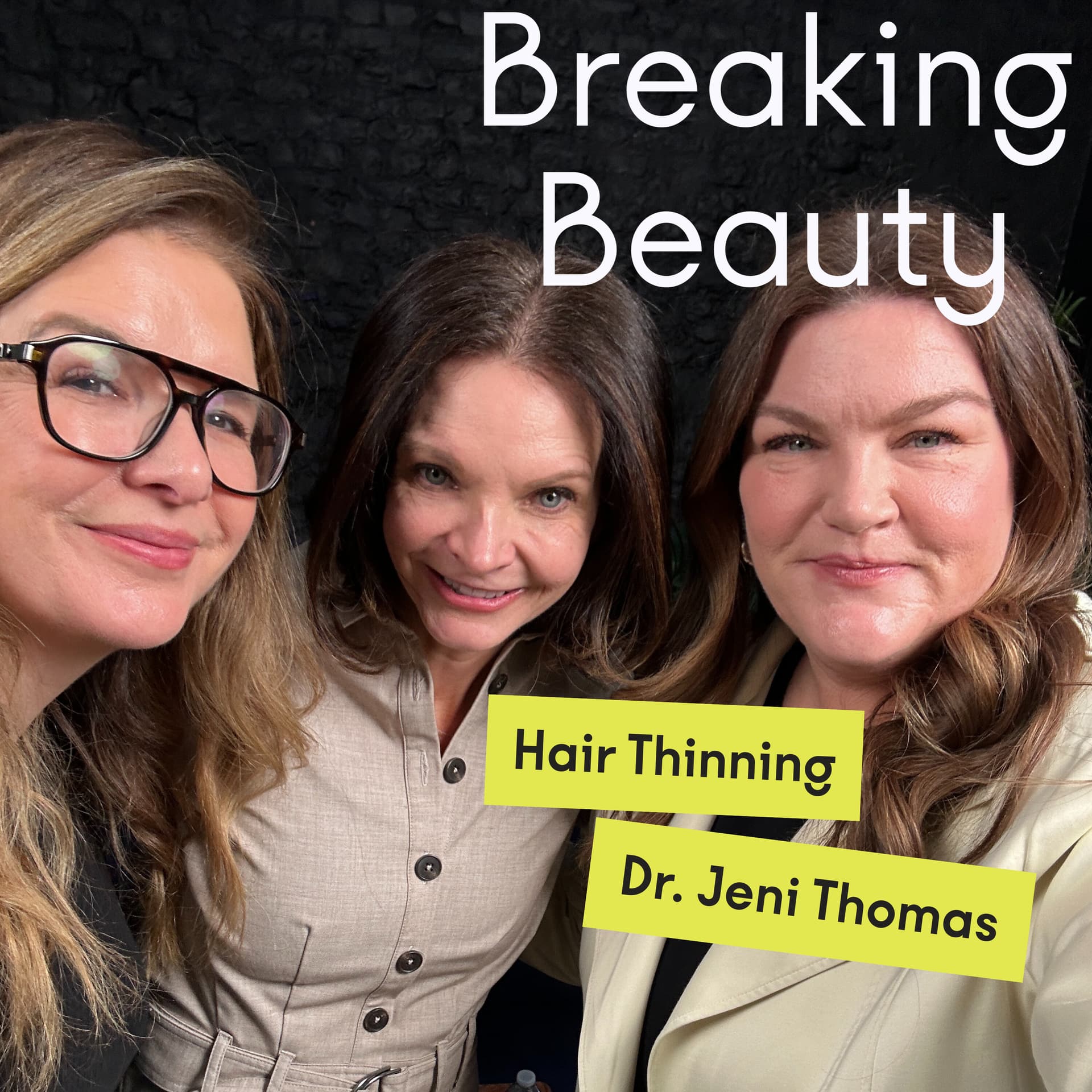
Episode Title How-to Address Hair Thinning on a Budget, New Thinking Behind Hair Fallout and Why Drugstore Haircare is so #DamnGood with Scientist Dr. Jeni Thomas
Podcast Hosts
- Jill Dunn
- Carlene Higgins
Episode Overview In this episode, Jill and Carlene are joined by Dr. Jeni Thomas, the Global Principal Scientist at Pantene, to discuss hair thinning and shedding. They address common misconceptions, the science behind hair health, scalp care, and the benefits of drugstore haircare products.
Key Concepts and Discussions
Normal vs. Problematic Shedding
- Daily Hair Loss Norms:
- It's normal to lose 50 to 150 strands of hair daily, varying by individual characteristics (hair length, thickness, color).
- Identifying a personal baseline is crucial to determine if hair loss is above normal.
- Signs of Excessive Shedding:
- Increased hair in brushes and shower drains can indicate a potential issue beyond normal shedding.
Hair Shedding Myths
- Common Misunderstandings:
- The notion of "hairball" in drains often leads people to panic but is generally part of the normal hair loss cycle.
- Misconceptions surrounding the effects of sulfates and silicones in shampoos; research shows they do not contribute to hair loss.
Stress and Hair Thinning
- Types of Stress:
- Both internal stress (hormonal changes, trauma) and external stress (pollution, UV exposure) affect hair health.
- Increased awareness of "scalp oxidative stress" as a significant factor in unnecessary hair loss.
Scalp Health as a Priority
- Scalp Care Importance:
- A healthy scalp is critical for hair retention and growth.
- The role of antioxidants in preventing scalp oxidative stress, which can help reduce hair shedding.
Drugstore Products vs. Luxury Brands
- Cost-Effectiveness:
- Dr. Thomas asserts that drugstore shampoos can match the efficacy of luxury brands, backed by rigorous scientific research.
- Pantene invests heavily in research, demonstrating that affordable products can deliver high-quality results.
Seasonal Hair Shedding
- Understanding Seasonal Trends:
- Seasonal shedding typically peaks in the fall and spring, a natural phenomenon often linked to biological cycles.
- The new Pantene collection aims to flatten this seasonal hair loss curve by combating oxidative stress.
Hair Types and Product Efficacy
- Universal Benefits:
- The products in the Pantene collection are formulated to work across various hair types, focusing on scalp health rather than just hair texture.
Future of Hair Science
- Emerging Technologies:
- The use of AI and advanced testing methods (like phototrichograms) enhances understanding of hair health and allows for more tailored solutions.
Promotional Segments
The episode features several product promotions, including
- Pantene's Abundant & Strong Collection: Focuses on root-strengthening and oxidative stress reduction.
- Medik8 Niacinamide Peptides Serum: Clinically proven to improve skin clarity.
- Blissy Silk Pillowcases: Promoted for their benefits to skin and hair health.
Final Thoughts Dr. Jeni Thomas emphasizes the normalization of discussing hair loss and encourages listeners to seek professional advice if concerned. The dialogue promotes a proactive approach to hair health, leveraging affordable options without sacrificing quality.
---
For more details about the products mentioned, you can visit the Breaking Beauty Podcast website. Tune in for further insights and beauty discussions in upcoming episodes!
Written by AI. May contain mistakes. Listen to the episode to check what was said.
Chapters
Tap a time to open that second in VOThe Excitement of Today's Episode
0:45 to 1:53
Discussion about the exciting topics and the partnership with Pantene.
“We're partnering up with our friends at P &G once again.”
Meet Dr. Jeni Thomas
1:53 to 2:49
Introduction of Dr. Jeni Thomas and her expertise in hair science.
“It's a three piece collection called Abundant and Strong.”
Drugstore vs. Luxury Hair Care
2:49 to 4:23
Discussion on why drugstore shampoos can be just as effective as luxury brands.
“Like give us a behind the scenes of the type of science and surveys and research that you all do.”
The Growing Interest in Scalp Care
4:23 to 6:34
Exploring the rise of scalp care awareness and its importance to hair health.
“And that's why Jill and I have joked were like, just use your Olay and Botox.”
Post-COVID Hair Loss Trends
6:34 to 8:01
Insights on how COVID has changed discussions around hair loss and shedding.
“And, you know, Jill and I first started talking about this, this issue during COVID, because I remember there was an article in The Atlantic that everybody's hair was falling out.”
Changing Attitudes Towards Hair Loss
8:01 to 9:19
How younger generations view hair loss and seek preventive measures.
“And I think you made a good point at the event when you were saying, you know, your mom, grandma, what they did, they were like, well, this is our fate.”
Understanding Hair Shedding vs. Thinning
11:44 to 14:01
Distinguishing between normal hair shedding and signs of hair thinning.
“tell me what you eat and I will tell you who you are?”
Understanding Hair Thinning and Shedding
14:01 to 19:08
Learn about the difference between hair breakage and shedding, including causes and impacts.
“if it starts to look like, oh, that that hairball is bigger.”
The Role of Oxidative Stress on Hair Health
19:09 to 21:08
Discover how oxidative stress from environmental factors can influence hair loss.
“I mean, when I, again, I go back to skincare, right?”
Innovative Haircare Solutions for Thinning Hair
21:09 to 23:25
Explore a new approach to hair treatment focusing on antioxidants and serums.
“And I think a lot of people understand serums again from face care.”
Show all 19 chapters
Scalp Oils and Hair Washing Frequency
28:01 to 29:16
Learn about the effects of scalp oils and the importance of washing hair more frequently.
“Are our scalp oils becoming rancid or what is happening and is it harmful to our scalp?”
Understanding Hair Shedding During Washing
29:17 to 31:06
Discover why hair appears to shed during washing and whether it actually causes hair loss.
“But we often do notice all that hair in the drain.”
Debunking Myths About Shampoo Ingredients
31:07 to 33:24
Explore the research behind sulfates and silicones in hair care products.
“Now, what about what we should avoid in shampoos and conditioners?”
Value of Affordable Hair Products
33:25 to 35:46
Understand why spending more on hair products might not yield better results.
“It's doing good to help hair emerge healthier and doing good to help your hair stay rooted in your scalp for longer.”
Seasonal Hair Loss Explained
35:47 to 37:45
Learn about seasonal hair loss patterns and how to manage them effectively.
“It's something that Abby brought up last night because she's genetically blessed with her hair.”
Advancements in Hair Science Research
37:46 to 39:54
Get insights into the latest advancements in hair science and the use of AI.
“Anyway, so we timed the research through this phase to see what happens to seasonal hair loss.”
Scalp Health Assessment and Results
39:55 to 42:03
Hear about real assessments of scalp health and the implications for hair growth.
“Give us a peek behind the curtain if we were to go and put our lab coats on.”
Addressing Hair Thinning Concerns
42:03 to 42:46
Listeners will learn about emotional aspects and commonality of hair thinning.
“I think that was definitely a contributing factor.”
Seeking Help and Simple Solutions
42:46 to 43:44
Key advice on consulting dermatologists and starting with simple solutions for hair health.
“And if, you know, if there's any like community or support groups or anything you would like to leave our listeners with.”
Transcript
Automatic transcript. May contain errors.0:00Dr. Jeni Thomas:The following podcast is a Dear Media production.
0:08Dr. Jeni Thomas:Welcome to Breaking Beauty, the podcast all about the breakthrough people, products and moments in beauty. We're your hosts, Jill Dunn and Carlene Higgins.
0:21Dr. Jeni Thomas:Hello and welcome back to Breaking Beauty Podcast with your weekly fill of what's damn good in the beauty world. I'm Carlene and this is my co-host Jill Dunn. Hey, hey guys. We've been with you for nine years now on the microphone. Of course, we're two longtime beauty editors turned beauty podcasters sharing the breakthrough people, products, and moments in beauty every single week. And Carlene, today we have a very exciting episode for everyone. Yeah, we do. We're partnering up with our friends at P &G once again. And we've been doing this for like 20 years since our magazine days, really. Yeah.
0:56Dr. Jeni Thomas:P &G introduced me to a lab coat for sure. So whether that's like Olay riding around in your car, talking about SPF. Everyday sunscreen with my sunroof open. We've also talked to plenty of P &G hair scientists, hair stylists over the years. And, you know, I'm a drugstore girly at heart. We all know that. So today's episode is very exciting. Yes. We're thrilled to bring you an education packed episode brought to you in part by our friends at Pantene. And Carleen, you and I were talking because we were fortunate enough last night to go to the Pantene event and there was a hairbrush there and there was a hairbrush that had like no hair shedding in it.
1:35Dr. Jeni Thomas:And then there was a hairbrush that was full and you were like relatable. Yes, that was me on the left. That was you on the right. And it's not fair, but it's the reality. So if you've ever felt like, is this normal when you look in the drain and see a pile of hair, this episode is definitely for you. So this is on the heels of Pantene's latest launch. It's a three piece collection called Abundant and Strong. And we are welcoming the absolutely brilliant Dr. Jenny Thomas, global principal scientist at Pantene. Welcome, Dr. Jenny. Thank you so much for having me. It's such a pleasure to be with you both.
2:09Dr. Jeni Thomas:Thank you so much. Well, I need to blow you up a little bit because you have so much incredible expertise that you're going to share with us today. And Dr. Thomas, she's been deep in the lab, bringing us affordable science-backed solutions to the most common hair challenges. And this week's episode, we're going to dive deep into the real science of hair shedding everyone, how not just internal stress, but external stress might be impacting your hair density. And by the way, this collection is very exciting. We at the event last night got to hang out with Abby Young from The Abby Young Method. So all the girlies are bonding over shedding, hair shedding, right?
2:44Dr. Jeni Thomas:Yes, it's a reality, like I said, for myself included. So you're a Pantene scientist. But as an insider, tell us why drugstore shampoo is just as good as the luxury products. Like give us a behind the scenes of the type of science and surveys and research that you all do. because I know even last night we were looking at peer-reviewed papers backing up the science. So tell us about that.
3:08Breaking Beauty Podcast Hosts:Yes, there is a crazy amount of research that goes on behind this little bottle that you see in the store. And I think the perception can often be drugstore shampoos. They're just the basic ones, the simplest ones. And that couldn't be further for them truth. I came into this field 20 years ago thinking, don't we know everything there is to know about hair, about shampoo, conditioner formulation? And that assumption was proven wrong. It's constantly learning more, constantly advancing. So we're talking about tools like genomics, proteomics, formulation advances, using tools that come from the energy industry, taking things that are non-traditional for beauty to see what more can we learn?
3:57Breaking Beauty Podcast Hosts:How can that help us get to better solutions? What dots can we connect? And honestly, that's what got us to where we are today with this abundant and strong collection.
4:06Dr. Jeni Thomas:Yeah. Very cool. I always joke with Jill. I'm like, you know, P &G, they just have more money than God. So they put it all into the research. Earmuffs P &G in the room. But no, but it's like there really is so much science and yet it's so affordable. And that's why Jill and I have joked were like, just use your Olay and Botox. Like that is the end of story. That's the secret.
4:31Breaking Beauty Podcast Hosts:We do have more than 200 scientists that are behind Pantene around the world. And I mean, you've been to the labs. You've seen that many of these scientists have been in this space for many years. Like there's just a love for what's possible and the fascinating substrates of scalp and hair and all the things that we can learn. So you have a very passionate group of people working constantly to get us to better results. Yeah.
4:58Dr. Jeni Thomas:What do you, what do you make of this total industry shift in the excitement, I guess, for lack of a better term around or interest around scalp care? Because it wasn't happening, you know, when we were in our magazine days, like Pete with scalp, it was a very French girl thing, I think to think about your scalp. Yes. But now it's like every, it's one of the most Googled things that everyone's caring about it more. What do you make of it?
5:21Breaking Beauty Podcast Hosts:I think it's such a good move. And I think it goes along with the mindset shift that's happening that hair care is more than just a quick fix of, oh, I can add shine, but I'll wash it off again tomorrow. And that's all that's possible. There's so much more that's possible, but you really have to think about it like you think of your skin, of your taking care of it for today, but also for the hair that you want to have next month, next year, and the role that scalp plays in there. It's intuitive, but people are willing to invest in their hair more for the long term now. Yeah. And then we're starting to understand, you know, why does it even matter to take care of your scalp?
6:02Breaking Beauty Podcast Hosts:What impact does it have on your hair? And we're realizing it has a pretty significant impact. That's been, the understanding of that has grown with people who have noticeable scalp issues. And so for them, they're constantly reminded their scalp is there. It's itchy, it's flaky, it's sending them signals. But we now know that even if your scalp is forgettable in the best of ways, as in it's not talking to you, your hair can still benefit from taking care of it. So it matters to everybody. Yeah.
6:35Dr. Jeni Thomas:And, you know, Jill and I first started talking about this, this issue during COVID, because I remember there was an article in The Atlantic that everybody's hair was falling out. And, you know, it was it was pretty scary. But they were so they were talking about stats. And that's kind of to us how this this started. And we started reporting on it. So where are we at now? Because it's post COVID. Everyone's back living their lives. Like, what are the stats look like now? how many people are dealing with, you know, hair falling? Because I know that you're keeping track of all of this. For sure.
7:10Breaking Beauty Podcast Hosts:And it's a little bit shocking. I mean, the latest stats would say two out of three women are concerned with hair loss. Wow. So this conversation, much like the scalp conversation, I think has evolved so much in that it's always been there. It just wasn't commonly talked about it. Right. Looking back at COVID times. So let's focus on the positive parts of it. And one of those is, I think it really elevated the hair shutting, hair falling conversation. People felt more comfortable talking about it. And so now you see these conversations happening across wide age ranges, across people that you would look at and say, why is she talking about hair loss?
7:49Breaking Beauty Podcast Hosts:She doesn't look like she has a problem. But people just became more familiar, comfortable and in tune with it and also recognizing there are many reasons why we experience with it. Yeah. Experience it, but it's common. Yeah.
8:03Dr. Jeni Thomas:And I think you made a good point at the event when you were saying, you know, your mom, grandma, what they did, they were like, well, this is our fate. They just wore wigs, hair pieces. Absolutely. That's an amazing option. We have lots of great options for that now, but I think it's just a new generation. They're like, there must be something we can do to have the hair that makes us feel our most confident, right? Yes. You know, and I think that's a big mindset shift as well. Yes. That's a good point.
8:31Breaking Beauty Podcast Hosts:Agree. Yeah. And it's also bringing in, bringing the conversation to people that are much younger than we, I would have expected 10 years ago. But there is this, you know, what can I do to prevent it? I see it happening. I'm starting to see signs and this feeling of like, oh, I feel like I just lost a little bit of myself over there as you see hairs falling. That similar to the SPF conversation, people are wanting to engage in it and take a more of a preventative approach as much as once you see it, start to do something about it. And there are far more options today that don't seem like it's life altering or I have to make this major tradeoff between what I love doing and what I think I have to do.
9:18Breaking Beauty Podcast Hosts:There's just far more possibilities, thankfully.
9:20Dr. Jeni Thomas:Yeah. Thank God. Like I said, thank God for hair dye, too, because back in the day, all they had was hats. I've said it before. Hats and wigs.
9:42Dr. Jeni Thomas:today's episode is brought to you in part by jones road beauty i love jones road beauty bobby brown is such an inspiration if you guys haven't listened to our episode that came out last year please go back in our archives she just is a makeup artist with the most she's been doing this for years she knows what makes skin sing no matter what your age is if you have a lot of texture and you haven't tried the Miracle Balm, you need to get into it. It comes in like bronzy shades, blushy shades. It's all about getting that glow. And it's a multitasker. You can use it as a highlighter or a bronzer or blush, even a lip tint.
10:18Dr. Jeni Thomas:She was putting it on without a mirror in front of us during our interview. And people just love this. It gives you this your skin, but better look. It's no must, no fuss, perfect for lazy slash busy people like me. And they're doing it again because the latest launch is a shadow stick. I cannot wait to try these. They're creamy high pigment eyeshadow sticks designed for real life. So you just swipe it on. I love a stick. I blend it in with my fingers. There's no brush, no fallout, no fuss. And what I like to do is when I want a slightly more dramatic look, I'll just do like turn it so that there's like a sharper edge to it.
10:56Dr. Jeni Thomas:And I'll put a line along my lash line to give a bit more definition. I might do a line under on my lower lashes as well. I love that kind of versatility and it comes in eight universal matte neutral shades. That's perfect. I'm not a big shimmer girly. You know, Bobbi Brown is always going to do it right. If you want to try it for yourselves, modern day makeup that's clean, strategic and multifunctional for effortless routines. For a limited time, our listeners are getting a free shimmer face oil. Woo woo. Sound the alarm on their first purchase when they use code beauty at checkout, head to jonesroadbeauty.com and use code beauty at checkout.
11:35Dr. Jeni Thomas:After your purchase, they will ask you where you heard about them. Please support our show and tell them that Breaking Beauty sent you. Have you ever heard the saying, tell me what you eat and I will tell you who you are? I'm Katie Lee Beagle and I'm food obsessed. Tune into my podcast All on the Table and get to know celebrities, boldface names and industry insiders in an all new way as they share the ingredients that make their recipe for life. I want to know it all from the favorite childhood birthday cake to the breakfast they eat every day, an engagement meal in Paris, or a guilty pleasure fast food indulgence.
12:12Dr. Jeni Thomas:You can tell a lot about a person by what's in their fridge. And hey, everybody's got to eat. Make sure to tune in every Thursday and follow so we can devour every last morsel together. We're putting it all on the table.
12:35Dr. Jeni Thomas:And so what is the difference in plain terms between normal everyday shedding and genuine long-term hair thinning? Like how do we know when there's actually we're seeing a problem?
12:47Breaking Beauty Podcast Hosts:Okay, so bear with me. We naturally lose hairs every day. This is just the way that our heads are built. And it's because of the natural hair growth cycle that we go through where you're actively growing hairs for anywhere between two to eight years. Then your hair goes through a transition phase before a resting phase. And then at the end of that resting phase, the strand that's sitting in your scalp just basically jumps out. And then it all starts over again. So the number of strands jumping out on any given day can be anywhere from 50 to 150. It's a very normal amount. It can show up differently if you've got long hair versus short hair, dark hair versus light hair, hairs that you are going to collect are going to look different person to person.
13:37Breaking Beauty Podcast Hosts:But you should get to know what is my normal. Right. Right. Now, when that normal starts to increase and you can't explain it because you've now gotten to longer lengths or you've gone from blonde to black and now it looks very different. But when that amount of hair that you collect on any given day starts to look more, your brush starts to get people often notice it in their brush, in their drain. They might even see it on their pillow overnight, but really brush and drain are the two biggest ones. if it starts to look like, oh, that that hairball is bigger. That's what you typically see before you start to see.
14:14Breaking Beauty Podcast Hosts:I have more visible scalp or my ponytail feels thinner. But once you start to see that, you know, OK, maybe there's something at play that's going beyond the normal 50 to 100 hairs I should be losing every day.
14:29Dr. Jeni Thomas:That's still a lot. 50 to 100 is I don't think people would think it was that many.
14:33Breaking Beauty Podcast Hosts:It is a lot. And so that means you should give yourself grace if you see some and say, okay, that's normal. But also if you imagine your head has about 100 ,000 hair strands on it anyway, it's a small amount. And thankfully also nature has done this hair loss process in a way those 100 to 150 hairs are coming from all over your head. They're not coming from any one spot that would make it much more noticeable. Right. What's the difference between breakage and shedding? Do you scientifically break that down? We do. Yeah. And it's important to break down. I think the experience to someone is, I just saw my hair fall.
15:11Breaking Beauty Podcast Hosts:Right. I don't know why. So it all ends up in the same hair that's on the floor. But scientifically, we think about it as breakage is a result of damage or extreme stress strain that you've put on your hair. The shedding, as we think about it, shedding from the root, there's a different cause there. And so the approach that we take to address shed that happens from breakage and shed that happens from the root are two different approaches. But honestly, if we put those together, we can have a really noticeable effect on just the number of hairs that you see falling around you.
15:49Dr. Jeni Thomas:I know that hormones is a big factor when it comes to hair shedding. I had quite a bit of that happen after I had my first child. And stress can be a big factor. Jill and I, we've talked about some of your friends who have lost quite a bit of hair when they've gone through traumatic experiences. What I was surprised to learn was this idea that actually external stress can be contributing to hair shedding. So UV and pollution, the same kind of external stress that we experience on our face. So talking about free radicals, to me, this seemed like a new way of thinking in terms of a causal factor that contributes to hair shedding.
16:34Dr. Jeni Thomas:So maybe you could elaborate on that.
16:36Breaking Beauty Podcast Hosts:So we asked people, what do you think are the biggest causes of hair falling and they said in top ones exactly what you mentioned carlene stress hormones life stage age genetics they didn't mention what's happening on their scalp and especially from external factors like free radicals and not surprising because we've only recently come to understand what impact it does have and it's meaningful So scalp oxidative stress is what's emerging as this is a really common cause because we're all exposed to UV every day. Pollution can contribute to it. Even the buildup of scalp oils, we all have that. And it ultimately leads to an excessive amount of hair that we're losing.
17:26Breaking Beauty Podcast Hosts:So we're still going to lose our hair from the natural growth cycle and from changes that you mentioned can impact it. But it's this unnecessary addition, which is arguably the most controllable cause of hair fall. And it's something we now know we can do something about that. So even if you do go through more hair falling with postpartum, more hair falling with a big stressful event, we can reduce the amount that you're seeing by taking out this external factor, the oxidative stress.
17:57Dr. Jeni Thomas:So what's happening? Like, is it free radicals are impacting sort of the DNA or your microbiome or like what's.
18:05Breaking Beauty Podcast Hosts:So free radicals, you know, they're they're quite destructive and they attack structures. And so imagine this, your hair strand is sitting in a scalp pore and imagine it tightly held around that hair at the root. But the free radicals attack the structure and just imagine the scalp skin becoming really loose. And so the hold that it has on hair at the root is just opening up, opening up like a really nicely worn sweater. And you've got these stretched out. Yeah, it's stretched out.
18:38Dr. Jeni Thomas:It's like I'm picturing it like pore sagging on my face. That's happening with the follicles on my scalp.
Read the full transcript
18:43Breaking Beauty Podcast Hosts:That's exactly it. I mean, that's that's the image it creates. And so that that pore strand doesn't have anything to hold on to. So it loses its anchor to the scalp and it falls out too soon. Too many of them fall out. Right. And we realize we can basically tighten the hold that your scalp has on hair at the roots and keep it in place for as long as it should be there.
19:07Dr. Jeni Thomas:Okay. Yeah.
19:08Breaking Beauty Podcast Hosts:And the end result is having more hairs on your head at any one time.
19:12Dr. Jeni Thomas:Yeah.
19:13Breaking Beauty Podcast Hosts:Very cool.
19:14Dr. Jeni Thomas:I mean, when I, again, I go back to skincare, right? So we've learned this as beauty editors that free radicals, they impact your DNA. And so we need antioxidants to combat that. And what's always been drilled into my head from dermatologists is that vitamin C is the gold standard. So tell me why with your collection, because there is no vitamin C in here. Correct. What you've chosen to use instead and why it makes sense for the scalp.
19:45Breaking Beauty Podcast Hosts:Yes. So, yes, antioxidants are the way to go after oxidative stress. And not all antioxidants are created equally. So for this, what we have is a combination of three ingredients that creates this really powerful antioxidant package. We call it our provitamin complex with niacinamide. But peroctone olamine is the start here. And that's an ingredient that's known to work in the unique scalp environment where imagine it's warm, it's dark. There are a lot of oils that are present, more so that you're going to have on the rest of your body. So it still has really strong antioxidant activity there.
20:28Breaking Beauty Podcast Hosts:And then we put that with Pantene Signature Provitamin B5 or Panthenol, which also has some inherent antioxidant activity. And then with niacinamide, you all know, skin barrier, enhancing ingredient. And there was something very interesting that we found when we put these three together, the antioxidant activity of that trio seemed to just boost. And then this was something that we tested in the clinical studies to say it's really effective at reducing scalp oxidative stress, which then reduces shedding and increases the number of hairs that you have on your head. Yeah.
21:08Dr. Jeni Thomas:So there's a shampoo, a conditioner, and a serum. And I think a lot of people understand serums again from face care. So very similar concept. And it has that same feel to it where it's not like an oil. It's not a dropper, everyone, if you're listening. And it looks like a very, it's in a glass bottle as well. Yeah. Very premium. Yeah. Pantene, I will say. I do like that feel, though, I will say, because, you know, to use an oil, maybe some people like to do hair oiling, but it's definitely it's not going to help you use it every day. Right. Because you're you don't necessarily want to wash every day.
21:46Dr. Jeni Thomas:It might mess with your hairstyle. It's very specific. So I like that this one kind of gives you like an invisible film and it doesn't feel tacky or anything. That's what I noticed just trying it on my hand so far. I'm glad you noticed that.
21:59Breaking Beauty Podcast Hosts:It's a really important point. The scalp oxidative stress or free radicals, we're exposed to them daily. UV, again, scalp oil buildup, all of these things are happening daily. and so we needed something that can fit into a daily hair care routine without having to ask you to go to great lengths to change your routine yeah so of course we have shampoo and conditioner use those on your wash days and it has this clinically proven technology but the scalp serum is what enables you to get the antioxidants regardless of your wash frequency but to your point people are nervous about putting something oily or greasy on their scalp because they think well, I'm just going to have to wash sooner.
22:42Breaking Beauty Podcast Hosts:So I don't know. There's nervousness about it. So one, it had to be non-greasy, leave you with a refreshed feeling, not at all any kind of dirty feeling. So this formula is really, it's quick drying. It's non-greasy. It's for daily use. It takes maybe 30 seconds to apply it. You just want to spread it throughout your scalp. There's a nice It's a little tingling sensation with it too. It's like cooling a bit. Yes. Yeah. Which is a good signal to say you've gotten it right at your roots, not all caught up in your hair. And you've spread it evenly so it's across your scalp because this isn't about spot treatment.
23:24Breaking Beauty Podcast Hosts:It's about preventing the shedding from happening across your whole scalp.
23:29Dr. Jeni Thomas:Last night we saw Abby demo it for us. We got her on the mic to do that. and it was like she was almost using the dropper to separate her hair into sections like you could tell she had used it a lot because she had her own little method right the abbey young method of doing it and it was almost like five like a full dropper length could do like she has very long hair but she could do like a whole section like yes you have like a bob how much product
23:54Breaking Beauty Podcast Hosts:are you putting in same amount yeah because this is all about your scalp and roots it has nothing to do with the length.
24:02Dr. Jeni Thomas:So one full dropper does basically your whole head, correct? Yeah. Okay. Yeah. Like it actually absorbs faster than most skincare serums I've ever tried. I'm sure that's by design. Yeah.
24:21Dr. Jeni Thomas:Today's episode is brought to you in part by Blissey. What kind of pillowcase are you guys using at home? Is it cotton? Is it satin? Let me tell you why I switched to silk. Well, I would wake up with those, you know, those creases, the pillow creases that you get when you're sleeping, the frizzy hair, all of that. And the thing about silk is that it's natural, it's cooling, and it's gentler on skin and hair than satin or any other fabrics you might be using. It helps to reduce frizz and breakage while you're sleeping for your hair. And it gives you healthier looking skin in weeks by reducing the look of fine lines, wrinkles, those sleep creases we talked about.
25:02Dr. Jeni Thomas:And it even helps to prevent breakouts. With Blissey, they use the highest quality of silk. It's 22 MOM or M-O-M-M-E. That's a 6A grade, 100 % pure mulberry silk. And the benefits of silk, like we said, naturally cooling, also breathable, hydrating and hypoallergenic. So that's going to help with skin conundrums as well. And with Blissey, the material has been dermatologist tested and recommended as well. Now, this is luxury, but also these pillowcases are fully machine washable, which I appreciate. You know, I'm lazy slash busy. I'm not going to be out there hand washing my pillowcases. And people are just loving Blissey.
25:47Dr. Jeni Thomas:Over 3 million have been sold. It's been featured in Vogue, Oprah Daily, Good Morning America. It's won a bunch of awards. And if you want to try it for yourself, because you're a listener, Blissey is offering 60 nights risk-free, plus an additional 30 % off when you shop at blissey.com slash breaking. That's B-L-I-S-S-Y.com slash breaking and use code breaking to get an additional 30 % off. Your skin and hair will thank you. Medicaid is one of our show partners this week. Medicaid is a clinically proven British skincare brand known for age defying results. I have so many of their products in my personal routine, everything from the liquid peptide serum to the crystal retinol.
26:28Dr. Jeni Thomas:Love both of those and All of Medicaid's products undergo clinical testing and have amazing before and after results, and everything is dermatologist recommended. And that's why I'm excited to share with you the latest secret from Medicaid. And this one is all about getting glass skin. And it's Medicaid's new niacinamide peptide serum, and it's powered by 10 % niacinamide. And this multi-active formula is clinically proven to deliver visibly clearer, smoother skin with poor reduction in seven days. Why I personally like the Medicaid niacinamide peptide serum is I find that it's overall, yes, it's brightening, but it also has zinc in there, which helps with reducing oil production.
27:09Dr. Jeni Thomas:And I really appreciate that any little acne scars or acne marks that I have, it's really brightening on those as well. So yes, it's gently exfoliating. Yes, it's brightening, but it also just makes my skin look so much clearer, which I really appreciate. So if you want to check it out for yourself, you can visit Medicaid.us, that's M-E-D-I-K and the number 8.us to discover more. Use code BREAKING20 to save 20 % off your order. Once again, that's Medicaid.us. Use code BREAKING20 to try out the niacinamide peptides serum. We'll link to this offer in our show notes and on our website. Now back to the show.
27:54Dr. Jeni Thomas:Now, the other thing that was overheard was that the oils on your scalp oxidize as well. So what does that mean? Are our scalp oils becoming rancid or what is happening and is it harmful to our scalp?
28:11Breaking Beauty Podcast Hosts:So it's not a pleasant thought, but just like your oils, your cooking oils can turn or go rancid, so can your scalp oils. Yeah. So some people, especially people who have hyper oil production on their scalp, they'll talk about an odor, like an off odor, which is often they're a sign that their oils are oxidizing. But it just it can break down into more irritating components like causing reactive oxygen species and a whole chain of reactions that then lead to more stress on your oxidative stress. Right. Right.
28:49Dr. Jeni Thomas:So honestly, the other thing that I'm hearing through this conversation is, should we be washing our hair more often? Because again, I'm thinking about it like my face, you know, what a dermatologist would say about the pollution, the everyday micro pollution that your face is accumulating. and it's making me wonder that should we be washing our hair more often to remove that layer of oils and just and the micro pollution itself and there has been published
29:20Breaking Beauty Podcast Hosts:research to show that the more often that you wash your that you wash the better it is for your scalp
29:28Dr. Jeni Thomas:so I want to ask you though we talked about washing your hair more often if you can you know So whatever that means for you. But we often do notice all that hair in the drain. So is that mechanically we're pulling it out? Or could that be backfiring on us washing our hair more often? Or is that a myth?
29:49Breaking Beauty Podcast Hosts:This is a great question because it causes a lot of panic for people when they go in the shower. And maybe they're rinsing the conditioner and see hairs coming out into their hands. And so there's a belief among people that conditioner can lead to hair fall. And it's not so, it makes perfect sense why they would see that or believe that because that's when they're feeling a lot of hairs coming out of their head. Right. But in fact, what happens is as the hairs are being jumping out of the scalp or falling out of the scalp, some of them fall directly to the floor, but a lot of them just get caught up in the mass of hair that you have.
30:31Breaking Beauty Podcast Hosts:See, the more textured hair you order, the longer it is, the more spaces it has to get caught up. So it's only when you get that detangling effect of a conditioner are you releasing all of it from the mass of your hair, even if it left your scalp a day or two ago.
30:48Dr. Jeni Thomas:Oh, interesting. So that's why you tend to see the hairball in the drain, in your hands, when you're washing.
30:56Breaking Beauty Podcast Hosts:But it doesn't mean that washing is causing hair loss. It just means that's the detangling effect that's letting it fully release from your mass of hair.
31:05Dr. Jeni Thomas:Yeah. Okay. Yeah, got it. Now, what about what we should avoid in shampoos and conditioners? And again, this could be a myth. Are sulfates and silicones contributors?
31:17Breaking Beauty Podcast Hosts:No. At least from what our research would say, I do not believe that they're contributing. I'll tell you a few studies. This one goes back to 1992, where there was the belief that silicones could be clogging your hair follicle and interfering with the growth cycle and causing more hair to fall. And there was a clinical study done over 48 weeks, so nearly a year, to follow people who use silicone-containing products. And this was in the ages of really large silicone particles that if anything's going to clog a follicle, it would be that. versus people who used products without silicone for an entire year.
31:58Breaking Beauty Podcast Hosts:And what they saw was there was no difference. Those products, the silicone did not clog a follicle and interfere with hair growth. Number two, there are plenty of studies to show you were asking about shed that comes from breakage. Silicones are so effective, especially if you have damaged hair, for reducing the amount of shed that happens from breakage. So they're a big help. sulfates. There's a lot of fear out there that, oh, they might be too harsh. They're contributing to hairs falling. And that's why a lot of people, when they see more hair fall, they'll often switch to a different shampoo or conditioner thinking that's what I need to do.
32:41Breaking Beauty Podcast Hosts:But we had in our clinical studies, two of them, sulfate containing shampoos. because the sulfates work with the chemistry in the product to help deliver the antioxidants to your scalp. So they're playing an active role, not just in cleansing, but in delivering the antioxidants. And we measured in these clinical studies what's the effect that it's having on the scalp condition. So we saw that the scalp barrier improved, the hydration of the scalp improved, which goes against the fear that people have that sulfates are going to be harsh on the scalp. So we feel quite confident from those results to say, no, these sulfate-containing shampoos with antioxidants is doing good for your scalp.
33:32Breaking Beauty Podcast Hosts:It's doing good to help hair emerge healthier and doing good to help your hair stay rooted in your scalp for longer. Okay. Let me ask you this.
33:41Dr. Jeni Thomas:when you're doing your testing, we know you're doing a lot of it. In some instances, maybe not with this line, but you might be looking at benchmarks from other brands like luxury brands or salon brands. Do you guys do that? Can you say?
33:54Breaking Beauty Podcast Hosts:We do test against what options do people have out there, whether it's a product or if it's some kind of behavior that they think would make a difference or even things like would onion juice make a difference? Onion water. Onion water, yes. I remember that. TikTok trends. We didn't actually test that. one. But I know that came up. Yeah.
34:13Dr. Jeni Thomas:Well, my question is, do you think that it's ever worth it to spend over$50 on a shampoo? Again, we know that you've been working at a drugstore brand for many years, but have you done that sort of test where you can say, okay, well, that's just a different ingredient that, you know, we wouldn't be able to incorporate, but they can. And so we just have our audience and they have theirs. Or is it a case where you're like, I don't understand the price difference. It's the packaging. I don't know. You tell me.
34:47Breaking Beauty Podcast Hosts:So I say this as a scientist, we've done some testing of products. Let's say repairing products in general of what we might offer for$10,$12 from Pantene versus what someone might pay$60 for. and with objective tests looking at the performance that you get we don't see that you get more by paying more my scientific view and i take the we nerd out on this i take that with the utmost of compliment um and we mean it that way yeah that way we see it just takes science And there's a lot of science that's behind this$10, a$10 conditioner, at least that comes from us. I can only speak for what we put out there or what's coming with the abundant and strong.
35:44Breaking Beauty Podcast Hosts:Very cool. Okay. So save your money, everyone.
35:46Dr. Jeni Thomas:That's what I'm gathering. It's something that Abby brought up last night because she's genetically blessed with her hair. Like she's, she's taken her hair to the next level with the Abby Young method. We can all agree. It looks incredible. It's like shiny, glossy, like mermaid, beautiful hair, if you're not familiar. But she talked about something last night, why she likes to use a product like this, even though she has a lot of hair, is seasonal shed. Yes.
36:11Breaking Beauty Podcast Hosts:So talk to us about that. Okay. So I will say with Abby, she does have amazing hair and she's genetically blessed. But she also went through a transformation because she had been doing a lot to her hair, not caring for it well. and she spent, what is it, a year longer transforming her hair and all through her routine. And so while she's blessed, it's really what she, the care that she puts into it that explains why, yes, her hair is amazing. Seasonal hair loss. She mentioned that. And that was one of the things that we noticed in the clinical study is the antioxidant approach basically flattens the seasonal hair loss curve.
36:52Breaking Beauty Podcast Hosts:So this is a little known hair loss fact. So we shed more hair in the fall and little peak in the spring too. It's just part of that natural hair growth cycle. So you might have noticed more hair in the shower, more hair falling around you in these October, November months. It's very natural. We don't necessarily know why. People have theories, much like you know i'm just going on it does your hair go mercury retrograde what is happening i
37:27Dr. Jeni Thomas:think it's personally my personal opinion is that our our body is looking to conserve energy and the hair is the first thing to go which is why when my friends had those health challenges their body needed to reserve the energy to heal other things and i think that is what's happening but my very
37:44Breaking Beauty Podcast Hosts:unscientific opinion everyone it could be it could be because in the summer we just saw a lot of oxidative stress that built up and we don't know right exactly why but it's real and what we did very intentionally with the clinical studies was to time it so that we could cover that seasonal hair loss phase that's a very important factor with hair studies by the way because it can complicate the results if you don't account for it. Anyway, so we timed the research through this phase to see what happens to seasonal hair loss. And we saw while those that were on the placebo, they had that seasonal hair loss spike.
38:25Breaking Beauty Podcast Hosts:Those that were treating oxidative stress with the antioxidants that's now in this collection, they kept all of that hair for the most part on their head. Got it.
38:35Dr. Jeni Thomas:Yeah. Wow. Well, that's impressive. But let's talk about of the 500 people for all ethnicities. Did you notice a difference in the impact of this technology on one sort of hair type over the other?
38:51Breaking Beauty Podcast Hosts:We haven't seen much that's hair type dependent about this. And we have included across the clinical studies and that six week study that I mentioned, the full range of hair types, hair routines. And because it's so scalp and root focused, it seems to be universal action, which is great. And then knowing that your hair type is so much going to determine your hair routine, how often you wash or not, that's where the flexibility of getting it from the serum and from your wash routine is important so that you figure out what works in your routine. And also you can carry on with if you are someone who oils your hair, use different types of products to suit your hair texture, keep doing that.
39:40Breaking Beauty Podcast Hosts:If you found what works for you, keep doing that. This is just additive to that routine. But the benefit is there regardless of your hair type.
39:49Dr. Jeni Thomas:I'm interested from a research standpoint, what is the next gen of hair science? Are you using AI? Give us a peek behind the curtain if we were to go and put our lab coats on.
40:00Breaking Beauty Podcast Hosts:For sure. There's a lot more to learn. Every time we learn something, it opens up a new question. Yeah. So there's... So true. There's a lot more to learn. Yeah. With AI is a part of how fast can we learn things. And I'll give you an example. In this clinical research, one of the tools that we used was a phototrichogram. And this is about counting the number of hairs that are on your head. And then there was another tool to count the hairs that had fallen off your head. At first, we started this research years ago, we're literally manually counting. But as this work progressed, AI got us to the point where we were able to, one, count quickly, but two, separate out which hairs had fallen because they'd broken and which hairs had fallen because they had fallen from the root.
40:52Breaking Beauty Podcast Hosts:And so being able to separate that out then lets us tailor more solutions for one versus the other. And bring it all together. So thank you, AI, for that. Yeah, that's impressive.
41:05Dr. Jeni Thomas:Is this the tool that you experimented on, Carlene and I, with last night? You took a picture of our scalp? Was that the tool? That's, yes. It's like a high-res camera for your root area, everyone. And you could literally see that I had like three hairs growing out of one follicle. You can measure the density. That's supposed to be a good thing, by the way. Yeah. Like it was wild. And you could tell everybody was you were able to quantify the density. Yes. Of everybody's scalp photo. Yes. Which was so cool.
41:35Breaking Beauty Podcast Hosts:Your follicles are working hard for you.
41:38Dr. Jeni Thomas:Thank goodness for that. I mean, imagine after I get the abundant and strong on my head. Wow. Honestly, I was really impressed because you did my scalp and my results were so much better. They were great. Two years ago when I had it. Was it two years ago or a year ago? I think it was about a year ago. Yeah. Okay. And I just found it was so much better than the last time I had it done. So I'm going to go ahead and say one thing. I'm not using that crazy blow dryer that was so hot. The two in one. Yeah. The brush. The brush. And it was like so hot on my scalp. I think that was definitely a contributing factor.
42:15Dr. Jeni Thomas:I've also been on HRT for three months. So I don't know if that helped too. Oh, I think so. Yeah. Oh, I think so. For sure. But anyway, either way, I'm happy. It was it was. Yeah, your hair was looking real good under the microscope. Real strong, real abundant, real strong. Do you guys want to see these photos on Instagram? Should we post them? Yes, please. With our density. So we were right there with you nerding out. And then our final question for you is if you have a single most important piece of advice for anyone navigating this, because it can be emotional, this experience as well. And if, you know, if there's any like community or support groups or anything you would like to leave our listeners with.
42:52Breaking Beauty Podcast Hosts:It's a great question. It is very emotional. And I think one of the most important things to remember is. If you are noticing hair shed, you're in the majority. I mean, two out of three women are concerned with this. So if you're not noticing, you're lucky. But that is the minority of women. So one, I think people are talking so much more about this and you should feel comfortable talking about it because it is so common. Right. If you're really concerned, seek help from a dermatologist because they can run a whole battery of tests to see if there are underlying issues that should be addressed.
43:35Breaking Beauty Podcast Hosts:But you can also just start with simple solutions and see, does this make a difference? is this already helping get me to the point where I want to be with my hair? Yeah. Fantastic.
43:45Dr. Jeni Thomas:Well, thank you so much for joining us, Dr. Jenny Thomas. It's been a delight. We're so excited to try this out in our own showers and in our own vanities. And for everybody that's wondering, the Pantene Abundant and Strong Collection is available now for purchase on Amazon, in your drugstores, and we will link to it in our show notes as well. So thank you once again. Thank you so much for having me. I'm a longtime listener.
44:08Breaking Beauty Podcast Hosts:It is such a thrill to be here on the couch with you. Thank you so much.
44:14Dr. Jeni Thomas:Thanks for listening. You can find details on every product mentioned in today's episode, along with our exclusive promo codes on our blog at breakingbeautypodcast.com. While you're there, be sure to sign up for our newsletter. Every episode will be delivered directly to your inbox so you won't miss a single thing. And get social with us. Let us know what you think of the episode. You can follow us on Instagram at Breaking Beauty Podcast. and did you know we also have a private Facebook group just search Breaking Beauty Podcast chat room you can even leave us a voicemail at any time with questions or feedback at 1-844-227-0302 and don't forget to subscribe to us wherever you get your podcast fix Spotify Stitcher Google Podcasts and Apple Podcasts where you can show us some love by writing a review see you next Wednesday
45:17Breaking Beauty Podcast Hosts:Please note that this episode may contain paid endorsements and advertisements for products and services. Individuals on the show may have a direct or indirect financial interest in products or services referred to in this episode.
From the publisher
Have you ever looked at your hairbrush or the shower drain and felt that instant wave of dread? You aren't alone. Today, we are diving deep into the world of hair density, scalp health, and the breakthrough science behind keeping your hair where it belongs: on your head.
This episode is brought to you in part by our friends at Pantene and we’re joined by their Global Principal Scientist Dr. Jeni Thomas. Dr. Thomas is pulling back the curtain on the “why” behind hair shedding and explaining how drugstore haircare is leading the charge in high-tech solutions that don’t require a prescription – or a bank loan.
In this episode, we discuss:
- Normal vs. problematic shedding: How many falling strands a day is actually normal? We learn how to identify your personal baseline and how to know when it’s time to seek help.
- Hair shedding myths: The real reason why you see a “hairball” in the shower drain, sulfates and silicones explained, and is the “seasonal shed” a real thing?
- Stress test: Is internal or external stress at the root of hair thinning? Dr. Jeni Thomas weighs in on the latest thinking based on the newest research.
- Root-anchoring: Why strengthening your roots at the scalp is the first and easiest step in preventing hair fall.
- Luxury vs. drugstore: The facts on why you don't need to spend $$$ on a shampoo to get next-level results.
For products or links mentioned in this episode, see our episode recaps on our website.
PROMO CODES: When you support our sponsors, you support the creation of Breaking Beauty Podcast!
Pantene
Pantene Abundant & Strong collection is all about root-focused care that strengthens the scalp's hold on hair roots by reducing oxidative stress. It’s now available for purchase at Amazon and mass-market retailers.
Medik8
Meet Medik8’s new Niacinamide Peptides Serum! Powered by 10% Niacinamide, this multi-active formula is clinically proven to deliver visibly clearer, smoother skin with pore reduction in 7 days. Visit Medik8.us to discover more, and use code BREAKING20 to save 20% off your order.
Blissy
Wake up with clearer skin, smoother hair, and cooler sleep. Use code BREAKING for an extra 30% off at blissy.com/BREAKING. Because you’re a listener, Blissy is offering 60-nights risk-free. Your skin and hair will thank you.
Jones Road Beauty
Jones Road Beauty is a modern-day makeup that’s clean, strategic and multifunctional for effortless routines. For a limited time our listeners are getting a free Shimmer Face Oil on their first purchase. Just head to JonesRoadBeauty.com and use code BEAUTY at checkout. After you purchase, they will ask you where you heard about them. Please support our show and tell them our show sent you.
Related episodes like this:
- SPF Truths vs. Myths With Olay Scientist Dr. Frauke Neuser
- Hair Growth Secrets From Trichologist Abbey Yung
- 7 Hair Truths That Only a Hairstylist Will Tell You with Kardashian Hair Pro Andrew Fitzsimons
Get social with us and let us know what you think of the episode! Find us on Instagram, Tiktok,X, Threads. Join our private Facebook group. Or give us a call and leave us a voicemail at 1-844-227-0302. Sign up for our Substack here. Subscribe to our YouTube Channel to watch our episodes!
*Disclaimer: Unless otherwise stated, all products reviewed are gratis media samples submitted for editorial consideration.*
Hosts: Carlene Higgins and Jill Dunn
Theme song, used with permission: Cherry Bomb by Saya
Produced by Dear Media Studio
See Privacy Policy at https://art19.com/privacy and California Privacy Notice at https://art19.com/privacy#do-not-sell-my-info.


