Ask ChatGPT

 Business of Sport
20 Nov 2026 · 1h 27m · 30 chapters
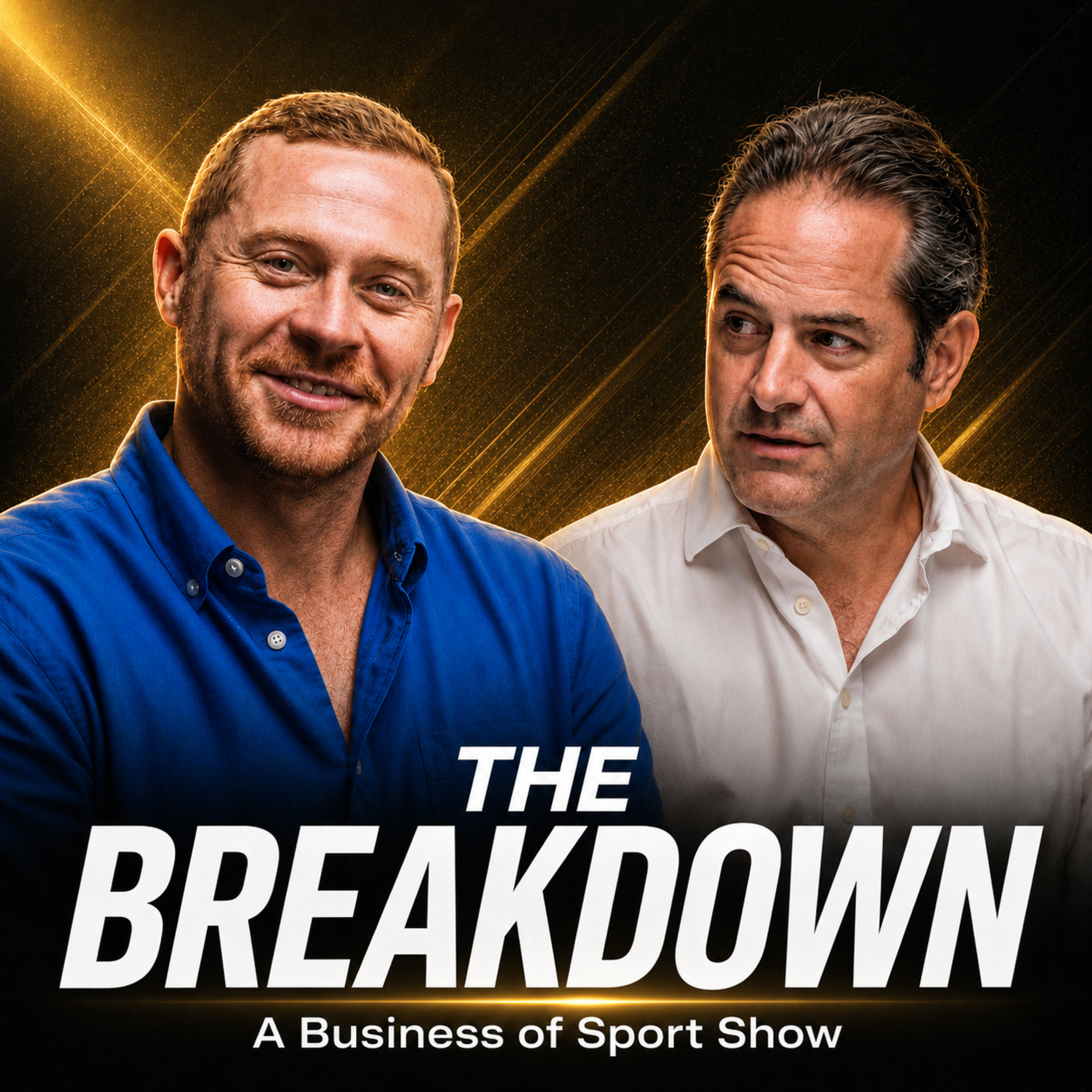
The Breakdown dissects Welsh Rugby Union (WRU) financial and governance turmoil after Wales’ historic win over New Zealand, re-litigates “Sandpaper Gate” in Australian cricket, and discusses UEFA finding a challenger to FIFA president Gianni Infantino.
No guests are identified in the transcript; it’s hosted by Charlie (and co-host “Charles Jr.”). The episode references external figures: Esmond Kwaja (cricket memoir author), Dame Anne Rafferty (led a WRU inquiry), Lyndon Faulkner (new WRU chairman), Richard Collier Keywood (PwC partner, former WRU chairman), and Abby Tierney (WRU chief executive).
Wales’ on-field performance (first win over the All Blacks in 73 years) highlights how badly WRU mismanagement is undermining the sport off-field. WRU is described as structurally losing money (about £18m and £14m operating losses in two years; £60m debt facility; forecast ~£16.1m loss next year) and cutting support to regions. The episode argues DEI-led leadership changes after misogyny allegations replaced rugby-commercial expertise with public-sector-style governance, damaging revenue, communications, and fan trust. It also claims Cricket Australia won’t reopen investigations into “Sandpaper Gate,” raising ICC jurisdiction questions.
Wales’ 346 tackles, five tries vs New Zealand, 55,000 attendance with 20,000 empty seats; Principality Stadium revenue comparisons; WRU restructuring speculation (regions potentially reduced).
Written by AI. May contain mistakes.
Explore the significant heritage of Welsh rugby and the challenges it faces today.
“The Wales-New Zealand game was one of the very few sports events that I know that I will remember for the next 20 years.”
Discuss the repercussions of the recent revelations in Australian cricket regarding the Sandpaper Gate scandal.
“Sandpaper gate, Australian crickets, reputational nadir.”
Examine the political dynamics within UEFA and the emergence of a candidate against Infantino.
“This week, after much speculation, UEFA have found a candidate to stand against Infantino.”
Hosts share their excitement about recent sporting events and high-profile matches.
“I mean, I've just given the line bike of my life to get here on time, and I'm worried about taking this jacket off in case I reveal what's underneath it.”
Dive deep into the discussion about the competitive match between England and Spain.
“I watched the France-South Africa game on Friday night.”
Explore the impact of the English football academy system on player development.
“I mean, you know, they're just too good to play against with 10 men.”
Discuss the thrilling Wales vs. New Zealand rugby match and its significance.
“And that is why the E4P Academy system is now starting to produce these types of players.”
Discussing the emotional impact of a recent rugby match on fans and its significance to Welsh identity.
“Sporting rivalry aside, an appreciation for what an exceptional moment we just witnessed.”
Exploring the turmoil within the Welsh Rugby Union despite a recent victory.
“because even as that glorious performance was unfolding, behind the scenes is absolute turmoil in Welsh rugby.”
Analyzing the financial issues of the Welsh Rugby Union, including debts and losses.
“which was a refinancing of various different loans that they had into one central financial agreement that was signed in January 26.”
Discussing the implications of cost-cutting measures on professional rugby clubs in Wales.
“There are two ways to go, aren't there, when you've got a major loss.”
Examining the revenue problems faced by Welsh rugby compared to other unions.
“they were turning over about 90 million.”
Introducing the new chairman of the WRU and his vision for the future.
“the Welsh rugby union has been unable to continue to support them in the way in which other unions do.”
Discussing potential strategies to improve revenue and manage resources effectively.
“Now, if you read between the lines there, he is focusing in directly on this revenue point, right?”
Discusses the financial challenges facing Welsh rugby and its reliance on the Principality Stadium.
“But we're talking about club rugby in Wales being the heartbeat of everything.”
Examines the leadership changes in the Welsh Rugby Union and the cultural implications involved.
“I totally, totally, totally agree with you.”
Analyzes the new board's composition and the governance issues hindering the WRU's performance.
“The problem, the challenge is, is in answering that problem, you create a new problem, which is you've now got Welsh rugby being overseen by a board that knows nothing about professional elite sport, Wales or rugby.”
Discussion on the challenges facing Welsh Rugby, including fan disengagement and management issues.
“So that alone, you're going, fucking hell, my God.”
Overview of the infamous sandpaper incident in Australian cricket and its long-lasting implications.
“exercised on it, we're going to put him off a real long run here, right?”
A detailed recount of the events surrounding the sandpaper cheating scandal involving Australian players.
“My God, it's probably been one of the biggest stories around for lots of different reasons, but not least because now this is something that is eight years old.”
Exploring the events and fallout of the sandpaper scandal in Australian cricket.
“Bancroft was a young kid he was fresh to that test team that test squad and clearly very keen to make an impression with a group of people who were relatively experienced in the international cricket setup.”
Discussing the toxic culture within Cricket Australia that led to unethical practices.
“We've hammered the ECB for some of their leadership of English cricket.”
Analyzing the long-term effects of the scandal on the players and the organization.
“We've done our work this week, haven't we?”
Considering the implications of the investigation's conclusions and potential ICC involvement.
“And has rebuilt that cricket organization now to today.”
Discussion on the allegations against Cricket Australia regarding systemic cheating in cricket.
“You know, because ultimately the ICC is a sanctioning body of the test circuit, right?”
Analysis of UEFA's candidate against Infantino and the implications for FIFA's leadership.
“Yeah, they've completely botched this, Chas.”
Exploration of the political dynamics surrounding Infantino and FIFA, including potential legal challenges.
“And the reason for that is that – so there are various bits of litigation.”
The hosts summarize the episode and invite listeners to continue the conversation.
“I had a lot of fun going through all of this, speaking to people close to the various organisations and bringing it all together.”
The hosts summarize the episode and invite listeners to continue the conversation.
“Thinking about your next step towards a career in sports leadership, our partners at the Global Institute of Sport are the number one ranked university for getting you a job in sport.”
Details about the upcoming Transfer Room Leaders Football Finance Forum.

Get the gist, explore an idea or ask about something said.
 Claude
On Business of Sport, what are the key points of this episode?
Searching your listeningAutomatic transcript. May contain errors.
0:00The Wales-New Zealand game was one of the very few sports events that I know that I will remember for the next 20 years. but the WRU is and has been for some time in a complete mess. We're not doing this because of the result of the weekend, but what the weekend showed was the great elements of Welsh rugby, the power of Welsh rugby, what it really means to Wales. And that only makes what we're about to talk about even more poignant, even more important. Sandpaper gate, Australian crickets, reputational nadir. Recently, Esmond Kwaja wrote a memoir that has brought all of this back because he said the whole team was actually aware of what was going on.
0:32And that directly flew in the face of what had been told before. Cricket Australia have come out now and said we will not open the investigation again. Is this not a matter for the ICC now? This week, after much speculation, UEFA have found a candidate to stand against Infantino. He's not an Arsene Wenger, he's not a Montigliani, he's not an Al-Khalifi, he's not a Seferin. If UEFA really want the outcome that they strive for from the beginning, i.e. the removal of Infantino, they have to do it the undemocratic way.
1:03Hello and welcome to The Breakdown. Sometimes the topics for this show write themselves. We said last week we were planning a deep dive into Welsh rugby and more specifically the WRU. Then came one of the most incredible results in international rugby for many years, serving us up the perfect opportunity to both praise the value of this sport to a country who are immensely proud of their rugby heritage, while also looking at why it has all been going wrong for them in recent years. Add to that a look at the chaos down under as Sandpaper Gate re-emerges with the same destruction it did in 2018 in South Africa, along with the emergence of a UEFA-backed competitor to Gianni Infantino's FIFA presidency ahead of the elections next March, and we have ourselves a breakdown.
1:43Thinking about your next step towards a career in sports leadership, our partners at the Global Institute of Sport are the number one ranked university for getting you a job in sport. GIS has an amazing 99 % graduate employment rate, with four out of five alumni working in sport within nine months, including at blue chip organizations across the world like the premier league the nba nike and in formula one gis has an innovative range of masters and bachelor's degrees devoted to the world's most exciting industry from sports business media and agent programs through to on the pitch coaching and performance analysis degrees you'll be joining an institution dedicated to fast tracking your career and connecting you with the employers that give you the edge gis's award-winning degrees are flexible and designed to fit around your busy lifestyle studying online globally with optional sports summits at London's Wembley Stadium, the Sydney Cricket Ground, Toronto's BMO Field, and at Lionel Messi's Inter Miami, immersing you in the industry throughout your studies.
2:39Boost your sports leadership prospects at the world's number one destination for careers in sport. Check out www.gis.sport.com. This episode of The Breakdown is brought to you by Fanbase. So what happens when someone comes to your club for the first time? Do they get a notification before kickoff telling them where to park and when the bar opens? Do they get a message from the captain on the way home? After their fifth game, do they get an offer for the sixth? Is any of that running on autopilot so your team can focus on the jobs that really matter for them? For most clubs, the answer is no. Fanbase changes that.
3:16With ticketing, attendance and fan data in one place, clubs can set up journeys like these once and let them run. So a first-time visitor becomes a regular, a regular becomes a season ticket holder, and a season ticket holder finally gets round to buying the kids' shirt. It's how clubs get new people through the gate, bring them back again and again, and grow what each supporter means to the club over time. More than 300 sports organisations already work this way with Fanbase. Find out what it could do for yours. Fanbase, it's more than a ticket. 10 ,000 deals. That's how many transfers across world football have been facilitated by Transfer Room.
3:55But Transfer Room is more than the world's largest football transfer marketplace. It's the operating system that backroom staff rely on to run their club effectively. Whether it's a head of recruitment leveraging Transfer Room's data on which markets to scout and AI recommendations on who's available to buy, or a CFO modelling potential deals or benchmarking salary offers to avoid overpaying, Transfer Room has integrated solutions to streamline every stage of the transfer process. and in one month's time clubs and agents from around the world will arrive in lisbon for two days across the 9th and 10th of november a particular highlight will be the transfer room leaders football finance forum where you can catch myself charlie and a special guest doing a live behind closed doors edition of the breakdown for 100 plus club owners ceos and cfos head over to www.transferroom.com to register your interest today Good morning, Charlie.
4:50You look pumped today, Charles Jr. You look like a man who's on a mission. Well, I am. I mean, I've just given the line bike of my life to get here on time, and I'm worried about taking this jacket off in case I reveal what's underneath it. But aside from that, the topics that we have today are absolutely hot. Smoking. Smoking. Smoking hot. I can't wait. Yeah, I know. It's one of those weeks where you don't have to search for the subject matter. It comes and whacks you in the face, and then it's a question saying, well, we can't do everything. But we're going to do our best. But before we get on to that, it was a terrific weekend sport.
5:25One of my favourites. It was great. What did you watch? I watched the France-South Africa game on Friday night. Which was terrific. Which was incredible, wasn't it? Amazing game. I mean, just all the reasons why you're in mind, top-level international rugby. It's hard to beat as a sport. It's the best. And I say that as a football person. The very, very top of rugby, there's nothing like it. It's on your seat. That said, the following night, there was a football match, which must have come very, very close to it in terms of excitement, quality and jeopardy. And it was England playing Spain in Madrid.
6:08Doesn't get much tougher than that. Doesn't get much bigger than that. Competitive match because they're both competing to try and win the Nations League. Isn't that an interesting statement, though? this whole period previously of international friendlies, no one cares of international football outside of tournament football. A lot of people going, oh, what's the point of the nation? We really care about it. We cared watching that. And also people going, cool, England haven't won silverware in a while. This is actually now really important. So you're classing the nation's league as silverware.
6:35We talked last week about rugby, bringing the nation's championship thing together and trying to create something like fair play to football because I did sit there really caring about the result of that match and slightly having PTSD of what happened in the summer against Argentina when they slowly started creeping back. With a friendly, there's always an asterisk against it, isn't there? Which is even if that's just a normal friendly match, England against Spain, and then there's a whole bunch of substitutions made either at halftime or after 60 minutes, even if you go on and win that match and end Spain's, whatever it was, 42 match unbeaten run, there's a bit of asterisk against saying, well, you know, if it was competitive, they wouldn't have made all those substitutions.
7:09If it was competitive, it would have been a different type of game, etc. So the fact that it's competitive and is sort of formally acknowledged as such means that you really absolutely have the opportunity to take it seriously. What did you make of it, though? The actual game? Yeah. I thought we were great for, well, great for 60 minutes. And then when Anderson got sent off... You can't afford to play against them with 10 men. That's just brutal, isn't it? I mean, you know, they're just too good to play against with 10 men. Bloody difficult playing against them with 11 men, playing against them with 10 men.
7:34They're a good team, aren't they? And it was one of those, it was two brain fades in quick, quick succession. So you had Kwanzaa. It was almost like that game had got to the point, And you just sometimes see this in football, where everything's going so well that it's almost like you're living in a dreamland. Everything we're doing is coming off. The opposition have got nothing. We're going to go on and score four or five here. This is all becoming too easy. So Kwanzaa then wanders into the midfield with the ball, not knowing where he's going. Because, hey, everything was working out at that point, right?
8:06Everything was working out. It looked like there was only one scorer of the next goal in that game, and it was going to be England. I thought it was just talk about what happened up to that point. The academy revolution in England is now 20 years in, more or less, 15 to 20 years in, since we really started categorizing, structuring, funding academies. This is basically the first generation that came through the full system when it was EPPP, which is when you're cap one, cap two, cap three, competitive matches against each other, certain minimum coaching standards, a much higher level of technical requirement within the academies.
8:47This looked for the first time like an England team that could harness the traditional strengths of English football in terms of energy, hard work and that stuff, but to do so offer sufficient level of technical foundation that you're not going to get outdone just on the footballing side. So it's almost like, right, the first 10 or 15 minutes of the game where we can hold on to the ball here, you know we're not one of those england teams that's going to watch you have the ball for 10 minutes we when we get the ball we can hang on we've got players who are technically able to hang on to it and who are technically and tactically capable of pressing you in certain areas and making your life uncomfortable and then as the game came on it's like right now that we've got in your head that with your your technically equal now we're going to apply the english side of the game and we're going to get in your faces and we're just going to make your life a misery and it was like oh my god if this is a if this is a vision of what english national football can be which I thought it most closely approximated to Klopp.
9:39It was like watching Klopp's Liverpool playing against Man City. The athletic ability to press really high, but also the technical ability then to do something with the ball when you had it, just in terms of the body angles, the body shapes. So it was tantalising. And in some ways, what happened in the last 20 minutes is a red herring. Because, sure, down to 10 men, away in Madrid, with Spain suddenly thinking, right, we've got a moment here where we could turn this around. I won't say it's inevitable that they were going to start scoring some goals, but it was highly, highly likely. But that first 60 minutes would have caused Spain and maybe a couple of other international teams a bit of a pause for thought.
10:18Okay, this actually starts to look like a slightly different England team. Do you know what I liked? And I realised it watching. Back on, I guess, the academy point, the diversity, the breadth of representation in that England team from a club perspective. Look at the front line. You had Anthony Gordon, Barcelona, Kane, Bayern Munich, Rodgers Chelsea Rice Arsenal Anderson City Hall Newcastle Konza Leverkusen Trafford Leeds like you had it wasn't just the absolute elite of the English football clubs you started to see the Brett or Bellingham of course Real Madrid like you started to see the wide range the wide ranging representation of that talent now and it not all focused on just a couple of clubs but also like if you look at that you know Anderson very recently not of Man City of what were your classes lower English football clubs Same for Anthony Gordon coming through systems.
11:05Same for Morgan Rogers coming through Borough to Villa. Esri Conza coming through Charlton. Esri Conza coming through Charlton. So yeah. And that is why the E4P Academy system is now starting to produce these types of players. Because unlike in other countries, there are so many football clubs in England who can afford and who have committed to having very serious academies. That it means that the level of competition between the clubs is very, very serious growing up. Now, if you look at a lot of the other countries, we'll find that almost all the top young players go into one of the super clubs.
11:36It means on a week-to-week basis, their games program often is not that competitive. You'll regularly see that Barcelona under-16s has gone 1-8-0. That's not happening here. That's simply not happening here. So anyway... And Fair Play Tuchel. Yeah, I mean, obviously there was an element of looking at that game thinking, crikey, I mean, we're only four months after. It's not like it's a whole new group of players. It was almost like, what could have been? Still brought one Dan Byrne, didn't he? He did. Cut off himself. He did. No headers in the halfway line. He did. And then, of course, watching Wales, which we're going to come on to in much more detail, the Wales-New Zealand game, which I know that you couldn't watch because you were at a church service, was one of the very few sports events that I know that I will remember for the next 20 years.
12:27Yeah. It was quite extraordinary. I think I messaged you after about five or ten minutes, no ten minutes or so, saying, Wales have got New Zealand on the rack here. And I didn't mean to say we're ahead, because at that point I think it was two tries to one in front or something like that. It was more just the shape of the game was, Christ, this could happen. This wasn't a breakaway try. They were actually pressurising them in all sorts of different areas of the game. And knowing, having spent a lot of time in Wales in my life, knowing how much that would mean, that victory was going to mean to the nation, made the jeopardy very, very high because it was like, oh no, they're going to throw it away again.
13:07They've been here before. They've been within one point, I think two or three times of beating the All Blacks. Yeah, last year they were really close. They let it slip. And obviously, as everyone pointed out, there have been during those 70 odd years that they hadn't beaten the All Blacks, there have been some brilliant Welsh sides in that time. You know, there have been Welsh sides who have dominated Europe in that period who have still not beaten the All Blacks. And then you've got a team who could, a year ago, barely beat Fiji, who have now beaten the All Blacks. So what was it? I think, I'm going to try and get it right.
13:38I think we've won six Six Nations titles, four grand slams in that kind of golden generation over the last, let's say, 15, 20 years or whatever. You had those teams that, I mean, they were ranked number one in the world in 2019. Couldn't beat them. This group go out there and with no one, expecting anything put in the performance of their lifetime and you know yes unfortunately I missed the first half I caught the second and I ended up for the last 20 minutes in a pub and there were grown men standing up crying at the end of this in a pub and also I've heard it said a few times on a few other pods but it was exactly the same in a pub whether it was in England and Twickenham where people watching on the big screen there was this kind of collective happiness appreciation English fans in that pub going oh yes come on it was such a unity if you want that result.
14:25Sporting rivalry aside, an appreciation for what an exceptional moment we just witnessed. Because what rugby means to that country, that group of people, just goes, it's so ingrained in the identity of being Welsh. It's one of three countries in the world for which rugby is a religion. South African, New Zealand being the others? Yeah. South African, New Zealand, Wales, rugby is a religion. And knowing the pain which it causes the Welsh when they are bad at rugby is, you know, whatever rivalry might mean. And I know that we as English people can take the slightly big brother attitude, which they probably wouldn't take in reverse, which is understandable.
15:01But I think for a lot of English people, we actually deep down want to have healthy Welsh rugby. I think it's an important rugby rivalry for us. It's our biggest rugby rivalry historically, England's biggest rugby rivalry. France maybe as well, but domestically, you know, We know that Ireland have been through a purple patch recently. Scotland went through a purple patch in the 1990s. But if you look back over 50 years and say, who's won the most Grand Slams? Who's perennially, potentially, the team that can take it to England? And I think what was really interesting to see was, even in recent years at times, when they have been quite good, they've been quite good in a slightly un-Welsh way, which is quite, you know, called Warren Ball when Gatlin was in charge.
15:50It was very forward-dominated, very tight.
15:56Not this victory. It was a really complete performance until, of course, the last 15, 20 minutes when it was hanging on. Yeah. But, I mean, hanging on, incredible. I mean, I have some of the stats that I wrote down in front of me as I was looking through it. Great. 346 tackles. That's a record in international rugby. First win in 73 years. That's 34 consecutive defeats that had ended. Five tries in that game for Wales, more than they've ever scored against New Zealand. Now, this is the thing I wanted to debunk as well. A lot of excuses coming out, oh, New Zealand made a lot of changes, but fine, yeah, they made eight changes to the 15, but there were still 780 test caps from the squad, which was 100 more than what Wales had.
16:28They were 25 to one in a two-person... They were 25 to one to win that game. So the bookies gave them a 4 % chance of winning. It's an absolutely immense shock. And if you were to ask the bookies in advance, what's that 4%, they'd say, well, New Zealand could get a man sent off. Yeah. Right? And even then. If you get a man set off after 10 minutes and you're playing against 14 for the whole game, who knows, potentially it could happen. But I think we want to use that as a platform to do something that we've been meaning to do for quite a long time. And we've been asked to do more times than I can remember by correspondence on our sub stack and by comments on YouTube and Spotify, which is to have a look at the WRU, the Welsh Rugby Union, the governing body of Welsh rugby.
17:11because even as that glorious performance was unfolding, behind the scenes is absolute turmoil in Welsh rugby. We got lucky in a sense, didn't we? Because we mentioned it last week that we were going to do this. So we're not doing this because of the result of the weekend. But what the weekend showed was the great elements of Welsh rugby, the power of Welsh rugby, what it really means to Wales, that sport. and that only makes what we're about to talk about even more poignant, even more important. Totally agree. 100 % agree. If this podcast is meant to talk about sports business and sports governance that matters, the governance and business of Welsh rugby really matters, really, really does matter.
17:56And if there was any more news pegs required, they've got their AGM. The Welsh Rugby Union have their AGM on Sunday, this coming Sunday. and there is feverish gossip, rumours, speculation about what might happen at the AGM because, not to put too fine a point on it, the WIRU is and has been for some time in a complete mess. Now, it might be as well to outline what the current mess is, but then to be able to go back and try and explain where it all starts or where the mess starts and where the problems start and what the outcomes are. So the mess at the moment, Charlie, let's start off financially.
18:46So the Welsh Rugby Union, it's not unclear exactly how much in debt it is, but it has a£60 million debt facility, which was a refinancing of various different loans that they had into one central financial agreement that was signed in January 26. These are bank loans. These are bank loans. Now sitting with Goldman's and HSBC, I think. That's right. They have recorded a loss, an operating loss of£18 million for the most recent financial year and£14 million for the previous financial year. Right. So it doesn't take a mathematical genius, and I certainly wouldn't claim myself to be one, to say if you've got£60 million of either already outstanding loans and then a£30 million overdraft facility, If you're losing£15 million a year, that's going to go wrong very, very soon, okay?
19:36Just from a pure cash flow and finance perspective. And what that has done… Most concerningly also, they are forecasting a 16, 1, 6 million loss next year as well. Indeed. It's going to continue. It's 15 every year, right? It's£15 million structural loss a year as things currently stand. This has led to… There are two ways to go, aren't there, when you've got a major loss. You either say we're going to cut costs and or you say we need to raise revenues. Yeah. Okay. And what they've decided to do internally is to cut costs. And what that looks like is the amount of financial support that they give to their professional clubs.
20:17They have four professional clubs that they call regions, but I prefer to call club. You've got the Newport Gwent Dragons. You've got Cardiff Rugby. You've got the Ospreys, which is the coming together of the old Neath and Swansea access. And then you've got the Hlechli Scarlets, just known as Scarlets now. I don't know. Pretty good pronunciation. I've spent a lot of time in Wales. You can say more than just Bachrain. Bachrain. No, I spent a lot of time in Wales and love the country. And so you've got those four clubs who have been central to the story of rugby in this country. You know, when we talked, we were speaking earlier on about, you know, Wales beating the All Blacks.
20:56Actually, the last Welsh side to beat the All Blacks was Canetley, famously, at their old ground, Straddy Park. So glorious history, images in people's minds of the famous greats of the 1970s and indeed the 1990s, playing for these clubs, coming through these clubs and ending up obviously playing for the national team, playing for the Lions. Lions greats in there. Barbarians, famous barbarians tribe was heavily influenced by the Welsh. And what they basically decided is we can't afford to subsidize these four clubs. And one of them is going to have to go. Now, the original thought was actually two of them are going to have to go.
21:38Then it went to three, right? And remember this, because I'm going to come back onto this. It comes down to communication and the governments. So if you imagine being an administrator, player or fan of these four clubs, with it being very unclear which of the clubs might go or might stay, when you're going down to two clubs, then obviously there's a lot of fear around any of them might go when you're going down to two clubs. When you go down to three clubs, it then has started to become more centered on, will it be the Ospreys or the Scarlets that might go? But that's been a year of speculation about this thing, right?
22:14Now, if you actually look at what the subsidies are that we're talking about, we're not talking about very much in the big scheme of things. We're talking about 6 million quid a year per club, this type of thing. It's not some colossal amount of money when you bear in mind that this is a union that turns over 110 million. But that turnover is the problem. because if you go back seven, eight, nine years, they were turning over about 90 million. Now, if you just simply apply inflation to that, you would expect them currently to be turning over 135 million. And if they were turning over 135 million, they wouldn't have this problem.
23:00So the issue is, is that over the last decade, and bear in mind that that decade, that last decade starts with Wells at number one in the world, right? in 2018, 2019. 2019. Right? And even before that, number one in Europe, right? Yeah. That's that Grand Slam period I'm talking about where they won four Grand Slams. Yeah, four Grand Slams in the Six Nations. Immense achievement. The golden generation. Yeah. And iconic players who were obviously major figures in the British and Irish Lions. Warburton, Bigger, Halfpenny, Alan Wynn-Jones. Adam Davies. Adam Davies, George North. You can roll them off.
23:34Jamie Roberts. They formed about half John Davies. John Davies. I went out to Australia for the 2013 Lions tour. And it was like being on a Welsh tour. Gatlin, I mean, you had... They had about half the Lions time. I mean, half of it, but also the fans. The fans just went with it. It was amazing. So this fun... You know, we often say about English football does not have a revenue problem. It's got a cost control problem. Welsh rugby has a revenue problem. And I don't say that lightly, right? So just bear in mind that in Wales, rugby is commercially the dominant sport in terms of the brand Wales, Wales PLC, what everyone can get behind.
24:19The Welsh national rugby side is on a totally different level to the Welsh national football side. Cardiff City and Swansea City have done well in the last 20 to 30 years to build new stadiums, increase their relevance and resonance and do better. Averaging 15 ,000, 20 ,000 a game. That's great. That's fine. But that's very, very different from what the Welsh national side means in that country. So what's happened is that they've failed to increase their revenues in the way that other unions have. And as the costs of running professional rugby clubs have gone up, the Welsh rugby union has been unable to continue to support them in the way in which other unions do.
25:04So I thought I'd have a look at the Scottish RFU as a comparison. rugby in Scotland is very much a smaller thing than it is in Wales, albeit Scotland's a bigger country, but nonetheless. So the Scottish RFU has been gradually increasing its revenues during this period and has got up to about 85 million a year. So they are now not far short of the WRU when the gap 10 to 12 years ago was big, like 40 million a year. The gap's now about 10 to 15 million a year. And they are only subsidizing two clubs. They're subsidizing Edinburgh and they're subsidizing Glasgow, which they wholly own themselves.
25:41The Scottish RFU owns those clubs. They are just simply subsidiaries of the National Union. So they're not even just subsidizing them, they're just funding them. They're just paying for them as part of their entire program. Whereas in the Welsh regions, these are independently owned clubs that are taking a subsidy from the WRU. Remember, the WRU owned Cardiff because they had to buy them out of. But the theory is that we'll be taken private again. That's the aim. Right, which is all part of this moving. Now, we're going to get into what the current governance and leadership of Welsh rugby has been.
26:13But there's a new chairman. Yes. And the new chairman is a man called Lyndon Faulkner, who's a former elite rugby player himself. He played for Pontypool in the 80s in a very strong Pontypool side. Didn't actually play for Wales. His uncle, Charlie Faulkner, was a legendary Welsh player. So he comes from a big Welsh rugby family, played at the top level himself, and then went on to have a very successful business career both in the UK and overseas. So he's just been appointed the new chairman. And it was interesting to me that he's nailed it. He's understood. Can we also just say this? Quote here, previously the finances were okay, but they are very worrying now.
26:50There is a business aspect that needs to be fixed. Without that, we haven't got the money to go where the investment needs to go. Now, if you read between the lines there, he is focusing in directly on this revenue point, right? He can see that over the time that he's been out of Wales, that the revenue thing has really hit. What's his background? Well, his background is technology. Microsoft. Microsoft, yeah. Launching big, like this guy, this guy's going to look at this and go, what on earth are you doing? Yeah. What have you been doing? Look at our inventory. Look at some of the numbers against our inventory.
27:23I mean, excuse, I want to have a little run here. you've laid it out beautifully, right? But people will have heard often in political terms, right? You don't tax your way to growth. You look for opportunities to invest money to try and create more value. You want people to buy into projects and ambitions. They've got heritage attached to this better than the majority of other sports could ever dream of. You know, we talk about all of the challenges that emerging IP and everything faces right now in this current market. You have a slam dunk sitting here with this. And we are now having to analyze something and cutting years of institution.
27:59Now, I know 2003, 2004, I think, was when those four regions were carved up. But we're talking about club rugby in Wales being the heartbeat of everything. And you're making a terminal change based on a 6 million loss. Like, find that money. The deal for the Principality Stadium, they just renewed it, right? They just renewed it from 26 to 30, I think. But previously, 16 to 26, it was reportedly around 1.25 million a year. It was a 12.5 million deal, 12.25, whatever. So just bear in mind, that's about the level that you'd expect at a lower-end English championship club. This is not just a rugby stadium.
28:28This is used for Taylor Swift concerts. It's used for AJ Fury. I'm like, package that up. Put that at six million quid and save the rugby club. What's Twickers? What's the RFU getting for Allianz? 10-ish plus? A bit more, I think. I think it's 12 to 14. And actually you'd say, sorry, just quickly. In terms of assets, speaking as a commercial sports person myself, the Principality Stadium is a better asset than Twickenham because it is the national stadium, right? And because effectively, if you think of it, if anyone's been to Cardiff, you come in on the railway station and you just walk up from the Cardiff railway station, you just walk up to the principality, right?
29:08So this is the national stadium in the heart of the capital, Cardiff. Unbelievable build of a stadium, miles better than Twickenham. I mean, just not even comparable, which doesn't just hold big rugby matches, matches doesn't just hold big concerts, also holds big football matches as well, right? It's a year-round facility, which is, if you were to say to a lot of real core British sports people in this country, what's your favourite stadium? The principality comes in the first two or three on a constant basis. We had Bill Sweeney, the chief executive of the RFU, on the show a year and a half ago.
29:44And amongst all of the things he said about rugby, about everything else, the thing that Sky Sports picked up, and you could see Bill's biggest thing, was the fact that Twickenham can't host Beyonce concerts. It can't extend its revenue beyond it because the relationship it has with local councils and laws, et cetera, et cetera, et cetera. Anyway, Bill, CEO of RFU saying, our biggest missed opportunity here is not being able to position this stadium as multi-purpose, multi-revenue driving. Chas, and it's a dump, and it's in the wrong part of town. Yeah, I mean, right? So, no, I don't think that's controversial.
30:12It's a deeply unsatisfactory statement. They've made the best that they can possibly make of it, but when you compare it in terms of modernity, that compared the Principality Stadium. But why is, and AJ Fury, you know, in a few weeks' time, why is that a millennium? Well, guess what? Government, councils, they said, yeah, yeah, okay, yeah, we can host a late license. They made that stadia available. That brings in more - 1.25 million a year. 1.25 million a year. And I'm going to say, as I said, it's been renewed for another four years. They haven't quite disclosed what it is. But if it's 1.25 a year, we're going to guess that the Principality haven't seriously said, oh yeah, suddenly we'll pay 6 million.
30:45So back to the initial point, like you have, and that's just one thing, right? That's one thing. So creativity, proper leadership, proper commerciality, like leverage this most powerful brand. Brand clarity. Leverage that most powerful brand and make some money. Don't go and cut the heartbeats of institutions. Brilliant, Charlie. I totally agree with you. I totally, totally, totally agree with you. Now, why has this happened? The reason why this has happened, the reason for Welsh rugby's revenue problem. The roots of this lie, I mean, I'm not going to say that we're going to hark back to a golden age of the WRU when it was the best run sports organization in the world.
31:23That would be absolutely ridiculous. Even 10 years ago, it was regarded as many rugby unions are as being a bit fuddy-duddy, committees of blazers. It was fundamentally run as the RFU was by representatives of the local clubs, the grassroots clubs. Ultimately, the WRU council, the Welsh Rugby Council had ultimate control over the Welsh Rugby Board. And therefore, there was lots of sort of behind the scenes politics involving those sort of men in blazers and all that type of stuff. So I'm not saying that things were perfect. But what was not in doubt was that it was a very rugby-centered organization.
32:00They were good at rugby, and they were okay commercially, right? Not brilliant, but the numbers were, as we've just outlined just now, at least competitive with other rugby unions, right? So bear in mind that during the period that we're talking about here, the RFU has increased revenues from around about 160, 170 to about 230, right? So if you go back seven or eight years and you've got Welsh rugby at about 100 and the RFU at about 170, and then you say, right, the RFU kicks on up here, a mixture of inflation plus increased revenues, and then Welsh rugby stands absolutely still down here, right?
32:36That is where the problem comes. Now, what happened is really important to understand why. This isn't just, oh, there's a commercial director who's not very good or something like this. It's fundamental. So three to four years ago, well, a bit longer than that really, allegations started to appear surrounding the WRU and the culture within the WRU. And there were, in particular, very specific allegations surrounding misogyny. So there were whistleblowers saying that the people within the WRU are basically sexist. And this, in the modern age, is the greatest sin of all. You cannot have that hanging over you.
33:19And to be fair, you can't. It's bad for your brand as well. So it's bad commercially as well. It's just bad. It's just bad, full stop. But it went well beyond that into being a national issue. So Sport Wales ordered an independent inquiry. And the independent review was led by somebody called Dame Anne Rafferty, a criminal lawyer and a criminal judge. And she produced this 134-page report. I decided to read it or skim read it because I didn't want to pronounce on this report without having got my head around the core and the gist of it. Journalistic training. There were 36 recommendations. And that report came out three years ago, exactly three years ago.
34:08And this all came after a BBC Wales investigation in January 2023, looking into allegations that have been made in 2022, like whistleblowing allegations. Right. So this report was, as you might expect, was something that was basically commissioned by the government and chaired by a judge who has no background in sport, etc. This report was very heavily focused on what we might call DEI. Right. So pretty much all of it was around, you know, misogyny, bullying, toxicity, all of this type of stuff. And absolutely fair enough. that's what the issues, the published issues were at the time. It made recommendations, and those recommendations were all adopted.
34:55And what that effectively meant was the new leadership of the WRU. And where it came from was we can't have anyone who has previously been associated with Welsh rugby, because Welsh rugby has now been painted as structurally misogynist, sexist, and all this type of stuff. And beyond that, even, we need a new chairman and we need a new chief executive. And one of those positions has to be a woman. And was that specific? That was actually a recommendation in the report? Yeah. Wow. So to demonstrate that we're changing. Yeah. Okay. So they then appointed a man as chairman, right? Now, it was an odd hire, I have to say.
35:34I mean, a very, very strange hire. It was a PWC lifer partner called Richard Collier Keywood, who had no background in professional sport, wasn't Welsh, had sat on various charities as chair. So he had chairing experience of charities. And then he effectively then appointed as chief executive a lady called Abby Tierney, who had been a civil servant running the passport office. Great institution, the passport office. They've had a great few years, haven't they? Leave aside the fact that the passport office has been a national disgrace for most of the last decade and was famously during COVID, you know, post-COVID was the worst performing in terms of getting back to anything like operating strength.
36:20She was appointed as chief executive. Also, no commercial experience, well, very limited commercial experience and no professional sport experience, let alone rugby experience. So you've now got two either non-Welsh or in Tierney's case, maybe partly, I think her dad was originally Welsh maybe, but she'd grown up in England very much and had that background in Welsh rugby, overseeing a national institution. so what happens the rest of the board changes the non-exectives then become people mostly from the public sector the charity sector very heavily female represented so 12 person board 6 females it reminds you of Lancashire cricket it reminds me a lot of Lancashire cricket it's almost identical to Lancashire cricket and the thing is do you know what I get it I do get it I understand it you've got a problem and you say right, we're going to answer that problem.
37:18The problem, the challenge is, is in answering that problem, you create a new problem, which is you've now got Welsh rugby being overseen by a board that knows nothing about professional elite sport, Wales or rugby. Whether they are men or women. Whether they are men or women, right? So look, I mean, there are one or two of the ladies who are on the board who used to play rugby for Wales back in the amateur days, et cetera. So I'm not saying that there's nobody on the board who understands the rules of rugby. It's not the case, but it's very different running elite professional sports. and if there's one lesson that I've tried to gently inculcate into this podcast over the last 10 months it's that elite professional sports brutal it's brutal and we come on this later on with the Australians and cricket right if you want to win at elite sport you cannot afford to be like a public body run by committees DEI all this type of stuff does that mean say that you need to be misogynistic and sexist and toxic?
38:12No. But there'll always be a little line to be trod of, we do want to win, by the way. We do need to win because the point of being an elite professional sport is to be elite. And to be elite requires sacrifices, it requires intensity, it requires holding people to an account, it requires a deep almost obsessive passion for the sport in question itself. So, the board that was put in place has failed in two massive areas, the two most important areas. And I'm sorry, people who are passionate about DEI, I would regard that as being a third attenuated thing to be taken into account to be good at.
38:54It's no good for an elite body to be outstanding at DEI and crap at the core sporting bit and the commercial bit, right? You've got to be good at the sporting bit and the commercial bit because otherwise you don't even produce the money to be able to achieve your DEI outcomes. And one of the big challenges that they have at the moment is funding of women's rugby. You know, they don't have the money to fund their women's team properly, which means that there are challenges there as well. So let's dial in on equality here, because when you're in place, then you're going to be judged equally, whether you're a man or a woman.
39:26And then we're going to look at performance. And that's performance behind the scenes of the business and it's performance on the pitch. Because as we know, as you just highlighted in sport, winning matters in these organisations. and I want to come to 55 ,000 you know attendants in that most incredible game because it matters commercially as well yes correct 55 ,000 in that stadium at the weekend there's a 20 ,000 empty seats there's a reason those 20 ,000 empty seats existed in the heartland of it and part of it is financial but part of it is a massive disconnect with an organisation that people who have led Welsh rugby now can't bring themselves to go and be a part of because yes there is an increased pressure on their wallet and Welsh rugby is a working class sport which is unusual for the sport of rugby in general across the world but if we're looking at Abby's performance you know I spoke to people I know you spoke we did a lot of research in the run up to this more so actually than we probably do and what I mean by that is speaking to people in and around it and communication was at the heart of everything I was speaking about they were going we don't know what is going on in this organization this year Abby has presided over an organization in fact she has led some of the communications that have taken the professional regions the teams from we're going to have four to we're going to have two to we're going to have three.
40:35Now, that's a problem for a fan base. Of course it is. It's the lifeblood. It's the passion. It's the heart of what these people support. But it's also a problem for jobs, for work, for livelihoods. Players are leaving the region. So we go to Welsh rugby pathways. We look at the quality of player produced in Wales. They're leaving Welsh rugby to go and apply their trade in other places because they don't know if they're going to have a job next year. Their rugby club could get cut. Four to two to three in the space of less than 12 months, What message does that send out? Plus the commercial element, plus the losses, plus all of this.
41:05If you're a board assessing the success of your chief executive, I don't care whether you're a man, woman, dog, parrot, whatever it is, that is not good enough. If you were appointed in the first place, specifically and pretty much only, to remove the issue of misogyny and sexism, then effectively... Yeah, so the board has to fire itself as well. Well, and there's a serious governance issue around exactly how the board does get appointed because it's not very clear. Now the council has been removed. It almost sees like the board reappoints itself, which is a governance issue. But Charlie, so under Collier Keywood, right, cost, we talked about cost.
41:41Collier Keywood, PwC, no sport, shock horror, guess what they want to do while he's in charge? Oh, let's hire loads of management consultants to come and assess and build a strategy around where we've been going wrong and where we need to move forward in the future. By my calculations, it was about, you know, six to seven million spent in the last few years on management consultants fees. It was three million last year, just over three million last year around the restructuring of some of those finances, right? So that alone, you're going, fucking hell, my God. Okay, but then even if you get the best management consultants in, the best strategy, what do you need?
42:12You need an executive who can then deliver on that strategy. So you're now in a situation where you spent all that money, you've got an opportunity, if you've hired the best people, to go and execute on something that could do well, but you don't have the people in the building who actually know how to go and deliver that on a daily basis. Yeah. Well, that's a fact and all. Can we touch on this? I think it is important for the fans as well. This heart, right? This heart of this sport. 55 ,000 people in the stadium to see the greatest moment for Welsh rugby for a long time. Go back to the Six Nations this year.
42:47The lowest ever Six Nations attendance, I think, for Wales against France. 56 ,000. 56 ,000. 20 ,000 extra seats. According, if you compare, a lot of people reference ticket pricing and it has gone up, but it's not the reason. That's not the reason. And it's not gone up any more than others have. It may have gone up more based on who you're generally selling to in Wales versus who you're selling to elsewhere. What you generally take the piss out of me for is a prawn sandwich brigade walking into Twickenham and their barbers and their gilets. But it goes into that brigade, right? So there are Welsh friends of mine in London who historically have had a box.
43:25And they've got very successful businesses here in London, and they travel down for the weekend for every Welsh match. And they gave up their box 18 months ago. Not because they can't afford it. They can easily afford it. It's because they didn't want to associate themselves. They were taking clients down to something which they felt ashamed of and embarrassed about. And that's what makes me so sad and angry about this whole situation, is that unless you understand what rugby means to the Welsh, deeply, intrinsically, really, really understand it, you are not going to be able to deliver any kind of a strategy because the strategy has to be built around that passion.
44:02And what I mean by that is, you know, when you do have Welsh business owners who say, we cannot support this because these people don't get it, then you actually got a commercial problem. And when you've got 25 ,000 spare seats in stadiums for matches against France and the All Blacks, you've got a commercial problem. So it's not even that you can say, well, that's all those people speaking over there, but what they need to understand that we're doing the right things commercially. No, by disengaging with those people, you've created your own commercial issue in itself. So I spoke to a couple of former Welsh internationals and asked, okay, what needs to happen here, right?
44:39Because you're dealing with something very precious and something very alive. This is not a dying thing. This is a mismanaged thing. This is a very, very vibrant. You can tell from the amount of people who are really exercised about it, that this is not something that's dying on its ass. This is something which people are really, really engaged with, right? So what one of them in particular said was, and he took me in real depth through it, we need to work much more closely with the professional clubs to understand what their function actually is. There's no point in us as a country subsidizing those clubs to go and sign a whole bunch of journeymen from outside of Wales.
45:15They need to be primarily pathway clubs for young Welsh players coming through. and then you sign one or two marquee players who are real proper stars, who are effectively almost paid by the union to be the people who set the standards, the people who, you know, and they had these players in the past. If you go back 15 years, they had some superstars who came to Welsh rugby, but only one or two per club at a time. And that they then need to be judged on the quality of player they're bringing through as opposed to it being demanded that they be, in quotation marks, competitive, right? So in other words, they are permanent members of the URC, okay?
45:52The United Rugby Championship, that's the league which combines the French, Scottish, Irish, South African, and Welsh and Italian teams, right? So that league has, broadly speaking, been a success. The Welsh clubs are founder members of it. There's no relegation. There's no promotion. And of course, you want to see Welsh clubs do as well as possible within that. but whether they finish 8th or 12th actually doesn't really matter. What really matters is that those clubs are able to bring through young Welsh players in the right way with quality coaching. And if at a certain point they decide actually I'm going to earn more money by playing for Gloucester or Bath across the bridge, that's fine.
46:34That's great. That's good. In football, do we say, oh no, Jude Bellingham's going to play for Real Madrid? No, it's great. Harry Kane's going to buy Munich. Brilliant, fantastic. That's going to lift the level of our national team. So we're actually now starting to see, by no design of the WRU, who tried to keep all the top Welsh players in Wales for as long as possible, we're actually now starting to see those top Welsh players go and play in England and still be allowed to play for the Welsh national team. So they've lowered the threshold, didn't they? They've lowered the threshold. And actually, what you were starting to see on Saturday was that some of those top Welsh players who are now being given a platform in their club rugby to play at a higher level are bringing that back into the national side, bringing those standards back into the national side and driving that.
47:16So I think the key here is to think about these clubs and say, the WRU needs to have a framework, as the Scottish Rugby Union does, which helps those clubs commercially, right? Because those clubs on an individual basis are not going to be able to afford to have big commercial departments. It's not going to happen that way. So in other words, the WRU needs to be a pipeline for commercial support to those clubs. The WRU does need to give them a subsidy because they are developing the Welsh national players of tomorrow. And the WRU needs to be working much more hand in glove with them in terms of how can we make certain things efficient.
47:52So scouting systems is one of the things that this former Welsh rugby great said. said, you know, at the moment you've got separate scouting systems all over the place. Do we need that? Do we actually just need one consistent scouting system across the whole country that then feeds players into those four regions on an WRU directive? Now, the thing is, is not to say whether these recommendations are right or wrong. The thing is, is that to even understand and think about these things, you need to know a lot about rugby and a lot about elite sport. And if you've got a chairman and chief executive who have no background in elite sport, they will not understand things like performance pathways.
48:27They will not understand that when you cut a region, you're not just cutting a cost, you're also cutting a pathway, right? And that that's then going to have severe consequences for your national team, which then means you have 20 ,000 fewer people in the stadium, which then means you've got a bigger commercial problem, right? And just to add a bit of flavour to that, I'll try a bit of one minute, a little bit of history on where that success came from previously, because it's in the not-so-distant past, as we talked about, this golden generation came through one of the best pathway systems around.
48:52So, So, you know, in kind of like between 2005, let's say 2010, you had when these clubs, these four regions were coming about, you had the WRU controlling the funding down into what you would class as the academies. They had a 45 % of that cost covered by an EU grant to build and develop the game from the academy level. That paid for extra coaches that would go in and work with what they classed as the elite category at about 70 players on a WRU watch list from the four academies. They would get extra one-on-one coaching and training and position specific advice on how to improve as players. It created aspiration amongst the academies because they wanted to get on that WRU watch list.
49:26It created better teams for all of those regions to then put out in competitive rugby. It drew international players into Welsh rugby because they saw a groundwork and a performance level that there wouldn't be a drop-off if someone who played in New Zealand domestic rugby came to Welsh rugby. Those players, like the Dan Biggers, etc., and Sam Walbert, They benefited from the experience that these international players brought in. And so one thing I heard and found very interesting around where some of this had gone wrong recently, it was like, well, take all the emotion out. If you cut a region, you cut opportunities because we only have four clubs.
50:02So there's only, you know, you cut 23 opportunities per weekend to get on the pitch and have a squad. And to do that, the terminal damage to Welsh rugby is insurmountable. You can't change that. It's unthinkable. So you have to create a system which provides those opportunities at the highest level. You have to mean that when the Dan Biggers and the Sam Warburton step onto that international pitch, they're ready for international rugby. They've played enough games. So when they walk into international rugby, they're far better equipped to deal with that. And that's what the golden generation did really well.
50:32They had experience when they walked into that team. And then for the six, seven, eight years where Wales were winning grand slams, competing at the top end of tournaments, those guys just knew how to win. So the pathway system, and then sorry, to go on the pathways bit, funding stopped, the EU grant stopped, WRU in 2012 put the cost of academies back on the regions. So the EU grant's a really interesting point, right? So if you think about the EU grant effectively as being a British government grant, right? Because the British government was a net contributor to the EU, right? So the British government paid 15 billion to the EU, and then we got a bit back.
51:12Right. So all that needed to happen then at the end, at the time of Brexit, was for the WRU to be sufficiently keyed in to national and regional government to say, this is a key part of our national infrastructure here and commercially. It's very important for the Wales PLC, because if you have 20 ,000 fewer people coming into Cardiff to watch a match, the economic impact of that is very, very substantial. So the problems here have been layering up for a long time and then have been brought to a head by having a three-year period of having non-elite sports people running the game. And now, just to bring things full circle, there's a new chairman.
51:52And the new chairman is somebody with an elite background both in sport and commercial, right? Private business guy who's also been an elite sportsman himself. And that's when we come back to the AGM this Sunday and what people are waiting for. What people are waiting to see is, is Lyndon Faulkner going to do what everyone thinks he needs to do, which is to clean out the executive ranks at the WRU and replace them with rugby people? Or is he going to be captured by the system and become, OK, new face here. I know you didn't like the previous chairman. I've got a Welsh accent. I'm a rugby guy. So I'm going to be the more acceptable face.
52:24But fundamentally, I'm going to carry on doing things in the same way. Or is he going to be the person who comes in and says, no, this is now going to change. and it's going to change substantially. Because if somebody of that weight, and I'm talking about not just in rugby terms, I'm going to go in business terms, when somebody as senior as him walks into the boardrooms of all the big business in Wales as a region, and indeed outside of Wales, because you're marketing to a big region as well, and says, this is the future, this is the strategy, this is the brand, this is where we're going, they'll get great commercial revenues.
52:53The whole thing will flip on its head. It's just that the narrative for the last few years has been so bad that commercial entities don't want to be associated with it. So this is an opportunity. Lyndon Faulkner, this is a moment. He could become the guy who creates this change. And I really, really hope that he is. And then right back to the beginning as we started, the timely victory over the All Blacks shows what can happen, what it can be, what it does to the nation, the power of that. And if you're a brand, right, again, now, and you see that, even if it's a one-off and you need to build more consistency behind the scenes, that's huge.
53:27I want a part of that. Absolutely. Right, so from one subject that got Charlie Jr. exercised on it, we're going to put him off a real long run here, right? Now, I don't know, for those of you who don't know Charlie, he was a fast bowler in his youth until back injuries took their toll. So if you imagine him with his wristbands on and his headband here, and he's pouring the ground out by the boundary rope with the ball in his hand, waiting to, ooh, but what is it he has in his pocket?
54:02Oh, don't bring it out. No, no, keep it in there. Sorry, sorry. Stick it down the trousers. Stick it down the trousers. Ooh, it's a piece of sandpaper. It turns out he wasn't very confident of taking any wickets with that bowl off the long run. He needed a bit of help along the way. We are, of course, about to talk about sandpaper gate, Australian cricket's reputational nadir. Charlie? Self-implosion recently, right? My God, it's probably been one of the biggest stories around for lots of different reasons, but not least because now this is something that is eight years old. Happened what seems like a lifetime ago, yet with all the revelations from Usman Khawaja's new memoir, as fresh as anything.
54:43I can't deny it, Charlie. This is a weird one. It's kind of been challenging to approach. Personally, I know Pat Cummins well. We're mates. I love the guy. He's great. and despite from all the bashing from my mates about being an Aussie sympathiser and all of that. And you've met with some of the other protagonists as well, haven't you? I have, yeah. The thing you really got from it was that this was a real squad, a group of players, they got on really well. They had lives around the game that intertwined. And this whole situation is, you know, it's kind of like schadenfreude element. When stuff goes wrong for English cricket, the Aussies fucking love it.
55:19So let's actually enjoy an implosion of a team that generally has a crack at us for a lot of things and is now going through this moment of just absolute chaos. Is it worth just revisiting the original incident? So let's bring it right down. Well, the initial incident, as was originally told, was that three Aussie players in 2018 in an Aussie tour of South Africa, they contrived to cheat. they constructed a situation where they took sandpaper onto the pitch they roughed up one side of the ball more so than you would normally be able to do to get the ball reverse swinging Bancroft was a young kid he was fresh to that test team that test squad and clearly very keen to make an impression with a group of people who were relatively experienced in the international cricket setup.
56:13David Warner, maverick opening batsman, huge personality, was fronted as the mastermind of this. And Steve Smith as the captain was the person that whether you were directly involved, let it happen, whatever, it may not be your direct fault, it's your responsibility. You've got to front up to this. This is your team. This is happening under your watch. So those three took the punishment when Bancroft was caught on camera, on the pitch, shoving sandpaper down his trousers to try and cover up what they had been doing. What ensued was punishments for all three of them. They took the blame. It was very much, no, this was our idea.
56:53Steve Smith came out and took full responsibility for it. Bancroft got a nine-month ban. I think Warner and Smith got a year's ban. Warner also was banned from ever holding a leadership position in cricket or in test international cricket, I think. And there was a massive rebuild off the back of it. So Justin Langer came in as head coach, replacing Darren Lehman. They brought the cameras in. Amazon Prime started their fantastic, actually. The Test, it's called, series. One of the best sports stocks I've seen. But essentially rebuilding Australian cricket. Recently, Isman Khawaja wrote a memoir that has brought all of this back because he said the whole team was actually aware of what was going on.
57:31And that directly flew in the face of what had been told before. I don't want us here. I admit, I'm conflicted in being neutral on this. Pat Cummins gave a 79-minute press conference insisting. I mean, one of the most extraordinary things from a captain of an organization, a sports team that I've seen. Regardless of what he said, I admired the leadership. I mean, to stand there in front of the media and say, I will answer any question that you have for me. And he was effusively pushing back on the accusations of Khawaja. and that has spurred on other people who were previously involved within that setup to come out and tell their story notably Cameron Bancroft who are recording this yesterday so Wednesday this week wrote 4 ,000 plus words in one of the Aussie newspapers and it's quite an extraordinary statement extract whatever you want story basically this guy just you can see just lifting the weight probably from his shoulders of what had been and in such detail so detailed and it implicated the people in it just as much as Usman had suggested it would but Charlie the reason I don't really want to go into this that the players said is because at the moment there's no new evidence direct evidence new video footage new whatever it's a game of he said she said the motives of this whole thing still confuse me I don't know what the solution is here I don't know where the line can be drawn in the sand but what I do look at and the way that we approach these types of topics.
59:02And we've got to be fair, right? We've hammered the ECB for some of their leadership of English cricket. Cricket Australia's handling of this situation back in 2018 was a shambles. And it was very much geared towards serving a particular outcome that they could accept and move forward with. Was it a shambles? I think in its own judged... Now, we'll come on later on to the ethics of it, but what they achieved... Was it honest? No. Okay. So a shambles from an honesty perspective. Was it a shambles in the outcome? Did it suit Cricket Australia? Absolutely it suit Cricket Australia. So as a hard-edged performance decision, they were facing the possibility, if the whole can of worms had been opened, of losing pretty much all of their test team for a substantial period of time.
59:50And with all the reputational damage where it comes, it's not a couple of rotten apples, it's an entire thing, right? What they instead have managed to do is the nucleus of that team has indeed formed the nucleus of the test team in the intervening eight years, during which time they've won lots of series and they've been able to get on with their lives being a brutal cricket-winning machine during most of that time. So it's funny, isn't it? Because our allegations, our angst against the ECB is they're a bunch of shambling clowns when it comes to elite sport, that they don't understand what is required to win in elite sport, that they make weak and soft decisions which are just blown around by the wind depending on whatever happens at one particular period in time.
1:00:34They don't hold people from a performance perspective accountable for performance. They're just a weak organisation when it comes to elite performance. Now, we've also praised them commercially for what they've done with 100 and T20 before that. But when it comes to elite performance, we said they're very, very weak. What this looks like is that the culture within Cricket Australia is almost like Man City, winning becomes something which is so critical that you are willing to do pretty much anything to win. And therefore, if you are Cricket Australia and you're sat there thinking, right, I've got two options here.
1:01:11Tell the truth and start losing or brush the truth under the carpet and keep winning. You choose brush the truth under the carpet and keep winning. So go back to 2018, this happens. Essentially, that's what their process of review of the situation because the process was a sham because it was a sham now just afterwards something called a lot just to back that up right something called a long staff review was done and it was a look at the culture of that organization and it basically concluded that the ball tampering scandal wasn't a rogue act by three players it was a predictable result of a toxic win at all cost culture that was created by cricket australia's leadership and specifically I highlighted a few of those points also having gone through it, right?
1:01:54145 pages this was. Well done. We've done our work this week, haven't we? We really have. So four things. It found arrogant and controlling behaviour. They described Cricket Australia as dictatorial organisation that bullied players, state organisations and partners rather than collaborating with them. Winning without counting the costs. Hey, executives treated the national team like a corporate brand demanding aggressive dominance on the field while ignoring ethical boundaries. Shared blame Longstaff concluded that CA executives deserve just as much blame for Sandpaper Gate as Steve Smith, as David Warner, as Cameron Bancroft Really actually what it went in, players just felt like commodities within that organisation at the time And that's very clear from Bancroft's account Bancroft's account, which is a fascinating, Charlie mentioned it it's a fascinating read I have to say it reads as the words of an honest man, I can't say more than that, I don't want to get into the he said, she said, because it's not, Kowaja's trying to sell a book, Bancroft's not trying to sell anything, right?
1:02:56He accepts that his international career is done. He's a proficient first-class cricketer who earns what he earns by playing good first-class cricket, but he accepts he's never going to be an Australian national cricketer again. So what he says basically is that when you came into Cricket Australia, i.e. the national team, not just his teammates, but everybody, there was an aura and a sort of pressure around the entire environment, which meant that he felt that he had no option but to go along with what he was being asked to do. Everyone can relate to that moment, right? Yeah, definitely. Whether you're at school or whatever, and you walk into a room for the first time and you want to impress the people that have been there, the older kids, whatever.
1:03:37100%. And the likelihood of you sticking to your guns or ethics when asked to do something that maybe is wrong, it takes a very, very strong character to do that. And I don't think, I think a lot of people would sympathise with the reasons for him doing it. The article's also interesting. Just one other point I want to raise, I want to get your thoughts on, is that all of the reporting of this at the time and over the intervening eight years has been about the use of sandpaper in that test and maybe another test to achieve the specific outcome. But one of the things that Bancroft makes clear is that picking the seam, which is another way of affecting the condition of the ball in favour of the bowlers, was something that they were doing anyway.
1:04:19And that the sandpaper was only used because the seam picking wasn't producing significant enough results. And that David Warner had been in charge of the ball's condition. By the way, that is a normal thing for a cricket team. Even at sort of lower levels, you'll have one player, one outfield fielder, who the ball is thrown to by the wicketkeeper to look after the ball as they would see it, shine its track, which is totally legitimate. Which is totally legitimate and no problem with that. So the boundary between shining the ball and looking after the ball and affecting the ball in an illegitimate way.
1:04:56With an external agent, right? Well, in the case of sandpaper and external agent, but picking the seam is also not legal within the laws of cricket, right? So the reason why it got farmed onto Bancroft was that Warner was already under suspicion by other international teams for the way in which he was looking after the ball, right? So the assumption of the Australian cricket team was the cameras and the eyes are on Warner. but if we get this young lad over here to have some sandpaper in his pocket no one's eyes are going to be on him he's the newbie everyone's looking at Warner so Warner gets the ball shines it a bit chucks it to Bancroft and then everyone goes well okay Warner's the guy you can own the block yeah yeah so I think what do you think happens next Charlie?
1:05:42well I think to touch on that I just want to finish off what that investigation so that happens Cricket Australia then basically they go for speed of resolution rather than thorough investigation. Brush it on the carpet. The reason this is such a relevant topic for us to be talking about rather than the gossip show as well is because the impact already the minute this started coming out on Cricket Australia as a brand, a commercial entity, all of that was detrimental and potentially eternally damaging. So therefore it did not encourage them to go through the thorough investigation that this required because what they did is they basically looked at this in the context of that afternoon, not in the context of a far bigger picture.
1:06:18And as Bancroft has now said in that statement and people assumed, they did it in Port Elizabeth both in the test before. They weren't caught. So they had far more to investigate. They didn't interview key players. And most interestingly, they didn't interview the bowlers. They didn't interview the bowlers. The ones I know, they didn't interview Stark, Hazelwood and Lyon. Now, even at my amateurish level of bowling, you know what the ball could and should look like at a certain time of a match. Bancroft said he was going and seeking affirmation from them on what the ball was doing, whether what he was doing was good.
1:06:50Is it working? Now, is it working? Now, look, and that's the element where I think there's some ambiguity. Well, okay, you can ask if it's working or not, but are you saying, is my sandpaper working? Is a different thing to, is what I'm doing with the ball working? If you don't interview those people who are the ones with the ball in hand more than anyone else, how can you come to the conclusion that they eventually do, which puts all of this on those three individuals? And that, Charlie, I think is where we then get to today, right? Because all this happens, those players get banned. They take what now looks like those three players.
1:07:22But cricket Australia left a massive hole here, clearly behind the scenes, right? Deliberately. Deliberately. So two things were unable to happen. First of all, they were able to patch up the commercial repercussions. A couple of rotten apples, right? Warner and Bancroft, rotten apples. Steve Smith, he's having to take the Hicks, he's captain. Okay, that's them gone. Rest of us, brand Australia. Brilliant, fantastic. And they got lucky, because there's no better person than to bring it through. than Pat and his brand. Yeah. Clean cut. Clean cut, yeah. Great talent. But what they kept in place was their entire fast-burning attack, which then went on to destroy all the other international opposition in the intervening period.
1:08:02So it is very... And has rebuilt that cricket organization now to today. So Charlie, I think that, and that is the interesting question about this whole thing. Right, let's try and pick it apart first. Motivation from Khawaja. Yeah, obviously he's selling a book. Do you think it goes beyond that? by all this pious kind of element of, you know, we couldn't sit on this anymore, was why he's the person to tell it, considering Warner has also retired. You know, to me, if this was the story and it's come out as it was, it would be David Warner's to tell. So I was kind of surprised at that. I found some of the narrative around it challenging because it was, to me, incredibly naive.
1:08:36You know, he said, I don't want more punishment for players. You know, we just want to get this off our shoulders and tell the truth. So the three people that have showed this for so long can be lightened from this responsibility. like come on if you think this group of players who have staunchly denied any knowledge and access of it even if just after his book he had come out and let's say you know the bowling group said he actually know what we did know court of public opinion which is probably where this is going to have to play out now court of public opinion would have made it very hard for a lot of those players to go back and feature on the pitch captaining that side versus New Zealand because the integrity that they've built up over the last few years has now disappeared so I don't buy this whole I find it hard to understand you know them going well you know we don't want that punishment anymore punishment to the playing group.
1:09:19But I think what I just said there, you know, Cricket Australia have come out now and said, we will not open the investigation again. Well, no shit. If you open the investigation again, the first thing that it will really do is go back over the previous one. And if you've not conducted the previous one in the way that was really required to deal with the situation back then, you're not going to go and expose yourself. Well, because the next investigation, which will have to be an independent investigation, will say you brushed on the carpet it last time. Exactly. Inevitably. Exactly. So if that's not going to happen, what does this now look like?
1:09:53Because it's now in the position and will continue to be of he said, he said, she said. Is this not a matter for the ICC now? Well, it's a good question. You know, because ultimately the ICC is a sanctioning body of the test circuit, right? And, you know, you have the ICC World Test Championship and so on and so forth. And if Cricket Australia prove themselves to be unable or unwilling to address the situation sufficiently, you would think that the ICC should step in and say, right, guys, stop. Your own players are alleging that they have been systematically cheating the system, right? And you're trying to brush that under the carpet.
1:10:26I'm afraid we can't do that because our other member nations are the ones who've been losing test series to you, losing commercial contracts, losing attendance and audience because you guys have been winning all the time. Yeah, you're right. It should be an ICC investigation. If it's going to continue like that now, based on the revelations, based on this dual narrative. I think there's ambiguity in it, right? Because one thing I noticed from the Bancroft thing was that he said that Steve Smith's attitude was, keep that away from me, I don't want to know about it. Yeah. Right? Now, on the one hand, that part exonerates Smith.
1:10:58On the other hand, it suggests that, of course, he did know about it, right? Which he'd already accepted that he did. So that itself is not a news revelation. What it shows is that when you are in these situations, inaction, not being the person who puts their hand up and says that's wrong is basically the same as buying into it. Yeah. Right? Just being a little bit smarter, a bit cleverer about it. Oh, see no evil here, no evil. I don't want to see that. Right? So my suspicion here is that the bowlers were protected. Right? We're going to chuck you the ball. Wink, wink, nudge, nudge. We'll do our very best with it, lads.
1:11:32You now, right? So there you go. And they look at the, right, with the seam picked apart on one side, sandpaper, etc. Oh, that looks like very sharp work from young Cameron. I mean, of course not. But they can still stand there and say without, quote, lying. Clauseable denial. They can say without lying, I didn't know exactly what was happening. Yeah. But that's a nuance, isn't it? It is a nuance which doesn't stand up in the court of public opinion. So anyway. So we're getting back to this then. How does it end? Ultimately, if Cricket Australia don't reopen an investigation, does the ICC get involved?
1:12:05I think that's a really great point. And in theory, you'd look at it and go, why wouldn't they? Surely this now has to be because this has just been admitted as not just a few people, but almost state, you know, state-sponsored, premeditated cheating. Let's say nothing like that happens and the bowlers stick to their story, then you're just in this limbo. Limbo, stasis. Cricket Australia's forum, I don't know if you saw this, that they said they were going to run. I mean, absolute joke. You know, saying, oh, players can come and just talk about it if they want to. They don't have to if they don't.
1:12:33He's like a psychiatrist couch. And then we're going to actually have control over what is potentially released or not to... Absolutely. It's like, come on, guys, what are you doing? There's the other side of it, which I do just want to say at the end, where the current executiveship of Cricket Australia were not in place when this happened. They're sweeping this up now retrospectively again. Todd Greenberg has been doing, from a by all accounts, a pretty good job. But as an organisation, the culture, the way of acting, the win at all costs mentality. We've spoken about like two organizations here.
1:13:07We've accused one of not having any of that. And then we've got one here, which we're going, like, whoa, you've got to tame it. There are certain organizations in sport or institutions in sport which are always going to have an element of win at all costs because their own intrinsic core to them, the all blacks at rugby, the Argentines at football, the Cricket Australia core to their entire belief about themselves is we win we're winners this is what we do and within reason we will do whatever it takes and if you speak to people in rugby and say so you know during those years of all black dominance Richie McCaw always above you know played things absolutely by the rules they'd be like come off it like he would do anything anything to win and his team would do anything to win literally anything now of course the referees you know It's their job to try and draw those lines, but they were always pushing at those lines because that's an elite sport is what winning organizations do.
1:14:07It is then the job of the chief executive of these organizations to say, okay, guys, but the line does stop here, right? Because when you step over that line, it goes into commercial things. And I just want to, there's one last point here. In Bancroft's relation, the then PR, head of PR for Cricket Australia, who's a lady, I can't remember her name, she told him, and she was very clear with the team at the time, this is wrong, I don't agree with it, this is a bad idea. So it is perfectly possible to be part of a winning culture unit and team and still have a boundary. Still hold that boundary and be the person who holds that boundary.
1:14:48And I think if anything, what this reflects on is that lack of top-line leadership that says, guys, of course we all want to win. Of course, we're desperate for you to win, but always remember that the brand of our cricket has to come with honesty attached to it. Pete Hutchison was the lady. Thank you. And that was the bit that's been avoided. Anyhow, I think we said that all needs to be said. It's going to be interesting how it plays out. Cricket Australia clearly want to brush it under the carpet again. Clear. So now it's a question of whether the ICC steps in. Talking about segueing, talking about international sporting bodies, it's time to talk about FIFA.
1:15:25and I don't propose to talk about it for a long time but we should note the fact that this week after much speculation UEFA have found a candidate to stand against Infantino which they had to do they couldn't let him stand unopposed because that would have exposed Seferin and all the rest of them to charge with cowardice you said this guy should never be president of FIFA and none of you would even stand against him so what right have you now got to say he shouldn't be president of FIFA where you couldn't even run against him I really think there's a load of bull for God. Yeah, they've completely botched this, Chas.
1:16:02The power, the strength, the authority, the praise that we gave for that Alistair Campbell interview. My God, he's actually saying this kind of stuff. My God, like how, this is what strong leadership. You're talking about Seferin here. I'm talking about Seferin, UA. This is what strong leadership can look like when things go wrong and you really disagree and you're not afraid to say anything. And then, as we mentioned, I think a few weeks ago or whenever on the show, you know, we talked about the importance of striking while the iron's hot. You know what Infantino is going to be doing behind the scenes.
1:16:29That guy is a street fighter. He is going to be out to all of those organisations that he convinces to vote for him. Remember the one vote value of, you know, I'm going to be going into those smaller countries reminding them, yes, I got this wrong. I'm sorry, I'll never do it again. But I'm going to give you an extra 40 mil and we're going to keep funding you. And that funds you in particular, as well as your national programmes. And like anything that UEFA want to do here? They're talking this big game. They won't give you the money. This is about re-establishing that power. Oh, they want your money back.
1:16:58They want it back. Exactly. Well, there was one critical moment wasn't there, which is in the very first instance, Seferin, backed by the UEFA nations, said until this guy goes, our nations will not compete in FIFA competitions. And that is existential. Because when it strikes at the core of Infantino's promise and premise, so when he goes to the Jamaica Football Federation or the Congolese Football Federation and says, I'm going to give you more money. What he's effectively doing there is saying, we run international competitions that make loads of money because the Europeans take part in them.
1:17:32I then get that money and I give it to you. Once you remove the European nations competing in those competitions, there isn't any money and there's nothing for him to distribute. So the moment they sold the pass and withdrew that threat not to compete, I think it was a women's under 20, something like that, a FIFA Women's Under-20 competition. Once they withdrew that threat, effectively, Infantino could make the promise and it could be believed, right? Because let's not imagine that people who are running these football federations in the Caribbean islands or in the Central African countries are sat there going, we're really concerned about the ethics of Gianni Infantino, right?
1:18:08They don't care. They're sat there thinking, I'm either going to get 10 million or I'm going to get 20 million. The difference between 10 and 20 in my country, with the costs being what they are in my country is the difference between both football doing better in my country and frankly me doing better in my country, right? So whatever is happening at the very top level, that's above my pay grade. As long as that guy can credibly tell me that he's going to give me 20 rather than 10, he's my guy, right? So that's when the pass was sold by UEFA. Now there's just one thing I want to enter. By the way, we should mention it's Philippe Diallo, the head of the French Football Federation who has been put forward by UEFA as the guy to contest against Infantino.
1:18:45And Prima Facy, while he isn't a major figure on the football stage, he is credible, the head of the French Football Federation, one of the biggest federations in the world, and a federation that's perceived to have done a very good job in the last 10 years, 20 years. It's not a ridiculous candidate. Does he have the weight and the connectivity to drag in votes from these different parts of the world? he's not an Arsene Wenger he's not a Montigliani he's not an Al-Khalifi he's not a Seferin these were the names that was the calibre that was being spoken of this is a career football executive who's clearly respected and done a good job but is he the all conquering toppling Infantino character no he's not so here's what I think is happening first of all they knew they had to put somebody up it would be disgrace not to it would be just basically we've cocked up this entire thing so they can now stand behind somebody and go well we always said we're going to put somebody up we have put somebody up The other thing, which is the Hail Mary, is that they will be hoping, and by they I mean UEFA and Seferin, that the various bits of litigation which are starting to envelop Infantino start to come to pass before the election in March.
1:19:46And that might happen. And the reason for that is that – so there are various bits of litigation. First of all, UEFA has filed court documents in the US, including a potential criminal complaint against Infantino. I don't think that's going to come to anything quick enough for this to happen. But the bit that might is that the Democrats in Congress had already launched an inquiry into Infantino's ties with the Trump family. And they had already been complaining a month ago about FIFA's relative lack of cooperation with that inquiry. But at that point, the Democrats did not have control of the House and therefore they didn't have control of the committees in the House.
1:20:33Now they do. Now they've got control. And they are now talking about subpoenas coming out in early January, right? So in other words, all the various relevant people are going to be called in to Congress to testify. Now, it's a tight timescale. But if that happens, and if that starts to look really bad, this could potentially provide a trigger for just change, things starting to look like it might change. And there's been something which was leaked out this week, and I think it's been leaked out from the US, is that Infantino had been in talks with the Kushner family for 10 months before it eventually came out, right?
1:21:13So there have been secret talks going on for 10 months, and there have been 11 meetings during those 10 months. And the original meetings were not with Joshua Kushner, the head of Thrive Capital, who ended up being the preferred bidder, but his elder brother, Jared, who's married to Trump's daughter. so the original meetings between infantino and the trump kushner world were him and jared and that has now come out now and that's what the democrats are going to dig their teeth into you think it can happen quick enough because i joke you know we look at the whole issue with city right and you know these massive organizations they can bury organizations and paperwork this is going to have to be done by mid-march at the latest because that's when the election is and then you'll write back into the okay well he's won the presidency so how do we remove him through all these different processes.
1:22:00My view, if you can do that, fantastic. But the reality is, and we said it from the start, whether they like it or not, and they tried at the beginning to do it the democratic way, and that didn't work. If UEFA really want the outcome that they strive for from the beginning, i.e. the removal of Infantino, they have to do it the undemocratic way. They have to remove. We said it at the time. I'm not changing anything. And if it is this important to the future of football and for everyone involved in it, you are striking until those things that you described, the real moments that will hit the smaller nations, so they are forced to make that decision happen.
1:22:35Now, I'm not saying I agree or disagree, like, judge that, but I'm saying if that's the outcome that you want, that is what you have to do. Because this democratic process of sticking someone up against Infantino, we know what's going to happen. And if it was Al-Khalifi, Arsene Wenger, Montigliani, I would still favour Infantino. But at least I would have maybe looked at it a little bit more of like, okay, you've done a bit behind and those people credibly may give a run at it. They'll ask questions. But it's almost, it doesn't actually matter, going back on myself. The thing that matters is what these countries whose votes win Infantino that election, what they get from him.
1:23:17And for you to change that is far more than sticking up some candidate 48 hours before you need to announce them because, hey, guess what? we've run this campaign and we're going to have egg on our face if we fail to do so and on that pithy conclusion we shall bring this week's show to an end what a show what a show I feel drained knackered knackered yes and it's early in the day and it's early in the day no couple of pints for us now no no no back to work back to the graft indeed anyway thanks very much thanks John bye thank you so much as always for tuning in that show is dripping with passion slightly carried away at times on our side, quite possibly, but that reflects the gravity of those topics discussed.
1:23:59All of these things are stirring immense emotion, reminding us what sport is really about. I had a lot of fun going through all of this, speaking to people close to the various organisations and bringing it all together. Hopefully you all enjoyed the end product and come and join us this afternoon on Substack as we'll continue the chat while also dropping into a couple of other areas we couldn't get through today. Thank you as always for joining us and we'll see you next week. Thinking about your next step towards a career in sports leadership, our partners at the Global Institute of Sport are the number one ranked university for getting you a job in sport.
1:24:31GIS has an amazing 99 % graduate employment rate with four out of five alumni working in sport within nine months, including at blue chip organisations across the world like the Premier League, the NBA, Nike and in Formula One. GIS has an innovative range of master's and bachelor's degrees devoted to the world's most exciting industry. From sports business, media and agent programs through to on-the-pitch coaching and performance analysis degrees, you'll be joining an institution dedicated to fast-tracking your career and connecting you with the employers that give you the edge. GIS's award-winning degrees are flexible and designed to fit around your busy lifestyle, studying online globally with optional sports summits at London's Wembley Stadium, the Sydney Cricket Ground, Toronto's BMO Field and at Lionel Messi's Inter Miami, immersing you in the industry throughout your studies.
1:25:18boost your sports leadership prospects at the world's number one destination for careers in sport check out www.gis.sport forward slash bos this episode of the breakdown is brought to you by fanbase so what happens when someone comes to your club for the first time do they get a notification before kickoff telling them where to park and when the bar opens do they get a message from the captain on the way home after their fifth game do they get an offer for the sixth is any of that running on autopilot so your team can focus on the jobs that really matter for them for most clubs the answer is no fan base changes that with ticketing attendance and fan data in one place clubs can set up journeys like these once and let them run so a first-time visitor becomes a regular a regular becomes a season ticket holder and a season ticket holder finally gets round to buying the kids shirt it's how clubs get new people through the gate bring them back again and again and grow what each supporter means to the club over time.
1:26:19More than 300 sports organisations already work this way with Fanbase. Find out what it could do for yours. Fanbase, it's more than a ticket. 10 ,000 deals. That's how many transfers across world football have been facilitated by Transfer Room. But Transfer Room is more than the world's largest football transfer marketplace. It's the operating system that backroom staff rely on to run their club effectively. Whether it's a head of recruitment leveraging Transfer Room's data on which markets to scout and AI recommendations on who's available to buy, or a CFO modelling potential deals or benchmarking salary offers to avoid overpaying, Transfer Room has integrated solutions to streamline every stage of the transfer process.
1:26:58And in one month's time, clubs and agents from around the world will arrive in Lisbon for two days across the 9th and 10th of November. A particular highlight will be the Transfer Room Leaders Football Finance Forum, where you can catch myself, Charlie, and a special guest doing a live behind closed doors edition of The Breakdown for 100 plus club owners, CEOs, and CFOs. Head over to www.transferroom.com to register your interest today.
Sometimes the topics for the show write themself. We said last week we were planning a deep dive into the Welsh Rugby and more specifically the WRU. Then came the most incredible results in international rugby for many years, serving us up the perfect opportunity to both praise the value of this sport to a country who are immensely proud of their rugby heritage while looking at why it has all been going wrong for them in recent years. Add to that a look at the chaos Down Under as Sandpapergate re-emerges with the same destruction it did in 2018 in South Africa, along with the emergence of a UEFA back competitor to Gianni Infantino’s Presidency ahead of elections next March, and we have ourselves a breakdown.
Disclaimer:
The content of this podcast is intended as commentary and opinion on matters of public interest in the sports industry. While we make every effort to ensure accuracy, figures, statistics, and financial data referenced may be based on publicly available estimates and could be subject to error or change. Nothing in this podcast should be taken as a statement of fact. If you believe any information is inaccurate, please contact us at [email protected] and we will endeavour to correct the record promptly.
A huge thank you to our amazing partners on the show:
GIS
https://gis.sport/BoS
Fanbase
https://app.fanbaseclub.com/
Transferroom
www.transferroom.com/businessofsport
Subscribe to our Substack for bonus content:
https://substack.com/@businessofsport
If you’re interested in partnering with the show, please reach out to us at
[email protected]