Ask ChatGPT


 CFO Weekly
20 Oct 2026 · 21m · 10 chapters
CFO strategy in an AI era—where AI truly improves forecasting, reporting, and analysis, where it creates false precision, and why fundamentals (pricing, margins, liquidity, unit economics) still drive durable value.
AI speeds modeling (15–20 hours down to 3–5), can automate close (10–15 days to 2–3), and helps scenario planning, but requires experienced humans to filter irrelevant risks and validate outputs. Faster closes can improve decisions, but AI can also generate too much information.
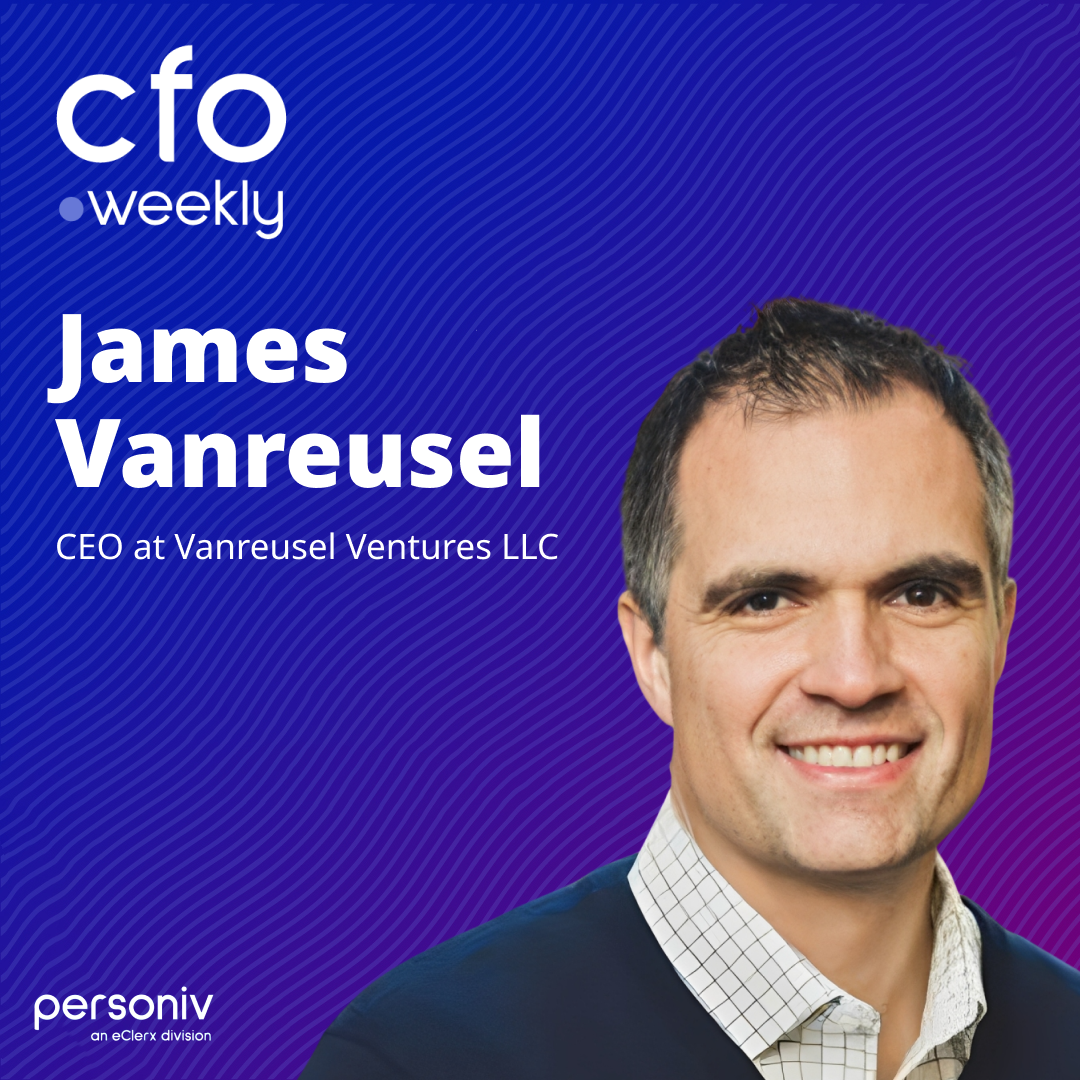
James Van Roussel, founder/CEO of Van Roussel Ventures; former Wall Street institutional equity sales (8 years), microfinance bank CFO in Samoa (5 years), now fractional CFO/corporate finance consultant for VC-backed companies and international nonprofits, including M&A and due diligence.
bloated income statements at mature companies; expense cuts to reach EBITDA growth; switching from VC (hypergrowth) to PE (EBITDA growth) and targeting break-even before IPO.
Written by AI. May contain mistakes.
Explore how the CFO role is becoming more strategic and cross-functional.
“It's going to continue to be a very high level role and it needs to continue to be cross-functional to be successful.”
James shares his diverse career path and insights into finance.
“and his team help emerging companies build the financial systems, teams, and decision-making discipline they need to scale.”
Discussing the differences between financial sophistication and discipline in startups.
“Back then in my early career, we learned a lot about investing, trading stocks, how IPOs work, how capital markets work.”
Insights on how AI is transforming forecasting and reporting in finance.
“And AI has become almost impossible to avoid in finance conversations.”
Exploring whether faster data processing leads to better financial decisions.
“So, for example, you might have created projections and then you run a prompt saying, what are all the things that could go wrong or what are the risks?”
How to assess whether AI finance tools solve real business problems.
“What I found is if I spend too much time using AI, I seem to get frustrated because you end up going in circles.”
Discussing why basic financial metrics still matter in an AI-driven world.
“Do you ever see a day where Excel will be irrelevant?”
Understanding the shift in investment strategies as companies grow.
“Why do pricing, gross margin, cash conversion, and unit economics still matter more than many founders realize, even in this new AI-heavy environment?”
Learn about the differences between venture capital and private equity and how these affect company growth strategies.
“And it comes back to this ROI calculation of if I put$100 into you, what do I get back?”
Discover how the role of CFO is evolving with AI and what skills will be crucial in the future.
“You might be looking at 60 different industries, you see these trends appear.”

Get the gist, explore an idea or ask about something said.
 Claude
On CFO Weekly, what are the key points of this episode?
Searching your listeningAutomatic transcript. May contain errors.
0:01James Vanreusel: The CFO role is being very strategic. It's going to continue to be a very high level role and it needs to continue to be cross-functional to be successful.
0:16Megan Weis: Welcome back to CFO Weekly, where we're talking with financial leaders about how to build efficiency in their teams, create time for strategy, and ultimately get results. This podcast is brought to you by Persona, the trusted leader in finance and accounting outsourcing for over 30 years. See how Persona's customized solutions can help you streamline your operations with teams that start as small as one. Visit the website at persona.com to learn more. I'm your host, Megan Weiss. Let's jump right in.
0:52Megan Weis: Welcome back to CFO Weekly. Today, I'm joined by James Van Roussel, founder and CEO of Van Roussel Ventures, where he and his team help emerging companies build the financial systems, teams, and decision-making discipline they need to scale. James brings a career spanning Wall Street, private equity, asset management, microfinance, and CFO advisory, giving him a broad perspective on what actually creates durable business value. In this episode, we'll explore where AI is genuinely improving forecasting, reporting, and analysis. where the hype gets ahead of reality and why fundamentals like pricing, margins, liquidity, and unit economics still matter more than many founders want to admit.
1:34Megan Weis: James, thank you so much for taking the time to be on the show with me today.
1:38James Vanreusel: Oh, it's my pleasure.
1:40Megan Weis: Yeah, I'm really looking forward to this topic. I think it's super interesting. So as you look back on your early days on Wall Street, was there a moment when you realized that sophisticated models and data can only take you so far if the underlying economics of the business are not strong?
1:59James Vanreusel: I think what I've learned over the, I guess it's a few decades now, is really understanding how business works. Back then in my early career, we learned a lot about investing, trading stocks, how IPOs work, how capital markets work. But we would rely relatively heavily on cell-side research and analysts to really do the digging, listen to all the calls, etc. Now I've been on the other side of the table quite a bit and have conducted the calls that the analysts listen to. And so I have a much better understanding of how everything works and how I would say, you know, stock prices work when they go up, when they go down, why they go up and really what the companies need to show from a fundamental standpoint that's really going to move the valuation really of the stock and of the company.
2:56Megan Weis: And before we go any further, just kind of walk us through your career, where you started and where you are today.
3:03James Vanreusel: So originally I'm from Europe and I came over to the U.S. to go to business school and started working on Wall Street right out of business school. So I was doing institutional equity sales for about eight years. And after that, I really wanted to get into something that was more socially oriented, so social finance oriented. And I went into microfinance and started working with an individual who had just launched a few years prior a microfinance bank in Samoa. And so for the next five years as that organization's full-time CFO, I was helping to launch and operate banks in the South Pacific on different islands.
3:46James Vanreusel: Then after that, I moved from New York to San Francisco and started what I'm doing now, which is a corporate finance consultancy. We do a lot of fractional CFO work for both VC-backed companies as well as international nonprofits, including some M &A work, transaction work, and due diligence work as well. And so that's been about 12 years now. The company has grown and as well as the services and the different industries and companies we work with.
4:19Megan Weis: Wow. Sounds like an amazing career. Congratulations.
4:22James Vanreusel: Thank you.
4:23Megan Weis: And you've worked at both ends of the spectrum from sophisticated financial markets to early stage companies still building basic finance infrastructure. So what has that taught you about the difference between financial sophistication and financial discipline?
4:39James Vanreusel: I think when you look at early stage companies, and I'll just go with the venture capital route. If you look at early stage startups, pre-seed, seed, they're very unsophisticated. They're really focused on product and sales. Develop the product, sell the product, get cash in to grow. And it's really once you get to a series A and you're raising 10 million plus dollars that you're being asked to present U.S. gap financials and models to be able to raise that level of money. When you get to a series B, you start developing a board. You might need to get an audit done as well. And so the sophistication increases as the, I would say, sophistication and size of investors increases as the risk goes up and the governance that investors need to have also increases.
5:36James Vanreusel: And so if you don't have that sophistication early on, it'll come back to hurt you because if you invest early on to get the sophistication, it'll be a lot cheaper than doing it after the fact. And so you can see as you go through to the IPO stage, which gets you to capital markets, that at that point, you should be very sophisticated with some very smart financial people on your board, you're probably, you know, at the IPO level looking at getting audited by the big four and paying a lot of money for that because you want that brand name behind you when you get valued that you go public.
6:18Megan Weis: And AI has become almost impossible to avoid in finance conversations. So from what you're seeing with founders and finance teams, where is it genuinely creating better outcomes?
6:32James Vanreusel: I would say for us, we are intently using it. We're really focused on finding ways to do higher quality work faster. And I would say that the higher quality work is really the main focus. I would say you start off in different areas. I think modeling has become a lot faster. It might have taken you 15 to 20 hours to build a good, sophisticated model. Now you could potentially do it in three to five hours. I think the accounting close as well can be automated. And instead of 10-day or 15-day close, you can get to a two to three-day close. It does take quite a lot of work and organization and reviewing your step-by-step workflows.
7:25James Vanreusel: that gets you there. But AI, I think, is instrumental to everything you do. It doesn't replace the people because you still need somebody who knows what's going on, who can look at the output and say, yes, this is correct, or no, there are some serious errors in here. And so you still need an expert, but it can go a lot faster, a lot more automated. And I find that the quality of the output can be a lot higher as well.
7:54Megan Weis: And in my conversations these days, it seems like forecasting is one area where AI gets a lot of attention. Where have you seen it actually improve the quality or speed of forecasting? And where can it create a false sense of precision?
8:10James Vanreusel: With forecasting, I think having lots of data, so big data, can be really helpful. It can run different time series analyses, just different ways of looking at the numbers. It can run lots of different scenarios as well very quickly. And I think that's very interesting. Where it can go wrong is that there is so much uncertainty out there in the world. And I think it takes somebody who has a lot of experience to understand what is important and what isn't important. So, for example, you might have created projections and then you run a prompt saying, what are all the things that could go wrong or what are the risks?
8:54And it might give you 25 different ones, but probably 80 % of them are just not relevant.
9:01James Vanreusel: And so you do need somebody with experience and a keen eye to be able to evaluate where to look and what specifically for the company you're doing this for makes sense.
9:14Megan Weis: And you've touched on reporting and analysis, which both be automated much faster. But does that actually lead to better decisions? Or are companies sometimes just producing more information without improving judgment?
9:28James Vanreusel: The fact that we can close the books faster can lead to better decision making because you're not waiting two weeks to get the numbers. So I think from that perspective, definitely helpful. One thing that I do see is that AI produces too much and knowing how to cut it down is, I think, just as important as having it help you find answers or information. What I found is if I spend too much time using AI, I seem to get frustrated because you end up going in circles.
10:04Megan Weis: And when a founder asks you whether they should invest in a new AI finance tool, how do you help them decide whether it solves a real business problem or it's simply the latest shiny object?
10:16James Vanreusel: I would say there are some very good tools out there. I think that there's a distinction to be made between a software that's been around for, say, a decade and is implementing AI now that makes it a lot more powerful versus what's called an AI native software, where you really start with the AI and then build the solution around it. The ones that we're most used to is the older software that's seeing lots of improvements. And because they've already worked in the past, they'll work even better now. The new ones, I find, need to be tested quite rigorously because sometimes the output just isn't what you want it to be.
11:01James Vanreusel: It might be slightly more expensive as well. it still needs that person in there to look at the output and sometimes also, you know, get the right input in. It's not quite there. It's getting there. And I think that the biggest benefit really is just the ability to do so much more with the same number of people. That's my biggest benefit that I see there.
11:26Megan Weis: Do you ever see a day where Excel will be irrelevant? or do you think that will always be a tool in an accountant's tool chest?
11:35James Vanreusel: I don't know. I saw one AI native tool that wasn't using Excel anymore. And it was very, the inputs and the outputs that were being produced looked very strange. So I think there'd have to be a re-education around that. Everybody is so used to looking at Excel that it might take some time. But I would add one other thing as well that I've said many times, which is I have always found that the best entrepreneurs or the best founders who are successful typically are strong in finance. So they might already have a CPA or they might already have something else. And I think that AI, you know, really benefits them as well because they can get the information and the data from AI a lot faster and in more detail and be able to figure out themselves what decisions they have to make.
12:31James Vanreusel: So AI is very helpful when you know and understand the output very well.
12:36Megan Weis: And you spend a lot of time helping companies to build strong financial foundations. Why do pricing, gross margin, cash conversion, and unit economics still matter more than many founders realize, even in this new AI-heavy environment?
12:52James Vanreusel: It really matters because it always comes down to the return on investment. So what do I get for every dollar invested? Whether you're looking at buying stocks or advertising or anything else, it's if I put$100 in, can I double it or triple it? And so a lot of times AI is a multiplier when it goes right. That's really what you want to invest in.
13:20Megan Weis: And can you share a situation where a company was focused on growth or new technology, but the real issue turned out to be something much more basic in the underlying economics?
13:32James Vanreusel: I've started working with companies that had some level of maturity. They'd been around for six, seven, eight years. Their income statement become very bloated, meaning that they kept losing money and they kept having to raise money. And at some point, investors don't want to invest money anymore in you if there's no end in sight or the numbers don't keep improving. Sometimes there are big opportunities to come in and really cut expenses by a significant amount without really hurting the organization. And it comes back to this ROI calculation of if I put$100 into you, what do I get back? and sometimes when you become slightly more mature, investors want to see some path to break even or profitability.
14:25James Vanreusel: And you can switch investors as well. So VCs are usually into hyper growth, whereas PE firms are really looking at EBITDA growth. And EBITDA has to do with not just revenue, but expenses as well. And so you can get to a point where you say, okay, I need more money than a VC is able to give me now. I need to go the private equity route because I'm close to IPO. So what does that look like? And how do I switch over the type of investor that can give me enough money to get to IPO? Or you might be saying, I've grown a lot. Now I need to do some kind of M &A transaction, sell the company. What do I need to start looking at?
15:09James Vanreusel: And then you start looking at EBITDA growth instead of revenue growth. So depending on the timing of the organization, that'll switch as well. So it's not only revenue growth. Sometimes once you get to the spending, you need to look at unit economics and benchmark it as well in the industry and say, okay, you know, the cost to produce a widget, $5 doesn't work. It needs to be$2. How do I get there? That's another. These are all different challenges.
15:40Megan Weis: So when you think about bloated income statements or a company that needs to cut expenses, what's usually like some of the low hanging fruit? Where should they look first?
15:52James Vanreusel: A good way to look at it sometimes is just to say, OK, what's the percent of revenue that I'm spending? Right. So on the SG &A side, you might just say I'm at 28 percent of revenues, which is high. The industry is at 22. I want to get to 20. How do I get there? You're really setting targets and finding new ways to get there. A lot of it is innovation. And so when you do the annual budgeting and you're looking at your department heads, you want to be able to say, here's your budget. And it might be 20 % less than they had asked for. Okay, we'll figure out how to do the same amount with 20 % less.
16:34James Vanreusel: So you want to challenge people to innovate as well, to do more with less money. I think other areas to look at is really, you talked about gross margin before. So if you look at direct margin and gross margin, how do I maximize those? If I have gross margin at 33 % and the industry is at 38, okay, how do I become more efficient in how I do things, in how I spend my money, in how I hire people. Do I hire more contractors versus W-2s? Do I hire internationally? There's lots of different ways and figuring out how to be efficient in the money you spend is critical.
17:20Megan Weis: And as AI spreads across finance and accounting, where do you think that human judgment becomes even more important for CFOs and founders?
17:29James Vanreusel: it's having that reality check and the critical thinking that's needed and also the ability to look ahead so what i think bcs have a big advantage of is they see so many different companies that are trying to get ahead and look ahead and so they see several years into the future as to what people are trying to make and sell that's just not available right now on wall street as well, you get so much information that part of the skill is to be able to see what's important and ignore the rest. You might be looking at 60 different industries, you see these trends appear. That's a very important skill to have.
18:15James Vanreusel: You also just need to have the information flow to be able to get there.
18:20Megan Weis: And speaking of looking ahead, but this is the last question, how do you see the role of the CFO evolving in the next three to five years and what new skills or mindsets are going to be critical for the CFO of tomorrow?
18:34James Vanreusel: The ability to use AI, I think it's going to become an even more strategic role. You're still going to be building teams. And I think the more experience that you can get working with different companies, I think is hugely valuable. I continue to see the CFO role as being very strategic. I like the fractional CFO model because I think smaller companies and startups only need a certain amount of time because it's strategic and you really just need a controller or an FP &A person to do the majority of the work. And then you need the CFO to help you scale. But that's really just a small percentage of the time that's needed.
19:18James Vanreusel: And it's only really as you get larger and larger that you're doing more deals and transactions and negotiations. And you're really thinking alongside the CEO as to what's the next step and which company do we need to buy and things like that. So I think it's going to continue to be a very high level role and it needs to continue to be cross-functional to be successful.
19:47Megan Weis: James, thank you so much for taking the time to be here with us today. I really appreciate you sharing all of your experience and knowledge.
19:54James Vanreusel: It was a pleasure talking to you. And I always like to share my latest thing.
20:01Megan Weis: And to all of our listeners, please tune in next week. And until then, take care. Thank you for listening to this episode of CFO Weekly. We hope you picked up some useful insights and strategies to help move your business forward. If you enjoyed the conversation, be sure to subscribe on your favorite podcast platform so you never miss an episode. And if you found it valuable, we'd love for you to leave a review and share it with your network. It helps us bring even more great content to finance leaders like you. For more episodes, resources, and to see how Persona can support your accounting and finance needs, visit persona.com.
20:39Megan Weis: See you next week.
In this episode of CFO Weekly, James Vanreusel, Founder and CEO of Vanreusel Ventures, joins Megan Weis to explore where AI is genuinely improving forecasting, reporting, and analysis, and why fundamentals like pricing, margins, and unit economics still matter most, drawing on a career spanning Wall Street, microfinance, and more than a decade of fractional CFO work.