
In short
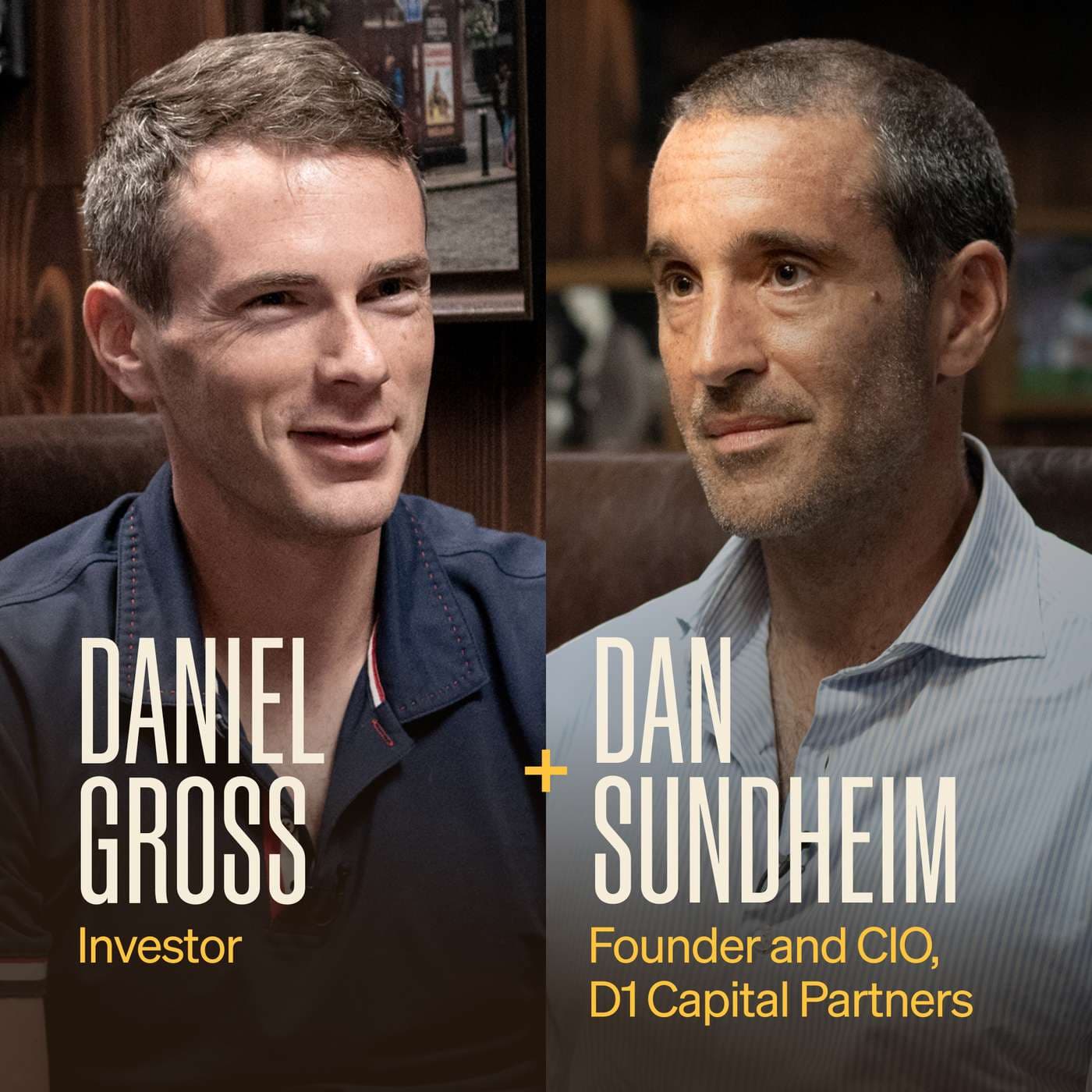
Podcast Summary: Cheeky Pint - Dan Sundheim of D1 Capital on the Art of Public Market Investing
Episode Overview In this episode, John Collison interviews Dan Sundheim, founder of D1 Capital, a prominent hedge fund manager known for his expertise in public market investing. The discussion covers various topics, including the GameStop short squeeze, the emotional complexities of managing large sums of capital, and insights into the art of stock picking.
Key Topics Discussed
- D1 Capital Overview
- Investment Strategy: D1 Capital focuses on both public and private companies using fundamental analysis over a horizon of three to five years.
- AUM: Approximately $25 billion, with two-thirds in private and one-third in public investments.
- Stock Picking and Portfolio Management
- The process of stock selection is collaborative, beginning with team discussions before moving to memo writing.
- Sundheim emphasizes the importance of being proactive, often buying shares before the formal memo is finalized.
- GameStop Incident
- Sundheim recounts the challenges during the GameStop short squeeze, emphasizing the emotional toll and stress of sudden market fluctuations.
- He describes the phenomenon as unprecedented, highlighting the risks associated with short selling.
- Short-Selling Strategies
- Sundheim believes that the current market environment presents new short-selling opportunities, albeit with a need for smaller position sizes to manage risk after the GameStop experience.
- He discusses the importance of differentiating between various types of shorts, such as cyclical risks and terminal value risks.
- The Public vs. Private Market Debate
- Sundheim expresses skepticism about public markets, suggesting that high volatility and irrational pricing can undermine a company's intrinsic value.
- He argues that successful private companies may benefit more from staying private, citing issues with employee compensation tied to volatile stock prices.
- Insights on Companies and Industries
- Elon Musk's Business Approach: Sundheim admires Musk's ability to control costs and drive innovation, contributing to sustainable business models.
- Rolls-Royce Example: Discusses how operational improvements and new management led to significant growth, contrasting with U.S. companies that may quickly price in changes.
- Advice for Aspiring Investors
- Sundheim encourages young investors to read extensively, analyze stock pitches, and learn from the market as a mentor.
- He recommends studying the writings of Warren Buffett for insights into investment philosophy.
- Market Predictions and Economic Outlook
- Sundheim shares his thoughts on potential market bubbles, influenced by emerging technologies and shifts in investor sentiment.
- He notes the importance of understanding underlying economic trends and technological advancements in shaping the future of investing.
Key Takeaways
- Emotional Resilience: Investors must cultivate a high pain tolerance to manage the emotional stress associated with significant market volatility.
- Pattern Recognition: Successful stock picking relies on recognizing patterns through experience and understanding business fundamentals.
- Public Market Vulnerabilities: The public market's volatility can lead to misaligned employee incentives and long-term strategic issues for companies.
- Emphasis on Learning: Continuous learning through reading and analysis is vital for developing strong investing acumen.
Recommended Resources
- [The Essays of Warren Buffett: Lessons for Corporate America by Lawrence A. Cunningham](https://www.amazon.com/Essays-Warren-Buffett-Lessons-Corporate/dp/161283383X/)
- [The Buffett Partnership Letters (1957-1970)](https://www.ivey.uwo.ca/media/2975913/buffett-partnership-letters.pdf)
- [Value Investors Club (VIC)](https://www.valueinvestorsclub.com/)
Episode Timestamps
- (00:00) The D1 operating model
- (07:54) Getting it wrong on NFLX
- (11:44) What makes a good stock picker
- (18:16) Portfolio-building
- (24:35) GameStop
- (35:57) The art of short-selling
- (41:48) How to spot a turnaround
- (47:12) Waking up at 3am
- (59:31) Money management
- (01:09:52) China
- (01:14:44) Are we in a bubble?
- (01:20:41) SpaceX
- (01:25:04) Investing in private companies
- (01:32:55) Thoughts on the banking industry
- (01:35:58) Advice for budding investors
This episode provides a comprehensive insight into public market investing through the lens of a seasoned expert, highlighting both practical strategies and philosophical reflections on the market dynamics.
Written by AI. May contain mistakes. Listen to the episode to check what was said.
Transcript
Automatic transcript. May contain errors.0:00I don't think I've ever had a Guinness. unlike Scott Wu amazing I've had many many many years perhaps thousands but I'm not sure I've ever had to get this without an alarm clock I will wake up almost exactly between 2.55 and 3am almost every day wow so you wake up ahead of earnings no no forget earnings like every day I just want to see what happens at the open no I don't want to wake up I actually don't want to wake up I mean if I ran a private company like Stripe I wouldn't go public I think the public markets you know That's kind of ironic because you're a public markets investor. Yeah, I think the public markets are kind of problematic at this point.
0:39Dan Sondheim is one of the world's top hedge fund managers. He runs D1 Capital, which invests in public and private companies across a bunch of totally different industries. Dan's one of the smartest investors I know. So Daniel Gross and I try to get into his head and figure out how he analyzes companies. Cheers!
0:57you actually use like if you are trading underneath the table during the interview like are you in interactive brokers are you whatsapping someone who executes this i'm just emailing i'm emailing the trader with that yeah i mean i'm checking bloomberg all day long that's the app on the phone my phone yes but i just i'm just emailing texting my trader and if the trader is like sleeping or something is there an app that you use or if you're sleeping during the day We haven't encountered that problem. That'd be a different problem. But if you're sleeping at night, we actually have overnight traders in Asia.
1:32Once you told me sometimes when you struggle to sleep at night, there's nothing better to do than wake up and start trading Asia. So is that your East Coast trader or do you have another person? Yeah, we have another person who sits in... We outsource. I see. Yeah. I see. Yeah, yeah, yeah. And then what fraction of AUM is just Dan Sondheim trades? Or Dan Sondheim decisions? 95 % plus. Oh, so all of them. Yeah. I mean, people have trading authority, but most of the trades I put it myself. Okay, so memos come up to you and then you ultimately size them and decide whether to do the monage or something like that.
2:12Yeah, I mean, the process starts way before the memo. I'm in dialogue with the team about the idea, why they like it. we're having conversations way before it gets to the memo stage. By the time it gets to the memo stage, and usually we start buying it before, because in the public markets, if you have a good idea, you could take a month and a half to write a memo, but by that time, the price may have moved. So usually we start buying it before the memo is done, and the memo is kind of the final compilation of the due diligence, and that's when the best thing that could happen is we're buying it and then the stock keeps going down.
2:52So by the time you have the memo and have even the most conviction, you can buy more. A lot of times it's going the wrong way. But a part of the time, do you finish writing the memo and you're like, oh no, this is a terrible company. This is not good. Yeah, yeah. No, that doesn't happen. Because usually they'll start writing the memo and then they'll come to me and be like, I think I made a mistake and we'll sell it. I don't think I've ever owned a position because we had discussed it then read the memo and been like, oh my God, what are we doing here? Yes. That would be a bad sign for the analyst.
3:24We jumped right off the deep end. Describe what D1 does, AUM, strategy for the uninitiated. Yeah. So we invest in public and private companies. We do fundamental analysis and so deep research, trying to understand business models, trying to understand company prospects, choosing the right management team. And whether it's public or private, we're investing with a horizon of three to five years. And we applied the same due diligence process to both public and private. Obviously, private is a one-way door and public is a two-way door. So, you know, that's different. Is private actually a one-way door even as just the private markets have matured and there's so much more secondary activity and things like that?
4:09Like, do you still have to treat it as a one-way door? Definitely. I mean, you can sell like the best companies you can sell easily, but those aren't the companies you want to sell. So, you know, we rarely transact in the secondary market because, you know, we don't want to sell the best companies. And it's hard. Like, people think you can just transact in the secondary market, but if you want to sell $50 million,$100 million, people have to get information rights from the company. And then it's like... And it's viewed as a signal if you're like... Exactly. If I go to the management team and say, I want to sell and the person doesn't follow through, it's not great.
4:43So the AUM is about 25 billion, about two-thirds private, $10 million public. Public is long, short, all bottom up, no quant. Really kind of the same thing people were doing in terms of stock picking 30 years ago. When you say no quant, that is you're contrasting to some of the more short term kind of technical firms that are just trading based on what will happen the next day, the next week, the next month. Exactly. And we're not using any computer programs to guide our trading. We are not trading based on quarters. You could be doing my job the same way 20 years ago. You wouldn't have exactly the same tools, but it's just - Do you think of any of those signals that people talk about when you think of one to to enter or exit a trade?
5:33The stock would be oversold or overbought? No. What I find interesting about you guys is you're long-term in that you're not, like you're saying, some of the quant guys who are just trying to predict what happens in the next, what's the next buyer doing or the high frequency guys or something like that. You're instead just thinking, is this company selling a good product? Will their sales exceed what people expect? And will that add up to a good business? And so the work is evaluating future earnings of the company. But there are some people who are really buy and hold. Like Costco seems to attract a lot of shareholders who think there is no price that is too expensive for Costco.
6:13And there's kind of a huge loyalty there. Whereas you kind of have a price on both ends, where at this price, I'm an enthusiastic buyer. And at this price, God bless him. I'm selling the entire position. And you kind of have that price boundary at both ends. Yeah. I mean, so, practically, we may say we think that in three years, this company is going to be worth double, right? So kind of roughly 20-something percent IRR. But if we're right about the company, usually it doesn't go 24%, 24%, 24%. People pull forward the IRR. The stock may go up 50 % in the first year if things go well. well, then the forward IR all of a sudden looks a lot worse and you're kind of moving capital to the next opportunity.
6:57I think the biggest mistakes, if we would look back, I mean, it's easy to think about the mistakes where you lost money. And you think about those a lot. But the biggest mistakes are selling the Costco's too early because the IRR is totally dependent upon what you assume the exit multiple is. And that is difficult to be precise about what the right exit multiple is for a business. So let's talk about painful mistakes. Can we talk about Netflix or something like that? Yeah. So Netflix, when we started the firm, almost every LP I met with, they only 20-year stock pitch. So I pitched them Netflix.
7:33And actually, when we were interviewing candidates, what we did was we gave every single interviewee the same case study. We said, this is in 2018. So we said, look at Netflix, look at Spotify. If you had to buy one of these businesses and hold them for five years, which one would it be and why? So it was like Netflix all the time because I was talking about Netflix with LPs. I was talking about it with interview candidates. And ultimately, the thesis was correct, and I didn't hold it long enough. And so in 2018, the reason Netflix was contrarian was it was obviously a great product that people loved, but they were burning a lot of money.
8:14And so it's just not clear, was this like a classic tech company or would they ever make money? Like that's why it might have been contrarian with all these. Yeah, I think the issue is like there's very few tech companies that are massively capital intensive, right? Almost every tech company loses money for a period of time. But the typical software company you're looking at, like, you know, there's operating losses, you leverage it, and then people are very used to that business model. Up until the LLMs, there were very few tech companies where it's like a huge fixed investment, and then the incremental margins on the sales are extremely high.
8:48And so, what that meant was that Netflix was investing heavily in content, which is a fixed cost, and then they were selling that to consumers. The next year, they were investing more in content and selling it to more consumers. But you're constantly investing more and more in content. And the skeptics thought this would have to keep going up forever and they'd never make money. Yeah, because the cash flow just looks worse and worse every year because you're investing more and more. But ultimately, that created a moat that was, I think, the defining aspect of the business model that made Netflix what it is today.
9:24Meaning that it's like a flywheel. You invest a ton before anyone else. Actually, what happened here is the media companies enabled Netflix by selling them content. And then Netflix invested a ton, sold to people globally, took that money, invested more in content, actually borrowed in the high yield market, invested more in content, sold to more people. And then the flywheel, then within five years, they're investing way more in content than anyone else. They're selling it to way more consumers. The incremental cost of selling that content is very, very low. And so you have this fixed asset that you've built up that - And what kind of ultimately caused you to sell it?
10:02We had transitions on our team. And look, we cover every sector, right? So, there's like, we're covering at any given time 300 stocks. And we had transitions on our team and our media analysts left. And I was focusing on other things. It was not excusable because if I look back, we get plenty of things wrong. But Netflix, we're exactly right. Yeah, how do you think about there's like a sense of, do you ever have this issue where people want to pitch new things because they're like new and exciting and I guess like the good old Occam's razor idea is just hold what you have and I have to push back against it.
10:40Yeah, I probably should push back more. I mean like, you know, I think it's like a human tendency like, oh, this is a new company. I love investing. Let's learn about this new company and this sounds super exciting. But at the end of the day, you know, there's like only so many amazing companies and trying to, you know, sell them and move into something else is almost always a bad decision. That's the nice thing about the private markets is that once you invest, you can't sell. And usually for the best companies, that's a huge benefit ultimately. I just want to go back to starting D1 for a second.
11:12So the lore is that prior to D1, you were at a firm called Viking. Is that right? Yep. And the lore is that almost all of Viking returns increasingly came from Dan Suntime I'm offhandedly making a comment to someone at the water cooler that, oh, that could be a good stock or definitely don't invest in that. And people would be like taking those trades as their own for the most part. Those are your words, not mine. I've never said that. That's the lore. And I guess my question is, when someone comes up to you, an analyst on your team today, and says, oh, hey, what do you think of XYZ? And you do that sort of Dan Suntime, 30 seconds, 10 second take, what is going through your head head exactly that gives you just this binary sense of like looks good, not good?
12:01Well look, I mean every situation is different. I think the biggest risk is sometimes people will come to you with an idea and they come to the idea and they pitch it for a little bit and I think about it and I give them an answer. And I don't have enough information to give them a really solid answer but whatever I say they think is like okay well if he said that's not good then I'm just going to forget about it. And that's actually not, that's not constructive. I am wrong all the time, even when I've done a ton of work. And if it's just like a 30-second pitch to the water cooler, I can say, like, that sounds interesting.
12:32Or I can say that doesn't sound interesting. Yeah. But I'd say my hit rate there is dramatically lower than once we've done all the work. And there is a risk, like, analysts are like, they try to take my temperature and if I'm going to be, if it's going to be something that interests me, and if it's not going to interest me, don't waste time on it. That's actually not great. But I think what Daniel is getting at is like, you seem to have an intuitive sense for companies and in this underwriting? Like, it's not just all about does the model, you know, spit out in 19 % or a 21 % IRR? And what is that that the spidey sense is picking up on?
13:04I mean, I think it's like anything else in life. It's like pattern recognition, right? It's like part of it is just understanding business models, understanding, you know, what kind of valuations companies should be trading at. Part of it is just having invested in this capacity for 20 something years, you know, you get a sense. Like if somebody comes to you and pitches like an idea to allocate a ton of R &D resources to some engineering project, you probably have a pretty good sense like up front whether or not like they should go write a big memo proposing that or not. When you interview young, younger.
13:44It's an art, not a science. Right. So when you interview younger, say portfolio managers, or when you meet, do you have a sense fairly quickly if they have whatever this is? Do you think this is a thing just people have or they don't? I think the answer is yes. So a couple things. One, we don't hire portfolio managers. I pretty much only hire people who've never done public equity before, which has pros and cons. So what have they done before? Piano teacher. We typically hire from private equity. Because then they have the analytical skills, they understand accounting, they understand financial modeling, and then we can teach them the stock picking.
14:31If I hire somebody laterally who's a portfolio manager in another fund, that's rarely been successful, almost never. Because of negative transfer, like the expectations are all on. Everybody has a different, like every firm has a different approach to investing. And getting people to change their habits to align more with how we invest is incredibly difficult. Now, like if I hire somebody from private equity, it takes about three years for them to really be like contributing to B1. So obviously it would be much faster for me to just hire an external and there's funds. And what is that? So like they come in, you say it takes three years.
15:09What's happening? You know, they're, say, they're three months in, and they're trying to speak up in a meeting, and you must be thinking to yourself, this isn't really the D1 way. Like, what is that exactly that changes in them over the course of the three years? Yeah, look, I would tell you that I wish that it is incredibly difficult to figure out who is going to be great. and even after three years, I'd say our hit rate still is not as high as you would expect. I imagine if you hire an engineer after three years, you probably have a pretty good sense of that guy's a good engineer or a girl's a good engineer.
15:48I think that we have a pretty good sense, but it takes even five years to really get a sense because some people start out where they're analytically really solid and they work incredibly hard. But the actual intuition of stock picking hasn't come to that yet. Is it because you're saying the job is so pattern recognition oriented that you just need some time to build up the pattern recognition? Is that what they're learning? Once in a while, people come in and right out of the gate, you're like, wow, this person sees it. They see the ball really clearly. But that is a very small fraction of the time.
16:33Most people get great over time, and they have to learn an industry. So when they come in, we will say, you're going to cover FinTech. And it just takes them a year just to understand FinTech, right? Then they have to see, well, why is XYZ stock trading at this multiple? And why is this stock trading at this multiple? What's the market saying? And I think it's like the market is constantly giving you data points. Some of them are false signals and some of them are good signals. And over the long term, they're all good signals. And the people who do great at this job, you have to have some commercial sense, which I think is probably just you're either born with it or not.
17:13Charlie Munger's money-making gene. Yeah, I wish I could test for that. It's impossible. But you also have to love the job. You have to wake up in the morning in the shower, be thinking about your stocks. This isn't the kind of job where you close your laptop, you go home, and you forget about it. You have to always be on, and there's people who love it. If you love it and you have that commercial instinct, and you have to be analytically sharp. Do you have a leaderboard of individual people's portfolios and how they're doing compared to each other? Yes. Yeah, everyone has what we call a mock portfolio.
17:50So every week, they have to take the positions they cover, and they have to say, if I was managing capital, here's how I would allocate capital among the names that I— And then what happens at the end of the year is that sometimes it's like, I own these five stocks. My mock portfolio was up, and we take it very seriously. The mock portfolio actually goes into people's comp. Sometimes it's like that person did phenomenally well in their ideas and I didn't monetize them. And then sometimes it's the opposite. But it takes care of a lot of the typical hedge fund thing of at the end of the year, like, oh, everyone remembers the things that they want to do that worked out.
18:34People have to pre-register what they're going to come to you at the end of the year and say, see, I was right. Yeah, exactly. So I know, like, did I... Do you have a situation with the mock portfolio where someone goes short something you're long, or vice versa? That hasn't happened yet? No, that hasn't happened yet. But like, there are big discrepancies. Because sometimes analysts will be like, I think this is a 5 % position. And I'll be like, I think you're crazy. I think this should be double that. Do you have a mock portfolio yourself, or is D1 your mock portfolio? No, D1's my... That wouldn't be very useful yet.
19:10D1 is my portfolio. Yes. And then, okay, you talked about sizing positions. Everyone's coming to you with all these good ideas, because they're bad ideas, and they're totally idiosyncratic. Some are super safe bet. Some are kind of flyers. Some are industrials and tech and banks and everything. How do you size positions, and how do you just assemble that into a sensible portfolio? Yeah, that is really difficult to answer, because it is entirely an art that we're always trying to get better at. And we look at tons of data just to see what we could do better. But it is really just to feel like, look, for every stock, there is a target price.
19:53But then there's also what kind of risk. There's a risk reward calculation. Like, okay, maybe you can make 50%, but you also could lose 50%. You're wrong. Sometimes you can make 25%, but the risk of losing money is quite low over time. And it's a matter of like you have to compare those two ideas, which are inherently very, very different. And construct a portfolio which has, you don't want all names where you could make 100 % but lose 40. But you probably don't want to have a portfolio full of names where you only make 20 % and lose three. So it's a lot of things that go into it. There's like the risk reward.
20:31There's like the ultimate upside. There's a sense of like what's currently happening in the business. Like, you know, if a business we think currently has a lot of momentum, I'm not predicting quarters, but if the business currently has a lot of momentum, the chance of you losing money in the short term, assuming it's at a reasonable valuation, is much lower than if a business—we're often buying businesses when they're going through really tough periods, right? You have to be very careful because, you know, often that's the best buying opportunity, but, you know, that's the riskiest time, too, because sometimes it's hard to call the bottom.
21:06When you say you have to be really careful, isn't there a principal agent issue here where when you analyze a company, you try to see, you know, you try to predict what its earnings will be three years hence and be more right than everyone else's. You know, maybe they're too pessimistic on the company and you think it'll actually really over and compare it to people's expectations. but you're actually really sensitive to what people think in the short term because your LPs are grading you on the performance in the year and the performance in the quarter. Correct. And you're judging this poor analyst, you know, and their job on the mock portfolio, which you're saying is like updated weekly.
21:47And so aren't you not actually looking at companies on a three-year time horizon because they have to like perfectly perform at every step along the way and they can't be misunderstood for any short period? Yeah, the way I think about it is, any given time, we are planting seeds and then we're harvesting. Like, there's some companies that we invested in a year ago and our thesis is starting to play out and you're making money, hopefully, on that idea. And, you know, maybe you're selling that idea at that point. And then you're putting in new ideas in the portfolio that might take another year to play out.
22:20And so it's not like if we started out with a bunch of ideas that all had three-year targets all at once, like, yes. But the portfolio is a living thing. You have a range of positions. Some you've had for a year or two, and you think the business is going to turn the stocks into work. And then there's other companies that you're buying now because they're really depressed and really out of favor. And you know they're not going to go up in the next—you don't think they're going to go up in the next three or six months. But over any medium-term retirement, they will. So it's like always— So you have limited capacity in your portfolio for the out-of-favor stuff, where ultimately you're smoothing this for LPs, where you always need some companies that are performing and are popular?
22:59No, because I may have bought a company a year ago that was out of favor. And maybe it's still out of favor, but eventually, the way economic cycles or industry cycles work, the company I bought a year ago, maybe I didn't make money on it for the first nine months, and now it's starting to inflect. And I'm putting a new company in the portfolio, which is out of favor, and that will start to work. It's impossible to predict. that'll start to work six, 12, 18 months in the future. But if you have a portfolio of things that you've built over time, our monthly returns and quarterly returns are purely an output.
23:33There's nothing, it is arbitrary in some respects. I think Jeff Bezos once said, when people congratulate them on a quarter, he said, yeah, but that quarter was cemented three years ago when they made this decision to do XYZ. It's kind of the same thing with us. When the stock's working, we probably were investing in that stock a year 18 months ago. And then now we're investing in a new stock, which hopefully will pay off in 18 months. So one thing you're kind of famous for is pain tolerance. You go through phases of euphoria in markets. You go through phases of pain in markets. And I was just wondering if you'd walk us through maybe across D1's history, the most painful phase.
24:17And just how was that for you? It's a very oblique way of asking about GameStop. Yeah. I do have a high pain tolerance. But so the first three years of our fun, our fun did phenomenally well, way better than I would have expected. There's always some mean reversion you expect that like, okay, the next 12 months are going to be harder because you've just made so much money. As we were entering 2021, we had an amazing run. And everybody at the firm was elated. Everyone had done well. They were part of a winning team. And for me, I'm always a little nervous in the back of my head when things are going too well.
25:01What I didn't expect was that the mean reversion would happen within three weeks and would be so dramatic that we never came close to going into business, never had margin calls, but it was an absolutely insane - But so what happened? What three weeks was that? Okay, so 2020 ends. Everything is great. We're up. I don't even remember how much we were up, but we lost. Very, very high. And, you know, back then, we are fairly aggressive short sellers. Like, you know, I like shorting stocks. It's masochistic. I love doing it. And I've always liked shorting stocks. And this is a time when, you know, we go back to, like, 2021, think in your head.
Read the full transcript
25:46The government was mailing everybody checks. Everybody was sitting at home, they weren't going to the office. You know, Reddit was starting to become a big thing. And all those things came together to create a massive short squeeze on the order that I've never seen before. The way I've always thought about stocks is like, let's say I short a stock. I think it's going to earn X. I know that if I'm wrong, it's going to go up this much and probably goes up more than it should fundamentally because people are short and they're going to have to cover. That's my whole career. I've never had in my risk-reward framework, nothing happens fundamentally and a stock goes up 400 % in two weeks.
26:28That's what happened. And if you think about what shorting is, shorting is leverage, right? It's just borrowing shares that you have to pay back. Imagine borrowing a lot of money and the amount that you have to pay back goes up by 100 % every week. That's very stressful. It's like the development market debt trap kind of. Yeah, that was quite stressful. And then imagine that also at the same time, you know, the American populace is basically all like coming together to think that like these are the people you should attack. these short-tellers. And so, it was like CNBC was like, it felt like everybody was behind this massive short squeeze and felt like it was a great thing because these hedge fund managers were paying, you know, for what.
27:18That was the surprising thing, right? Because it's the age-old inner crisis, all the correlations go to one. And things that are supposedly in your model uncorrelated actually turn out not to be. You know, this is the long-term capital management issue. It's like, oh, everything's correlated. And similarly here, wasn't it that like any one stock spiking 400 % would have been fine. Yeah. But it was the fact that this new retail phenomenon of all of the highly shorted stocks by hedge funds melting up together was maybe the thing that... Exactly. People say GameStop, but GameStop is just like, that's a name that people use because it was the most prominent name.
27:55But like, what was the experience like? So it's week one, it's up 100%. The week was like, the experience was like, I was almost like in shock. We were losing an amount of money that was almost hard to even fathom that you could lose that much money in a short period of time. And imagine we were going from being on top of the world to within three weeks, people were saying, oh, these funds are going to go out of business. And I am generally pretty even-keeled when it comes to markets. I've been doing this a long time. I've seen a lot of things. that was you know the toughest period I've ever had and it was it was really stressful to the point of like you know I was uh it was almost like you know I felt like I was an emotional shock now I was still laser focused and I knew you know I'm like I'm on top of it I you know I'm acting completely rationally but yeah it was like very very very hard and I had friends who were getting bailed out by other funds.
29:00And you felt like the whole world was against you because there's all these people paying up. It kind of was. It was really hard. What I'd say about this job is that there's an asymmetry of emotion. When you're making a lot of money, it's not like I'm tap dancing around my house, euphoric. My lifestyle doesn't change. I feel like, yes, I'm happy that we're succeeding, but, you know, I'm happy but I'm not euphoric. When you go through something like that, I mean, it is like so painful and stressful. And it's not because I'm losing my own money. It's more about losing other people's money. It's more about like, you know, you know that what's happening is completely economically irrational and how long can you actually stick with it?
29:53Yeah, is it the painful thing that like if you're covering the shores, you know that you're covering it at a bad time because this is not a long-term sustainable price level. Yeah, so we covered everything at the worst time. And I knew it was the worst time. But if it kept going on for two weeks, now all of a sudden there's a real problem. And I wasn't going to put the firm at risk. And I told my investors, I said, this is the worst time. Now, if I had held that short portfolio, forget like from the top, if I had just held from the end of 2020, money. I mean, they underperformed massively. Like, you know, it would have been like - You were right on the shorts.
30:28I was right on the shorts, but like I was wrong on the risk management. So again, there's this new phenomenon of retail melt-ups in stocks. And in particular, certain stocks seem to attract the retail crowd. And the price movement of the company stock just seems to, like I was just looking at there's like a lot of retail interest in Opendoor. And so the price movement just kind of takes off and starts doing its own thing that's kind of different to what's been happening, how it's been valued previously. How does this new retail phenomenon change the short selling game for you? I would say that the opportunity for short selling is better than it's ever been in my career.
31:10However, Oh, damn it, this is. This is a however. But however, you cannot capitalize on that opportunity. Like, we went back to 2019, and the same thing was happening. I would, you know, be massively short these companies. But after going through GameStop, there's a ton of opportunity, but you have to be much smaller in each individual name so that, you know, you don't subject yourself to, you know, what happened in January of 2021. But is this a new kind of science, just, like, understanding what the crowd is going to do? Or is that just like impossible? There's no science behind that. You could have like the Reddit analytics and like following the tweets.
31:54Yeah, you could follow Reddit tweets all day long. But like, I mean, like, where does that tell me? Like, okay, the stock went up 100%. There's a bunch of people who like the stock. Obviously, if I read the Reddit, like, duh, they like the stock went up 100%. Like, I think it doesn't, there's no information signal there. I know that people are buying the stock. I know that they're buying the stock for a reason that I think is kind of silly. And, you know, the most important thing to me is that, like, we just have to be able to write it out. So, like, whatever happens, risk management cannot happen after the fact.
32:30Like, anything you do after the fact is not risk management. It's actually just destroying capital. Risk management has to happen before the fact. Meaning, like, you size these positions so that, like, when it goes up, you don't have to cover. Right. Anyone who says, like, oh, I risk-managed the portfolio because things were going against me, almost, if you're a bad stock picker, sure. Yeah, it's like I'm caught by losses. If you're any good at stock picking, risk-management after the fact is a bad idea. Yeah. So we now size things. So, like, look, I'm not trying to figure out, like, what's happening on Reddit or this or that.
33:03You know, people, like, you know, it's like people get excited about one stock is in fashion one day, then next week they move on to another one. I can't predict that. All I can do is size positions such that if they get excited and the stock goes crazy, we don't have to cover. We just kind of let it go and ride it through. So is it something like previously you could have had a more concentrated short portfolio where you could have had a few shorts that you really like. Now, then you would have said, oh, it can go crazy and it can 2x if it wants and I'm still fine. Whereas now you need to have many more individual short positions where any of them can 10x or 20x and you're still able to write it out.
33:42Correct. 10X or 20X is a little extreme. We don't have that very often. But this kind of stuff happens. It does happen. We don't show like$1 stocks. But yes, that's exactly right. After GameStop, we took about a year off of short selling. And then I reengaged in short selling. It's like someone going through a tough breakup and saying, I'm not dating right now. Yeah, it was like, okay, we're going to step back. I didn't know there was a 500 mile hurricane existed. I didn't know that could happen. It happened. Okay, so now we have to figure out what kind of windows we want to put in our house, right?
34:12So we took about a year off from shorting, which hurt us a lot in 2022. When we got back into it, I said, look, we're going to have to be more diverse. We're going to have to be less aggressive. And, you know, my view going in is like, logically, you should expect that your returns will be worse. And then the question is like, okay, so shorting is a really hard thing to do. So at some point, it's like, okay, if you're going to diversify so much and your returns are down, like, is it even worth it? And if you asked me at the time, my LP has asked me, I'd say, like, I don't know. Like, I like shorting stocks.
34:47I think we can do it. But this new strategy, not quite sure if the juice is worth the squeeze. As it turns out, if you look at our short alpha since that time and since we implemented the more diverse portfolio you referenced, our short alpha has been as good or better. And I think the reason is... As your long alpha or as the prior short alpha? when we were more concentrated. I think the reason is that you can't be as big, but there's so many more mispriced stocks that you can have 40 of them instead of having eight of them. Yes. And so - What makes a good short? Good question. Yeah, I mean, there's a lot of different kinds of shorts.
35:31So the ones we've been talking about are like stocks where usually what gets the retail crowd excited on social media? Usually it's stocks that have some story which is novel and exciting. Maybe it's new technology. The revenue growth is really good. And you're kind of analyzing the business model and saying, like, this technology just doesn't work. Or, like, this company is actually, you know, the founder is horrible. That's its own thing. And then you have shorts that we think have real terminal value risk, where we look at the company and say, I actually don't think this company will be around in 15 years.
36:16And that's usually because of something secular is happening in the economy. But there's like Kodak type stuff where the business will go away as opposed to Theranos type stuff, usually where it's like pure fraud. Exactly. Theranos would be like its own thing. So there's like frauds, which I used to do a lot more when I was younger. It's hard to find frauds at$10 billion companies. It happens, but we're not training. I guess capital markets are pretty good for eliminating frauds from the... Yeah, like you'll find them, but they're usually in companies that are$1 billion market caps or$2 billion market caps, which is kind of below the threshold where we play.
36:52Because you can't get enough exposure. Yeah, I mean, a fraud rarely gets to be like Enron size. So you have the retail stocks, which are just like story stocks that have, you know, there's really no real substance to the company. Then you have terminal value stocks, like Kodak would be a good example, where you just look and say like, here is where I see the economy going because of some secular trend or some technological innovation, and this company's business model is going to be severely compromised over the next decade. Then you have stocks where you just think that the business from a competitive standpoint is just really disadvantaged and is going to seed market share for a very long period of time.
37:39And then I'd say the last and least attractive shorts are the ones where it's like cyclically they're just over earning a lot. And you believe that the real earnings, if you were to look like through a cycle, are much lower than people think. And how do you think about, so there's a company, maybe they're in a bad place in the economy, it just doesn't seem like it'll work out, but there's always this fear, you know, that they get bought out, whether there's a sudden management change. And do you just, I guess, do you just size your books such that that's okay for you, or do you use options? I find that like, generally, companies that have secular risks almost never get bought.
38:19Like, I rarely has, do I ever see a CEO say, I want to go buy something that grows slower than I do. Right? This doesn't happen. Nobody wants to take the time to do an acquisition that's going to invite a bunch of secular risk into their business. Maybe Ron Perlman did that back in the day. But that doesn't happen. What can happen is if you have a company, like the example I gave, where there's a company in the industry that you just believe is going to seed market share. for a long period of time because of their positioning or management or strategy. And then what can happen is like an activist comes in, takes a big stake in the company and says like, we're going to replace the managing team.
39:06And once we do that, the new managing team will pursue a different strategy and they will no longer lose market share. That is a big risk in that category. Yeah. That's kind of the only category where like - And you don't use, and to manage that risk, you just manage your book. Do you use derivatives at all? I really don't use derivatives at all. The problem with derivatives is like, look, at the end of the day when you break down what is a derivative, it's just leverage and implied volatility. Like if I want leverage, I can go get leverage from a prime broker. I don't have any view on implied volatility.
39:45and the problem with derivatives is there's typically a time frame. I'm not good at time frames. I don't know when a stock is going to work or that's very difficult. So I don't like having something that, making a bet that something's going to happen in a certain period of time. I just, so we keep it pretty simple and just trade underlying stocks. So I think that like nobody buys businesses that grow slower than them or rarely. People usually don't buy companies that are market share donors. Like, with CEOs, like, I really want to, like, buy this, it's like, that's like a headache, right? So, there's a stage of the life cycle where companies kind of become unacquirable, kind of?
40:25Those companies, like, I don't worry about them being acquired. What do you worry about, as I said, activist comes in, replaces management. Usually, the new management team can't fix it, but sometimes they can. And that's a risk. You know, in terms of like the companies where I said like they have no terminal value, the risk is just that they usually trade at low multiples, right? And so, you're basically just DCFing the cash flows. And if the cash flows, if something happens and people receive the cash flow, it's going to like last a little bit longer. Yeah. Because the starting valuation is low, they can go up.
41:00Cyclical shorts are just entirely different. The risk is just that like you're early or you're just wrong about the cycle. like there's something about the cycle which is different this time. But those are kind of the main categories of shorts. Speaking of cyclicals, why has Rolls done so well? Like they're up 5X, 10X over the last few years? Rolls Royce, the jet engine and turbine manufacturer. Yeah, yeah, yeah. Main business is aircraft engines for wide-body jets. They're not big in AI, IGTs? Not as far as I know. They have an SMR business. Okay. So that could eventually help. Rolls is not very cyclical.
41:41Aren't engine makers historically cyclical? Not as much as you would think, because most of the business is, I sell you an engine, and I sell you an engine for not much money, but I make a lot of money in aftermarket, which is much more predictable. So the air framers are cyclical, but the engine makers aren't? Air framers are cyclical, but pretty good secular growth, and it's a duopoly. Rolls Royce was just hardly managed for a long time. Like, it actually had, making jet engines is incredibly difficult. I mean... It sounds hard. A new jet engine... I kind of do that. Yeah, you think might be hard.
42:16It probably takes like five to ten years to do the R &D to develop a new jet engine. So Rolls Royce actually had good technology. It was just very, very poorly managed. And they signed a bunch of contracts with airlines that were very unfavorable. and he had a new CEO come in, and he operationally turned the business around in a pretty fantastic way. You guys were long wills, right? Yes. So that's a good example of like, how do you, because every management team says, Yeah, how did you figure that out? Yeah, every management team says, we're going to turn this thing around, and every management team has a projection that looks good.
42:57And so how did you determine that now, finally they're going to turn it around. Let me start by saying the US and Europe are very different in this respect. I find that, let's take a US company that had a turnaround, the industrial company, 3M. 3M had been a horrible stock for a very long time. Wasn't well managed. New CEO comes in, puts up one or two good quarters. We owned it. everybody basically understands what's happening and the stock kind of goes to fair value with the assumption that the margins are going to go to where they should go. Like the U.S. is pretty quick at like seeing change happening and then pricing in that change.
43:41In Europe, I find, you know, once a company like Rolls had underperformed for so long, I guess that European and mutual funds, they just kind of got in their head that like, Rolls is something we just don't want to touch. So the voting machine is laggier in Europe? Laggier. Why is the information connectivity higher than in the US? Like, what's going on? I think it's hard for me to say, but I've seen it over and over again in Europe. Like, it's almost like when Rolls was being turned around, it was pretty clear after the first year that like what he was doing was going to work. And it wasn't like really that difficult.
44:27Like based on earnings, based on deliveries, based on talking to customers. Based on, you know, you meet with the management team. They say like, here's like, here's our plan. Here's what we're going to do. You know, you see things playing out. You see the, you know, income saving progressing like as the person said. You know, you get a sense for like, Tufan is the name of the CEO. You get a sense for like, okay, is this person good? The same way you would assess a kind of founder. Is the right framework that it's the U.S. and rest of the world, or is Europe kind of uniquely bad at this compared to Latin America, compared to Asia?
45:01I don't do enough in Latin America to have a strong view. But like a Japanese turnaround? I think Japanese turnaround would be closer to Europe than the U.S., But I've done a lot more turnarounds in Europe. If Rolls-Royce was trading in the U.S., I'm fairly confident that after the first few quarters and people meeting the CEO, it was very clear to me that the CEO was excellent. And why is that functionally? Like, do hedge fund managers, or like most of them presumably are in the U.S., and they mostly like to buy American stocks? I think the American markets are just much more efficient. There's just a lot more capital.
45:40and... But there are no hedge funds that have... Very few hedge funds, presumably, only invest in the US. I think you'd be surprised. I think Europe is generally viewed, appropriately so, as an extremely low GDP on exciting... Wow. ...place growth. There's an issue where presenting that to your LPs is kind of embarrassing. Is that part of the problem? Like, oh, we took a position in a European company. I'm not sure we would want to do that. I have no, no, no. Obviously, you don't. But I'm just trying to understand why the average hedge fund manager doesn't just like back up into roles. But isn't it just a home country bias?
46:17Like people invest in what they know? Yeah. I mean, I think it's, let's see. I think it's, look, it's much easier from the U.S. to invest in U.S. companies. You understand the accounting. It's, you know, it's U.S. gap. You don't have to stay up all night in the middle of the night to follow the stocks and report earnings. You're assuming that hedge funds are - If you have a big position in another time zone, do you stay up to watch earnings? Or do you wake up to watch earnings? I actually have, without an alarm clock, I will wake up almost exactly between 2.55 and 3am almost every day. Wow. Wait, let's - Yeah, there's so much to unpack.
46:58So you wake up ahead of earnings. No, no, forget earnings. Like every day. Oh, okay. Like every day. Just because I've been doing it for 20 years, the European market opens, depending on the other time, at 3am. I just want to see what happens at the open. No, I don't want to wake up. I actually don't want to wake up. Yeah, but you're there. But it's just like, old habits die hard. So you wake up, check you have finance, and go back to sleep? Yeah, sometimes I'll send out a bunch of texts to people who have no interest in getting I'm getting a text at 3am and I'll think of things. Do your team have a special setting on their iPhones where it doesn't just chirp?
47:41Exactly, yeah. It does attract an alarm. I've never actually asked them. If the company reports earnings, I expect the analyst to be awake. Wow. And I'm awake too. That would be like, that's happened once in a while. Do you go back to sleep then? I try to. But don't. I try to, but look, it's like - So I just want to have a split screen. So you are in Miami. You're up. The analyst is in a one-bedroom in New York City. Yeah. Laptop in the bed, on the phone with you. It's 3 o 'clock in the morning. Company's about to report earnings. His girlfriend doesn't understand why. She's already at the couch in the other room.
48:20Yeah, yeah. And then it gaps down. It's gapping down. It's red. We can see the red reflected on the analyst's face. It's a great movie. Yeah. Yeah, yeah, yeah. And then what are you telling them to do right now? Are you just saying why is it red? It should be green. Well, I mean, usually it's red for the right reason. And then it's just a matter of understanding, okay, well, is the stock overreacting or what actually happened? Does this actually change our view of the intrinsic value of the company or not? And that's a matter of the analyst is, in real time, we're discussing what happened. and sometimes we're buying.
49:02Rarely we're selling, but sometimes it's like, sometimes there's a quarter where it's like, you just, your whole thesis is just wrong. Usually it's like, your thesis isn't totally broken. Maybe it's, maybe the stock is down 5, 10%. And you kind of say like, I understand why, but it doesn't really change my long term. So it's been 30 minutes now. You did your stuff. Now it's four o 'clock in the morning. Do you go back to sleep? Yeah, it depends. Because the analyst is not going back to sleep. I'm telling you that. Yeah, it depends. Like, ideally, I go back to sleep. It depends how red it is. If it's really red, then it's hard to do.
49:41Then there's more like we have to like, if it's down 20%, it's not like, oh, that's a nurse and the sock's down 20%. What's for breakfast? Yeah, let's go. I'm going to go back to bed and catch you in the morning. It's like, then we're like, game on. Then we're like, then it might as well be three in the afternoon because we're, you know, deeply trying to understand like where, you know, where we were wrong or if we were wrong. You might be right at that moment and it's time to buy maybe. Yeah, sometimes. Yeah. Yeah. So, okay, let's talk about it. So, what do you, so you wake up. So, now it's, you went back to bed because it was up 2 % or something.
50:18You go back to bed. Yeah. Now it's what, 7 a.m., 6 a.m., you wake up again. Mm. And then you reach for your phone. And what's like in your inbox? What are you reading? Because you said you're not CNBC. At that point, like the analyst, like, usually when the earnings report comes out, it's like, it's stressful for the analyst because like, the company reports, you're being judged on your... A couple of reports, and I'm like on the phone with them, I'm like, Yeah, think. What's happening? And they're like, give me a second. I'm like, think faster. And I'm kidding. But like in real time, but not really.
50:49But in real time, the analyst is looking at it and telling me his perception of what's happening. And then by the time I wake up in the morning, there's usually a thoughtful earnings review, which goes through in detail what happened. And I only go back to bed if there's nothing that has to happen. If we're not going to have to make dramatic changes one way or another to the position, I'll go back to bed. And in the morning, I'll read what is like the analyst has time to step back, think about it, write things up. And then we, by that time, we have a few more hours of trading in Europe. We may do something we may not.
51:31Let's talk about across all markets. There is this after hours thing. And you would know better than me, but I feel like it's gotten even crazier in recent years where it reports the stock can occasionally act extremely erratically in both directions. I think after App reported earnings last quarter, it was down 13%. And then it opened the next day up 13%. What's going on there? And you'd think it's thin, thin enough. At some point, someone should come in and make markets. Well, look, for sure, this is not what we do. But there are bonds that as soon as the earnings report comes out, like they're effectively having AI read the earnings report and interpret and then it's just like it's just trading.
52:17When you're staring at that, I presume sometimes will wait because you kind of anticipate this thing to flop around for a while. We transact in the aftermarket but it depends. Like if Nvidia reports, the aftermarket liquidity is going to be huge. If a company that's$10 million reports, it's a waste of time. If you try to buy the stock, you're just going to send it up too much. It's like better waiting.
52:41Dan's in the business of money management, efficiently allocating capital to companies around the world. That's the job he signed up for and seems to be going pretty well for him so far. But what we see at Stripe is that as companies scale, every founder, every CFO, every finance team, they are becoming money managers too, and not in the way that they want or that Dan does. Managing a fleet of international bank accounts, dealing with trapped liquidity, paying global teams. It's the kind of complexity that creeps up on fast-growing businesses. At Stripe, we believe that treasury management should be fast, globally native, and programmable.
53:12And that's why we're building a new financial home for your business right inside your Stripe dashboard. You can now do things like hold balances in pounds and euros and dollars and convert between them instantly, 24-7, and at low cost. If you need to pay a partner, you can send money to over 150 countries with just an email address. Explore Stripe's new money management capabilities at stripe.com slash treasury.
53:36So, another thing funds will often do is, as they get big, they'll expand to other kinds of products, macro. Is that ever something you think about? Definitely not macro. First of all, it's tempting to think that because you're good at one thing, you're going to be good at all these different things. And I think that, in and of itself, is a mistake. But the thing about my business that I like is that if you buy a great company, you might be wrong for a little bit, but time is your friend. Yeah. Like you own it. Maybe it has a couple back orders, doesn't go up, blah, blah, blah. But as time goes on, the company compounds value, you know, it grows.
54:17If I'm going to short U.S. government bonds, I might never be right. Like there's not like, it's not like, oh, like over time it has to go back to 5%. Like, you're just basically making a bet. Where like, in my job, I like the fact that like, if you buy bad businesses, you don't have that. But if you buy great businesses, you overpay for them a little bit, you get their earnings wrong a little bit in the short term. Over time, value compounds and time is your friend. Macro, that's not the case. It's more of like a binary bet. So you have this story of like, it basically takes time and then the market catches up.
54:56Do you have any particular stocks that you can share where the markets didn't get it for a very long time and it actually took quite some time for it to catch up? Yeah, I mean sometimes it takes the markets like years to really get it. What's an example? I mean Netflix is an example. I mean if you really like - And is the get it moment the multiple expansion moment? Yes. Okay. That's really the thing, right? Yeah. The interesting thing about when people don't get it. So if I told you what's logical, okay? Let's say you have a company. Here's a good example. Booking.com, which was called Priceline back when I owned it.
55:40It was growing 40 % a year and it traded at nine times earnings. Why did it trade nine times earnings? It traded nine times when it was growing 40 % a year? Correct. That's not meant to be an occupied corner of the scatterplot. Correct. I mean, yes, it didn't make a lot of sense. But the narrative back then was like, okay, they're just arbing Google, and this is a flimsy business model, whatever.
56:05Now, years go by. I don't know how fast booking is growing right off the top of my head, but I imagine it's single digits. High teens, I think. Is it that fast? Okay, I'd be surprised if it's growing high teens, but it's a lot slower than it used to be, and it trades at like 3x the multiple, right? So the multiple should be correlated with growth rate. But sometimes the market is just so skeptical about the business model that even as the business slows, the multiple goes up. So it would be fair to say that D1 makes... I think Meta is trading at a higher multiple than it did for the last 10 years.
56:37And I mean, we'd have to look, like don't take that as fact. But I would say Meta's multiple has expanded over time, even though just with the low large numbers, it's still growing incredibly fast for its size. But it's growing slower than it was 10 years ago. But now, I think for Meta's whole life, there was a lot of question about the mode and TikTok and this and that. And now it's growing slower, but it has a much higher multiple. But would it be fair to say that D1 makes most of its money on this concept of multiple expansion? Like, is that the actual trade? Yeah, so that's what I wanted to ask about.
57:15Because, you know, Ben Graham talks about the voting machine versus the weighing machine. And if I read a D1 memo, it'll all talk about company fundamentals voting machine stuff. Where, you know, Siemens Energy is a great business. And, like, there's going to be so many turbine orders because of AI. And the wind thing is complex, but it's actually grand and whatever. But over a one-year period, the largest part of stock moves, as Daniel is saying, will be multiple expansion, which is basically sentiment. And so aren't you actually in the sentiment? Is it vibes? Are you kind of vibe trading? Yeah.
57:49I mean, I like to think of myself as being a little more active than vibe trading. But look, I think that you're always going to make the most money for multiple expansion. Just like it's hard to have that differentiated view on a company's growth rate. You can have a different view on the longevity of the growth rate or the ultimate margin profile of the company based upon some work you've done. But the multiple over the long term is a function of the perception of the stability of the cash flows over long term. and sometimes people are skeptical about business model and then over time it gets proven out that the business model doesn't deserve to be, have that skepticism and then the multiple expands.
58:38You do make most of your money on multiple expansion and that's why I said at the beginning, we talked about like, you know, like actually like gauging what is the right multiple for a business is quite hard. And when I sell companies too early, it's almost always because we use too low of a multiple at exit. If I'm a nonprofit, if I'm ARC or if I'm the pen endowment or pick a non-profit. Not like Cathie Wood's arc. No, no, no, sorry. I'll rock. That's a non-profit too. Yeah, yeah. But okay, if I'm a non-profit that you want to help out and I say we need to put all our money into a single stock for the next, we're not going to touch it, we're not going to look, we're actually going to lock it up contractually for the next 10 years.
59:19Paz, what would you recommend? I think we're sort of narrowing it down. There's very few tech companies I would say I feel comfortable saying. Because I just think tech just changes too quickly. So it wouldn't be a tech company. It would have to be a company with a moat that I just felt like would be incredibly difficult to penetrate. With a growth rate that was probably not super high but well above GDP for a long period of time. And you're including valuation in this equation. Like we're just going to buy a stock for a non-profit endowment now, and then in 10 years' time we're going to sell.
59:57It's an odds trading strategy. We're in the nonprofit business, not the investment business. I like Siemens Energy quite a bit. I think that you may get a lot of the multiple expansion in the next two years, and then the next eight years might be less exciting. We're not even going to look at it over the 10-year period. I like, there's a couple called Clean Harbors, which I like a lot, which is they do hazardous waste and they own the majority of the incinerators in the United States. You can't really build more incinerators because of NIMBY. and as you have more onshoring, there's going to be more hazardous waste and they have both the incinerators and they have the network to go collect.
1:00:39And so it's just very, very good business. And the starting multiple is pretty reasonable and I think, you know, I can grow earnings well into the teens for 10 years. I would tell you like, I think that predicting things beyond three years is incredibly difficult. I've seen more instances in my career where things change in a way you just couldn't expect. And that happens all the time. So, 10 years is hard. Why do you like Seamn's Energy so much? Look, I think that over the next five to 10 years, First, we started with training these AI models. And I think we're still in the early stages of that, this is early innings.
1:01:31At some point, the scaling laws will asymptote out, but I think we still have years of high energy uses to train models. And then there's going to be a really long tail of inference. And so, I think that, and interestingly, the gas turbine companies being Siemens Energy, GEG, Minora, Mitsubishi, they're not AI native. So when they look at this, they say, this is like every other cycle we've seen. This is, we're not going to do it again. We're not going to build capacity and then all these crazy people who are building these data centers all of a sudden realize it was a bad investment and we're stuck with the capacity.
1:02:10So I think that there's a disconnect between what people in Silicon Valley think is going to happen next 10 years and what gas turbine manufacturers think is going to happen. So I think that gas turbines are going to be in shortage for a very long time. Because all of the producers are conservative by nature. Conservative, yeah, they're conservative by nature. And by the way, it's not crazy. You look at it, you're sitting there in Germany, you're like, okay, Maslow's putting in tens of billions of dollars. Every day there's an announcement,$100 billion, this sounds insane. I am not getting on board with this.
1:02:44I tend to think that the term manufacturers are more wrong than but. And then, you know, look, I think that the electrical grid in the United States and globally, people have not invested in the electrical grid at all. Because electricity demand in the United States grew at 0 % for the last 20 years. And so if you think about the next 20 years, I think electricity demand will grow at 4%. It doesn't sound like a lot, but if you compound 4 % over 20 years and you haven't invested for 20 years before that, it's very material. The second thing with – they have a few businesses, but the main ones are important, gas turbines and then products that upgrade electrical grids.
1:03:25The other thing about electrical grids is not only have they not been invested in, as you start to introduce solar farms and wind farms and people having solar in their own house, All of a sudden, you need to have a much more dynamic—it used to be you have a power plant. That power plant sends power out through power lines to houses or businesses, and that's it. Now, all of a sudden, you have solar, wind producing power in faraway places that then have to connect to the grid. Now the grid is handling both consumers actually consuming energy and actually sending energy into the grid. So, you know, the grid just wasn't set up to, one, handle the amount of energy that's going to be consumed in the United States and globally.
1:04:11And two, it wasn't set up for all these renewables, which are going to fragment the electrical production, you know, in all kinds of different places. And require that it's not just like one power plant setting it this way. It's going to be like pretty dynamic distribution of electricity. Should we be thinking of, so if we take Siemens as an example, so they make the turbines. Siemens Energy. Siemens Energy. The turbines are in short supply, so the price goes up. The commodity producer, in this case, Siemens, does not want to produce more of the commodity because they're free of cycles. And so in theory, the amount they can charge should go up.
1:04:48The shortage goes up. But then I would assume if they don't produce more and demand continues to go up, the year at which you would get your turbine should also elongate. So it goes from 27 to 28 to 29. and then you start to ask the question, are there other sources of energy we should be using? And then you get into the whole battery thing and whatever. The solution to long lead times is long lead times. Yeah, and just my question is, do you ever think, as you think about like, oh, what the right price for the stock is, is there a point at which the lead time becomes so extreme that, because at the end of the day, people don't want the turbines, they want the energy, that other forms of energy become more exciting somehow?
1:05:26Yeah, I think it's two things. I think one, like eventually, let's assume that Silicon Valley is correct. And all this investment is going to be high ROI, and therefore they're going to keep doing it. Eventually, I think Siemens and Mitsubishi and GE will say, you know what, we have to build some more capacity. That will happen. I think over a very long period of time, nuclear will be probably a more viable option for energy. That's probably the best, you know, in terms of like taking everything into account, like steadiness of like the electricity, environmental factors. Nuclear is much better than gas.
1:06:03But nuclear plants take a really long time to bring on and have all kinds of other complexities. So I think that two things will happen. I think over the very long term, there will be more nuclear. But I think that like people miss that, like the United States has been pretty early in building out these huge clusters. Most countries in the world that have developed economies are going to need to build out. Maybe they don't need to have the same kind of clusters that OpenAI is building in Abilene, but they're going to need to have, probably for national security reasons, their own training clusters.
1:06:37At minimum, they're going to have their own inference clusters. So, I think that everyone's focused in the US, and the US is important, but this is going to happen everywhere. AI is not going to train to the US. It's going to happen in Japan, it's going to happen in Korea. So, I think that the tail on this, It may be like any kind of the internet. There may be an overbuild. But if you look over 20 years, I just think that electricity is basically intelligence. And intelligence is what everyone's investing in. And ultimately, the bottleneck is going to be electricity. And so companies that enable electricity production, assuming they have some moats, are going to be good investments.
1:07:25And I would tell you, interestingly, going back to the Europe comment, Siemens Energy and GE Vinova are basically the same company. There's no two companies I've ever looked at that are more similar. They have almost the same revenue, dollar revenue. I think it's like 45, so 50. The products they sell are pretty equivalent. The products they sell are pretty equivalent. Nobody would say, like, this one's a rat leader. They sell like, they're in the same businesses, turbines, electrical grid, and wind energy. G-Renova trades at 2x the enterprise value of Siemens Energy, just to give you a sense of like, and ultimately, there's no reason why the margins should be higher at G-Renova.
1:08:07The revenue base is the same. So, I think the Europeans are implicitly just a lot more skeptical of the sustainability and longevity of this AI cycle. And that has to narrow one way or another. I don't think you can have two companies in one trade at half the price of the other one. And there's nothing about it that's actually worse. There's also the other open mystery, which is I think, I believe the onshore TSMC trades at a 20 % discount to the US ADR. What's going on there? How is that possible? That is also extreme. Yeah. and it just shows you like, you know, the US equity markets either have more liquidity or just a different perception of the risk inherent in buying TSMC.
1:09:03Yeah. And 20 % is quite meaningful for the same company. Yeah. But Siemens Energy is 50 % discount. Now, I understand TSMC is the same company, literally. But like these are pretty close. Yeah. Well, okay, you raised different regions trading at different multiples, and you raised Asia, which is a great segue. Everything in China is really cheap right now. ByteDance trades at a really low multiple. Alibaba trades at a really low multiple. Do you guys do much in China? Yeah, what's going on there? Is that just a value trap? What's going on there? Yeah. We stopped investing in China about three years ago.
1:09:41So, look, everything has a price, right? I think that the reason we stopped investing there is fundamentally I have an issue with the way their economy works. I think the government has way too much influence on how resources are allocated. And so, sorry, you have an issue as a moral matter or you just have an issue as a practical capitalistic? Practical capitalistic matter. You know, I'm not making moral judgments on China. I personally don't think it's the best. You're just saying you don't know how to predict how the market will perform. Look, I think that what markets don't like is uncertainty.
1:10:16And the problem with China is twofold. One is that the government has way too much influence on how resources are allocated. I don't think they're particularly good at making those decisions, as you saw during COVID when they shut everything down for no reason. And they will arbitrarily decide which industries are important and which ones are not important. And if you make too much money, that's bad. And so like all of those factors, like, you know, for a while we were seeing Chinese internet companies, like they didn't want to beat earnings. Because if you beat earnings, your stock goes up too much.
1:10:53You know, you might be flagging that like you're over earning and, you know. This was, you know, so then if you look at a company, if you know they're not going to beat earnings, what are you left with? You're left with like a distribution which is not particularly attractive. Yeah. And so I think that, like, the economy there is, you know, it's just very, very difficult. That being said, I think the valuations are extremely cheap. And I think the Chinese people are probably the most commercial, hardworking, smart. You know, I would, you know, if you look all over Southeast Asia, you know, the best companies are usually run by Chinese.
1:11:37Like, Chinese people are incredibly industrious, incredibly smart, incredibly commercial. So, I find it kind of sad that, you know, what's happening in China is stifling innovation that probably would be better than, like, before this all happened. If we went back 10 years ago, I think we would probably all sit here and say, like, these Chinese internet companies are actually probably technologically ahead of where we are. Like, TikTok was, you know, obviously came out of China. WeChat was really probably the most advanced form of social media globally. But the way governments behave is incredibly impactful to companies.
1:12:20So you think the tech is very cool, but just fundamentally being an equity holder there is hard? The tech is very cool. I just don't think it's progressing at the same rate it used to because a lot of the great entrepreneurs have left because they felt like the environment for for starting companies, for, you know, driving new innovation that was going to make a lot of money. Like, that wasn't something that was, like, looked favorably upon by the government. So the best people left, a lot of them went to Singapore. And that, to me, like, I think that's a shame because with the right government and with the right economic system, And China should be, you know, the most important economy in the world.
1:13:01And it should be a technological leader. And I think the geopolitical tensions would be entirely different. And I have a ton of respect for, you know, what China did from 1970s to 2020. Like, I think it is pretty much an economic miracle. But what we've seen the last five years is, like, governments matter. And, you know, it matters what your political system is. and it matters how the government intervenes and due process matters. There's a famous case where many of the digital education apps were banned overnight. Did that really update your view of China? Yeah, that, like, investors hate uncertainty.
1:13:38And you want to, like, okay, like, in the U.S., like, can something bad happen to social media companies? They get called in front of Congress. But there's due process, right? Like, you know that, like, there is a system that you can't have Donald Trump, can't just wave his hand and get rid of Meta because he doesn't like the fact that they're allowing people to say bad things about him. And so when you have a government that can act capriciously, that has a humongous gravitational pull on valuations. Some big picture questions related to China. So there's all these charts one could look at of the concentration of MAG7 into the S &P 500.
1:14:18And you could look at the 1970s equivalent of the Nifty 50, there's the inflation which seems to be tracking the double hump story. First of all, do you care at all about these analogies? Do these analogies mean anything to you? These charts with all the JPEG artifacts on them. They're always very convincing. I think there's like, history rhymes, right? And the same thing in the market. It's interesting to look at what's happened historically to these companies. it's dangerous to say like look at it and just extrapolate to the point where you're saying it's yeah but then my question would be what would be the sign for you actually that the bubble is close to peaking like is there something an anecdote or an actual piece of evidence you'd look at you say like okay maybe we all believe in ai but we so you're saying ai is a bubble no i'm saying i believe in cyclicality yeah like the internet worked but it was also a bubble it was recently in a way that I liked, which is people associate using AI, that AI may currently be or in future be a bubble as some kind of negative statement.
1:15:29But because every major tech change, the canals, the railroads, the internet, whatever, has been accompanied by a huge speculative bubble, because it has to when you think about it. Yeah. Because Americans are optimistic. Right. But it's an AI optimistic statement to make that there will be a bubble. We are actually celebrating how important it is. Daniel is saying he's an AGI believer, and AI is clearly going to be a big thing. Therefore, is it this year, is it next year? When's the bubble? Look, if you look at the checklist of things, you kind of want to look at what's going to be closer to the end of the bubble.
1:16:01If you went back a year ago, you'd be like, okay, yes, there's a lot of money being spent, but these companies have massive amounts of cash flow, Microsoft picks up a ton of cash flow. Once you start having debt-fueled investment, that's usually you know a bad leading indicator because obviously like when you have a lot of debt like there's not much you know room to make mistakes um and um you are seeing like some of these latest projects are debt finance i think that nobody knows like i think um even if you spoke to you know i know when daria was sitting here it's like they invest they keep investing and training and maybe it's pre-training, post-training, but at some point, the returns on that training are going to be disappointing.
1:16:49And then it's the people being freaked out a little bit. But usually then the next time it's like back to okay, the next model's good. At some point, they're going to say, well, we're asymptoting out. The returns on this new investment are actually not working. That's when I think you'll see a pretty big correction. Okay, so there's the theory that there's a correction because the returns to pre-training start asymptoting. And then there's a theory of bubbles, like if you look at the 1970s and to some extent.com, which I think was really hampered by the fact that the Fed raised rates into 1999 and 2000.
1:17:26There's another view of bubbles, which is like there's an awesome thing happening. Everyone gets overexcited, but then some random thing hits the bubble. and because things have run up so much, everyone starts panic selling all the way down because there's all the people that bought their cost basis of NVIDIA. Not to pick on anyone, it's like$4 trillion. So then, and so my question is, do you think we're in that mode and is this like a productive one? Like at day one, do you ever, like do you guys ever think like, oh, like what could be that thing and how do we prepare for that thing? Or do you sort of think like...
1:17:57I think to our detriment, we should have owned more AI stocks. There are definitely like things, you go down the list of like, What constitutes a bubble? And you can check some things, like massive debt. Massive debt-fueled investment, just like people were building fire. What else is on that checklist? Valuations. So like in, you know, and bad companies trading crazy valuations. Circular finance. I would tell you like, NVIDIA is, we can have a debate about what the earnings are going to be in a few years, but it's not expensive. Like NVIDIA trades at 20-something times multiple. That's, I think, within reason and I don't think there's anything I see in the public markets which is bubble-like from a valuation standpoint.
1:18:44I think if you look back in history, 70 % of the time that you have this kind of major breakthrough technology, there is a stock market bubble. And maybe what you're seeing right now in some of those retail stocks, like where open door goes from one to ten, maybe that is like things are starting to bubble. But we haven't seen like large cap, I don't think the large cap AI stocks are trading at crazy valuations at all. So we're not seeing that yet. So maybe we're just, maybe it's 1997, 1986. And by the time that we're in the equivalent of 1999, NVIDIA will be three times higher and it's possible.
1:19:25Someone said to me recently as well that for a proper kind of crisis, you also need things that people thought were safe to not try to be safe. Like in 2000, when the Nasdaq went down 85%, it's like, well, that's a real bummer. But we did know that we were buying these highly gassed tech stocks, whereas it's when the debt actually turns out to not be safe. The debt turns out to be equity. Exactly. Yeah. That's when you get real issues. It's very different in 1999 though. There were horrible companies which had no real economic prospects trading at crazy valuations. I'm just not seeing that in the public markets now.
1:20:02Well, I am, just not in AI. Yeah, yeah. You're a huge fan of SpaceX and BigColder. Why are you so excited about this? What's going on there? Everyone understands Elon is an amazing inventor and amazing entrepreneur. I think people underestimate how good of a business person he is in that it's like, Okay, like, yes, does he invent great things? He does. But he is ruthless about bringing down costs to a point where his business becomes, you know, a natural monopoly because it is a low-cost provider. With SpaceX, you know, the whole problem with space in general, doing anything in space historically was that it was very expensive to launch anything in the space because, one, the rocket blew up.
1:20:50and therefore it better be really high value if you're going to sit up there because it's like if you're going to take a plane from New York to LA and every time you do it the 747 blows up the plane tickets will be really expensive. You better really want to go to LA, right? I think so the first thing is like the idea of bringing down the cost dramatically by making things reusable. Now I think like he was like five to 10 years ahead of everybody else. Now obviously it's more reusable and the scale of the rockets is getting so big and each rocket will be able to flow more than 100 times. And so the cost per ton of launching things in the space is going to go down by relative like five years ago is going to go down by like 99.9%.
1:21:36Like it's dramatic, the cost. And so once you bring down the costs that way, obviously like the first order effect is like, you launch a bunch of LEO satellites, which gave us this great Starlink. I think that will continue in a way that probably surprises people in that, I think SpaceX will probably capture more of the global telecommunications market than people expect. You saw them buying Spectrum from Echo Star. But then it's like, okay, so if you really step back and say, what else should we be doing in space if the cost per ton is dramatically lower? I value the company based on the launch business, which is a near monopoly and a fantastic business.
1:22:22And then our expectation, like what happens with Starlink, which is just a matter of like P times Q subs. But when you bring the cost per ton down so dramatically, you open up markets. It's optional, yeah. They would say like, yeah, you fly from LA to Sydney in 30 minutes. Or we start having solar panels in space that are, you know, people say data centers in space. I don't know what it's going to be. Certainly, there will be U.S. defense deployments in space, right, for sure. And then I think there's a lot of option value. I look at it and say, I think the business can triple without having to make any big bets about people traveling 30 minutes across the world or data centers in space.
1:23:05But there are legitimate, a lot of medication is better manufactured in space than it is on Earth. There will be plenty of application over the long term, and that's why I think it's the equivalent of Tesla's RoboTaxi. There is this option value out there that, no, Tesla's not an EV company. It is going to own global transportation because it's a low-cost provider, and so I think you have that with SpaceX. And that's why I like it, because you have the downside of the cash flows from Starlink and the launch business, but you still have the option value of all the things we could dream about, which are impossible to quantify.
1:23:40I totally agree on the under-appreciated aspect of Elon being the business savvy, where, let's not forget, Tesla invented a new mode of selling cars direct to consumer. They had to get the laws changed in certain states, because the current dealership system was enshrined. Similarly with SpaceX, for what they do, it's actually a very capital efficient business, and they've built it with profits, rather than venture funding, or they've built it with revenues, customer revenues rather than venture funding. And so I think that's really under-appreciated. I think he's a better business person than he is inventor.
1:24:11He's amazing at both, but people don't understand. He just naturally understands, just get the cost down, get the cost down, get the cost down. And that's very hard to compete against. Do you want another? Sure, I'll have another. Great. You keep going there. You know, they say Stripe is actually controlled by an Irish mafia behind the scenes. Did you actually, I mean, it's quite interesting. I didn't realize until you said it that T1 is mostly private snow by size. Yes, by size. Did you expect that to happen when you started? No, I did not. I did not expect that to happen. It's actually just more a function of how things played out than a deliberate strategy for us to grow the driver business at the expense of the public business.
1:24:59Our public business went through some big ups, some big downs. and like, you know, I think our public business, we are, and look, there is a limit to how much we can manage on the public side. We announced a few weeks ago that at the end of this year, we're going to be closing the hedge fund. We may replace redemptions, but the most important thing is like, in our business, returns are negatively correlated with size. And especially on the short side. Because you just own too much of a company to, like you move the stock when you try to trade it and stuff? It's not so much on the long side, it's on the short side, because you turn things over and it's like if I'm$30 billion, you can't really short$5 billion companies.
1:25:39Could you not grow EUM and be more long exposure? Probably what you'd want to do is, and what we may do in the future is, what other funds have done is like, you have your hedge fund which does long short, and then you have a separate fund which is just long only, and that can scale quite a lot because we tend to hold them longer, and you can buy very large cap companies. So privates. So what were your first private position for D1? That's a good question. We launched, I think our first private position at launch was I rolled a stake. I had taken a stake starting in like 2010 in a company called Lineage, which is a cold storage warehouse company that I rolled off of my personal balance sheet into the fund.
1:26:29And then we made subsequent investments. And then, you know, in the first couple of years, like, we did a variety of different things. Like, some, I think, worked out not as well. Jewel was like a, I'm not quite sure if that was good and bad at times. I think it's going to be good now. And then, like, you know, we did Ramp really early. That was good. You know, John was nice enough to allow us to invest in Stripe in 2019. Yeah, how did you underwrite Stripe? Because again, we weren't profitable at the time. And I don't know, yeah, what does the process look like for something like that? I actually started out my career as a financial service analyst.
1:27:10So I had looked at all the card networks, all the processors. It was pretty clear to me that the competitive set in merchant processing was very mediocre at best. And that their technology was not conducive to most internet companies. and nor did they have the tech stack that would allow them to adjust to what was happening in terms of e-commerce. And, you know, look, at the end of the day, it was like, I think that there's going to be one, maybe two companies that actually can provide the technology for companies to enable e-commerce or any online transactions. And you guys seem pretty smart.
1:27:57So we do a lot of work on managing teams and huge market, great managing team, we competitive set is like perfect recipe for making a lot of money. So you've got RAMP, Stripe, SpaceX, and maybe one day of course all these companies go public, but it would seem as if there's like a lot of later stage private companies now. Well, like, why do you think that's happening? And where do you think that's going to go in a couple of years? Like, are public markets just going to kind of be the laggards and all the new hot stuff will be private? Or will it rebalance one day? I mean, if I ran a private company like Stripe, I wouldn't go public.
1:28:42I think the public markets, you know. It's kind of ironic because you're a public markets investor. Yeah. I think the public markets are kind of problematic at this point. Let's just take Stripe, for example. And I won't speak for John. But basically, Stripe grows earnings cash flow at some amount, value compounds, and then the tender offers. And the tender offers are relatively in line with the value creation. And therefore, the people who are working at the company, they're creating that value, get paid for that value because the stock price goes up in line with value creation. And now what we see in public markets is you take your company public and depending on what the retail crowd is doing at that day, the stock may trade at some insane value.
1:29:28And most people are high-fiving. This is amazing. Our stock is trading 2x where it should be. This is great. We're all rich. The problem with that is that you've now pulled forward a ton of value. And so all the people working at the company now are being overpaid because, you know, they didn't actually create this value. The stock gave this value. And then, like, the people who you're hiring, and those people are probably more likely to just cash out because they've just made too much money. You're robbing future employees to pay current employees. Exactly. And then, like, future employees, now you have to give them stock options that are as used at a stock price you don't really believe in.
1:30:08And so the stock is so volatile that you're actually not being paid as an employee based on value creation. You're being paid arbitrarily based upon multiples which have nothing to do with the true intrinsic value of the company. So I think it's like obviously it's bad to be undervalued as a company because then you're issuing stock to employees at too low of a value. And then they don't appreciate it usually. But it's pretty bad to be overvalued too. Yeah, because employees, if the stock doesn't go up, they will definitely come back to you and ask for more options. If the stock goes up way more than it should, they're not going to come back to you and be like, oh, you know what?
1:30:45Like, hey, I made too much money. And so you end up having this asymmetric, I think it's really not a healthy dynamic to be a public company. Is there anything that should be changed about the public markets to make it better? So, for example, like, you know, Robinhood got rid of commissions. Is zero the correct amount of friction for entering and exiting trades? This is hard. I had breakfast with Vlad this morning, and I really like Vlad. I think that it's a moment in time. Like, my view is that over the long term, stocks will go to intrinsic value. Yeah. It's taken longer than I've expected for some of these things.
1:31:22Like, it's definitely like... Some of the shorts you were here. I still believe it. I believe it. I can't tell you I have a lot of evidence that's the case. But that will happen. That doesn't necessarily help a company like Stripe if they go public and like if eventually in five years it's in fair value. But in the meantime, they're just kind of like. Whips up and down. Whips up and down. That's bad. I'm not sure you can do anything like to change markets. Markets are inherently volatile. It just so happens that like at this moment they are more in the. You would think that in the current world, if I told you that we just have perfect information, everybody has all the information, it's at your fingertips, everything should be more efficient.
1:32:05Yeah, yeah. Wow, stocks are going to be so correctly priced. It should be correctly priced because everyone has access to the same information. It's actually gotten less efficient over time, for sure. And I don't know. I don't think you can just necessarily fix that. You mentioned starting your career as a banking analyst. How has the banking industry changed? You know, look, most of the banks tend to be very dominant in one geography. They're not like tech companies like Google or Meta where they're just dominant. Like, J.P. Morgan is dominant in the U.S., but like Europe doesn't matter. Like, same thing with the European banks.
1:32:42Up until now, I think the legacy banks have more or less in most geographies been able to keep their market share. However, you increasingly are seeing banks like Newbank or Revolut that don't have the tech debt of mainframes and old code. And just offer better customer experiences. Don't have branches. Yeah. Iterate on product faster, have better engineers. And I think that those banks are going to increasingly take market share. Neobanks have happened in Brazil with Nubank, have happened in Europe with Revolution, Monzo, and people like that. Haven't happened in the US, really. And there's probably other geos where they have and haven't.
1:33:30How do you do the view on, will it happen in all markets? Are certain markets more impervious than others? I think that it depends how good the incumbent bank is. I think JP Morgan is a very well-run bank and the big banks are well-run. But do I think that they are vulnerable to disruption? Definitely. But you still buy bank stocks. So how do you get comfortable? Then there's like a more theoretical question of like, okay, well, if all these AI agents, basically, if before Revolut and Nubank just hired the best engineers, and so they were just like naturally going to beat JP Morgan. But if like AI agents makes, you know, now everybody has the best engineers because best engineers are actually not people.
1:34:13They're just agents. maybe JP Morgan can be as good as other companies. That's theoretical. It's probably not correct. In the US, I haven't seen someone come in and be that disruptive. But is that because of market structure reasons, or just we haven't seen the great founder yet? It's a good question. I mean, like banking is not, it's not like you have both sides. You need deposits, you need to provide credit, right? And you need a lot of scale. In a market like the US is much more difficult to penetrate because it's so big and the competitors have so much capital to invest. Whereas like smaller countries, like Revolut interestingly has like low single legit, mid single legit market share in every country.
1:34:55I think that'll keep growing, but they don't actually provide credit. Right. So I think we're in the early days of disruption. I think you roll forward like 20 years, there's going to be some companies that didn't exist 10 years ago, but are going to become enormously large banks. But I also think the incumbent banks are probably going to innovate enough that they're not going to go the way of like JCPenney. Last question. If you're a youngster interested in investing, you have views on companies, but you don't feel confident yet in how to underwrite and construct a model and things like that, what advice would you give them?
1:35:33Someone who's interested in this stuff, but still getting their feet wet? I think that pretty much with, you know, anything you want to do in life, I just believe that reading, like, just incessantly is, like, the way to, you know, get ahead. And investing so differently. Like, when I was, it's just, like, read stock pitches, like, over and over and over again. And then watch those stocks, see how things play out. Like, the market will be your mentor. like and um but i think you need to just like really like i i learned by there's a website called value investors club and like i just read everything that people pitched and i had you want to have some like framework i liked reading buffett's books because you know he has some faults obviously but he just like he has a way of like distilling down the complicated into very simple ideas and so i would read a lot of buffett books i read a lot of stock pitches I didn't get my hands on with regard to what's happening in technology, what's happening in the economy.
1:36:35To me, it's just like the more you read, the better you are. Obviously, the Buffett stuff is very worth reading. There's the Cunningham book that takes all the letters and smushes them together. That's my favorite book. Exactly. That is a classic, and a lot of people listening have probably read it. So all the Berkshire letters. What I actually read recently for the first time is if you go back and read the Buffett partnership letters. So this was the partnership he had with which he bought Berkshire Hathaway and turned it into. But this was like a fund, more of a hedge fund than the C-Corp that is Berkshire.
1:37:09What's interesting is I find it stylistically very different. This is the late 50s, early 60s. And it's before he got so polished. It's before he got so folksy and approachable and careful in what he said. and a little more of the raw ambition is on display before he sanded that off. Yeah. And it's, I don't know if you've gone back and read them. I haven't read them. Oh, it's awesome. I'll send you. It's really good reading. But the original Buffett partnership letters are kind of, I mean, obviously it's Buffett, so it's similar in a way to the Berkshire letters, but I actually think they're better in certain ways.
1:37:44Yeah. He is a brilliant guy, but he actually does like to portray himself in a certain light. The Buffett partnership letters felt more authentically. Yeah, they shine a light on who he truly is. But it's been good for his business to portray himself in that light. It makes sense. You can't argue with the results. Yeah. All right. Done. Daniel, thank you, guys. All right. Thank you.
From the publisher
Seasoned public and private investor Dan Sundheim sits down with John to discuss the harrowing GameStop short squeeze, waking up at 3am for the European market open, and the emotional asymmetry of managing billions of dollars. They cover why he thinks successful private companies should avoid the public markets, the real genius of Elon Musk's business approach, and the pattern recognition that comes from years of investing. This is a rare, candid look into the strategies and mindset of a top public markets investor.
Show notes
- [Read] The Essays of Warren Buffett: Lessons for Corporate America by Lawrence A. Cunningham : https://www.amazon.com/Essays-Warren-Buffett-Lessons-Corporate/dp/161283383X/
- [Read] The Buffett Partnership Letters (1957-1970): https://www.ivey.uwo.ca/media/2975913/buffett-partnership-letters.pdf
- [Read] Value Investors Club (VIC): ValueInvestorsClub.com
Timestamps
(00:00) The D1 operating model
(07:54) Getting it wrong on NFLX
(11:44) What makes a good stock picker
(18:16) Portfolio-building
(24:35) GameStop
(35:57) The art of short-selling
(41:48) How to spot a turnaround
(47:12) Waking up at 3am
(53:14) Money management
(59:31) Dan’s 10-year hands-off stock pick
(01:09:52) China
(01:14:44) Are we in a bubble?
(01:20:41) SpaceX
(01:25:04) Investing in private companies
(01:32:55) Thoughts on the banking industry
(01:35:58) Advice for budding investors


