
In short
Podcast Episode Summary: Des Traynor on Reinventing Intercom Twice and the “Four Horsemen” of Good AI Companies
Podcast
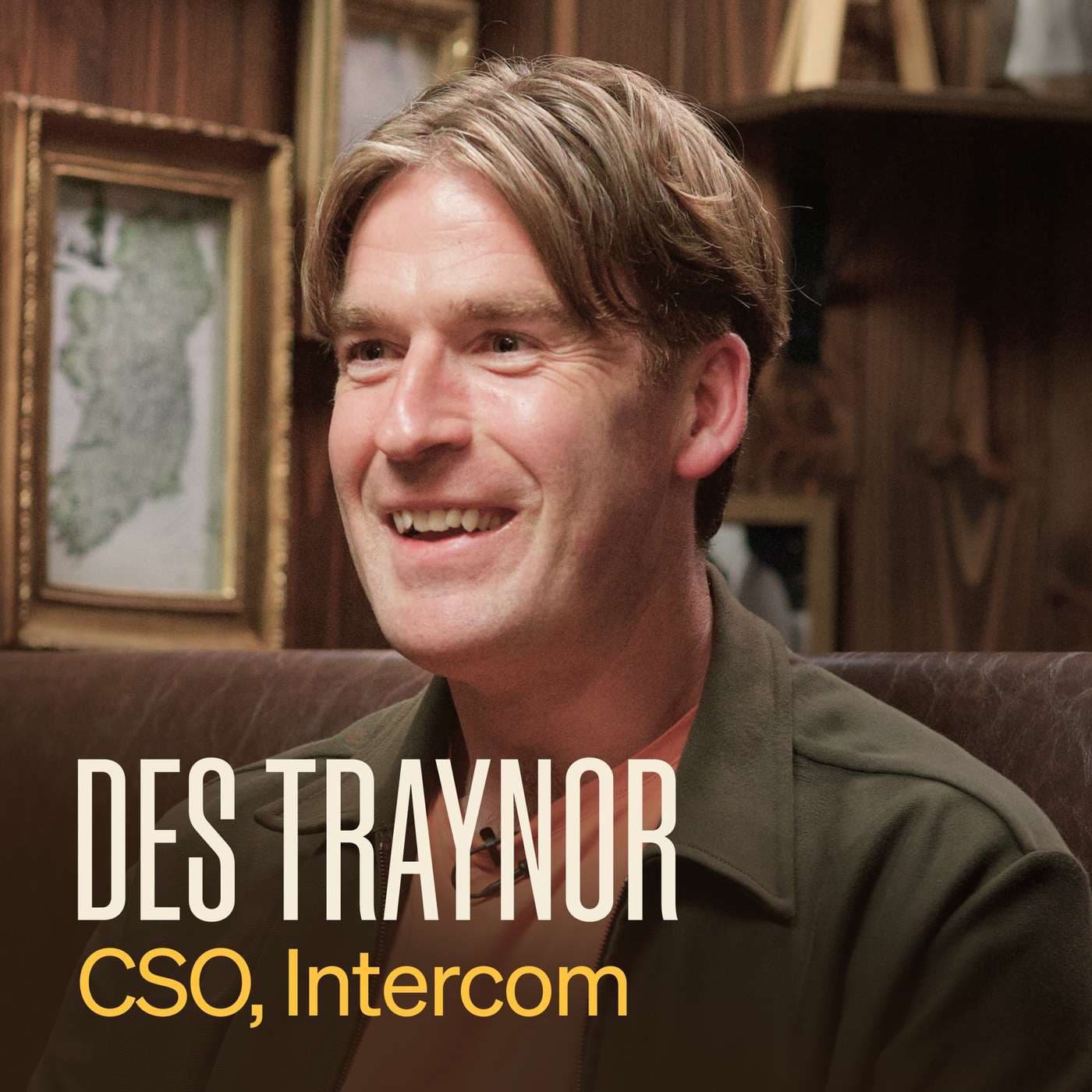
Cheeky Pint Host: John Collison Guest: Des Traynor, Co-founder of Intercom Episode Title: Des Traynor on reinventing Intercom twice and the “four horsemen” of good AI companies Episode Description: Des Traynor discusses the evolution of Intercom, its transition to AI, product marketing strategies, co-founder dynamics, and essential elements for success in the AI landscape.
Key Themes and Discussions
- Reinventing Intercom
- Initial Idea: Intercom started by enabling internet businesses to communicate with their customers directly.
- Evolution: Transitioned from a customer communication tool to a robust customer service platform.
- AI Transformation: In 2022, focusing on AI customer service agent Fin, launched in March 2023, signaling Intercom's pivot towards AI.
- Introducing Fin
- Current Performance: Fin handles over 1 million customer resolutions weekly with a resolution rate increasing from 25% at launch to 65% currently.
- AI Capabilities: Utilizes advanced models (GPT-3.5 and GPT-4) to effectively manage customer service scenarios, reflecting a significant growth trajectory.
- Challenges in Selling AI Products
- Market Skepticism: Many companies claim to be AI-driven, leading to skepticism among potential customers.
- Understanding Value: Companies often miscalculate the effectiveness and potential of AI tools.
- Customer Interactions: The shift in customer preferences towards automated solutions, as they find AI can handle queries efficiently.
- Product Marketing Strategies
- Listening to Users: Emphasis on regular user feedback and customer interactions to inform product development.
- Usage-Based Billing Model: Transitioning to a charge-per-resolution model for AI services, which aligns payment with value delivered.
- Building Trust: The introduction of a guarantee that reflects confidence in product performance.
- Insights on Co-Founder Dynamics
- Differences in Approach: Des highlights the importance of having a mix of personalities among co-founders—visionary vs. operational focus.
- Culture of Openness: Emphasis on resilience and adaptability as critical traits for navigating the changing tech landscape.
- Predictors of Company Success
- Real Problems: Successful companies address genuine needs and have a product that solves real problems.
- Avoiding Distraction: Founders need to be focused and avoid getting sidetracked by trends or personal branding.
- Market Understanding: Companies must understand their market and customer base, ensuring they build solutions that are truly beneficial.
- The Future of AI in Business
- AI Native Characteristics: Intercom is moving towards integrating AI into all aspects of their operations—from R&D processes to customer interactions.
- Productivity Increases: AI tools are being used to improve the efficiency of workflows within Intercom.
Key Takeaways
- Adaptability: Companies must be willing to pivot and embrace new technologies, such as AI, to remain competitive.
- Customer-Centric Approach: Continuous dialogue with users leads to better product iterations and increased satisfaction.
- Cautious Expansion: Businesses should focus on mastering one area before overextending into others, maintaining clarity in their offerings.
- Revenue Models: As AI solutions evolve, new billing models (e.g., usage-based pricing) will be critical for sustainability.
Conclusion In this episode of Cheeky Pint, Des Traynor offers invaluable insights into the journey of Intercom's evolution, the challenges of integrating AI, and the importance of understanding the market and user needs. The discussion underscores the necessity for businesses to be adaptable, customer-focused, and strategically cautious about their growth paths.
Written by AI. May contain mistakes. Listen to the episode to check what was said.
Transcript
Automatic transcript. May contain errors.0:28Do you ever work in a bar? AI version of Intercom on the Mondays. It was a lot easier to invest when being a founder was uncool. I blame genuinely the social network. I blame just kind of the entrepreneurial lifestyle. I blame my TikTok. I blame all these things. Soho house. Yeah, yeah, exactly. You just show me your technique and I will learn from you because I'm pretty sure I'm doing wrong. This is the first time I've ever poured a pint of Guinness in America. My fellow Irishman, Des Treanor, is the co-founder of Intercom, the customer service giant turned AI company. He's also a prolific blogger and one of the most respected voices on product strategy.
0:59Cheers. Okay. You are my first Irish guest. And so I actually have a critically important question that has been burning this entire time. Whenever we release these episodes, all the YouTube commenters are obsessed with people splitting the G. This was never a thing for me growing up, a thing I never saw in Ireland. It's like an invasive species, maybe from TikTok. Is this a thing? No. It's not amongst anyone who you would respect. It's very much an actual TikTok thing. It's a slight bit of a tourist thing because of that. But it basically means that you're drinking, I think, it's a quarter to a pint in your first mouthful.
1:38And it's like, I don't know. A waste of good goodness. Yes. Yeah, okay. It's a little like when I first came to America, drinking games. It's like, back home, drinking is a very serious activity. Exactly. You wouldn't make a game out of it. Exactly, yeah, yeah, yeah. I was very confused by that in America. Okay, and then my other stout-related question is, I saw you opining on, like, Beamish, Murphy's, everything like this I don't know what is your what is your view on the stout landscape in particular I probably default to Guinness there's been like there's been moments when I'd go Kilkenny Beamish Murphy it's kind of usually it's like when you're every year in their respective hometowns but for the most part I'd default to Guinness and for like one brief day I tried Island's Edge I don't know if you remember when they Heineken it was Heineken Heineken launched a Guinness killer and it lasted all of like six months or something like that they were literally I think literally they were giving it away at the end and still couldn't get rid of it heard all the Guinness stats about, you know, the Guinness used to be a majority of Ireland's stock market.
2:31Obviously, the canal system was built for Guinness distribution. But sometimes when you tell people that Guinness used to be a very significant part of Ireland's economy, you know, they don't believe you, but the stats are really there. And it's weird, like it trickles into modern day, like where I live by Castle Knock, like a lot of chunks of the Phoenix Park are owned still. By the Guinness. Exactly, or the house used to be there and it's like, they don't, and then maybe they donated it to OPW or something like that. But yeah, it's very much still kind of carries forward. Yes. Okay. And we're not actually going to talk about Guinness the whole time.
3:01We should also talk about Intercom. And I was thinking in preparing for this, I'm very impressed by businesses that can reinvent themselves or maybe even reinvent themselves multiple times. So you think about Netflix, they started with the original DVD by mail business. And then, oh my God, the internet's coming. And they had a few abortive attempts at streaming, like remember the whole quickster debacle, but then really cracked streaming movies. And so, you know, you can watch The Godfather or you can watch whatever movie you want on Netflix. And then, of course, as they got more squeezed by the rights holders, you actually can't go watch The Godfather on Netflix anymore.
3:38Or you type any movie into Netflix and it's not there. Because now Netflix is all first-party content that they have developed themselves. And so they've reinvented the platform once again to be, rather than watching other people's content, watching Netflix content. They've twice reinvented the company from DVD by mail to streaming third-party content to streaming first-party content. Intercom strikes me as a business that has similarly been reinvented twice, where you guys got started with the Intercom feature of, you know, you can talk to your customer through the website. And then you guys became a customer service company, which is actually different for reasons we can talk about.
4:10And now you're becoming an AI customer service company. That's my theory of Intercom. Is that actually an accurate theory? Yeah, that's true. There's a bit of extra context I'd give it. So when we started, it wasn't really, it was like about this, it was like literally when we started. And our initial plan was like, hey, you remember the internet because Stripe was in its early days back then as well. But there was no tooling to run a SaaS business. It was like literally nothing. It was like you were using, you were kind of abusing like PayPal for payments and you were using like MailChimp for like talking to your customers.
4:41And so, you know, we had this idea of like talking to your customers is really important. so someone should work on that you know and uh and like there's so much stuff in the early releases of intercom like it was the first live cdp like you actually see who's live in your product right now and what you're doing and you could store data against them you could say show me all my premium customers and weirdly like use cases like that still exist today like i was in denmark last week and i was like oh i should message all my copenhagen customers and see you and like all that stuff is like you're still kind of like who else is doing this yeah so we sort of started out like with a very very general purpose idea which was like let internet businesses talk to their customers.
5:13And then we kind of fell in love with this jobs to be done methodology. And like as one of the things you do in that is you look at how your product is actually used and then you iterate on it from that point of view. And that kind of led us down this path of sales marketing and support. And then I guess to skip a load of years here, let's just say 2020, things were great. 2022, things weren't as great. And then it was like, well, you need to focus. Concise pre-see of the period. Exactly. Let's just cut a lot of the reasons why or whatever. Some sort of disease as well along the way. But yeah, so 2022, it was like, hey, own returned, own had left in 2020, I think.
5:47Own returned. Business had been in declining revenue. He said, we need to focus. We're going to focus on customer service. And then a short time later, I think maybe 10 weeks later, AI happened. ChatGPT launched, I think on a Thursday. I think I had a call with Fergal, our head of AI, on Friday. I spoke with own all through the weekend. And we made the decision, own made the decision on the Sunday, I think it was, and we started working on the AI version of Intercom on the Monday. That was 2022. And I think, were it not for that, it's hard to say exactly where things would have gone, but certainly that's the reason I'm sitting here.
6:18And obviously, people are naturally wired to be skeptical. When they hear the AI version of Intercom, you have everyone and their mother out there saying we're an AI company now, but you actually are an AI company now. And so describe what the AI version of Intercom actually means? The biggest thing it means for us is our product, Fin. So we launched Fin in March, I think 2023. We launched a few little AI features. We were the first people to actually build anything on the GPT 3.5, and then we launched Fin in March GPT 4 launch day. Fin was basically the first chatbot that worked. It's the best way you could think about it.
6:51What that really meant was it could actually have conversations and answer questions. And when we launched it, it was doing, I think, 25 % resolution rate. And that was crazy numbers. Today, it's like 65%. And today, Finn's resolving about over a million conversations a week. It's handled about 40 million actual end-to-end customer service scenarios to date. It's growing over 200 % year over year. We charge a dollar per answer so you can work the revenue out, or a 99 cent even. It's becoming just this AI sort of growth story inside Intercom, which is already a mature SaaS business into hundreds of millions of revenue.
7:25But I think when we think about what does it mean to be AI, It's like, first of all, what is the future growth of your business? And the answer is AI. And then over the last, say, six months, we've been going hard on being like a kind of properly deep AI company. We're now at a point where we're like, you know, we're using our own models inside FIM. We're using custom re-rank or custom retrieval, summarization, et cetera. And we're doing a lot of this work. We have like an AI lab of 50 people. And we really just kind of have gone all in on the idea that like, you know, like obviously Intercom still has a help desk product.
7:51But like the entire future of CS is clearly going to be AI. And that's what we're all in on. Yes, yes. maybe there's the repeated pattern in tech where the enthusiasm for technologies comes before the technology being ready. And so people are excited about computer games before the wave of good computer games, or people are pitching mobile internet and you'll buy cinema tickets via WAP. J2ME and all that. Exactly, yeah, yeah. We actually had our version of that. We had a product called Resolution Bot. It was originally called Answer Bot, but I think Zendesk tried to sue us because they had a competitive product.
8:19But Resolution Bot was actually a good AI product at the time, but it's just AI wasn't there. And so that was the actual reason why we had such a head start because we actually already had a little AI group ready to go. We'd already built a rag engine ready to go. So we were able to jump a lot quicker than a lot of folks. But yeah, I think a lot of these products, you're right, have kind of two or three stabs before they go mainstreaming. Yeah, and there was this whole enthusiasm cycle for bots in 2017, I want to say, and the tech just wasn't there at all. It was a horrible experience for customers.
8:44It was also quite clunky to set up for businesses. Yeah, yeah. And at some point, I think everyone looked, there was a genuine question at times where it was just like, is a web form not just better? Yeah. I think a lot of cases it was. Yeah, yeah, yeah. Whereas I think now people are starting to have the experience of, you know, the classic thing is, you know, you're talking to a bot. It's like, please, will you please just connect me to a human? Whereas now it's like, can you just connect me to a bot? We see that a lot. We see like, oh, hey, Jenny, sorry to bother you. Can you put me back on to Finn?
9:09It was actually doing a great job. I just thought it wasn't, you know, because I asked a few too many questions. But yeah, I think like there's a general pattern we're noticing, which is like a lot of experiences are just better digitized. Because partially because of like human considerations. One of the reasons people go to the kiosk at McDonald's, as opposed to their actual counter, is because they don't have to think out loud in front of a human. They're like, oh, give me a second. Do I want fries? A lot of the reason why people prefer Waymo, for some people, it's like, I just don't want to have the conversation.
9:35I don't want the awkwardness around tipping or whatever it might be. And I just think what we see a lot is once fan answers one question well, people are like, oh, this thing's paying out. Now that you're doing that, I'm going to ask you all of the things I was wondering about. Yeah, yeah, yeah. Whereas I think they'd feel probably nearly weird unloading all that on one per CS rep. Okay, so you're seeing a lot of induced demand where people use interactive customer service much more. Which is interesting because it turns Finn into not just being a kind of a cost takeout, but also it's like, how much better would your business be if everyone knew how to do everything they wanted to do?
10:06And the answer is a lot of times it's a lot better. And it's not just the whole, like, I don't want to burden a human. It's also, like, people often, one of the biggest fallacies in AI is people compare it with this perfect human that does not exist. like the driver that never crashes or like in our case, it's like, well, a human artisanal handcrafted answer. And I'm like, yeah, like let's pretend that will be there in seven seconds. It won't be. It'll probably be 18 minutes. It's also not going to be perfect. It might not speak that language. And let's presume you're doing those handcrafted answers, which you're not.
10:32Someone is like busily trying to close the case before they move on to the next one. So like I think, yeah, comparing it, like I don't know, we have this thing where we expect our AI products to be flawless and we're totally tolerant of like humans showing up hungover only speaking one language and only working six hours or whatever. It's just a funny contrast. Yes, yes. That's interesting. And it's interesting you talk about product onboarding here because I think of Intercom as you guys are very you guys have a house view that product onboarding should be much better. And I remember a lot of the use cases you would talk about for the original Intercom, talk to your customers through the website was that you can have personalized nurture tracks.
11:04And it's weird that you drop people into SaaS products and just expect them to be able to use them right. And you should see how people are using the product and then give them kind of specific steers based on their usage. And it sounds like you're coming to this vision again, which is people should have better onboarding support, people should be nurtured along based on their use case, but now kind of interactively AI-powered? Yeah, I mean, we talk a bit about this idea of what is ultimately a customer agent going to be. That's what Finn will be as it grows up. It'll just become this way in which customer conversations are handled.
11:34Obviously, the most direct attack here is customer service. But, you know, I think every single customer touchpoint can be improved by, like, by basically immediate, accurate answers available all the time. Isn't an obvious limitation, like, right now you require customers to come up with a prompt? And if you look at why TikTok is so successful, it's like, I would never prompt for, you know, I want to see videos of planes landing low over the beach in St. Martin. But, like, it turns out that's what I want to see. Yeah, yeah, yeah. And similarly, people probably have many more things they need, and they will actually come up with a prompt for.
12:07And I think the product today is still mostly prompt-based. As in, it's reacting to what customers say. Exactly. A customer has to come along and type things into the box. I mean, today, that's what customer service is. It's still kind of like, here's my problem, and then we'll solve it. I think, for sure, there's obvious directions this will go. Hey, what does a good customer look like? And maybe we can honestly infer that as well. but certainly like people like you should do things like this is definitely an understandable domain and uh and then i just think working at the right level of interruptive help you know like you don't want to be too naggy or too pop-upy like you know it gets kind of quite grating but i think if you can get the first message right you can sort of say hey if you come here you're always going to get the thing you should do next or like the thing it looks like you're stuck on like if someone's on the i don't know the renewal page and they have an error message we know they're probably going to open it to thing and we know they're probably going to say something that's got you know a lot of the context already there so yeah we can work out the right things to say I think that's pretty doable.
12:56MARK MANDELAVYSKI - It feels like you could do a lot around, yeah, you train a model on what the customer is seeing on that web page at that moment in time and use it to feed the answer and things like that. ALEX LANGSHURNANI - We already do a lot of that already, customer context. So knowing that it's John, and he's on the premium plan, and he's on the playlist page, and there's an error on the screen. It's all useful information when it comes to it. Because I think people, a lot of the YC, I could build that in a weekend type hacker news crowd, And I think one of the things they often, you know, they're thinking every customer support career begins with like, hi there, my name is blah, my user number is blah.
13:30But actually, like most support conversations begin with like, this is broken. And you're like, what's broken? And like, so to solve that, you need like a phatic reply engine. It's just like, hey, let's chat about what's going on here. But like, we realized quickly, like people will kind of disengage. So any amount of extra context that when you say this is broken, and if someone says this is broken, and there's a big red error box on the screen, we're like, well, it's probably that thing that they're talking about. A lot of people just don't realize how deep you have to go to actually do a great job.
13:53Like we do, say if you install Fin today, you get like 65 % resolution right after 30 days. Like that's shocking, but like we have had to go really deep to actually get to those numbers and it involves like all sorts of, every single smart thing you can think of we've had to do and then optimize and then find the right model for it and all that. But one of them is customer context and that obviously answers a lot of things. Yes. What are the other smart things? Abstraction. So like, you know, I guarantee you've got like no pages on your website that say Stripes works really well for a dentistry office, right?
14:21You probably don't have that in your docs. A very naive rag bot will be basically like, well, it doesn't say dentist, and we're told not to hallucinate, so no, we don't do dentists, sorry. And the abstraction is, in that case, is, well, what is a dentist? It's a type of business. Does Stripe work for businesses? Can dentists be internet businesses? Well, we say we're great for internet business. So you're kind of working out what's the best sort of risk-tolerant way to make grounded inferences without going over the cliff. That's one of like 27 different sort of components of fin. And then you've got obviously your rag and then you've got like, you're like, hey, is this, is an escalation appropriate at this time?
14:55Like, hey, have they threatened something or if they, you know, like you have every single type of problem, it kind of ends up, you have to walk through it all to actually recreate customer service. I think a lot of times people will compare it with like, how do I reset my password? Ha, I found it. And you're like, right, cool. That's like 0.4 % of the scenarios you deal with when you're in customer service. There's like, there's a pattern. Did you ever see the movie Armageddon where like, it's like Bruce Willis and Ben Affleck or whatever. But the gist of it is they train a load of, I think it's like oil drillers to become astronauts.
15:22And the comedy, the joke at the time that Ben Affleck always says, he got drunk and he recorded the voiceover for the DVD. And he was like, I always said, why didn't we just train the astronauts to drill oil? Surely that's an easier problem. I think the thing that we're realizing with the AI movement is some version of, what's going to happen sooner? Will AI people learn how to do CS or will CS people learn how to do AI? Thankfully, as I said, we kind of started off with CS and AI in our DNA. I would say people, you mean companies in this space. Yeah, exactly. OpenAI get better at customer service faster than Zendesk gets better at AI.
15:50Exactly. Exactly that. I think we were lucky in that we kind of had already backed both horses somewhere along the way. One thing I find interesting about what you do is every company is thinking about AI right now. Every company had a board meeting in 2023 where the board was like, can we do a special deep dive on AI? Because it just feels like it's a lot happening and we need to be making sure we're on the leading edge of AI. And then every company was like, oh, we're actually doing a lot in AI. For example, we've seen great automation wins in customer service. And so it's kind of like the joke about the bike shed versus the nuclear power plant where everyone has opinions on how to build a bike shed.
16:22Similarly, everyone has opinions on how to do AI customer service. And so I'm curious how you sell given that I'm guessing a lot of your customers think, oh, we know how to do that. It's not that hard. We hooked it up to a model. We're actually very smart on this topic already, how you sell in that environment where everyone has opinions. Yeah, I've never seen the build versus buy thing play out more often than we do today, especially with a lot of customers who are like, you know that meme on Reddit of I'm not good at girls or guys, whatever. There's a lot of that where it's like, oh, you would never possibly understand as B2C shopping company.
16:56And you're like, really? I've never heard of such a thing. Sometimes, honestly, we just be like, hey, look, Godspeed. You go and start building this. P.S. Here's a torture test. When you think you've got something good, run these 100 questions to us. Let us know. oftentimes that's where they're like yeah okay we think we need to buy your product but like I think there is a everyone has this idea of like in a move to AI what can we definitely do and we can definitely answer questions like how do I reset my password and again this is the back to the hole that's such a small amount what they can't do is actually have conversations and all that sort of stuff we're like we're like what is your opinion on the president and how they're performing and like a lot of times well you know you don't want you know you don't want anyone to answer that question on behalf of your company.
17:37But I think a lot of times people, like they dip their toes. It's almost like they fire the tracer bullet. They're like, yep, this seems like we're making great progress. And every AI product has this problem where you make epic progress in the first two weeks. And then you hit this wall, this plateau. And then like two years later, you're telling people, oh, Apple intelligence is coming in 26 or whatever, right? So like in this case, a lot of people start the project, feel like they definitely don't need to buy fin. We just help them understand the difference between a good bot and a bad bot.
18:05And then they come back and they buy Fin. So where is the Fin business these days? I'm curious both just how it's performing on revenue, metrics, and then are you selling it to existing intercom customers? Are you selling it to new accounts? Just how does the whole thing work? We're about 6 ,000 customers and are growing quickly. Fin does about a million resolutions a week. We're charging a dollar per resolution. So you can do that. That's a 50 million revenue run, right? Give or take. When we launched initially, we sold just to our own customer base. And then as we kind of progressed, we realized, hang on, moving help desk is a nightmare.
18:39Like you've probably done it once or twice, right? If we've done one, two, right? It's a whole ordeal. And Fin is brilliant. So we're like, loads of people want this product, but can't buy it. So we made the decision to launch what we internally call Fin standalone or Fin for platforms. So now you can use Fin on top of Zendesk or HubSpot or Salesforce or any of those as well. So basically, Fin is available to everyone. And that's a relatively new muscle that we've been growing. but that's kind of where we see a lot of the future growth. And so is Finn like you can connect your iPods to iTunes for Windows, but we hope that one day you buy a Mac and it's part of the whole digital hub strategy?
19:19Or we're actually now all in on Finn the Engine and whatever customer service platform you use is actually not a topic of huge interest to us? This is such a core question that we kick back and forth quite a lot. This is the off-site debate that is currently going to happen. At least it's certainly one of them. The way we think about it first and foremost is the future is AI. So Finn just has to win, kind of at all costs, including our help desk. Weirdly, our customers, they turn Finn on and are like, damn, this thing's good. Hey, now that 65 % of our support volume, maybe we don't need XYZ competitor, and maybe we can go all in on your help desk too.
19:54And we're like, okay, cool. That wasn't our game plan, but we're happy to help, if you know what I mean. I think the actual, the battleground we care most about genuinely has to be the AI agent. That's the one we care about most. But it does produce a lot of demand for the actual help desk product, too. I'm curious what your AI stack looks like, where concretely, what are the models or collection of models and prompts and everything that you are using in production? How do you handle model upgrades, given that the behavior is changing so much underneath the hoods? How deep do you go in terms of developing the stack yourself?
20:28then you can talk about the stack. First thing I'd say is obviously, fin isn't like one thing, it's like 27 different things or whatever. So every one of those is like, whether it's the summarizer or whether it's like the re-ranker, the retrieval engine or any of these or the direct answer, which is where we actually go and formulate the answer. Every one of those is paired with the fastest, cheapest, lightest, most accurate LLM that can actually do the job reliably, like very, very high reliability. So that means there's no one particular model. so our primary partner will be Anthropic for Claude Sonnet.
21:00We've architected it such that we can plug and play various different pieces. Whenever a new model comes out, or honestly a new idea for a new architecture is in, hey, we recently launched the ability for Fin to do complex queries, which would be like, say, go and issue the refund and update the name on the utility bill or something like that. Whenever we have to change the architecture, we have this kind of arduous torture test of thousands or at least a thousand CS scenarios where we have like, here's the question, here's the context we're provided, here's what the current fin answer to this question is, here's the best available human answer that we know of, and then basically here's what this new version would offer us.
21:36And then so whenever we say GPT-5 comes out or something like that, we're like, the reason we're not just, a lot of our competitors are kind of quickly, oh, we never run on GPT-5. And I'm like, oh, I'd take a beat on that one. You know, like you shouldn't assume everything's going to be great for your use case always, right? and so we ultimately we have to run it through this pretty like expensive test to work out where the edges are if it's scoring higher resolution right we need to understand why because it could be just that it's like trying more stuff yes but that could also the shadow side of that could be like excess hallucinations or whatever so whenever a model upgrade comes we have to trigger this whole thing but when we launched fit it was like 25 resolution today it's like 65 uh we've been increasing it roughly a percentage point a month give or take but like very little of that is actually because of the upgrades or the bumps from the models.
Read the full transcript
22:20Genuinely, I actually think, and I say this with a lot of respect and love for the CS craft, I actually think we've had enough intelligence for CS for quite a while. In fact, we published some material on this on our research blog most recently. When you look at, people are saying things like, oh, the latest, whatever, Grok can compete in mathematical Olympiad, like level seven or whatever. We're like, right, I think you can probably do most CS. So it's often not a lack of intelligence is the reason why we're not 100%. It's because they're too distracted by any. Exactly. A lot of the wins come from, honestly, better architecture, better tailored models, or changing into UI can change exactly how things work.
23:00And then sometimes you will get an occasional bump here and there from a model swap. It strikes me that a lot of how you include the account context and the amount of account context you include is a big part of the secret sauce. Perhaps, but it varies customer to customer. It really is one of these areas where it's a thousand lead bullets. It's not like a single silver one. If you look at a resolutionary graph, there's no pop, give or take one or two little tweaks. It's mostly just, hey, we ground out through optimizing this prompt and changing this handover. We ground out another 0.7%. And you see the AI team celebrate that on the balcony on the Friday and it'd be like, yay, 0.7 up, whatever.
23:40It's hard to work out exactly what bits. And then there's obviously multiplicative benefits. You might have a win over here at a cost, do something over here as well. MARK MANDELAWICZ - Yeah. How deep down the stack will you go? Like, what's Intercom's version of Apple Silicon? CHRIS BROADFOOT - That, I don't know for sure. I mean, we're going to chase any edge we can get. Right now, I think custom models is definitely where we're going. And that's a large investment from the AI group, which is the most contested resource that we have. Every bit of work they're doing is finding a new edge in resolution rate or resolution quality.
24:07So right now it's paying out pretty well. So I think we're going to kind of place all our chips there until something changes. What does selling AI look like? It's quite difficult. It's difficult in marketing and selling. Because it's so crowded and noisy? Well, there's that, but it's also, like, it used to be the case, and for sure Intercom used to be one of these companies where our product looked the nicest. So all we had to do was the age-old, you know, blah, blah, blah, reinvented and in a big sexy screenshot. And you can still get away with that in certain domains. like linear can get away with that because their product is the sexiest right i think with ai everyone's chatbots look the same everyone's kind of copied our messenger everyone you know like everyone's kind of like roughly like converging on a certain ui paradigm and so you have to ask like then when we say like you know we are the best ai agent like what do you think all the rest of them are saying we're the worst like no of course so they're all saying this and then and then everyone has the same screenshots because it's like look what we do inside a chat window yeah so you're like all right how do you actually out market and then how do you outsell and one of the reasons we launched the Fin guarantee, this idea that we'll pay you a million dollars if you find somebody that outperforms us.
25:07Because we're trying to stress to the market this idea that we actually believe in our product to a ludicrous degree such that you should engage with us on any sort of bake-off you're doing. Yes. But I think from a marketing perspective, it's really hard to stand out. So all you can really do is rely on backing up your claims as hard as you can. And obviously, customer testimonials. Selling is harder. Because I think, again, in the olden days, selling SaaS in the olden days being pre-2022. It was kind of like, our UI is nice, theirs is ugly. Here's a feature-grade checkbox. We've got 24 checks.
25:39They've got 17. D7 matter. We're in. And that was like that. Obviously, I'm skipping over several steps. Of course, sales enable would kill me. But you get the basic idea, right? And I think now selling AI is closer to selling infrastructure in a sense. It's more like... Our cloud is better than their cloud. And our performance criteria are better. At times, it might feel like Intel AMD. or at times it's like, you know, it's our response times versus theirs or whatever. But like you're ultimately coming into it like with a battle of metrics and so like our resolution rate and our CSAT versus theirs.
26:09But then people say, well, why? And then you have to then explain what's actually happening beneath the surface a little bit so that people can actually get a bit of conviction. Other than just like trust us or like please just go and try our product because it's not that easy to try a thing. You have to still have to like turn a lot of keys and open a lot of APIs and stuff. So like the challenge genuinely becomes like, How do you have a sales team that's actually able to speak with a good degree of familiarity about AI? It's funny you mentioned this. We have this specific problem at Stripe, which is invariably, when people switch to Stripe from a legacy processor, they see a significant revenue uplift.
26:45And you think businesses are in the business of finding ways to get more revenue. You think they'd be really interested in this. And we have this thing that sounds shockingly good, which is if you just move over to Stripe, you start immediately getting more revenue. And it basically comes from two places. One is conversion on the actual point of payment that if your mobile app or if your web flow is kind of janky or doesn't offer the customer's preferred payment method or something, they will abandon. And if you just look at the abandonment rates, if you're seeing a kind of only 85 % conversion rate on that form, then obviously getting it up to 90%, that's a huge deal.
27:22And those would be very high numbers. Most businesses would not see anything close to a 90 % conversion rate on that form. And so there's huge improvement possible there to make the customer kind of checkout experience as smooth as possible. And obviously things like link, then where you're not asking people to re-enter the payment details, that delivers a big off lift. The second one, which is even crazier, is after people enter their credit card details, frequently charges are denied kind of spuriously. And so your bank thinks that it's fraudulent because they haven't heard of this merchant or whatever, and so they'll deny it, or they'll think it's fraud or whatever like that.
27:56And we, through many, many years of optimization, have gotten good at ensuring that if it is a valid transaction, that that is not denied. So what all that adds up to is that we can make the claim, and we've seen it play out again and again. We just have Hertz switch for all their e-commerce payments to Stripe, that when people move to Stripe, they see a significant uplift in revenue. That's surprisingly hard to sell, because everyone is out there saying, we are the thing that gives with more revenue. And we've had the exact same thing where despite you can have all the numbers and all the case studies in the world, it's just, it's hard to sell because it's undifferentiated as a message.
28:29I remember even when we switched back to Stripe, either you or Patrick were saying like, oh, well, don't forget to do Link. And I was like, really? I was like, is this really a thing that like, you know, people have, what, some business has forgotten its credit card or something like that and you're going to be able to renew it? Right, it feels unlikely. Yeah, it just feels implausible. But like at the same time, the data is not like not really debatable. I think people like to be able to explain it to themselves and like not like you know i think he average wouldn't i was talking to a guy who runs procurement and uh he was saying like you have to understand i'm just getting bullshitted to all day you know it's just all day relentless absolute nonsense in my face so like if you think that like you're like oh 65 thing is gonna stick it's not it's just like i take it i divide it by 10 at this stage you know and you tell me oh you're gonna save me two million in cs salaries or whatever i'm like yeah maybe in three years time we'll see 200 grand you know like that's the kind of default posture for a lot of these people.
29:18I think it is just, it's like they've developed quite an adverse reaction to like marketing. People do not have enough empathy for the procurement person who just has to endure nonstop nonsense. Absolute garbage. That's funny. I mean, this kind of gets to the topic you and I have discussed a lot, which is product marketing. How do you effectively product market in a world of everyone making claims? Like one is the guarantee that you're a guy's$1 guarantee. Has that worked? It's certainly, it's worked from a point of view of like, I don't actually know how many people are in the program right now, but I could say what has worked is like...
29:50It's landed the message of we stand behind the problems. Totally. Being able to say like, here is the reason why you can buy a con of us. I think that's a strong message. I mean, obviously, like being able to point to real customers or real results sort of like, and you can say, hey, go talk to Natalie at Newly or whatever company you want. Go talk to that person and ask them because like, that's their name, that's their job title. They work there. They're saying this. With 6 ,000 customers, it gets more believable as the numbers kind of tick up. But so I guess either you can make crazy guarantee claims, you can just point to a lot of successful customers.
30:23For us, it might be different depending on your domain, but for us, it's not like we can show you, we can show you like, hey, here's a beautiful back-end product, here's fancy reporting and all that, but that doesn't speak to the core thing someone's buying when they're buying AI off you is to some degree a replacement of work that they have to do. And the two things they care about are, how much work are you going to do for me and how well are you going to do that work? And you basically need to product market both of those things. and it's very easy to say, we're going to do all the work, and we're doing really well.
30:49So you have to actually really help them understand how to appraise the scenario. Like, sometimes we put time into actually helping people identify when they're being lied to, in a sense. So we'll say, like, hey, try this type of question, or ask them about this. You know, help them, you know, almost kind of teach them to be much more conscientious buyers, because we know the more informed buyer, like, that suits us. It doesn't suit people who are just kind of, like, jazz-handsing their way to an AI product. But like, yeah, it's a difficult one. Ultimately, like five years ago, I would have been like, well, the trick, John, is GIFs.
31:19You know, have you ever considered using movies on your homepage? You know, that's really engaging. None of that works anymore, right? Because I just think like what you're selling is basically, it's like an iceberg. Like you're saying, this little bit of like upfront UI of like, here's what actually happens for your customers. Doesn't that look nice? And you're selling this like gargantuan pile of work beneath the surface that is like, hey, all of the human toil goes away if you make the switch. Yeah, I can see that. What are your other pet peeves when it comes to product marketing? Actually, do you want another pint?
31:44Yeah, sure, sure, sure. See, again, this one, did I not let it settle for long enough? And then you have the small head. I actually think your one's going to work out perfectly. Is the settling time load-bearing? Okay, so what are your pet peeves when it comes to product marketing? I think the thing that still kills me, and it's still very common, is marketers that love marketing. So rather than actually saying anything useful or specific, you'll get like, forget everything you know about email. And you're like, okay, what am I buying? Or like, transformation reinvented. and you're like, cool, sounds like I'm going to reinvent some Transformers, but what's actually happening here?
32:14I think there is a general still type of thing where my screensaver on my laptop is literally a typewriter where somebody said, what are you actually trying to say? I keep that there as a reminder of just nine times out of ten, the best marketing comes from just writing the thing you want to say. Because do you ever get into a Google Doc and be like, our goal is that by reading this document, the reader will know the following. And I'm like, cool, can we just say that? Why is there 2 ,000 more words here? So I think, I guess, speaking in a way that sounds great to marketers is probably the thing that kills me most because they don't market, especially in the AI era, they don't really necessarily understand the depth of what's actually happening with the AI or whatever.
32:53There's a funny stat that Ogilvy used to quote, which would say something like, of all the winners of the Cannes Awards every year, something like two-thirds of them would lose their contract that year because the thing they won the award for was not actually effective in market at all. and I think there's such a repetitive pattern there where a lot of people, they will look at, say, a stripe or a linear and they'll be like, all right, we should just do that. And the thing that people don't get is like, everything means something. And this is where our CEO is so differentiated. It's just like every single decision we pick here, what photo, what icon, what typeface, whatever, it all sends a message.
33:28Are we conventional or not? Are we futuristic or not? And I think whenever I see folks just copy-paste somebody else's branding. Even in a sort of like, oh, we'll change your homework along the way. I think what they're really doing is saying we don't really understand what we're doing here. And that's why a classic of this is, you know, whenever an incubator spits it and you're back to startups and they all basically have right-hand side screenshot, left-hand side three bullets, sign up button, whatever, you're kind of like, okay, cool. But have you actually thought about what you're trying to say to the world?
33:55There's also a thing for startups where they probably shouldn't look at what established companies are doing because like Stripe for so long, we clung to making sure that we had code on the homepage and people are like, if you want to accept credit card payments for your website, we're the place to come. And at a certain point, most of the relevant people come to your page actually know that you could do that and you can experiment a little bit more. And Salesforce doesn't have to hit CRM so hard on the homepage because after 20 years, they've earned the right to talk about Einstein a bit. Oftentimes, a startup has a great idea for a great product and they pitch it.
34:25And then six months later, they work on some new feature. And in their heads, the new feature is the big thing that they're so impressed with. Not realizing that 99.49s of the world have not even heard about the original thing yet. But there they go, destroying their original pitch by being like, oh no, we've got blah, blah. I'm like, dude, no one's even heard of the original thing yet. And here you're pitching some nuanced take on some extra feature. Yeah, yeah, yeah. Speaking of David Ogilvie, you've read On Advertising, I presume. What is this? It was just like, that's such a beautiful book where all the marketing copy in it is so good, like the Rolls-Royce ad of the only sound you'll hear at 60 miles an hour is the ticking of the clock.
34:57But somehow that should be mandatory reading for all product marketers. Absolutely. What kind of person succeeds in product at Intercom? When we set up Intercom originally, we were building one thing. Once we forked out to building many different areas like sales marketing and support, I think we gave a lot of freedom to product leaders and say, you own the sales product or the marketing product. I think the folks who succeed there, they have to have decent taste. I don't mean that in some lofty abstract way, but they have to use good software, identify good software ultimately know how to like pick one out of the bunch in a sense right like a very common interview question i ask people is like what apps are on your phone what's your favorite app and the amount of times someone's like oh you know i never really thought about that i'm like oh so like like what's your favorite song like you know like i'm sure you care about some things yeah yeah certainly if you're interviewing musicians they should have a favorite song yeah yeah you'd like to think that but they also probably have a favorite app too so i think like taste is a kind of prerequisite and then i just think like the confidence to pick a direction and And then we say, at Intercom, we often say, shipping is an act of confidence and humility.
36:01What that means is you have to be confident enough to put it live and then humble enough to take the slap in the face when you got it wrong totally and react to that slap. Don't be like, no, it's not me, it's the customers who don't get it. So I think we need high taste and then confidence and then ultimately understanding that, in the Marc Andreessen sense, a product is a conversation with the market. Your launch is your opening bit and then you have to basically adapt and react to what gets thrown back at you, which might drag you in different directions. And then you need to have, again, the confidence to prune certain things and be like, no, we're not building an attribution engine.
36:32Yes, we'll take on some feedback on the CRM side. But I think a lot of product managers who don't work out for us are a lot more spreadsheet-y. And they won't take a bet. They won't take a gamble. They won't take a standstill. They'll just be forever mired in, well, the data suggests. And they're just trying to hedge their bets for us. It's just not the sort of company we are. I think we kind of believe in having an opinion about a space. Well, and the second part of what you're saying, if I'm hearing you right, is the good product managers actually can listen to the market. They have to be able to, yeah.
37:05And hear what. Yeah. I think about this a lot in the context of tech companies where Stripe's first operating principle is users first. First, we think that actually paying attention to what users tell us, tell us in every sense, you know, via revealed preferences in the data, just like when we actually have conversations with them. We start every week with a Monday morning meeting. The first thing we do is we actually host, you know, we host a customer to tell us and give us a report card. And, you know, it's not an A, you know, it's seldom an A. You know, they always have things they want to fix.
37:39And they're very pragmatic things that they want us to improve. There's no overcomplicating. And then when we do our weekly all-hands fireside, we also bring customers that. But I feel like there's a problem of over-complexifying things and under-talking to users in Silicon Valley, where, yeah, it's a bit too much celebration of the individual kind of product vision, or a bit too much, as you say, trying to delay your way out of it. And if you're a product manager and you're not talking to many customers each week, something is probably wrong. I bring that up because the whole original Intercom product was a way to talk to customers.
38:18This is kind of your guys. Absolutely. But would you agree with that diagnosis that a lot of tech products would be better if people simply talked to customers more? Yeah. I mean, one of the ideas that stuck on me very early on, I think it was 2009, 2010, I'm going to just a deep cut or whatever. but there's a guy called Jared Spool who's like a famous UX guy. And I was on this tread of like interaction design association type people. And somebody wrote this really long, like, you know, hey, I've shipped X and I've shipped Y and I can't work this out. And does anyone have any speculation as to why people aren't doing this thing, even though I make it really obvious on the screen?
38:52And he just like replied on. He's like, have you tried asking them? And I remember like at the time I was like, right on. Like it was like, it felt like a revolutionary thing to say. But I find like, you know, I shared this piece a while ago, which was the questions I ask in every single product review. So you can either get ready to meet me or just ideally other people can replicate. But question one is basically, what did our users say about this when you showed it to them? And everyone has to have an answer to that question when we go in. I'm like, hey, well, what did the users say? And I need to understand that because if you're not actually asking your users, what are you doing?
39:24The only validation we have is the market. I do think in Diwali, and I'd say Diwali, but that just basically means in the tech industry. There is this epidemic of hiding behind your data and what can we instrument and how many different mixed-panel dashboards can prove to me that this product should be working, just ignore the fact that it isn't or whatever. I think there's something kind of just fundamentally broken there. And interestingly, you said Stripe's value is users first. I'm just curious, is that deliberately, I mean, every word you guys say is deliberate, but that's deliberately users as in, do you mean like pointy-clicky users or do you mean customers or do you mean prospects?
39:59Yeah, we deliberately chose users because we just meant the people using the product as opposed to customers. If there's a buyer versus user distinction, we want to focus on the people who are actually using the product. The people who are managing fraud within the business or actually responsible for increasing conversion or something like that. So that was why we chose that one. It's not perfect. It makes sense because I find oftentimes if you want to perfect the product, you talk to the users. If you want to expand your market, you talk to prospective buyers. But whenever I, even in my own portfolio, when I talk, what are you actually doing?
40:33The businesses that are, how would you say, prematurely talking to more prospects when they have a load of unhappy users are guaranteed this kind of miles wide, inches deep, messy product that doesn't actually satisfy anyone. Yes. But they'll get there kind of like one promise at a time. Oh, we'll build that for Johnny, and Johnny will sign it. We'll build this for Jenny, and Jenny will sign. And at no point do they have one happy customer. What they have is like a marauding churn bomb of a user base. It's funny you say that. It feels like many tech companies over-rotate on sales feedback, which will, by definition, be from the marginal user.
41:07And they're marginal in two senses. So you have all your existing users, you know, dancing with the girl that brought you over here. And then you have this future potential user who, firstly, by virtue of the fact they're not already using you, maybe they're slightly outside your wheelhouse It's sort of like the use case isn't perfect or something like that. So maybe they're not quite as good a fit as your existing customers. And then also, by virtue of the fact that they have a whole existing way of doing things, when they migrate over to your product, they'll do so in a bit worse shape of integration, where maybe they'll only use one of the four features or not everyone in the org will be bought in, versus the people who grew up on your product.
41:48And so maybe just restating what you're saying, I'm always struck by people are way too focused on we tried to win this big new shiny enterprise account and we didn't have Feature X and so therefore we're going to develop Feature X. As opposed to you've all these users who grew up in your product and really like it, but they wish you had fixed A, B, and C. And just the nature of the fact that sales gets more airtime than account management essentially means people really misprioritize where they spend. Yeah, and people take NRR for granted and think that net new revenue is hard. I think one of the things that we see a lot of is, in terms of working out for your current customers, we used the phrase permission to innovate and permission to expand in Intercom, which is basically like you have permission to innovate when your product's pretty good.
42:34Like, okay, let's work on V3, but is V2 in good condition? And then permission to expand is like, V3 isn't actually that exciting. Everyone's happy with V2. Now I think we can try to do something new for customers, like expand our share of wallet or whatever. But I think a lot of people try to solve revenue growth with like aimless product expansion. They're just trying to increase the share of wallet for the people who are stuck with you. And then they convince themselves they got PMF or that they have some sort of a good product because they're kind of like foie gras style, force-feeding new features down the throats of their trapped users.
43:08And they're like, we're doing great, but they don't realize what they're actually doing is making their current product so messy that they're destroying the hope of future revenue because you can force your current customers into whatever upsells you have or whatever, but your product marketing along the way is getting really difficult because all these features don't make sense. And they're just kind of like, you've tried to do this land and expand thing, but you're actually just expanding. And there's no landing happening in the new product. And then you end up twisting yourselves in knots. And a lot of startups, like Jason Lemkin used to have this thing of like from zero to one is impossible, from one to 10 is hard, and from 10 to 100 is inevitable.
43:40Like I think a lot of people, I don't think that's proven out to be true as much as it was back when he said it. I think a lot of people get stuck in some sort of glue around, somewhere around the 10 million mark, where they don't know how to get the next 10 ,000 logos. So they just try and milk the revenue out of the existing customers. It's true, like just forced product adoption of new stuff. Like, you know, you see a lot of, here's your copilot. I know I didn't want it, but here you go. Like that type of thing. Dez is describing here how they've transformed Intercom from a SaaS product to a frontier AI business.
44:10And to do so, they had to pivot not just the product, but the monetization model as well. Because inference costs are so significant, AI-powered companies tend to charge based on usage rather than just allowing for unlimited plans. It gets complicated and really multidimensional very quickly. Now, fortunately, complicated and multidimensional is what Stripe Billing specializes in. Our usage-based billing engine can ingest up to 100 ,000 events a second. 100 ,000 events a second. So AI companies can monetize products based on real-time customer usage. We're powering consumption billing for companies like Figma, Cognition, and tons of other leading AI applications.
44:48Our usage-based billing platform has grown 145 % so far this year. So whether you're changing your business model, like Intercom, or starting a new product from scratch, your business strategy should dictate the billing system and not the other way around. For usage-based billing, check out Stripe Billing. As you think about the prototypical $10 million revenue B2B company, yeah, what are the common mistakes you see and what do you think the actual path that more of them should follow is? I mean, the biggest problem of mistake is not aligning your fundraising with your time. I think a lot of folks, we got a little bit over-convinced during the era of cloud that every business had a right to be like a unicorn.
45:29And so there's a lot of businesses whose idea was totally fine, but actually they should have gone and base camped it more so than they did because they've raised on the assumption there's an easy path to hundreds of millions of revenue. It would be more small, profitable$30 million revenue companies. Well, yeah, exactly. And I think a lot of these businesses would be great if only they didn't raise 20 and tell their investors that they're going to easily be worth a billion or whatever. I think there's a genuine mismatch there where I think people have overstated how big this idea could get. As in, hey, I know all we do is time tracking for dentists in Delaware, but believe me, we're going to be a billion-dollar company.
46:06And you're like, okay, well, one of your restrictions is going to have to break here. So that's one problem, which is more like kind of business model and venture ambition. The other stuff I see is like it is kind of like not focusing enough on the thing you're the majority of your customers value. Like it's easy to say in the best business in the world is like one line of code that all users execute and you sell it to all users, right? They're like the sweet spot. It's hard to do it in a differentiated way because obviously people learn that line of code. And that's where you're getting a lot of these like horizontal products.
46:34They say something like a Loom or whatever. They're like a brilliant, they're a piece in everyone's workflow, but they're no one's like end-to-end workflow. I think they can do well too. But I think the challenge is like when people, rather than nailing a specific small thing, come back to kind of the earlier point, like rather than like saying, hey, let's get really good at X before we go beyond. When they kind of prematurely expand, I think they forego all opportunity of like kind of being the best. And if they picked a really important area first, then they don't say it out loud. What they're saying is it's okay to not be the best at the most important thing we do.
47:06And I remember, I think it was 2012, I was in your office in Fidai, and I remember at the time, it wasn't obvious to me that you weren't going to expand and do some sort of peer-to-peer transfers and computer PayPal. And I remember you guys had the discipline, and you were like, absolutely not. We care about helping businesses charge. And there's a real harsh discipline you need to have to just basically say no to all of the surrounding opportunities. And I think a lot of people, that discipline is the first thing to go when you hear about competitors. You're going to hear somebody else encroaching on your space.
47:36You're going to have this really weird broad view of all the things you do. Like I know we just do like whatever it is, GIFs and screenshots. But actually when you think about we're a global creativity platform, and they have this premature view of themselves as being massive, and then they feel like they need to go and raise off that, and they need to expand into that. But I think at the core of every great business, every great SaaS business, but in the future AI business, is something that they're just truly world class. And it's not some sort of 80-20 trade-off. They've just basically said, we'll be better than anyone at this.
48:06You take linear, it's basically like they have literally the world's most efficient UI for product management. And they've all sort of project management. And they've just gone really deep into all of the surrounding adjacencies you would need to actually do that job really well. Figma is just an amazing creative collaboration machine. Everyone who has done really well, they've picked one thing and just gone really hard, really deep, really far on it. they haven't like prematurely blown up and gone in seven different directions. And I also think there's a weird celebration in the Valley of Act 2.
48:41Like the Valley is obsessed with finding second acts that are totally unrelated to the first business. Like the number of people who bring up like, you know, oh, and we like invent like an AWS. It's like, okay, you need to use a non-cliche example if you're going to make that argument. And the flip side is, you know, you're mentioning Figma, which is a great example where that market proved to be way bigger than people might originally have thought. My favorite example of this is NVIDIA, where they are the world's largest companies, and they started in the 1990s making GPUs. And if you're an investment banker trying to make a case for how NVIDIA can be a really big company, maybe you'd say, oh, well, and we can expand into, maybe we'll actually make our own gaming rigs, because it was all gaming at the time originally.
49:24Maybe we'll make gaming consoles, or we'll expand to some larger markets. Whereas actually what transpired is it turns out the GPU market is quite a lot bigger than people thought. And being the best at GPUs is a really valuable prize. And you can't rush it. It'll emerge. They could have killed themselves if they had gone in every other direction. And they would have lost their edge in some sense. Figma is a great example for me of permission to expand. in that they literally nailed to a point of no credible competition this idea of just the Photoshop killer, basically, let's just say. And now they can talk about slides and text-to-app builders and every other dimension they want to go.
50:04And everyone's like, yeah, that's great, because you guys make great software. I think you have to first be known for, I'm trying to think, if Stripe launched a payroll product, it would carry the brand of Stripe in the sense of being, well, it's probably really good, really reliable, really fast. that probably has really nice APIs, probably works really well, you can almost impute all the ideas that will be carried into it. And I just think you have to get to that point before you have permission to make that bet. Obviously, it's a lot easier with some stablecoin or whatever, but what kills me is when I'm like, I don't even want to name a weak SaaS company, but pick your favorite mediocre SaaS company and anything.
50:38Is there any direction you would allow them expand in your head? No, it's the short answer. Yeah, that's interesting. Who are you really excited to adopt new products for versus who are you steering clear of the new products? Like if Linear launched a, I don't know, let's just say a source control tool, I'm like, yeah, it's probably going to be really, really good. And like Seth Godin has this hilarious point where he talks about like the value of brand once it's like weaponized. He describes like Nike and Hyatt hotels. And he says, if Nike opened a hotel, you can close your eyes and see it. You know exactly what the corridors are going to look like.
51:09You know the vibe of the whole place. You know everything. It's going to be, if Hyatt launched a sneaker, you're like, what? and it's just that's the difference because Hyatt has a logo and Nike has a brand and that's the difference you know a version of this actually maybe quite literally is I don't know if I saw Equinox launch the hotel and a pretty good idea because the design center they had for the hotel is you just want to be able to get a good night's sleep and it's funny how that's like a differentiated product pitch in the hotel space of like don't give me any of that other shite I just want to be able to go to my room and not have like a super loud noise outside the window or like weird light coming into the room.
51:47You just want to be able to get to sleep. Precisely. Yeah. I thought that was funny. And you're mentioning kind of Stripe's expansions. And so this may be a good segue into your pricing model change. You guys are the poster child for the move from per seat SaaS pricing, the old way of doing things, to usage-based pricing. Maybe you can describe a little bit about that and then how you implemented it and what you're doing with Stripe. Yeah, sure. our pricing journey is long and complex and a lot of your listeners or viewers will know. Indicom pricing is a charged topic? Yeah, yeah. Not anymore.
52:23You know, we've turned a corner. Let me just back up a bit. So like when we had like two diverse product strategies we were trying to do sales software, marketing software, support software and like sales software is typically sell based on leads created and marketing was charged by like how many contacted people you want to send and support were sell by seats. So we had this extremely, let's just say detailed, but like unnecessary. complex pricing setup. And we lied to ourselves and said, don't worry, because there's always going to be a human to help people navigate this, because you're never going to have to self-service this.
52:50But ultimately, people are just like, I have been refreshing this for seven minutes, and I can't understand a word of it. And that was just one of the few things we got wrong in our first move-up market. When Owen returned, one of the decisions he made was just like, hey, we need to sort our pricing. And we handed back, truly handed back, I think about$50 million of revenue. Was that controversial with the board, with investors? We had support for it. I think it was like people don't really underestimate, people massively underestimate what it means to have a really happy customer base. It's because word amount doesn't have like an attribution or a UTM code, if you know what I mean.
53:25So like they don't understand how to think about like happy customers. So making the decision to basically like, you know, kind of standardize on an easy to understand pricing that's like fair, transparent, predictable, et cetera. That was the first decision that we made. This was before AI, right? And us returning to Stripe was a large part of that. In fact, as a small segue, I think a couple of years prior, I had said to you or to Patrick, you guys should actually build as part of your product offering a pricing page creator. I think at the time, I probably got one of those thumbs up replies or something like that.
53:58I was like, yeah, whatever it is. But it's on the list. I think you've done it since. We have. But my thinking at the time was basically some version of this. you need to not let your customers go wild with pricing. You need to actually put some sort of guardrails onto how they think about pricing. Otherwise, they're going to go and invent stuff that you guys don't support. And then they're going to move all your business logic off. Pricing is writing checks. Yes, exactly. And I remember sitting in a Stripe mini all-hands explaining that, hey, none of our business logic runs through Stripe. Either you or Patrick were saying some version of that's not a good thing.
54:31I think, generally speaking, my advice to any software company is don't afford yourself too many degrees of freedom here. because you'll actually cripple yourselves in a quagmire of complexity that will take you many years and ultimately many tens of millions of dollars to get out of. It's a weird failure mode that every single company falls into, which is you start signing deals that have some super creative pricing structure and the customer negotiates A, B, C, D, and E. And it's like it is built in Microsoft Word, but it is actually, it's just not built practically in code because it just exists for this one customer.
55:02And it may not even be possible to build in code. Like sometimes, you know, it's kind of ambiguous or it's like, and if in the subsequent year this happens, then we go back to the prior year and we do an adjustment. There's a guy called Ricky and he decides what the discount is. Exactly. It's like a time travel component to the whole thing. And then they obviously have this, again, we see all customers running into it, these kind of manual billing issues where there is a guy who has to deal with all these like contracts that were agreed during the sales process. And so, as you're saying, an opinionated billing engine is actually pretty important.
55:33assuming you believe that billing should be automated. If you're happy, like, manually getting out the calculator for every single customer month, then that's fine. And having a large deal desk function and doing all the work behind the scenes. Yeah, so that was, like, the first piece of our pricing. And then the second piece was, obviously, when we launched Fin, then it was like, hey, how do we charge for this? Because we're replacing seats. And, like, at the time, it hasn't proved out this way fully, but, like, at the time, Fin looked like it was going to be pretty cannibalistic to Intercom because it was like, hey, if we're automating, at the time, what we thought was, like, 25 % of your revenue, we assumed that means, like, 25 % less seats in the future.
56:04Or at the very least, what it would likely mean is the growth rate or the NRR of the seats model will be affected by the fact that it fills in all the work. And now at 65%, you'd expect it to be even further true. So it was like, hey, how do we charge in a way that makes sense? And then also, how do we be aggressive? As in, we really wanted to put a mark on the market that sort of says, we're very AI forward. And I think what Owen and then Dara came up with was just like, hey, let's just charge per literal resolution. Every time we do work, we charge. Every time we don't, we don't. And this is at a time when AI was margin negative and all that sort of stuff.
56:38We were still working out how the whole world plays out. Today, we're really happy with our margins, but at the time, it was like, hey, this could. It was a bet. Yes, it was definitely a bet. We made the decision, and I think the market responded really well because I think it was very clear that the single statement of, we only get paid when we do work. We don't get paid when we don't do work. It's from the same vein as the guarantee, which is just like, that's how you know that we believe in our product and that's how you know our product works. It's been copied a million times since, but I think the actual decisions that we made in the run-up there were really, really important from a point of view of backing up our claims.
57:14And then obviously for a lot of our competitors, they were like, we don't really have a great way to respond to that because either our product doesn't work or we're kind of hooked on these really expensive resolutions. And we were totally thrown a cat amongst the pigeons there, which has been really well received by the market. And our customers generally do love it. It is funny, though. like you still get people being like 99 cents ridiculously expensive and then you know you're like why do you think this and the answer is because some version of we don't know how to calculate cogs yeah yeah yeah yeah have you how much of the humans costing you yeah exactly and how much is your office costing you and all the other stuff yeah yeah but people like certainty how do you get them okay with the variable components you know you can obviously you can contract out whatever you want right like um but what we offered people is like hey like you know So most of the time, people have at least one or two years look back on what, you know, like we have customers who spike for tax season or customers who spike for Christmas or whatever.
58:04And we can basically say, like, hey, let's contract your base rate and let's talk about overages for the months you need it. And that's like, that totally works. What we're basically saying is, like, yes, you don't have predictability in the sense of it not being fixed, but you have, like, you can model it based on what's happened in your history. And it's only really, like, brand new startups that don't have a clue what's going to happen, but, like, they're not usually worried about this. Yeah, yeah. So you're using a relatively new product, Stripe. usage-based billing for this. How is that you migrated from Zora for that?
58:29How has that process been? Yeah, I mean, I would say, just to go back to the earlier, like we afforded ourselves too much complexity and we kind of codified that complexity in Zora. I guess the best way to describe it is we just twisted ourselves in knots, you know, and it got to a place where we actually, we ended up like Kieran Lee, who is our CTO here, he ended up actually returning to the company one mission, which was like, I am going to own... Fixed billing. Yeah, exactly, to fix this, right? And it worked, right? But it was a substantial amount of work to unwind so much and then to kind of deconstruct so many of these a la carte Microsoft Word style deals into something that was a go-forward, acceptable or whatever.
59:12And then obviously moving towards a clean, transparent seat-based pricing and then just layering on usage-based on top was actually pretty simple in the greater scheme of things. And all the stuff that we needed, you guys were ahead of us on, like discounts for volume, et cetera, all the sort of obvious stuff people would push for. Yeah, yeah. Is this just where pricing in this new world goes? Because obviously, no one buys labor on an unlimited basis. And at least for the moment, the inputs of AI do actually scale with usage for a significant basis. And so it feels like you have to have some usage-based pricing.
59:48This is certainly the bet we are making, where, again, the reason that billing, the top thing they're thinking about, is kind of making billing work well in the usage-based world is it just feels like many products are becoming much more expensive to serve and therefore have to have a usage-based component. But is this permanent or, I don't know, does the AI get cheap enough that maybe we go back to unlimited plans or, I don't know. I don't know if unlimited plans will ever, well, I don't know. Here's how I think about it. Like, I think ultimately all AI has like two vectors. There's like how much work are you doing and how well are you doing it?
1:00:19Yes. And the volume of work you're doing, it's almost, well actually both of them are going to be proportional to how many tokens you're burning or whatever. So you're going to want to factor that in, especially if you're a consumer app as well, where we're just going to go nuts. So I think you have to have some, I'm not a fan of cost plus pricing, but it does place a kind of a lower bound on what you can do here, which is just like, unlike SaaS, you are actually sending money out the back door as well. So I think you have to have something that's proportionate to how much work you're doing. and then I think aside from that, you have to charge consistently like how much work are you displacing.
1:00:53I think that's where you can sort of say, hey, like, you know, for us anyway, like if you take an average person who sits in a seat to do customer service, if they do like, let's just say they do 20 conversations a day, that's what, 400 conversations a month. When we were thinking about how we charge, we're like, hey, well, if that person does 400 a month and, you know, Finn does 65 % of that seat, we're still up because we're only charging like whatever,$90 for the seat. So from our point of view, it was like an obvious and easy swap. I think for a lot of businesses, it might not be. If your AI doesn't work or it's spurious or its value can't be articulated, like isn't it cool that you can now dynamically summarize a GitHub issue or something like that?
1:01:28You're like, cool, I don't know how much people will pay for that because they don't know either. Or like, hey, you can now generate random graphics in your newsletter tool. It's like vitamins versus painkillers, AI pricing. Yeah, and specifically, in this case, the painkillers have a very strict, Like, if we don't do it, a human's going to do it, and we know exactly what they cost. And the vitamins doesn't have anything approximating that. So not only is it a nice to have, it's like I don't even know what it's worth. I saw a while ago, someone said, when Studio Ghibli came out and everyone was using that, someone said, okay, the Fiverr.com equivalent of all these things would have been like trillions of dollars.
1:02:05And you're like, right, but no one was ever going to spend that. So there's no sane way to actually talk about what actually happens here. I think it was Berne Hobart who said that. When you're tied to business outcome, that business outcome is usually done by humans, I think it's going to be really, really easy to make a business case for saying, swap this over to AI. It's better, faster, cheaper. I think when your AI is not tied to business impact or is debatable in quality or whatever, I think you end up with these people who are just like, I'll just stick a tenner on the seat and see what happens.
1:02:31So it's like a normal seat or an AI seat. You're kind of like, I hope no one uses the AI too much. You're permitting yourself to build weak AI stuff if you do that because you're not pushing yourselves to say, hey, we need to articulate the value of each incremental usage here. When you talk about this AI pricing dynamic, one thing that really strikes me is just how fast AI companies grow from a revenue perspective. So I just saw Matty from Eleven Labs. We actually had a great session at our customer event in London. But he tweeted that they've just passed$200 million in ARR. And that's two years after founding on it, maybe three years after founding.
1:03:07But in my day, businesses didn't do that. and it's really striking for me how somehow they seem to climb the revenue ramps much quicker. I know. I mean, you guys with Finn is another example. Yeah, yeah, for sure. We forecast like Finn will be 100 million probably early next year or whatever. And like back in... Yeah, from when? Starting from... I don't know. Probably about two years or something like that. Yeah, yeah. So two years to 100 million in ARF. When we started and probably when you guys started it was like that was the threshold to go public. Exactly, yeah. It used to take a long time to get to 100 million in ARF.
1:03:38It was like seven years. There used to be a lot of money. Exactly, back in the day. But yeah, the acceleration is more there. Maddie's 11 is a fantastic product, right? And it's a great example of, there's like four kind of, if you like, horsemen of AI products that I observe whenever I'm investing. It's rare you see all four, but the things you want in an AI startup is kind of one is the revenue backed by usage. And that's why I love usage-based revenue, right? As opposed to shelfware or pilotware. where, okay, we sold it to two guys in the corner and they're going to put it live someday. So you want revenue backed by usage.
1:04:12You want the usage tied to a real business impact. So it has to be mission critical. If you're building a phone product on top of 11, if that doesn't work, that's really bad. So it's critical. The third one is, obviously, you want deep AI, deep differentiated AI. It can't be a thin wrapper. And then the fourth one is, yes, you want positive unit margins on all this, or at least a clear path to positive unit margins if you're not there already. And I think when you look at so much of the AI landscape, you'll see so few businesses that I've all for. It's such a rare sort of error to be in, to be like, actually, okay, we're doing a real thing, we're real differentiated AI, it really matters to businesses and we're making money off it.
1:04:47Most of the time when you hear about these, well, we went from zero to six million overnight, it's kind of like to generate JPEGs of a Smurf or whatever. And you're like, all right, cool, I'm not sure that's going to renew. That's the simplest AI investing framework I've heard. I'll tell you why it's simple because you're going to basically write no checks. So I guess I'd say most of the AI companies I've invested in are probably three or four. The only one I might quibble with there, I think that's very good for staying out of trouble. And this is where I tend to push back when people are saying, oh, it's an AI bubble.
1:05:18It's like, I don't know, I think people are happy with the tokens they're buying. I think there's a lot of tokens happening and just generally they seem to be delivering useful outcomes at customers because they're actually delivering value on the customer service side or people enjoy their mid-journey adventure. But people are getting value from the product. So it's a pushback that doesn't... I was going to push back on number four, which is positive unit margins, because just aren't the underlying costs... Again, when you guys started, Finn, it sounds like it was underwater, right? But then just pretty quickly at right sizes as you optimize it.
1:05:51And so couldn't one be too focused on the current implementation? Yeah, I mean, this is a conversation we have internally with our CFO quite a bit, actually. Because we're good. You can imagine it would be the kind of thing a CFO Yeah, yeah, yeah. Hey, Des, do you have five minutes? Yeah, that's exactly what's happening. Money losing AI product. Yeah, hey, quick chat. I can't help but notice the team have done this preemptive loading or whatever it's called. So, there's a shitload of money. So, what's my counter to that? I guess I prefer it if the path towards profitability isn't just like, you know, OpenAI is going to figure this out for me, right?
1:06:23An interesting way I'd say this, like with Finn, for example, obviously our profit goes up when we are firing less dead tokens. a dead token being we've generated an answer and it wasn't right, so we can't charge money for it. Like if you're like say, guessing the next line of code, right, or like tab to autocomplete the next line of code, if like five of six of those is wrong, I don't know if you're ever going to get bailed out, because you're basically five-sixths of your costs is like, you know, it's not something you can resell. Yes. So like there's a question there of like, how much of your tokens are actually generating a thing that a user wants?
1:06:55Independent of what you charge for it, as long as the user wants it, I think you're always in good condition. Whereas if you're like burning a million tokens to find one and that one, you're never going to be able to recoup your cost. Or at least, you know, I'd love to see your telemetry to make sure that you actually have thought this true. I suspect you haven't, you know. I'm curious about the co-founder dynamic you guys have across all the co-founders where, let me try this on. My sense is that people want to have a subject matter area based explanation for co-founder, you know, collaboration where, you know, I'm the technical guy and the business guy, whatever.
1:07:24And in my experience, or at least with me and Patrick, it's much more personality tension-based, where I would say he's more visionary and expansionary. And I'm more, well, you know, we have food at home already. You've got to finish the products that you're already doing. Or, you know, I'm more frugal and he always wants to spend all our money or, you know, whatever the tension you're describing is. And then there's a useful, well, one, it's useful to have someone to be able to go mad by yourself trying to solve all these fairly naughty problems. but also a good company strategy probably exists at the intersection of those tensions.
1:07:59Does that describe your relationship with your co-founders? And what would you describe as the personality tensions? I mean, we're definitely all different. There's a lot of key things we all agree on. Owen would be like a, like first and foremost, I mean, he's a very strong CEO. He's very decisive and he's very brave is the best way I could describe it. An interesting thing, when he returned to Intercom, one of the things he did was basically rebuild the culture. And one of the things he focused on was resilience and open-mindedness. We didn't know AI was coming. He didn't know AI was coming.
1:08:29But to be able to react to AI requires a lot of manic pivots, zero certainty, and ultimately conviction bets. And I can't think of somebody better to do it. That wouldn't have been me. Not in a million years. Even being as AI-pilled as I am, I still would have. And I even look back at my own performance in that period. I'm like, you know what? I wasn't brave enough. One of the things I'm pushed for was the city of creating the team fin, which is like, hey, let's just build a new startup. Let's isolate them from everything else. Different floor, different section in the office. No one else is in there.
1:09:03It's just their own Slack channels, their own everything. They're entirely secluded. And had he not pushed for that, I don't know if we would have the clarity and the focus that we needed. People might be offended. Yeah, yeah, of course. All of the things, all of the downsides you'd possibly guess are all there. I also think that there's no path to, there's no way, the phrase I've settled on when I look back on this is like, sometimes you have to go too far to know you've gone far enough. And I think a lot of the mistakes I see in people who are trying to adapt to AI, for an example, and I'll come back to the co-founder in a sec, is they tell themselves that they've done enough because they, oh, a few sparkly buttons, the merge feature is AI, and we're happy.
1:09:39We have an AI assistant. Yeah, exactly. And we've updated our homepage to say we're AI first. So we're good. And I think you need to be willing, genuinely willing to make brave, hard-to-undo bets. And I think you need, obviously, having this moral authority of a founder and being CEO gives you some of that. But still, it's a huge decision to make. And I think I am much more of an, my default DNA is I'm more of an operator in the sense of, all right, what are we doing? Okay, well, I'll make it work, whatever it is. And I think if it was a company of people like me, what you'd see is probably predictable, reliable, sustainable performance or whatever, but probably not enough actual, well, definitely not enough kind of brave big swings, which is actually where you need to get to.
1:10:24But I mean, it is a cocktail. Somebody needs to go and actually do the thing once we've decided what we're doing as well. It's the way it ended up. I was leading Team Fin after I undecided it. And that was ultimately what led to the creation of the whole Fin initiative or whatever. You've now worked with so many different companies externally. You've seen a lot. What is predictive of success and what is predictive of failure? The biggest thing I'll always come back to when I'm talking to anyone who's trying to pitch me to invest or pitch me to introduce John to invest is it's always some version of do you have a real product that solves a real problem that really exists and people are really already trying to solve by paying money or time somewhere.
1:11:02It sounds so trivial, but you'd be shocked how many times you'll fail or you'll get some sort of jazz hands type routine somewhere along the way where it's like don't look too much at this but just trust me the areas that i i end up being blind to and that is like you know the extremely market expanding type things like as in if someone said to you hey like all companies are gonna have a chat room and they're gonna all hang out in an all day and have unproductive conversations it's gonna be big i'd be like oh i don't see it like you know uh whereas like the so you would have missed out on slack or whatever right but i think like i can almost you know hear from the like what you know what are you building and why and who's it for and show me what the product does.
1:11:36If it's not a real solution to a real problem, I'm kind of already out. And then the other big, I'd say, prediction is just, like, there's one of the things that's happened in the last 10 years, I'm sure you've seen this a lot, is, like, it was a lot easier to invest when being a founder was uncool. And I think, like, combination of, like, I blame genuinely the social network, I blame just kind of the entrepreneurial lifestyle, I blame, like, TikTok, I blame all these things. Soho House has me up there. Exactly. All of that, right. To some degree, like remote working, I'd throw into the mix as well.
1:12:09But I think the amount of people who are chasing the trinkets of being a founder of a startup, even if they're quite smart and they can actually go and build something, if their actual motivation isn't the problem or isn't just some deep desire to be quite successful, but it is instead to be perceived like the whole kind of, I could have been a contender rather than I could have contended. Yes. If you don't really, really want to actually play the game, instead you just want to be seen to be playing the game, I think that's probably the single biggest thing that tells me. Best case scenario, you'll sell at$5 million, but more likely you'll still be alive in seven years.
1:12:41All your investors will wonder what you're doing, and you'll be basically sending one investor update every now and then. Yes. I have noticed investor updates with metrics don't predict success, but investor updates without metrics that tell a really fancy story but don't have metrics are actually quite predictive of failure. Yeah. Those companies always fail. I basically 100 % agree. And honestly, you can even tell where the metrics are in the update. Yeah. Because often I was like, my favorite updates, I mean, there's a company that actually probably should do it. And no investor updates are fine.
1:13:13There's like a bunch of successful companies that just never buy. We never sent investor updates. I'm sorry for all the investors, but we were bad communicators. I was curious, actually. Yeah, yeah. Exactly. But if you go, I owe you an email. If you go to the trouble of writing an investor update and then make a proactive decision to not say how your business is doing, that suggests some deep denial about what running a business means. So there's one company, I can't say it, but we're both an investor in it, but their updates, one of their most recent ones was just like, here's performance, ARR plus 17%, blah, plus this, blah, plus that.
1:13:47Something like, I hope you can see from the numbers, we're doing great. Best of luck. See you next quarter. I was like, yeah, brilliant. Archive, I'll mark it up. There's something like that. I think in general, the degree to, I think it was Paul Graham said, the ratio of numbers to words is usually the actual thing you're looking for, which is if the numbers speak, then the words don't have to. Yes, yes. What else is predictive of success? Numbers is one. I almost kind of want to say the inverse of all the things that I hate seeing. I hate seeing founders who invest massively in their personal brand instead of their company brand.
1:14:17I hate seeing people who are obsessed about it. If the first three or four updates I get are bags for retweets and quote tweets and all that sort of stuff, that's always not a great sign because it sort of says to me, you haven't worked out how to market or whatever. Anything around what are the customers saying, that's like, whenever I reply and say, what do customers think of this feature? They're like, oh, we're going to ask them. Maybe what you're describing is there's a very boring playbook, boring and glamorous playbook for making products work about writing code, talking to customers, running that iterative loop, and avoiding distractions.
1:14:49And people who seem incurious about that playbook or just are failing to execute on it is kind of a warning sign. Yeah, I would say that's definitely true. So it's basically like if you've got a decent product, decent area, or real solution, and are you just willing to work on the boring stuff that needs doing to actually make that whole thing. And then will you get bored in a year or are you still excited by it? I think, to some degree, even a successful founders can get distracted by glamorous opportunities, whether it's like, oh, there's a new wave of crypto or NFTs or whatever. You'll see people get their head turned quite a bit.
1:15:26And I think that if you're genuinely married to the problem, married to the solution, you'll tend to not be as distractible. And then so many of these businesses just need time. They just need time and execution. Yeah, totally. Last question, because I've had a lot. In what ways is Intercom itself AI native? The biggest initiatives we've driven recently has been around how we actually do R &D. So I think we launched this initiative, Dara launched it, I think, about four months ago, called 2X, where we basically said, hey, we're going to double the productivity of R &D before February 1st. That means we measure this, and everyone's going to poke holes in this, and that's gone, but it doesn't really matter.
1:16:05The measurement is, I think, it's deployments to production involving code that has to execute regularly, right? So it's a hard thing to fake. If you fake it, it's like, we should probably fire you. Yeah, yeah, yeah. Now, interestingly, everyone's just like, is that just the engineers going really hard? No, like, there's like so many different elements to this. But one of the biggest ones that we saw recently, which really has been like awesome, is Emmett, our head of design, he basically said every designer by August 1st needs to be shipping code. This is like the end to the discussion of should designers code, right?
1:16:36Designers should code. So we basically said, hey, all designers can now ship code. Weirdly, the win there is that the amount of engineering distraction has just gone away. So every paper code in your UI used to result in a GitHub issue that would get filed and triaged and get picked up on a Friday in between breaks or whatever. And now all that just goes. So now you're like, oh, I want to fix this button, fix that padding, fix that thing, change that radius, change that color. All that shit just happens automatically. And it's getting to much meatier stuff like redesign this entire UI, redesign this flow, change this wizard.
1:17:06All of that's now being managed entirely by our design team. What that has resulted in is engineers who are now doing far more, staying in the zone far greater, using whether it's Cloud Code or Codex or any of those, or Augment or any of those tools to actually just be far more productive. There's some real wins here. One recent one we had was Finworks and Slack. But when we were building that, it was built very firmly from, how do we use AI here? It was like, let's build one perfect Slack solution, let's document all of our principles, and then let's have Cloud Code write the Microsoft Teams, the Discord, the WhatsApp.
1:17:39It's every other solution. So we went live to production with Slack, but I think we have everything else now in public beta and it'll all go live. So we're finding all these, it's a lot of 1.2x wins, but then every now and then there's a 50x productivity boost that we're finding. So I think that's probably the biggest way in which the product has been built from an AI native way. On the go-to-market side of the house, we've been slower, but I think we're looking at, Like we've trained a GPT, if you like, on like all of our marketing copy, our principles, our content, our visuals, et cetera. And we've been using that to produce a lot of like, you know, stuff like event invites and things like that.
1:18:13Well, Des, thank you. Cheers, thanks very much. Yeah.
From the publisher
Des Traynor, cofounder of Intercom, sits down for a Cheeky Pint with John Collison to discuss the growth of Fin (Intercom’s AI customer service agent), why selling AI products is hard, advice for product marketers, and cofounder dynamics.
Full transcript on Substack: https://cheekypint.substack.com/p/des-traynor-on-reinventing-intercom
Timestamps:
(00:00) Intro
(02:58) Reinventing Intercom
(06:31) Fin
(18:06) 1M resolutions a week
(24:22) Selling AI
(29:34) Product marketing
(37:18) Listening to users
(44:14) Usage-based billing
(45:14) Advice for startups
(52:09) AI pricing
(01:07:27) Cofounder dynamics
(01:11:04) Predictors of company success
(01:15:56) How AI-native is Intercom?


