
In short
Podcast Summary: Cheeky Pint - Stablecoin Special with Zach Abrams and Henri Stern
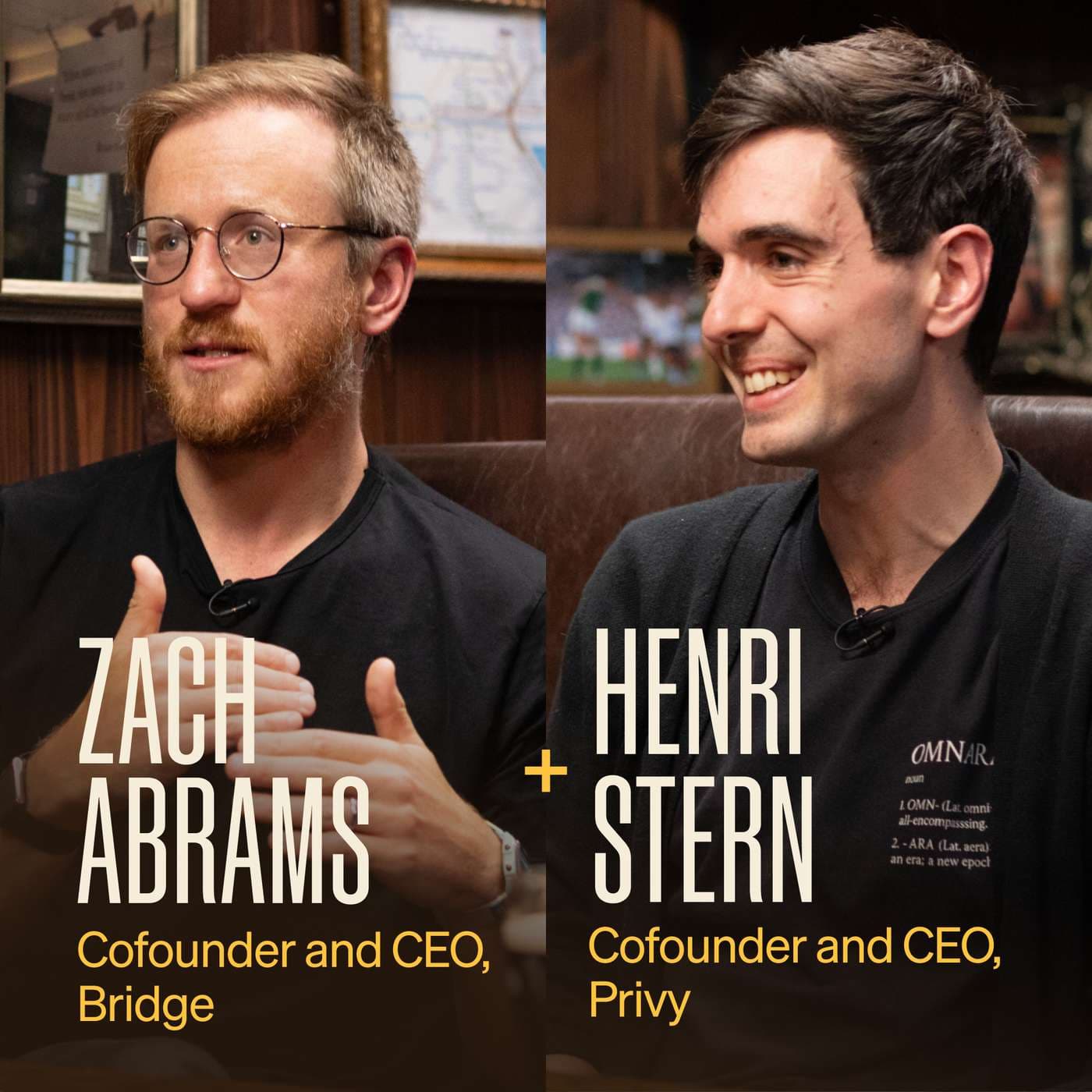
Episode Overview In this episode of *Cheeky Pint*, John Collison, co-founder of Stripe, interviews Zach Abrams, CEO and co-founder of Bridge, and Henri Stern, CEO and co-founder of Privy. The discussion revolves around the future of stablecoins and the evolution of crypto infrastructure, especially following the recent acquisitions of both companies by Stripe.
Key Topics Discussed
- Introduction to Bridge and Privy (00:00)
- Both guests share their backgrounds and the purpose of their companies in the stablecoin ecosystem.
- Bridge is a leading stablecoin orchestration platform.
- Privy focuses on crypto wallet infrastructure.
- Current Use of Stablecoins (06:39)
- Discussion on real-world applications, with examples such as cross-border payments and neobanks.
- Emphasis on stablecoins as broad payment platforms that enable various financial applications.
- US Dollar Dominance (14:27)
- Insight into the overwhelming preference for US Dollar stablecoins in the market.
- Exploration of why local currency stablecoins have not gained traction.
- Future of Banking (25:50)
- Predictions on how stablecoins will integrate into traditional banking systems.
- Discussion on the modular financial stack made possible by stablecoins and their potential impact on banking infrastructure.
- Understanding Blockchains (34:35)
- Examination of the various blockchains and their suitability for different use cases.
- Discussion about the inadequacies of existing blockchains for payments and the need for specialized solutions.
- Building Modular Stacks (42:27)
- Insights into the importance of having a modular financial stack for increased adaptability and innovation.
- The vision of companies building their own stablecoins to maintain control of their financial infrastructure.
- Open Issuance and Mergers & Acquisitions (47:14 & 56:55)
- Overview of how companies can issue their own stablecoins easily and the implications for the fintech landscape.
- Insights into the M&A strategies of Stripe and the integration process for acquired companies.
- The Future of Stablecoins (01:11:02)
- Predictions about the evolution of stablecoins in the next few years and their becoming ubiquitous in financial transactions.
- Discussion about the potential for stablecoins to become transparent infrastructure, receding into the background of financial interactions.
Key Takeaways
- Stablecoins Are Here to Stay: Experts assert that stablecoins represent a significant financial innovation, with a broad range of applications across various industries.
- Integration with Traditional Finance: The conversation highlights the inevitable integration of stablecoin technology into traditional banking and fintech, presenting an opportunity for transformation.
- Focus on User Experience: Both Bridge and Privy emphasize the importance of creating seamless experiences for users interacting with financial services enabled by stablecoins.
- Local Stablecoins Still Need Development: While US Dollar stablecoins dominate, there’s a recognized necessity for the development of local currency stablecoins to facilitate global financial inclusion.
- M&A Success Factors: The discussion on M&A emphasizes the importance of cultural alignment and the potential for accelerated growth through strategic acquisitions, especially in the rapidly evolving crypto space.
Conclusion The podcast episode provides deep insights into the current landscape and future potential of stablecoins, emphasizing their role in shaping the financial infrastructure of tomorrow. With the ongoing developments in technology and regulatory environments, the conversation leaves listeners with a sense of optimism about the integration and adoption of stablecoins in everyday financial transactions.
Written by AI. May contain mistakes. Listen to the episode to check what was said.
Transcript
Automatic transcript. May contain errors.0:00Stablecoins are the biggest financial innovation happening right now. so I invited two experts for a pint. Zach Abrams, founder of Bridge, the leading stablecoin orchestration platform, and Henry Stern, the founder of Privy, the leading crypto wallet infrastructure. Both these companies recently joined Stripe via acquisitions, and they're in the thick of helping both crypto companies and regular companies build with stablecoins. Cheers. Yeah, cheers. Okay, lots to talk about with both Bridge and Privy. I realized with Bridge, when you started it, it was 2023. was that like at the very nadir of the doom loop for crypto?
0:35We started right before then. So we started right when it was interesting, which maybe made it worse. Which is fine. You did not know it was going to be horrible. This was, it wasn't 20, 2023 is when we launched our APIs. 2022 is when we start, Sean and I started the company and raised money. And then immediately after we raised money, Terra Luna happened. And then the whole space was nuked. and then FTX happened and it was nuked again. Okay, so remind me of the vibes here. Like 2022 was still, like that was pre-FTX blowout? Pre-FTX, the things were going really well. It was before, like when the Ukraine war happened, the whole sort of economy started to shift.
1:22And it was before that. VC funding was really high. And then by June, it was gone. Everywhere was, everything had, you know, most of the space had evaporated, but especially in the crypto space. And at the time, to mark this in crypto years, when we started the company, the first idea we had was using your bank account to acquire NFTs. So it was the NFT phase of the carbon dating of the company.
1:54And that's where almost all the volume was, was NFT drops. The other thing I was going to say just about Bridges and Beginnings is we had an early all-hands at Privy, where it was a lunch and learn, and one of our teammates, Max, worked with Zach prior. So Zach came to pitch Bridge to Privy, being like, we're going to work on stablequins. And we were like, what is this guy talking about? This is not a market. It does not exist. Well, on our side, when the NFT market blew up, our initial product went away. And we were sort of pivoting around to try to figure out what we wanted to do. One of our first ideas was to build wallets as a service, which is obviously your business.
2:36At the time, I don't think that you, maybe you existed, but at least it wasn't, you weren't on our radar at all. And I remember looking at the space and being like, no, that's a tar pit. There's nothing for us to build there. It's so deeply competitive. And then we quickly moved on and went our way to stablecoin. So for me, looking back, you went through the exact same thing, saw that same idea, saw that same opportunity. And it was like, yes, this is the thing. I obviously built something really good there. And so how do you describe Plus Bridge Does today to people? We enable developers to build with stablecoins.
3:13And it could be anything they want to build. So we help folks like SpaceX use stablecoins to move money cross-border. We help folks like Dollar App build neobanks on top of stablecoins. We help folks like Felix Pago build cross-border payments experiences with stablecoins. We help treasurers rebalance their internal funds with stablecoins. Stablecoins are sort of this broad payment platform on top of which a bunch of new payment experiences can be built. And we build APIs to let people use it. I want to come back to all those use cases. but maybe first to catch up. So how about Privy? Where in the crypto hype and then bust and then re-hype cycle did you guys start Privy?
3:51Peak hype. I'd worked in crypto prior and I think I came out of that experience thinking this space is incredible. We have these rails that can be used to sort of codify ownership on the web in a way that hasn't been possible before but also no one cares about building like products that people actually want to use And so, this is an endless space where we'll work on protocols, but never actually, no offense to protocols, which I think are deeply useful, but only if they get carried through all the way to utility. Yes, you need to actual any customer use cases. And so, I left and I think peak crypto brought me back, which is I was like, I want to work on data tokenization, which was the initial idea.
4:28A good place to do that was crypto. So our first version of it was, can we build data tokenization that would enable crypto companies to privately KYC people, which is a very 2021 idea of these private pools of liquidity that you need to be KYC for. Oh my gosh, I remember. That led us to wallets, which was this is really hard because people don't have the means of actually signing for things and most users don't want to get a wallet. And so we're like, we should solve that problem first and then we can come back to it. And that's how we got to Privy. And so how do you describe to people how Privy does today?
5:00We build basically digital asset accounts. Wallets are the means of controlling cryptos, stable coins, any digital asset. And so we build APIs so developers can build basically digital asset accounts directly into their app. Rather than requiring a user to go outside the app to get an account, you can get it as part of your Neobank payments platform consumer app. And those are the people that we serve. But basically, we give you the means of controlling assets in-app. Yes. So, basically, no one plans to be disrupted by stable coins, funnily enough. And so, if you're a remittance app, if you're a neobank, if you're any of these guys, you want to natively build digital asset functionality into your app, and you guys provide the wallet infrastructure for them to do that.
5:46Exactly. And I think the goal is to say, like, you shouldn't need a PhD or deep interest in, you know, self-sovereignty. In order to want to engage in the space, you should be able to do it as easily as you do anything else on the web. and we make that possible. When I talk to business people who are not in stablecoins, and especially maybe say people who are in fintech but not in stablecoins, they say, I'm sure hearing a lot about stablecoins, but it doesn't seem like they're actually happening yet in a real way. And obviously the Stripe, Bridge, Privy, House view informed by all the data we're seeing in our customer usage is like, no, they're happening.
6:20Like they're maybe not happening for you yet in a big way, but they're happening at an industry level. But I think people have a hard time visualizing because they say, well, I don't pay at the bar using stablecoins. I am myself not paying data today, therefore I just don't see it. Maybe you guys can level set for people what's actually working because consumer retail payments in the U.S. are not the hotbed of stablecoin innovation. Where is the stablecoin stuff happening today? The first use case was predominantly cross-border payments. And it was taking money in. Our first developer was this team called Zulu.
6:55and they were a company based in Colombia and they were taking Colombian pesos, converting them into stable coins, sending those stable coins through the bridge APIs, converting them into dollars. So you'd go from Colombian pesos to US dollars via stable coins. And for a bunch of reasons, it was cheaper and faster. And they showed us the cross-border payment opportunity because before then, I actually had no idea that stable coins would be useful for cross-border payments. And then since then, we've seen like neobanks, like Dollar App and so on become very, very successful, building on top of us.
7:27And they're a global US dollar app built on stablecoins that can be used all across Latim. Okay, so cross-border payments, dollar balances, dollar holdings for people in emerging markets. Anything else? After that, we've seen, so SpaceX came to us, they're selling Starlink all over the world. and so as a result they're collecting local so people are paying for starlink and and you know dozens many dozens of different countries with their cards so they're getting local currencies in all these countries and they need to repatriate all those funds to the u.s because they fund their business out of the u.s and so they started using us to bring currencies back to the u.s and so they would take money out of a bunch of different countries in africa and latam and send it to the US via stablecoins.
8:16How do they do the initial conversion from, you know, Rwandan local currency or, you know, Bolivars or what have you to US dollars? So we do that for them. But the way that we do that is that in almost all these markets now, there are very robust FX markets effectively that exists between, you know, a stablecoin like USDC or USDT and the local currency. And this was It was like the last, you know, with each one of these crypto cycles, like more of the infrastructure gets built that enables the next thing. And in the last crypto cycle, the big thing that happened was that all these local exchanges started.
8:56So you had local exchanges in Latam, in Africa, the Middle East, the Philippines all begin to get scale. And those exchanges are dominated by stablecoin volume. And they've effectively just become alternative FX markets. What's the remaining gap like? Is there the biggest gap between marketing and reality of this is doable today? I would say that the biggest thing that we see in the market is that these FX markets, so converting between Mexican peso and USDC or Mexican peso and dollar, some of these fiat markets are phenomenally deep and phenomenally efficient. So someone could send$100 million to Mexico and convert it into pesos without moving the market.
9:38market, but the stablecoin market is not as deep. So it's hyper-efficient. The interesting dynamic at play is that in the fiat FX markets, as you get bigger, your pricing comes down. In the crypto markets, as you get bigger, your pricing goes up because the spreads widen. So the market is way more efficient for startups. Over time, the markets get deeper and deeper. And so those startups are scaling and scaling and scaling. We see that with like Felix Tago and others. I think what you're highlighting with the FX dynamic is underappreciated in crypto being a platform on which, you know, it's like a shelling point for everyone to come together to create better things.
10:20And so we now have just more efficient ways to convert bolivars to US dollars than we had before. It's not particularly crypto native, that particular leg, but crypto is load bearing in bringing everyone together. That's kind of what we see, I think, in our market, which is to say, like, you know, my analogy is stable coins. It's a very self-serving software to hardware analogy, but like stable coins are like Starlink for money, where you need the ground stations to actually beam the pipes up from coax or fiber onto a line of sight like zero gravity, like space. Once it's in zero gravity, it's super efficient to actually move the data around and move the money around.
10:59But the ground stations on the ground have to be built. And at least where we take care of the market is mostly after you guys have done the really hard work of converting fiat to crypto. Then the question is, what can you actually do with the crypto? And that's where, you know, obviously wallets and those are the powers that people will come to us for. That analogy may be deeper than you think. Because, you know, in the Starlink network where they started with more ground stations and then over time they're enabling more satellite to satellite connectivity to reduce the need for ground stations.
11:26And so it could be a pretty deep analogy. Okay, same question to you. Henry, what are people actually using stablecoins for? For us, a lot of it is basically once wallets as the account system are kind of like the control plane. Once you have the stablecoin, what can you do with it? And so I think the majority of what people use us for is, one, specifically the holding. I want to hold these assets and I want to put these assets to work. So it's opening up credit markets and yield generally for people who otherwise didn't have access before. And one of the things that's shocking about USDT is like USDT is like a 0-100 hedge fund.
12:00Like they keep all of the carrier for you, which speaks to how like much people want stable currency across the world. And then the other thing that we're seeing to your point about startups is kind of the emergence of like fintech super apps. A lot of early stage companies that now have the actual stack to build everything that has taken, you know, the neobanks of the world, the revoluts, the clarnas, decades to build and they can do in a year because everything's ready for them here. So those are the sort of two types of use cases, which is I want to build like bank accounts that are fully global, that work for any consumer once they can get their hands on crypto.
12:32And then I want to make sure that these assets are put to work either through traditional markets or by actually investing in other assets. Yeah, that's what I mean, one of the things I'm most optimistic about is you have like the financial world before, if you wanted to expand into a bunch of different countries, you had to uniquely build your US infrastructure, uniquely build your European infrastructure, uniquely build your Mexican infrastructure. And the next company that came around had to do the same thing, you know, and then the next company around had to come and do the same thing. And now what's possible is you have a wallet and one person just needs to build a US dollar stablecoin and then you throw it into the wallet and now you have a US balance.
13:12And then someone else in the world needs to build a Naira stablecoin and now you have Naira. Someone else in the world, JPY stablecoin. Now you have - Yeah, previously it was N squared and now it's just N. Yeah, exactly. You kind of open source your financial stack. And, you know, it's like very early days in this. And to get here, we need local stable coins. And right now stable coins are dominated by US dollars. But you open source your financial stack. And the companies who are building on top of this are behind today, but basically making a bet that the cumulative power of all the builders in the world is going to create a better application over N years.
13:46Why have the local stablecoins been so slow? Because US dollars are not that big a share of global currency balances, but US dollars are 95 plus percent of stablecoin balances. What's going on with the Euros and the Canadian dollars and the Swiss francs? My theory is that this is like revealed preference. US dollars are not that big a share for physical reasons. Exactly, whereas the true preference, if you go to a country that, you know, I can think of many, and you have a crisp$100 bill that's worth a lot more than, like, any other currency, I've traveled to places where I have euros and dollars, and people are like, no, give me the dollars first.
14:24So, I believe you in the emerging market context, where, you know, clearly, if you're in Turkey and you can hold, like, Turkish lira or US dollars, that's not even really a contest. I don't, as a European, I'm not that unhappy holding euros. I'm not that concerned about it. And so, euro stablecoins, Swiss francs stablecoins, just other major market stablecoins should be a lot bigger. This is where, I mean, I don't know, the two dichotomies to me is like US versus global, and then it's like B2B versus B2C. I think the majority of the stablecoin market today is B2B, and that'll change. But like the reality is basically, where it is B2C, it's emerging markets, hence the US dollar preference.
15:00And where it's B2B, it's American companies, hence the US dollar preference. So supposedly it'll even out over time, but at least for now it seems to be revealed preference that like dollars are. I think that's probably true. I think that the majority of the two main use cases for stablecoins for many years was trading. And in that market, everything is just quoted in dollars. And there is a real network effect. So, you know, as more and more liquidity was built around a few dollars, that makes sense. I think over time you will see more of these stablecoins. But ultimately those same network effects are going to, you know, I think perpetuate.
15:39I think you're going to see while like fiat US dollars are X percent of the global market, stablecoin US dollars are going to be, you know, way more forever. But I do think we, and I hope we get to local stablecoins being 15, 20 % of the market because you need them transactionally in all these markets and you want to have alternative FX markets and you want people to be able to store in local currencies. I think that's going to create much better experiences, but we're not there yet. And to your point just about the history of this, Tether got started as a deposit asset for trading. You didn't want to basically have to trade out back to dollars.
16:11You didn't want to hold your position over night. So you would move into a stablecoin. And they couldn't get dollars. Exactly. But I think it's a 24 seven currency. You don't have to wait to move. So I think why should you care if you're working on a business today that broadly handles money, but it's like my money works fine. Yes, yes. It's like I think the UX is gonna be much better for consumers to actually have an always on money rail. Beyond that, there's a reality which is you get to have a relationship with your user that's much longer lasting. Instantly Uber has done this where Uber drivers get financing for their cars via Uber.
16:49But now any company can really do this where instead of like paying out and then the relationship ends because the bank now owns the user, they can maintain a relationship with the user via these accounts that they enable. So every company ostensibly has a neobanking arm that they can build into this to create a much tighter loop of benefits to their constituency. But what's the long-term equilibrium here? Because presumably consumers don't want their money spread out across 15 different services they interact with, or do they? I mean, credit card chopping, such as I see it on Reddit subthreads, would say that maybe they do.
17:20But I think this is the entire point and where at least Privy gets dinged a lot with embedded wallets is it used to be the wallet was the users and you would carry it with yourself from like app to app to app and you had a single point where you held everything. And that's great for centralization of these controls. It's really bad for UX because it means you're running third party software on every site you go to. We've enabled an inversion of that whereby the app can serve their own self custodial wallets as part of the app experience, but it creates this fragmentation. And at least to me, this is the real opportunity for building these money networks where if you can help users make sense of that fragmentation, where even though you have your assets in 15 different apps, each app on your phone is a bank.
18:00You have some control plane where you can manage those assets between all of them. It's not that fragmented if it's programmable. That's the hope. Yeah. I think that this question is like overwhelmingly going to be dictated by regulatory requirements. I think in like a free market, then we would resolve to like 90 % US dollars or something. Is MICA good, bad, fine? I would say it seems to be fine, but it could be bad. And I think the thing with all of these like regulatory requirements are that they're sort of like untested. And so what's basically happening is there's a few folks who are compliant in Europe, and they're stretching it to the regulatory requirements to meet their specific needs.
18:50And then over time, they're going to clamp down. And what it looks like to be compliant in Europe will probably be very different in five years versus today. Oh, interesting. So you're saying we haven't seen MICA enforcement yet, and that will inform people's views of MICA? Yes, exactly. Like the way that USDC is complying with the requirements are very different than the way local European issuers are complying with the requirements. The interesting like delta for us at least was we saw European customers trying a lot more things under Micah because at least they knew ostensibly where the lines were.
19:24Which wasn't true before Genius. And now we're seeing that with Genius where people are willing to engage. So I would argue that compared to what existed before, which was no clarity and no willingness to engage, something is better than nothing. It's been very good for the European cryptos. Totally. You described Tether as a 0-100 hedge fund. I hadn't heard that before. But it feels to me that paying out 0 % of the yield is not the long-term equilibrium when it comes to stablecoins. And so what happens to Tether? I went to Kenya on holiday a year ago. It's very widespread in emerging markets today.
20:01There was a poster that had a crypto app on it, and there were two logos on it. It was Bitcoin and it was Tether. I do think brand matters in a sense. I think if you ask someone, do you want Tether or alternate stable, they will pick Tether. I think for the most part, and you have more views on this with open issuance, but there will be brought in our operability and every app can have their own so that they can choose how to program their stablecoin. But I wonder if the network effects are already so entrenched and so powerful that maybe they are forced to change some of how the yield management works, but it's too far established for it to be a complete inversion.
20:37Yeah, I mean, I think Tether is going to be wildly successful. I mean, it already has been. It seems to be okay for themselves. Yeah, one of the most successful fintechs in the last three decades or something. But I think there will be and continue to be. I think there is this enormous network effect behind their business. That being said, I think that pretty soon, like in the next year, any consumer who wants access to the risk-free rate is going to have access to it. And I think that is going to create a sucking sound from some USDT. but I also think that it's going to take the market and expand it like materially.
21:18What I hope happens is that, you know, USDT grows, but instead of it's at like 60, 70 % of the market, it becomes like 10 % of the market. The alternative point is simply like, you know, also let's figure out the alternative. Like the reality is you can hold Tether or you can use 25%, you can lose 25 % of your net worth every year by doing nothing. I agree it's better. I'm just wondering what's the long-term competitive equilibrium? Like in five years, do you think Tether pays yield? No. Really? No. I would take the same side of that. Just because that is their view, their worldview. Yeah, yeah, yeah.
21:48I don't think they have to in order to stay dominant. Yeah. The areas where Tether is most successful, which is in trading, there is no need to pay yields back. And the network effects there are really material. That being said, I think that the trading use case was like 100 % of the market two years ago, was 80 % of the market today, and will be 5 % of the market in some number of years. We're talking about the international adoption of stablecoins. Where I've been explaining it to people is, I feel like it's pretty common that you have very network-effective products that are adopted first internationally and then come into the US.
22:28And so WhatsApp used to only be used internationally. And then it was used by Americans who are kind of cosmopolitan and had international friends, you know, or like I travel abroad a lot, you know, or whatever. It's like, you know, if you have WeChat, it's because you know people in China. And so for a while it was that. And now it's more mainstream in the United States. And it's not totally broadly used, but it's pretty commonly used. That feels to me the story of how stablecoins get adopted in the United States, where you start to see some of these network effects being used. Is that the case, or will we just see other ways they're adopted?
23:04I think we're really seeing a complete sigmoid in terms of where the adoption's happening. So you have these absolute whales, like apps and companies that have, call it, 20 ,000 users. But the users are moving millions of dollars in assets through trading and investing and using stablecoins heavily in the U.S. and elsewhere. And then on the other side, you've got a lot of - So the whales are the businesses or the customers? The traders themselves. The customers. Okay. So you have very large U.S. traders doing all that stuff. And on the other side, you've got much smaller consumers abroad in a much wider network that you're talking about.
23:37But I suspect you kind of see this, it's going to be a two-pronged strategy where it comes in through both ends. I think that's true. But I mean, I think right now we see the dynamic that you're mentioning certainly playing out. And a great example of this is the poly markets of the world, like global markets built on top of stable coins. They're now coming into the US. Those same markets are going to be stable coin oriented. And so people are going to be able to deposit from their bank accounts, but it's all going to land in stable coins because you want one global market. and we're seeing the same thing with fintechs where you have folks who are expanding internationally.
24:12Eventually, you just want one dollar balance. You're not going to want many different dollar balances. And I think that's definitely the case. I think that as we look, startups that are starting today, even if you were just serving the US market, it makes sense for you to build unstable coins for it's cheaper, it's much faster go-to-market. market, but you also know that eventually you probably will want to go international, and this is the foundation that enables you to do that. Everyone wants to be future-proof, and civil coins are the only way to do that. Yes. Well, it's cool. As a European, at least, as a French person, it always felt tough to see French startups because the market's too small and there's too many European differences.
Read the full transcript
24:54Yes. Selling into France doesn't mean you can sell it to Spain or Germany. And the US has never had that problem because the market is so big. Yes. And it's kind of cool to see that at a fintech level, which is always kind of landlocked playing out globally, where there's just a much bigger opportunity if you can build a global business from day one. The other amazing dynamic is that the fintech ecosystem just overall has been very concentrated globally. Like in the U.S., we don't appreciate how many banks there are and how many of them are willing to support all these different crazy fintech ideas.
25:27And how many of them have APIs and lending products or card products or what have you. But in some countries, you go into a country, there's one bank. And that bank has no interest in enabling you to build a fintech. And as a result, the consumers in that market see no advancement in their financial experiences. And so stablecoins represent the first opportunity for large swaths of the world. People in the U.S. do not have a good mental model for how different the banking ecosystem in every other country is. Because the U.S. is so sweet generous. It's like 5 ,000 banks or whatever the number is currently in the U.S.
26:00Whereas every other banking market has between three and eight banks. And it's very concentrated and generally pretty steady. Yeah. When we were talking to a bunch of founders in all these different markets, some of them would tell us, oh, we're getting our bank license in whatever country. And in my mind, I'm just like, oh, that's the equivalent of getting an MTL or something, whatever. And in their mind, they're like, no, this is a huge deal. And now I have a much deeper appreciation. Appreciation. Yeah. Who will build the successful Neobank in the US? And is it going to be a single super app?
26:39Or is it actually going to get fragmented as like, you know, there'll be more of them because it's - Okay, it sounds like you have a thesis here. Well, I think it's actually much more likely to your point about like this is open sourcing the like FinTech stack. Like the reality is you actually get to pick and choose the layers at which you want to play. You can offer credit to your consumers or you can offer like, you know, balances to your consumer. You can offer payments to your consumer. You don't have to bundle all of them if you don't want to. So I think we'll see like two things. We'll see, I would argue that today the closest things or like, I guess call it Robinhood and Cash App are the closest things I see to like a European style neobank working in the US.
27:12I think gravity has shifted thanks to the sort of stuff that crypto has enabled and stable coins have enabled. And I basically wonder if it's going to be singular platforms or if it's just going to become a part of the fabric of many more platforms. I think that will happen. But if you think concretely, like if you measure neobanking primacy as where does your paycheck get deposited? Like at least in my case, I moved to the US for college. And when I was there, freshman year in college, I set up a Bank of America account. And my Stripe paycheck to this day is deposited in that Bank of America account.
27:45And like... In 10 years' time, who are people getting their paychecks deposited into? I think that the market is going to... I think that these banks are still going to be really big. They were... Same thing happened to me. I was on campus and someone gave me a free Duke t-shirt to sign up for a bank account. And I've still had that bank account, you know. So they really understand the cocktail LTV dynamics or like those t-shirts or cash money. It's like a venture type outcome for them. Like is banking going to be as sticky as it was if you have a lot more competition in the market, which ostensibly this will, you know, engender.
28:26Well, what I think is going to happen, I think that most financial experiences are going to be rebuilt on blockchains. I think lending is going to be rebuilt on blockchains. I think obviously trading is going to be, I think saving is going to be, spending is going to be. I think a lot of these financial experiences are going to get rebuilt on blockchains and they will all compound each other to make the next generation of neobanks that are building on top of crypto wallets materially better across a bunch of different dimensions. And as a result, I think there will be a pretty material fragmentation of the market versus is where it is today.
29:05And it's already relatively fragmented. A very hard day for us at Privy was SVB. It's a stressful set of... That was the first week we launched. Oh my God. Yeah, it was a long few days and we were asked by our backers to diversify risk a little bit more than we had up till then. It was our only bank account. And so we've then built basically like, you know, accounts at like three different institutions. And at least the pitch for self-custody in crypto is to say the account is yours, the skin that you choose to take it through, meaning the UX of the actual sort of rails, the add-on services that you get, all that will come through the sleeve that I guess you put the account in.
29:48Yes. But the account is yours and can be ported over and over and over again. So I think that's one of the big questions I'm interested in over the next decade is what is the split of custodial versus self-custodial accounts? So this is like a very old-timey analogy, but many people don't realize that Chase builds their own software. The big banks do. But if you bank with a credit union or a mid-sized bank, they absolutely do not build their own banking software for the ledgering and managing the account and anything like that. And there's Fiserv, there's Jack Henry, there's First Data, there's a few companies like this who build the bank cores as they're known.
30:21And so the banks are actually, you know, a balance sheet and a credit strategy and a brand and various things, but in front of all this software that is provided by someone else. And so are you saying that your vision is that there's much more of that where you can plug in the crypto equivalent of a bank core? Again, this is like a total TradFi analogy, but you can plug in the crypto equivalent of a bank core into a neobank or, you know, maybe Uber and Lyft want to build this for their drivers, you know, or something like that. Is that basically your vision of where things go? That's, I think, the hope in many ways for where things should go or could go.
30:57I think, you know, it's very much an open question. It's a big part of where we feel as privy that we have a responsibility to trying to make sure that it's kind of an even playing field and there are good opportunities on both sides of the aisle. But, yeah, I think that's exactly the point. I think the point would be the ledger is already public because it's on chain. The account is really like cryptography. It's like private keys that people should be able to take with them. And accordingly, you can move the banking core yourself as a consumer. And I think the Uber and Lyft analogy is at this point a very tired crypto analogy.
31:29I'm sure you've heard it. But the old crypto dream was what if Uber basically enabled you to have a different rating system based on where you were in a different pool. So the core network is shared, but then the actual app and delivery mechanism through which you have is something that you can build on top of much, much more easily. Yeah. Was that a woefully out of touch analogy for me showing just how? No, I've been trying to figure out how do we explain self-custody because the only self-custodial asset is cash. And so it's very helpful actually to have more mental models for it. So one of the mistakes I think people make thinking about crypto is they think of it as a disgrace invention.
32:10Like, you know, one day we had computers, but of course, one day we had like Univac. And, you know, then we had the Apple One and then we had the Macintosh, you know. And actually, the computers got much better over time to the point of almost being different things. And I think similarly, people think of blockchains happening at one point in time. But like we tried for the payments use case, we tried raw Bitcoin, no lightning or anything back in the day in like 2013, 2014. That was not a good payments blockchain, I'll tell you that. Despite the fact that the Bitcoin white paper really talked about payments as the core use case rather than many things that have really worked for Bitcoin.
32:45And so I'm curious, as you look at the last five to 10 years of blockchain advancements, just how would you guys describe them? We started building, you know, payments use cases on top of blockchains like two, three years ago. And it became very clear to us immediately that none of these things were optimized for this use case. And it was like a bunch of micro decisions that probably made sense for different use cases that were being optimized for, but made it really hard for us to be successful. So like one example is that on some blockchains, in order to make the address, make it possible for that address to accept USDC, you have to fund it and prime it so that it is available to accept that USDC.
33:36And that might cost 30 cents. You can't send USDC to an address that doesn't have it? Yeah, that does not have gas and has not been basically programmed to accept USDC. Because it would be stuck there, most fact. Yeah, the transaction would just get denied and you couldn't get it out. And so imagine that you want to use this blockchain to create millions of wallets at the same time. That becomes phenomenally expensive. The other thing is that the majority of these blockchains, in order to send a stablecoin transaction, you need this other random token. Now it's kind of just common that folks are comfortable with that.
34:20Or just the throughput requirements on blockchains or the failure rates on blockchains are relatively high for payments use cases. I mean, in fact, the first time we did an aid payment disbursement, we were working with the U.S. government to disperse aid payments into LATAM. We were sending tens of thousands of payments, which was like a lot for us. It's not that much for Stripe. It took us like 18 hours to send all of those transactions. And what was the bottleneck? It was basically all of the transactions need to be serially sent and confirmed through the blockchain. And what would end up happening is that there's a relatively high failure rate for these.
35:05So a decent number would fail. We'd have to capture them, chronicle them, and then resend them. And it's just because they're not picked up. No worse fate working on a blockchain than having to manually set the nonce for the transaction when you get to that place. It's a dark, dark time. Yeah. And so we just realized time and time again that there's been blockchains that have been built for trading use cases and blockchains being built for storage use cases, but not many blockchains that were built for payments use cases, which have their own, you know, it's hundreds of very small decisions that add up to a materially improved experience if you want to build payment infrastructure.
35:48Wouldn't Solana people say Solana solves this? It's the blockchain built for scalability? Solana is a great blockchain for a lot of use cases, but it's still not great for payments. Yeah. Maybe a geeky, very geeky take on this. If you go through the history, it's like very early Bitcoin is, I think, the reemergence of pure computing from the late 90s, early aughts, where instead of these being volunteer networks like TOR is or others. This is now, we've built incentivization into P2P. So you have a means of incentivizing resource coordination globally through these networks. So that's like step one.
36:25I think step two with Ethereum is we've gone from a single purpose chain, Bitcoin, to now actually a programmable chain. So this is akin to like von Leungman architecture. You move from fixed programs to you can now store the program separately from the compute and you can have the computer do anything. And so these are like Turing complete, they are actually Turing complete blockchains. And Ethereum is the world computer in that regard. And I think the phase we're in now is scalability. So this is the L2, Solana, and also specialization. And I think a lot of what crypto gets wrong is a super tribal take.
37:04The meme is, we want to bring on the next billion people. But I think a lot of people don't mean it because if you bring on the next billion people, then you are no longer the rebel fighting for this technology. The technology gets accepted, which feels very hard. But I think conversely, the appropriate concern is like, we know how to build scalable systems, just use a database. Like they were great. And so if we give away a lot of what has made these systems janky, but has been needed for us to scale this technology, and we re-centralize, then what was all this for anyways? And this is, I think, like a sensible way to say, if crypto becomes solely regulatory arbitrage, it'll have been because we'll have taken away a lot of things that make these real special.
37:45So I think some of the defensiveness around new chains comes from like three things. It's like too many scam chains around and people being like, well, this is a new chain, it's probably a scam. And like, instead of adding the XKCD comic, instead of adding your 15th standard, just use one of the ones that's already here. The second I think is a fear of I've bled for this and now these newcomers are gonna take it away from me. And I think the third really rational one is like a concern that there are easy technical paths to solving some of the inefficiencies that blockchains introduce, but those come at a cost.
38:22The UX can be better, but the questions of self-sovereignty, decentralization, and so on are given up. But at least the way I would see it is like tempo is another computing device. You know, sometimes the mobile phone is a great form factor for doing a number of things. sometimes the computer is sometimes rarely the ipad is but like you need different computing forms to do these things and like i think tempo is a chain purpose built for like one use case and doesn't mean it'll be good for everything uh but conversely it doesn't mean the other things are like particularly good for that either payments being yeah i think it's like interesting where you see these like this isn't like a blockchain specific thing but you see these like pockets where uh there are moments in time where a bunch of people build the same thing to solve the same problem because the problem becomes so acute that the world is like, oh, this is obviously a thing that someone needs to build a solution around to do it.
39:14And if you zoom into the blockchain where we've seen this now twice, where a couple years ago, everyone was building scalable blockchains, Sui and Aptos and Solana and all of these kind of came out right around the same time period to solve the scalability problems of Ethereum and Bitcoin. And then now we're going through the same moment where everyone's realizing that those blockchains that were previously created were really good, but not great for payments use cases. And we have Tempo and others coming out to solve the payments use case and all of them seemingly coming out and going to market at the same time, which is a good thing for the blockchain ecosystem because one or many of these will solve these problems.
39:53And this was a part of the conversations that we had at Privy when talking to Stripe about M &A. which was like what are conditions under which we think we can be successful here? And I think one of them was the need to be able to work with competitive endeavors. Endeavor's competitive to Stripe itself and no offense to the bridge as well. And I think the point was to say it's way too early in market development to try and like verticalize the stack. Part of the core value prop of the stack is that actually it's like layered and you can assemble it in the way that best fits your use case. And I think, at least the fear that I'm seeing is people thinking, well, this is a play at owning the entire thing as opposed to owning modules that you can intercompose that I hope, for the sake of us being useful to Stripe, that Stripe will compose so that Stripe users get a really great experience leveraging Bridge, leveraging Privy, but where Privy and Bridge customers can use whatever they want to get the best possible experience for their use case and their users.
40:48So that's at least part of what I've been excited about, but I think has taken, you know, talking to my team and so on about, you know, this is how we'll work with Tempo and this is how we won't. I think it's like if you're serious about all these layers of the stack, you can't bind them all together because just like there's no way you're going to get that much. You know, if Microsoft is serious about the Office suite, they're going to have it run on Mac and Windows because you're just not going to get a meaningful market share of an Office suite otherwise. And beyond that, Microsoft at this point has its own laptops, but they're not building their own chips.
41:19Maybe they are, but the point is you can't verticalize the entire computer. They're also mostly not building their own laptops that are running Windows software. Ultimately, we want these blockchains to solve payments use cases. Folks are only going to build payments use cases around infrastructure that they feel like is open and neutral. There's not a world where there's like a JP Morgan chain and a Stripe chain and a Bank of America chain. And there's like a thousand, you know, unique company blockchains. That's not going to happen. The one thing I think I'll note is a lot of the things that are being solved by Tempo are like theoretically possible on any other chain.
41:56But I think this is one thing that we often get wrong in this space, which is the gap between the theoretically possible and the actually true. And so, of the tempo features that I know our customers are excited about, the ability to sponsor gas with any asset, the ability to have batch transactions built into the chain, really reliable throughput where transactions aren't getting dropped, or priority lanes for payments where you're not paying more because something happened on the chain. All this stuff is theoretically possible elsewhere, but I think making it a primary purpose of the chain and making it something that comes out of the box with it ends up leading to a very different developer experience if you're building with it.
42:34And so I - You didn't touch on the most controversial of all of those, which is decentralization. No, but yeah, and I think that's the two sides are like if you work, I think the set of launch partners that Tempo has is exceedingly exciting because if you build for these customers, it's been super true of how Previous sought to build, which is we will build for customers. They will dictate our product roadmap in a very real way. And that is how we stay away from like shiny object syndrome or building stuff that no one actually cares to use. And I think if Tempo can do that and deliver for the partnerships that they have, they'll build an exceedingly useful payment chain.
43:12I think it comes at the risk of actually over-centralizing. And I think the real question is over a two-year, three-year journey, can they make good on actually decentralizing the validator set and the people who are running transaction validation on Tempo altogether? Doesn't this get to the related question, which is like, nobody really knows how a token should be valued. In particular, it's not clear, it's at least never been clear to me that you could have 10 times the transaction volume on Ethereum or 100 times the transaction volume on Ethereum. And no one can really tell you mathematically what that should correspond to in terms of the Ethereum token price.
43:50And I think if you try to reason about it bottoms up on like, this is how much value will accrue to the underlying token holder. This is what's so interesting about the dynamics. Like Ethereum, I think, has vastly underperformed its utility as a network. Yeah, it's like a value capture, value creation. And like Ethereum, wild value creation, like of all the blockchains, minimal value capture. Whereas there are a bunch of others where, you know, like Solana is probably perfect, you know, value creation, value capture. And then there are some others where there's like very little value creation, lots of value capture.
44:22You should name them. No, but that's why I think Bitcoin at least is very simple. Like, we know what we're valuing and it is valued by the market in that way. Yeah, and Solana. Yeah, it all depends on what your reference point is. Is your reference point other crypto assets or is your reference point companies? Why is crypto so tribal? Is it just because it's as if everyone was a shareholder in their soccer team and people were constantly starting new soccer teams? Is that basically what's going on? I think there's two reasons. I think one, people's relationship to money is very complicated. And I think, you know, as a French, for like being a French person in the US, like it's stark to see the difference between how people interact with money as a thing.
45:04And so I think it is that. It is like soccer teams and a self of identification with something that's like quasi religious, especially because like, you know, working in crypto for the last decade has been just being rejected time and again by like anyone else. You can tell how the crypto market is going by how people describe what they do. I work in tech or in fintech. But I think being part of a leper colony for long enough creates really strong bonds of kinship with others. And then on top of that, you've got money. And that creates, I think, an insane amount of tribalism where you feel like if anybody else succeed, it comes at your detriment.
45:44Everyone went to the share of suffering together. Yeah, and I mean, I think crypto being so zero-sum is such a great shame because there's such an opportunity to make this technology. Zero-sum in mindset. In mindset, exactly. It's not actually serious. No, it's not, and it shouldn't be. It's very positive sum. But I think we all act as though someone else succeeding means we are doing less well. Yes. What has changed in your guys' world's post-Genius Act? On our side, it has been this incredible tailwind to our business. that the benefits of stablecoins have not changed. You know, you can... And they were legal before, so it's funny.
46:19It's not a technical change to your business. Yeah, like the building of global products and the economic benefits of using stablecoins, the cross-border opportunities of stablecoins, all of these benefits were there, but the perceived risk of engaging with stablecoins or issuing stablecoins was really high. So it made everyone comfortable with doing stuff with stablecoins. Yes, yes. Yes, it purely like in people's ROI brain, you know, it lowered the risk up front and increased the... It was like an official statement from the U.S. government that stablecoins are happening. Yes, and so that's the first thing that happened.
46:54And the second thing that happened is, you know, we launched this open issuance platform because now all these folks are interested in launching stablecoins. And now people realize there's license for them to participate in the market. and this market is likely going to be very big and a permanent part of the US financial ecosystem. Describe the open issuance strategy and early customers and just like, what's going on there? Yeah, we have, Bridge was sort of predicated on the belief that, you know, one, stablecoins would be important, and then two, that there would be many of them. And our belief that there would be many of them was, you know, just purely based on like companies acting in a self-interested manner and that they're going to want to control the infrastructure on top of which they're built, and they're going to want the underlying economics of the stablecoin.
47:41And importantly, this has not been the case up to now, where it's mostly been USDC and Tether. It's like where most stablecoin balance is. Yeah, and it was all USDC, all Tether for a long time, and that was because the perceived risk of issuing a stablecoin, creating a stablecoin, doing that was really high. And we then, over the last basically year, have been building this open issuance platform that makes it really easy for any platform to come to us to issue their own stablecoin so that they can access the underlying economic benefits and they can control the money on top of which whatever financial experience they want is built.
48:17So who is issuing their own stablecoin and who should issue their own stablecoin? Like who listening to this should be like, I should issue a stablecoin. I mean, everybody who's sitting on top of money, they should issue a stablecoin. That's the market, is all money at rest. And today we're issuing stable coins with Phantom, we're issuing stable coins with MetaMask, we're issuing stable coin for Hyperliquid. These are all the leading crypto wallets in the first two cases and a trading platform in the third case. This has been an interesting duopoly that we've seen, which is a lot, you know, one of the things that we find really important is to serve both traditional businesses who are otherwise uninterested in crypto other than the benefits that crypto gets them, and then crypto businesses.
48:58And I think both are going to be big businesses. I mean, one of them already are, and crypto businesses will continue to grow. But I think it's really important to serve both because you have early adopters in the crypto businesses who are the first to do these things that then set the rails for this is how it's done for everyone else. And I think Genius has at least opened it up so that you have a lot more traditional businesses engaging as early adopters and willing to be early adopters of the tech itself. Yeah, like what we see on the adoption curve is you had a lot of the crypto businesses, you know, the phantoms, the MetaMask coming and issuing stable coins, issuing stable coins first.
49:28We very quickly see the fintechs coming after them. And this is like any of those folks who are building a global neobank, they're sitting on top of stable coins. They're sitting on top of millions, tens of millions, hundreds of millions, billions of dollars of stable coins. And they can literally just swap them out and all of a sudden earn, you know, 4 % on all of those balances. it is extremely economically rational for them to do that. Is the yield the only reason why you would want to do it as a business sitting on a balance? No, the other really big reason is that then you control your money.
50:01And that manifests in two ways. So one is, let's say you want to build on a specific blockchain. Let's say you want to build on Tempo or you want to build on ARK or you want to build on SWE or you want to build on Aptos or what have you. If it's your stablecoin, you can guarantee that it will be available to you. Or maybe you want to build your own blockchain. you can guarantee that your asset will be available wherever you move. And then the second thing is that you control all of the fundamental economics of it. So right now, a lot of stablecoins like Tether, for instance, charges burn fees when you move out of that stablecoin.
50:36So let's say you build a giant platform on top of a stablecoin. And then over time, that stablecoin changes the economic game. and now all of a sudden in order to move in and out of it there are additional fees now all of a sudden to move in and out of it there are delays if you want it you know you know if you want it free but if you want it fast you have to pay more for it all the economics of building on the platform like it's not that different than being zynga and building on facebook you know and then all of a sudden facebook is like oh you're making more money than we are like why don't we take that money and so it just reduces general platform dependence which can be economic but can be roadmap and all those things.
51:11But it feels like the leap from I want to use stable coins, should I build my own? This is if you're already convinced that you want to use stable coins, these are advantages of building your own. Like, do you have the pitch for the people who, you know, have balances in a Chase account and are generally saying, well, I am earning yields, like my savings account kind of works. Like, what's the pitch for the business that, you know, is otherwise not using stable coins at all? So I think that ultimately all like corporate treasuries will move into stable coins. So like, let's say you're a large global company and you have a business, and I was actually talking to one such company, you have a business in the US, and then you have a business in Brazil.
51:48And in order to move money from the US to Brazil, you actually, because of the way your entities are set up, you need to move it from the US to Ireland, Ireland to Singapore, Singapore to Brazil. Today, that's swift, settle, swift, settle, swift, settle. In the future, you should just tokenize your treasury, set up wallets and all balances, click a button, and it goes one, two, three, four, down into the thing. And that should be your own stablecoin because you don't want your balances commingled with everyone else and you want access to the yield. That's a very good analogy where, yeah, say for a corporate treasurer, they then have their own system for kind of managing their treasury.
52:22But importantly, people think, won't this be crazy if there are thousands, tens of thousands of stablecoins? Part of the vision is that they're all interoperable, right? Yes, there will be, ultimately, these stablecoins will recede into the background purely as infrastructure. and I believe that in a couple years, you know, today you look at a product and you're like, oh, that's a stablecoin balance and that's a dollar balance and like it's like another FX out there and actually there are many because you could have a wallet and in that wallet you could have US dollars and you could have USDC on Solana and USDC on ETH and USDT on Tron and so on.
52:55But so like is the right analogy for people because I think when people hear everyone's going to have their own stablecoin, currently stablecoins are very different. It's a big thing. You know, they're very hard boundaries between them. Maybe people's mental model should be like, you have money in different bank accounts, like with different banks. And moving money between banks isn't like completely instant and trivial, but it's pretty trivial. And that's maybe the mental model. Yeah. And I think it will be like completely trivial to move money, like, you know, already from moving money to MetaMask, to Phantom with stable coins we issue, it's a seamless transition.
53:32And when you move from one to the other, it settles as cash or MUSD. And that's going to be the case as money pings all around the world when it comes to Stripe and then when it goes to Walmart, then when it goes to Amazon and so on, it will just change shape and be attributed to each of the different entities. How about you, the genius question, how's it changed your life? So we're a software business. In this regard, I feel very grateful compared to both of you. We have a much simpler life than you do. And we're not involved in the flow of funds. And so we build software, we build really key management and then everything that comes with it, which enables these digital asset accounts.
54:08So what it's really done for us is it's opened up a lot of new business for us of companies who are not willing to engage. Companies being excited. Who are. So much broader US customer base, much broader fintech base, and then much larger companies who are now engaging in this. What got you excited about JourneyStrike? Many things. I think, so Zach, we have a strong interweaving journey with Zach where I think, so the first time I met Zach was when he was talking about what Bridge was and we all thought this is a crazy idea, stable clients are not a thing. The second time I met Zach, I think it was your reference call for Sequoia.
54:46Yeah, yeah, yeah. Where our joint investor at Sequoia was like, do you want to talk to Zach? I feel like it'd be helpful for him to understand what we're like to work with. And then the third time was you were my reference for Ribbit. And then the fourth time, we were doing a lot of work together. And I think you had a choice sentence, which was something along the lines of, in the next two years, we will either work together or we will compete very heavily. And it wasn't said as a threat. It was said as a pure statement of fact, which I think was factual, in fact. because what you guys were building was so close to each other we're building very different products in so many ways like I would argue that you guys are building like the programs you guys are building stable coins are programs no but geographically close but geographically close and there's a sense that as you expand you'll want to move into each other's spaces so I think this is part of the answer it's the least romantic part but the least romantic part of the answer was there was a real sense of if we want to move fast and we want to have real impact in the space there's deep value to bundles and to being able to layer our software with stablecoin orchestration, stablecoin issuance, with traditional fiat money movement and rails, with the networks that Stripe has built across like marketplaces and merchants.
56:03And so there was a sense of we can take what are 10-year roadmaps for us with many possibilities of death and turn these into two-year roadmaps where the expected value that we have in the world becomes much, much greater if we're able to become become a part of a whole that can serve something much more complete. So that was the first one. I think the second one, which is gonna sound very brown nosy, so sorry. It's like a lot of how we've shaped Privy was looking at Stripe as a business and what it meant to take very complex things and make them more simple. And hopefully work towards elegance of APIs in order to unlock things that otherwise would not be possible.
56:42And so, at least from, you know, in a world in which we were going to be acquired, who would the acquirer be? I think it romantically made a lot of sense for us that this would be it. And then, frankly, going back to Zach, I think having seen him go through the journey and talking to him about, you know, what it was like, felt very reassuring. It felt like, you know, he had sort of walked so we could run. I don't know how you would do this, but, like, basically, he had done all of the hard things of figuring out M &A and integration. and we got to sort of pave the road for you to go down. How about you, Zach?
57:16So first, when we started talking, I didn't think our company was acquirable. Like, I just didn't. I thought we were so optimistic about what was possible with stable coins. No one else could be more optimistic? No one could be more. There was like the Venn diagram of companies that were as optimistic and had like the capital behind it, you know, and the tolerance to push this space forward was like, there was like, I didn't think there was anybody in that intersection. So I think it's like, we went through the process. We, you know, Sean and I were kind of like the whole time, like, this is like not real.
57:57And then over time, it became pretty apparent that it was real. And there was like a very like a strong shared belief in how big the opportunity ahead was. And I feel like we have pushed the stablecoin space forward in this like pretty material way over the last two years. And we wanted to continue pushing the space forward and pushing it as far as it could possibly go. And it was pretty clear that that was like much more possible to do that together than to do it alone. I mean, there's just a lot of things like our stablecoin issuance platform that we just launched. An amazing opportunity. We could launch that as an independent business, but it is a very different opportunity, a very different set of customers that are interested in working with us as a result.
58:48Well, a question I have that, you know, Asta, my co-founder and I have been asking is like, how has your view of M &A changed over the last, call it, year through a few iterations? I mean, obviously you've done M &A before. Yes. Hopefully you will do M &A post-fact. We've not discussed it to you from the prospect, but like what's changed about your worldview on this is how we should acquire and integrate companies within Stripe? Yeah. At some level, Bridge and Privy make me much more bullish on M &A because we had an idea going in and Stripe was very much taking crypto and stablecoins seriously and there's no way we would collectively be where we are now or there's no way Stripe would be where we collectively are now had we not bought Bridge and Privy.
59:37Now, I think not everything is like crypto where I think the cultural difference between companies like Stripe that essentially grew up before crypto. I mean, technically, the big contract paper precedes Stripe, but for all intents and purposes, grew up before crypto. And more crypto-native companies. I basically think that cultural difference is useful. And part of what we are bringing in is that culture. And that's probably not true in other pure, like, we know how to build software and we know how to build a bunch of things. And so it makes me more bullish because of how well it has worked, broadly speaking.
1:00:18I think the other real nuance is like Oracle buys companies for 15 times PE when they're growing at 15 % to 20 % in a mature industry, and then they pull out 10 % of the cost, blah, blah, blah. But it's like this total rinse and repeat of very established companies, and they know how to do that really well. They're exceptional, by the way. They're almost like a quasi-private equity firm, but it's a different thing. Whereas I think the real art is how do you grow new initiatives internally through acquisitions and do that well? And there is prior art here, and we always try to learn from that. Google is a good example of YouTube is now a$50 billion revenue business, and I believe they literally had no revenue.
1:01:08I mean, they were hemorrhaging money when Google acquired them, but importantly, they had no revenue. And now it's like one of the crown jewels in Google. And actually, as you look across a huge amount of Google, it was all acquired in at this incredibly early stage. There were acquisitions that became Google Maps and separately Google Earth and Google Docs and all this kind of stuff. And there's actually some good acquired episodes on this recently. And I think that is a different skill to acquire things that are growing 10x and build those businesses. And a big part of the art of it, you guys have seen, is companies are sort of standardization machines because there's a way they do things, right?
1:01:54and when a large company makes an acquisition, the natural tendency is like, okay, great, we're going to do things the Stripe way now. And there are some places where it's valuable to do things the Stripe way. There are certain things Stripe is good at, but it's an incredible art to, okay, these are things that we're going to standardize. These are things where, yeah, you guys are going to stay doing it the startup way and that's more freewheeling than the Stripe way and that's great. When we closed the deal, I reached out to a bunch of folks who had sold their companies to get feedback on, how did you like it?
1:02:31Was this good? Was it not good? And for sure, there was a fair share of horror stories and regret and tears. But the person who was the most impactful was this guy who leads integrations at Google. and he had seen you know youtube and nest and ways and uh deep mind and you know all these like really successful and some unsuccessful sure and one of the things that he told me uh because i was coming in you know like i think any founder who comes in the company is like you like running your company you think you're like pretty good at running your company you know there's a reason why your company was bought and so you kind of want to like keep running your company and like doing your thing.
1:03:12And he was telling me that now he's seen basically all these acquisitions and you buy a company because you believe that there is some way in which one plus one equals more than two. And so if you totally stay independent and you don't do any form of integration, there is like one plus one equals maybe two, but probably less than two. Almost certainly, like definitially, you are setting yourself up for less than two. And so at some point in time during the journey, there is like this moment that comes and it could be in year one or it could be in year five or whatever, where it becomes clear that the two need to come together to like create that value.
1:03:56You have to learn how to use the stuff that the large company has because otherwise, why are you going to work together? Yeah. And it doesn't happen right away, but at some point it becomes clear and then you need to lean into it. Yes. And a great example of this is like DeepMind at Google. DeepMind was a totally separate business, separate everything for 10 years. But now AI is like its thing and now it's one. And the art was like enabling it to stay its own thing and like push forward the frontiers. But as soon as we entered this moment, bringing them together. It's like a bit of collective faith.
1:04:31We can suspend this belief that the connection points arise in ways that are organic. Yeah, and a big part of my conviction is we think crypto-enabled transactions are going to be a very large part of the economy and just stripes business in the relatively near future. but then it's also the case that there isn't going to be a crypto economy and a regular economy and never the two shall meet. And we're already seeing this. Like one of my favorite, one of the most bullish stablecoin things in my mind is the Felix Pago website. Felix Pago is a remittance app. It's powered by stablecoins. It doesn't mention stablecoins or crypto anywhere on the website.
1:05:14It just talks about customer value. The fact that it has nice integrations with WhatsApp and things like that. And so Felix Pago is just off competing in the remittance space. And, you know, same with, You know, you're talking about neobanks starting to integrate. You have your fiat balance and your stablecoin balance. And so we're just seeing this convergence. And so I think our collective belief is, okay, we can build something really compelling on the infrastructure side here. There's actually a lot to build. Like there's a lot of scope to have a good offering in the market. And so that's why it ends up being better together.
1:05:45And then the integration challenges, again, you have these like separate companies, separate code bases. and you're trying to integrate as you grow like an absolute banshee, that's just like, I don't know, it's a fun challenge, let's just say. I mean, it's so, everything about it is so hard. Like, I did not appreciate how hard it is. Like, even little things like, you know, our CRM is different from Stripe's CRM, is different from your CRM, you know, and bringing those things, you know, and so if we're all talking to the same customer, who's on first? Yes, and, you know, we have acquired, you know, bridge and privy at the inflection, it's really working kink in the life cycle when everyone talks about, you know, that hold on for dear life startup stage.
1:06:28And so then what you have when you have an acquisition is you're at the hold on for dear life startup stage of this thing really has product market fit. Oh, and now we have to layer on a CRM migration and all these other things. And just no one has more bandwidth. Most startups are already running at 120 % capacity. and so you can't add more things on. Which anyway, that's what makes it challenging. CR migration though must come. I'm curious on the other side, obviously having been on our side of the table, what was it like on your side of the table? Is there a good backup routine between you and Patrick or other people on the strike side of the room of there is a pro champion and there is a wet blanket as part of the acquisition talks?
1:07:12How do you make decisions? Surprisingly, no. where I think, look, all of me, Patrick, Will, Rob, we're all super bullish on crypto, super bullish on you guys after we met you. And so it's not like anyone, I don't think they would survive the company very long if someone's walking around like, I don't know, I don't think this tableclone thing is going to be a thing. And so the debate you're always having is, do we build this in-house? For every acquisition, there is some price that is too expensive. and of course part of the challenge there is early stage startups it's just like so hard to put a number on things like venture rounds it's like you know what is the price like what people are paying at some level and so you end up doing a lot of math and it kind of comes down to some amount of gut feel and yeah yeah um there's a lot of spreadsheets backing up that good feel gut feel um and a lot of it is about the um the founders and the team because what you're buying is not what already exists.
1:08:15Again, it's not like that Oracle late stage, we're going to buy Cerner and this existing business and customers and everything like that. It's like we are going to build the leading crypto infrastructure products together over the coming decades. And there's just a lot of uncertainty in that. Last question, just what do you guys project the next two to three years looks like for each of you on the product side, on the business side? I think, I don't know, it's been true thus far and we're still early, obviously, but it's been true thus far that every year we look at the company and it's completely unrecognizable from the prior year.
1:08:51And I think if we can keep that up for another three years, we're really in business and it's going to be very interesting three years from now. So I suspect the scale of customer and the amount of, call it household names, who are not, it starts in many ways with FinTech because they are the most exposed to money as a thing. But I think my hope is that the amount of household names and stablecoins themselves become ubiquitous, where they are just a part of the fabric of reality if you're interfacing with economic systems in the world. One, I think I hope wallets become ubiquitous, whereby everybody has a means of owning and controlling digital assets and being able to port them across platforms and being able to put them to work in ways we couldn't have imagined.
1:09:34And then I hope, I think, there's a sort of two-step going on, which is Stripe itself becomes much more crypto-native. And crypto kind of suffuses the entirety of how the company operates in a few ways, which is it's like another rail that Stripe users can choose to utilize. But also, it is a superpower that, separate from being another rail, is just a whole new means that they get to tap into. Like, you know, some stuff, it's like, you know, if you want to do a stablecoin sandwich to move money from A to B, there were other ways of doing it that might not have been as good. But there are things that you can do now with call it open issuance that you just could not have done before.
1:10:12And then I also think, like, hopefully Stripe is, like, the best purveyor of crypto tooling via, you know, Stripe's efforts, via the brands that it has in Bridge and Privy. So my hope is that we're able to, at least on the privy side, grow the team really sensibly to a place where we're both delivering extreme value to standalone customers that we have that we can dream of today, who are really incorporating us as a core part of their stack, akin to AWS and level of importance, and then also serving that through Stripe and enabling Stripe products. That's a, yeah. Yeah. I mean, I agree with what you said at the beginning really resonated.
1:10:55Like our company, same with Bridge, totally unrecognizable versus last year or the year before. Before Bridge, there really wasn't that much infrastructure, really any infrastructure to build financial experiences with stablecoins. So that kind of means like, you know, we started the company three years ago. Our APIs were available for like roughly two years. So that means there's kind of only been like two years-ish of teams building at like the application layer on top of stablecoins. And so, you know, it's like I feel like I am like, even though I live in this, like constantly reminded of how early we are and how few applications have been built and how few of the big problems that need to be solved have been solved.
1:11:40And I think what I'm most excited about is more and more of those teams coming and building on that application layer, which pushes the frontier of stablecoins forward. And, you know, that then forces us to change our company, change our APIs and change who and how we serve people. I think I really agree with what you're saying, which is people still have no idea how big stablecoins are going to be. And I think they discount it because it feels like it's a lot of hype right now. but we're going to look back when stablecoins are 100 times bigger and just think of this moment as so cute. One question I have is whether they will in fact disappear and to me at least it's one place where it's for companies building on stablecoins really important to maintain optionality.
1:12:20Like, you know, the joke is something like Bitcoin grows one death at a time which is a person holding gold dies and a new generation will decide to hold the digital equivalent. Like, it's not just I think a difference in like degree it is a difference in kind in a few different ways. And so I think the question of like, will it be branded as stable coins or will you just like lose track of the fact that it's the underlying medium? To me, that's a real question that like I'm interested in. I can see both paths five years from now. I think it's more likely that actually people will be more aware of this infrastructure because it is unique in different ways.
1:12:53Interesting. I'm in the other camp. Okay. I think it will recede into the background. I think I'm more in Zach's camp because there's so many tech improvements where like remember when everyone was talking about Ajax, like JavaScript application, that applications are still JavaScript web applications, but we don't talk about Ajax anymore. Or there was a time when all your iPods went solid state and didn't have a spinning hard disk and your songs didn't skip anymore. But it happened, life got better. Or like the cloud or... Are stablecoins the cloud or the solid state drive? Are stablecoins the computer?
1:13:28Because we talk about the computer today. I can... You might have told me, well, you have a spreadsheet, but I've got a human computer over here. Yeah, we do and we don't talk about the computer, right? Like my car now unlocks when I walk up to us. It's just a car. But I think both. I think your car is like 38 computers. But then you also do have your computer. I think potentially that's how it happens. For the most part, it will recede and it will become a fabric of reality. But in some places, I think it'll be blindingly obvious. Okay, we're going to do another one of these in five years' time and we'll check back in on whether people are still talking about stablecoins just by the 100 extra volume.
1:14:04Alrighty. Thank you, guys.
From the publisher
Zach Abrams, the CEO and cofounder of Bridge, the leading stablecoin orchestration platform, and Henri Stern, CEO and cofounder of Privy, the leading crypto wallet infrastructure, sit down with John to discuss the future of stablecoins, issuing, and what it will take for crypto to become ubiquitous. Both companies recently joined Stripe, and are uniquely positioned to dissect how crypto is changing financial infrastructure.
Key moments
(00:00) Introducing Bridge + Privy
(06:39) How stablecoins are being used today
(14:27) US Dollar dominance
(25:50) The future of banking
(34:35) Blockchains
(42:27) Building a modular stack
(47:14) Open issuance
(56:55) M&A
(01:11:02) The future of stablecoins


