
In short
Consumer VC Podcast Episode Summary
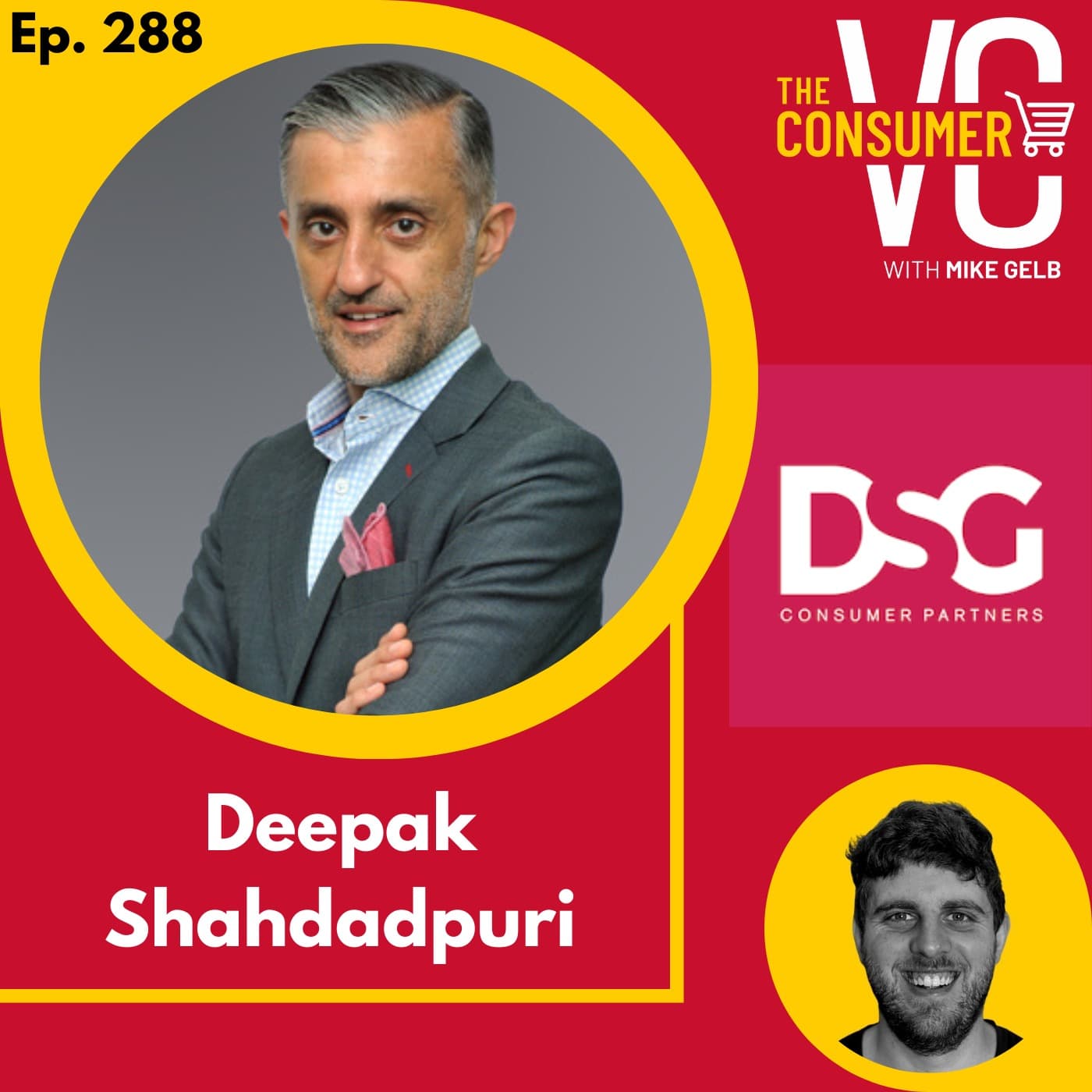
Episode Title Deepak Shahdadpuri (DSG Consumer Partners) - Why India is Ripe for Premium Consumer Brands, How to Localize Brands, and Trends In India and South East Asia
Guest Deepak Shahdadpuri Founder and Managing Director of DSG Consumer Partners, India's leading consumer-only venture capital fund.
Episode Overview In this episode, Mike Gelb interviews Deepak Shahdadpuri, focusing on the unique consumer market in India compared to the U.S., the potential for premium consumer brands in the region, and Shahdadpuri's journey from growth-stage investing to early-stage investments.
Key Takeaways
- The Potential of the Indian Market
- Consumer Demand: Shahdadpuri highlights a growing demand for premium and local brands in India, fueled by increasing disposable incomes and a shift in consumer preferences.
- Cultural Shift: An evolving mindset among Indian consumers shows a pride in local products, moving away from the perception that foreign brands are superior.
- Transition to Early-Stage Investing
- Background: Shahdadpuri's journey into consumer investment began with a personal connection to a wine startup in India, leading him to recognize the untapped potential in the consumer sector.
- Founding DSG: Shahdadpuri founded DSG Consumer Partners, the first VC fund in India focusing exclusively on consumer goods, after witnessing a lack of institutional support in this space.
- Investment Philosophy
- Localized Approach: DSG aims to develop brands that are tailored for the Indian consumer, emphasizing the importance of local adaptations in marketing and product development.
- Long-Term Commitment: Shahdadpuri notes that building a consumer brand takes time, often requiring a decade for significant results.
- Due Diligence Process
- Investment Stages: Shahdadpuri discusses different investment stages—from seed to more mature companies—highlighting the importance of understanding the founder's passion and market fit.
- Capital Efficiency Metrics: They focus on capital efficiency as a key performance indicator, assessing how effectively the invested capital translates into revenue growth.
Discussion Points
The Consumer Landscape
- Shahdadpuri draws comparisons between Indian and Western markets, noting that while certain product categories may be saturated in the U.S., India's market is still developing.
- He emphasizes that many categories remain unfilled, allowing first-mover advantages for innovative brands.
Challenges and Opportunities
- Market Education: The success of premium brands often relies on educating consumers about new products and their benefits.
- Sampling as Strategy: Shahdadpuri mentions in-store sampling as an effective method for trial and brand discovery, although this changed during COVID-19, necessitating a pivot to digital marketing strategies.
Insights from the Host and Guest
- Mike Gelb engages with Shahdadpuri about the difficulties early-stage brands face and the unique dynamics of the Indian consumer market.
- Shahdadpuri shares anecdotes about his investment journeys and the learnings along the way, particularly the need for resilience and adaptability in entrepreneurship.
Recommended Reads
- Thinking Fast and Slow by Daniel Kahneman: A book recommended for understanding consumer behavior and decision-making.
- The Game Changers by Ryu Sangvi: A personal and professional read highlighting transformative entrepreneurship in India.
Conclusion Shahdadpuri's insights into the Indian consumer market and his experiences in venture capital provide a valuable perspective for founders and investors alike. The episode underscores the importance of localization, understanding market dynamics, and the long-term vision necessary for building successful consumer brands in emerging markets.
---
For further insights, subscribe to the Consumer VC newsletter and tune into more episodes exploring the intersection of venture capital and consumer innovation.
Written by AI. May contain mistakes. Listen to the episode to check what was said.
Transcript
Automatic transcript. May contain errors.0:00This episode is brought to you by Vobin from Carta. Vobin from Carta is the easiest way to launch and run your venture investing. They offer SPVs and fund vehicles for GPs at all stages of the journey, from your first syndicate to operating a multi-million dollar venture fund. If you're interested in investing in startups, stick around after the episode where I chat with Gabriel Shin from the Vobin from Carta team, who shares his perspective and tips about how to start investing and how Vobin from Carta can get you set up. The link to Vobin from Carta's website is in the show notes.
0:44Hello, I'm your host, Mike Gelb, and this is the Consumer VC podcast, where we discuss the intersection of venture capital and consumer innovation. If you're enjoying the show, also subscribe to my newsletter at theconsumervc.com, where you'll receive all new episodes straight to your inbox and a weekly recap of all the consumer deals that are happening. All continent episodes are for informational and entertainment purposes only and is not investment advice. This episode is brought to you by Vauban Promkarta. Vauban Promkarta is the easiest way to launch and run your venture investing. They offer SPVs and fund vehicles for GPs at all stages of the journey, from your first syndicate to offering a multi-million dollar venture fund.
1:25If you're interested in investing in startups, stick around after the episode where I chat with Gabriel Shin from the Vauban from Carta team, who shares his perspective and tips about how to start investing and how Vauban from Carta can get you set up. The link to Vauban from Carta's website is in the show notes. Our guest today is Deepak Shadampirai, founder and managing director of DSG Consumer Partners. DSG Consumer Partners is India and Southeast Asia's leading consumer-only venture capital fund. Some of their investments include Viva, Piccolo Organics, and the Golden Duck. We focus this conversation on what makes India an exciting and different consumer market than the US, why Indian premium consumer brands are ripe for growth, and why Deepak went from investing at the growth stage and later stage to investing in the earlier stages.
2:16Without further ado, here's Deepak.
2:22Deepak, we made it happen. You're here on the show. We made it happen. So excited thank you so much for coming on how are you i'm very well today from a very rainy singapore as i look out of the window oh well it's actually been very rainy here in los angeles too we've gotten like um actually like crazy weather for la for la mind you but um but but pretty pretty crazy weather over the past few weeks um let's start from the beginning why consumer what was your first consumer investment and what kind of attracted you to um i know it's a large category but consumer brands specifically. I think you use the right word.
3:00I stumbled upon it as opposed to having planned to do it. I think the first consumer investment I ever made in a professional capacity, forget about some angel stuff I used to do, was in 2004 when I invested in what was then a very nascent small startup sort of making wines in India. So it was an insurgent brand in the wine category. It was the third ever brand in India launched in the wine category. And it was started by a friend of mine. And so he's sort of born and brought up in India, went to Stanford, studied engineering, worked with Oracle in Napa, came back to India and said, I want to do something different.
3:47And he said, India is the third largest grower of grapes. So the Thompson seed is grapes, which get exported globally. The green grapes we eat everywhere. And he says, clearly there's climate that works. He went back to UC, did a course on winemaking and viticulture, and realized that the geographic region and the soils were very good. But India did not have any sort of grape varietal. So he took cuttings from California, Chenin, Chardonnay, and just planted it. And that's where it started. At that time, when I first met him, I was working as a consultant in Bain. And then after I left Bain, I joined a technology venture capital firm called Reuters Venture Capital.
4:31And my job was to make technology investments. My boss sent me off to India. I met Rajiv. And I couldn't find much that excited me about tech. It wasn't my thing. So I'm a lawyer and an accountant by training. So I don't actually have a real tech background. and so got to know Rajeeb. I thought what he was doing was very cool. After four years of doing TechVC and spending a lot of time in India, I realized there were a lot of TechVCs chasing too many deals in India and this is 2000 to 2004 but there was no institutional fund, not even one that would even look at investing in a CPG brand. So I had left REC.
5:12I raised my own fund for the first time in 2004 and the first deal I ever did was invest three million dollars in this what I hope will become a big winery. Keep in mind right so people who know wine will say where's India? India doesn't make wine, it makes zero sense. So that's where it started. I learned a lot from being on the board. I was on the board for 17 years and that's where it started right and I got the consumer bug and I've been doing mainly consumer since 2004 and only consumer since 2012. Wow. That's awesome. I love that story. So you kind of went to India for the firm that you were working with.
5:55You were actually supposed to make technology investments. You thought it was maybe oversaturated in tech when it came to India. And there's an opportunity within investing in consumer brands that no one was paying attention to. And so you kind of shifted and pivoted. You ended up then starting, obviously, DSG as a result. Yeah, I mean, I think shifting and pivoting is the wrong word. So in 2004, I said, there's something here. I said, I don't know if it's going to be a full-time career. So I raised a small pool of money in 2004. We've made five investments over two years only in consumer brands.
6:32So we invested in Sula Wines, which is now a large market leading wine brand in India. It went public in December. Very profitable, pays a dividend. It's now listed on the Indian Stock Exchange. I invested in an art auction house. So think of Christie's or Sotheby's, but the equivalent for India called Saffron Art. I invested in a company called Baker's Circle, which is an institutional B2B supplier of frozen bread. So we don't have a consumer brand. The thesis was we'll do institutional and consumer. But the founder did such a good job in sort of institutional sales. So if you walk into a Burger King or a McDonald's or a Subway in India, you're likely to be eating one of our products.
7:20So we make it for all the big brands. We don't have our own brand. And to be honest, we tried launching our own brand in parallel. And this particular founder is just so good at B2B that he never succeeded in B2C. And we invested in a company called ClearTrip, which was at that point, one of the two Expedia lookalikes for India. There were two, MakeMyTrip and the second one was ClearTrip. So made four investments, all with consumer-facing brands other than Baker Circle. And the thesis was that the Indian consumer is going to start sort of patronizing more local brands made in India for India. There's some categories where we felt that you can't have a local brand.
8:07Think of Google. Google everywhere is Google. But for more traditional packaged goods, we thought the strongest brands would be Indian brands or domestic brands, whichever market you invest in, building for that demographic and for that user base. That was the broad idea. It wasn't I'm pivoting. I had an idea. So we made four or five investments in 04 and 05. I then, and that was under a fund called Jam India, which I founded, which was a precursor to DSG. Two years into it, I was approached by a friend of mine who was setting up a sort of a mid-market private equity fund. He said, why don't you join me?
8:53Do your consumer, but do a little more. And we raised$200 million. I then packed my bags. I was living in London in those days. I had never lived in India in my life. I was born and brought up in Singapore. So I packed my bags, my wife, my seven-month-old son, and we moved to Bombay in July 2007. And I spent six years in Bombay managing a$200 million sort of mid-market growth fund that did consumer infrastructure, which my partner ran, and financial services, which I ran. So did that for six years. And this was the first time I was sort of lived in India full-time. My son went to school there.
9:37My second child, my daughter, was born in Bombay. So six years of full-time India, immersed myself and really got to know India really well, as opposed to being a someone living in London, visiting India every month. And those six years sort of validated what I hypothesized earlier on, that the Indian consumer was coming of age, GDP was growing, disposable income was sort of, hasn't got to a point where there was a huge increase in discretion in spending, but you could see it coming. And half of my time in my six years was looking at consumer deals. Fast forward to 2012 for very personal reasons, my wife and I decided to move back to Singapore, where I'm from, to spend time with my parents.
10:29So I came back to Singapore in 2012, had a chance to recalibrate and decided to go all in. So by this time, the deals I sort of invested in in 2004 and 2005, the travel company, the bakery ingredients company, Sula Wines, had all exploded. They had all grown between 5 and 10x in top line. And two of them had become the number one brands in that category in India. So that sort of validated my hypothesis. But keep in mind, these were 2004 and 2005 investments. And I was looking back at December 2012. So these were six, seven, eight years into my journey. And that sort of confirmed the fact to build a consumer brand, it takes a decade.
11:12So got back to Singapore. I said, let's do this properly. So started DSG Consumer Partners. When we did this, we were the first fund in India, a first VC fund in India to have consumer in the name. There was no fund looking exclusively at at CPG or consumer more broadly. Some of my friends who run other venture funds questioned the thesis saying, Deepak, are you sure it's big enough or exciting enough to have a fund doing nothing but that? Went to sort of my early backers who backed me in the 04 and 05 when I was in my first bunch of consumer deals, raised a very small fund, only$12 million, and then got to work.
11:56So fund one was$12 million. We made 21 investments across three years. So 2013 to 2016, 2013, 2014, 2015, on average, seven deals a year. And that was the start of DSG, was the first formal sort of portfolio. And since then, we've raised capital every three years. We raised fund Fund two in 2016, fund three in 2019, and fund four last year. So it's grown since then, but that's where it started. No, that's really helpful. That's really helpful. And I would say, I guess backing up a little bit in terms of you had this insight where you thought the Indian consumer would buy from Indian brands, from brands that actually were started and were homegrown in India.
12:53What specifically, because I know that you're an accountant, you were for Bain, you, what specifically on, was there a particular metric or statistic that you were kind of interested in that you, that kind of confirmed that, okay, maybe this actually could happen? Or was it just like a hunch or how did you think about that? I think let's simplify. Let's break it down into a sort of the demand and supply side. So whilst I was living in London and traveling to India, I saw an opportunity because there were a lot of gaps in the market, right? Because I would come, I was living in London. I would come to India on a business trip and I would go to the supermarket or to a store.
13:36I said, why can't I buy this? Why can't I buy that? This is what I need. And I moved to India full time with a young baby and then had my second child. And keep in mind, my wife and I had never lived in India before. We expected to find things at the grocery store, at the drugstore, at the pharmacy, which we were used to in Singapore and London. And suddenly, when you want to buy cold brew coffee, no one's heard of it. You want to buy hypoallergenic cream, no one's heard of it. You want Greek yogurt, lots of protein. They've heard of it, but you can't get it, right? So there was a clear gap in the market of products and services that we were used to in the West.
14:16The question then was, so what? The fact that you don't get it here, does the Indian consumer even care?
14:26Over those six years, I just spent time, got to make a lot of local friends, and got to know India, at least the urban India really well. I do not know rural India very well. India is 1.4 billion people. When I say India, my India is 300 million people who live in 10 big cities, who travel a lot, many of whom go abroad to study, many of whom sort of work around the world. I mean, you live in the US, you've seen the number of Indian CEOs of the largest companies in the US. And Netflix and Spotify and technology and social media changed everything. The world became flat. So Netflix made sure that what you watch in LA is what I watched in Bombay the same day.
15:12Same thing with Spotify. So information started moving very quickly. We also saw in 2010, 2011, 2012, the reverse migration. So most Indians were leaving India in the 90s, 2000s for a better life abroad. As the Indian domestic economy picked up, a large number of those, including the founder of Sula, who ran to Stanford, worked at Oracle, could have done anything, said, you know what, I'm going to go back to India because I think the next two decades will be India's sort of best time. And these guys who had spent a decade or more abroad came back and they were used to a particular sort of ability to buy and consume.
15:54So that was the demand side. On the supply side, what was interesting was, although many of the products and services I spoke about wasn't readily available in mainstream shops, there was a huge parallel market. So in each city, in Bombay, in Delhi, there would be shops or markets that only sold products that were imported. So they wouldn't go to an official distributor because there wasn't one. There would be people either in LA or in London or in Australia or in Dubai or in Singapore sending pallets of products, right? Because I'll give you a real example. So my child had very sensitive skin, prone and we wanted to have particular skin cream.
16:36Couldn't find it in India. There was a market who would bring in Mustela from the UK, triple the price because there was enough demand that the official channels weren't fulfilling. So I said, demand clearly is there. Supply is broken. There were importers who saw the demand and bringing it on the site, very high margins, I think over the next 20 years this is going to sort of clean up and instead of importing many of these products many of these products could be made in India localized for the Indian consumer because Indian skin is different pigmentation is different they eat different things they like different flavors so the whole the whole need to sort of sort of bringing it in the gray market is not required.
17:25The other big change was up till 15 or 20 years ago, there was a conception that anything made in India wasn't as good as anything made in anywhere else. So if you bought a bottle of wine, and this is what I saw first sent. So we launched Sula. Sula launched in 2000 before I invested. And I saw Sula's growth in the first decade. And particularly in the first five years, it was very difficult convincing a sommelier or a general manager of a restaurant to stock Indian wine. And he would say, no one would drink Indian wine. If I have a guest coming in, they're used to Australian or French or Californian or Napa or Sonoma.
18:05How do I tell him that this wine from Maharashtra is any good? It's just not local. It's not, we don't do this stuff. It's changed now. But the perception was that if it's important, it's much better. Right. In the last 20 years, that's changed. The millennials and the younger Indians are very proudly Indian. They believe that India can be as good as, if not better, in most categories, given how big a country we have and what we can do. And it was ripe for brands to come in and sort of build for India. So that was the thesis. And that's all we back. If you look at my playbook 10 years ago and my playbook today, we want to build brands in India or Southeast Asia.
18:52Let's talk about Southeast Asia later on. That is being built for the Indian consumer where India is big enough a market where we don't have to export anything. So instead of buying, I'm going to throw up a random example, right? Instead of buying Heinz ketchup, because everyone knows Heinz, there should be no reason we can't build a brand of ketchups or sauces made in India for the Indian consumer with an Indian palate and an Indian storytelling and an Indian brand. Okay, Heinz is not Indian. It's big, it's very visible. So that was the thesis. and we said we can't compete with the Unilevers and the Nestle's on price on everything.
19:39So let's enter the premium category. And why premium? Because the people in the premium segment, which represents 2 % of India, were already buying imported items from the gray market. So they said, we don't like the locally made ketchup or we don't like the locally made whatever. I'm going to buy products imported from the US or Australia. from the shops I told you about and pay a high premium. So as we started DSG, we said, let's back brands who are going to build products as good as the best products in the world, but make them in India and price them at a premium to any Indian made product.
20:15So we weren't going against the masses. We don't want to compete with the guys who are competing in price, but let's convince the Indian consumer that we are the best made in India product and we are as good as anything else you import and let's build the packaging, the storytelling and the price. So almost every brand we invested in, in the first five years, at the time of launch, we were the most expensive made in India product because to get that, to position your product as the best in class, you can't be cheaper than something else. Okay. And these are the big fights I had with some of my CEOs and some of the head of sales of my companies because it's a deep back.
20:57No one's heard of our brand. We are launching next week. And you want me to go to the retailer and the distributor and tell him this product that no one's heard of is more expensive than the current market leader. I said, yes, because we are much better than the current market leader. Do a blind tasting, show him the backup pack, no gunk, no colors, real tomatoes as opposed to tomato and pumpkin and other flavorings. And let's see what happens, right? There was a pushback. The retailer or distributor will buy one carton of 24. And we said, keep it. Let's see what rate of sales you get. Let's see what the offtake is.
21:36If no one buys it, then you know no one buys it. If people buy it, just call us up and we'll sort of send you a next case or a next tell it. And that's how we began it, really small, educating the market. And in many categories, we even took a bigger bet, which was introducing a new category to India. Because if you win in a category introduction play, you become synonymous with the category. What might go wrong is that the category may have no relevance in India. But we've done it four, five, six, seven times. We've not always made it work. but where it's worked it's become literally I mean if you speak to anyone in India and ask him you know which is the best Greek yogurt brand I'll be shocked if they don't say Epigamia because there was no Greek yogurt in India till they introduced it no one understood what it was for the first two years we spent a lot of time communicating what it was fast forward today if you're in Bombay or Delhi and you walk into any grocery store there'll be 10 brands of Greek yogurt of every shape, size, form.
22:47But everyone, including our competitors, would say they wouldn't have been there if it wasn't for Rohan who created Epigamia. No, that's really helpful and useful. So what was it like going from investing in mid-market companies? Like what was kind of like your average check size from that standpoint? Moving into 12 million, 21 investments, investments in a$12 million fund. I imagine your check size was what, like 300K or 400K average per one. So what was that kind of like? And how did you kind of, what was also kind of like your diligence process later when you started DSG fund one? I think moving from Beacon, which is the mid-market fund to DSG was very different, but keep in mind that I had done, I've been doing venture investing as a principal since 2000.
23:39So I've been doing it for 12 years before I started DSG. And prior to that at Bain, I spent 75 % of my time at Bain in the private equity group working on deals with TPG, KKR, Blackstone. So I've been exposed to investing from buyouts. Got it. All the way to early stage. all the way to early stage before I joined the growth fund or before I co-founded the growth fund. So having done that and after the growth fund, I then look back saying the time I had the most fun, forget about everything else, right? I had the most fun in 04 and 05 when I was backing consumer founders, many of them pre-revenue, pre-product.
24:26and Sula was the latest stage. Revenue was$3 million. I had been there when there was a team of anything between one and 20. I would sort of spend time through the breeze with the founders. I got involved in packaging, tastings, pricing, and I had a lot of fun. The fact that I made money was great. So I knew I could support my family by doing it, but I actually had fun. When I was doing my growth buyout stage in India for six years, every deal was, you're right, every check was between 10 and 15 million. Every deal would have an advisor or a banker. He would pitch to 20 funds. There would be a process.
25:05There'd be a data room. And it wouldn't be one-on-one, right? There was no proprietary deal flow. I learned a lot, but I had no fun. It wasn't miserable, but it wasn't as fun as speaking to Rajiv at Sula. He had planted, you know, he had launched four varietals. He's the Chenin, the Sauvignon. And in those days, our reds were not of the quality they are today. They're really good today. And I'm proudly, happily drink them. But in the early years, the product needed a lot of work. And the labeling needed a lot of work. And, you know, those are the discussions I really enjoyed. So when I moved back to Singapore, I was 43 then when I moved back.
25:49And I'd been working for 25 years. And I said, you know what? I've got another 20 years of really hard work in me. And I want to do something I really enjoy. So DSG was designed as a project. Fund 1 had no institutional investors. Fund 1 was family and friends, mainly the investors who backed me in 2004 and 2005. because by this time, the Sula wine, the clear trip, the Baker Circle had all. So that original 0405, I put$15 million to work. I made about four and a half X. I given the money back. The investors were happy. And they said, Deepak, you clearly stumbled onto something in 0405. You're doing it all over again.
26:29So we'll back you again. So that was how DSG started. Friends and family. there wasn't even one investor who hadn't known me for at least a decade in that fund. I didn't even try and pitch it to anyone. I'm like, guys, I've done it before. Most of you were there on the original journey. Most of you were not on the growth journey with me because that wasn't what excited you. I'm coming back to do what I did in O4 and O5. O4 and O5 was an experiment. This time, I'm going to go all in. Let's see what happens. It's 10 years later. I think India is more ready than it was initially. So let's do it. So walk me through a little bit investing in the early stages, all the way from your first fund of$12 million all the way up to your most recent, excuse me, fund number four.
27:21Walk me through a little bit about your due diligence process. What types of attributes does the company need to be at in order for you to be interested in terms of the actual size of the company? Okay. I mean, let's split it up, right? So we invest in, I mean, let's call it seed or pre-seed, whatever you want, right? There's a category of companies where your product is not yet in the market and you may not even have a product ready. And I'll give you the example of the first deal we did in Fund One. It's a company called Veeba. V-E-E-B-A. It's sort of like a Heinz. It makes sources and emulsions.
27:59it's a very big business now but when I invested in VeeBud there was no brand name there was no product the company wasn't even incorporated I had met the founder in 04 when he was running another company in the same space called Fun Foods this was the same time as I made the Sula investment I said you know what I think is there's an interesting category in the source space I just invested in industrial bakery business and we supply all the bread to Subway, even today. So if you ever eat a Subway sandwich in India, 100 % of all the bread at Subway, which is a lot of bread comes from us. So every Subway bakes its bread on premise.
Read the full transcript
28:39So Subway has a combi oven where you bake it, but it comes in a frozen shape that looks like a pencil. You proof it and then you bake a bread, but that frozen dough comes from us. And as part of my diligence, when I did that deal in 04 was to go and speak to Subway. I said, this is what we do. You guys supply bread to us. I said, what else do you buy? He said, our biggest spend is on sauces. So you go to Subway, you have the meat, you have the vegetables, you go to cheese, and then you have 20 different sauces. And I said, great. You know, if you're buying a lot of bread, you're going to be buying a lot of sauces.
29:13So I said, who supplies your sauces? He said that there are only three companies in India. These are the three. I went to meet all three of them. And in that process, I met Viraj, who was in the same space. And I said, you know, can I invest in your business? His dad was running the business at that point. And they said, no, we don't need outside money. We are sort of bootstrapped from day one. We're profitable. Don't need your cash. Three years later, the dad sold the business to Germany's Dr. Otka. And prior to closing the sale, I spoke to Viraj. I said, I think you're making a mistake. it's good money, your dad will sort of retire on this.
29:51But I think India's consumption hasn't even started. It's going to be 50x in 25 years. But anyway, the transaction happened. He had to go. He became the CEO of the business, worked with Dr. Otka for three years, and then he left. When his non-compete ended, and we kept in touch. I said, you know, your dad's happy. He's retired. He's written a book. I said, what are you up to now? He says, well, he said, Deepak, I think you were right. It was way too early to sell. I said, let's do it again. I said, they were doing something very different. They were doing something mass market, very successful brand.
30:26Why don't we do something solely focused on wellness, better for you? Same category. But as consumers become wealthy, they just want better quality, functional. It's like a lot of the guests you have on your podcast, right uh and one i i had many role models or many sort of uh companies i was sort of saying we could do a bit of this a bit of that uh and one of them was primal kitchen you know sort of primal kitchen was very functional but the whole idea was let's launch a range of products uh and we said let's not do something that's already made in india on the shelf so at that point first deal i said let's not go and compete with everyone on the shelf.
31:09You'll be the 10th sauce or ketchup company. So let's launch a portfolio of products that Indians already know, but they can't buy on the store easily. And by this point in 2012, Subway had become very successful. It's been in India for over a decade, they had hundreds of outlets. So everyone knew what Chipotle sauce was. They knew what ranch was. They knew what Southwest was. But you couldn't buy it easily. And if you could, they were imported from the US and it was very expensive. And because it wasn't brought in officially by a distributor, often the expiry date was one month away. So we said, Indians now know this category.
31:54They go to Subway a lot. But if someone wants to recreate a sandwich or a sub or a taco they can't get this anywhere so we if you look back you can google it the first launch of Viva I think was only seven SKUs and every SKU was new to the Indian market the most common product we had was mayonnaise but it was India's first ever 100 % olive oil mayonnaise and it was made without egg. It was mayonnaise, but it was much better, no gunk, only olive oil. And that's how we started. And our products were by far the most expensive. And our packaging was very normal for India. It was sort of not the tiny squeezy ones or the big because our products were chunky.
32:43It was a mixture of salad dressings and sauces. So that gives you an example of we sat down together we had a hypothesis we then spent two days trying to figure out what we call the company because I want he said Deepak let's call it this I said that's that's that's rubbish and he so we then actually so I took him to Sula so I said why don't and Sula by that point had built a beautiful winery and a resort and a hotel very Napa like so I took Viraj to to spend two nights with me at the winery I said Viraj this is what Rajiv has built from nothing he's now a very large business, very profitable.
33:20He's got a hotel, he's got a visitor center. And then we still spent, we couldn't come up with the name. And on the last day, as we were leaving the winery, and he said, Deepak, why did Rajiv call the business Sula? He said, well, Sula is his mother's name. So he just wanted to have a tribute to his mom. Then he said, Deepak, that's a damn good idea. So I'm going to call my next company after my mom, which is Viva. So we went back to Delhi. we then went to the registry of companies, registered the company, and then we spent a month driving around Rajasthan to look for a piece of land to buy to build a factory.
33:57So again, so in that example, it literally was business building with the founder. So there we look for a, it's all about the founder and the team and a coming together of minds on a category we think could be very big. So I would say that is 25 % of what we do at DSGCP. Long way of answering your initial question of what do I look for in a deal. So we look for people who are excited to build a category with us. So that's 25%. There, the diligence is on the founder, either what he's done in the past. In Viraj's case, he had been in a very similar industry before. And what the category is like today and our view of what the category could be like 20 years from now.
34:45The next 25 % of our deals are the companies incorporated. He knows he wants to be in the pet business or he knows he wants to be in the baby skincare business, he or she, but they haven't launched yet. There's no packaging. There may or may not be a branding. There are four companies we've invested in in the last four years, three years, where companies incorporated, the founding team is there. They had a brand name, which we thought was awful. But they hadn't launched and no one knew the brand name existed.
35:23We're like, dude, have you done any focus groups? Have you spoken to anyone? It's like, no, no, no, we really like it. So we said, guys, this is why we don't think it's going work. Let's help you do focus groups and let's play around with it. And then we actually came up with the name. So the most recent example is a company called a pet, a pet sort of a broad pet platform that does pet services, pet food, and sort of pet related products. It's called Super Tales. That's the name of it today. So I won't tell you what the name was before we renamed it. Okay, so that's why we like to get in early, right?
36:06Get in as early as we can, making sure that the founder is totally aligned about the category. The mistakes we've made in the past is founders who find a big category, but are not passionate about it, and we've done quite a few of those, end up not doing so well for us. So they found the category, they know it's going to be big. They know they can make a lot of money, but they really don't love the category. So that's the biggest learning over the last 11 years. So we really need to believe that this is what you really want to do, as opposed to you doing it just to make money. So real affinity with the category.
36:44And then we spend a lot of time on the category. The third bucket is where there's a product, there's a team, the product's been launched, but revenues are sub a million dollars so you have a few SKUs maybe D2C only or only in one city or in a small part of a one city so you launched you bootstrapped yourself and you have some traction you could be doing you know$50 ,000 a month$100 ,000 a month but still very early and there we said we look at the product we look at the team first we love you you we know you're passionate we look at the product? Do we like the product? And product is defined as, do we like what's inside the product, the liquid or what's being consumed?
37:29Do we like the packaging? Do we like the brand? Do we like the brand story? Do we like the pricing? If we don't like it, what would we change? We then discuss it with the founders. And this is, like I said, you go to$100 ,000 a month, but we think for you to really scale, you've got to change a few things or a lot of things. And this is why, and this is your company, let's debate this. If he is not open to any feedback, we're like, guys, we're the wrong partner for you. If he's open to feedback, we engage and we don't expect him to listen to everything at all, but we want him to engage. Because most founders in any category they're passionate about is going to know 10x of what my team are going to know anyway.
38:17So we have a macro viewpoint, having done this for a long time, but we don't have a micro viewpoint on cold brew coffee specific. OK, so we want him to push us back as well and tell us this is why we think, Deepak, you're wrong or your team's wrong or we disagree. So and because he's got some revenue, we start looking at KPIs. And the most important KPI to us for a company that already has revenue is capital efficiency. So capital efficiency to us is defined as total capital raised to date. It could be just the founder putting his money in or some family and friends, or he may have done a seed round before us, raised, I don't know, half a million dollars.
39:00It really depends. So we look at capital efficiency, and that's defined as total revenue raised to date and your current ARR. So if you raised half a million today to bootstrap you to where you are and you're doing$100 ,000 a month, means your ARR is 1.2 million, means your capital efficiency is 1.2 million over half a million, which is 2.2. Got it. Got it. How well you've used capital you've gotten today to get your business to where you are today? Again, it's a very powerful matrix, a very powerful KPI, but it is very different for each business, each category, and sort of how capital intensive your business is.
39:47If you're capital light, you're more likely to have a higher or you should have a higher capital efficiency. if you're like a manufacturing business like Sula or Aviva where you build your own factory from day one that capital efficiency doesn't look very different right so you've got to peel the onion but we we spend an insane amount of time looking at capital efficiency it's easier as the company gets bigger but at that early stage early revenue is hard and this is where we look at capital efficiency to date. And more importantly, if we are putting in the next million dollars, which means the total raise would have been the half a million before us and our million, so one and a half million after you take our money, we need to be comfortable that before the next round of funding, you must be at an ARR of at least three million.
40:43If we feel our million dollars doesn't get you there, and therefore whoever looks at your business 18 or 24 months from now says, oh, you raised$1.5 million to date and you're only doing a million in revenue, you failed. Okay, so that's how we think about it. And the last bucket is businesses which are slightly larger. They're doing$5 million a year. Either we did not see them early on or we passed them or we like them now. We look at everything, but their capital efficiency becomes even more important because you've been at it for five years. You raised two or three rounds of funding, let's see what that happens and across the board we spend too much time on on margins so again we invest only in consumer so we have a strong view of what a beverage company what a frozen company what a chilled company should have at gross margins and depending on whether you're direct to consumer or you're going to distributors or retailers, we know what each slice is taken by the distributor and the retailer and everything else.
41:50So we need to make sure your gross margins are good. And all of this is before marketing spend, right? So if you don't have enough margin because you don't understand it, or you're just trying to push revenue, and if your style of business is, I'm going to go top line and figure out how I make money later is sort of scares us. And that's what happened in, I think, in 2019, 2020, 2021, we saw a lot of that because I've been doing this for 20 years. And it was always very sensible, right? Most founders understood the margin. I think what happened for a short window was that non-traditional CPG investors started investing in CPG.
42:35Many of them came from venture tech. And they are really good at venture tech, right? And in venture tech, if you win the category, it is a winner take all or winner takes most. Google is Google, Dropbox is Dropbox. There are other competitors. But if you win the category, you are going to get a disproportionate share. So you can go out and market grab and sort of reap in the benefits later. In CPG, it's very different. You will never see one brand in any category take a disproportionate share, whether it's ice cream or soft drinks or water or yogurt. It's the opposite. So this whole idea, I'm going to spend to get market share, doesn't work.
43:21So we saw a lot of investors come into consumer goods with the right long-term view of building brands, but in our opinion, the wrong playbook, not because they were being difficult, because that's worked for them in what they used to do. Many of them have retreated now, aren't doing it as much, but that that sort of put the market in a very confusing state for founders because they would meet us they would meet other funds or and i would say you know i think you're worth three to four million the other guys he will say not five or six he said oh i think you're worth 20 and and then we would have a debate i'm like guys you know it's a good fund great brand name they've never done consumer before we do consumer, they're really good they can help you with the website and optimization and they know everything on UI but they can't get you into Whole Foods or the Whole Foods equivalent or they can't get you into retail and take your choice if you're more traditional like us, come with us if your product or service is very D2C where you don't ever have such physical distribution maybe they can help you.
44:41I don't know. Right, right, right. Well, and it's also so few, I mean, I've, I've, I've a few thoughts on that. I'm going to sound like a broken record because I say this a lot about tech firms coming into consumer. I think that what's been lost a little bit in the 2010s is for the case of, you know, DTC brands, Dizinator brands is I, sometimes I feel like tech investors thought of them as technology businesses, whereas rather using the technology as a distribution for distribution, as opposed to the business ultimately is a consumer product, right? It's not actually a technology business. And so, and evaluate by how these brands are being valued are like a technology business, which is very, very quite different when it comes to the multiples and evaluations that you can achieve of tech.
45:31So kind of just reiterating what you said and totally agree that it's been a difficult time because what that could lead to is many bridge rounds, down rounds, which ultimately are recaps, ultimately just are not very good for the business. So that can be pretty painful to go through if you make that wrong decision. Absolutely. Again, I think, and again, no one knew, right? I think it's good they tried because it may have worked, but it isn't working. It isn't working. I think some have done a better job than others because, you know, there are some consumer brands which is tech centric and technology can make a huge difference.
46:14They're better off where gross margins are much higher and D2C maybe could work for longer. Like skincare has gross margins of 80 to 85 percent. Food and beverage does not. There's enough margin in 85 percent to sort of do more D2C. But again, going back to first principles, irrespective of how your initial go-to market is, our view is to be very successful. And our definition of very successful is, is your brand strong enough that Nestle or Unilever or L 'Oreal or Mondelez or Mars would like to buy you? and they are. So I spend a lot of my time meeting global and regional CEOs of all the companies I mentioned at least once a year, if not more.
47:01And most of them know me, at least in the region personally. And they want to see the fundamental belief is you need to be where your consumer is. When you're small and you are bootstrapped, you find the most capital efficient way of getting discovered. So think of any consumer brand. You create a product, it's great, or you think is great. No one knows you exist. You're brand new, right? So you start, how do you get discovered? Okay, after you get discovered, how do you get someone to try you? After someone tries you is, if they try you and they don't like you or the experience, then there's something wrong with the product market, product market fit, whatever it is.
47:39But assuming you do that well, then you need repeats. So again, you want to optimize the cost on the discovery and the trials. So maybe social media, maybe technology can help you. I started the first 10 years doing mainly food and beverage. And our idea was the best way to be discovered is be close to where the consumer buys that product. So we'd show up on the aisle and do sampling. So you do two things, you get discovered, and you get trialed at the same time. Because if you're selling a new yogurt, and you stand by the yogurt aisle saying, please try this yogurt. It's a Greek yogurt. And he'll say, what is Greek yogurt, man?
48:19We've been having yogurt in India for 100 centuries. It's an Indian thing. We're like, just try it. It's different. This is why it's different. That has four grams of protein. Ours has nine grams of protein. It's a different occasion. So for Epigamia, not only did we have a new brand, we said we can't, because Indians eat yogurt three times a day with a meal. We're like, how do we sort of avoid the confusion? So we actually created a new occasion for the Indian consumer, which is if you're eating yogurt as breakfast, lunch, or dinner, which is when it's mainly consumed, unlike the West, then please buy traditional yogurt or curd.
48:55We are Greek yogurt. It's a snack. So this is what you do post-run, pre-run, after the gym, pre-yoga. So we said different occasion and it's high protein and we saw the function and occasion so that the consumer wasn't confused. And it worked really well for us. And most of our success stories were samplings because it's the most cost-effective way of discovery and trial. And COVID happened. And you can't sample. You can't go to a supermarket. And that's when we said, you know what? You don't have a choice, right? Social media, send pamphlets. Let's figure it out. And in food and beverage, when someone tries it, there's an instant reaction of whether I like it or not, taste-wise.
49:43And if they pick up a couple to buy, you know there's some traction. For some products, you can't get instant feedback, right? For example, in skincare, if we make a claim that if you wash your face every day with this, the wrinkles are going to go away and you look better, you need to wash it for a month. So we said, even if you are at the aisle and sample it, there's no way anyone's going to know if it's effective or not. Okay. So in that category, we said, you may not need to sample on premise because that person washes his face at home, not in public. So then different challenge, maybe you get discovered offline and you give them a small sampler, they go home or you do it on social media.
50:25We don't know. So we go brand by brand. we don't have a set playbook for anything. It's sometimes frustrating for the DHGCP team, especially the new guys who join us saying, where's your playbook? We don't have a playbook. It doesn't exist. Our playbook is back to the right team. We convince about the category and work with the founder who is very comfortable breaking the problem down into first principles and saying for my product and my brand and my price point, how do I test it? Do I go offline first do i go online first we encourage them never to go both some do but our viewers do not do both this does not include being on social media and having a website or having instagram page that that you should do but we don't think you should be doing shopify and doing offline at the same time because it's really hard doing one thing we're not saying both can't work we're like pick one because if all we're trying to do is to get to 50 or a hundred thousand dollars a month, you should be able to do it on either.
51:28So pick the one you think will get you there on the lowest cost base to test the hypothesis that people want to buy your brand. Right. That makes a lot of sense. Yeah. That's a very long-winded answer to your question of what we look at because it depends on the stage of the business. Well, I know you don't have one playbook, so you might not like this question, but going, taking it back to when, when, um, when you invested in what became Viva and when one of your, um, hypothesis or inspirations was Primal Kitchen, right? in the West. What are some of the nuances when you're looking for inspiration?
52:12And obviously, you don't always look for inspiration when it comes to collaborating very early stage with founders from what's happening in the West. But what are some nuances that you have to take in consideration when it comes to the Indian market that is quite different to the West? when you're thinking about bringing like a type of brand over to India? Yeah. So we don't think of bringing a type of brand. We are asking ourselves, how does a brand, whether it's in the US or anywhere else, it could be any market, how does a brand enter a... And unlike India, where many categories are still blank, you can launch in...
52:55I mean, 20 years from now, I don't think many funds are going to say, oh, we launched India's first Greek yogurt or first cold brew coffee, because it's just never going to happen, right? Because every category is going to be filled. So that bit's easy. I think what we do is look around and say, how did Primal Kitchen come up in a very competitive environment with really big brands, Heinz, Unilever, everyone's got brands in that space and charge a premium and grow really large. And if you go back, it was, well, I've heard too many podcasts, read too much, But to me, I distilled it down to two things.
53:34He said there was a segment of the consumer who wants functional because for whatever reason, they follow a lifestyle. It could be I'm vegan, I'm keto, I'm whatever. Right. And that demands you to change how and when you eat. So they want the functionality element. Second big movement was consumers as they become more wealthy in any geography, after they binge and become unhealthy and fat, they realize they need to become healthy and better for you. So in addition to functionality, they want products that are as natural or as clean. So no fillers, no gunk. if you make a really good product based on better for you and clean unfortunately it's going to cost a lot more money than a product which is made in a big factory with with a lot of sugar uh and therefore your consumer base is initially going to be small uh but that market who's willing to pay uh will lean on influencers this is this i'm using the word influencer prior to there being social media these are guys who are thought leaders who would in the space and we said that's what happened so primal kitchen was one i said you know very competitive similar broad space as viva uh but did really well and what did he do he did functional and he did clean uh and we took at many other brands across categories and we said you know what india does not have a better for you.
55:09I'm not saying we are the perfect no filler product. All we said is we want to be at a time of launch. And I wish I had some of my old packaging around because our packaging, that company is 10 years old now and the packaging has changed. But our initial initial skew, which you would take it for normal, we did not have a made in India fat-free anything. Didn't exist. Or we didn't have anything with only 3 % fat. So our original products and it was purely based on low fat, low sugar, no added sugar, as a hook to tell the consumer that we are better for you. And then it came to sampling. It had to be on the taste.
55:49So we looked at sort of look at the trends, but you have to localize it, right? Because the flavors that work in the West, since we're talking about food, may not work here. example would be epigamia which is a lot inspired by chobani but the flavors that work really well in india is yogurt is mango as opposed to strawberry so strawberry sells okay but yogurt outsells i mean mango outsells strawberry 10 is to 1 because it's the fruit that indians prefer so you have to localize it uh you have to sort of create an occasion when that occasion wasn't there and you need to be willing to experiment and be ready for it to be rejected.
56:35That's helpful. That's helpful. You know, those are some of like, as you say, like you need to localize it for the actual market that you're actually doing it. Like it reminds me, I was talking with an investor who invested in an alcohol tea company, alcoholic tea company. And they said that when they were doing the iterations, they kept making it sweeter and sweeter and sweeter because they're like, Americans love their sweet. So that was kind of localized for the US market in that particular example. Wrapping up here, what's one book that's inspired you personally and one book that's inspired you professionally, Deepak?
57:11Too many books, right? I think the one that I read most often, and I just recommended it to my son last week, is Thinking Fast and Slow. So it is very insightful. It tells you a lot about human behavior. Again, what is a consumer brand, right? If we understand psychology, we would be the best marketeers, right? Building a brand is all about a story. Let's take for granted that the product in any category or service is the best it can be. So why does someone buy brand A over brand B over brand C? assuming all of them are identical because that story resonates with Mike or resonates with Deepak on one or more pillars.
58:04And thinking fast and slow tells you how the brain works. It's only one element of how you make a decision, but how important psychology is in terms of any brand you build. So, you know, I always tell my team, anyone I read, read that book, depending on your state of mind when you read it. The first time I read it in a neutral state of mind, it was more about economics, right? With the brand lens, I realized, you know, you got to do a lot of work because a consumer gives you two seconds to make a decision. So how do you understand his psyche and how do you build a story to engage with his psyche?
58:45So that is a book I would recommend strongly from a professional point of view. So personally, I'm just looking for the book here because this is a book, sort of the books that inspire me personally change over time. But this is a book, again, it's very India specific. It's written by a friend of mine called Ryu Sangvi. It's called The Game Changes. And it's about transforming India. right and the importance of having entrepreneurs who think against the grain who are in many ways outliers in their social group and who see a vision for the country and again it's a very emerging markets problem and this is a book I often recommend founders I've invested in, I'm like, guys, you do not have to follow any predetermined playbook.
59:45You have 1.4 billion people. Look at any data set. GDP has grown, but it's going to grow much more exponentially. We still haven't hit that$4 ,000 real GDP per capita when discretionary spending will sort of take off. And it's both a professional and a personal book because it tells you the hard stories, each one of the people. So what we did is that he actually interviewed one, two, three, four, five, six, seven, eight, nine, ten. He interviewed 10 different people from a film director to the best-known Indian chef to a private equity professional with a view of why are you successful in what you do, okay?
1:00:34So it's got a personal element of, you know, You really need to think against the grain. You really need to push back when everyone says it's not going to work. And it resonates with me in my most successful founders. If I think of Rajiv Salman at Sula, if I think of Rohan at Epigamia, if I think of Viraj at Viva, I know for a fact I've been in the room when people said, you can't make wine in India. Even if you did, no one's going to buy it. Even if they did, you will never compete with anyone else. Right. Same with the Greek yogurt. So you really need to be sort of strong-willed and sell that dream and build that story.
1:01:16So anyone who wants to do something really difficult, great book to read. Okay, cool. No, really appreciate that because you're the only person that's mentioned the Game Changers. So you're very original, Deepak. I think we've had a few past guests mentioned Thinking Fast and Slow. So really excited to add that to our book list, the Game Changers. Deepak, this was so much fun. Thank you so much for your time. I'm glad it sort of happened. And I am going to make sure I ping you before I come to LA so that I see you in New York. That'd be great. Oh, that'd be great. That'd be great. Thanks again, Deepak, so much for taking the time.
1:01:56Thank you. And there you have it. It was such a pleasure chatting with Deepak. Deepak, thanks again for coming on the show. Gabriel, thank you for joining me today. How are you? Yeah, really great. Thanks for having me, Mike. No, it's a really, really appreciate it. So when someone wants to invest, whether they've started their own fund, their emerging manager, or they and they have LPs, or whether they're an angel investor, how do they typically get started? What should what should they be thinking about? Yeah, that's a great question. So yeah, our platform makes it easy for people to pull funds together and invest in early stage startups.
1:02:29There's a number of reasons someone would use, you know, SPVs or want to create a venture capital fund. So, you know, for angels, I would say, you know, the most important part is, you know, diversifying your portfolio. So instead of, you know, putting 10 checks into, you know, a single company, you can diversify by putting your eggs in various different baskets using an SPV. So that's, it's a predominantly popular use case to kind of diversify your angel investing. As you know, it's a highly risky asset class. So instead of being concentrated in one single asset, it allows you to invest in multiple.
1:03:08So that's a use case there. Cool. So how does Vobin kind of make it easy? And what do you need to think about on the admin side in order to actually set up whether you're angel investing, whether they're setting up like an SVV or a fund? Yeah. So fundraising is a pretty difficult task, whether you're a founder, angel, or a venture capitalist. So with our product, we have all the ancillary services incorporated into the platform using a digital platform. So we handle the legal documents to create a separate legal entity. We have a banking partner that is incorporated into the dashboard. We'll onboard the investors.
1:03:51You'll have real-time information of how your fundraising process is going. And then we'll handle any administrative aspects such as reporting, any taxes, and ultimately the distribution at an exit scenario. So, you know, if a company goes IPO, if a company gets acquired, you know, how does that capital flow back to the investors? So, you know, we handle all of that. So our clients can focus on, you know, finding great opportunities, networking, building relationships, and building those investor relationships, which takes a lot of time and effort, as anyone who's been fundraising will know. Yeah, what, what do you feel like, you know, maybe on the SPV side things, and also on the emerging managers side, what do you think that they maybe struggle or have, or have like a hard time with?
1:04:42Yeah, so I think with the angel side, you know, a lot of a lot of angels will be investing directly. And, you know, some are unfamiliar with the concept of an SPV. You know, syndicating is a concept that's used in the financial markets, whether, you know, you're a bank syndicating loans or a bank syndicating investments. It's a really good way to, you know, share your network, deal flow with your network, you know, get into those really competitive deals by having those higher minimum tickets, pulling those funds together. So I think, you know, for angels, the concept of SPVs and syndicating is relatively still new.
1:05:24And, you know, there's a large market where I think they would significantly benefit. You're able to also monetize off that deal flow as well. So you can charge carry, which is, you know, a portion of the profits upon an exit scenario, or you can charge fees. So, you know, finding an opportunity, trying to fundraise for the deal is a lot of hard work and sometimes being compensated for that does definitely help incentivize the deal. For emerging fund managers, it's a really great way to start building your track record. So, you know, when you're talking to LPs or, you know, investors, one of their strategies is, you know, how do I get some co-investment opportunities or direct investments?
1:06:09And so building that relationship, showing your deal flow allows you to build those relationships with those LPs to ultimately invest into your funds. Additionally, it's a really good way to kind of show your track record of the companies that you've invested, where the ability to fundraise, getting access to those top deals, and then going out to the market and showing a track record of your resume. so it definitely paints a better picture than you know saying you know one day I want to be a VC fund manager and not having anything to back it up with I hope you all enjoyed that episode again if you're really loving the podcast highly recommend subscribing to the newsletter at theconsumervc.com where you'll receive all new episodes straight to your inbox and a weekly recap of all the consumer deals that are happening thanks for listening bye
1:07:03Oh, oh, oh.
From the publisher
Our guest today is Deepak Shahdadpuri, Founder and Managing Director of DSG Consumer Partners. DSG Consumer Partners is India & Southeast Asia's leading consumer-only venture capital fund. Some of their investments are Veeba, Piccolo Organic, and The Golden Duck. We focus this conversation on what makes India an exciting and different consumer market than the U.S., why Indian premium brands are ripe for growth, and he went from growth stage / later stage investing to earlier stage investing.
This issue is brought to you by Vauban from Carta. Vauban from Carta is the easiest way to launch & run your venture investing. They offer SPVs, and fund vehicles for GPs at all stages of the journey - from your first syndicate to operating a multi-million dollar venture fund. Their end-to-end platform automates your back-office and manual workflows so you can focus on what matters: finding the next unicorn & building investor relationships.