In short
Consumer VC Podcast Episode Notes
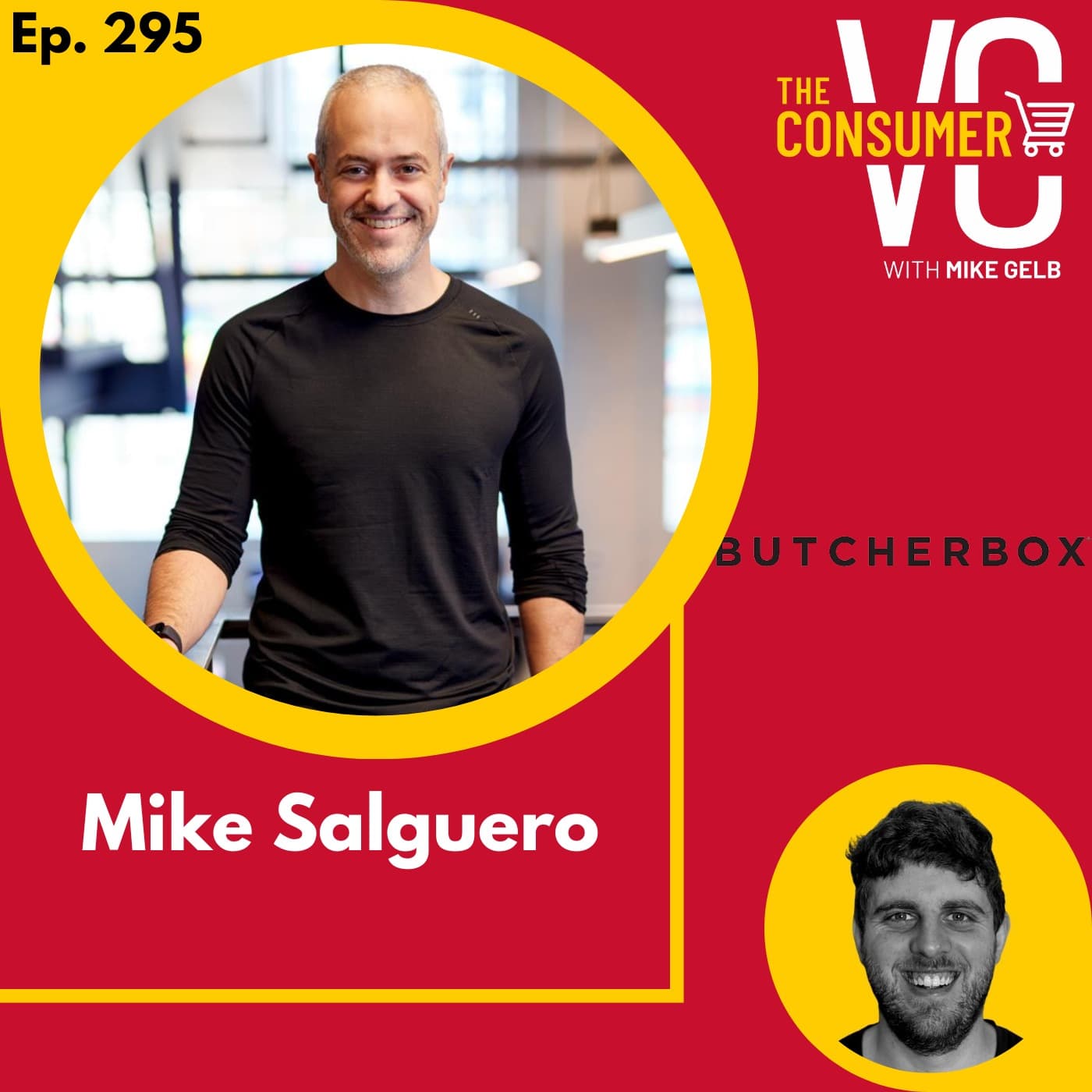
Episode Overview Title: Mike Salguero (ButcherBox) - How He Bootstrapped ButcherBox to $600 Million, Why He Didn't Take Any VC Money, And Lessons From Raising Money at CustomMade Host: Mike Gelb Guest: Mike Salguero, Founder and CEO of ButcherBox Date: [Insert Date]
Description: In this episode, Mike Salguero, the founder of ButcherBox, shares his entrepreneurial journey, the differences between bootstrapping and venture-backed businesses, and the lessons learned from his previous venture, CustomMade. Salguero discusses how he grew ButcherBox to $600 million in sales without taking any venture capital funding.
---
Key Topics Discussed
- Background of Mike Salguero
- Early Ventures:
- Co-founded CustomMade, a venture-backed company focused on custom woodworking.
- Raised $30 million through five rounds of financing.
- Faced significant challenges, leading to a foreclosure and a shift in the business model.
- Transition to ButcherBox
- Concept and Vision:
- Launched ButcherBox with the aim of offering high-quality meat delivered directly to consumers.
- Initially viewed as a potential "hobby business" with a focus on a lifestyle rather than aggressive growth.
- Bootstrapping Success:
- Achieved $600 million in sales through a bootstrapped approach, avoiding venture capital.
- Differences Between Bootstrapped and Venture-Backed Businesses
- Venture-Backed Challenges:
- Pressure to scale rapidly and meet investor expectations.
- Personal dilution of ownership and control over business decisions.
- Experience of "pushing a boulder up a hill" without product-market fit.
- Bootstrapped Advantages:
- Greater control over business decisions and company direction.
- Focus on sustainable growth without external pressure.
- Ability to build a company aligned with personal lifestyle goals.
- Growth Strategies for ButcherBox
- Marketing and Influencer Strategy:
- Leveraged influencer marketing to promote ButcherBox, especially among health-conscious communities.
- Utilized Kickstarter to gauge interest and secure initial funding.
- Operational Efficiency:
- Outsourced supply chain logistics and customer service to maintain a lean operation.
- Focused on a curated box model, minimizing the risk of overproduction.
- Insights on Funding and Investment
- Philosophy on Raising Money:
- Critique of the common narrative that raising venture capital is essential for success.
- Emphasis on the importance of defining personal lifestyle goals before seeking investment.
- Acknowledgement that some businesses, particularly tech startups, do require substantial funding.
- Lessons Learned from CustomMade
- Key Takeaways:
- The importance of aligning business models with market needs and consumer behavior.
- Understanding the operational complexities involved in venture-backed businesses.
- Recognition of the emotional and psychological impacts of fundraising pressures.
- Future of ButcherBox and Market Trends
- Retail Expansion Plans:
- Intention to enter the retail market, recognizing that 92% of meat purchases occur in stores.
- Grass-Fed Market Insights:
- Current growth rate of grass-fed beef is slow, with an aim to increase consumer awareness and demand.
---
Key Quotes
- "One of the biggest lies that entrepreneurs are taught is that you need to raise money in order to be successful."
- "When you're not constrained, you start to just think that you do things better than other people, and that's not the case."
---
Recommended Actions for Entrepreneurs
- Vision Planning:
- Conduct a visioning exercise to determine personal and business goals for the next 3 years.
- Evaluate Funding Needs:
- Assess whether raising venture capital aligns with your lifestyle and business model.
- Leverage Influencer Marketing:
- Explore cost-effective marketing strategies that resonate with target audiences.
---
Conclusion Mike Salguero's journey from CustomMade to ButcherBox illustrates the potential for success through bootstrapping and the importance of aligning business strategy with personal values. His insights into the pitfalls of venture funding and the significance of strategic marketing provide valuable lessons for aspiring entrepreneurs.
Written by AI. May contain mistakes. Listen to the episode to check what was said.
Transcript
Automatic transcript. May contain errors.0:00This episode is brought to you by Vobin from Carta. Vobin from Carta is the easiest way to launch and run your venture investing. They offer SPVs and fund vehicles for GPs at all stages of the journey, from your first syndicate to operating a multi-million dollar venture fund. If you're interested in investing in startups, stick around after the episode where I chat with Gabriel Shin from the Vobin from Carta team, who shares his perspective and tips about how to start investing and how Vobin from Carta can get you set up. The link to Vobin from Carta's website is in the show notes.
0:44Hey, I'm your host, Mike Gelb, and this is a Consumer VC podcast where we discuss the innovation within consumer and venture capital. If you're enjoying this podcast, I highly recommend checking out my newsletter at theconsumervc.com, where you'll receive all new episodes straight to your inbox and a weekly recap of all the consumer deals that are happening. Please note that all content and episodes are for informational and entertainment purposes only and is not investment advice. This episode is brought to you by Vauban from Carta. Vauban from Carta is the easiest way to launch and run your venture investing.
1:18They offer SPVs and fun vehicles for GPs at all stages of the journey, from your first syndicate to offering a multi-million dollar venture fund. If you're interested in investing in startups, stick around after the episode where I chat with Gabriel Shin from the Vauban from Carta team, who shares his perspective and tips about how to start investing and how Vobin from Carta can get you set up. The link to Vobin from Carta's website is in the show notes. Thank you, Daniel Gulati, for introducing me to our guest today, Mike Salguero. Mike is the founder and CEO of ButcherBox. ButcherBox delivers 100 % grass-fed beef, free-range organic chicken, humanly raised pork and wild caught seafood directly to your door.
2:02ButcherBox is a unique brand that we're covering on this show since it's actually not venture backed. Mike bootstrapped it all the way to 600 million in sales, which is pretty phenomenal. Previously, Mike was the CEO at Custom Made that was venture backed. So we discussed some of the differences between venture backed and bootstrap businesses when he knew that ButcherBox was going to be bigger than he intended, how to find businesses based on the lifestyle you want to lead, and ButcherBox's growth journey, which is pretty phenomenal. Without further ado, here's Mike. Mike, thank you so much for joining me here today.
2:38How are you? Great. Doing well. Thanks. So I want to start from the very beginning, or at least the beginning of your custom-made journey. So you bought custom-made initially. What was the premise behind the company? Why did you ended up purchasing it? And what were you kind of looking to achieve or the opportunity that you thought? Yeah, my co-founder and I were both working in real estate and really had a dream of going into business together. And in 2008, he was buying a custom coffee table and stumbled across his website, custommade.com and bought a beautiful coffee table from a woodworker in Maryland.
3:17And during the process of purchasing this coffee table, the maker's like, I make all my money from this website custom made and I pay$35 a year for my subscription. And so Seth, my buddy and I, two real estate guys were like, we call it a shack in Manhattan. This is like a shack in Manhattan. Great SEO, great foot traffic, lots of business happening. And what it needs to be is like re-pivoted and we need to spruce it up. So this was 2008. The website was being run by a webmaster who owned the website. It was making$35 ,000 a year in sales. And I reached out to him and was like, we'd like to purchase the website.
4:01And he didn't respond to me. A few months later, I was let go from my job working as a real estate developer. And I wanted to get let go. I was trying to get laid off so I could collect unemployment and start a company. And within a week of me being laid off, he wrote back and was like, I'll sell. This was 2008 when the world was kind of collapsing in terms of the financial world was collapsing. And we ran around town with a logo on a cell phone and went out to raise$500 ,000, 140 ,000 of which was to purchase a website. And then the rest was going to be to pivot the website to new technology.
4:46So people should be able to log in, manage their own profile, et cetera, et cetera. We had no web experience whatsoever. I was 26 at the time, so no running a business experience whatsoever. In fact, the first mentor I found, I literally was like, what do I do? What does a CEO do all day. And we got started. And that was a seven and a half year journey. We raised about $30 million of financing. We did five rounds of financing. The third round is when we finally got some VCs involved. Google and first round capital led a round. And then six months later, another firm that didn't get in in the first round.
5:32It's always good to have a firm that didn't get in in the first round so that they're like hungry to do another round. They wanted in. So then we raised, you know, 4 million. And then a year after that, we raised 18. And so very heavily, like heavily financed. And the business didn't work. You know, the original business was, which was a subscription business for woodworkers probably would have worked if we had not spent money as quickly as we did. But when we decided that we wanted to raise venture, we went out looking for venture capital and everyone's like, no, like woodworking business, no way, I'm not doing that.
6:14That's not transformational. And then we started talking about the potential of it being a marketplace, like where you as a customer could post something that you want and makers could bid on it. And literally as soon as we said the word marketplace, everyone wanted in our deal. This was 2011. It was Airbnb and Uber and this world of a two-sided marketplace was really hot. And people didn't want to miss out on the next deal. So we ended up raising a bunch of money. I mean, it didn't go well. What we were really good at was selling people on our vision without product market fit. And it was like pushing a boulder up the hill.
7:02We'd always be like, oh, we need to get to this milestone. And we'd totally miss it. And then we need to get to this one. And we'd totally miss it. And then our board is like, it must be a product problem. It must be an engineering problem. It must be a marketing problem. And so little by little, we went around the company and had to let a lot of people go and just tried and tried and tried and tried and tried to make it work and it didn't work. So ultimately we had a venture bank. We did a friendly foreclosure where they're foreclosed on the asset. My co-founder then did a workout with them. He still runs the company today.
7:34Custommade.com is now just a jewelry site and they do all the work. There's no like maker piece. It's like if you want an amazing engagement ring that is totally custom and half the price that you normally pay, you go to custom made and they can do that for you. Yeah, I'm actually now an investor in custom made. I'm still rooting for custom made. I'm rooting for my co-founder to turn it into the business we always thought it would be. But I left when the foreclosure thing happened. I and about 50 employees left. I was planning on taking like 100 days off and I ended up taking the weekend off and then starting ButcherBox.
8:09And when I started ButcherBox, I was okay with it being a hobby business. My vision for the business, I think entrepreneurs, before you start a company, you should think out three years and what does your life look like? My vision for the company was that it was a hobby, that I was in Argentina at a coffee shop and I was looking at my numbers. Then I closed my laptop and go about my day. That did not turn out to be the case. Once we launched ButcherBox, it really just like the snowball just started gaining momentum, which is a very different experience for me than the one I had been living for eight years at CustomMade.
8:47So during CustomMade, I mean, you mentioned how you pivoted the business from a subscription to a marketplace business, which a marketplace business, you're taking a percentage off the sale. Did you pivot to marketplace once you got word that VCs were interested in marketplaces or like what, and you wanted to raise from VC so badly? Or what was kind of like the initial reasoning behind actually pivoting that business? We had subscribers, right? And so we were calling new potential subscribers every day, like sending them emails and calling them and trying to get them to sign up for our site. And the biggest complaint we got was like, well, how do I know there's any work on that website?
9:25And so we created this thing called the job board. And the job board was like, like almost like a bulletin board. So people could post like, I live in Albany, I'm looking for a custom bookshelf, I have my budget$2 ,500, this is kind of what I'm thinking, here's a photo. So we built out that, the ability for people to do it. But really, it was so that we could point to the maker to it and say like, hey, look, there are jobs in your area, you should sign up so you can bid on it. And then when I was in a meeting, it was the summer of no, we called it, after we had been just told no by everybody, I was in this meeting and I was like, pull up the job board.
10:03We had just launched it. And you could like, literally, we set it so that you could like see the jobs rolling in, like it would refresh all the time. So we literally are in this meeting and it's like job. And I'm like, all we have to do is stand in between that and this transaction and we can be the largest marketplace for customer stuff. And I swear, as soon as I said the word marketplace, people are like marketplace, I'm in. Wow. Wow. And of course, not a listing of a marketplace that was that that kind of word um using that yeah so so then like we raised money against the vision of creating marketplace and then we launched the marketplace and once we launched the marketplace it started to like show signs of it potentially working and then that's when that like other investment came in six months later um and you know it just kind of snowballed from there and in your mind in terms of why the model you thought worked for vc funding Is that because you just thought that the opportunity was so huge that it made sense for VC?
11:01Here's the thing about VC. If you think about, so if you're an entrepreneur and you're in it, right? And you're 28 and you don't really know what you're doing, right? What are all the messages that the market is showing us? You go on TechCrunch. I bet if we went on TechCrunch today, the first five articles are about someone who raised money. uh you what go to entrepreneur magazine same thing um you watch on tv shark tank uh there is a constant stream of information that tells entrepreneurs especially tech entrepreneurs that the only way that they can be successful is to raise a ton of money and that is not accurate it.
11:46Like that is not the truth. There are way more businesses out there, entrepreneurs out there who went the path of not raising money and have like their own business that is like, they can do what they want. They can have the lifestyle that they want. There's like plenty of reasons to not raise money. And in our first company, I mean, if we had just stayed at the friends and family or the angel round, like we needed to raise money to like buy the$140 ,000 website. But if we had just stayed at kind of that amount, rather than being like, oh, everyone else is raising venture, we should raise venture.
12:21We would have done great. But instead, we got enamored with this idea of raising venture. And it was a big mistake. And, you know, like, look, looking back on it, I mean, I'm so grateful that people gave me$30 million to blow through and learn a ton of lessons and like, you know, I, I'm super grateful for that. So, uh, but I think that, you know, I, I get on podcasts and I write about this. Like, I think one of the biggest lies that, um, entrepreneurs are taught is that you need to raise money in order to be successful. That's not true. Um, now some businesses, like if you're, you know, if you're doing chat GPT, like, sure, you need to raise money.
13:07If you're trying to put a rocket on the moon, okay, go raise money. But if you're trying to build a website that is a subscription-based business, there are plenty of ways to not raise money and to still have a great business on your hands. What were some of the downsides that you saw from raising money in terms of maybe engaging with VCs or just your own experience? Well, I wouldn't put that the business didn't work on them. Although they bought into the marketplace concept. So when the marketplace concept wasn't really working, we weren't about to roll back to a subscription. On the positive side, you've got people who have a lot of experience looking at a lot of different stuff who can be helpful every once in a while.
13:55They have good insights every once in a while. On the negative side, you've got a board member who may have read the deck before the meeting, maybe. They've got a ton of deals that they're in. They're trying to generate new business. And they frankly don't have a lot of time for giving you the insights that you might need. And so they come in and they're like, the button should be yellow. You're like, okay, I mean, we already tested it and this color works. And they're like, I just think it should be yellow. Or like, why does this page look like this? It should be like that. And you're like, okay.
14:30Okay. Now, granted, usually what happens is your board is really great to start with. And then when the numbers aren't going well is when things get a little heated and toxic. And for us, I mean, we, and again, I don't blame the VCs for this, but we let our, you know, the whole founding team, the people who were there at the very beginning, like we let them go. So we had to up-level our team and get better people and hire for resume and all these other things that we were just kind of pushed into doing. So that's one. I mean, the second is dilution. I mean, by the end of Custom Made, I had a decent salary and owned 4 % of the company.
15:15And I kind of looked at that and was like, man, I could go get a CEO job. Not that anyone would hire me, but I could go get a CEO job and have a decent salary and get 4 % of the company. I worked myself into a job. And that's what happens. I think most people start with a business plan and I need to go raise money. Instead of a lifestyle plan, what kind of lifestyle do you want to have? And then figuring out if that makes the most sense, if raising money makes the most sense for the lifestyle you want to have. Having VCs is a lot more of work. You have to update them and talk to them and answer their questions.
15:59And they put in provisions that means that they control you and can throw you out whenever they want and all this other stuff that you have to navigate. And it's a lot harder. I think people are like, oh my God, I need to go raise money. And then they're like, oh, I raised money. Thank God. And it's like, that's when the hard work starts. That's when you have You serve other masters than yourself and your customers, and that can be tough. And so when I started ButcherBox, I was like, I'm not raising money. I don't care if the business is small. I'm not raising money. And I've been tempted many times.
16:31I think I've received one term sheet. I've gotten into some really interesting conversations, and we have continued to stay true to the, hey, let's do things a little differently and not raise money. And honestly, I think we've had some pretty amazing growth and success. I don't think we'd be in business right now if we raised money, given the timing, given everything that happened. I literally don't think we'd be in business. Why don't you think that? We started in 2015. So if I wanted to go raise money as a founder who had raised money, I probably could have raised several million dollars and gotten going.
17:092017, Blue Apron goes public in the summer of 2017. their stock price starts at like$140 and within three months is at like$35 or$40. Just eroded all the value before the people could get out of the lockout period. So basically money just dried up. Like all, like there were so much money in box subscription. Blue Apron had done like a, um, uh, a$2 billion valuation raise right before going public. And like the money just dried up immediately. And so what happened was like Plated and Green Chef and you name it, they all just kind of like got sold or went under. And so that would have been us. We would have been in 2017 trying to raise money, like, woohoo, look at our numbers.
17:55This is great. We're losing money. And one of the great things that we had to do as a company was to come out of the gate making money on every transaction. So we had to think about scrappy ways to market rather than like, let's just use Facebook. And really, we stumbled into this like influencer marketing where we reached out to people who followed a paleo diet, like dietitians or like the Whole30 diet, stuff like that. And these people wrote about us. And it worked. And we would not even be looking in that channel if we had gone the traditional route well so i mean they say that of course like timing is everything and timing is everything um of course concerning to business and it seems like one of the timing part that you pounced on was the actual influence for marketing maybe starting to heat up what were maybe three or four of the other parts of as you look back and the success at butcher box where it is now where maybe like three or four things that um the timing just happened to be right and you were able to really take advantage of it well i think the business in general so we launched uh we launched on a kickstarter uh in september of uh 2015 the september issue of consumer reports was the case for grass-fed beef so i think just like oh the timing of the whole business was like perfectly primed um so there's that uh influencers worked really well we um we were pretty early on facebook video so like in 2017 and 18 uh it was pretty clear that uh zuckerberg slash facebook were going to be prioritizing uh video content like if you you started looking at your wall and you're like there's a lot of videos here um and so we just we just went into um doing videos kind of before other people did uh and And so that was a nice little hole in the market for a bit.
19:55How were you also thinking? Because as you said, like when, you know, one of it seems like one of your pieces of advice to entrepreneurs is when you think about starting a business, think about the lifestyle you want to lead when starting a business and how with venture backed, you kind of always have a boss, so to speak, which is your board, whereas you're not, you aren't. What were kind of like the lifestyle that you wanted to achieve? And also, I mean, like, how did you also approach it? if the lifestyle maybe was more relaxed per se, um, than a, um, then, then it wasn't custom made, at least when you were ventured back to custom made.
20:29Um, I mean, shipping and dealing with a grass fed beef sounds like a pretty complex, um, complex, um, supply chain and a complex, um, kind of product that you're actually delivering to consumers. How, what was kind of the start there? Yeah. So I wanted to run a hobby business, right? I, the, the idea was if I got a thousand subscribers and I, and I got a$20 profit from them. I'd have enough money to like pay for a few people and make my nut and like not have to work. That was the idea. Right. So, um, yeah, it seems complicated, but actually we found a cutting facility that cuts steaks and, uh, steaks and pork and chicken.
21:09Cause we started with beef, chicken, pork, um, does all the cutting on one side of their business and then all the, the frozen fulfillment on the other side of business. So they were like shipping out boxes to our customers. So we had like one company handling the cutting and the fulfillment. I outsourced customer service. I, you know, I had a team that used to build websites for CrossFit gyms, build the first website. uh we use code that was easily like you know um it was like basically wordpress on top of stripe um so that like i could find uh odesk workers to be able to like i guess upwork now um to be able to like work on um and so yeah no it was like set up as a hobby and then even down to like so one um meat had not been sold on subscription really like omaha stakes was the biggest player omaha does was, um, uh, gift giving.
22:06They don't do subscription. Right. So, uh, that was unique. And the reason why is because I wanted it to be a hobby business. Uh, two, we did this thing where it was a curated box. And what that meant was like, we were going to ship you whatever we wanted to, you were going to give us$129 and we were going to ship you whatever we wanted to. Why did we do that? Well, we didn't have any money, so we didn't want to guess at inventory levels. Like we didn't want to be like, Oh, how many ribeyes are going to be sold this month? we wanted to say like here's a box we're gonna put together the box with the great stuff that we think that you'll want and ship it to you and that that worked well how how also did you think if it was you know meant to be a hobby business and meant to have you know this ideal where we have like a thousand customers that are you know a really kind of small but very robust customer based you're making maybe 20 bucks um um on each customer so you can have this incredible life's all business when did that thinking begin to flip because now you're at i think like 600 million it's like a pretty large um business when was that kind of thinking that oh wow i actually have something here that is much larger than what i initially set out to be it was like day two of the kickstarter yeah because it just started being pulled like we started being like it just it just resonated and it it we started seeing a whole i mean within three days on kickstarter i think we're up to like 100 grand in purchases.
23:27And it was clear to me that we had something bigger on our hands than the hobby business that I had wanted to start. But even still, there's a way in which you can... So I tell people, I think entrepreneurs should go and do a visioning exercise where you think about your life three years in the future. And what are you doing? What does your day look like? Are you going to the gym before you go to work? Are you actually working from home? Are you hanging out with your kids? Blah, blah, blah, blah, blah. What's your day? The whole thing. Describe it. Are you in an office? How many employees? Who are you interfacing with?
24:02What do you do all day? Are you in your zone of genius? Are you doing the work that you love? Everything. Oftentimes, it's like go for a walk, let your heart speak, and write down what your soul is telling you rather than your head. Get out of your head, write something down. I think business plans are very in your head versus let your heart speak and see what happens. in that plan. So my plan was like, I'm going to be in Argentina. I'm going to look at my numbers. It's going to be very hands-off. I'm going to be able to travel a bunch, like all this stuff. And the reality is that like, yeah, the business wanted to be, ButcherBox wanted to be bigger than I ever imagined.
24:37But the plan actually, if I, if what I did, when I looked at the plan three years in and said like, Hmm, does this make sense? The plan was like pretty spot on because I had built the business in a way in which it was still like a hobby, where obviously it was bigger, more employees, but because I hadn't raised venture and because we hadn't taken on big expenses like our own distribution center, our own cutting facility, because I still believed in a model of outsourcing to great people, et cetera, et cetera. It ended up, it continued to be like what I intended it to be. No, that's also interesting how you also thought about your own supply chain and actually kind of outsourcing that and making sure that you're actually aren't owning that to, again, be kind of a, for it to kind of be a, even though it's massive, but like more of like a hobby business in terms of how much time you have to spend per week in order to kind of keep it going and keep it alive.
25:40After like day one or day two of Kickstarter and you realize that this is actually a way bigger opportunity than you initially thought, what were also some of the ways you were able to kind of capitalize on that? Well, we just ran the influencer strategy for two and a half years. That's all we did. Again, when you don't raise money, you don't have the luxury of like, let's try 97 channels and see which one works. You don't do that. You're looking for very small, cheap signals that something's going to work. In our case, we had an influencer write during our Kickstarter campaign, write a tweet that was like, this is an interesting thing.
26:14And we saw a bunch of people sign up. and it was by a bunch i mean like 10 or 7 or something right so very few but but it was enough it was like a signal it's like oh influencer this could work and then we just like went after every influencer in uh keto paleo whole 30 like anything anyone who is like on the cutting edge of go eat grass-fed beef because it's healthier for you we reached out to all of them and within two years we all of them had promoted us as a you know their choice for grass-fed beef how do you think about like the grass-fed um beef market like moving forward how do you think about from a gross perspective is there is there still like a lot of room for it to grow yeah grass-fed beef is and again we don't just do beef we do beef chicken pork bison lamb seafood like we do everything we're trying to compete against like you going to the back of the grocery store um uh and we're trying to be in the grocery store.
27:10So grass-fed beef is unfortunately not growing that fast. The recent data that we've seen projects a 4.5 % increase year over year. You know, we're still dealing with like 2 % of the overall meat consumer in this country is grass-fed. And when you go to school on the way in which animals are raised and the difference in like their quality of life by being grass-fed versus being confined-fed, the choice is pretty clear that grass-fed is the way to go. And so what we want to do as a company is our mission is to transform meat. It's basically to provide you meat that you don't have to feel guilty about.
27:53You know, unfortunately, that space, it's growing. And I think if we looked at 20 years from now, I think it's going to be, hopefully, if we do our jobs well, it'll be a majority of the meat consumed in this country is meat raised right. But that's not where we are today, and it's not growing fast enough. How then, when you're partnering with farmers and also on the supply side, how do you also think about product quality? Since, of course, you're not owning your own distribution. Here's the thing. I think that it's a common misconception amongst entrepreneurs, especially those who have taken a lot of funding, to believe that you can do it better than a different company.
28:36And oftentimes it's like, well, we need to do our own distribution because our employees will care more. And it's like, well, I mean, that's kind of true. But we believe in a model more similar to Toyota, which is like, how do we hire the best vendors we can find and then hold their feet to the fire in terms of quarterly business reviews and like, let's improve this and, you know, like telling people what needs to be improved and then kind of working with them to improve far faster than starting your own anything. and where a lot of these companies have failed if you look at like you know blue aprons trading at 43 million dollars or something um is they spent a ton of money on building out their own infrastructure now sometimes like in the blue apron case it's like well we had to because like nobody was chopping vegetables and putting them in the in in bags like okay um but you know they they may have completely had to think about things differently if they didn't have funding it's like we can't chop it we need to send you the whole vegetable or something like it's a it when you're not constrained you start to just think that you do things better than other people and that's not the case so you know you're asking the question like how do you keep quality of product if you don't own it i actually think by not owning it you have a much better chance of having a high quality product how does this relate just think about you know obviously the product that you're delivered, whether you should own it versus not own it, and as well as in custom made when you were there, being VC backed versus ButcherBox, which is, of course, bootstrapped.
30:16Think about all these things when it comes to your own kind of angel investing philosophy in consumer startups, what has to kind of be right in your mind in order for you to be interested? Yeah, well, I'll say this, but I don't want to encourage a lot of inbound because I am trying to sit on the sidelines right now in terms of investing in other companies. So I used to really scrutinize my investments early on. I made my first angel investment in
Read the full transcript
30:512011 and really dig into everything and then write a check. And it turns out that the things that I reluctantly wrote a check to are the things that had a 7x return. And the things that I'm like, oh, this is going to work, didn't return anything. And what I've learned is that I'm not very good at... And so I think it's more about managing a pipeline. How do you get invited into interesting deals? And then just saying yes. Just write the check. You figure out an amount that you are okay losing. And then I just write a check basically to everybody. Again, I'm not doing that right now, but that I don't have a very good angel investing philosophy, which is actually why I've now allocated more capital to becoming an LP in funds.
31:44Because I just prefer someone else to do it for me. So while I'm very anti VC, I do invest in the anti VC for certain businesses, I do invest in the asset class. Why then if you are anti VC for certain businesses, what, what types of VC funds kind of, uh, piques your interest? Is there like particularly categories or, or they could be a generalist or, um, it turns out what they invest in. I tend to invest, well, actually in all of them. And this is true, largely true for the investments I make as well. I tend to invest in like people I think are good operators, like people who, um, I've seen out there for the past 10 years, just doing good work.
32:22Those are the types of places I like to invest in. That's great. That's great. And I remember you mentioned back to ButcherBox that you're also, I guess, have plans to go into retail. Why go into retail at this point? 92 % of the meat purchased in the United States is sold at retail. So, well, 92 % of the meat that's going to be prepared at home is sold at retail. Obviously, there's food service as well, which we could also try to go into. We want to fish where the fish are, right? So even though COVID dramatically changed the numbers in terms of how many people were getting D to C direct to their door meat, the number is still pretty small.
33:05And so we believe like what we're trying to build here is a beloved brand that's known for doing things right. and I don't think that that needs to just be an online experience. I think if you want to be a brand, well, the place where most brands are purchased is the retail store. And if you think about it, there's actually not many brands in meat. The number of brands in meat that people can name is generally less than five. So it's a massive space with, I believe, quite a large white space of having your own brand. What's one book that's inspired you personally and one book that's has powered you professionally?
33:44Personally, well, it's kind of like professionally and personally, but The Big Leap by Gay Hendricks. Cliff notes on that one is everybody has a thermostat of joy that they allow themselves to feel. So let's just say your thermostat's set at 72 degrees. What happens is if things are going really well in life, you know, new kid, business is doing great, you're feeling in shape, like things are going great. If you go above the 72 degrees, you start to sabotage your life to bring yourself back down to 72. And so the book is all about the practice of like noticing that that's happening and also reinforcing to yourself that you deserve to be happy and you deserve more joy.
34:31So you can go from 72 degrees to 73 degrees to 75 degrees. and that's been personally very good for me because I had a lot of stuff go really well. Not only did I have a business that took off beyond my wildest dreams, I also was blessed to have, I was a year into the business and I had identical twin girls born, which is a one in a hundred chance. And I just felt like all of this amazing stuff happening and kind of freaked out. It was hard to appreciate that. And I started to self-sabotage rather than being okay in the moment and telling myself I needed more or I deserved more joy. On the professional side, man, I read a ton of books.
35:24Well, this is like a personal professional one as well. But the 15 commitments of conscious leadership is really good. I'm a big fan of this idea of conscious leadership, which is like awakening to your triggers and the things that pull you out of love and curiosity and put you into fear and anxiety. And that's a really good one. And then on the real business business book, I mean, the whole Jim Collins, Good to Great, and the other one built to last and the other one are great. Yeah, there's a, I mean, there's a ton of books that are worth reading. No, I appreciate that. The Big Leap, we haven't had that one mentioned before the podcast.
36:05So very original, Mike, very original. Yeah. Excited to add that to the book list. On the leadership side, how do you feel that your leadership style might have changed ever since when we were first CEO at Custom Made all the way up till now? So custom made, I had a co-founder and a board and a lot of pressure and didn't really have the confidence. I was 26 and didn't necessarily have the confidence that I knew what I was supposed to do or knew what I was doing. My tendency now is I'm a heart-based leader. My goal, part of my job is to love my people, love my employees, love my customers, love our vendors, just love.
36:49And so I lead with my heart. I am oftentimes blamed for being overly generous or too idealistic or whatever. And I just believe that people actually work. It used to be that you come to the office every day, but you work more than you do spending time with your family. People are making an enormous sacrifice to be working for me. And I try to honor that and feel that every day rather than just try to extract from them because that's just not how it works. I used to be more of a fear leader. um you know my co-founder and i would walk around and be like hey you coming in on saturday and like you better there was a lot more fear and i think frankly that was our fear that we were just like pushing on everybody else um and that doesn't work i i'm i'm a big believer in just opening my heart and um being a heart-based leader appreciate that i appreciate that um well mike i really appreciate you coming on the show thank you so much for your time yeah thank you appreciate it and there you have it.
37:58It was a pleasure chatting with Mike. I hope you all enjoyed this one. Gabriel, thank you for joining me today. How are you? Yeah, really great. Thanks for having me, Mike. No, it's a really, really appreciate it. So what do you feel like, you know, maybe on the SPV side things and also on the emerging managers side, what do you think that they maybe struggle or have like a hard time with? Yeah. So I think with the angel side, a lot of angels will be investing directly and some are unfamiliar with the concept of an SPV. Syndicating is a concept that's used in the financial markets, whether you're a bank syndicating loans or a bank syndicating investments.
38:44It's a really good way to share your network, deal flow with your network, get into those really competitive deals by having those higher minimum tickets, pulling those funds together. So I think for angels, the concept of SPVs and syndicating is relatively still new. And there's a large market where I think they would significantly benefit. You're able to also monetize off that deal flow as well. So you can charge carry, which is a portion of the profits upon an exit scenario, or you can charge fees. So finding an opportunity, trying to fundraise for the deal is a lot of hard work. And sometimes being compensated for that does definitely help incentivize the deal.
39:32For emerging fund managers, it's a really great way to start building your track record. So when you're talking to LPs or investors, one of their strategies is, you know, how do I get some co-investment opportunities or direct investments? And so building that relationship, showing your deal flow allows you to build those relationships with those LPs to ultimately invest into your funds. Additionally, it's a really good way to kind of show, you know, your track record of, you know, the companies that you've invested, were the ability to fundraise, getting access to those top deals, and then going out to the market and showing a track record of your resume.
40:13So it definitely paints a better picture than saying, one day I want to be a VC fund manager and not having anything to back it up with. No, I appreciate that. Yeah. And for anyone that's listening that doesn't quite understand what an SPV is, how I think about it as well is that you're almost raising a VC fund, but on one deal. So you raise it from other people, but it's just solely on one deal. So you get like, and maybe an allocation from a company. Let's say it's like a 200k allocation, maybe you put up 20k in that 200k allocation. And then it's your job to go out and and to actually fulfill the rest of the round with other investors.
40:52And then as Gabriel said, you can charge a carry from it. So that's like a percentage of the profits. So that typically is around like 20%. Is that roughly right? Yeah, that's exactly right. So SPVs or a special purpose vehicle is a legal entity that's incorporated. In venture, it's predominantly used to pool funds together, invest into a single asset or company. And with that, you have the functionalities of commercializing some of that, the legal entity. So, you know, as you mentioned, earning some carry, earning some upfront fees, and really compensating your hard work for fundraising. If you are loving the show, I highly recommend checking out the newsletter at theconsumervc.com where you'll receive all new episodes straight to your inbox and a weekly recap of all the consumer deals that are happening.
41:43I'm also doing some more events. So you'll also be the first one to receive information about those.
41:56You
From the publisher
Thank you Daniel Gulati for introducing me to our guest today, Mike Salguero. Mike is the founder and CEO of ButcherBox, which delivers 100% grass-fed beef, free-range organic chicken, humanely raised pork, and wild-caught seafood directly to your door. ButcherBox is a unique brand that we’re covering on the show since it’s not venture-backed but bootstrapped to $600 million in sales. Previously, Mike was the CEO at CustomMade which was venture-backed. We discuss some of the differences between venture-backed and bootstrapped companies, when he knew that ButcherBox was going to be bigger than he intended, how to find businesses based on the lifestyle you lead, and their growth journey.
***Sponsor***
This issue is brought to you by Vauban from Carta. Vauban from Carta is the easiest way to launch & run your venture investing. They offer SPVs, and fund vehicles for GPs at all stages of the journey - from your first syndicate to operating a multi-million dollar venture fund. Their end-to-end platform automates your back-office and manual workflows so you can focus on what matters: finding the next unicorn & building investor relationships.
Click Here to Get Started - https://structurer.vauban.io/