
In short
Consumer VC Podcast Episode Summary: Rakesh Narayana (Access VC)
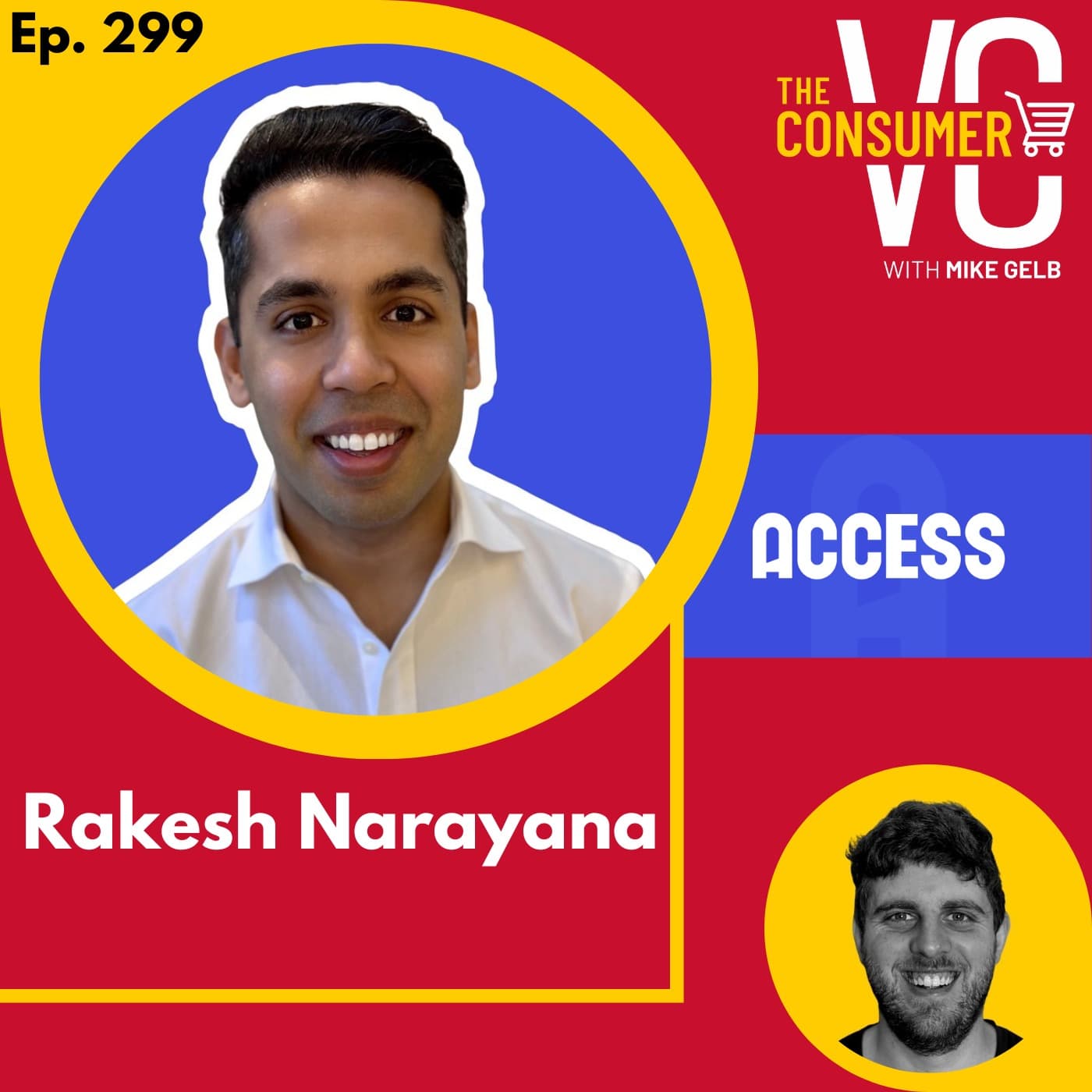
Podcast Title: Consumer VC: Venture Capital I B2C Startups I Commerce Episode Title: Rakesh Narayana (Access VC) - How They Are Changing The Image of Corporate Venture Capital, and How They Evaluate Opportunities From an Exit Potential Host: Mike Gelb Guest: Rakesh Narayana, General Manager at Access VC
Episode Overview In this episode, Mike Gelb interviews Rakesh Narayana, who heads Access VC, the venture capital arm of Reckitt, a consumer goods conglomerate. Rakesh discusses the unique approach of Access VC to corporate venture capital (CVC), addressing the industry's reputation and focusing on exit potentials when evaluating investment opportunities.
Key Topics Discussed
- Corporate Venture Capital's Reputation
- Challenges: Corporate venture capital (CVC) often suffers from a negative image due to perceived toxic terms and lack of transparency.
- Access VC's Differentiation: Rakesh emphasizes that Access VC aims to create a transparent investment structure without toxic terms that could hinder startups’ growth and exit options.
- Rakesh's Background and Journey
- Raised in India, Rakesh's journey into consumer brands began with his early career working in a Chinese factory for Reckitt, focusing on increasing the gross margin of Durex condoms.
- His fascination with consumer brands stems from their profound impact in developing nations where brands often fill gaps left by traditional institutions.
- Investment Philosophy
- Focus Areas: Access VC primarily invests in consumer healthcare and hygiene, with a significant portion (80%) directed towards consumer brands and the rest (20%) towards consumer enablement companies.
- Investment Criteria: Rakesh highlights the importance of gross margins, consumer engagement (aiming for a minimum of 100,000 loyal customers), and the brand's identity tied to positive impact and sustainability.
- Exit Strategies
- Rakesh discusses various exit pathways for startups: acquisition by large strategics, private equity, or aggregators.
- He stresses the importance of understanding potential buyers and creating long-term value for them, rather than just focusing on short-term exit valuations.
- Retail Strategy
- Rakesh advises startups to approach retail incrementally, starting with smaller stores to prove their concept before scaling to larger retailers.
- Categories lacking maturity, like menopause products, require careful navigation due to potential market misalignment.
- Investing in Underserved Categories
- Rakesh brings attention to categories like menopause products and sexual wellness that are currently undervalued and lack significant investor interest due to demographic biases in the VC landscape.
- He stresses the need for diversity in VC to appropriately address these areas.
Key Takeaways
- Incremental Approach to Retail: Start small, gain traction, and then scale distribution to larger retailers to avoid failure.
- Diversity in VC: A diverse investor background is crucial for understanding and supporting emerging market needs.
- Exit Planning is Essential: Founders should consider exit strategies from the start, aligning their growth with potential buyer interests.
- Sustainability Matters: Modern consumers, especially younger ones, prefer brands that possess a clear positive impact and sustainable practices.
Conclusion Rakesh Narayana provides insightful perspectives on how Access VC is redefining corporate venture capital's role in supporting consumer brands. By focusing on transparency, sustainability, and understanding the unique challenges of underserved categories, Access VC aims to pave a path for meaningful investment in consumer innovation.
---
For further insights and updates, listeners are encouraged to visit [Consumer VC's website](http://www.theconsumervc.com) and subscribe to the newsletter for updates and weekly recaps of deals in the consumer space.
Written by AI. May contain mistakes. Listen to the episode to check what was said.
Transcript
Automatic transcript. May contain errors.0:00Look, I think it's a question of when do you go to retail. I think it's more a question of who you go to and at what scale. My advice has always been go to retail and just crush it in those 20 stores. Do not go to Target until you've crushed them. And when you go to Target, it's easy to say, hey, Target, can I have every store you have on every store in all of America? You'd rather start with saying, hey, can I get distribution in like 500 stores? And that's all I want. And can I prove it to you guys that this works? And once you do that, you want them asking you for more distribution. When you're in that position of sort of power, if you would, they're saying, hey, let us put you on every store.
0:46I think that's when you win retail. So I think small, incremental, very careful steps in retail is what I always attack people on. Hi, I'm your host, Mike Gelb, and this is the Consumer VC podcast where we discuss the intersection of venture capital and consumer innovation. If you're enjoying the show, also subscribe to the newsletter at theconsumervc.com where you'll receive all new episodes straight to your inbox and a weekly recap of all the consumer deals that are happening. All content and episodes are for informational and entertainment purposes only. It is not investment advice. This episode is brought to you by Vobin from Carta.
1:22Vobin from Carta is the easiest way to launch and run your venture investing. They offer SPVs and fund vehicles for GPs at all stages of the journey, from your first syndicate to offering a multi-million dollar venture fund. If you're interested in investing in startups, stick around after the episode where I chat with Gabriel Shin from the Vobin from Carta team, who shares his perspective and tips about how to start investing and how Voban from Carta can get you set up. The link to Voban from Carta's website is in the show notes. Our guest today is Rakesh Narayana, who is the general manager at AccessVC.
1:58AccessVC is the venture capital arm of Rekit. Rekit is a publicly traded consumer goods conglomerate focused on the hygiene, health, and nutrition spaces. You probably recognize their brands Lysol, Dettol, and Calgon. So AccessVC is the venture arm that Rakesh leads. Some of their investments include Beekeepers Naturals, Mod, and Future Method. In this episode, we're going to talk about corporate venture capital, which doesn't have the best reputation in the world of venture. And we're going to be talking about how AccessVC approaches corporate venture capital a bit differently than what it's known to be, in a great way.
2:35We're going to be talking about their different approach, how they make investments, and how they think about exit potential and talk about exit potential with founders. I really enjoy this conversation. Without further ado, here's Rakesh.
2:51Rakesh, thank you so much for joining me here today. How are you? Hey, Mike. Thank you for having me. And I hear you're nearly at your 300th episode, so congratulations. Yeah, who knows? This actually might be episode 300. So I'll have to do some calculations, but either way, it will certainly be a special one. Very good. Hope it's not so bad that you have to shut down your podcast after this. I hope that doesn't happen. Oh, man. No, no, no. Not at all. Not at all. So let's start from the very beginning. What got you interested in consumer brand? How did you end up at... So I am originally from India, and from a very sort of traditional middle-class family in India.
3:29One of my team once asked me, like, hey, what was your childhood like? And I said, If you open Google and type Indian family on a motorcycle, you'll find pictures of four people, two kids on a motorcycle. And that was pretty much a summary of the kind of family I came from. So I grew up in India most of my life. I was a bit of, as you guys in the U.S. call it, like an army brat. So I moved around quite a lot of places and lots of schools and all of these things. and one of the things that I've always found fascinating about living in India and since then having moved to London for university and then most of my career is that in countries which are developing where there isn't a lot of infrastructure, etc.
4:19Brands have a lot of ability to impact your life, right? Like in the West where you start to think about brands like governments and the FBI and the IRS and all of these sort of systems in place to help you as an individual. In most of the developing world, people think of brands. You think about mobile phone and telco, you think of a brand. You think about healthcare, you think of a brand. Everything is driven by consumer brands. And I think when you come from developing markets, you sort of have this sense of brands are like ultimate. So that's one reason I've been fascinated by consumer brands.
4:59on the other side of things i've always said um you know i was raised for a lot of my life by my grandmother um and now i have i have a two-year-old daughter and i've always said i'd like to do things that both ends of the spectrum really understand what i do right uh so when i say i work on a brand and like my grandma gets it she's like more much more excited than if i ever said i worked in investment bank right and and so therefore it's fascinating and on the flip side you know So when my two-year-old is old enough to understand that I drink Oatly and I work on brands like that, there's a lot of fascination.
5:36I've been making our baby chinos with Oatly. It's actually quite funny. It's the most millennial thing to do. So that sort of availability and people knowing about what you do and sort of being in everyday culture is something that's always fascinated me. So that's how I got interested in consumer brands. how I got into it is a whole different story when I finished university I was originally going to go work for a consulting house here in London and one of the executives at Rekit who is now retired had this fascinating idea look we're going to take kids who've come from Asia and we're going to send them but who've studied in the west who've studied in Europe and in the US and stuff and we're going to come back to Asia and help them build businesses and you know help them support records core infrastructure then so my first real job believe it or not was working in the world's largest condom factory in China right like so like 22 years old yeah I got I got shipped out there uh you know and uh to a city called Qingdao which you know forgive my geography I'd never heard of until sort of two days before uh I'd been to and it has like nine million people it's one of the most developed cities in the world and it's you know in the in the west edge western edge of china and i turned up there with like you know all these bits of how companies work and brands work and people operate and all of those things went went for a toss and i had to sort of learn what consumer brands are ground up in a factory in china where my first job was to increase the gross margin of durex condoms by 10 percentage right and that was That's an interesting way to start your career.
7:23So that's how I got into consumer brands and sort of have grown up in CPG since then, worked in consulting for a few years, and more and more recently at record at running their venture capital division. That's a pretty incredible experience right out of the gate from college. Yeah, for sure. And, you know, for the first sort of, I don't know, two years of my life, you know, working there, I couldn't stop giggling every time we would have a management meeting like a child. You know, we would have meetings and we would be talking about like condoms and lubes and, you know, sex toys. And, you know, I would just be in the corner just giggling and people would just be like nodding with a sad nod.
8:04but you know doing that is always sort of made me realize one one the scale and the and the reach that consumer brands have in the world like the fact that you know we we don't really know each other but we can talk about a brand like you know coca-cola or nike or dulex or whatever and have a lot to talk about right is is something that you know we wouldn't we wouldn't particularly do on many other topics so that's that's something that i think i've always found that access i think is it's fascinating no totally i mean if you look at like any any type of category you're usually affiliated with one or two brands that obviously produce that that item in that category and um and you and you already have that kind of that affinity with it um which i think is i agree with you what's pretty cool about brand i mean it's also just like you know i mean i was talking with um uh with a um operator investor and he was saying how one of his friends started like a you know, a very successful software company, but also had this like consumer brand that he did on the side that he started and he did it at dinner parties.
9:08All people wanted to ask about was the, you know, consumer brand that he was working on, not like this, you know, successful software company. So no, no disrespect for software. Cause we definitely have a lot of software companies on the show and what they're building is very interesting stuff. But I, I do agree with you that, that, that in terms of what, if what, what can be like interesting conversations and what actually could unite people. It's, it's talking about brands for sure. So you worked a few years in consulting, you worked at Reckitt. How did you transition to their VC fund? Why does Reckitt have a VC fund period in general?
9:46Yeah. So I think on the first question, I worked in consulting and I'd spent most of my time in consulting, working on helping smaller companies raise or exit to bigger companies. So that was a big focus area of mine. But the other point of focus, which was just an upcoming topic at the time, was e-commerce and digital for larger companies. There would be large billion-dollar battery manufacturers and so on and so forth. We're like, hey, look, we've got this very sort of offline business. How do we think about building e-commerce? What is this thing called e-commerce? right like d2c was not even a thing then um and and helping them build that was was sort of my core thesis and after having done that for a few years i came to came join racket uh as sort of chief of staff to the president of our group um you know and and their their traditional sort of consulting exit path so when you're like 25 worked in consulting for a few years you go do a chief of staff role thing right it's it's a it's a relatively traditional path you take um and when When I was in CPG and I've spent enough time here, one of the things you realize is, and this is not just true of CPG, it's true of all large companies, that in a world where like a Nestle and a Dunno and all of these kinds of big multinational exist, how could an Oatly be from a startup from Sweden?
11:07I just don't get it. Where is this coming from? Because they have surely more resources, more people, more talent, everything. So how do all of these startups emerge in CP? And this is the same thing at Racket. We have all of these categories where we're market leaders in, but you still see the real ultimate cutting edge stuff coming from a lot of really interesting startups who are experimenting with new technologies or experimenting with new consumer groups and insights and so on and so forth. So there is almost a systemic thing where when you're large and when you're a big ship, you miss out on the speedboats.
11:47You're never launching speedboats, and the speedboats are always the emerging brands. So that sort of conundrum, if you will, has always excited me. And when I'd done my chief of staff role for a few years and I was figuring out what we wanted to do, one of the theses we submitted to the CEO was like, hey, look, we'd like to build a consumer VC. And then he was like, get out of my room because 20 other people have done this before. What are you guys going to do differently? Like, you know, every CPG out there has got one. No one's ever created any value. Oh, and by the way, if you go ask startups, they're going to tell you all these CVCs are like, we don't want to take money from them.
12:25So the whole thesis was like, you know, this is not going to work. So we went away. We're like, okay, we're going to take some time. Rethink what it is that we want to build. And then we came back and pitched V1 of what we have now, which is Access VC. And Access VC, like it says on the name, was a bit of an antithesis to CVC. So we were like, hey, look, let's look at what are the five, six big things of CVC that people hate. People hate the toxic worms. People are worried that if you take money from a CBC, you have no exit options. People are worried you're going to have too much control. All of these things.
13:02And we're going to reimburse them and say like, hey, we're going to start a fund which is going to be super transparent and open about how we take capital and who we take capital from. We're never going to have a toxic term in our term sheet. We're going to be committed to the fact that all of these startups, if they exit, they would exit to the best home possible. And so on and so forth. So we wrote down this thesis and then we pitched it to the CEO. And it was like, yeah, I still don't buy it. Go away and think about it more. Because it's not unique enough. And then we were like, okay, we're going to come back.
13:35And we said, what's the one thing we can build that is going to show credibility that we are who we say we are? And the inception of that was B Corp. right so we said let's let's try and figure out if we can we can be the first VC that gets a B Corp certification because when you have a B Corp you are committed not just sort of as a company but also legally right that you will follow the the commitments of being a benefit corporation and we've been working on that for sort of 18 months or two years and and you know in perfect coincidence I think just a week or two ago we've just got a B Corp and we have officially become like the world's first corporate venture capital with a B Corp.
14:19So that's a bit the thesis of how we started. Okay. So can you give an example of what toxic terms like CVCs traditionally have done? Usually it tends to be things like, okay, you have an investment from X food manufacturer. Oh, by the way, you can never take money from anybody else in the food manufacturing space. you have 20 % of your company is in equity with these guys. So if you ever have to exit, you can only exit to them. Or you have, oh, when you launch a brand, you can never launch a brand which is competing with our core business. So you have a whole variety of these things or you can't enter a new market where these big companies have a big footprint.
15:10So there's been multiple restrictions put from corporate venture capitals in the past. And I think a lot of that has changed now. But I think a lot of that negative sentiment still lingers in the market. What happens if you have a portfolio company and Rekit is interested in acquiring that company? and yet there's another, there's maybe like a Biddymore or another company that's also interested. If you're on the board of that company, do you have to say, okay, this is a conflict of interest. I'm not going to vote in terms of what actually happens or be part of what happens or how does it actually end up working out in your mind?
15:56Yeah, look, it's a very good question. And I think the first thing to say is until a company is sold, the company is owned by the founder right it's not owned by the vc it's not owned by the cvc it's not owned by the investors it's the founder's company and ultimately the first sentence of our thesis is like companies and startups should go to homes which is the best place for them right so if we are interested to to work your scenario right if say we're invested in the company and we're interested in acquiring them but there are other people as well what happens is like as soon as even the discussion of an exit or an acquisition comes out, we're on the board, we lead the board, right?
16:37Because we say, we tell the founders, and it's actually in our term sheet, if the founder at any point feels like there is a conflict, they have the right to say, please, can you lead? And that happens a lot, right? It happens because they want to launch in categories we're presenting. And, you know, so that's very cool. And we write it in the term sheets. The founder gets a lot of comfort around that. But we also do it from a data privacy point of view because AccessVC is set up as an independent entity with one LP. So we have our own board. We have our own sort of investment committee. And everything that's shared with this doesn't go to the parent, if you would, doesn't go back to the mothership.
17:18So any insights we have, any data we have, everything stays within this small sort of group. So our only objective is to maximize value for the investments we've made. And if for a couple like, hey, Reket want to buy this, but somebody else does as well, wherever the founder sees fit, it goes. How do you think, when you think about the word strategic, because strategic gets kind of thrown out a lot. I feel like it's kind of a buzzword. Oh, we need strategic investors. We need this and that. How do you think about strategic from your mind when it comes to Reket? Because as you say, you are very independent when it comes to making your decisions, when it comes to investing in startups.
17:50But how do you actually also leverage the value that you can when it comes to Reket, maybe on the distribution side, or do you not even kind of go there? Yeah, it's a question. What the hell does strategic even mean? Good question. Look, for me, if you're a startup, when you're taking sort of capital in returns for equity from anyone, I think there is a lot of narrative about we can help you do X, Y, Z on top of giving you money, right? We can help you with distribution. We can help you with digital. or we can help you with marketing. And we always say, like, the problem is nobody knows what good help looks like, right?
18:32So strategic for me is, like, if you're a startup and, you know, you've got core capabilities and, like, hey, I know how to build a brand. I know how to nail Amazon. You know, I can crush it with retail. Then there is no real value that a strategic... Anyone can add in the things that you can do super well. If at that point and for that startup, Like maybe a supply chain investor is a really good strategic investor. Maybe a retail investor can be a very good strategic investor. So I think that definition is so dependent on you and your management team as a founder and team. I think that's one.
19:08The second part of it, I would say, is there is a lot of blind spots if you're building a CPG brand. right um you know you i'm sure you can tell your story around laundress and a lot of these things where like you know you there is a lot of regulations and protection that is built around keeping people safe right you know if you if you are building a food brand right you've got to follow certain certain guidelines if you're building a healthcare brand you've got to go through the fda etc etc and that kind of stuff there are maybe like three people in the world who can advise you on. And that's where a strategic can also play a lot of value.
19:45So for me, strategic is really like differentiated value, which you couldn't buy online. And if you can buy it online, honestly, if somebody tells you designing brands is our strategic value, I'm like, it's really not a strategic value because I can find you 5 ,000 design firms. That's a commoditized value. Totally, totally. I mean, like one example, when I think of a strategic one, like back when I had Daniel Gulati on at Comcast Ventures, he was saying how, you know, one of the ways that they're able to show, show like help DTC companies is providing, you know, potentially providing discounts when it comes to advertising on TV and on linear TV for their brands, which that sounds pretty cool.
20:36So like, but of course, strategic means a lot of different things in terms of the value you can add in different ways. So you have a 100 million pound fund. How do you think overall about the fund deployment and as well as which categories you actually want to play in? Sure. So obviously, with being part of Racket, we focus our investment on two areas, consumer healthcare and consumer hygiene. So there's consumer in front of both, so it obviously makes it all B2C. So majority of our fund, I would say 80 % of it is deployed in consumer brands and about 20 % is deployed in consumer enablement companies, so e-commerce companies and things like that, where there is value to be created by supporting the infrastructure and the network of startups.
21:28That's the way we think about allocation per se. in terms of spaces itself I think if you look at Rekit as a company we are invested and we have large big brands billion dollar brands in spaces which are shy buy categories sexual health is a very good one digestive health is another one aging population is another one so lots of spaces where the consumer audience and the buying audience is massive but there are actually very few brands out there that is building innovative solutions. So those kinds of categories, we always look to invest in. So let me give you an example. We invested in a company called Jude.
22:09Jude works on bladder care supplements and sort of incontinence device products for the elderly. Now, if you think about who this applies to, it isn't sort of, you know, that 1 % New Yorkers who have more than a million dollars of disposable income. Like, it's everybody. like you know it's everybody it's all human beings will go through it at some point in their life or uh you know and therefore your mass your population size is really the your time if you would right so that's the way i would i would think about the spaces we invest in where the opportunity is big but the consumer brands that are being are very built being built are very very few and that's where we really lean forward how um how also when you think um uh When you think about different categories as well, when you're talking to entrepreneurs, how as well do you think about exit potential or how startups maybe should think about exits?
23:10Exit's a hot topic of mine, Mike. So it really is something we can spend a bit of time talking. Right. Look, I think exit is like the bad E word to be spoken in a startup, right? Because no founder ever wakes up thinking like, oh, I'm going to leave this company and I want to sell it. So therefore, nobody wants to talk about it. When you take money from VCs, the VCs usually tell you. They don't want to talk about it. They don't want to talk about it. If it's in your deck, that is a red flag, right? Exactly. It means you're not passionate about it. Like, okay. The VCs can be focused on exit and that's perfectly okay.
23:50And usually that's the advice you get given, right? they tell you, oh, you focus on building the company and strategic options, all of this, we will focus on and that's what we can help you with. And I think it's a little bit like building a house, but then the realtor telling you, don't worry about the neighborhood, don't worry about the market, don't worry about if you can ever sell this house or not. Just build a house as well as you can and just live in it. And if you hear that from a realtor, it would be stupid advice. So it's no different from a startup, right? When you're a CEO of the company, frankly, from inception to hiring to exit, everything is part of your responsibility.
24:29And I think, you know, all startups should think about it. But the question is, like, how do you think about it? Because most people are very good at building brands, but aren't very sort of, haven't really spent much of time thinking about where do consumer brands go, right? and in my mind I think there is like four obvious ways to take a company forward I think the one and the most obvious is you know you sell to a large strategic you know racket procter and gamble universe so many of them you know that that's that's one that's one one way to go the second way is you know you you raise a lot of capital from PE large growth equity and you know you're building your brand from 100 million to like whatever right that's that's option two and then option three was very trendy until last year, as you know, were the SPACs and going public and somehow nobody wants to go public anymore so that's completely gone off trend.
25:27What's replaced them now is maybe the aggregators, where I think aggregators are becoming more and more common where people are happy to buy you, gulp up five,$30 million brands and sort of run them together. So I think those are maybe the three right now that's existing. Large strategic P, large cap, or an aggregator. I would say those are three obvious ways to think about who your customer is, right? And it's a little bit like, you know, when you get advice on building brands, you always get told, oh, you know, you should think about your consumer, you should think about your customer, you should know them really well.
26:00In some ways, selling your company is no different, right? Like you need to know who your buyer is, who your consumer is. And I think it's actually not rocket science and you could work it out sort of on the back of an envelope. If you think of all the big strategics, who have been acquiring, they're all public companies. So you can really hear half of their CEO speeches for the last three years, and you can tell what kind of companies they're buying, what their focus areas are, what are the places they want to go to, what are the new countries, what are the new categories. It's actually all available publicly.
26:33So that already helps you sort of draw a thesis on, hey, where can my brand sit and what's the best house for my brand? I think that once you've done that, then the question becomes like, how do you think about value creation for the other party right and what i mean by that is when you when you're a brand it's very easy to sort of think i'm going to build a brand for whatever zero to a hundred million dollars exit for 500 million dollars hey presto end of the world right like that's that's that's the end of the story right like but in reality if you sit on the other side what you hear is like okay if you're if you're a buyer of this brand and if you've spent$500 million on a brand, that's EBITDA zero.
27:15That's good news in CPG still, EBITDA zero. It takes roughly 20 to 25 years for the parent company to generate that kind of profit. That's a long period of time. That's like as old as you are. That's like another Mike on Earth. That's going to take these guys some effort. So the question becomes, if you work out at what size do I sell my company and what profile can whoever acquires it create more value? Like the Aesop story is one of my favorite ones, right? And we can talk about it in a minute. But I think there are a few companies who've done this. Eric Ryan's done this again and again with Method and then Oli.
27:57Like if you find the right sort of stage of your company to exit with the right sort of P &L structure, then I think these brands will have 100 plus year of life. and if it goes to the wrong party and if it goes at too high valuation, the easiest thing to do is to write it off and shut it down. It's painful, but it's easy. So I think you have to think about exit from a point of view of longevity of the brands as well as what the right phase is for your own company as you think about these things. Does that make sense? No, it does. It does. Well, I guess back to investing. When you're in diligence looking at a brand, how are you thinking about what maybe the exit potential could be for that brand and also what are maybe parts about like the pnl have to kind of excite you and or or or work in your mind for for you to be to for you to see of course not saying that you can predict an exit or anything like that but it that that maybe gives you confidence that it might be attractive to a to a potential strategic or PE shop?
29:07The first thing, and this is maybe the most obvious, is genuine interest and whether you've captured a minimum cohort of absolute loyalists towards your brand. We think of that number as 100 ,000 unique consumers. At 100 ,000 mark for a CPG brand in the US, it feels like that's a tangible number where there is something unique here, there is something people will follow and the brand will live on. So I think that's one of the things we think about. But from a P &L point of view, I think the absolute killer is always gross margin in CPG. It's not EBITDA margins. I think in EBITDA margins, people are a bit more flexible, but gross margin is very, very hard to crack if you aren't in the right place already.
Read the full transcript
29:56And again, you can work this backwards if you look at the big CPGs in food, You know, you know where you can figure out where their margins sit, 40, 50 percent. Beauty sits, you know, 60, 70 percent. So if you're building brands which are superior to those, I think exit becomes more obvious because somebody can buy it and it's enhancing their own portfolio. Right. Versus if you're building like a super affordable, super cheap cosmetic brand, which is like 20 percent gross margin and exit becomes very difficult. Right. I'm not saying those brands shouldn't exist. there's a place for them but the trouble is like you know it really limits your options on where you go um so i think that's gross margin is the is the second point third thing i would say um is i don't want to say brand purpose because purpose like strategy is like the other big cliche uh but brand identity maybe right brand identity beyond just having a fantastic product um you know sustainability was what is sort of table stakes now i think nobody buys brands which don't have basic levels of sustainability, is, you know, as much as possible plastic-free, chemicals-free, et cetera.
31:04So I think that's become table stakes. But I think brands which have not just neutrality, but also have a positive impact on the world, I think is another criteria we continue to look at. Right? So, you know, every time we invest, but also every time a consumer picks up your product, does that make the world, like, a little bit better? And, you know, and I think there's a lot of consumers, like I'm sure, including you, me, especially people who are younger, buy those kinds of brands, even if it's a dollar more. And I think that's a third lens to look at brands from, especially when we look at it, we're quite critical.
31:41I really appreciate you saying your own criteria. And I totally agree with you in terms of, I mean, I agree with you on all the things you said, but on the brand identity and how it's also like counter-positioned towards some of the other brands too. I'd imagine that's also like, that's also has to be compelling. And I love how you kind of going back to, at the end of the day, it's like gross margin. That is pretty, pretty critical. But you have those strong gross margins and not being able to as well, I'd imagine, be able to be in a position where you actually can have a strong wholesale business, even though you aren't in wholesale, but you actually have like the margin profile where it actually could make sense for, for wholesale and, and not just DTC.
32:24What are the typical kind of stages stage in the brand? When you, when you actually do investment, what's like the, the typical check size that, that you typically deploy and the, the initial check size. And then also what in terms of maybe like revenue ballpark, a brands usually are at. So usually when we invest in the company, they've had the, you know, anywhere between$1 to$5 million in revenue. And we invest about the similar number, anywhere between$1 and$5 million into equity. But usually the indicator for us is the 100 ,000 consumers. So we look at number, because it's easy to get to$5 million if your product is like$500, right?
33:06But then that's not a lot of people buying your brand. And in some ways, we're in the world of large CPG, as opposed to very luxurious premium brands. So that's something we look at. And the companies also tend to have nailed one channel really well. So they've either cracked D2C or cracked Amazon or have started in retail. But we don't expect them to be in all three, certainly, especially at that kind of size or scale. But as long as there is a strong level of consumer affinity and they've crossed the$1 million mark, we look at in that. them. When they're obviously like beyond the hundred millions, then it's also, you know, they're too big for us.
33:48So we also don't invest there. It becomes sort of more an acquisition discussion and it goes to our business development folks. We also have a smaller accelerator program, which we run out of London, which focuses on early stage entrepreneurs, like folks with fantastic ideas, but maybe not so much experience, you know, looking for their first, second, third check. We also do that as part of like an angel accelerator program. That's really helpful because I know you're very, very passionate too about different exits. Part of your discussions when you talk to CEOs, is part of your discussions how big do you want to grow this brand?
34:21Oh, I think all CPG CEOs, employees, everybody would hope to have like billion dollar brands, right? Like it's like the beacon of CPG. Everyone thinks about like the brands of that size. But I think there are successful companies that can sit in all phases. And maybe now is a good time to talk about the ASOP example, right? Like where the first time they were acquired, they were a$50 million brand. And the second time they've been acquired, they're a$500 million brand. And clearly different CPGs find those sizes and that kind of growth profile more interesting. um so i think i don't i don't think there is a one number that you know every ceo cpg is looking for uh but i think the amount of value you can create post buying i think is what everybody's after it's it's not the delt like it's not what size you're buying at but what size you believe you can better do i think that's what people are people are really looking for do you also just think in this current climate that strategics um are um kind of have more leverage when it comes to the exit just because the SPAC market has dried up?
35:35I know you mentioned maybe the Amazon aggregator market as a replacement to the SPAC market, but I'd imagine Amazon aggregators are just typically acquiring much lower revenue businesses than what was exiting the SPACs. Would love to just kind of hear about how you think about the current kind of exit market or M &A seen today? I think it is a harder market from both sides, right? It's a harder market, certainly for startups, because you're not getting the 10x, 20x revenue valuation at minus 20, minus 30 % EBITDA. I think those days have gone, right? I think now most investors are expecting, certainly at scale, you are profitable, right?
36:20Even EBITDA zero is being seen as unacceptable beyond a certain scale. People are already asking, are you at 10%, 15 % EBITDA minimum? So I think it has made it harder. Therefore, CEOs start to spend a lot less time on growth and more time on operational efficiency and so on and so forth. So it also changes where people are focusing on for which not every startup founder is ready for. It's a very different job to go out there, drum up business, and get consumers from TikTok versus get a gross margin and EBITDA fixed. It's almost like a different profile. So I think it is going to be harder for startups and founders.
37:03On the flip side, also for strategics, there is a lot more scrutiny on what is being acquired. Ultimately, these are publicly listed companies. They have public stockholders. They have pension funds. They have big money invested by people who want credible, sustainable returns. And you don't want funds deployed to anything. So even when companies look at startups, they are routinized on what they buy. Are they going to really add value or are they going to destroy these startups? There's more questions asked on every side. So it's a harder market, Mike, so there's no doubt about it. But I think on the flip side, what the market also is doing is it's removing a lot of noise from the system.
37:50For when you build clean beauty, there were like 5 ,000 clean beauty startups. And it was just a question of how much VC money can get into every single one of these. And product differentiation and uniqueness and all of that sort of took a bit of a backseat. And raising more capital became sort of the ultimate beacon of success in startups. certainly in CPG startups, right? And I think that's sort of going away, right? Now people are asking the question of like, don't tell me ARR, like, because that means nothing. What did you do the last 12 months, right? Like that's what really matters because that's dollars in the bank.
38:25So in that wave, I think a lot of the startups who haven't been very disciplined in capital allocation will probably wind down. And then what you're left with will be the really fantastic ones, which I think we'll have like another 100 years to go, right? The same way the ones that get acquired are going to be some stellar startups, which will also stand the test of time. So in some ways, all these companies become more sustainable per se, which I think is probably for the best. So in terms of sustainability, how are you thinking about right now? I know that big topic right now is, oh, if you're a company, you have to get profitability.
38:59You have to get the profitability. And you're seeing also a number of bridge rounds or inside rounds rather than growth rounds or up rounds. But what are you telling entrepreneurs in today's market? What does profitability need to you? When do you think a company should be at maybe a profitable level in terms of revenue or the size that they're at? Oh, it's a hard question and it's all so dependent on the type of business they're in. But I think, you know, if you can break startups, I think, into sort of four buckets, right? I think companies which are in the zero to$25 million revenue bucket, then the$25 to sort of$100 million bucket, then the$100 to$250 and then$250 and beyond.
39:53And I think in that first bucket, zero to$25, I think you should have got to zero EBITDA by the time you're at$25 million revenue. And I think that is what is expected now, if not more. Whereas in the past, I think you could go up to$100 without being EBITDA zero. And I think that those days are gone. I think if you're at$100 million in revenue today, you're expected to at least be at 10 % EBITDA. So there is a meaningful expectation on profit, not only because you want to see if these companies will survive without more venture funding, but also because you want to see whether these brands can survive in omnichannel worlds.
40:37so you know when you go when you're in retail when you're in d2c and on amazon i think but all three obviously you've seen this before d2c is the most expensive so the excuse has always been oh we're 100 million but we're only d2c therefore we're not profitable but the day we go to retail we're going to be profitable i'm like it doesn't it doesn't work like that right like it's not like you know there's just free profit sitting on retail floors you in retail you're competing against the big boys right like you know you're competing against like every large cpg out there you're fighting for every inch of sort of shelf space there is you know every time you get listed there's listing fees there is all sorts of costs that come with retail and the and the most dangerous thing about retail i always tell startups is like you only get one shot right you just you can never have a second shot of retail if your product is not sort of doing x number of units per store, per facing, per shelf, you're out.
41:35They're going to keep you in there for three months. D2C is so much more forgiving. You can take the brand off. You can reskin it. You can rebuild your website. You can try again. The environment is so much more forgiving than an attempt to. But I think even with infinite capital, retail doesn't give you second chances. So I think in that sense, you're expected to be omnichannel by the time you're$100 million unprofitable. And I think that's the profile that's expected to lead. When does it make sense then for a company? Because you say you only get one shot. You're competing against the big boys.
42:09You're competing against these incumbents, which have control the shelves ultimately, given how much leverage they have with their supply chains. When does it make sense for a company in your mind to actually go to retail? look I think it's a question of when do you go to retail I think it's more a question of who you go to and at what scale right my advice has always been go to this small independent retail and just crush it in those 20 stores do not go to Target until you've crushed them right like and when you go to Target you know it's easy to say hey Target can I have every store you have on every store in all of America.
42:54You'd rather start with saying, hey, can I get distribution in like 500 stores, right? And that's all I want. And like, can I prove it to you guys that this works? And once you do that, you want them asking you for more distribution, right? When you're in that position of sort of power, if you would, they're saying, hey, let us put you on every store. I think that's when you win retail. So I think small incremental, very careful steps in retail as what I always attract people on. Because more than anything, right, if you look at cash management, not the most interesting topic, but, right, like, you know, you've got X amount of capital in the bank.
43:29If you want to put one product in every Walmart store in the U.S., you know, you've probably burned through all of your Series A, just building inventory, right? So if you don't sell, that's it, right? You know, you've got to wind down shop because you've got so much stock sitting, which can expire. So I think retail is a very tricky game. So I think progressive small retail, I think, is a very important thing to think about. The other part of retail is the category you're in. So very recently, we were spending some time with a company who were building incredible products in the menopause space.
44:06Now, menopause is in CPG an emerging category, still not established, still not spoken about by most people. Retail have no footprint there. Now, if in those brands you try and go retail, the retailer doesn't know where to put you. Like, you know, should this sit next to, you know, supplements? Should this sit next to, you know, sanitary pads? Should this sit next to healthcare? Where does this sit? And they have no clue. And they're like, they're asking you for advice and you don't know because you've never worked in retail. And it creates this difficulty. So you also want to only go to retail in categories where there is a level of maturity.
44:47or the retailer is like, hey, look, we're going to super lean forward in this space and we're going to think about this and we're going to put our money against it as well and then you can go there. So category is important before you go to retail and also sequencing is important. No, that's really useful in terms of just all these different kind of considerations you have to think about when you're going to retail. And also I agree, because it's one of those things that if you go into 20 stores, you perform really well in those 20 stores, then you then have demand from that retailer saying, okay, let's go more, let's go more.
45:22And then you have that kind of backing from them, from that side. Instead of going national, and then it maybe doesn't work national, and then you maybe lost that vote of confidence from the retailer. Exactly. And it's very, very hard. You're totally right. There are very few brands who have recovered from a failed launch in a large retailer, right? Because it's just very hard. You won't get VC money after that. It creates a string of issues that you're always sort of justifying for the rest of your brand's existence. Let's talk a little bit about menopause, maybe some of the categories that are obviously underserved when it comes to brand recognition and as well as different types of products and maybe on the innovation side.
46:01um in some of in some of these categories menopause maybe uh sexual wellness which i know you also invest in you know how do you see the landscape under when it comes to investors do you find that there's actually not that many investors that actually are serving this space and it's an opportunity that uh uh for you all to um to invest in or is there actually pretty like a robust investor community there it's a it's a good question and you know the answer actually is quite simple. Rather, the problem is quite simple. It's a problem of diversity. Majority of VC, VC as an industry historically comes from tech and finance, right?
46:43And VC and CPG certainly, I think most of the folks, you probably know I've met in my career also, are ex-bankers who are sort of enjoying consumer goods because it's very accessible and therefore have become a bunch of capitalists. So the flow is very much from PE and banking and all of these kinds of industries into VC. And that creates sort of a duo problem. Those industries that feed into VC have never had a very high diversity. It tends to be sort of, you know, middle-aged white men. And then they have sort of become the leaders in CPG VC, right? So, you know, most of these VCs are run by that profile of people.
47:24There are a few sort of fantastic female-run VCs and also sort of operator-run VCs. But the big bulk of it are people who are like, you know, ex-bankers, white, are not very diverse, you know, come from big cities, et cetera, et cetera. And therefore, they find it very difficult to relate to certain problems. They're like, oh, but menopause has never been a problem in the last 20 years I've been in this industry. Oh, yeah, actually, it has been. It's just no one's spoken about it. and the voice of people who are going through it has not been as big and so on and so forth. So the problem is the problems get minimized because you don't relate to it as an investor.
48:04And when you don't relate to it, you think, ah, there's no market for this. It's actually quite funny with the same with bladder control and that category. We found a lot of interest from very old investors who are like, hey, I never thought this was a problem. I've just turned 65 and this is a real problem. like you know and they've like whispered to me in the corridors after we've finished the meeting saying like oh you know like this is a really good company because you know i can see the need for it i would pay anything right and and so it's like you unless you're in the shoes of the the person who needs a solution you you sort of underestimate the market which is true also of sexual health you know sexual health and 99 of the world still tends to be a very taboo category people don't talk about it retailers don't want it on shelves right um um you know they see it as like a as a super sort of no-go categories how could you have a mass retailer with sex toys like unacceptable but you know um but but of course like the market for it is like everybody on earth so there's a big sort of disparity between between these the third other category we've looked at and one of my favorite ones is um is poo poo right and kids pooping is one of the big biggest pain problems parents have a lot of these macro everyday problems which there is a lot of demand for but but the but the market is just full of brands built in like the 60s and the 70s and the pink it and shrink it era of marketing um right and and therefore don't get investing so when when we find these kinds of brands, I always think it's like a goldmine almost of like, these brands can grow a hundred X to where, from where they are.
49:46And they have very little investor profiles going after them. Yeah. I'd imagine from an investor perspective, like it's, um, you know, if you think about like the supply and demand side, um, since of course, um, brands, you know, need capital in order to grow. Um, and since there isn't a lot of capital, it's because you say it's a lot of like, you know, old white males that are actually investing in these categories and, you know, They're not, they're not so, they're not, you know, they don't understand the problem, for example, for like, in like women's health company, for example. And they don't, they can't really empathize.
50:20That's why, like, I said this, I said this one, but I would love it if we can kind of take more of like an enterprise SaaS approach when it comes to consumer, where it's like, okay, what are the actual enterprise SaaS? Like, okay, what are the actual like companies problems that are dealing with? It's not you, it's the company, right? That it's actually is the customer. And so it's, it's opening consumer. I think that sometimes what gets lost is that, okay, well, this is a consumer company. I'm a consumer. So if I don't get it, then no one's going to get it, right? And that's just exactly not what happens.
50:52Wrapping up here, what's one book that's inspired you personally and one book that's inspired you professionally? One book inspiration is hard, but I'll tell you two things I'm reading and then maybe that's helpful. One fiction and nonfiction that I've read maybe in recent times. I think, well, I'm reading The Happiness Advantage by Shonaka and it's nothing related to VC, it's nothing related to CPG, but it's a fascinating book because it talks about how you split happiness and success and not look at them as like, if you're successful, you're happy, and if you're happy, you're successful, because it's just a perpetuating cycle of chicken and the egg and you don't know what came first.
51:30I've really loved that book and we're talking about as young new parents how do we raise kids who can differentiate between the two and strive for both so I think that's one thing I'm reading for those of you who hate reading there's also a fantastic YouTube video I think Sean Akar's got one of the best TED talks out there so worth watching the other one I'm reading right now is Americana which is a really cool book about a kid from Sudan who's building a life in the U.S. and how a lot of people come from very rich, inherent cultures in Asia and Africa and come to the U.S. and how they become Americanized and how that creates a subculture.
52:15And, you know, as an immigrant myself, I find that a very fascinating topic and, you know, living in London, coming from India. So that's something I'm reading, also very interesting. I think you're the first that has mentioned both these books on the show. So really excited to add to our list. and this is great. Both sound terrific. Rakesh, thank you so much for your time. This was a lot of fun. Likewise, Mike. Thank you for having me and good luck with everything. Thank you. You as well. And there you have it. It was a pleasure chatting with Rakesh. Rakesh, thanks again so much for coming on the show.
52:47Gabriel, thank you for joining me today. How are you? Yeah, really great. Thanks for having me, Mike. No, I really appreciate it. And what are typically the fees that are associated whether you set up a Vobin account or even if you want to run your investment portfolio off of Obin or another one, what's typically the cost that you're going to incur? Yeah, from a cost perspective, we're extremely price competitive. So if you went through the traditional route, you'd have to go to a fund lawyer. You'd have to go to a high street bank or a major bank to get a bank account for the investment vehicle.
53:26And then you'd have an administrator kind of administer the SPV until there's an exit. Overall costs can be north of, you know, 20K. When you go through a platform like Vauban, you know, we charge about 8K, which includes the lifetime administration of the SPV, including the legals, the banking, the investor onboarding and the administration. So relatively cost effective, I would say, you know, in terms of deal size, it can be anywhere from 50K allocations on upwards. How does that 8K kind of get broken down? Is that if you're like a pretty active, I guess, like if you're a pretty active investor, maybe you're not using the platform for just one investment, you're using for several.
54:07Does that kind of turn out to like 8K annually or maybe part of that 8K annually or how does it kind of work as a function? Yeah, definitely. So it's a transactional fee. So once you have significant interest from investors wanting to invest into the allocation or the company that you're fundraising for, it'd be paid on the back end. So once you've successfully fundraised. So there is no economics up front. It's only once you've successfully fundraised, which is extremely beneficial. There's no downside risk for you to create an SPV. So there has been, you know, clients where, you know, they're structuring an SPV, but, you know, their anchor investor falls through or, you know, it's super competitive.
54:51And, you know, the lead VC just takes the full round for themselves. So they're not left carrying the bag of, you know, creating a legal entity and, you know, bearing the costs. So it's only paid once you've successfully fundraised. And it's a one time fee, which covers the lifetime administration. Again, if you're enjoying the show, I highly recommend subscribing to the Consumer VC newsletter at theconsumervc.com, where you'll receive all new episodes straight to your inbox and a weekly recap of all the deals that are happening. Thanks for listening.
From the publisher
Our guest today is Rakesh Narayana, who is the General Manager of Access VC. Access is the venture capital arm of Reckitt. Reckitt is a publicly traded consumer goods conglomerate focused on the hygiene, health and nutrition spaces. You probably recongize their brands Lysol, Dettol, and Calgon. So Access VC is their venture arm that Rakesh leads, some of their investments include Beekeeper’s Naturals, Maude, and Future Method. In this episode, we’re going to talk about how Access VC approaches their investments since corporate venture capital in general typically doesn’t have the best reputation and we’re going to be speaking about how Access VC is taking a different approach, how they make investments and think about exit potential.
**Sponsor***
This issue is brought to you by Vauban from Carta. Vauban from Carta is the easiest way to launch & run your venture investing. They offer SPVs, and fund vehicles for GPs at all stages of the journey - from your first syndicate to operating a multi-million dollar venture fund. Their end-to-end platform automates your back-office and manual workflows so you can focus on what matters: finding the next unicorn & building investor relationships.
Click Here to Get Started - https://structurer.vauban.io/