
In short
Podcast Episode Summary
Podcast Title
Consumer VC
Episode Title
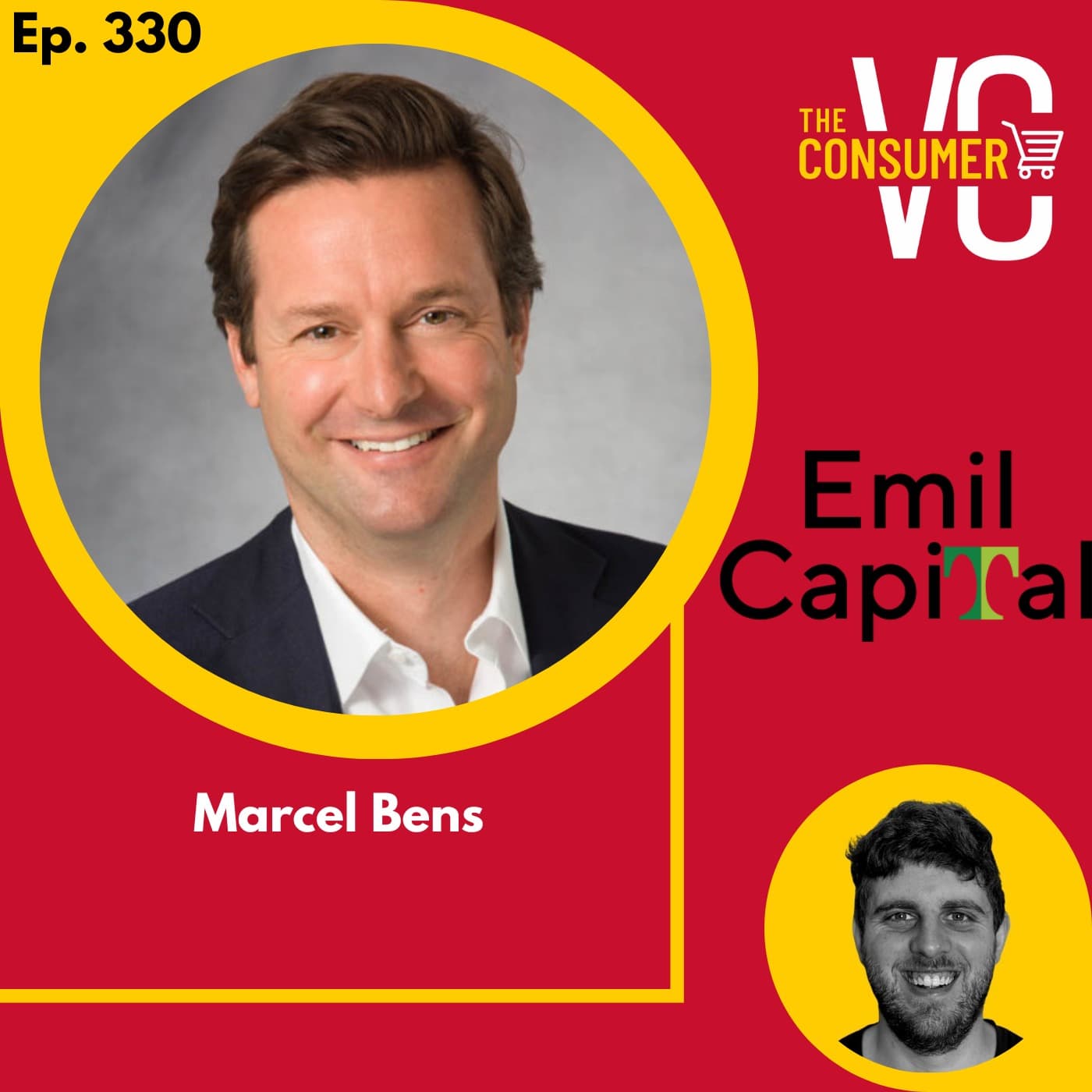
The Evolution of Premium Products in Mainstream Retail with Marcel Bens, CEO of Emil Capital Partners
Episode Overview In this episode of Consumer VC, host Mike Gelb interviews Marcel Bens, CEO of Emil Capital, focusing on strategies behind early-stage investments in North American consumer brands. The discussion centers around Emil Capital's unique investment approach, particularly their focus on 'better-for-you' products and the existing market landscape.
Key Themes and Discussions
- Investment Strategy at Emil Capital
- Emil Capital functions as a hybrid venture firm, primarily backed by the Tengelman Group.
- The firm invests in 'better-for-you' consumer brands, focusing on health and wellness products.
- Check sizes range from $1-5 million, filling a gap between angel investors and larger private equity.
- Consumer Behavior and Premium Pricing
- Consumers are willing to pay a premium for high-quality, efficacious products.
- The transition of 'better-for-you' products from niche markets (like Whole Foods) to mainstream retail indicates a significant shift in consumer preferences.
- Identifying Successful Brands
- Key indicators for success include repeat purchases and customer loyalty, rather than just customer acquisition.
- Brands that effectively solve consumer problems while also connecting emotionally tend to perform better.
- Market Dynamics
- The conversation highlighted how retailers, including conventional chains, are increasingly allocating shelf space for organic and premium products.
- Trends in the health and wellness sector, such as gut health, recovery, and sleep, are emerging as significant areas for investment.
- Navigating Retail Opportunities
- Success in retail for DTC (direct-to-consumer) brands depends heavily on the brand's ability to maintain customer loyalty and velocity in sales.
- Analyzing distribution channels and market conditions is crucial for DTC brands transitioning to retail.
Important Quotes
- “You don't need national distribution to be an exciting brand. What you need to show is repeat purchases, loyalty.”
- “When conventional retailers start having dedicated aisles for organic products, that's an inflection point.”
Key Takeaways
- Emerging Categories: Gut health, recovery, and sleep products are seen as future growth areas in the consumer market.
- Clean Labeling: Consumers prefer products with clear and simple ingredient lists, emphasizing the importance of transparency in the better-for-you category.
- Founders' Characteristics: Successful founders display a willingness to listen to their teams and adapt, which is critical for navigating challenges in business.
Closing Remarks Marcel Bens emphasized the importance of patience and adaptability in investment strategies, particularly within the fast-evolving consumer goods sector. Furthermore, he shared his insights on how to assess potential investments by focusing on both functional and emotional aspects of consumer products.
For more insights and future episodes, listeners are encouraged to follow the podcast and subscribe to updates on consumer trends and investments.
Additional Resources
- Partner: Propeller Industries, specializing in finance and accounting for venture-stage companies.
- Newsletter: [Subscribe to the Consumer VC newsletter](https://www.theconsumervc.com/).
---
This summary encapsulates the discussion points and takesaways from the episode, presenting a concise overview of the insights shared by Marcel Bens.
Written by AI. May contain mistakes. Listen to the episode to check what was said.
Transcript
Automatic transcript. May contain errors.0:00People who, you know, they are willing to pay a premium if they know the product works, the product is efficacious, functional, tastes good, high quality, organic, organic, you know, people will pay for that. Hello, I'm your host, Mike Gelb, and this is the Consumer VC. We discuss the intersection of venture capital and consumer innovation. This show is brought to you by Propeller Industries, the leading strategic finance and accounting partner for venture stage companies. Now, I know this is free content, but that doesn't mean I don't have a favor to ask of you. If you're enjoying the show, please subscribe on whichever channel or platform that you're listening on, whether that's YouTube, Spotify, Apple.
0:39And if you really love the show, Check out the consumervc.com and subscribe to our email, where you'll receive weekly updates of all the consumer deals and news that are happening, and as well as being the first to know when a new episode drops. All content episodes are for informational and entertainment purposes only, and is not investment advice. Our guest today is Marcel Benz, who is the CEO of Emile Capital. Emile Capital is an early stage investment firm that backs the next generation of consumer brands. They are backed by the Tengelmon Group, which is one of the world's largest consumer goods holding companies today.
1:15Now, some of their investments include Renewal Mill, Wish, Uber, and Milk and Honey. We discuss key factors when evaluating potential investments in the wellness and better for you food and beverage sectors. Also, what the current state of the market is for investing in consumer brands. And will GLP One with Drugs change global food consumption habits and more? Without further ado, here's Marcel. Marcel, thank you so much for joining me today. How are you doing? I'm great. Thank you. Thanks, Mike, for having me. No, really appreciate you coming on. This has been rescheduled a couple of times on my end.
1:51So thanks so much for being with me. I want to start a little bit at the founding of Emile Capital and a bit about the capital structure of the investment firm. seems like you're the venture arm of Tangleman Group. But if you're able to present the reason why it made sense as well for the Tangleman Group to launch Emil Capital. And since we're in the US, people might not be as familiar with the Tangleman Group as well. So if you can give a little backstory about that. I know Emil is the name stems from the founder or one of the co-founders of Tangleman Group. But if you can give us a little background about the fund and as well as Tangleman Group as well, and a little bit about that relationship, That'd be awesome.
2:34Yeah. So we're a bit of a hybrid venture firm. We are structured like a venture capital firm, but with a single LP, which, as you mentioned, is the Tengelman Group. We were brought in. We were incepted about 12 years ago, two founders, one of which is the fifth generation family member who five generations ago started the Tengamon Group, and then one of another senior partner. So together they started. I joined at Inception. That was in 2011. And we've been investing in consumer products ever since. Now, the mandate that was interesting for Tengamon is North America. The family over many generations have always had a very, very close ties to the United States.
3:33So the Tengelman Group used to own the Great Atlantic and Pacific Tea Company, so A &P. They bought the majority back in the 70s and held on to it for a long time. So the ties to the US were always there. And then the strategy was from a Tengelman perspective, I assume, not knowing all the details, was just diversification, regional diversification, and investing in a category that they believed in was going to grow. And so the mandate where we sat around the table and say, what do we what do we want to do is investing in better for you, better for you brands, better for you consumer brands that solve a real problem.
4:16You know, this was at a time when, you know, of course, you had your Whole Foods and you had your growing organic aisles, but it wasn't mainstream yet. Better for You was not there where it is today. So that's number one. That's, let's say, more the category that we were interested in. And the other thing was the check sizes. At that time, now you see this obviously much more often. But back then in the consumer space, you had angel investors and then you had larger private equity. But you didn't really have so much in the middle, you know, companies that would write a, you know, one to five million dollar check.
4:57You'd have you'd have angel investors doing one hundred thousand or then larger private equity doing, you know, 15, 20. But getting the company in the consumer space, you know, over that edge to get into the private equity takes takes capital. And so we thought that was a white space. Turned out it was a white space. And so let's say from an investment strategy perspective, that's what we then started doing. And the Tengelman Group in itself is a retail conglomerate based out of Europe. Again, 150 years old, I think maybe now 160 years old. It started as a large merchant company. So importing coffee and chocolate, so cocoa into Europe and distributing it.
5:45then over time developed into kind of a retail conglomerate. That's really helpful. How, one to$5 million checks, how do you think as well around the amount of companies that you, that you actually want to invest in over a year, year basis? Is it kind of more, more so of an evergreen fund? I know it's a single LP, but how does that actual relationship kind of work? And as well as what's the kind of deployment schedule or, or how often are you, or are you investing in the companies? Yeah, so we're on our, I would say, technically on our third fund right now. Again, scheduled as a typical fund with a three to four year investment period of the capital that's committed.
6:27We do typical capital calls to our LP. Again, single LP obviously makes that easier, but it's basically the same structure. Now, the uniqueness is that our investment committee, the CEO of the Tengamon Group is part of our investment committee. So is the other senior partner, who's the other co-founder who started Emile Capital, and myself. So we're an investment committee of three people, with two of them being very closely tied to the Tengamon Group, and then myself as CEO of Emile Capital. I understand that it's very separate. But it's not a CVC because you're not thinking about strategic or, hey, we want to invest in this company early and then maybe have a chance to buy it later on if it pans out.
7:17But how also do you think about value when it comes to utilizing the mass amount of resources that the Tengelman group uses for the portfolio companies? Are you able to utilize some of those resources or not so much that's not as much the mandate? Yeah, I mean, we do it obviously through our network and the people that we know and talking to experts. Again, this is a predominantly European business, so it's not like we help in distribution or selling the product. But of course, given it is a retail conglomerate, there are many people we can talk to and get advice, you know, how to do this or that.
8:03How can we support the businesses that we invest in? So the relationship is extremely close, which is good because that's how we learn. Right. That's how we can always be very transparent with our LP. So it's not like there's quarterly meetings or quarterly financial report. And then that's it. I mean, we're in close contact on a very, very regular basis. And that's beneficial because the strategy around our investment is also related to what are the values of the firm values of the Tengenman firm values and the values, quite frankly, of the family, right? That still runs it. Like, what do they believe in?
8:44And so we try to closely align with that firm family values, which then, of course, mirrors the investment strategy and categories we like to invest in at Emil Capital. So I know you mentioned that you that the primary goal for setting up this fund was investing in better for you businesses. And that was and at the time you were investing in better for you businesses when better for you businesses was still really the the natural grocery sector. right? It hadn't really expanded into conventional grocery. And it seems like we've kind of crossed that chasm from going to natural and conventional, maybe from niche to mainstream.
9:28Were there any key moments along this path over the past 10 or so years that you thought this is really kind of an inflection point that we've actually now seen this transition of the consumer more thinking thinking and not just, you know, maybe the consumer that's just buying in the in the natural sector, but, you know, maybe maybe consumer that are consumers that are buying, you know, in in general stores as well or or conventional as well, that they're that that if they're if there were kind of like moments in time that you thought that that this chasm was was crossed or even beginning to to turn over.
10:08Yeah, it's when your your conventional retailers start having dedicated aisles for organic products. I think that's when you saw that inflection point that you don't just buy organic products or better for you products in a Whole Foods. It's going mainstream, right? When it starts popping up at the big retailers and then the conversation, right? The conversation of the consumer on the content creation, the social media development around, you know, how do we solve problems for the consumer? And that's kind of more how we thought about this. It wasn't just let's only invest in better for you, but it's really around how can we solve real problems that the consumer has through better for you options, right?
10:59Services and products. And so we've always been agnostic, category agnostic. You know, we've invested in companies, not just in food and beverage. But for us, it was really important to always look at, you know, are we solving a problem? Are we offering something beneficial, a better option for the consumer? And again, the inflection points are if mainstream, you know, conventional retailers start putting more of those products, better for you products on the shelf, right? And that, of course, is related to as you see bigger companies, the big strategics interested in purchasing through M &A, right?
11:43Either merging like a typical M &A transaction, you would see more of these companies being acquired by strategics. And that was interesting, right? Because now you have a market of investing in those companies. That's really, really interesting. I mean, one, a conversation that I had that on this podcast was with Clement from Verlin Vest, who's I think the executive director at Verlin Vest. He said that, yeah. And he was saying how the ideal scenario is, staking right now for a minute on food and beverage, but kind of the ideal scenario is if the company has performed quite well in natural. And then as well as there's a really an opportunity in conventional to be, you know, an incredible business and actually be able to penetrate conventional very strong, especially as you pointed out, conventional retailers now, you know, have organic sections.
12:41They have, you know, dedicated sections to better for you in the larger chains. First of all, is that also how you think about it? And two, what are better for you products? When you look at the wide ranging now of so many better for you products coming to market, what are some of the attributes that you look out for that you realize, okay, this could actually be a much bigger business than it currently is and maybe go across different retailers, different sales channels? Yeah, great questions. I think the answer to both are very similar. the way that we really look at companies, and that's maybe what Clement was also referring to, is you don't need national distribution to be an exciting brand, right?
13:35What you need to show is repeat purchases, loyalty, right? And how do you create loyalty? Again, it's you solve a problem, You solve a problem for a consumer, which is the functional part of that equation. And then, of course, you need to make it interesting and fun. And that's the emotional part of that equation. Once you've solved for that, then I think you have an interesting brand. And so our recommendation is always own a certain distribution channel, a region. You don't have to go broad, but you go deep and focus on velocities, right? Focus on repeat purchases. A lot of investors and also companies focus a lot on customer acquisition.
14:29For us, that is just step one. Most important thing is loyalty, right? And that's repeat purchases and that's high velocity. And so I think I would answer both questions with exactly that. What makes it interesting is the company that can solve the functional aspect and the emotional aspect. Then you have a winning equation, in my view. But what about price as well? Because, for example, if you're in natural grocery and the consumer might have more disposable income, might be willing to spend more, for example, on your product, when you transition to conventional grocery, it's possible. I know that these lines are now getting blurred quite a bit, but it's possible that you might have people that have very similar views, that they want to be eating better, might not have as much disposable income, might not be able to actually work.
15:25And of course, you need to kind of stay at consistent velocities in order for the Walmarts of the world, the targets of the world to keep wanting you back for more. So how do you also analyze companies that not only have a, are self-internative problem, is a great product, but also is priced correctly where it actually makes, where it actually can be a long lasting business? Yeah, no, look, that's a great question. Yes, prices tend to be higher for certain products in the natural you want. If you go conventional, there is more price sensitivity. Again, I do think the way you solve it is by a product that's functional, a product that attaches itself emotionally and functional to the consumer.
16:09And that's why that's really what we're looking at. And if you have that, the consumer will be willing to pay a premium because it's not just a me too product. Now, when we look at companies, we do, of course, look at their margin structure and also analyze whether these products make sense in the conventional chain. For us, it's always important to kind of go for the masses, to have a large addressable market. And so we look at investments where we can see the product margin in a good shape so that we can go after both natural and conventional channel. But again, I think there are a lot of premium, great premium products out there, even in, let's say, a more price sensitive retail environment.
17:05Right. I'll give you an example. One of our one of our investments, their biggest account is Aldi. Right. And this is a premium product. And the velocity is it's the biggest account is Aldi. And you would say, like, huh, that's that's interesting. Why? It's it's not a cheap product, not cheap to make. And it's you know, it's a premium product. But the biggest account is in retail is Aldi, which I think is a great case study. that you can see that people who, you know, they are willing to pay a premium if they know the product works, the product is efficacious, it's functional, it tastes good, high quality, organic, you know, people will pay for that.
17:48Yeah. I mean, I also think talking to brands, I think it's also really interesting when conventional, going into conventional was actually their first road to retail and not natural. And I think that's also pretty cool because there tends to be, and again, these things are changing, but tends to be more price sensitivity in conventional than natural. And I think that you're almost doing the hard work up front in a lot of ways. Still, you have to obviously get into natural, which getting into a new account is always, always challenging. But if you're able to prove yourself out in conventional, then I think it's pretty interesting because in the natural channel, it might be a little bit easier as well, which is pretty cool.
18:34No, you're absolutely right. Again, there are many brands out there. Now, this brand at Aldi that I was referring to is a company called Good Belly. They manufacture probiotic juices, so a premium product, very efficacious premium product. But one example in our portfolio is a company called KidFresh. They started in conventional, and then they went into natural, and they make healthy frozen kids' meals. And the strategy was we want to offer healthier products at a similar price to the consumer than what was there before. Great strategy. You mentioned probiotics. Why do you think gut health has become such a significant focus in the health and wellness industry?
19:20Yeah, because I think people are understanding the benefits. Right. I think the previously everybody was when referring to probiotics, just thinking about the science behind it, explaining way too much about the science, but not really about what does it actually do to you? And more and more research that that you can read explains these benefits that it's, you know, not just in the gut, but, you know, it has cognitive benefits. But what most people are surprised about is that 70 % of our immune system is dictated by our gut and that the gut is very individual, very personalized. So not every probiotic works for every individual the same way.
20:09And so I think it's interesting for us as an investment strategy. There are two other categories that I would jump into that I would add to this, you know, that kind of frames in our world, the whole body health world. But gut health is interesting because I think there's still so much to find out on how to understand the microbiome of each individual. and that's personalized. I mean, there's a great Netflix documentary that came out a couple months ago called Hack Your Health. And, you know, everybody should watch that. It's super interesting and it kind of substantiated our investment strategy around investing in companies that analyze the microbiome, that try to come up with better solutions for the microbiome, but generally also gut health, gut health solutions.
21:03Now, the other two categories I would add to that, that I think right now are the most exciting consumer categories or better for you categories is recovery. So exercise, post-workout recovery and sleep. And if you look at those three categories and you look at the conversation in the world, I mean, you know, in the consumer world, Those are the biggest, hottest trends that I see right now in the consumer category that are not just me too. Now, you need to differentiate yourself in these categories by offering efficacious products, right? Again, with that emotional connection. And that's the exciting part.
21:44But I think those three categories are going to be interesting for us in the next decade. And that's where we've placed some significant capital into companies to grow those. So, I mean, within those spaces, exercise, post-recovery, and sleep, what companies, I know you've obviously already mentioned your portfolio companies, but what pain points kind of excite you in those areas that you think are being solved? And maybe what are some pain points as well that haven't been solved yet that you're very excited for this new frontier? Yeah, I mean, look, obviously, you know, I'm biased with the company that we've invested in, a company called Next Foods that focuses exactly on those things.
22:26It's two brands, Cherry Bundy and Good Belly. Cherry Bundy focuses on exercise recovery and sleep and Good Belly on gut health. Now, the interesting part about that is these are all natural products, right? It's all about using science, but kind of going against science-based products with all natural offerings. And that's what we think is exciting. The pain points are price, right? These are agricultural products. These are fruit juices, concentrates. This is a tart cherry that grows from a tree. Those are pain points more from an operational cost perspective that makes it a premium product. Right.
23:14But the benefits are clear. But to to your to your question, what are the pain points? I think pricing is a pain point with with premium products in that space to get it to the masses. But I also think that once consumers realize the efficaciousness of these products, they're willing to pay that. But it is an agricultural product. You have a lot of companies that are really more science based. That's where I would wonder how beneficial, like, what are you putting into your body? And we know from the educated consumer, they are worried about what they're putting into their body. And so for me, that would be another pain point on the mass of products that are coming into the market in those categories.
24:05Number one, are they really efficacious? And number two, it's kind of the ingredient list, right? Like what are you putting inside your body? And yeah, that's where I would be concerned. This episode is brought to you by Propeller Industries. If you run a high growth business and you're focused on profitability, extending your runway and improving your operational efficiency, you probably need a finance and accounting whiz that will grow with you. Well, instead of hiring someone full time, what would be cost effective is working with Propeller Industries. Propeller Industries is a leading strategic finance and accounting partner for venture stage companies and has partnered with over a thousand startups and high growth businesses across consumer products, consumer tech, and enterprise.
24:49Some of the brands that they've worked with are Liquid Death, Olipop, Hims, Farmer's Dog, Away, MoviePass, and Giphy. Propeller also provides specialized support for fundraising and M &A with transaction advisory services. Propeller's TA team of former investment bankers and investors can step in on more of a project basis when pursuing full-scale financing and M &A. There's a link to Propeller Industries in the show notes if you want to learn more information. from the ingredient choices and i know this can be this is a bit of a broad question and it can be fairly category dependent but but what ingredients is stick out to you when you actually go into it could be ingredient ingredient list or maybe actually a better way to phrase it is is the actual new nutrition label is there is there products that what what would kind of stick out to you if you're reading like nutrition labels and seeing, oh, wow, like this is actually not nearly as good for you, for example, as a as a marketing says for you, is there specific like, like things that you kind of look for when it comes to nutrition labels to make sure that what the product actually says is actually in your terms?
25:57I know healthy, it's, it's, it's a funny phrase, because I think therein lies the problem, right? Because there's so much that you don't understand that's on ingredient panels, nutrition panels, ingredient lists. I think the way that we often look at this is, do you understand, does an intelligent 14-year-old or 16-year-old person, consumer, understand the ingredients? I think that's a good bar to have with the better for you category. If it's, you know, a ingredient list that has 50 ingredients, and, you know, 80 % of those you don't really understand, that would that would concern me. And I think you see that in the market, right?
26:50The whole, the whole movement towards clean label in food and beverage is very important. You want to know what you're putting inside your body, you want to understand the ingredients. And that's not always the case. Can you also just say what clean label means to you? I think it depends on the category, but if it's better, I think it depends on the category. But in general, if it's food and beverage, if it's products that you understand, that's really plain and simple. So if it says tart cherry on there and it's tart cherry, If it says water on there and it's water, if it says fruit juice concentrates or, you know, agave syrup, those things are.
27:36But any kind of colorings, chemical colorings, preservatives that aren't natural, you know, that's where that's where I would get concerned. Now, doesn't mean that all those products are necessarily unhealthy. But clean ingredients for me are ingredients that you understand. When you walk into a convention, a expo hall, let's say like an expo West, for example, and there's, there's millions, what seems like millions of brands, right? It's pretty overwhelming. How do you, and of course you only have, even though it's over a three, four day period, you only have, only have a little bit of time really just because there's thousands of brands that are, that are presenting.
28:22How do you make decisions in terms of and really understand when you do want to discover new brands to potentially invest in and really be on the journey with a founder? How do you make decisions in terms of which brands actually you want to spend time with and which brands you want to pass on or is maybe not worth your time that day? Yeah. Well, maybe a little anecdote story there, because I haven't been at Expo West in a couple of years. And now, unfortunately, when, you know, before a few years ago, when I used to go, it was really more meeting people I already know instead of kind of new people.
29:09Right. Because everybody's there. So easier to easy to have meetings, meet other investors, meet companies that you're already in touch with or you just have gotten in touch with. So I would say because you're referring to Expo West, it changed. But 10 years ago, I always thought it was interesting to go to an Expo West or others because it wasn't so overcrowded. And you could see, you could just basically observe where the consumers would go. And so if you'd see like a big group of people around a brand, that's kind of a good, you know, kind of litmus test of like interesting. Why are all these people there?
29:52Well, maybe there's a celebrity. Okay, but maybe it's the product. So let's take a closer look at the product. Like it's pretty much impossible now, as you just said, right, because there's so much going on. But I used to love going to those shows because you could really just observe because it's not about me as the consumer. It's about others at the consumer. You could observe like, OK, what's interesting to consumers right now? You know, is it is it Greek yogurt? Right. Way back when. Is it bottled water with, you know, electrolytes or alkaline? is it protein powders shakes bars um i always thought that was interesting what where do you find the most people around which brand and then go look at that and talk to the people talk to the founders it's very hard to do that right now um because there's just so many people and that's why i think it's become you know it's it's become a networking event more or less um uh which is fine too.
30:58So, so are you going to go back to XOS, do you think, or no? Yeah, I'll go. You know, when I have time, I always like, I always like meeting people there, having conversations, but again, it's not really, it's not anymore a venue to look at companies to invest in, as much as it used to be. But you do certainly every year, what I also hear from my team, you see certain themes, right, that are popping up in the food and beverage space. And I think analyzing those themes is super helpful. That's kind of the market mapping around what are trends, what are people thinking about, right? And what we found is these three categories.
Read the full transcript
31:45There's a lot of conversations around sleep, exercise, recovery, and gut health. um so has it has it become easier or harder over the years to invest in better for you brands because on one hand i would think there's so much more popping up so many more so many more companies being made and so it can be hard to really understand if you really want to go into a category which is that which is the company you actually want to back in the category on the other hand there's also a lot more retailers that are open to to better for you companies so in terms of route to market, it could actually look quite different and quite unique depending on the company.
32:22And there's a lot more kind of data to collect as well that you can see. So you can maybe you might be able to have more proof points with companies, for example. I think it's always hard, to be honest. I think, you know, we've certainly invested in companies that have done very well and others that haven't, right, for all various reasons. so I couldn't say it's gotten easier or harder I think it's it's always hard so I you know I yeah I think it's always hard I think you need to pick some let's say metrics that you go for that you look for in companies and you should stay true to that right and as an investor but but also as a company, stay true to your values.
33:18What is your offering as an investor is like, stay true to what you're looking for in a business, right? And of course, a lot has to do with the team, the founder, the execution of the product and service. But I would never say it's gotten easier or harder just because there's more companies there. I think it's always important and has been 10, 12 years ago to look for something unique that, again, is solving a unique issue, a unique problem. And to your point, yes, you know, more companies also means more me too. That's where you need, in my view, to try to shy away from, because if you're not one of the top performers in that category, then you're just a me too product.
34:08And I think then you're just going to fall by the wayside. Then how do you then identify maybe what emerging categories are within, I know that you mentioned maybe some three categories, maybe those categories are emerging, maybe they're more on the macro side. But how do you kind of identify more of categories that you think are very niche now that maybe could become major categories in the future? I wish I had that magical algorithm there, right? Of that, that oracle, don't we all right of like, hey, why don't you tell me like what's, what's hot? I think, look, I think most of those, most of the analysis are more mainly lag, lag measures versus kind of lead measures.
34:55I think everybody's trying to figure out those lead measures of, you know, what, what makes a trend. Now, you can see it through conversations. You can see it through social media engagement. What are people talking about on social media? What is the content that content creators are putting out there that people are interested in? And what we, of course, see, and that hasn't changed, though, is whole body health, health and wellness, longevity. People want to live a healthier, longer life. And they're thinking about how do I do that? And and, you know, and and that for me is always a safe bet in companies that you're investing behind is companies that focus on health and wellness.
35:46trying to live a healthier, higher quality life. That's at least our ambition. Yeah. I mean, it seems like almost the best research that you can do is just keep talking to founders and keep talking to founders because they're the ones that are kind of in the route. The beginning, you kind of create a much more specific thesis around a particular trend. You might then miss the trend and might miss it entirely and almost overthink it, especially since you're investing in like the one to five million dollar range brand. So that. Yeah. And again, it's more of a lag measure. But, you know, you do realize when you've seen investment proposals in the same category 10 times over a couple of weeks.
36:33Right. Then you're like, oh, interesting. A lot of founders are thinking about this topic. A lot of founders are interested in solving a specific issue or creating a specific brand around a specific product category. That's when, you know, OK, there's something going on there. But again, it'd be nice to have that Oracle that kind of tells you, hey, this is going to be the next the next thing. So it's always slowly moving. But I think health and wellness, whole body health are good safe bets, right? People think more and more about what am I putting on my body? What am I putting inside my body?
37:17And I think that's helpful. How do you assess founders? Great question. I would say the number one thing is listening. Are they willing to listen? The way that I analyze a founder, if he has a team, let's say they come in for a management meeting, is how much does the founder talk and how much does his team talk? And if it's only the founder, you know, I'm not so I don't get so excited if he lets his team speak a lot, you know, because he's hired people to do their job. And if he gives them kind of the room to express their opinion, to share their story, to, you know, talk about the business, that's a really, really good sign for me.
38:15You know, if there are management meetings where the founder talks the entire time and the team just sits around and listens, not a good sign. Because ultimately, that means the founder is not going to be able to let go. And that'll kind of put a dent on growth. So that's one thing. That's kind of one test in management meetings that I look for is how much does the founder talk versus all. But generally, characteristics, of course, are, you know, is this this ownership principle of, you know, do they have not just the passion, but do they have the ownership to and, you know, to keep going? because it's always going to be hard.
38:56I read something, I think it was a week ago, where somebody commented saying, there's never been a founding story that went like, I started this company, everything went great, and then I sold it. I always like that because it's very simple in saying it's always hard. Are founders willing to go beyond that when things get hard. Now, you can't really test that until it gets there. But every company and every portfolio will have times where it's going to get really, really hard. And the good founders, they don't quit, right? They keep going. So I hope that answers the question. Yeah, that's very helpful.
39:39How else do you think about investing in consumer brands where, of course the product is differentiated, but it isn't, isn't maybe there's maybe isn't, isn't, isn't a technology innovation or, or ingredients versus true food tech companies or, or tech companies where I would imagine they have longer horizon when it comes to, when it comes to maybe outcome or, or, or, or just, or the amount of time you're actually partnered with those companies. But how do you think about investing in the differences as well from like an ROI perspective? Because I'd imagine that they are quite different. Yeah, I think it's the time horizon when you expect to see liquidity, right, of realizing and justifying that investment.
40:29Is that more flexible, just considering that this is quite a unique venture firm and that you have a single LP? Or is it still like a typical time horizon, let's say like seven to 10 years? Yeah. So, I mean, yes and no. We are, we tend to be, you know, we try to see the world in a flexible way. Why? Because we believe giving the company an opportunity to exit when they deserve or when they've earned their right to exit. but we still have to justify our existence right as a as an investment firm so we can't hold on to companies forever but since we are also more of like a an evergreen fund we have a little bit more flexibility but of course we have our internal plans on what do we think this company needs from a time horizon perspective and look early stage businesses you're lucky if it's you three to five years if it's early, it's always more seven to 10 years.
41:36So you got to have some patient capital. Now, I don't like the word patient capital, because it always, you know, it always kind of can lead to a conversation like, oh, you guys can wait a little bit longer, you know, you don't need the money, we still have to justify right and pay bills and justify to our LP our existence. So it's a little bit of a yes and no. I know it's not the answer you want to hear, but it's a little bit of the yes and no. And every company is different. What we do like to consider ourselves as being cooperative with the founder and really trying to build a business that leaves something behind and isn't just a flash in the pan.
42:27Right. It's it really leaves a a leave something better behind. And and some companies, it takes a little longer to justify to justify that investment longer term to get to get to a certain size where strategics will be interested in. or a public market opportunity arises that you then go after. What are the reasons why a DDC brand, when they actually go into retail, what are some of the reasons that it might not actually work as a retail brand that you mind? That maybe it works pretty well as a DDC brand, but they weren't able to kind of cause that chasm and actually create a compelling retail business?
43:21We just love your thoughts. Look, I think in simple terms, I think most of it is that they probably, on a D2C business, spent a lot of money acquiring customers and that the repeat purchase rate was not that high. and therefore they go into retail with strong, let's say, overall sales numbers. But when you look at the cohorts, when you look at the actual consumer, the lifetime value of that consumer is not high enough to justify going into retail. And in retail to stay on shelf and be successful, again, of course, it's all about velocity, right? And you can, you know, of course you have, you know, trade spend that you can use to acquire new customers.
44:18But ultimately, it's about velocities and repeat purchases. And so that's why, again, I think successful brands will focus more on repeat purchases instead of customer acquisitions. the ones that aren't going to be as successful are going to spend a lot of money on uh on uh customer acquisition um and they might have good sales but i think that's going to be hard in retail because you can get off because it's you know i mean you talk to sales people they have this you know a lot of sales people say it's easy to get on shelf right but it's hard to get off the shelf and it's true yeah totally how also i know you also invest in technology companies too and and and these technology companies can look quite different to to consumer companies the outcomes successful outcomes can look quite different to consumer companies how do you think about underwriting uh technology companies versus consumer companies trajectory and as well as maybe desired, if this changes, the desired ROI for each type of business?
45:25Yeah, I mean, the tech companies we've invested in, let's say consumer tech, I would make it similar from an ROI perspective than consumer businesses. We're not tech investors, so that's always very different. But let's say the consumer tech business we've invested in. And the interesting part about consumer tech is it doesn't just solve a, let's say, demand problem. It also solves a supply problem. And I think in consumer tech, that's interesting. CPG or products, food and beverage is really more like a demand problem. The consumer has a need. And can I fill that need? Can I offer products and services better for you to fill that need state?
46:20In consumer tech, I think the interesting ones are that focus on demand and supply. So we have a company that we've invested in called Zeal. They provide massage on demand. It's a demand problem. Customers want to have the benefit of a massage at home. And it's a supply issue because there are many massage therapists that have excess time where they could earn money to provide their service. Same thing like an Uber, right? Uber is the same thing. It was a demand problem and a supply problem that was solved. And so in consumer tech, I think once you have that, that's a good investment. Got it. No, that's helpful in terms of how you think about it as well as solving a problem.
47:12my final question for you is what's one book that's inspired you personally and one book that's inspired you professionally so professionally i thought the you know the book and maybe you know the name i forgot the name i know the cover it's like blue orange um just recently that i read that i thought was really interesting that also helped me a lot as kind of a you know like as a ceo and was ben horowitz's book yes yes yes um the hard thing about heart drink the hard thing about thank you the hard thing about hard things um and personally my favorite book that i read you know way back when uh uh probably uh oh god 30 years ago 35 years ago um that have always stuck to me is the pillars of earth yeah it's a Ken Follett book.
48:02It's a Ken Follett book. It's a great story over multiple generations. And it's about building a church. Well, it's like building a large church in England. It's called Pillars of Earth. And the interesting part about it, I always thought, is thinking about you know building a company it's brick by brick right you you start with a strong foundation and you build from that so I always thought it was interesting how they framed it that this big cathedral so large church cathedral was built over several generations and nobody really who worked there for generations saw the end product but everybody was part of that initial journey I just thought from a personal level, that's, that's, uh, you know, it was always very, uh, very inspiring.
48:59That's awesome. I don't think we've had anyone yet. Anyone mentioned the pillars of earth. So you're so original, Marcel, this is great. This is great. And hard things are hard things. I've heard one. How many, I was going to say how many people have mentioned that that is mentioned quite a bit. Do you want to know the most mentioned book? uh yes i do shoe dog shoe dog is the most mentioned book on the show for sure it's a good it's a good book another book i would recommend is uh it's a nigerian uh writer called chinwa and uh his book was called things things fall apart things fall apart it's not a big book small book but very interesting especially for like founders ceos uh it's a it's a it's a great book.
49:47Awesome. That sounds great. I don't think we've had anyone that mentioned when things fall apart. So very original, Marcel. Really appreciate it. Thank you so much. Marcel, thanks again so much for your time. I really appreciate it. This has been a lot of fun. Thank you, Mike. Thanks for having me. Thank you. Love to be here. And there you have it. It was a pleasure having Marcel on the podcast. Marcel, thanks again so much for coming on the show. Thanks also to our partner, Propeller Industries, for supporting this show. If you're really enjoying the show, subscribe to our newsletter at theconsumervc.com, where I share a weekly update of all the consumer deals and news that's happening in the world of emerging consumer.
50:22And you'll be the first to know when a new episode drops. Thanks for listening. I hope you enjoyed.
From the publisher
Today, we're diving into the secrets of successful early-stage investments in North American consumer brands with Marcel Bens, CEO of Emil Capital. In this episode, Marcel shares the unique strategy of Emil Capital’s hybrid venture firm, with its sharp focus on 'better-for-you' products and how it bridges the critical investment gap between angel investors and larger private equity firms. We’ll explore how they strategically deploy $1-5 million checks, backed by the rich history of the Tangleman Group, to drive growth and diversification across regions.
Thank you to our Partner –– Propeller Industries https://www.propellerindustries.com/
Propeller Industries is the leading strategic finance and accounting partner for venture-stage companies.
0:00:28 - Why Do Consumers Pay a Premium for High-Quality Products?
0:07:04 - How Is the Investment Deployment Strategy Structured?
0:13:14 - What Are the Opportunities in Better-for-You Products?
0:19:01 - What Are the Market Strategies for Premium Products?
0:25:47 - How to Decode Nutrition Labels for Better Choices?
0:30:37 - How to Select the Right Brands at Conventions?
0:34:48 - How to Identify Niche Emerging Categories?
0:38:37 - How to Invest in Consumer Brands and Tech?
0:48:49 - What Is the Approach to Building a Company Brick by Brick?
Subscribe to Our Newsletter:
https://www.theconsumervc.com/
Subscribe on Spotify:
https://open.spotify.com/show/4Hjm74Z...
Subscribe on Apple Podcasts:
https://podcasts.apple.com/gb/podcast...
Follow on Twitter:
/ mikegelb
Follow on Instagram:
/ mikegelb
Follow on TikTok:
/ consumervc