
In short
Consumer VC Podcast Episode Summary
Episode Title
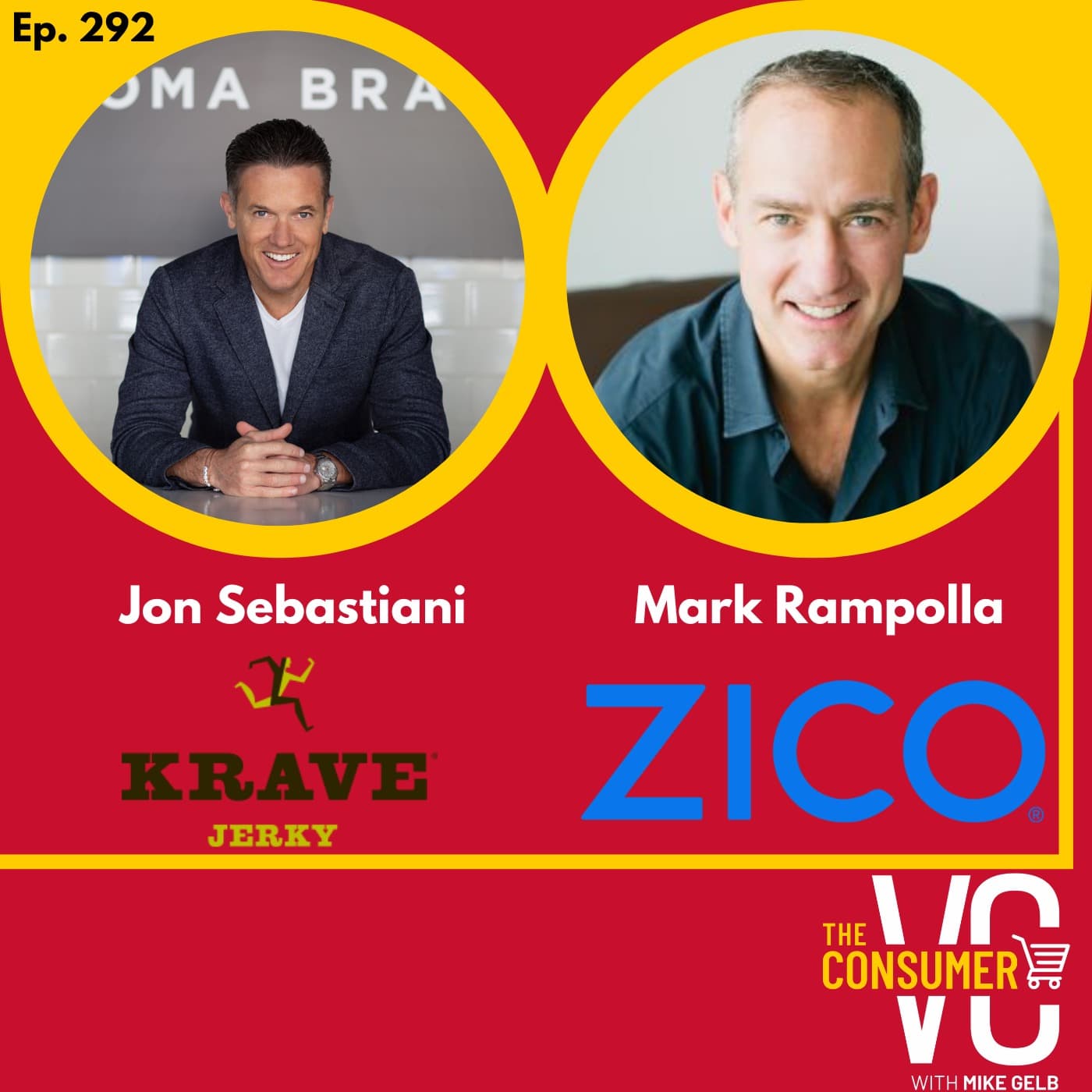
When You Start, Scale, Sell and Then Buy Back Your Business From Hershey And Coca Cola with Jon Sebastiani (Krave Jerky) and Mark Rampolla (Zico)
Hosts
- Mike Gelb - Host of the Consumer VC podcast
Guests
- Jon Sebastiani - Founder of Krave Jerky
- Mark Rampolla - Founder of Zico
Episode Overview
In this episode, Mike interviews Jon and Mark, two entrepreneurs who successfully founded, scaled, sold, and subsequently bought back their companies—Krave Jerky and Zico, respectively. The conversation dives deep into their origin stories, experiences with corporate acquirers, and the challenges they faced when taking their brands back.
---
Key Themes and Discussions
- Founder Journeys
- Mark Rampolla: Transitioned from a corporate background to founding Zico after discovering coconut water's potential while living in Latin America. His vision included selling it to Coca-Cola, hoping to promote health within a global beverage giant.
- Jon Sebastiani: Came from a wine family and pivoted to the meat snack market after realizing the health potential of jerky. He aimed to elevate jerky as a premium fitness product and was motivated by personal health and wellness.
- Acquisition Experiences
- Zico: Initially saw success and growth but struggled post-acquisition by Coca-Cola. The product lost market share due to mishandling and prioritization of other brands within Coke's portfolio.
- Crave Jerky: Jon's company experienced similar challenges after being acquired by Hershey. The brand's quality declined as Hershey aimed to reduce costs, leading to decreased consumer loyalty and market performance.
- Buying Back Their Brands
- Both Jon and Mark faced opportunities to buy back their brands after realizing they were not thriving under corporate management.
- Jon emphasized the importance of brand equity and consumer perception in rebuilding Crave after its quality suffered.
- Mark shared insights on regaining Zico, highlighting the need for strong relationships with retailers and a focus on product quality.
- Challenges of Rebuilding
- Both founders discussed the complexities of re-establishing their brands, including quality improvements, retailer relations, and brand perception.
- Emphasized the importance of having a dedicated team, with Jon noting the loss of his original team during Crave's acquisition by Hershey.
---
Key Takeaways
- Importance of Founders: Successful brands often hinge on the passion and dedication of their founders. The drive to succeed comes from personal stakes beyond just financial gain.
- Corporate Acquisition Risks: Large corporations often prioritize short-term profits over long-term brand health, which can lead to significant challenges for acquired brands.
- Rebuilding Brand Equity: When regaining control of their brands, both Jon and Mark emphasized the necessity of restoring product quality and consumer trust.
- Strategic Relationships: Building and maintaining strong relationships with retailers is crucial for brand success post-acquisition.
- Focus on Quality: Quality is a non-negotiable aspect of food and beverage products. Brands must ensure that their offerings meet consumer expectations to thrive.
---
Quotes
- Jon Sebastiani: "If there's anybody that can bring it back to life, it's going to be me and the team that I can assemble."
- Mark Rampolla: "Details matter, right? Nuances matter. The specifics of the category, the brand, and the situation."
---
Conclusion
This episode of Consumer VC provided valuable insights into the experiences of two successful entrepreneurs who navigated the complexities of founding, selling, and buying back their brands. It highlighted the importance of quality, brand equity, and the entrepreneurial spirit in achieving long-term success in the competitive consumer space.
For more episodes, visit [Consumer VC](http://www.theconsumervc.com) and subscribe to the newsletter for updates.
Written by AI. May contain mistakes. Listen to the episode to check what was said.
Transcript
Automatic transcript. May contain errors.0:00This episode is brought to you by Vobin from Carta. Vobin from Carta is the easiest way to launch and run your venture investing. They offer SPVs and fund vehicles for GPs at all stages of the journey, from your first syndicate to operating a multi-million dollar venture fund. If you're interested in investing in startups, stick around after the episode where I chat with Gabriel Shin from the Vobin from Carta team, who shares his perspective and tips about how to start investing and how Vobin from Carta can get you set up. The link to Vobin from Carta's website is in the show notes.
0:44Hello, I'm your host, Mike Gelb, and this is the Consumer VC podcast, where we discuss the intersection of venture capital and consumer innovation. If you're enjoying this show, also subscribe to my newsletter at theconsumervc.com, where you'll receive new episodes straight to your inbox and a weekly recap of all the consumer deals that are happening. All content and episodes are for informational and entertainment purposes only and is not investment advice. This episode is brought to you by Vauban from Carta. Vauban from Carta is the easiest way to launch and run your venture investing. They offer SPVs and fun vehicles for GPs at all stages of the journey, from your first syndicate to offering a multi-million dollar venture fund.
1:24If you're interested in investing in startups, stick around after the episode where I chat with Gabriel Shin from the Vauban from Carta team, who shares his perspective and tips about how to start investing and how Vauban from Carta can get you set up. The link to Vauban from Carta's website is in the show notes. Before we start today's episode, which is quite a unique one, and you'll hear why later on, I want to give a huge shout out to Ben Jang, who is at Sonoma Brands. Ben was an OG supporter of the Consumer VC back in the early days when I'd only produced a handful of episodes. He's responsible for introducing me to John Sebastiani and convincing John to come on the podcast a couple of years ago, and then helped me get Ty Haney to come on the podcast and be our headliner at our Consumer VC Lab event last October in 2022.
2:11Ben and I talked and riffed about wanting to do an episode for a long time with both John Sebastiani and Mark Rampolla, and now it finally happened. What makes this episode unique is that it's very rare for an entrepreneur to start their business, scale their business, sell their business for a good outcome, and then be able to buy back their business from an acquirer. John and Mark each did it respectfully with Crave and Zico. I really enjoyed this conversation with both of them. Without further ado, here's John and Mark.
2:51John and Mark, Mark and John, thank you so much for joining me joined me here today on the show. How are you both doing? Doing well, Mike. Thanks. Nice to be here. Very well, Mike. Good to see you again. Yeah, great to see you. Great to see you. So give us like a little bit, I guess let's start a little bit of like the origin story, a quick snippet of like the story of obviously Crave and Zico and why you both decided to founded these brands. Maybe Mark, we'll start with you. You know, mine was a little bit of a, maybe a personal journey looking for a business. Like I was, I don't think I definitely didn't think of myself as an entrepreneur.
3:29I grew up in a family of no business people at all. I was a Peace Corps volunteer after college. Then I went on a corporate route. And I think I woke up one day and realized like, oh shit, like I don't want my boss's job. I don't want my boss's boss's job. Like I don't want to be a corporate guy anymore. What the hell do I do? And I really wasn't sure what I would do. And I decided to start looking around at businesses. And, but it really took me a while to sort of get my mind into like what it would take to become an entrepreneur. So I was looking around for ideas that really resonated with my life that I felt like fortunately I somehow had a sense like I got to be ready to dedicate at least 20 years of my life to this and so I was looking for an idea that was you know fit with my lifestyle that I could get excited about that I believed in was consistent with my sort of personal mission and vision and at the time I was living in Latin America with my with my family and drinking coconut water all the time I'd been an athlete all my life and had you know moved to by and large natural products And I was also very interested in sustainability and the environmental challenges.
4:40And so when I learned that there's a waste product that, you know, coconut water was, coconut trees were planted all over the world for the meat and oil and the water was literally thrown away, yet I knew its hydration properties. I thought, man, if we can build this into a great business, you know, it's amazing. And for better or worse, my vision from the beginning was I wanted to sell it to Coca-Cola. The idea was, the biggest change I can make in the world is let's help them sell something healthy, better for you, and scale it globally. So for better or worse, that was the vision before I even started.
5:13Cool. Cool. No, no, no. Really appreciate that, Mark. How about you, John, with Crave? Yeah, you got it. So it's a very, very similar story in terms of the prioritization of personal health and wellness and that being the catalyst for starting my business, but a little bit of a different origin story. I came from a multi-generational wine family. So I grew up in and around the kitchen and the vineyard and was very familiar with food and the way that we would describe with certain words to romanticize how flavors are combined with various wines and so on and so forth. But, you know, fortunately now, unfortunately at that time, my family business crumbled in the third generation, of me being the fourth.
5:59So I was in my early 30s. I had already invested my entire life into this family business. And then in a matter of a couple months, it just went away. It wasn't my decision. It was my parents' decision. And so for me, it was like I had to reinvent myself. I was operating under sort of a survivalist mentality. And I was somebody that cared very much about my own journey. I never wanted to be viewed in the shadow of a family business. And it was a fairly notable family business. I mean, in the 70s, we were the second largest winery in the country. And so similar to Mark, you know, at this time of like tremendous anxiety of what am I going to do?
6:44And how can I look at my family straight in the face of being proud of my career? And I fell on to what made sense to me, which was my own fitness and my own wellness. And I was running marathons at the time. And I just stumbled onto the meat snack space by myself consuming it as a way of losing weight in preparation for the New York City Marathon. And it just kind of hit me like a ton of bricks that there actually wasn't anything available that fit the ingredient profile that I was looking for. Nobody was talking about the product through the lens of health and wellness. And I thought, my Lord, am I, have I just lost my mind?
7:26Am I going to take this seriously coming from the romance of the wine industry to go into the gutter of the, of the sea store jerky set? But that's what I decided to do and elevate it, premiumize it, position it as a fitness food, really invite women into the category from, from a transparency standpoint, really focus on fair farming standards and transparency of ingredients. And I don't think I can claim that I, from day one, wanted to sell it to Hershey, but I can tell you for certain that actually selling it to Hershey when they expressed interest was the greatest thing in the world, that somehow this brand could steer the ship of Hershey into a new direction of health and wellness snacking.
8:15Well, I'd love to dive in in terms of where each of your companies were at by the time you actually were acquired by Coke and obviously Hershey. Maybe, John, we'll start with you. Obviously, you weren't the first to bring jerky to the U.S. market, but you were the first or one of the first to kind of show how it could be actually a health product and a premium product in jerky. How were you seeing that market at the time that you were – you obviously weren't a small brand at this point when you were told to Hershey. But what was the market like in 2015 when you're about to sell? It's a great question, and let me kind of approach it a couple different ways.
9:02First off, when I stumbled into this category, as an entrepreneur, I was at the right place at the right time. There's just no two ways about it. Yes, I had a good plan and I built a great team. But, you know, as investors now, we need to recognize that certain categories have the window wide open and a first mover that goes through it has a tremendous advantage. And so for me, I found myself at the right place at the right time when Crave was started. Let's just call a spade a spade. We executed flawlessly, I will admit. And I think the resulting behavior of the consumer over the five years that I held this asset was pretty phenomenal.
9:41I mean, we helped double the category size of major retailers like Target and Safeway. We helped demonstrate that the consumer, a premium consumer, was willing to pay a premium price point, demanded now transparency of ingredients. We were that brand that made it very uncool to have corn syrup and sodium nitrates in the products. And so at the time that we sold, yes, other private equity firms had begun to back other premium brands. So there was a mushrooming impact in the category. The category was growing four times faster than any subset within the snack space. So it was really obvious to the strategics.
10:25And it was a pretty big category to begin with. It was a$4 billion category with really two main players, Jack Links and ConAgra. And so I think Hershey saw a growing category, double digit, a deep desire to step into snacking as opposed to indulgence only, and that they were going to put Crave as the hood ornament to really lead them into this new frontier. year. We were growing double digit, or I should say triple digit, 2X year over year. So it's all public information. We were on an LTM basis over 35 million, but a forward 12 closer to 80 million. And so those were the revenue dynamics at the point that Hershey did the deal.
11:09No, that's really helpful. That's really helpful. And also just thanks for giving us a bit of context of kind of the history, the major players of jerky. Mark, by the time, so in 2012, 2013, where was Zico at this time in terms of how big you are? How are you kind of assessing the market? I know one of your big competitors, I've heard both you and also Mike talk on different podcasts about Bida Coco and kind of like the coconut battles and wars that were happening in New York City. Where was Zico kind of positioned in 2012 and 2013? And if you can kind of describe or kind of have your thought behind how that deal kind of came to be.
11:47Yeah, the parallels with John are a little bit uncanny and beverage to snack. I think timing matters a lot. And I now see and understand the power of category. So in many ways, um mike kirbin from bite of coco and i had been battling it out for nine years nine years by that eight eight years or so by by that point and that competition builds categories so the category was hot and and there was a lot of energy into it we were spending money we're investing money we're growing both brands were growing triple digits pretty consistently the cat we're leading you know kind of building a category and um all the major players were expressing at least some interest.
12:28Pepsi was floating around. Pepsi had moved to buy a manufacturer in Brazil thinking that they could lock something up. We, Bite a Coco, at some point entered conversations with Dr. Pepper on a distribution agreement. And so we had begun, Coke had approached us pretty early on just because of the results we were having in New York. And we were teeny at the time. You know, so we were, it took us, you know, we eventually got to about a$75 million run rate when we sold. But that was, the growth was like this. You know, first couple of years were really not big dollars, but fast growth, but in a very limited market with velocity that was through the roof.
13:15So, so Koch expressed some interest early on. And we, we did, I decided to do a sort of a multi-step deal with them. So we brought them in as a minority investor in 2008 and, you know, not dissimilar to the times now, right? Very complicated economic situation. A lot of investors sitting on the sideline, a fraction of the number of investors that there are today. And so, you know, I sort of made a calculated move like, look, I'd rather, you know, kind of kind of have a partnership there that had a potential to lead to something. and by 2013, it was clear that either they needed to buy or we were going to need to raise and invest significant capital to continue the growth and to be competitive.
14:06And it just made sense for them to buy. I think they, similar to John's story with Hershey with Crave, Coke is always sort of wondering, is the floor going to fall out on their core business? What's the trends on health and wellness? What brands make sense? So I think they did have big hopes and expectations and plans for Zico as part of sort of a global portfolio of health and wellness. And we'll get into what happened. But at the time, I sort of felt like I have two daughters. I felt like Zico was my son and he had gotten into the Harvard of the beverage world. and it's not my problem anymore.
14:44He's on his own, let him go do his thing. Yeah, I mean, what happened, Mark, just because I believe at the time before, in 2012, 2013, in Coconut, Kuwata category, which you and also Mike from Vitacoco were kind of the two leading players. But Zico, from what I understand, was actually the leading player. They actually had the majority of the market share and that kind of flipped and flipped quite drastically. What actually kind of happened post-acquisition during Coke that you think kind of led to that kind of loss in market share? Yeah, no, fascinating story. You know, I'll look at it from two lenses.
15:21One is, you know, I'll give credit where credit's due. I think I know for a fact, you know, Mike was not happy and quite scared when we signed the Coke deal, right? Like I think he thought the first Coke deal in 2008. I think he rightly thought, oh man, if Coke really gets behind this, it could be game over, right? So he did made some smart moves. He went fast. I think his calculation was, all right, maybe Coke's got power, they've got distribution, they've got money, but they're going to be slow. So he moved really fast to do a land grab with Dr. Pepper across the country. That was a smart move.
15:59Meanwhile, Coke, and I'll be critical here, but I'll be critical respectfully because I'm no different. Had I stayed, I had an internship in grad school at Coke. Had I stayed and become a corporate executive at Coke, I wouldn't have been any different. I don't assume that I would be. But given who Coke is, the people involved, where they are in the organization, it got lost. It's a rounding error, right? It's not only the last letter in the alphabet, it's the smallest brand in their portfolio. So you're talking about a massive system. So what happened? They, first of all, they thought, should it be in the juice business or the water business?
16:40No, no, no, no. Let's put it in the non-carbonated division, right? So they moved the brand three or four times. When I left, they replaced me. I think there were one, two, three, probably four general manager or presidents in about seven years. It was in their Biler network. No, no, no, no, no. Let's do it out of the bottler network. No, no, let's go back into the bottler network, right? They kept the brand integrity very strong. They built on the work we had done for supply chain. The one thing where they totally dropped the ball on was distribution. It just, they couldn't get it right and figure out how to market it and sell it and manage it appropriately.
17:21So it just kind of did this. It grew, you know, they doubled, but it should have been 5X the size, you know? They also changed like part of the formulas. as well, right? Yeah, they did a couple. When I was running it, we had a lot of innovation going on. We had different formulas from different sources. We had Foley, not from concentrate. We had some concentrate that we were playing with. We were debating. We were testing. We had some sports drinks developed, frankly, that ultimately a formula that could have become of a body armor. We had different flavors and they picked and choose, frankly, I think the wrong combination at first, at first.
18:04So they did some ridiculous flavors. I'll own, we rolled out a from concentrate product under my gut watch as a test. It didn't work. And, and, you know, we were starting to pull that back and they probably took a little longer, but that eventually got out of the system. But I really think it's just early brands at this stage take time, they take care, they take attention. All the major strategic struggle with this, and Coke's the biggest of all of them, right? And so I think it just was, they underestimated what it would take. I overestimated their capabilities, frankly. No, I appreciate you sharing all that.
18:51That's really helpful. John, what was it like as well when Crave was acquired by Hershey? How did they, in your view, kind of manage the brand and also the expectations behind the brand itself? So again, a lot of the similar attributes of the Coke-Zico dynamic played out with Hershey and Crave. And I think as we all know, I mean, clearly these are massive companies. They're public companies. Their organizations are structured to perform in three-month increments. They're bonused for that level of performance. So how can you just logically plug in a$75 million brand into the organization that's never dealt in snacks or meat, for that matter, and expect high-powered individuals to run it and manage it.
19:49It got lost. That being said, a little bit more context. I got to hand it to Hershey in a major way that they embraced health and wellness in the snacking set. I think as you look at the company today, they are a powerhouse in salty snacking at this point with a number of very successful acquisitions. With Crave, we were the first one. they they meant to keep the business in Sonoma they hired a general manager that moved to Sonoma they built a whole team in the very office that I'm sitting in right now and and what happened is is that a few of those individuals got hired away to other meat snack businesses and then they bought Amplify and Amplify has skinny pop in it a big business it's a popcorn business it's not nearly the challenging supply chain dynamics that meat jerky has.
20:40And so I think it became a little bit tougher of a business to manage. It got deprioritized through a bigger acquisition. And I think what happened in my journey with Hershey, as opposed to Zika, where it was around distribution, the crave dynamic was around quality, product quality. And I think we often forget, that many of us don't, but it's the most commonsensical component to food and beverage is it's got to taste good. I mean, it seems like such an obvious statement, but many people miss it. And in the case of Crave, what slowly began to occur is that through efforts to consolidate manufacturing, through efforts to basically save costs on ingredients, the quality really began going to suffer.
21:32And at the same time, while we had a massive first mover advantage, many of the Me Too brands behind us were catching up and they had premium flavors and they had soft grass fed, you know, animals that were raised and they had all the components. They were more nimble. They were more focused and they started to eat our lunch in terms of performance at retail. And once you hit the backside of that mountain, your deceleration can really quickly occur just as fast as Mark was talking about the ramp up. We had the ramp up, but the same thing can happen on the ramp on the backside. And that happened very quickly.
22:08No, that makes a lot of sense in terms of, I mean, and that's typically when a brand gets acquired by one of the bigger food beverage corporations, they might drop the ball just to increase the actual margin itself on the product line and to create their supply chain a bit more streamlined when it's actually being adapted to their own supply chains. And so definitely see that in both of your cases. So what prompted Hershey, John, to... It seemed like they were going to discontinue the brand or stop it. And they, I would imagine, called you up and asked if you wanted to buy the brand back. What was going through your mind?
22:55How did you also assess that decision too? Well, one thing to note, I think Mark would agree that this ecosystem that we belong to, the strategics belong to it too. And they're a very, very important part of the startup environment, of the investing environment. And so, you know, we all build relationships that we hope to withstand time and that we build relationships that have the strength to get over some short-term turbulence. And I really handed to Hershey that there was a self-acknowledgement that the brand didn't work in their portfolio. And there were a number of very specific reasons, one of which we just talked about.
23:32And I think there was an intentionality by the company of feeling bad about it. I mean, when you're an entrepreneur and you've got a phenomenal business that many buyers want to buy, you want it's like a child. It's very much like a child or a son, as Mark referred to. And that's like when you hand your child over to a bigger company, yeah, the money's great. Don't get me wrong. But it's even more important that the brand survives and thrives and works and that you're proud of it and that your actual kids get to see it live on. And it didn't happen. And I think absent of that reality, the only way to really make it right was to come back to the entrepreneur and say, hey, it didn't perform like we thought.
24:16our only way to somewhat make things right and maintain this mutual respect that we have for each other is to give you the first chance to buy it back. And by this time, you know, it's another similarity between Mark and me is we both, you know, I had built my own shop now. And so I had, you know, an investment shop that we'd invested across multiple platforms. Of course, we looked at this opportunity with a little bit of nostalgia. I can't, deny that fact that I'm like, okay, this is my baby. If there's anybody that can bring it back to life, it's going to be me and the team that I can assemble.
24:55I'm motivated by that reality. I am highly charged when complicated solves are in front of me and I get to go do it. I was inspired by the story of building it twice. And fundamentally, Mike, I believed I could make money on it again. And so that is the foundation. This wasn't just a publicity stunt to do this. I mean, my team at Cinema Brands Capital ran deep diligence. We did comprehensive consumer studies to make sure that that brand was not dead in the eyes of the consumer. And we determined that the category is still growing. The competitive set is much bigger now. It was sort of comical how many jerky brands started to mushroom up at Expo and various food shows around after we sold.
25:47But we made a bet that the premium side of this category would have a second life, that there would be another opportunity to build Crave back and engage in a roll-up, which is why we bought Chef's Cut right after we bought Crave, so that we own two premium brands. And we're betting on the fact, which is happening in real time, that the premium segment will have a second coming and the value brands will start to dilute itself away. But I think that the foundational part here is we believe we can make money on this again. So totally understand. It's obviously your baby. So the opportunity to buy back a company that you built, it's an incredible opportunity.
26:33As you say, though, you look at it like any business opportunity. Can you actually make money here? When you when you pointed out that maybe one of the maybe mishandlings from from Hershey, which, again, like big corporations, this is like a small this is a rounding error per se in terms of what what crave was to to Hershey, how they, you know, maybe damage the product by by trying to increase margin. How did you measure and make sure, John, that there was still brand equity here, that there was still brand integrity, even if the quality hadn't been there in a few years? Yeah, just again, doing some fairly comprehensive consumer research and doing aided and unaided studies on brand perception with tens of thousands of consumers that came back to us and that the position of the brand was so premium for so long that a few years of poor quality did not destroy the brand.
27:33You know, dealing with the consumer is one dynamic. Just as important is dealing with your retail partners. And I think the brand clearly had been damaged in the retail environment. It was decelerating, so sort of like catching a falling knife. I mean, at some point, you need retailers to believe that the founder's back. They can rebuild this brand to what it once was. You need your retail partners to believe that. And when I bought it back the first six months or maybe one year, I received more unexpected gut punches than I was betting on. And so, you know, just saying, hey, I'm John. I'm the original founder.
28:17I'm back. We bought it back. And please get us back on shelf. It was not that easy. Not that easy at all. And so, you know, it's the second time around is hard. There's no question. Timing, as we talked about and Mark talked about, is super important. And this is a category that's been played out a bit. There have been other exits. There have been a lot of brands that went under. There's bigger brands. I have competition that were smaller than me when I sold to Hershey that are now much bigger than me. They're well-funded. You've got some dynamics of vertical integration going on because it's a category that's very hard to manufacture.
28:54We wrestle with do we need to be vertically integrated? Do we want to be contract manufactured? I believe that we're in a good spot. We built a great team. We've clearly reestablished the brands. And I think our retail partners, we have very strong success stories. But at the same time, we got a lot of wood to chop here. I mean, by no means is this... We're two years in. It's a little bit harder than I predicted, to be honest. But at the same time, I'm inspired by it. Our team is motivated by it. It's the origin story of our firm. So we're full of optimism. I really appreciate that. Mark, So you get a call from Coke saying, hey, we're going to either discontinue this brand or Zico or would you happen to be interested in buying it back?
Read the full transcript
29:40Walk me through that whole time for you and also like your kind of decision making if you actually should bring back Zico. Sure. So a little different than John. I maintained some great relationships at Coke. So I still knew a lot of people. but they were very clear they were going to run a process that's it and and so um they were in fact they made an announcement you know soon after covid had hit they were going to sell off or shut down 200 brands globally to focus on the core zika was just one of them so i i knew the whole m &a department and their their comment was look we just figured this out we don't know what the heck we're doing we need a little time right which brands are they going to shut down which Are they going to sell?
30:28And so I just said, look, we just want to be in the mix. And so, you know, like John, I was now on my way with my partners, one main partner, Dan, now, you know, building what is now a, you know, half a billion dollar asset management firm, right? So we have institutional investors. So this absolutely could not be just a pure personal decision, so much so that I actually recused myself from our investment committee process. My team did diligence, like John said, and his did like they would any other deal. That being said, of course, you know, I've got some inside information and some knowledge.
31:04You know, there was a fascinating personal part to this, too. I, you know, I came in one day when I first got the call and I saw my wife coming downstairs. I had a big smile on my face and I had the sort of smile that scares her. She's like, what's up? and I said we might be buying Zico back and she was really upset and she said what are you talking about and I told her the whole story she said can you give me a moment to sit with the fact that they want to kill it oh right right so we needed as a family to sort of go through that emotional old process. My second phone call, my immediate phone call was to my partner, Dan, like, look, can we consider this?
31:53Should we consider this? How would we consider this? So we ran a process and we competed. There were bidders. But we knew, I think I felt like everything else being equal, we would get it. We weren't going to get it below market or below others. But if we competed and you know ran worked through the process i thought we had a shot and we did a similar process to john we did a lot of consumer research we had a lot of retailer conversations um what was interesting here was um while this whole process was happening market share was falling fast because as soon as they announced they were shutting it down retailers were done they're like forget about it so we had a challenging process to get back on shelf literally at one point after we took over the brand, but before we actually started distributing it, market share hit zero.
32:43There's data, it's like zero. And so, but we knew they had spent 50 million on marketing for a few years. So the consumer awareness was through the roof. Every major retailer we talked to said, look, we love the category, Vitacoco needs a competitor. We love Zico. We didn't like dealing with Coke, with Zico. So bring it back, you know? And out of the gate, I also knew, I don't think I have quite the stomach john has like i i needed to make sure i had somebody running it out of the gate so before we even closed the deal in fact as part of the negotiating team negotiating process we brought on a team so we knew we had a team out of the gate so they did a lot of this work to kind of vet it and then we we kind of were building a plan simultaneously as we acquired the brand and And like John said, it's been a tough two years.
33:37Our biggest challenge was actually freight. You know, you can imagine a single source product out of Asia when freight goes from 2 ,500 to 20 ,000. So, you know, we basically paused on everything for about a year until freight normalized. But now the business is, you know, really starting to take off. So it's going to be an interesting repeat ride for sure. But again, like John said as well, for us, this has to make money. It has to. We're a firm. We have funds. This isn't a fund. Our investors expect a return on their capital, and we are committed to give them what we hope will be an extraordinary return on capital for this.
34:20Did you also feel like, I appreciate you sharing about the distribution side and talked to some of the retail partners about how they said they were still kind of Fedococo needs a competitor. We love Zico, but we just really didn't like dealing with Coke's people. Totally understand that from maybe that standpoint. But on the product side itself, did you feel like you had to go back to maybe like the old recipe, old formula? Or how were you thinking about that from that side too? Yeah, good question. Aside from some really bad innovations, some just ridiculous flavors, some combos that made no sense, the core coconut water product was as good or better than ever.
35:06We had built, after having years of challenging supply chains in Brazil and Philippines and Indonesia, we had finally started to build a really world-class supply chain before we sold the business. And Coke kept that intact and kept the entire team intact. The whole commercial team was gutted, but the supply chain team remained intact. And in fact, they had invested heavily. And so they had, for example, a testing protocol, methodology, and equipment that without a doubt is the best in the world today. We can test any, in fact, any natural product, but specifically coconut water from anywhere in the world and tell you where it was grown, when it was grown, at the sort of biochemical basis from the soil based on the water.
36:02and including how many people add sugars and additives and other things. Because there were up to 80, I think 80 brands in the market by this time. And the vast majority of them were false, falsifying their information. And so we were able to have the data to support that. So that was, in fact, extraordinary. But at the same time, as soon as Coke made this announcement, all the suppliers started saying, well, clearly Zico's done. So we're going to start doing other things. So we had to scramble to rebuild those relationships as well, because we effectively bought the brand, not the business. And so we had to build back the business.
36:44So that took some time and effort, but we were able to get that back fully, fully intact and ready to grow again. That's great. How did also, since it's not quite a rebrand, it's obviously now a staple. both Crave and Zico are brands that have been with us now through years and years. But how do you also think about, of course, you have to convince the retailers, which you both talked about, that these brands are back and we now have dedicated teams. Maybe they hadn't maybe had that in some time that are really focused on the product. But how do you also think about on the consumer in mind when you're bringing brands back and making sure that consumers know that this is maybe the original brand that maybe you fell in love with.
37:33We went through maybe a rough patch here, but now we're back. How do you think about these types of things? Maybe John, we'll start with you. Yeah. I think first off, I mean, the very sort of easy tactical shifts that need to be done is you've got to convey that something new and fresh just happened. And the best way of doing that is going through a fairly comprehensive of packaging improvement or change. And so we didn't completely shed the brand and the positioning, but we gave a meaningful facelift to the package, to the brand logo. We created some new flavor profiles. We were a bit of a late follower into the zero sugar segment, but nonetheless, we developed very quickly a series of zero sugar lines that were driving a lot of the growth in the category.
38:24But I think, you know, predominantly where the consumer needs to really land is inside the bag. And, you know, I think as I shared a few minutes ago, the dominant reason why the brand began to decline is the quality did not meet the expectation. So we had to really rebuild the manufacturing network. We went back to some of the original commands that we worked with. We now today have built a vertical integrated model where we don't own the facility, but we are JV'd so that we can really have a margin profile that's equivalent to our competitive set. We can compete on trade spend and compete in promotion and so forth.
39:12And I think the consumer needs to see you, building back the retail relationships is probably the hardest part. And in order to do that, you need to demonstrate, obviously, progress and improvement in your velocities within the market. So we've been very laser focused on a few case studies of retailers that have brought the brand back and we've monitored what's happening to the category. Let me take 30 seconds to explain post-Hershey acquisition of Crave what happened to our category. The surging position of premium drove penny profit growth among retailers from natural channel to the math channel to the drug channel.
39:58After Crave sold and then Epic sold to General Mills, there was a mushrooming effect of value brands. And the value brands during the hold period of Hershey began to own more of the share. And I think there was a retail mindset that like, you know, premium is dead. Value and private label is where we're going to get more value to our customers and a higher penny profit. But when you really look at the category in the five years after Crave was sold to Hershey, the health of the category slowly deteriorated due to no premium brand really leading the category. And though that's been a part of our argument as we reintroduced the brand, I know it's two years, but we're still in the process of rebuilding relationships, that a healthy premium segment of the meat snack space is really critical to driving a profitable category for retailers.
40:56So it's been a nuanced category story. It's been fixing quality so that the consumer gives us a second chance by seeing a packaging change. But then when they put the product in their mouth, they're like, wow, there really is a change. And they go tell three or four friends about it. It's really that cyclicality that we had to go deliver against. No, I appreciate that kind of dissection when it came to premium and how as well you thought about premium. There wasn't really a clear leader at that point. Mark, how about yourself? Yeah, it's so interesting. I think the takeaway, I think, for others from this that I'll preface before I answer is details matter, right?
41:38Nuances matter. The specifics of the category, the brand, and the situation, and the supply chain, and the business, and the margins. And our situation is we have very totally different challenges and opportunities and strengths and weaknesses, but that's just the nature of doing the work, right? So as we dove in and understood the category and understood the brand, we concluded something very different. And this is just the reality of the situation that Zico in the coconut water category went. The category appeared when we were making the acquisition to be flat, if not down. and that you know creates some skepticism among our team among you know just looking at data we want to see a growing category but as we dove into it we realized is in talking to retailers they themselves told us well they're well keep in mind coke is category captain okay so you know that that parlance means hey they they own this space they're supposed to manage this space well they don't care about this space right so that that took things down next thing zico was a material player, you know, at one point, whatever, 30 plus percent market share, maybe it came down to 20.
42:50So all of a sudden that brand starts to disappear. So that brings the category down. You've got pricing going through the roof because of freight. You've got all these competitors coming in that are low value. So there were some dynamics that made that very specific. And what we, the thesis we had and what we believed is we don't actually have to do anything but put it on the shelf because the product quality was there, the brand integrity was there, and there's still this base of fanatically loyal consumers that just love Zico. So fortunately, that played out. So we've done nothing on marketing.
43:25We do very little on trade spend. Our goal has just been to get it on shelf. That's it. And fortunately, the velocity where we do get it on shelf has been extraordinary. Now, there's a balancing act. We've got a ridiculously complex supply chain. So, you know, building, it's like the proverbial cows, right? You know, when you got to milk them, the milk's coming, right? The coconuts are coming. So when we contract growers, we got to buy. If we buy, we got to sell. So there's that balance. So we can't, it's hard to build back to 100 million overnight. It's got to take a little bit of time. But our goal has been choose the retail partners that make sense, that stepped up that are committed to support us.
44:11Get it on shelf, keep it on shelf there. The velocity has been fantastic and then we'll expand little by little. So I think just the nuances of the category and the brand and the situations are different and those are really where you start to create value. No, I appreciate that. Thank you. Thank you, Mark. I know that obviously when you both sold your companies, life-changing money, right? I mean, just incredible, incredible amount of money. But is there anything that either of you would maybe have done differently, maybe in the diligence process, or just any, I'll just kind of keep it open, that you would have possibly done differently when you did have strategic kind of approach you?
44:55Maybe, Mark, we can start with you on this. Sure. I'll come. I mean, look, I don't spend really any time on woulda, coulda, shoulda, right? I made the decisions I make and I live my life as much as I can today and moving forward. That being said, I can at least look back and sort of with real sort of compassion and curiosity, isn't it interesting, the decisions I made? And I understand why I made them, but I can certainly go back and think through, interestingly, I believed that this was, you know, Coke was so good that this would be a no-brainer, right? What diligence am I going to do on Coke, right?
45:39I would think differently about that. I also own that we built a really great team and it was not built the last. Everybody in my team knew. Everybody was teed up. As soon as the deal got done, they started to scatter to the winds, right? They all went on to do amazing things at all sorts of brands. I didn't have the intention of building that, and Coke didn't have the desire of building a team that was going to remain intact. And I can see those now, and I'm choosing to do things very differently. We are building a team and organization now that's built to last, and that could be run it forever.
46:20It could be IPO. It could be acquire other brands, or it could be that it is acquired, right? But it's built to last and it's built for a culture and performance and results. And I think, you know, we'll be, we're economic animals, right? So we'll be very rational about this process. So, you know, I'm not going to say somebody comes up and offers stupid money, we're going to walk away. But I do think we'll be a lot smarter about negotiating. I didn't have a lot of leverage back then. And so we'll make sure we have adequate leverage. And effectively today, there's one way to get leverage, profitability.
47:06No one went broke making money. So this business will be profitable. It'll be run profitably. And that buys us the leverage we need to decide and set our own future. No, that's great. That's great. How about you, John? Yeah, I would also say that I'm not one that's going to second guess my decision. I think I made the right decision. I mean, it's it you occasionally can play when you compare yourself to others that held on a little bit longer. And maybe maybe this could have happened or not. But I I think most every day I would make the same decision again. But two things I would offer is thoughts.
47:45One is more professional. That is, I think, you know, Mark touched on it, which is these big businesses that are multi-multi-billion dollar, multi-category businesses. in my mind, I had Sonoma Brands Capital on my next to-do list. And I think if I were to go back, and I enjoy everything I'm doing today, so I wouldn't change that for anything. But for a buyer at a stage of business, like Crave was in, really the team, as Mark talked about, the magic of these success stories is often not just the founder, it's the team that the founder has assembled. And so that team kind of evaporated pretty quickly at Hershey.
48:33And that was part of the problem. That magic went away. And so I think professionally, there's a conversation between strategics and founders that all of us should be having about how do we increase the probability of success, which part of that is creating a longer bridge for the founder and the buyer. And there's examples of great founders that are colleagues to in the same sort of graduating class as us, like Justin Gold of Justin's that, you know, is still working with Hormel. And I think, you know, to a large degree, very successfully. The second part is more personal. And I would say that, yes, you opened up this question, Mike.
49:12It's like you talked about the money part and it's like, that's great. And it's yes, it's don't get me wrong. I mean, the day that that wire comes in is a pretty cool day. But I think I completely over-exaggerated in my mind that that was such the deal. And I totally underestimated how quickly, and I mean, I'm talking like a couple weeks, that you get used to it and that you miss the team. You miss the daily wins and losses. You're so close to the flame in terms of your business, your baby, and that journey. We all talk about, you know, we're so focused on the destination in life of the deal, the sale, the profit, the IRR that we miss sometimes enjoying the ride.
50:00And I think, you know, my journey was start to finish five years. I mean, it was pretty, pretty quick. I think if I would talk to my younger self at that time, I would have said, enjoy the ride more. I just was like a nervous Nelly every goddamn day that some surprise with some recall, some something was going to like, you know, take derail me. And I miss that. I miss that. We both, Mark and I live very complex lives. We don't just have one kid. We've got like 20 kids now. Well, I would echo that completely. And I think, yeah, I'll even give a little bit more sort of personal side for me. I thought I was done.
50:40Like, I thought I might literally be done with business. And it's not like I didn't make the kind of money some people make when they're done. But I had, you know, not many years before that, I was a Peace Corps volunteer making 200 bucks a month happy as a clam. You know what I mean? So it wasn't only about the money for me. But the reality was I hadn't fully accepted yet how much I love this, you know. And so this time around, though, I will admit as well, I think I would have been, I could have gone longer if I had had a true number two. I needed somebody that was a better, frankly, operator than me.
51:18I did a fine job, but there's better people out there that live and breathe. Guy Tom Hicks is running Zico now. Like, he's just a grinder, right? He could just do this forever. And so what I love now is like I talk with my team at Power Plant. We talk about a hundred year plan. You know, how do we build a firm that will last for a hundred years? And clearly I ain't around for that long. So it's just interesting to think very differently about this. And to John's point, I think I needed that part of the journey. I also needed a couple of years off, you know, to get to a point now where I can be a little bit more measured.
51:56I mean, don't get me wrong. We both, John and I work really hard and, you know, but I'll speak for myself. It's at a different pace, you know, and there's, I create time to be thoughtful and have a life. And I find that that brings value because, you know, the CEOs, the founders are the ones that are grinding away. It's helpful to have a partner around that can bring a little rationale, bring a little thought process, bring a little calmness sometimes to the madness of the situations. No, I really appreciate both your thoughts on that. And yeah, just everything around that period. I mean, what's also pretty fascinating, I know we've kind of brought this up a couple times, but that you both, after you sold Crave and Zico, you each started your own private equity firms, Sonoma Brands and PowerPlan, of course.
52:52um how do you think because it's it's pretty interesting that you're not only making investments you also have you know a portfolio of brands that that you own right how are you thinking about that part of your day-to-day because as you as you pointed out markets or or john it's not just one brand now that you're managing it's like 20 brands or at least you're working um day-to-day on 20 brands how how do you think about whether to maybe invest in a company or maybe to buy the company outright? I can talk about that. So by and large, our view is we are growth equity investors. We invest in world-class teams and we are comfortable and sort of intend to back them.
53:39So that means we're taking a minority position. That's our default position. And we like to say we bring really a sort of private equity-like approach to growth investing, which is when we go into an investment now, we're writing 15 to$30 million checks. We bring a partner, a principal, a vice president, an associate, and a group of operating partners all to one deal. But the vast majority of those are minority. That being said, we're comfortable in majority positions and situations that come up. So for example, we had a thesis during this time of strategic stepping away from brands, obviously Craven's Eco2 examples, but there's a lot of other ones.
54:21Would there be opportunities for other spin outs? And we had a thesis around coffee, had some reasons to believe that there was an opportunity there. We wound up acquiring Chameleon from Nestle. So we own that, you know, 100 % as a fun three investment. But by and large for us, they're all portfolio companies. You know, they're all managed like a portfolio company. We spend time on them like portfolio companies. So even Zico, of course, I got a lot of heart for it, but I sit on the board. I'm chairman of the board, but there's a board. I don't make the only decisions. We have outside board members.
54:59We have other parts of my team involved. There's a management team. I spend as much time with Zico as I do the five other boards I sit on. And so that's our lens. This time is a little unique. And that I think I would expect that we may acquire some other brands. That group that we used by Chameleon are great operators. We'll probably acquire a couple other brands under that platform. So fortunately, we have an investor base, what we call our LPs, that have been supportive enough to allow us to have some flexibility. And we'll kind of look at situation by situation. Appreciate that. How about you, John?
55:39Yeah, I think we too are minority investors. So Crave and Chef's Cut are one of the few of our total portfolio companies that we own a majority of. I think, you know, we both being past entrepreneurs gives us a very different approach to a prospective founder that we want to build a relationship with. There's a lot of experience and scar tissue that we've experienced in building our own businesses that create empathy and camaraderie that a different investor with a different background, say banking, just wouldn't be able to provide. We also have direct relationships that in many cases are transferable, whether they be brokers or retailers or what have you.
56:29So I think for me, when I started Sonoma Brands Capital, I built the firm on this founder first approach. And I didn't fully appreciate the real magic of a founder when you make an investment decision. I kind of thought that we had the secrets to success. We had the pattern recognition. We had the relationships that we could own a company. We could incubate a company. they were all the same. Well, it took me a year, year and a half in the early days of Sonoma to realize I was a little wrong and that, in fact, the best companies in our portfolio that are thriving are from phenomenal founders and that I think a brand success is the founder.
57:19So we have steered our ship even more away from ownership positions just because like we're not good. I'm not a good multi-company operator. And I can be great if I run one company, at least I was in the past. But I think we're not, we believe at the stage of business that we invest in, you need that founder that's 24-7, that's fighting for survival, that has a moment in their life like I had and like Mark had in our founding story. There was something to our, We didn't just decide because we were bored to go start a company. We were looking to transform our lives. And it could be very personal.
58:04It could be something that happened in your family or it could be some shock. But it's really, I'm going to win or I'm going to die trying. And I think that mentality is what we back and we look for. I appreciate that. Thank you. Thank you so much, John. I have a final question. This one's actually only from Mark because, John, you answered this the last time you were on the show. you put what's one book that inspired you personally, one book that inspired you professionally, John, you put different escaping the competitive herd and also the four agreements. Mark, what are, what's maybe one book that that's inspired you personally, one that's inspired you professionally.
58:43Well, the four agreements is a, is a, is a good one. Yeah. Look on the, on the personal front, I'm going to go with Thomas Merton, spiritual writer. You know, I was raised in a pretty Catholic home and Jesuit education. And so there's some perspective on life that's actually been really helpful to me in life and actually business as well. And on the business front, since I happen to have it right in front of me, this is my latest, 15 Commitments of Conscious Leadership. Really extraordinary book and kind a program that we're following that brings sort of a different level of communication and awareness among our own firm and among our companies as well.
59:31Awesome. We're really excited to add that to the list. Mark and John, thank you both so much for your time. This was a lot of fun. Thanks, Mike. Nice chatting, John. See you. See you, Mike. And there you have it. It was such a pleasure chatting with John and Mark. I thought this was a pretty unique episode because, again, it's not every day that you You start a business, you scale a business, you sell a business for a good outcome, and then you actually buy back those businesses from the acquirer. Ben, thanks again for your help making this happen. Gabriel, thank you for joining me today. How are you?
1:00:05Yeah, really great. Thanks for having me, Mike. No, I really appreciate it. So how also should one think about which platform to choose when it comes to running their portfolio? Because, for example, like we saw like a Shure go down last year. And I know that investors that I talked to were like very, very nervous of even like new platforms that are starting because that kind of had a bit of a chain reaction. How is Vobin, why is Vobin like pretty well positioned, do you think? Yeah, that's a great question. And I think, you know, based on the current market, counterparty risk is very real. even with SVB in the recent days.
1:00:51So yeah, being very mindful of who you're working with, especially with investments that's gonna be held for a long period of time is very important. Very unfortunate scenario with Assure where they went under and they were one of the leading SPV providers in the market. I would say how we differentiate ourselves and how we provide comfort is we're a Carter company And Carta has multiple different revenue streams from equity management, venture capital, total compensation, as well as Carta liquidity. So it's not purely the SPV and VC fund model that they're relying on. It's a holistic package of products that they have.
1:01:33They're extremely well capitalized from that side as well. And so, yeah, with the backing of Carta, we do have resources from a large organization who's been around for 10 plus years to provide additional comfort to the long term investments that we structure through our product. That's awesome. That's great. And how can you sign up to Vauban if this is something that you might be interested in doing or even getting started? if it's like your first time experiencing any of this and just interested in investing? Yeah, definitely. You can definitely check us out on our website, www.vobon.io. Alternatively, feel free to reach out to me.
1:02:15My name is Gabriel.Chin at vobon.io. And we're happy to kind of walk you through the platform. It's great. There's a lot of people who are starting their angel investing journey and want to share their deal flow with their own network. So it could be a small group of friends who want to get into angel investing. It could be a large angel syndicate or angel network. Yeah, we're happy to accommodate the various angel investors. If you are loving the show, I highly recommend checking out the newsletter at theconsumervc.com where you'll receive all new episodes straight to your inbox and a weekly recap of all the consumer deals that are happening.
1:02:55I'm also doing some more events. So you'll also be the first one to receive information about those.
1:03:07We'll see you next time.
From the publisher
Our guests today are Jon Sebastiani and Mark Rampolla. Jon founded Krave Jerky, one of the first premium jerky brands, and Mark founded Zico, one of the first coconut water brands in the U.S. It’s very rare for an entrepreneur to sell their business, get a good outcome, and then be able to buy back the business from the acquirer. This episode is about how both Jon and Mark founded, scaled, sold, and bought back their businesses.
****Sponsor****
This issue is brought to you by Vauban from Carta. Vauban from Carta is the easiest way to launch & run your venture investing. They offer SPVs, and fund vehicles for GPs at all stages of the journey - from your first syndicate to operating a multi-million dollar venture fund. Their end-to-end platform automates your back-office and manual workflows so you can focus on what matters: finding the next unicorn & building investor relationships.