
In short
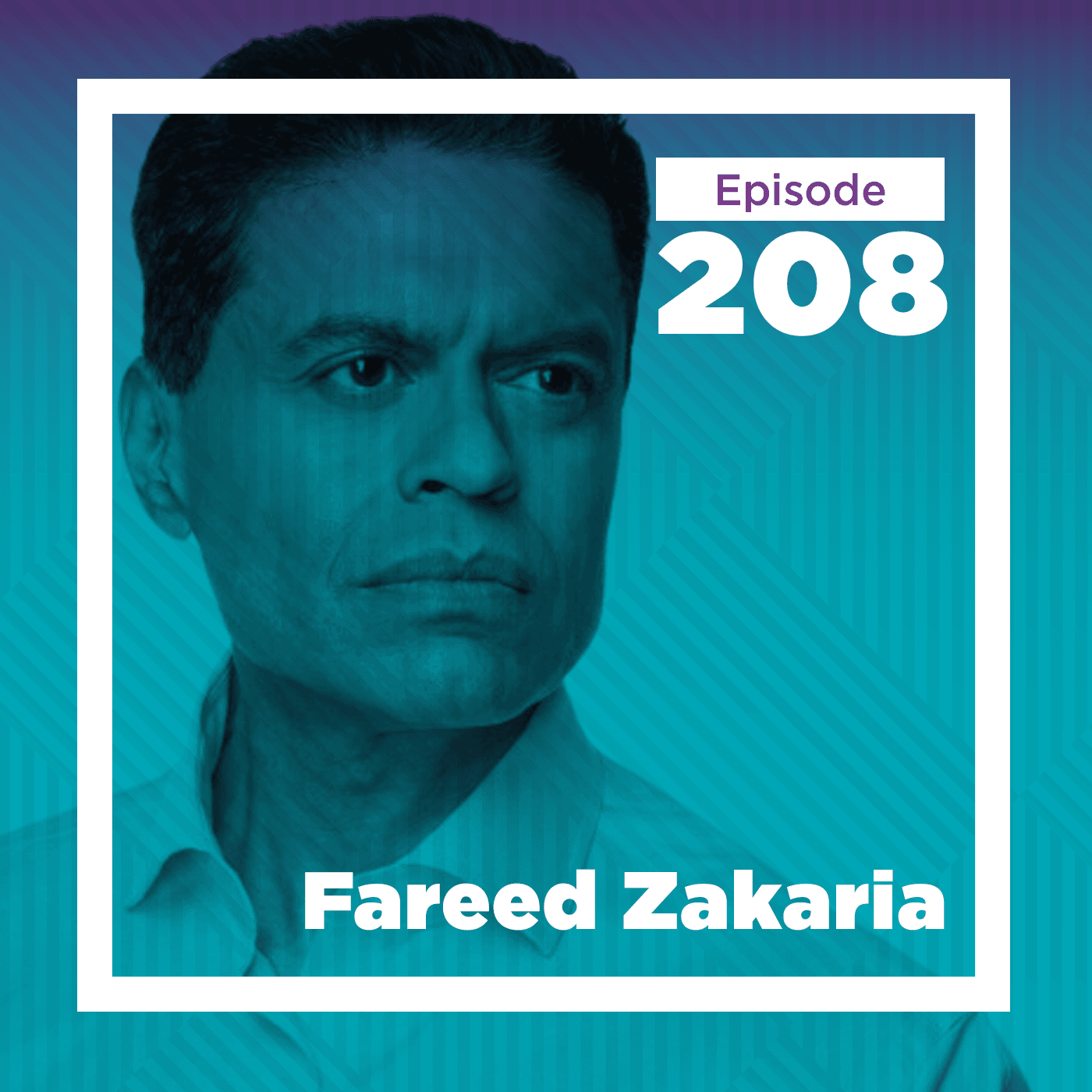
Podcast Episode Notes: Fareed Zakaria on the Age of Revolutions, the Power of Ideas, and the Rewards of Intellectual Curiosity
Episode Overview In this episode of *Conversations with Tyler*, Tyler Cowen speaks with Fareed Zakaria, a renowned journalist and author, about his latest book, *Age of Revolutions: Progress and Backlash from 1600 to the Present*. The discussion covers a wide range of topics, including Zakaria's intellectual influences, his perspective on liberalism, and reflections on his career choices.
Key Themes
- Importance of Ideas: Zakaria emphasizes that books and ideas are central to his work, transcending his role in television journalism.
- Classical Liberalism vs. Populism: The conversation explores the tension between classical liberal ideals and contemporary populist movements.
- Personal Influences: Zakaria reflects on key figures from his upbringing and education, including Khushwant Singh and Sam Huntington.
Key Takeaways
Intellectual Influences
- Khushwant Singh:
- Zakaria credits Singh, a prominent Indian journalist, with instilling in him a love for language and literature.
- Singh’s role extended beyond journalism to mentoring Zakaria in writing and critical thinking.
- Family Background:
- Zakaria’s father, an Indian nationalist who chose secular democracy over religious nationalism, shaped his political views.
- The influence of leftist ideas in the Bengali intelligentsia reflects the complexities of India's political history.
Reflections on Academia vs. Journalism
- Career Decisions:
- Initially aimed for an academic career at Harvard, Zakaria pivoted to journalism after a conversation with Walter Isaacson.
- He viewed academia as increasingly focused on theoretical frameworks, which he felt limited his intellectual curiosity.
- Debate Skills:
- Zakaria learned political strategy and persuasion during his time at the Yale Political Union, ultimately deciding against a career in active politics due to the environment's moral compromises.
Contemporary Issues
- Classical Liberalism:
- Zakaria argues that the classical liberal project is under threat from rising populism and authoritarianism.
- He stresses the importance of intellectual curiosity and the historical significance of the Enlightenment in promoting liberal values.
- Cultural Context:
- The discussion includes thoughts on the state of modern economies, particularly in relation to oil wealth and modernization in Middle Eastern countries.
- Zakaria contrasts the cultural and economic development of the Gulf states with the challenges faced by larger nations like Iran.
Personal Insights
- Life Balance:
- Despite a busy career, Zakaria emphasizes maintaining a rich personal life with his family and close friends.
- He reflects on the privileges of his position and expresses gratitude for his opportunities.
- Writing Process:
- Zakaria views writing books as a critical endeavor that provides depth and context to contemporary issues, despite it being challenging.
Conclusion Fareed Zakaria's discussion with Tyler Cowen is a rich exploration of ideas, personal history, and the currents shaping modern thought. His reflections highlight the ongoing challenges to liberalism in today's world while underscoring the enduring power of ideas and intellectual curiosity. Zakaria's book, *Age of Revolutions*, serves as a reminder of the importance of understanding historical contexts in navigating present and future societal challenges.
Written by AI. May contain mistakes. Listen to the episode to check what was said.
Transcript
Automatic transcript. May contain errors.0:04Conversations with Tyler is produced by the Mercatus Center at George Mason University, bridging the gap between academic ideas and real world problems. Learn more at mercatis .org. For full transcript of every conversation, enhanced with helpful links, visit ConversationsWithT Tyler .com.
0:26Hello everyone and welcome back to Conversations with Tyler. Today I'm chatting with Ferid Sakarya, who truly needs no introduction, but I would like to point out as of March 26th, he has a new and wonderful book out, Age of Revolutions, Progress and Backlash from 1600 to the present. Ferid, welcome. It's a huge pleasure to be here. I'm a little intimidated, I must confess because I've listened to you, I'm a fan of the podcast and you range very widely. And I'm worried you're going to ask me questions about something I wrote about 15 years ago that I don't remember. You will remember it, but I want to start by trying to figure out you.
1:05So what did you learn from Kuzwan Singh? And when was that? So this is the dedication of my book where I decided this garden book. I decided I was going to I kind of try to remember all the people who helped me along the way in my life. And it starts with Hushwan Singh, who is probably, if you had asked somebody in India 10 years ago, they would have told you, he's the most famous journalist in India. I got to know when I was 10 years old, he was my mom's boss, my mother worked at a magazine called the Illustrated Weekly of India. And he was an extraordinary character. He was a novelist who had also been a diplomat, and then he would become editor of this magazine.
1:49And he was a kind of intellectual who, I don't know, we have as many of these kinds of people as we used to. He was a novelist who won a couple of awards for his books. He was a great lover of the English language and a poetry in particular. And it was infectious. So he gave me this real love of the language and love of poetry that I still have to this day. He, in a sense, taught me how to write, made me understand what good writing was, turned me on to people like George Orwell. You know, I just have this very fond memory of he'd also taught me how to play tennis, how to swim, all kinds of things.
2:26My father was not very athletic, so he kind of filled that role in a way. So that's who he is. And you know, as you know, the list is wrong, I kind of tried to go through everybody who would really help me along the way. And what was it he saw in you that encouraged him to pay so much attention to you, because you were 10, you say, right? Yeah, I think I've always been intellectually very curious. I don't think I'm the smartest person in the world, but I am very intellectually curious, and I get fascinated by ideas and why things are some way. So even when I was very young, I remember I would read much more broadly than my peers.
3:06I think I looked this up once, but Henry Kissinger's memoirist came out when I was 14, I think. And I remember reading them because I remember my mom's at that point she was working at the times of India. They exopted it. And I remember telling her that they had chosen some of the wrong excerpts that there were other parts that would have been better. So I must have read enough of it to have had an opinion. Why couldn't you talk, Singh, out of his Nehruvian socialism? He was a great liberal. He loved tree speech, very broad minded as you know much better than I do, right? But he on economics was weak or no.
3:42Oh no, you're entirely right. And by the way, I would say the same is true of my father with whom I had many, many such conversations. My father, you'd find this interesting Tyler. My father was a young Indian nationalist who, as he once put it to me, made the most important decision in his life politically when he was 13 or 14 years old, which was as a young Indian Muslim, he chose narrowest vision of secular democracy as the foundation of a nation rather than Jinnah's view of religious nationalism. So he chose India rather than Pakistan as an Indian Muslim. And he was politically so, you know, interesting and forward leaning, but he was a hopeless social, I mean, sort of social democrat, but but veering towards socialism, both these guys were.
4:29And here's why I think for that whole generation of people, by the way, my father went to a goddess scholarship to London University and went to study with Harold Lasky, the great British socialist economist. And Lasky tollum, you're actually not an economist, you're a historian. So my father went on and got a PhD in a London University in Indian history. But that whole generation of Indians who wanted independence were imbued with two, there were two things going on one, the only people in Britain who supported Indian independence were the labor party and you know the Fabian Socialists, all their allies were all Socialists.
5:12So there was a kind of common cause and there was an it was much it was a symbiosis because these were your friends, these were your allies, these were the only people supporting you, the cause that mattered the most you in your life. And the second part was a lot of people who came out of third world countries felt we are never going to catch up with the West. If we just wait for the market to work its way in, you know, over hundreds of years. And they looked at in the 30s, the Soviet Union and thought this is a way to accelerate modernization industrialization. And so they all were much more comfortable with the idea of something that kind of sped up the historical process of modernization.
5:56You know, at my own view was that there was a big mistake. Though I do think there are elements of what the state was able to do that perhaps were better done in a place like South Korea than in India. But that really explains it. My father was in Britain in 45 as a student. And as a British subject then, you got to vote in the election if you were in London, if you were in Britain. So, I said to him, who did you vote for in the 1945 election? Remember, this is the famous election right after World War II, in which Churchill gets defeated and he gets up the next morning and looks at the papers and his wife says to him, darling, it's a blessing in disguise.
6:37And he says, well, at the moment, it seems very effectively disguised. My father voted in that election. I said to him, you're a huge fan of Churchill, because I had grown up around all the Churchill books and my father could quote the speeches and I said, did you vote for church? He said, oh, good Lord, no. I said, why I thought you were a great admirer of his. He said, look, on the set in the issue that mattered most to me in life, he was an unreconstructed imperialist. A vote for labor was a vote for Indian independence. A vote for church was a vote for the continuation of the empire. So, you know, that again is why their friends were all socialists.
7:15Why do you think the Bengali intelligentsia has been so especially left -wing? Is there a reason? Ah, so the Bengali intelligentsia was the kind of great intelligentsia of India, probably the most literate, the most learned. I think it's because they're very clever. And one of the things I've always noticed is that people who are very clever, political elites, tend to think that they should run the economy because they can do it better than the market. Milton Friedman used to say that there are two groups of people who don't like the free market. Academics intellectuals, because they think they can do it better than the market and businessmen, because they don't like competition.
7:58What they really want, this is sort of a variation of the Peter Teele argument. What they all really want is to be monopolists. And that former part is what I think what explains the Bengali intellectuals. And by the way, many of the kind of policy intellectuals in India in the 50s and 60s who were very much socialist were brilliant. This is not a case of stupid people. These were all, and they were all educated at places like Berkeley and the London School of Economics and Harvard. So we see the same phenomenon now, right? When you watch the Biden administration putting in all these rules about chip making and things, They think they can figure out the direction the economy is going in, the way it should be guided.
8:46I think that the reality is the market is much more powerful than they are in these areas. They give you one simple example. They decided, okay, we need to be making high end chips. So who do they bet on? They bet on Intel, a company that has failed miserably to compete with TSM see the great Taiwanese chip manufacturer and Intel is now getting multi -billion dollar grants from United States government from the European Union because you know If it fills all the categories that you're looking for big company stable well run probably you know in some sense Can guarantee a lot of jobs But of course the reality is that chipmaking is is so complicated And so that the future of chipmaking seems to be moving to companies like Nvidia and and AMD and micron, leaving Intel for the hands of Intel at last war and got rewarded for its failure by being given a check by the US government saying try again.
9:44And now it seems to be failing in this next war. And who knew that actually it's Nvidia whose chips turned out to be designed for gaming turned out to be ideal for artificial intelligence. It's a perfect example of how the Hayakian market signals that come bottom up are much more powerful than a political elite who tries to tell you what it is, but to answer your question. Political elites love the idea that political elites get to direct the economy. What did you learn from the Anglican Book of Common Prayer? So I went to an high -anglican school in India from, you know, until 12th grade and we'd start every morning singing a hymn, reciting a book out of the Book of Common Prayer.
10:28I learned probably two things. One was a kind of reverence for tradition and particularly I loved the hymnal. I think Britain's great contribution to music is religious music. It doesn't have anything to compete with, you know, the Germans and the Italians and opera and things like that. But religious music, I think the the the brits have done and the English have done particularly well. And the second thing I would say is an admiration for Christianity for its extraordinary emphasis on being nice to people who have not been lucky in life. I would say that's to me the central message of Christianity, certainly from the Sermon on the Mount, and And it's imbued through the book of common prayer, is be nice people who've been less fortunate than you.
11:18Be nice to poor people. Recognize that the first in God's kingdom, the first shall be last and the last shall be first. That there is an enormous emphasis on the idea that those things that make you powerful in this world are not the things that really matter, that your dignity as a human being doesn't come from that. I think that's a very powerful idea. Yeah, it's a very revolutionary idea. Tom Holland has a very good book about this. He's a wonderful historian and Britain. I think it's called Dominion. He's been a guest. Yeah. He points out what a revolutionary idea this was. It completely upended the Roman values, which were very much the first shall be first, you know, the powerful and the rich are the ones to be valued.
12:02And he points out, here's this Jewish preacher coming out of the Middle East saying, know the first shall be last, the last shall be first in the kingdom of heaven. Do you think you picked up an anti -clarical side from seeing at all? Yeah, I've always liked the kind of more radical Protestant which is actually also the more radical Sunni idea in Islam that people should have an individual relationship with God that there is the intermediaries seem to exist, to exert power and are often corrupt and often distort the message. Yeah. And I still believe that. I think that one of the most signalling things to look at in America is these televangelists who who take advantage of, you know, ordinary people and their faith.
12:49And clearly to me, it seemed to have constructed an elaborate and deeply corrupt a racket out of the whole thing. I went to Amrit's art the year before. And it was one of the most magical feelings I've ever had in any place. And I'm still not sure what exactly I can trace it to. I'm not a Sikh, of course. But what for you accounts for the strong, powerful, wondrous feeling one gets from that place? It's a very good question because I also have that feeling and I think it might explain, for example, Amritsari's, you know, kind of the most important place for the Sikh religion and has a beautiful temple, it's called the Golden Temple.
13:31And when Indira Gandhi as Prime Minister stormed it because there were a group of separators to hold up there. That really is what triggered enormous, enormous pain and anger in the Sikh community, which eventually led to her assassination. And I bring that up only to emphasize your point that it has a kind of special magical feeling for Sikhs. I think there's something about it architecturally, which is that there's a kind of serenity about it. Sometimes you can find Hindu temples that are very elaborate. Tickism is a kind of offshoot of Hinduism. And Hindu temples can be very elaborate, but very elaborate and ornate.
14:12And this somehow had a kind of simplicity to it. And then when you add to that the water, I've always thought that water adds an enormously calming effect. So it's something about that combination, I think, but I'm just speculating. What language did you grow up speaking? Hindi and Urdu more than anything else. Hindi and Urdu are two Indian languages, very, very related. They both have roughly the same grammatical structure, but then Hindi derives its vocabulary entirely from Sanskrit or almost entirely from Sanskrit and Urdu derives its vocabulary almost entirely from Persian. Although is a language of Indian Muslims and is the official language of Pakistan, it's a beautiful language, very lyrical, you know, very much influenced by that Persian literary sensibility.
15:03If you're speaking Hindi, there's a way to, if you're speaking one of the languages, there's a way to alternate between both, which a lot of Indian politicians used to do, as a way of signaling, a kind of broad, you know, kind of embrace of both the Hindu and the Muslim communities. He's narrow, India's first Prime Minister used to often do that. He would say, I'm delighted to be coming here to your home. And he would say, he'd repeat the word home first in Urdu then in Hindi so that both constituencies were covered. Modi by contrast, India's current Prime Minister, who's a great Hindu nationalist, takes pains almost never to use in Urdu word when he speaks.
15:43He speaks in a kind of highly Sanskritized Hindi that most Indians actually find hard to understand because the everyday language, Bollywood Hindi, is a mixture of Hindi words and Urdu words, you know, so Persian and Sanskrit origins. But for Modi and for people of his ilk in the BJP, his party, it's very important to quote and quote, cleanse the language Hindi from foreign influences. And that is why they will speak a very Sanskritized Hindi. given that you grew up speaking or to do your connection with Sing, who was born in what is now Pakistan. How much, if at all, do you have an aesthetic longing for what used to be called historic India?
16:26I don't mean in an imperialistic kind of way, but just there was something proper about the fact that it was all connected. Is that in your thought much at all? Yes, it's funny you, I don't I've ever written this, so I don't so I'm not quite sure how you pick that up, but it's absolutely. So I'll give you a simple example. Look, I think of the partition of India was a complete travesty. It was it was premised on this notion of religious nationalism. It was horrendously executed. The British got the the person who drew the lions, a man named Radcliffe, had never been to India. He had never been east of the Suez and was given this task and he did it in a month or two probably caused a million and a half to two million lives lost, maybe 10 million people displaced.
17:15And it broke that wonderfully diverse, syncretic aspect of India. So if you look at cities like Delhi and Lahore, what was beautiful about them is that they mixed together all the influencers of India, Hindu, Muslim, Punjabi, Sindhi. And now what But what you have is it's a much more bifurcated. So if you go to Lahore, Lahore is a sort of Muslim city in Pakistan and it has a Punjabi influence. In Delhi has become essentially much more Indian and Hindu and has lost that Muslim influence. And to me as somebody who really loves cosmopolitanism and diversity, it's sad to see that. It's almost like you've lost something that really made these places wonderfully rich.
18:00You know, I feel the same way when you look at it, when you read about the history of Europe, you think of a place like Vienna, which it is most dazzling moment was dazzling precisely because it was this polyglot population of people coming from all over the Habsburg Empire, a large segment of it was Jewish, and it had as a result all of the, I mean, think about Freud and Clinton and the music that came out of there and the architecture that came out of the turn of the century and the turn of the 19th century. And it's all gone. You know, it's kind of like this point is somewhat beautiful but slightly dull Austrian city.
18:37Do you feel Mumbai is still the most cosmopolitan part of current India? Yes, by far. Mumbai is definitely the most cosmopolitan. And it still has a lot of cosmopolitanism because India still has a lot of Muslims. I mean, even though it's, you know, the Muslim majority 30 areas ended up being Pakistan, Bangladesh. But there's very substantial minority, around 10 % which in Indian terms, maybe 12%, it's about 180 million Muslims, which makes it, I think, the third or fourth largest Muslim country in the world. Why do you think Indian Muslims have not radicalized so much, or at least it seems that way to me as an outsider?
19:18Know you're 100 % right, they have not radicalized at all. George W. Bush used to say, and it's basically true that it's extraordinary to see a population of 150 -plus Muslims living right next to Pakistan, right next to Afghanistan. And there was not a single known member of Al Qaeda. I think there are now maybe a handful of members who have been found to have been Indian Muslims. but given the scale of almost 200 million Muslims, the fact that they're at most five or ten who belong to these radical terrorist groups, is extraordinary. It's not even that. They don't vote for Muslim parties. In general, they vote for the Congress party, which is a secular party.
20:03So they don't even, even in their voting, forget terrorism. They don't even vote for, you know, kind of specifically Muslim or Islamic fundamentalist parties. And why is that though? I think it's the kind of, again, the syncredic nature of India. That India has always been diverse. Hinduism is very tolerant. It's a kind of unusual religion in that you can believe in one God and be Hindu. You can believe in 300. You can be vegetarian and believe that's a religious dictate. You can be non -vegetarian and believe that that's completely compatible with your religion. It's always embraced almost every variant and variation.
20:43And so I think in a sense Islam fit in within that tapestry very easily. And it's been around for a while. I mean, when people talk about cleansing India of, you know, Hindu nationalists talk about cleansing India of foreign influences, Islam has been in India since the 11th century. So it's been around for a long time. People I think feel comfortable and don't feel the need to assert that distinctive identity by voting in a parochial way. Some of that is changing and I worry about it because there is, you know, much more sustained persecution of Muslims these days in India. But I still think in many ways India is a sort of wonder of this.
21:28There's nothing quite like it, no country quite like it. There are, you know, 15 official languages and those are real languages. I mean, languages with thousands of years of literature and poetry, these are not dialects, they're 400 dialects in India. And yet there's something that unifies the country, kind of almost geographically, symbolizationally. First, we're already in a bit. What did you learn debating at the Yale Political Union? I had great fun. I learned more than anything else, honestly, how to do politics because, you know, the Yale Political Union was a kind of, It was a speaking, you know, it's sort of like a mini -parliament, but there were political parties.
22:07And you had to make alliances, you had to, you know, especially if you were trying to rise up there, and I became president myself more year, which was pretty fast. You had to be very good at politics, and I discovered if I can be totally honest, I was very good at politics, but it scared me. I did not like the person I became in doing it. You have to be pretty ruthless, pretty expedient. You have to make alliance. I wouldn't say you have to be deceptive, but you have to do a little bit of over -promising and switching horses when it seems necessary. And I don't know if I decided this consciously, but I think one of the reasons I'm a journalist and not an active participant is that I saw what it does to you as a person and I didn't love that.
22:58I was very good at it. I will, you know, boastfully say. There was, I think, 2003 piece in New York magazine. I know you know it. The suggested you might someday be Secretary of State. Now this was never you saying that. But when that came out, no one laughed. And now today that would be unthinkable because our politics is somehow crazier. What did you think in 2003 when you heard people thought you could someday be Secretary of State? You know I It was enormously flattered, obviously. I didn't myself think that that was a likely scenario because I had already begun to see a shift that had taken place.
23:38If you look back to when Nixon appointed Kissinger National Security Advisor, Kissinger had barely ever been a consultant to the Kennedy administration. It really been an academic. Nixon had been attracted to him for two reasons. One, he had read his Foreign Affairs articles, mostly Foreign Affairs. years. And two, he knew that Kissinger advised Nelson Rockefeller, and Nixon had a little bit of that envy of the Eastern establishment. When Carter appointed Brzynski, Brzynski was a famous academic, again, had never held government job. There was something about the Cold War, which made people think the stakes were so high, you had to find, you know, the most brilliant person you could or something like that.
24:21In the last 30 or 40 years, the trend has moved much further away from that and much more toward loyalty, toward people who have been supporting you, who have been on your team, who have worked on your campaign. And I've never wanted to do that. I've never done that. And so I always thought that that was a kind of, you know, people were using an old standard, which is here's this guy who writes really interesting stuff on foreign policy. maybe he's going to become a whole high government office. I don't think those kind of people like me are asked to do that kind of thing anymore. And it's a separate question as to whether I do it.
25:01I have been asked to serve in government several times. I've never, but never at that level. I've never really wanted to do it because I realized it's a version of what I was saying to you about the Yale political union. I'm not a very good courtier and you have to be a courtier if you're going to serve. you lose your own voice, you have to take on the voice of the principal, you know, the president, and you have to be a good team player. And I've always liked my own independence, my own voice. And so even though I was flattered at times when I would be offered these things, I never quite, never quite made sense to me.
25:38I always found some excuse, you know, economists have a wonderful phrase, revealed preferences. And after about the third time I was offered something when I turned it down, I realized to myself, you know what, my revealed preferences, I do not want to go into government. At the Yale Political Union, who beat you the most often in those debates? If anyone. I was pretty good. I think that I would say I had a roommate who was also a member of the Yale Political Union. I was right of center in those days, he was left very eloquent and very smart. His name is David Murphy. He then became a partner at Wachtel Lipton, which is literally the leading law firm in the country, the most profitable law firm by far.
26:26He now does arbitration, and he's still a formidable debater. We're still very much in touch. I think that was probably a Brad Berenson, was another person who was very good who I think served in the Bush White House as in the Office of Legal council and then became general council to GE. I would say those two more than anyone else. So in these years, if I understand it correctly, you're viewed very much as a prodigy. Did you feel pressure from that? No, if I'm being totally honest, I got energized by it. I felt like, you know, I had the wind behind my back. And I was amazed that America would, you know, that America, I mean, it wasn't America.
27:11It was where I was, you know, in Yale and Harvard and all that, that nobody cared where I came from, nobody cared. You know, I remember once being asked when I was a graduate student at Harvard, Tony Lake was their national security advisor. And his office called and said, I'd written something in the New York Times, I think, you know, Mr. Lake would like you to come to the White House to brief him. And I walked in and there was five people at around a table, Tony Lake, the deputy national Social Security Advisor Sandy Burger, George Stephanopoulos, who was then Director of Communications at the White House.
27:44Joe Nye, who was the senior professor at Harvard, one other person and myself. And I kept thinking to myself, I think I'm going to realize at some point that I'm not an American citizen. I mean, they're asking me for my advice on what America should do, and I'm not, you know, I'm on a student visa. And of course, nobody ever did, which is one of the great glories of America. What did you learn from Walter Isaacson? Walter... When I first got to know him was, you know, just a kind of a great journalist who had written this book, The Wise Men. One of my funny social faux pas is I met him at a cocktail party at Harvard, at a student group which he belonged to when he was at Harvard and that I belonged to as a grad student called the Signet Society.
Read the full transcript
28:32and we were chatting about books and somehow the the book the wise men came up and I puffed myself up as a graduate student and said, oh, you know, I just reviewed that book for the American scholar, the magazine of Phi Beta Kappa. And you know, I said, I just reviewed that book and he looked at me and he said, yeah, and I wrote it. So I learned from him, you know, more than anything else. Walter had this wonderful ambition. And I say wonderful because, you know, he was a journalist, but he was decided he was going to write this book about American foreign policy, about the group of people after World War II, who really charted the course of American foreign policy, charted the course of the American century.
29:19Then he decides to write a biography of Henry Kissinger. then he decides to write a book about Einstein. And I think, particularly when you trained as an academic, as I was, you kind of get into silo and you think to yourself, well, I only know about this one thing. And Walter has this amazing breath about him, where he's willing to take on anything, Leonardo da Vinci, and people to it off. The books are amazing. I think that sense of that breath of ambition, I've always loved. Yes, I like the Leonardo book. Now, you're out your dissertation under Huntington, right? Correct. And what was your thesis topic and how did you choose it?
29:57I'll be totally honest. So my thesis topic was, I try to answer the question when countries rise in great power, when they rise economically, they become great powers because they quickly translate that economic power into diplomatic and military power. What explains the principle exception in modern history, which is the United States? The United States, by 1880, by most measures, had overtaken Britain as the leading industrial power in the world. But if you looked at its army, its navy, its diplomatic representation, your number of embassies that had around the world, it ranked, you know, 20th in the world.
30:39I think it had, you know, many, many fewer foreign outposts than Italy. It had a smaller army than most European nations. So what explained this massive delay in America rising politically and diplomatically and militarily? My simple answer was that the United States was a very unusual creature in the modern world. It was a very strong nation with a very weak state. So that the federal government in the United States did not have the capacity to extract the resources from the society at large because I mean you didn't have income taxes and those days you still had the state malicious systems where you know the federal troops were not it was not that easy particularly in the shadow of the civil war for the federal government to raise troops so there were all these obstacles to America translating its national power into state power that could be used.
31:35Anyway now the reason I did it was partly I was fascinated by it Paul Kennedy had been my advisor, Yale, and he had been writing the rise in fall of the great powers, his great tome at the time. The second reason I did it was I wanted to get a job in academia, and this conformed to certain academic fashions at the time about testing hypotheses, testing various theories of real polity, called realism and classical realism and defensive realism, all of which I now look back with a certain amount of regret because I think it kind of added unnecessary theoretical layers to what was actually a very elegant historical thesis.
32:17But look, I was an immigrant kid. I wanted a job. And so part of the point was to write it in the style that would get me a job. And you know, it would have succeeded. It would have succeeded at that. It was a well regarded dissertation. It got published by Princeton. and but by then I decided to move away from academia. What put you off academia? And this was for the better in my view. I think two things. One, I could see that political science was moving away from the political science that I loved, which was a kind of a broad discipline rooted in the social sciences, but also rooted in the humanities, which was sort of a kind of rigorous, structural historical comparisons, looking at different countries, trying to understand why there were differences.
33:06It was moving much more toward a huge emphasis on things like rational choice, on game theory, on, you know, kind of, there was a kind of economist envy, just as economists have math envy, political scientists have economists envy. And it was moving in that direction, which, where the weather was the right direction or not, it was not something I felt like I would thrive in. And the second piece of it was actually very much related to Huntington. Sam Huntington was an extraordinary character, probably the most important social scientist in the second half of the 20th century. Huge contributions to several fields of political science.
33:45He lived next to me, me, obviously in a tiny graduate student department, but he in a townhouse on Beacon Hill. And so I would sometimes talk to him, we'd have coffee in the mornings and he had a routine which is he'd get up about 6am, he'd get down, go down to the basement of his townhouse and at 630 he would start writing or working on whatever his next big research project was. And he'd do that for three hours, untrubbed it at least, sometimes four. And then at about 930 -10 he would take the subway to Harvard. And his point was you got to start the day by doing the important work of academia, which is producing knowledge.
34:24All the rest of it teaching committee meetings, all that you can do later. And he was so disciplined about that, that every five years or so he put out another major piece of work, another major book. And I looked at that and I said to myself, I do not have the self -discipline to perform at that level. And so, you know, I need to go into something that has deadlines, that has structure, that has more feedback, you know, because it's as you know well, Tyler, there's a very lonely aspect to being an academic, you know, there's a lot of fun and there's lots of interesting things, but a lot of it is just sitting by yourself.
35:05The new Leonard Bernstein movie, there's a point at which Bradley Cooper says, I'm guessing this comes out of a Bernstein interview where he was asked, what's the difference between being a conductor and a composer? And he says, well, being a performer, you have a kind of constant relationship with the outside world. You have a, he says, you have a grand, you know, a life directed outward. But as a composer, as a creator, you only have a grand internal life. You know, it's all within you. and it has to and you have to be able to make generate ideas from that lonely space. And I've always found that hard.
35:46So for me writing books is the hardest thing I do. I feel like I have to do it because I feel as though everything else is trivia, television, column, everything else. I mean, I think it's important, but it's relatively, in my conception, in my hierarchy, it's trivia. The most important thing you can do is to try and write books that make a difference that put new ideas into the world, but it's the hardest thing for me. So by age 28 now, your editor of the journal Far and Affair is, which especially then was extremely important. How did that happen? Really luck. I was having lunch with Walter Isaacson.
36:31and this just shows you serendipity in life. I was having lunch with Walter Isaacson in New York and I was telling him that Sam Huntington had offered me an assistant professor at Harvard. There was an institute that Sam ran and that he had told me he thought he could create an assistant professor that was half time teaching, half time assistant director of that institute. And I was thrilled about it and Walter says to me, well, I don't know that you should really go into academia. You're, you know, there's this job out there, the managing editor of Foreign Affairs. And the editor in chief is, you know, he's much older.
37:08He's a real journalist. You would balance him out really well. You should, you should try and get that job. And I remember telling him, Walter, didn't you hear me? I think I'm going to get to be an assistant professor at Harvard. And he thinks it means that did you hear what I just told you? I think you could be managing editor of Foreign Affairs. And I realized that we were both totally socialized by our respective careers. In graduate school, you're on a conveyor belt and the end of the conveyor belt is becoming a great professor and what better place to start than Harvard. And in journalism, the idea of being managing editor by the time you're 28 is...
37:46So each of us was reflecting our biases and our silos. But then I went home and I realized, you know, I was really... I'd always love journalism. I started a magazine when I was in high school. I'd been the editor of the Yale Political Monthly. I'd every summer job I'd ever had, I'd worked at a magazine or a newspaper because I'd found them fun. I'd, again, reveal preferences, telling you more than you're, than what you say to yourself. And so I called them up and said, yeah, you know, throw my hat in the ring. Then I discovered it was very tough because I was 28 and everybody else, It was being interviewed was 45 plus.
38:24They had much more experience than I did. So I had to really hustle to be viable. But without that lunch with Walter, I wouldn't have happened. Was it you who commissioned Samuel Huntington's very famous Clash of Civilization's essay? Yes. I didn't commission it. So what happened is I went to Sam and told him I was going to take this job at Foreign Affairs which he was completely opposed to. My three advisors all advised me against taking the job. And I realized that the reason was that they were all great academics and the way you, within the world of academia, the way you gain fame and influences by having great protégés, by having great students who then go on to become great academics.
39:06And they all thought that my going would be a great loss to academia, but also, you know, and I kind of lost to their legacy. So Sam very much felt that I shouldn't take the job. And so I said to him, you know, I am going to do it. But can I ask a favor? You sent me a draft of an essay you've been writing for my comments a few months ago called the Clash of Civilizations. Can I take that with me to Foreign Affairs and publish it? And so that's how it I became. So I took it with me, we edited it, and we made it the first time ever, the lead essay. Foreign Affairs had never had a lead essay before.
39:41You know, the typeface or it was all the same. And we redesigned the magazine and we made this the, you know, the kind of the clear cover essay. In a world where we have a major war with Russia attacking Ukraine, significant conflict in the Sudan's ongoing conflict in Congo, several million lives killed there. Do you think that essay is still correct? Because those are very significant conflicts and they're not really cross -civilizational, right? There within particular groups. I think he got one thing very powerfully right, which is that at the end of the Cold War, where ideology was the core motivational factor behind much of the conflict of the Cold War, whether you were communist or capitalist, whether you were allied with the communists or the democratic world, whether you were a proxy for those were the kind of the, the battle lines of the late 20th century, of the mid -20th century, that once that went away, that what people were going to revert to was their identity, and their identity often rooted in religion.
40:50And so if you think about the rise of al -Qaeda, the rise of Islamic fundamentalism, you know, you think about the return of a certain kind of Chinese nationalism in China. I think that piece of it, you know, you look at the rise of Hindu nationalism in India. He really understood that people were going to fall back on these older, ascriptive identities in a way that they had not during the Cold War. What I think he got wrong was international relations is fundamentally a struggle for power and that a lot of those power struggles. It's not that they are motivated by things that are completely contradictory to identity politics, but they sometimes match up and they sometimes don't.
41:33most of many of the wars in the Arab world have been Arab on Arab, Muslim on Muslim. When Saddam Hussein invaded Kuwait, he was invading another fellow Arab fellow Sunni state. As you point out, a number of the African conflicts are essentially you'd have to say conflicts within civilizations. And some of the conflicts are ones where people find our dead fellows, so that the Chinese and the Russians are allying even though in a sense they're two different civilizations. And there's a long history of this. Richelieu, when he was running France, the great Catholic power, allied routinely with Protestant powers.
42:12So, power politics sometimes transcends identity politics. And I think he missed that. But it's still a very powerful and thought -provoking essay, I think. After 9 -11 in 2001 you wrote a famous essay for Newsweek, why do they hate us? You talked about the rulers failed ideas, religion. If you were to revise or rethink that piece today, how would you change it? Because we have 23 more years of data, right? Yeah, not very much honestly, but the central point I was making in that essay was that if you look at the Arab world, it is the principle outlier in the modern era where it has It's undergone almost no political modernization.
42:53That if you look at Latin America in 1970 versus 2000, you would have seen a sea change where mostly dictatorships in 1970 and was mostly democracies by 2001. If you looked at obviously central Europe, totally transformed from communist to liberal democracies. Even if you looked at Africa, you would have seen enormous transition. The Arab world had remained absolutely static, and my argument was that it was largely because of the curse of oil and oil wealth, which had impeded modernization. But along with that, because of that failed modernization, they had developed this kind of reactionary ideology of Islam, which said the answer is to go further back, not to go forward, to go back to Islam as the solution was the cry of the Islamic fundamentalists in the 1970s.
43:44and the problem that they were saying, the Islamist solution to was the failed modernization, the failed westernization of these countries. So that toxic mixture was at the heart of what was producing armed reactionary ideologies like al -Qaeda and things like that. I really do feel very proud of that essay, but you're absolutely right that we have 23 more years of data and what's interesting is that partly because of 9 .11, which I think in some ways was a kind of great wake up call. What you have seen is a much greater effort to buy elites to modernize the societies, not simply to buy a modernity by buying Western goods, but to find ways to actually modernize the society, you know, everything from all the stuff going on in Saudi Arabia right now, which is, yes, there's a lot of economic bringing golf and other sports in, but there's opening up the lives of women, allowing them to be educated, ending the segregation, allowing famously them to drive.
44:48And Saudi Arabia in a way was at the heart of this problem because it is the richest country. And it in many ways sent the signal of what kind of modernization was compatible with Islam and what was not. So I think that in a way you've seen more forward movement in the last 20 years than people realize, even though the regimes have largely stayed dictatorships. But that tension still exists, by the way, Egypt is a very brittle country because, again, it is fundamentally failed to modernize. I've been surprised how well some of the Gulf nations have done since say 2001. If we look at Iran, which is really not done so well, if you had to explain in as fundamental a model as possible.
45:33You know, if you see Iranians abroad, they earn high incomes, they have real science, they have real technology. There's some degree of national unity in a way, maybe you wouldn't find saying Iraq, but what's the fundamental thing at its core holding back Iran? I think it's very similar version of what we were just talking about. It's oil wealth, but UAE has made the transition, right? Why isn't Iran like UAE? So, to begin with those Gulf states, it's important to remember are tiny. You're talking about a million or two people in Qatar, I think you're talking about maybe 400 ,000 people. So, it's much easier for an elite to dominate and rule those places.
46:14There's a reason why Saudi Arabia was more difficult. Saudi Arabia is the one real country by which I mean real population size. And that's why what MBS is doing has been more difficult. and you've got to measure the populations, reaction to things. Iran is a big country, bigger than all of them. And I think that between the oil wealth and the failed modernization where the Shah went to, you know, in my current book, I talk about this. Iran strikes me very much like the French Revolution, where the Shah tried to move much too far, much too fast, much too disruptively, triggered an enormous backlash, which they're still living with now.
46:55And you add to that the oil wealth which makes it easy to not modernize. To just remind people what the problem with oil wealth is that it means you don't have to modernize your economy. You don't have to modernize your society because you can get enormous wealth just by drilling holes in the ground, actually by paying other people to drill holes in the ground. Mostly Western technology is used to extract those resources. So you never get through the painful process of actually modernizing your society. And many of these countries on that situation is I say the Gulf states are so unusual and it's not an accident that the most modern of the Gulf cities is Dubai, the one city that has no oil.
47:39You know, oil is 10 % of Dubai's GDP. It's about 90 % of Abu Davi's. So even there you see that variation and I think, you know, you're right to point to the the thing that needs explaining is why is Dubai Abu Dhabi in Qatar and maybe Saudi worked? Not why do the other ones not work? Because the other ones are all like Nigeria, like Venezuela, the oil -oil -rich countries that have never made it. There are these small exceptions and they're all very small. They're run by very, kind of, forward -leaning, absolute monarchs who have enormous power and can exercise that power because they have a tiny population.
48:19You would have famous interview with Lekwanyu, the theme being culture is destiny. Now Singapore has done very well since then. Do you think that is because of their culture? And why hasn't Singapore become more corrupt? Yeah, I don't. Lekwanyu clearly did. I think it's a perfectly example of they they had very good leadership and they and they institutionalized some of their best practices in a way that made a huge difference. So for example, why are they not corrupt? It's because Lee Kwan, you thought long and hard about this problem. And he decided that he was going to create a system of bureaucracy in Singapore, which was that they get paid close to market wages.
49:01So a cabinet minister in Singapore makes about one and a half million dollars. Senior civil servant makes about a million dollars at the highest level. And it permeates. They do it in a very rigorous process where they essentially benchmark against You know a company like McKinsey or things like that and they say to and of course you don't make the same amount But the idea is that you should be able to make the kind of money that allows you to live a good life Send your kids to to schools and colleges afford health care You know have a good retirement so that all those things that tend to be temptations to be corrupt You don't need to do because if you just do your job well You're gonna eat it so it's a perfect example of how there's nothing cultural about it there are Chinese bureaucracies in China.
49:46There are a lot of very smart people, but they are super corrupt. There's, you know, the Chinese businessmen in Indonesia and they're very corrupt, but Singapore managed through the structure of its system and its laws to do it. Now, to be fair, I'm Lee Kuan, you would argue that there's some part of this that is the Chinese Mandarin tradition of, you know, trusting bureaucrats and stuff, but I've never bought the cultural argument. You know, they used people used to say that if you look at Max Weber in his book on capitalism, the Protestant spirit, he basically said the two areas, the two cultures that are inimicable to growth that are going to be obstacle to growth were Catholicism and Confucianism.
50:29And, you know, I mean, if you look at Spain and Italy over the last 40 years, they've grown pretty pretty darn fast, in fact, somewhat faster than some of the larger countries in the north. And if you look at Confucianism, of course, now people say it's the Confucian ethic that has propelled China forward, the same is true of India. It used to be that people talked about the Hindu growth rate, meaning the low growth rate in the 1950s and 60s. And now they say there's something about Indian culture that actually is very pro -Untroponorial. I think that culture is a very big grab bag. When you see success or failure, you can always dip into that bag and find something that explains either the failure or the success.
51:13I'm struck that this year, both you and Ruchir Sharma have books coming out. Again, Fareed's book is Age of Revolutions, Progress and Backlash, from 1600 to the present. But I would describe broadly as classically liberal. Do you think classical liberalism is making a comeback or is it just being plowed under by progressivism, walkism, trumpism, liberalism, nationalism? Or are you leading a new trend? I wish I were leading a new trend, but I don't think I am. I think the reason these books are coming out and I certainly mine, as you know, is centrally occupied with the problem that there's a great danger that we're going to lose this enormous, probably the most important thing that's happened in the last five, six hundred years in human history is this movement that has allowed for the creation of modern liberal democratic societies with somewhat market economies, right?
52:07If you look at the graph of income of GDP, per capita GDP, it's like a straight line. There's no improvement until you get to about, But roughly speaking the 17th, 18th century in Europe, and then you see a sharp uptick, you see this extraordinary rise. And that coincides with the rise of science and intellectual curiosity and the scientific method and the industrial revolution after that. All that was a product of this great burst of liberal enlightenment thinking in the West. And I fear that that whole project is now under threat because of all the forces you described. You know, populism from the right and the left, you know, dictatorships and authoritarian regimes that want to manipulate it to serve their purposes.
53:00And part of the reason is it's just been so successful that it is, it is producing change and transformation economically, socially, and even personally and psychologically on a scale that is so disruptive and so troubling to people that they search for solutions. They search for, you know, if you think about what we've gone through in the last 30 years, and this is really the central argument of my book, massive expansion of globalization, massive expansion of information technology so that it has completely upended the old economy. All of this happening and people are overwhelmed. In that age of anxiety, they search for a solution and the easy solutions are the ones offered by the populace and they're deeply anti -liberal, illiberal.
53:50And so I worry that we're actually, you know, if we don't cherish what we have, we'll lose what has been one of the great, great periods of progress in human history. What's the most surprising thing you learned writing this book? One surprising thing that you may be a new Tyler that I did was that the left right divide that we talk about, it came about as kind of an accident. You think to yourself, why do we speak of people being left wing and right wing and left of center and right of center? It's because during the French Revolution, actually, just before the French Revolution, There was a national assembly chamber in which people used to sit according to their status, whether they were commoners, whether they were priests, whether they were aristocrats.
54:38That was the division. But as the debate turned into a debate about the preservation of the French monarchy, the people who wanted to preserve the monarch tended to cluster on the right of the chair of the presiding officer's chair, and the people who wanted to get rid of the monarchy tended to gather on the left. And then this architect, Adrian Paris, designs a new chamber for the National Assembly, which becomes a rectangular box in which there is literally a right side and a left side, and all the people who wanted to preserve the monarchy would congregate on the right and the people, or naturally this was not by a requirement.
55:17and all the people who wanted to upend the monarchy were on the left. And that is how you came up with left wing and right wing, which I've always thought is a wonderful example of sometimes in history, you have these serendipities, which then have a very long and powerful effect. Why does your book cover the 17th century Dutch Golden Age? The Dutch are the first modern country. They are the first country that, you know, certainly with the exception of ancient Greece and Roman. In modern history, the Dutch invent modern politics and economics. They invent modern politics in the sense that it's the first time politics is not about courts and kings.
56:00It is about a merchant republic with powerful factions and interest groups and political parties, precursor to political parties. It's the beginning of modern economics because it's an economics based not simply on land and agriculture, but on, And the famous thing that John Locke talked about, which is mixing human beings' labor with the land. And the Dutch literally do this when they reclaim land from the sea and find ways to manage it and then invent tall ships, which is in some ways one of the first great technological revolutions that has a direct economic impact. You put all that together.
56:39And the Dutch, they become the richest country in the world and they become the leading technological logical power in the world. So it was very important to me to start the stock, because they are really the beginnings of modern liberalism. And I should be clear when I say liberalism, I mean classical liberalism liberalism as in often pertaining to human liberty. Circa 1800, how large were the Chinese and Indian economies? Yeah, this is one of those highly misleading statistics that certainly the Chinese and Indians often use, but it tells you very little. So it's circa 1800 the Chinese and Indian economies are the two largest economies in the world.
57:18And people have taken this to mean, oh, you know, the West had a temporary spurt because of colonies and cheap energy and that, you know, the Chinese and Indians are just coming back to where they were. And that really misses, first of all, the statistic is misleading because in those days, GDP was simply measured by using population. All society was agricultural. The more people you had the larger your GDP. It was meaningless because the state could not extract that GDP in any meaningful way. And it's meaningless because it doesn't it doesn't measure progress, it doesn't measure per capita GDP growth, which is the most important thing to look at.
58:00So if you look at per capita GDP growth from 1350 to 1950 for 600 years, India and China have basically no movement. It's about $600. In 1350 and $600 in 1950. The West by comparison moves up 600 % in that period. So it's a roughly $500 per capita GDP to roughly $5 ,000 per capita GDP. And you can also look at all kinds of other measures. You can look at diet, the economic historians who've done this very well. And people in England were eating four to five times as much rain and protein as people in China and India. You can look at the extraordinary flourishing of science and engineering. You can look at the rise of the great universities.
58:50It's all happening in the West. The reason this is important is people need to understand the rise of the West has been a very profound, deep rooted historical phenomenon that began sometime in the 15th century. The fact that we're moving out of that phase is a big, big deal. This is not a momentary blip. This is a huge train or this is something that the West defined modernity. So even when countries try to be modern, they are in some way becoming Western because there is no path we know of to modernity without that. And we one other way of just thinking about how silly that statistic is, in pure GDP terms, China had a larger GDP than Britain in 1900.
59:33Now, look at Britain in 1900. The most advanced industrial society in the world, ruling one quarter of the world, the largest navy in the world, was able to humiliate China by using a small fraction of its military power during the opium power. So, that's what tells you that that number is really meaningless. The West has been significantly more advanced than the rest of the world since the 16th century at least. How did you end up writing online wine reviews for Slate? Michael Kinzley, who was my first boss at the New Republic, called me up one day and asked me if I would write a foreign affairs column for the new WebZine Slate that he was starting with Microsoft.
1:00:18And I said to him, I'd love to, but I just signed on with Newsweek to write monthly call him on foreign affairs. And he said, you got to write something for me. I really want you to be part of this new venture. It's really important to me. And I said, I tell you what I could write about was something I know about as much about as foreign affairs as wine. And I'll try and write it in a way that would be of interest to a non -wine drinker. And that was the mandate I set myself, which is try to write this in a way that is of interest to somebody who wouldn't. So I, you know, I try to answer why is it that the British love Bordeaux wines and they call them Clare.
1:00:55Right? We're red Bordeaux, it's a very long tradition and people have often said this is an example of British taste and culture. Well, of course, it isn't. It's an example of tariff policies. For 400 years, when Eleanor of Aquitaine was married, Henry II in France, for those of you remember the movie The Lion in Winter with Catherine Hepburn and Peter Routouel, everything that came out of Bordeaux was tax -free to Britain because of this marriage, because Eleanor of Acquitaine was French and came from essentially from Bordeaux, and so all Bordeaux products went to Britain tax -free. And as a result, the British developed an enormous liking for this wine.
1:01:34So it was a good way of trying to get people who are not interested in wine, interested in something about wine. Were your feelings conflicted at all when you started doing TV? Or was it just plain out right fun. Like I want to do this. This is for me. When I started to do it, I was just doing it as a commentator. You know, the main gig I got was George Stephanopoulos asked me if I would be on the Sunday round table that he inherited the show that David Brinkley used to run. And that was fun. That was just pure fun. When I started to try to do it myself and do my own show, I had a little show on PBS, Yes, that was more difficult.
1:02:15And I had to find a way to make, to come to terms with television, because I really fundamentally thought of myself as somebody who was a writer, who just happened to occasionally be on television offering an opinion. And you couldn't, if you look at it from that perspective, you can't but think that television is superficial. You know, because if you look at, if you take my show, which I'm very proud of, but if you tick the transcript of my show, it would probably fit on one page of the New York Times. That's just the nature of television. What I came to realize and what I had to come, I had to get myself to understand was that the better way to think about television is it's like high coup.
1:02:58You have a very limited, you know, you have real constraints in terms of time. But if you use those constraints well and powerfully and effectively, you can have a huge impact because you're hitting people in a place where Brent doesn't often hit. So I now think of the show very much in those terms. Each segment of my show is about six to seven minutes. I've theta myself. I've got six minutes with this person. What is it I can do? What can I extract? How can I hone this in a way that the audience gets the maximum insight out of it? The final question. From a great distance, it might seem that you're one of these people who's so busy being famous, that it just drives you crazy, or you don't get to do what you want to do in life.
1:03:46Yet the book is out, you've done many other things, you have an incredible network, you travel a lot, you enjoy wine and food in a serious way. what's your own self -account of how that has come to be a good, acceptable, fulfilling life for you and that you're not driven crazy by being too busy, being famous. Do you know what I'm getting at? Yeah, very much so. So I would say, first of all, I'm not that famous. You know, as my kids will often remind me, I'm like a third tier celebrity by which I mean, you know, there's the sort of Brad Pitt world, right? Like that's a completely different world.
1:04:23then there's the Anderson Cooper word and that sort of one level below. And I'm probably in that in the third range where, you know, if I'm at an airport every five or seven minutes somebody might come up to me and say, hey, I like the show, but it doesn't interfere with my life in any way. And, you know, it's a pleasure to have people. I've almost never had somebody once or twice somebody come up in Benasti. It's mostly, you know, people are very sweet, they're nice, occasionally somebody wants a selfie, but it's really not very intrusive. And it's not, and as I say, it's partly because I'm really not that famous.
1:04:58Where it does have the impact you're describing is, I have a lot of opportunities, you know, in terms of giving speeches, visiting places, conferences, people wanting to meet, all of that, you have to make choices. And that part managing my time is one of the most difficult parts of my life. And I've tried to do it well. I've tried to do it most importantly in a way that I still have a very rich personal life, mostly with my kids, but also with my close friends. My friends are, you know, I've maintained a social network that is mostly the people who are really my friends, you know, not the famous people who invite you on their boat.
1:05:39I know that that's not real. I know that if I didn't have my job, I wouldn't get those invitations. So I've tried to stay honest with myself that way. And to be enormously grateful and thankful for the opportunities, for the luck that has allowed me to do what I do, be nice to people, be decent, recognize that I'm in an unusually privileged position, be the best representation I can of myself. I think more than anything else probably having kids grounds you in that way, you know, because you can have all that other stuff and it makes no difference. You can be a terrible father. And I probably spend most of my time, you know, when I think and reflect and be self -critical, I want to be sure that I've done right by my kids, I've done right by my friends.
1:06:28Again, Farid's new book is Age of Revolutions, Progress and Backlash from 1600 to the present. Farid Zakariya, thank you very much. Thank you for having me on.
From the publisher
Those who know Fareed Zakaria through his weekly column or CNN show may be surprised to learn he considers books the important way he can put new ideas in the world. But Fareed's original aspiration was to be an academic, and it was a chance lunch with Walter Isaacson that convinced him to apply for a job as editor of Foreign Affairs instead of accepting an assistant professorship at Harvard. His latest book, Age of Revolutions: Progress and Backlash from 1600 to the Present is a testament to his enduring passion for ideas and his belief in the importance of classical liberalism in an age of increasing populism and authoritarianism.
Tyler sat down with Fareed to discuss what he learned from Khushwant Singh as a boy, what made his father lean towards socialism, why the Bengali intelligentsia is so left-wing, what's stuck with him from his time at an Anglican school, what's so special about visiting Amritsar, why he misses a more syncretic India, how his time at the Yale Political Union dissuaded him from politics, what he learned from Walter Isaacson and Sam Huntington, what put him off academia, how well some of his earlier writing as held up, why he's become focused on classical liberal values, whether he had reservations about becoming a TV journalist, how he's maintained a rich personal life, and more.
Read a full transcript enhanced with helpful links, or watch the full video.
Recorded March 8th, 2024.
Other ways to connect
- Follow us on X and Instagram
- Follow Tyler on X
- Follow Fareed on X
- Sign up for our newsletter
- Join our Discord
- Email us: cowenconvos@mercatus.gmu.edu
- Learn more about Conversations with Tyler and other Mercatus Center podcasts here.
Photo Credit: Jeremy P. Freeman, CNN