 Creative Pep Talk
25 Nov 2026 · 54m

 Add vo to ChatGPT or Claude to ask about everything you hear
vo listened to this episode to put together the overview and transcript, so there may be the odd mistake.
How to access “heart space”/right-brain creative flow instead of judgment/strategy; using emotion as the core of storytelling and illustration; practical ways to stay present while parenting and meeting deadlines.
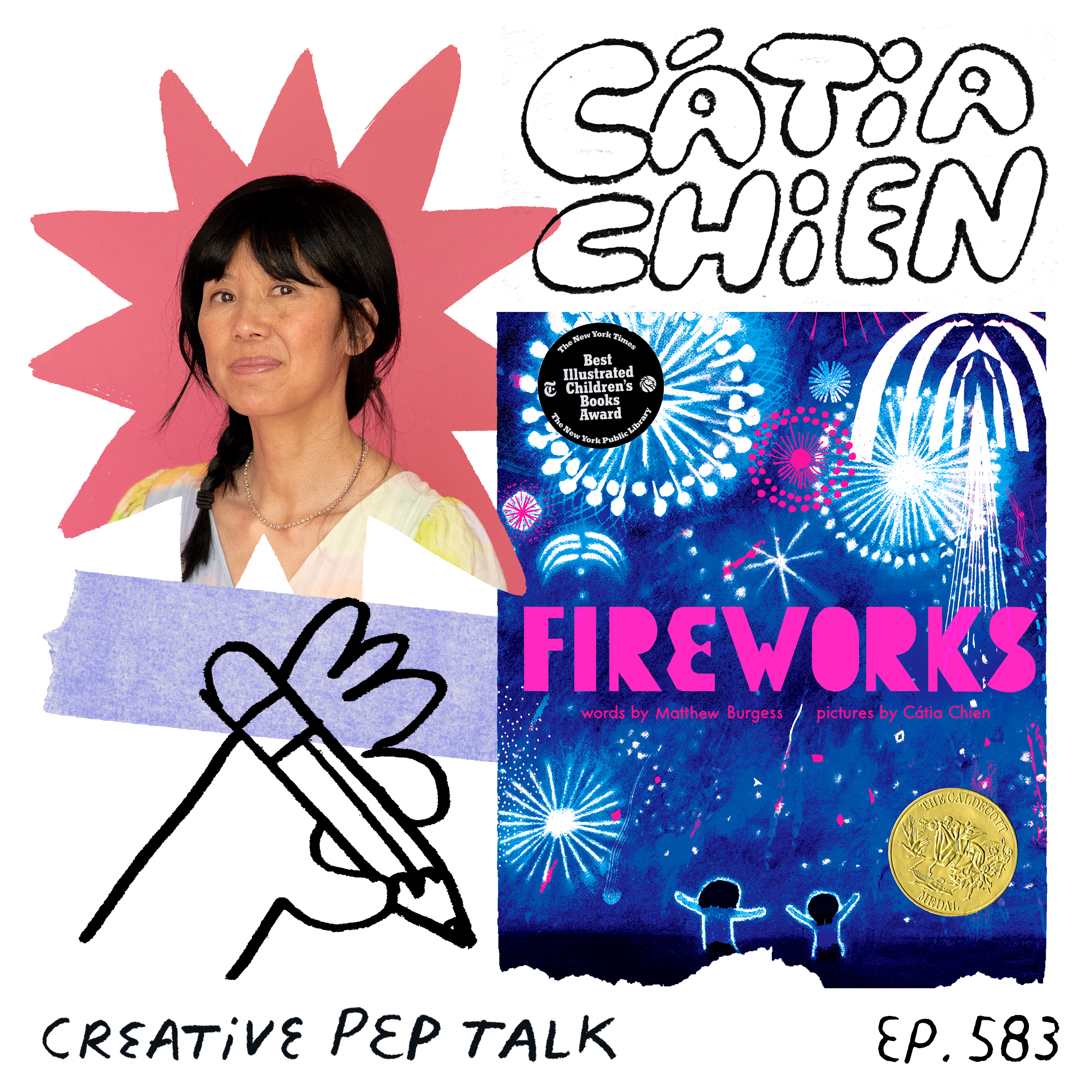
Katya (Katya) Chin, illustrator of children’s books. Noted works mentioned: The Bear and the Moon, The Town of Turtle, The Longest Let’s Go Boy, Fireworks (Caldecott winner). She researches characters and scenes (e.g., dog references, dog shows) and designs emotional arcs through lighting, composition, and immersive perspective.
Creative flow happens when judgment and fear about time/results shut off; she starts from the manuscript’s feeling immediately, then solves composition later. Technique should serve emotion, not ego or “drawing well.” Even when clarity is challenged (surreal transformations), emotional honesty guides the page.
The dog-centered grief in The Longest Let’s Go Boy; Fireworks’ kids running through water as immersive “slowing down of time”; The Town of Turtle’s tree transforming into a “sad” form to match the dog’s sadness.
0:00Are you stuck in your brain as a creator? Now, I know that my best art comes from what we would call the heart. When I think of it as really a different part of your brain, a different brain state, but it's what we think of as being in your heart, being in your emotions, speaking from that space. And because of the difficulty of our society and the sort of survival of the fittest, capitalistic, all of this, like, I have to do this to get there. I'm always thinking about the future. I'm not in the moment. I'm not in my feelings. I'm in my strategy brain. And I know I don't often even realize it until I somehow end up accidentally in this heart space.
0:44Maybe it's after I've had a beer with a buddy and I'm sat there like, man, I haven't been in this emotional state. Or maybe it's something that happens with one of my kids or my wife. We have a moment and it's like, oh man, I've been racing around stuck in my brain. I've been creating from that brain space. And so if that's you, this episode is for you. We're going to do interviews with artists that are really good at creating from the heart, creating from the right side of the brain. And these conversations, when I hear an artist in that zone, it helps me switch back on in my heart. This episode, this chat massively did that with me.
1:22It's with illustrator Katya Chin. She's done all kinds of amazing kids books like The Bear and The Moon. Another one, The Town of Turtle. This one, The Longest Let's Go Boy. I cried my eyes out for real sobbed reading this, but I do highly recommend it. She's a Caldecott winner for the Fireworks book, which is just so gorgeous. I mean, we'd get into all of these books and these amazing moments that she's created in them. I think she's kind of a master of creating from the heart. So you're going to love this chat. So many good takeaways for me. I was, I've been thinking about it ever since we had it.
2:02Stick around to the end. I will be back with our creative call to adventure. It's called take heart and it's going to help you supercharge, super switch into that heart mode. So stick around for that. But for now, here's my chat with Katya Chin. On the creative journey, it's easy to get lost, but don't worry, you'll lift off. Sometimes you just need a creative pep talk.
2:35Today's episode is brought to you by Vinted. I don't know about you, but our closets are often full of stuff we no longer need or just aren't getting much use from, but we don't have hardly any time to deal with it. However, recently we decided to try and sell some of it on Vented, a secondhand marketplace app, and couldn't believe how quick and easy it was. Super easy to get an account, just minutes to start listing. Vented suggested price ranges based on similar products, and even had checkboxes to easily categorize the brand and item type. We went from sitting on stuff we'd been meaning to deal with for months to listing them on Vented in minutes.
3:12Very cool. Plus, there are no seller fees and the app is free to download. Once the item sells, Vented even creates a prepaid shipping label for you. Don't just sit on unused stuff, get it listed and sold to someone who wants it and all the while make some extra cash in the process. I mean, who doesn't want a little bit of extra cash? Ready to clean out your closet and make some extra money? Download the Vented app for free and start listing with no seller fees. You keep every dollar you earn. I've been feeling that end of year slump creatively and just feeling tired, but then I ran into something that completely switched my passion back on and reminded me what's so fun about all of this.
3:52It was poet Amanda Gorman in her class on Masterclass talking about close reading a poem or a brief passage of literature. Her close reading process looks like reading it once for pleasure, twice to think about why the creator is doing what they're doing, and three times to think about what she might do differently. This sort of deconstruction of my favorite creative things always lights me on fire and I love that framework. Masterclass literally has the creative masters of the world teaching you their tricks with over 200 classes across 13 categories of business, writing, cooking, creativity, wellness, and more.
4:26There is going to be a master creative that you are a super fan and need to learn from on this platform. There's never been a better time to sign up because it's 50 % off right now for the holidays. also makes a great gift for a loved one. Go find a teacher they're a major fan of and say, hey, this reminded me of you. Masterclass keeps adding new classes, so there's never been a better time to get in. Right now, you can get up to 50 % off an annual membership at masterclass.com slash pep talk. That's 50 % off of Masterclass at masterclass.com slash pep talk. Head to masterclass.com slash pep talk to get the latest offer.
5:02I had seen your work a lot. I'd seen your books and I had, you know, taken them off the shelf and was gravitated towards them. They're gorgeous. And I flipped through them a bunch of times. But I don't know if I'd ever sat down and read them. And then I sat down and read four of them back to back and was feeling all kinds of feelings, including sobbing, which I'm sure you've heard that before. Yeah. Which one? With The Longest Let's Go Boy. Of course. Yeah. Oh my gosh. But I was, I mean, my emotions were all over the place reading all four of these books. We got The Bear and the Moon, Fireworks, The Town of Turtle.
5:45First of all, I just wanted to say thank you because it made me feel so energized to work on the book that I've already sold and I'm needing to be working on writing on and stuff like that. And it just put me in that creative mode, but they're incredible books. Thank you. I really, really was kind of blown away by how good they were. And I wondered if you could start by just sharing. So I don't know exactly if this is, if everybody experiences it like this, but that kind of romanticized right brain creative energy is very hard to hold on to. And it comes in a really intense wave. And it's like, I'm like, I forgot that you could see like this and you could feel that way.
6:42And I wondered if you could share maybe either the last time that you got into that mode or what predictably gets you in that mode. Do you relate to that? Yeah, I think you're talking about the flow when you get into that creative flow. Well, I'll just put one nuance to it. So there is, I get into flow when I'm working, I get into that, but there are some times when I will run into, I'll watch a movie or something will happen in life that I'm particularly sensitive to or a song or just something that kind of sparks me in a holistic emotional space that cuts me out of the everyday thing. And I just wondered if you related to that and then if you could remember the last thing that kind of put you in that space.
7:41I mean, I think that I can definitely relate to that. I think for me, and you named a few things that make sense as things that can drop you into that state. And I feel like that speaks to why it is something that everyone has access to in their lives. And they can do, there's no formula in one thing being the thing to get in with. but yeah I mean I think for me often what I find is that when I'm able to turn off the judgment mind the mind the part of me that's judging what I'm doing the part of me that's scared that I don't have enough time so the fear you know gets turned off and I'm more interested and curious and in the exploratory phase I'm more interested in finding out and discovering as opposed to trying to get a result at the other side of that.
8:38And a lot of times that's just my natural inclination anyway. Like when I create, that's sort of the place that I start. So it isn't necessarily something I have to kind of psych myself out to be able to do. And, you know, I know that I'm in that state because my husband will tell me that I'm not making sense. Like my sentences are not coming together as well because I'm really deeply in that world. And it's something that I used to be really self-conscious about. You know, I used to kind of just go long stretches of time working on a book and just, you know, you know, those college days where you can do, you know, all-nighters like maybe a week or two weeks in a row or even longer.
9:20And, and it'll just be the kind of thing where it's pretty obsessive. But now that I'm a parent And now that, you know, and being married, you know, you really do have to balance more than just your creative pursuits. So I have gotten better at being able to kind of bounce in and out of that zone. But I certainly don't love that as much as being able to kind of just be immersed in it and seeing it. Somewhere in there, you said that part of it was like not worrying about time. uh do you can you really easily notice when you've sat down and you're like oh i have this much time i have to get this part done or and you you're aware of like oh i'm not in that zone basically i'm asking you because that zone is very intense for me when i get into it like i really and i and it's my favorite zone to be in but because of being a parent and doing all of these different things and there's this commercial aspect to what I do and there's pressure on it.
10:21I just find myself not able to access that as much as I want to. Yeah, I relate to that. It's really, honestly, I think I don't know of any parent or anyone who has, who's juggling many, many balls, like to be able to actually say that they have the luxury of, or even the facility of staying in it and not have all these other thoughts that come up, you know, worries. I think that that's normal. And I think that it just starts to look different. The practice looks different and that's okay. There's a certain, there's a different level of rigor involved. And I don't know that there is like, I mean, I do have a sense of time for sure, because they're again like I have to pick up my kid I have to make sure that I need certain deadlines I mean that is it's still work for sure but I do think that part of what I'm saying when I say that there is no sense of time is that you have to at least for me like I have to for in the moment of working on the on the piece itself I have to be present enough to allow it to unfold.
11:39And so I cannot project the pressure of time onto it. And that's where that's what I'm talking about, the protecting it from that pressure from outside my projections of what it needs to be in the moment, because I need it to be there. That's not to say I don't compromise. And, you know, sometimes you just have to turn in a piece of work that's not 100 % what you're, you know, happy with. But, you know, while in process, I don't, I try not to think about that. And do you, so when you go into your workspace, are you, is it just natural that you go there? Yeah. Okay. Well, that's too bad for me.
12:23Cause I wanted to learn.
12:27I am. I'm just jealous of that because i think there were other times i'm sorry i was just kidding maybe it's a maybe it's a adhd maybe it's that brain that does go to a place where you hyper focus and you kind of just do the thing that you need to do i mean it's actually harder to get out of that that you don't transition as easily you don't hold on to like um some other things that you should be doing better um but yeah are you saying me or you are you adhd i feel like i definitely i'm adhd so i I have, but I think I get in modes. I think that is a problem. I get in this like, oh, I'm in this hustling, getting kids to school mode.
13:05And then I'm doing that mode. And I just think I need, I need some better rituals or something that help me switch because I can just like slam from that thing into the next thing. And I'm not getting the energy correct all the time. I mean, you know, I do, I would say I get there three times a week. I go there, but there's a lot of time, you know, where I'm sat at the desk and I should be fully there doing this thing. And I just waste more time worrying about time, getting into this mode of like, I got to get this done, that sort of thing. Yeah. Yeah. No, I hear you. I think three days a week is pretty good though.
13:46It's not bad. No, it's not bad. But also I ask you because like I said earlier, I was very, I gravitated towards your work. It's stunning, just very like eye-catching and interesting. But then as I was reading the books and reading the pictures, I just noticed like how good you are at capturing emotion and moments. And I wondered if that was, if you felt like a, like, are you good at capturing those moments as a creative person? Um, and also good at capturing those, like experiencing them and being present for them in real life. Um, yeah. Are you, I mean, I think that I've always been a very, very, very sensitive child always.
14:43Like I've always been that, that kid that felt things really deeply and um and kind of wasn't able to really separate uh what someone else is feeling what i was feeling for a long time and i i used to do this thing you have that too yeah yeah so i think it's you know i think that's kind of the thing is that if you are if you you know when you see it in the work oftentimes you see in the creator too you see that the creator has that ability to channel that in their life. And then it, and then they find that that actually is not a detriment. That is something that they can harness to become something that makes them special in their work in some way or a strength, I should say.
15:27And it took me a while to kind of figure that out. But I mean, I certainly for a long time thought that was like a, like, I'm really good at mimicking people too. Like I remember as a kid, like being able to like make jokes because that it was the, the way that someone is immediately, I can immediately take that in. I can, I can really see it really clearly visually. And to the point where I would call, I remember my brother would say like, Oh, it's like, it's like you, this is so bizarre, but you like trade. I can't even, I shouldn't. Say it, please. As soon as you said that, I'm like, this is good.
16:02Keep going. No, he, he would say, oh, it's sort of like a horror film where you kind of trade spaces, like a, like the, like where you trade faces because I would literally, if I, you know, I would be able to feel the person so much that their face would be on my, I love it. It's like face off with Nicolas Cage. I got face off. Yeah. But I think now I'm much more like as an adult, I like have learned how to, how to separate energies. And so I can, I can actually separate that. That's good. And not be as embedded in it. My 18-year-old daughter is also ADHD. I don't know if it's an ADHD thing, but every time she's telling stories, she does impressions without realizing it, like impressions of her friends.
16:47And I always call them out because she'll slip straight into it and it'll be like that person is here. And she didn't know that she did it. And I love that. And I also wonder, it makes me wonder if when you're trying to capture an emotion or a character in a drawing, do you ever find yourself like making those faces while you're drawing? Oh, absolutely. Don't you? You have to. Who doesn't? I'm not always conscious that I'm doing it, but sometimes they catch me and they'll be like, dad, why are you smiling while you're drawing like that? But that's kind of like an animator. They do that too. when they animate, they have to act it out.
17:27Absolutely. It's, I kind of feel the further I've gone in my illustration practice, the more I felt like, uh, there are a lot of parallels between acting and illustration. And, you know, there's this thing of here's the script, here's the manuscript. Now you bring it to life and, and give it feeling and, um, except you're kind of acting every character and you're also doing like the set design and all those kinds things too. It's weird. When you are capturing these moments, I'm just wondering if like when I'm reading through your books, there were several moments where with the dog in the longest let's go boy, I have to say anybody that hasn't read it, highly recommend it.
18:09Although make sure you give yourself some time and space. We had to say goodbye to a dog earlier this year and we got a new puppy. So just very, very like on the nose for me. But right when I opened it, it says, it's time for the one last let's go boy. And I was like, no, I can't do this. But there were a lot of moments in there, even with the dog, where you've captured both something very emotive in the dog's face, but it still looks like a dog's face. Like I feel like I've seen my dog make that face. And I, I just, it, it made, it made me feel challenged to be more present in my everyday. Because are these, do you feel like when you're, because you, you also did this, I could talk about some moments in fireworks as well that, that are like this.
19:01as you're moving through your day, are you sensitive to that and kind of cataloging it somewhere? How does that, how do you, how do you do that? That's what I want to know. I think most illustrators do research before they enter getting to the world of the book. And I do that too. It doesn't all just come from my head. I certainly, you know, for that book, I did a lot of sketches and experimentation and trying to figure out where I wanted to enter the story, whether it was going to be completely from the perspective of the dog, as in the POV of the dog. So you don't actually see the dog or and that's been done before, you know, but it limits a lot of the interactions that I wanted to show.
19:48um it wasn't as fun for me um and i wanted to and you know so i think and then also the way which and then selecting the the dog you know was also interesting kind of like a casting call right where you draw a bunch of different dogs and so i did look at a lot of different breeds um i went to a dog show um and did some sketching there and it's all fun and it doesn't necessarily mean that all those sketches all that research is going to directly be in the final result necessarily but it does mean that that is part of the on-ramp to the story and whatever that moment may serve I think for me I can't say directly what it does but what I can say is that what it it gets me thinking about it in that mode in that world and then ultimately picking that dog It was just some pictures that I saw, I think, that I was researching, going online and then looking at pictures and I was sketching them out.
20:49And then also just the memories of having a dog. You know, I had a dog when I was, I haven't had a dog as an adult, which is so strange. I've had a cat and I had a dog when I was growing up. It was a little wiener dog, a dog. But I wanted to have a dog that was sort of the archetypal, you know, image of a dog, kind of that sort of encompasses dog dogginess, I guess you can kind of imagine. And but I think it's more the feeling. I think I really wanted to kind of make sure that whatever was happening on the page, there is a way to translate the caricature of the dog doing something with the feeling of what was happening.
21:30You're really good at making them feel like scenes, like every spread feels like a scene. Are you thinking about feeling? Like what is the feeling that they're going to get from this page? Yeah, always. When I start a story, when I read a manuscript, immediately I go to the feeling. It's not just because you can figure out the story pacing. You can figure out like from reading, you know, you'll get to that. You can problem solve that. But no one's going to care if there's no feeling behind it. Like a good story is feeling based, I think. And so I need to know that I can connect to it emotionally.
22:09I need to know where the emotional beats are. I need to know that I can create and craft a really strong emotional arc. And I need to make sure that I'm interested and able to with the skill set that I have to bring that to bear. And that all kind of happens pretty immediately in reading a manuscript. And then the solving of that is a different puzzle. But the feeling that I want to explore that, it's immediate. When you say the solving, I'm wondering if you are thinking about, okay, this is the feeling that needs to go here that I'm feeling from the manuscript. Are you then thinking what scene gives me that feeling?
22:55Does that make sense? yeah it does make sense because if you're thinking like for example if you're thinking if you're feeling um that the moment is mood wise it's a sad moment then are you in my am i in my mind already setting up the stage like composing it to be that and how do i think about it how do i think about translating a feeling into compositional elements that comes in later uh but i sometimes though but sometimes it does this is when i know a manuscript really works for me is if I immediately have an image that I want to draw something, you know, and obviously it's not linear, right?
23:33So it might be just whatever that story be really that resonates with me. And I will start there. But I'm not necessarily crafting it in my head thinking, well, because it's sad, then I'm going to make sure that the lighting's like this. And I'm going to, you know, it's more just that it overall is capturing maybe something that I have seen or something that I've felt before. And I'm just trying to kind of mash it together into a scene, but lighting is definitely a big part of that. I wondered about that. That's part of what makes, that's part of what made me ask if you were, or say that it felt like scenes is that there is a really clear lighting element to every spread that feels very cinematic.
24:18I also, I do want to just say that when my wife and I, who writes, she writes books with me, saw this spread in fireworks that it's kids that are playing through the fire extinguisher. Yeah, fire hydrant. Sorry, it's not extinguisher. And I just, we both pointed that out separately as feeling exactly what it felt like to run through a sprinkler. Is this, is that kind of, how do you get to, how do you pull that image together? How do you capture that feeling? What is it like to create that piece? That piece in particular, and well, first is there is a way that something looks, right? When the story calls for an image of kids running through and they're joyfully kind of playing the water you can do a lot of different things with that you can you can paint a seat of the the whole neighborhood you can do um just one kid up close and then the kids far away from behind you can there's so many things you can do but i think depending on what elements you want to have in the story to lead to the next point of the story i think for me in this particular scene or at least for the beats in fireworks, what I really wanted to do is kind of create little pops of fireworks.
25:46And so I really wanted to kind of create the sense of the kids navigating through the city before the big firework display and finding those ordinary moments that are like the fireworks that they then take with them when they go to sleep, right? Like it all starts even the minute they leave the house or even the minute they put that amazing breakfast in their mouth. I mean, that's the way that kids show us that presence is the ultimate key to having happiness. They're able to really find the joy in the ordinary. But in order for that to land, it has to be an emotional beat that is quite impactful, even almost larger than life.
26:27So you cannot stay in the realm of representation because when it does, because you're outside observing it. You're not actually in it with the children. So really, I think where the camera then has to be, if you want to call it a camera or whatever. And I think about it more that way, because I used to be quite a cinephile, like I loved films, and I thought that I was just going to go into doing this and do film work, you know. But, you know, you're really placing it yourself as one of the children, like that's sort of like, first and foremost like that's the ultimate that's the place that I put myself um and so in that way I mean the imagining of running through water and with that kind of joy I don't think it's hard to imagine um because it doesn't have to be that exact scene it can be anything that you've experienced joy in that you can then place into that scene and what would be more joyful than the idea of kind of almost like again escaping time like the idea of when something feels good there's a slowing down of time there's this feeling that it's all around you and it's completely immersive yeah that there is no vantage point of like apartment buildings so i don't have the apartment buildings there because all of a sudden all that there is is water and kids running yeah are you thinking of that are you thinking that thought when you're making it like the immersive thing.
27:53That was what, that was what I felt was that it felt like doing this as a kid, because when you're running through a sprinkler or you're at like a little water pad place or something, it's so, I can, I can remember how kind of chaotic it felt because your eyes aren't open the whole time and you're running around and it's just like water and friends and laughing. And, um, Were you actively thinking about that or was it just an intuitive move to make it immersive that way? I think it's all of it. I think that as – and I'm sure it's that way with you too, is that you have all this background in understanding your craft.
28:37When you go to do the craft, you're not really thinking, well, I'm going to mix this color plus this. you let that kind of fall in the background knowing that that's there operating behind the scenes and then you're making the the the decisions based on emotion or based on something that you're leading with that's definitely always there in the background but i'm more than anything and again that's it wasn't the case in my earlier books um but more now so like more than ever is that earlier, you know, when it comes to like those techniques that you're talking about, the more craft oriented decisions, that was something that I practiced a lot more in my earlier books, right?
29:19Because also there's like an ego component of like, I want to show people that I can do this, that I'm an artist and I can, I can draw and I can, you know, but there's some freedom that you can gain from not, from kind of breaking that a little bit and setting that aside for something that can be actually quite messy and you don't know if it's going to work out and you're kind of just trying some things out and seeing but um but it's for the story it's for the emotion and i and i think so again it's a balance you don't i don't want the technique to over over shadow the emotional um discovery that i can get to when i draw
30:18so i grew up in a family that's a little bit competitive so for holidays it can be a little bit like what did you get dad oh yeah well i got him this that kind of thing well this year I think we got the perfect gift that's gonna blow my siblings out of the freaking water. It's an Aura digital frame, a frame that cycles through your favorite photos that you select in their app. My dad is always talking about how much he loves all the photos of the grandkids and how often he looks at them and loves seeing them all together and how happy it makes them. We got the Carver Matte frame, very snazzy, gonna look perfect in my dad's office, make him super happy and make all my siblings cry their eyes out like, well, I wish dad loved me like he loves you now.
30:59Well, maybe you should have thought of that and got him an Aura frame. In fact, you still can. There's still time. Don't wait. Win the holidays now with Aura frames. Aura is the number one digital frame loved by millions of families and their Black Friday Cyber Monday deal is the best of the year. For a limited time, visit AuraFrames.com and get up to$50 off select frames plus an additional$5 off your order with the promo code PEPTALK, all one word. That's A-U-R-A frames.com. Promo code PEPTALK. Support the show by mentioning us at checkout. Terms and conditions apply. This episode is sponsored by Squarespace.
31:38I freaking love having Squarespace as a sponsor because it's easy to sell it when you love something this much. I'm a big fan. Squarespace is an all-in-one website platform designed to help you succeed online. Here's what I love about Squarespace. They're intuitive and super versatile drag and drop tools. I mean, you can make a custom website without knowledge of code that makes people say, whoa, who made that for you? Looks like you built that from scratch. People have really said stuff like that to me about my site, and I built it myself quite easily with Squarespace. You can check it out at AndyJPizza.com if you want to check that out, what I did with it.
32:15It doesn't look templaty and it screams my creative brand. I also love that I have all of my domains through Squarespace now, which makes it seamless and easy to manage. I know the first thing as creative folks do when we get an idea is to grab that URL. Now you can keep track of all your websites and your domains in one place that's super intuitive and easy to manage. Head to squarespace.com slash peptalk for a free trial. And when you're ready to launch, use promo code peptalk, all one word, to save 10 % off your first purchase of a website or domain. One of the things I really like about your books are that I feel like a lot of illustration work is either heavy on style.
33:02It's really style conscious, aesthetic conscious, or it's emotion, storytelling, that sort of thing. and I'm yours connects not even, it's not even just a balance. It's that they feel very connected. Like the style choices feel connected to the storytelling and the emotion. And are you, was that always the case for you where you were approaching with both? Or was there a time when you were younger where you were more aesthetic conscious? How has that evolved? I think that my voice as an artist has evolved a lot through the years. I think initially I was much more conscious in wanting to master a technique and wanting to kind of master an approach.
33:57And I came from painting, so I really wanted to be able to capture light. I wanted to be able to be very clear with my representation of things, make sure that I could show mastery in storytelling through exact like, you know, those like the golden rule of making sure there's nothing like to center. You don't tween things like all these like elements, right, of keeping all that in mind. and I used acrylic for most of my early books and it was all acrylic. But meanwhile, in the background, I was making a mess in my sketchbooks or making a mess prior to doing the final. And realizing then later that, you know, through just having talked to many artists and even looking at a lot of books, you know, that all the stuff that I had in the background, that was ultimately more the soup that made me the kind of artist that I am than the actual final that I was showing in the world.
34:58So it's an interesting thing in terms of thinking about, like, what is the aesthetic consciousness of an artist? Like, does it come into being because you are consciously thinking about how you want to present yourself? Or are you just kind of doing the thing and it eventually kind of becomes your signature and you're not even thinking about it? So I think for me, like, I had both, like, the thing that I was presenting to the world, which is like a much more polished version of my work. And then I had the background, the actual me that was doing all that messy work that was making the ugly drawings, the stuff that I was like self-conscious about.
35:32And still, you know, obviously there's still parts of me that's really feeling, you know, self-conscious about some of the work that I'm doing now behind the scenes. And so I think that that's sort of like the, what I found to be kind of the natural way that it progresses for me is that I have a lot of stuff cooking in the background that I'm not necessarily ready to really understand where it goes yet, but I'm actually working on those things. And that kind of feeds into what I eventually present. But I think it still evolves and continues to evolve. And so it's not like one thing preparing the aesthetic kind of like, you know, advancing ahead of like who you are as an artist or, you know, I think it just feeds into itself, I guess, in a way.
36:16Does that make sense? Yeah, it makes sense. I was conscious of exactly what you're talking about to the degree in which it was inspiring me. There are so many tells in your book that you're really good at drawing. It's very obvious that you're good at drawing. And I'm more interested in image making than drawing. I've been drawing my whole life, but I'm more interested in image making, but I could tell, oh, you're really good at drawing. And you are making a lot of choices that don't show that off in a way where you're, because of the way that you will be fuzzy and bleeding off and vibey in different places.
37:01And it's something that made me realize how the way that that ego shows up for me and holds me back from letting emotion drive a piece in that way or pushing representation past, you know, making it fuzzier or whatever. I realized while I was looking at your books, I was like, oh, I don't do that because I'm afraid that when I send the work over to the person that I'm working with, that if they don't know what it is or if they have a question about something that it's kind of a critique on my ability does that make sense yeah it makes a lot of sense i mean there's a lot of i think that there's definitely still fear you know that something will be misunderstood and not land absolutely especially when you work on something and it feels really close to you i think it's hard to be your own critic you know with like an objective lens and we often i think when we make work, we're not just saying like, is this good?
38:06We're saying, am I okay? To the person that's looking at it. So you can feel really vulnerable to share at any point and whether there's ego or not involved. But for me, I'm not really as interested in being a good drawer. Like I'm not interested in drawing well. I'm interested in meaning making. And so that's why it just happens to be a tool that I'm using, but I'm not necessarily just focused on the tool and saying, I'm really wanting to get good at the tool. I want to get better at meaning making like that's where my interest lies. And however way I get there. And if I, you know, of course, like, you know, it's arguable whether or not it's working, but I think it's, it is something that I, I, I'm exploring for sure.
38:49It's working. And I love what it brought up for me because it, I'm never trying to impress anybody with my work. That isn't really a mode that I have creatively. And I don't really, most of the stuff I like are more like lo-fi things or imperfect things. And I just don't, I don't have a deep appreciation for like impressive art. And so I think I was under the impression that that kind of already checked a decent amount of my ego at the door. But then this brought up this other side of like, oh, I'm just worried that they're going to be like, what is this?
39:31But especially in – I could say your pictures, your images are very clear. They really capture with clarity. But then there's moments throughout where I feel like you're kind of risking them not being clear or playing with that. And especially in the Turtle book, I thought there's a lot of things in that book where they feel purposefully like you don't know what they are. and I thought that's so good for kids. Even when I like, a lot of the movies I like that are quite surreal or strange or whatever, they have something where I'm like, what is that? And I'm like, oh, I'm not letting, because of this worry of not being clear and that being, you know, putting my ability up for judgment, I'm not allowing for that stuff.
40:30The weird stuff, yeah. I think it's like, you know, have you seen, I'm sure you've seen The Fantastic Planet. I don't think I have. It's an old animated sci-fi film, 1970. I think I know what you're talking about. The one with the blue aliens, red eyes. Yeah, yeah, yeah. I haven't watched it, but I've seen a bunch of pieces of it and clips of it and that sort of thing, but I haven't seen the whole thing. Yeah, and when you think about what kind of stuff stays with you, you know, like that's the kind of stuff that like, and you know um and of course like i think we all have edges you know just because something feels like it's it's an edge for you know not like like someone's looking at your work and thinking well i i that's an edge for me and this person's doing it you know going beyond that edge um i think every person has like an edge that they're pushing up against and things that they're kind of wanting to overcome in some way.
41:27I think that's why art is so beautiful because it is a process of being more and more human, being more and more vulnerable in your ability to give to the world in some way. And I think what you're describing is what everyone, I think, feels. You know, like, oh, my ego is coming up again. I'm scared. You know, like, oh, it's coming up. Like, this one, this book really needs to sell. They're really putting a lot of money behind it or, oh, there's like marketing for it. And now like I really have to make sure that I have a really good, a good explanation for this page, even though it just kind of came to me and it was like messy and I don't even know what I'm doing.
42:08And, you know, there's a lot of that that happens. And I think, I think it's a, it's a continuing conversation. I think that's what we all grapple with. Yeah. Do you ever feel like, do you ever try to push it as far as it can go and send things to your editor where you're like, I don't know if they're going to be like, we want this element to be more exact or clear or something like that? Yeah, I've had a moment where I like slipped under the radar, which I haven't like, maybe I shouldn't talk about it. I mean, it's fine. It's totally going to be fine. Yeah, totally fine. But in the town of Turtle, that tree in front of the house, it's sort of the symbol of so much of their love and friendship.
43:00And it becomes, I guess, in my mind, and again, it wasn't something that I placed that much. It wasn't like I made it a symbol and then created the images around that symbol. It was just that it became evident as I was drawing it that that was going to be a big part of the way that we can tell what's emotionally happening in the story and to the dog. And so at some point in the story, when the dog is passing, you see this tree completely transform into a sad tree. Now, it looks nothing like a tree. It starts looking more like a giant mushroom, right, with like the leaves like that. And I remember that that was a big problem.
43:41it was a big problem it's like what the heck is that thing that just came out of nowhere it looks like a like a chef's hat like what is that that is not the tree we saw in the first page and trees don't just magically become that unless it's part of the story uh kids are going to be very confused this is not good and it was a topic of conversation multiple times um and i kept saying well emotionally it makes sense because when you are feeling sad, the world feels absolutely devastating. Everything looks sad. The tree looks sad because you're in it. It's emotionally honest. And I don't think the kids are going to be confused.
44:25I think the kids are going to just sense the page and move to the next page and not feel like the need to worry about what that tree is doing. They're going to get it because they're going to be in the story and feel sad like the three years feeling but it was definitely an ongoing conversation it wasn't a we all agree that that's a good decision it was more like there's lots of other things to do and that just kind of like it's like okay yeah so yeah we we have many and you know that's part of the deal you kind of you're just like right there may not be uh people on the other side that respond to it the way you want it to, but are you responding to it?
45:03Do you feel that it's honest to you? And it's a balance, of course, you know, but I, but I felt like, yeah, that was one that I felt like I wanted to make sure he had that moment. That's such a good example. I love this idea of when you're sad, the world looks sad and representing that that way is really, really powerful and interesting. Have you, you haven't written any kids books, have you? No. Okay. This reminded me, speaking of acting, it reminds me of this. Do you know Mitch Hedberg? He was a stand-up comedian. No. He's actually passed now. Okay. But he said that if you're a stand-up comedian, you often get asked if you act.
45:47And he said, it feels like you're a cook. And they're like, hey, and can you farm? And it feels like these very different things. And I do feel like asking you that, that was kind of what it felt like. Like, yeah, you make all these amazing pictures and do you write? And it just says, obviously they're connected, but they are very different things. Do you want to write? I do. I do want to write. Yeah. Yeah, they are very different things. Yeah, I don't know how it's going to be. I've been told that in talking to different creators that write and illustrate and that started just illustrating before, they said, well, one thing that, and I wonder how you feel about it.
46:28But I was told that it's good to kind of to think about it in the same way that you create art. You can transfer the process that you use for making art into writing a certain like in a way like it's not that you have to start from scratch. You sort of are still and I and I and I do think there's something to that, because obviously in doing illustrations for a book, you're not just an illustrator. You're a storyteller, you know, more than, more than anything else. That's what you're doing. You're, you're telling a story. You're creating a world around that story that you are creating on top of the words.
47:10And that's always like my, my objective when I illustrate a book, it is a different, like, it's a different thing, but I, I, I feel like it's not starting from scratch entirely. I completely agree. My favorite definition of illustration is writing with pictures. And I do think that's what separates it from just drawing is that you are, you are writing. I honestly feel, as you were saying that, I thought I almost feel like, even though I've been an illustrator a lot longer than I've been a writer, I almost feel like it's the reverse for me. I feel like illustration, I got into illustration and I was doing a lot of client work and, and stuff for bands and that sort of thing when I was in my early twenties.
47:50And that was very driven by aesthetics and sort of like a scene and that kind of thing. And I don't feel like illustration really made sense to me until I was writing a lot and telling stories and doing stories on stage and that sort of thing. And so I think I, and then starting to write books. And then I think I started to approach illustration as a writer. And that's when illustration made sense to me. So it almost feels like the reverse of what you're talking about. But I, I do think they're, they, they seem like, like worlds apart more than they really are. Hmm. And so when you write, are you at this point that I'm just curious how your art comes into play when you write?
48:36I think it's the way that it happens to me and I'm, you know, writing more and more stuff all the time. And I, I feel like it usually starts with a thing I want to talk about and then finding the symbolism that matches that and kind of brings that to life. and I have had the opposite. I have had an image that I feel drawn to and then I pull like my book Invisible Things is more like that where I was really I spent a long time drawing characters that were like hiding and in masks and I was drawn to this image and after making tons of characters, I started to realize like, oh, it's, it's the, it's about, it's bringing to life what I like about being alive, which is 95 % of our universe is invisible.
49:33Like we have this hidden realm that's everywhere. And that's kind of what these feel like to me. So I have done it that way, but I can do it the other way too. And I almost feel a little bit more natural doing it the other way. But then the, then the problem becomes making sure when you get into this symbol and the illustration that it starts, that you start moving intuitively instead of literally like words tend to work. And so that, that's something that I have been working on more and more. Cause I'm like, Oh, I want to say this. This is how, this is kind of the dominoes of how that would go.
50:14And then as I'm in the middle of it, I'm like, okay, but how does it feel as you're doing it? Does it feel right? And if it doesn't feel right, can you just mess with it until it maybe doesn't make sense, but it feels right? Yeah. I don't know if that makes sense because I'm kind of speaking abstractly, but yeah. No, no, no. It really, really, really, really makes sense because the first pass of a story manuscript is, is it clear? Like, are the images clear? And then the second, third pass is what else is it telling you? What is the meaning behind the combination of these two? Is there something interesting there that you can explore beyond the, right?
50:56So yeah, it makes sense what you're talking about. That's good. I just want to say a massive thank you because when I encounter books like this, it makes me so excited to be a picture bookmaker and to be an artist and be a creative. It just makes me feel like, oh, I'm really proud of being part of whatever this is and really inspired to make more and participate more. So thank you so much. I really, really mean that. And I'm excited to see the next stuff that you do. Thank you so much, Annie. It's been so fun to talk to you.
51:50What'd I tell you? It was a good episode, wasn't it? It was a good chat. I was like very much feeling it. I definitely want to have Katya back. Just, I mean, so inspired. So, so, so good. CTA, Call to Adventure, it's called Take Heart. The idea is they're going to take heart from different points in your life. You're going to, as you go make something, even in your sketchbook or maybe even something for something official, whatever. Here's my challenge to you. It's something I've been trying to do is just be aware of when my heart switches on. An example of this might be we have a puppy, Zelda, and she's driving us nuts.
52:26She's amazing and so difficult. This stage is so difficult. Five months. Oh my good Lord. And so, you know, I have to get up at 5.30 in the morning, take her out and I'll be stood in the backyard because she, you have to go in the backyard for her to go out there. I don't know why. I don't know. And I'm stood out there. It's freezing cold. It's 5.30 in the morning and I'm sat there and I look up and I see the Big Dipper and I'm like, ah, that's kind of nice. I can see all the stars and Orion's belt. And it's just like, ah, man, I'm not, I'm rarely up this early to see this. And it puts me in my heart.
53:06Or when I come back home, she has a smiley face that she does when I come home. She like her whole face transforms. These are little heart moments. And so I'm trying to capture these in my sketchbook. I'm trying to take those heart moments from life and bring them into my sketchbook. So here's what it's, what's cool is there's a symbiotic relationship here. Um, I'm not, maybe I'll do a whole episode about this cause I just really like this idea. There's a symbiotic relationship between, um, both you taking from your life when you have those heart moments, but guess what? It actually makes you want to notice more moments so that you can make art about this stuff.
53:40It actually inspires me to be more present, to look for those things. So there's just really cool back and forth. So that's my challenge to you is to get into your heart moments, steal the heart, take the heart from those times in your life where you're like, oh, I just, something happened. I, all of a sudden, I welled up. Think about when was the last time that you got tears in your eyes, not from a movie, not from a book, but from something that happened in real life. One thing that gets me every time is when my son tests for a new Taekwondo belt. I just, because I know it's so hard for him to go.
54:13He's like, it's a challenge for him to go. He doesn't like to have these commitments and whatnot. And so every time he levels up, that makes me well up. Take something from that and create something from it. Take that heart and then transplant. I could have called it heart transplant. Transplant it into your work. Okay. You know, even if it's just a little practice doodle, like even if it's just like warm up before you get into it, can you make something about that heart moment so you can get into your heart? I like this one. This one's too good. I want to probably use this on another CTA because I want to, and it's my podcast.
54:46So shut up. Massive thanks to Katya Chin. And I highly recommend these books. They're gorgeous. They are heart filled. They're just so good. Heartfelt is what I meant to say. Thanks, Katya. Come back, please. Love to chat more. Massive thanks to Sophie Miller for being a producer editor on the show. Thanks to Connor Jones of Pending Beautiful for audio edits, video edits, sound design, and animation. Thanks to Yoni Wolf of the band Y for our soundtrack and theme song. And thanks to all of you for sticking with us, listening to this episode. I hope that it got you in your heart in that creative zone.
55:23And until we speak again, stay in that creative zone. Stay pepped up.
56:06Thank you. and democracy. Hear from the people reimagining our political future without the jargon or the lecture. So follow More Like Us wherever you get your podcasts.
This conversation made me want to sit my butt in the chair and CREATE!
If you’re looking for something to switch on your creative brain and heart, this is it.
Cátia Chien’s picture books are absolutely incredible. SO much emotion captured with each image. One of my favorite chats on the show!
Episode 583
SHOW NOTES:
Cátia Chienhttps://www.catiachien.com
Producer / Editor: Sophie Miller http://sophiemiller.coAudio Editing / Sound Design: Conner Jones http://pendingbeautiful.coSoundtrack / Theme Song: Yoni Wolf / WHY? http://whywithaquestionmark.comSpotify Playlist of WHY? Songs Used on This Podcast: https://open.spotify.com/playlist/4ZIE7PHG5I1Ddg1BuVGRzj?si=4x_BzDZjQgqSpoaLXdVACg&pi=h4HsIKG0SP6Kg
SPONSORS:SQUARESPACEHead to https://www.squarespace.com/PEPTALK to save 10% off your first purchase of a website or domain using code PEPTALK
Scan the code with your iPhone camera
Listen in the app.