
In short
How “fandom” and creator culture are fragmenting into niches; OpenSauce as a STEM-focused creator convention; streaming platform metrics and earnings (Netflix vs YouTube); and regulation of social media access for teens.
Guests
Jim Louderback, former longtime CEO of VidCon; now editor/CEO of Inside the Creator Economy; produces OpenSauce’s Industry Day.
Key claims
- Fandom is changing because creators are more niche and kids’ fandoms often don’t overlap with friends.
- OpenSauce targets a narrow STEM slice: 800 makers and 125 top STEAM creators.
- Netflix is shifting investor focus from published watch-time/subscriber metrics to “quality” and won’t disclose details.
- YouTube ad revenue growth is accelerating; YouTube ads alone nearly match Netflix’s total revenue.
- France bans social media for under-15; Australia’s ban reduced Snapchat usage far more than YouTube.
Notable examples
Erling Haaland’s follower surge; Vozinha (Cape Verde goalie) follower growth; OpenSauce creators Mark Rober, Michael Reeves, Hank Green, William Osmond, Astro Alexandra; Netflix engagement measured by quality/variety/quantity; YouTube “shows” feature; Nick DiGiovanni watermelon experiments.
Written by AI. May contain mistakes. Listen to the episode to check what was said.
Chapters
Tap a time to open that second in VOWorld Cup Experience
0:45 to 1:30
Discussion about experiences in New York City during the World Cup.
“You were one of the few people, I guess, to not tune into the World Cup that weekend?”
YouTube World Cup Stats
1:30 to 3:00
Insights on YouTube's massive viewership during the World Cup.
“YouTube claims that roughly one-fifth of the people alive in the world today consumed some type of World Cup-related content on the platform in the last couple months.”
Athletes Gaining Followers
3:00 to 4:10
Discussion on athletes gaining millions of followers during the World Cup.
“I don't know if you've also seen one of the after effects or during effects, I should say, of the World Cup.”
Ranch Dressing Phenomenon
4:10 to 5:50
A quirky discussion on the popularity of ranch dressing among World Cup fans.
“But before that, I just want to let everybody know we've got a great interview today with Jim Lauderback.”
Influencer Insights from the World Cup
5:50 to 7:50
Exploring how World Cup participation boosts athlete influence.
“So first they had subscriber metrics that Netflix was talking about year over year, quarter over quarter.”
Netflix Earnings Report
7:50 to 11:20
Analysis of Netflix's earnings and challenges in subscriber metrics.
“And it's like, you know, how many times have we heard the story?”
YouTube Earnings and Growth
11:20 to 14:00
Breakdown of YouTube's earnings and its competitive position against Netflix.
“Let's switch gears and talk about some YouTube earnings.”
Exploring OpenSauce
14:14 to 16:00
Jim discusses the OpenSauce event, its structure, and target audience.
“So OpenSauce, been around for like four years.”
The Evolution of Niche Conventions
16:00 to 19:46
Discussion on the evolution of conventions and the rise of niche fandoms in the creator economy.
“So are there, I mean, I've heard it's sort of like the geek fest in the best possible way.”
AI and Its Impact on Creators
19:46 to 22:16
Jim shares insights on the dual feelings of excitement and concern regarding AI among creators.
“So if you are, this is a great place to come because you can discover new creators, celebrate the old creators, and dive around in 800 different wacky makers building all sorts of weird, interesting stuff.”
Show all 18 chapters
Surprising Dynamics at OpenSauce
22:16 to 23:40
Jim highlights surprising aspects of the OpenSauce event, including fan interactions with creators.
“with Jerry Brigg, everything with Dustin.”
Where to Find Jim Lauderback
23:40 to 23:57
Jim shares where listeners can find him and his work.
“Where can everybody find you and all of your musings?”
Social Media Regulations in France
23:57 to 27:31
Discussion on France's legislation banning social media for young teenagers and its implications.
“So, Joss, let's get into some uploads, downloads.”
The Potential Impact of Social Media Bans
27:31 to 28:00
Exploration of the potential effects of social media bans on children and app usage.
“So I just think this is, in one hand, it's really sort of, I think, encouraging and points to all signs that these social media should not be accessible to kids under the age of 16.”
Parental Controls on Streaming Platforms
28:00 to 29:14
Learn about the new parental controls introduced by Twitch for younger users.
“and addiction and all these sort of things.”
Impact of Screen Time on Children
29:14 to 30:19
Explore the effects of screen time on children's behavior and health.
“Like, yeah, it's we will look at it like I mean, their seatbelts were not required when we were kids.”
YouTube's New Shows Feature
30:19 to 31:55
Discover YouTube's new feature allowing creators to group episodic content.
“I mean, we're having watermelon, like, you know, gazpacho later.”
Improving Instagram's User Experience
31:55 to 33:11
Discuss suggestions for enhancing Instagram, including video history features.
“So I have this, I'm not on it that much and my mental health is so much better, but I go on it about once a week.”
Transcript
Automatic transcript. May contain errors.0:00Welcome to Crater Upload, your Crater Economy podcast. I'm Lauren Schnipper. And I'm Joshua Cohen. Lauren. What? You're in New York City. You didn't even come say hi in New Jersey? No, definitely not. It was called the World Cup. You couldn't get anywhere, man. Yeah, that's true. You couldn't get anywhere. I did get up the neck and to the crown of the Statue of Liberty in a torrential monsoon downpour. And did you know the steps to climb up to the crown are, I don't know, maybe two feet wide, if that. and it was raining and it was wet inside the belly of the beast because it's a nine million year old statue and my kids were like mommy I can't even believe you can do this without dying and I was like hell yeah I can it was 300 steps and I did it they used to let you climb up to the torch but they don't do that no more they do not do that no more they haven't done that since the 80s so I don't know yeah that was fun and we get to the ground and you're kind of like this is it like it's really small and also because it was raining I couldn't see like anything it's not like I saw the view which you're supposed to like see and like the whole thing and that wasn't a thing.
0:59Fascinating. Yeah. Fascinating. Thank you. You were one of the few people, I guess, to not tune into the World Cup that weekend? No, I did. I watched it. If you were actually then watching World Cup content and you were watching it on YouTube, you would have been one of the unique 1.7 billion viewers watching soccer, football, World Cup-related content on YouTube in 2026 so far. I was not watching it on YouTube, but congratulations to YouTube. It's interesting when you put it in perspective. YouTube claims that roughly one-fifth of the people alive in the world today consumed some type of World Cup-related content on the platform in the last couple months.
1:41I believe it. That one-fifth of the world's population wasn't just consuming World Cup content on YouTube. A decent percentage of it was also starting to follow these athletes on all these different social media platforms. so Erling Holland the Norwegian Viking yeah I've seen him who helped Norway get very far along in the tournament gained 32.1 million new Instagram followers over 39 days wow that's aggressive that'd be a lot right before the World Cup he had 40.6 million followers after the World Cup he had 72.7 million followers that's insane did he do something on the I didn't watch those games did he do something on the game that like like besides just be good did he get in fight or something he's good he was in contention for having the most goals during the world cup before they got knocked out um he helped his team obviously get as far as he did he's also a monster on the field i mean he's like six four six five so he's towering above other players yeah his youtube channel is also incredibly impressive too he didn't quite gain 32.1 million new subscribers on his youtube channel but he did see like 800 ,000 or a million new subscribers come to his YouTube channel too.
2:50He posts these vlogs about his experience at the World Cup and in different cities. Like he had this one in Texas where he just really wanted to go get a cowboy hat. Sure. As one does. I don't know if you've also seen one of the after effects or during effects, I should say, of the World Cup. Have you have you when was the last time you were in an airport? Like was it during the World Cup or no? No, before pre World Cup. So do you know what is front and center and every sort of like, you know store it in the airports right now take a guess ranch dressing because why oh you don't know about the whole ranch dressing thing oh because all these foreigners don't know what ranch dressing is and they come have ranch dressing and they love it yes it's like me going to france and coming home with 95 things of butter they're all going home with like 95 things of ranch dressing no it's like a thing look it up i'm not joking like it's i'll look in the airports and you're like why is all this ranch dressing in there like it's literally because of that That's fascinating.
3:42It's like Hidden Valley Ranch is like killing it right now. There's one more player to shout out, Vozinha, who is on the Capa Verde team. He's the goalie. He gained 29.4 million followers during the World Cup as well on Instagram. He started with like a few hundred thousand. I mean, I get it. It turns out this is the way to be an influencer. The way to be an influencer is to be an incredibly talented athlete and participate in the World Cup. I mean, I don't think it sounds so hard. All right, Josh, I want to get to some YouTube and Netflix earnings. But before that, I just want to let everybody know we've got a great interview today with Jim Lauderback.
4:16You know him, you love him. Of course, former longtime CEO of VidCon. He's now the editor and CEO of Inside the Creator Economy. He went to OpenSauce, which is the annual tech creator festival in SF, celebrating engineering, DIY, making and online science content. Neither of us could go. So we figured, why not have Jim come on and tell us all about it? So he will be on later. But before we get to that, Josh, talk us through a little bit of YouTube and Netflix earnings. So Netflix reported their earnings last Thursday and said that the revenue was$12.56 billion for Q2 2026. That's up 13.4 % year over year.
4:52However, the stock fell more than 8 % in trading afterwards, basically on weak guidance for the future, where they're only guiding to about 12 % revenue growth, which still seems a lot, but not enough for Wall Street, and engagement. So the entire kind of like analyst call of Netflix was people politely asking, are people still watching? Analysts like Rob Sanderson from Loop Capital Markets asked questions like this. Management has stated that engagement quality is improving even as reported viewing hours per member have softened. Can you help investors understand what internal metrics provide confidence and how these translate into lower churn, pricing power, higher ads monetization, etc.?
5:31At what point would slow growth and total viewing hours become a concern? And two questions like that, Greg Peters, the co-CEO of Netflix, answered, there's not a linear relationship between view hours and revenue and profit because all hours are not created equal. All hours don't provide the same kind of value to the business. And what Netflix is saying here is they want to take Wall Street and investors and they want to get them off all of these metrics that they've been conditioning them to look at in the past. So first they had subscriber metrics that Netflix was talking about year over year, quarter over quarter.
6:04And then Netflix said they're going to stop reporting the subscriber metrics. And Wall Street was like, OK. And now Netflix reports their total watch time. They release two reports a year where they talk about these the shows that get the most watch time, what people are watching, etc. They said they're going to decrease that to one time per year now. And they're trying to shift away from a quality over quantity. When before they were all about consumption, how many people are watching Netflix, what kind of hours are they consuming? And now they're like, as I think YouTube is establishing more and more dominance, they're trying to shift the narrative a little bit.
6:40and to be fair some of it checks out for instance live events are five percent of the content budget but only one percent of view hours kids and family animation is also five percent of spend but eight percent of view hours so it's the same money but eight times the hours and so like what is more better for the consumer in that what's going to attract more attention so if you just look at the total watch hours of those things it doesn't quite map out where you're always going to spend the same money for the same kind of dollars. But Netflix is now trying to make this point where like they're culturally important.
7:15People want to watch their shows, even even if they have something online for two hours and it costs them 10 times as much, 20 times as much as something else. If that two hours permeates into culture enough and brings enough of a buzz to the platform, it's totally worth it. Yeah, but I feel like in their defense, I'm not I actually think the quality of a viewer matters, right? How engaged a viewer is matters. We have had a lot of conversations on this podcast around how the amount of subscribers a creator has doesn't count as much as how engaged their top fans are. Like you might, you know, the story that goes of a micro influencer might have 10 ,000 followers, but if they can convert 70 % of those, you know, followers versus somebody who has like, you know, 10 to 20 million and they can convert like hardly any that actually like the quality of that, you know, subscriber on the smaller kind of like, you know, creator, micro creator is actually more valuable.
8:10Right. And it's like, you know, how many times have we heard the story? Like a TikTok, you know, view is nothing compared to like somebody who watches a full length, you know, YouTube video. So I don't actually think that they're wrong. It just also coincides with YouTube taking, you know, having more dominance in the space. So I think there's two truths here. Two things can be true, right? You know, as Dr. Becky would say when dealing with children, is that they're right. Like the viewers that watch Netflix, I think are highly engaged and like appreciate that content and come back for more and are really excited, but are a lot more people just zoning out and watching YouTube for long periods of time.
8:49And, you know, but is that viewer as valuable as a Netflix viewer? Like Like TBD on the Netflix versus YouTube quality of viewer. But I don't think that they're wrong in suggesting that their viewer is a sticky viewer and a quality, you know, consumer. At least trying to convince investors that that's the case. Yeah. But it's but it's also again, it's also true that like they're losing dominance. So like, you know, you know, I mean, there's the famous like when they were producing The Crown and, you know, there was it was all I don't there was like one scene with like 10 ,000 extras and like, you know, for no I mean, it's just like it was ridiculous money being spent per minute on shows like that, which like they probably can't do stuff like that.
9:30By the way, they shouldn't have been doing stuff like that forever. Like the story forever was like, how are they making, how are they spending this much money on content versus the viewers? And this is when they were kind of the dominant force. So like, there's a bit of course correction that probably should be done regardless of all of this. Listen, I'm not unsubscribing anytime. If anything, I'm subscribing to more things. I have a friend who has a very, who is the showrunner on a hit show on Peacock and the one with Jennifer Garner, five star weekend or whatever. I unsubscribe. I like Peacock.
9:57I am a Peacock fan. I love, I love a Netflix. situation, but I was like, I can watch Law and Order on Hulu. I'm going to unsubscribe. I'm going to restrain myself. I'm going to unsubscribe. Not only am I going to resubscribe to Peacock, I just subscribe to BritBox because you think I'm not going to watch the other Bennett sister? Like, what are you insane? And I'm not unsubscribing from Netflix or anything else as a result. So I don't know. This is just me. This is a data point. This is one data point, but I feel like it's a relevant one. Yeah, totally. Definitely. This N of 1 is instrumental in their calculus of how to move forward and all their practices.
10:33And here's also what Greg Peters said, that Netflix is going to start measuring engagement on three different dimensions, quality, variety, and quantity. So on quantity, view hours grew 2 % in the first half. That's an incremental 1.5 billion hours, which is a lot. It's crazy that 2 % is 1.5 billion, which he framed as a slight acceleration from 1.5 % growth in 2025. And then when he asked, what was the internal quality metric, Peter said, quote, we're not going to go into details of that quality metric because frankly, it's taken years for us to develop it and vet it and assess it and improve it.
11:07And we think that those details are a competitive advantage. So Netflix is saying, don't look at the numbers we publish. Look at the better number that we have, which we won't show you. And by the way, we're going to publish the first numbers we talked about less often. Great. Yes. More power to them. More power to them. Let's switch gears and talk about some YouTube earnings. Break it down for us. So Alphabet released their Q2 earnings this week. Their total revenue was$119.8 billion in the quarter, up 24%, beating the$116.93 billion analysts expected. YouTube advertising revenue went up about 13 % to$11.06 billion.
11:45And it's the first time YouTube ads have cleared$11 billion in any quarter. I think it's important to remember that's ads only. It doesn't count any of YouTube's subscription services, which lives inside of a segment. It's not the total part of the segment, but lives inside of a segment that did another 12.91 billion total for the quarter. If you remember, YouTube's advertising revenue in 2025 for the whole year was about like$40 billion. But then their total revenue, including subscriptions, was around$60 billion. dollars. What this means is that like YouTube's advertising business by itself, no subscriptions, not anything else, did 11.6 billion.
12:24And Netflix entire company, all revenue, subscriptions, advertising, and more did 12.56 billion. So YouTube's ad business is now almost as big as Netflix is total. And they're both going up around the same percentage, about 13 % year over year. But remember, that's only a component of YouTube's total revenue. And so given these numbers, if you're on the revenue team and financial teams at Netflix, you have to figure out a different way to spin this because the narrative on Wall Street and in the economy at large is that YouTube is a dominant player in the entertainment, marketing, media, and now attention game.
13:00And that used to be Netflix's turf and territory. And now Netflix is not going to win in its current format, playing the same game it has before. So it needs to either, one, adapt, which it is by licensing content from Rhett and Link, from Hot Ones, from Nick DiGiovanni, and more. And two, just change the rules of the game a little bit. So it's applying both tactics here. My seven-year-old is obsessed with Nick DiGiovanni and his watermelon sort of series of videos where he can make anything, any sort of food, drink, product out of a watermelon. He gave me a tutorial on how to make caviar out of watermelon yesterday.
13:40And yeah, there's a lot of watermelon experimentation going on in my house right now. Nisi Giovanni's great. He's family friendly. He's great. He's good for multi-generations. I'm like so not mad at me. He's talking to me about like arrowroot flour. He's like, and then you take the arrowroot flour. And I was like, sure. Like, I don't know. There's all sorts of things. I'm like, great. Love it. Yeah, he's fantastic. Yeah. He made like a keg out of like a watermelon. It was great. Okay, we are going to go into our interview with Jim Lauderbeck about OpenSauce. Jim Lauderbeck, welcome to Creator Upload.
14:11Thank you. It's good to be back and it's nice to see you. I mean, it's about time. So good to see you. So OpenSauce, been around for like four years. I know you've been a bunch. I know you spoke this year. Can you give for the kids a little bit of sort of like a taste of what is OpenSauce? Who goes? What's the whole deal? Sure. Yeah. And look, my involvement was much more than speaking. I produced the whole industry day and I've been doing this for three days. So you've been doing it for three years or three days? How many years? Oh, you said three days. Yeah, I've been doing it. Sorry. No, well, the event was three days, but I've been producing the industry day for three years.
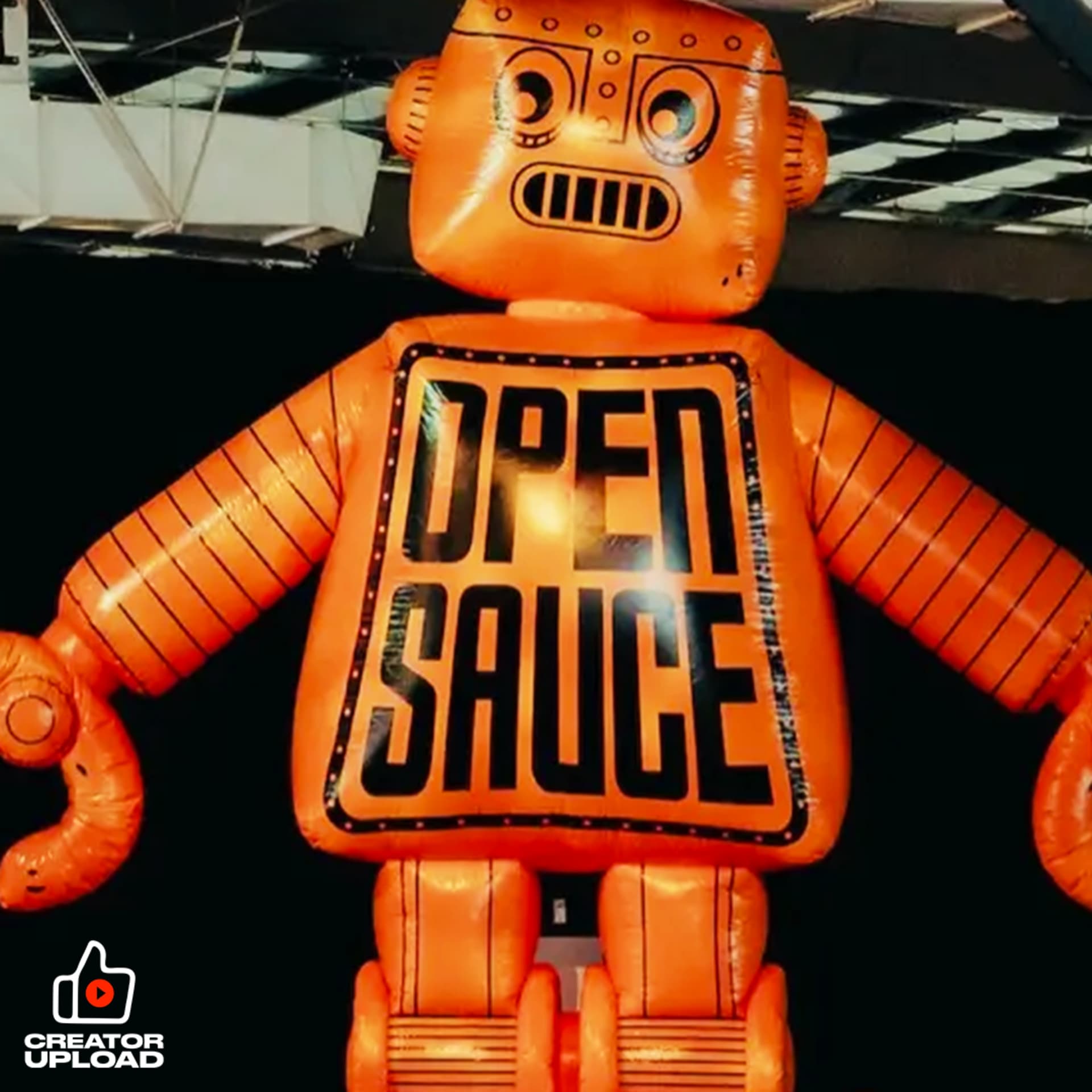
14:44Oh, I didn't realize that. Even better. Look at this. I don't even realize the cream of the crop. You're brilliant. Oh, God, I know people. Oh, God, I'm so excited. Okay. So I should have done that. So tell us about it. Tell us about it. Yeah. So OpenSauce is, they don't like it being called this, but I'm going to do it anyway. It's kind of like imagine VidCon and Maker Faire got together and had a baby. Sure. And so it's basically an event over three days. There's an industry component on Friday. And then Saturday and Sunday is a festival, which has, I don't know, 800 makers showing off their weird, interesting, wonderful, crazy crafts that they built.
15:21mostly electronics, some robots, some drones, some involving lots of different parts. And then 125 top creators in the STEM area, or STEAM actually is what they're calling it, science, technology, engineering, art, slash animation, and math. And so what you get is you get a very sort of niche-focused version of VidCon that's all about STEM, that's all about creators, but it's also all about programming and AI and building stuff and engineering. And it's all held in the place where Maker Faire started, which is in San Mateo at their expo center. It's a wild ways, crazy, wonderful weekend of just geekhood.
16:02So are there, I mean, I've heard it's sort of like the geek fest in the best possible way. I've heard that before. So like, but these makers, do they all necessarily have like big social presence or is it like, how does that, how do those kinds of worlds collide? So the way the worlds collide is you think about it from the audience perspective. If you're a nerd or a geek and you like engineering, you like STEM creators, like William Osmond, you like Mark Rober, you like Michael Reeves, you like Astro Alexandra. I could go on and on, but those are just some of the creators that were there. And you probably also really like people doing building stuff, whether it's with 3D printers or it's with computers or it's drones or whatever.
16:42So if all of those combine in your interest, it's a perfect place for you. And because it's in the San Francisco Bay Area, halfway between the city and Silicon Valley, you've got this great group of engineers and creators and developers and companies that are focused on that. And so it's this big celebration of that intersection of your geekhood, your nerdiness, your creator love, science, engineering, and all that. Well, it's also interesting because it feels like on one hand, those folks are kind of like the fans, but they're also like part of the sort of industry because they're makers themselves.
17:15Right. So. So, OK, so you're in the fourth year. You've been very involved thus far. Like how have things changed? Like I think specifically around like niche cons. Like obviously, like I mentioned, you were, you know, the CEO of VidCon for many, many years. And VidCon, of course, is the OG conference that sort of, the way I like to describe it is like VidCon was created when being a creator meant sort of one thing, right? Like there wasn't like nine million different verticals, right? And so I think, and I can speak to this as a lover of VidCon, I've been on the advisory board for 100 years. It's trying to find its footing in this new space where people are very, creators are very niche.
17:52So what is that sort of, what do you think about that overall kind of concept in general in terms of the sort of cons being more niche? And then how have you seen that sort of evolve open source in the last four years? Look, I think you nailed it on the head when you said that the creator space has expanded and changed. There are way more creators now and way more things they're talking about and more platforms than there were in, you know, 15, 16, 17, when I added you to the advisory board. I was happy to do that. To be fair, because I called you and said, add me to the advisory board. But also because I was trying to get Facebook to come to VidCon and be on the industry track.
18:31Yes. At that point, you were like the only person I knew at Facebook. So it was a match made in heaven because Facebook ended up becoming a huge part of it. So thanks. But anyway, back in those days, you could fit all of the creator economy probably in one event. And fandom in those days, even if let's say you're a teen and you like Phil DeFranco, chances are, you know, your friends either like Phil or they like Toby Turner or they like Jenna Marbles and you could all go together and share your fandom and have a great time. Well, now, 10 years later, 12 years later, you've got all these different fandoms, all these different niches.
19:10And the state of fandom for teens, I think, has changed, too, where these days, most kids belong to fandoms that none of their friends know about. So it's hard to capture all of that in one place. And it's hard. VidCon brings 300 to 400 creators. OpenSauce brings 100 to 125 creators. None of those capture everything. And so the way I think open source works is it goes after a very narrow slice, not that narrow, but narrow enough. And it really can appeal to people who are interested in that slice. And again, if you're a fan of Mark Rober, chances are you're a fan of Michael Reeves or a fan of Hank Green or a fan of William Osmond who started it.
19:51So if you are, this is a great place to come because you can discover new creators, celebrate the old creators, and dive around in 800 different wacky makers building all sorts of weird, interesting stuff. So what is the, of this niche of creators, what is top of mind? I'm assuming AI. Like, what is everybody excited about? What is everybody worried about? Well, they're both excited and worried about AI. The last year in particular, there was a very negative sentiment around AI. I think we're seeing AI as being more adopted, but still worrisome to some of the groups that are there. So the animators certainly see AI as a problem, as a way that may be taking some of their livelihood away, but also as a way to make more stuff more quickly.
20:37But also, 3D printing has not gone away. It's gotten even bigger and better, and there's really cool things you can do with it. But we're seeing more around automated things like drones. There was a huge drone vendor there showing off automated package delivery. And even battery-operated cars, electric cars, GM was there. And a startup making brand new cars was there. So all of those things have happened over time. And I don't think we ever saw – yeah, we did see Kia once at VidCon. That's wrong. Kia was there one year. But to have GM, to have this other startup there, all these interesting things.
21:13You know, GM's making a huge move because of Lucy's there. Lucy's at GM. Yeah, right. Exactly. Yes. Lucy Tate, who was a long time, she was at Whaler for a long time, and she's now at GM. So she was at VidSummit. There was huge GM sort of trucks at VidSummit, and so I'm not surprised to hear. Yeah. I had her speak on my industry track last year. I had her boss speak there. Yeah. But yeah, and that was the beginning. So they brought a car last year. They did a lot more this year. That's awesome. Okay. So in the final sort of questions, like what is the thing that sort of most surprised you on the ground at OpenSauce, in a good or bad way.
21:46You know, in a good way, and this is, I think I was just surprised by how it just keeps on getting bigger and how the fans for these engineers and these engineering creators and these nerds, they hang on every word. And it shouldn't surprise me because I know that. Yeah. But you think about nerds and they might be a little bit, you know, the classic stereotype is they're, you know, kind of in their shell and they're not as outgoing. going, but they were out there in force. I mean, I did it. I moderated a session with Mark Rober, with Jerry Brigg, everything with Dustin. And, and it was, and it was amazing with Joel Hartman.
22:25It was amazing. And everybody hung on every word and they, they, they screamed and yelled in the right places. And then afterwards they ended up a couple of, two of the speakers came down and just signed autographs and said hi for like a half hour afterwards. That was really cool to see. The other surprising thing was just everybody was so polite. I mean, remember some of the creators we saw 10 years ago? The fans were not polite. Oh, my gosh. They're so polite now. Oh, my God. The fans used to be, when I was there with Shane Dawson at VidCon years ago, these fans would be like, sit on my lap and like scream at him.
23:00And he'd be like, I don't feel comfortable doing that. And they'd be like, sit on my lap. Like it was like, I mean, you just made me think about it. That's so great. And also, look, another thing is the creators, even the biggest creators, would just walk around and look at all the different things there. And people would just say hi and come up to them. Is this an older fan base? Is this fan base a little older? Like tweenie? Maybe a little bit. But there are a lot of kids there. A lot of parents bringing their kids to learn how to solder and things like that. But like creators would just pop out, surprise and delight, walk around.
23:32People would say hi. They might talk to him a little bit and then they go away. That would never have happened at VidCon 10 years ago. No, my God. No, no, my God, please. What a insane. All right, Jim, thank you so much. Where can everybody find you and all of your musings? Find me at louderback.com. Find me at LinkedIn. Inside the Crater Economy is the newsletter I write there and on Beehive. And yeah, find me at OpenSauce next year. Love it. Thank you so much, Jim, for coming on the podcast. So, Joss, let's get into some uploads, downloads. We haven't talked about social media kind of bans for kids in a bit.
24:01And I think it's notable. So France just became the first European Union member to ban social media for young teenagers this week, which is set to begin sort of a wave of new regulations because it's, you know, France is the size of Texas. It's hard to sort of do this in one country. So European Union is like thinking about this as sort of like a holistic thing. But France is the first one to really put it into place. So France passed this legislation banning social media for children under 15 in a vote on Tuesday, beating the European Commission's planned rules, which are set to be announced this summer.
24:33Other countries, including Greece, Germany, Spain, Italy, Portugal, Denmark, Sweden, Poland, Austria, Slovenia, Ireland and the Netherlands, have also expressed interest in similar measures. I think it's just kind of fascinating. I was thinking about this, like just, you know, zooming out about like if and when this would ever happen in the U.S. And it's like it's funny because in some ways, obviously, the U.S. is thought of this sort of puritanical country or drinking age is like higher, all the things. But if anything hints at like sort of a limitation of free speech, we're like, hell no, we'd never do this, despite the fact that like, you know, people can drive cars, but there's there's laws to have seatbelts, you know.
25:09So I just, you know, and according to like Bloomberg, Trump has vehemently has posed all of these kinds of legislation because he thinks, again, threatens Americans free speech or disproportionately targets U.S. companies. I also want to just talk about there's been a lot of talk about, of course, you know, Australia, you know, banned social media for, I think, under 16 back in December. And there's a lot of sort of back and forth about whether or not this has been effective. Right. So Jonathan Haidt, famously the, you know, social scientist who wrote The Anxious Generation, which kicked off the social media ban sort of for kids worldwide, but specifically in Australia.
Read the full transcript
25:43I forget which legislature, but like someone in Australia who is in a government position's wife read The Anxious Generation and said to her husband, like, you better get on this and like cut to there's a social media ban. This is a true story in Australia. And I think there's something there's a couple of interesting things to note about, you know, how it's sort of going right now. and he did a big post on LinkedIn about it. And he said, you know, there's a lot of people sort of saying that it's like not working, right? Because kids can still access YouTube, but it's, he was sort of saying the point wasn't to get kids sort of off of YouTube specifically.
26:14It was to limit their ability to create like accounts on these platforms. So, you know, he said in his post, like YouTube is often accessed without an account because most of this content is viewable that way. So this means while many YouTube accounts have been revoked since the age minimum took place, YouTube usage under 16 is less likely to be affected by the new law compared to platforms like Snapchat, right, which require an account to view content. So to give a sort of snapshot of this, so Custodio, which did sort of some data polls on this, after the age minimum went to in fact on Australia, Snapchat monthly usage for kids dropped 40 % among 13 to 15 year olds.
26:55YouTube only dropped like 3%, 40%. That is huge, right? And they have another sort of set of data that says, YouGov did a survey conducted to parents, and they said that three in five Australians said the ban has been effective. A majority, 61 % of parents of 16 and under reported at least two out of four positive behavior changes in their kids, including more in-person social interactions, that's at 43%, children who are noticeably more present and engaged, 38%, and improvements in the relationship with their child at 38%. And so it's working, kids. And not to mention, we're like six or so months into this.
27:33So like, give it a beat. So I just think this is, in one hand, it's really sort of, I think, encouraging and points to all signs that these social media should not be accessible to kids under the age of 16. If and when this country ever puts that into effect, who knows? I think it's more likely that the social media companies themselves will put these things into effect due to them losing lawsuits like the Facebook lost recently where they were found liable for creating an algorithm that creates harm and addiction and all these sort of things. So upload in my mind. It's fascinating. And just thinking about the downstream effects of this, if it becomes popularized, at least in these different countries and then around the globe, like how are these apps going to look, feel and act differently?
28:19Like maybe you won't need a login for Instagram or Facebook or Snapchat or TikTok in order to start viewing content. Right. That could to me, that's not a positive necessarily of what. But I think more likely that they're going to be forced to create more sort of controls and everything like Twitch literally also just on the heels of this. They're now letting parents, you know, control whether or not their kids under the age of 13 can stream live. So Twitch is giving parents more control over how their children are using a streaming platform, including the ability to block them from broadcasting entirely.
28:53Accounts for 13 to 17-year-old children providing account management features to parents and a weekly email summarizing their teens' activities, including channels and hours watched. I mean, this is stuff that can happen and can't be implemented. And when parents are forced to look at the data that their kid has been streaming all hours of the night, God knows how many hours, I mean, behavior is going to change. I really I am of the mind that we're going to look back on this 10 years plus that, you know, we just let the Internet run our children's lives. Like, what the F were we doing? Like, yeah, it's we will look at it like I mean, their seatbelts were not required when we were kids.
29:28Like we are that old to remember that. And like now that's insane. Baby car seats were not required. They weren't. And like I think most of us would agree, like, that's kind of insane now. And I am of the mind that this is the similar kind of like we will think of the same way about this. that the fact that there were very little protections for kids on social media. From another N of one POV, when my kids have less screen time, they're way nicer. When they have less screen time or more screen time? Less screen time. You think, Josh? Yeah. I got a kid in the other room who didn't want to do camp this week, so he's on the thing, and I got to get out of here in like 10 minutes, and he's going to lose his shit, even though I've given him all the warnings that we are leaving at a certain time because I got to turn off the TV.
30:08I mean, it's not, their brains can't handle it. They found some loopholes though, which I'm okay with. Like they're doing these drawing tutorials so they can watch the drawing tutorial on YouTube and then they draw. It's amazing. Yeah, no, totally. I feel like that's okay. I mean, we're having watermelon, like, you know, gazpacho later. So like, forget it. More power to it. You know, Nick Giovanni. Okay, Josh, do you have any uploads or downloads? Lauren, quick upload from my side. YouTube is finally releasing this shows feature. Okay, yeah. And so what it is, officially from the YouTube Creators Expo is, quote, a new way to group your episodic content is here.
30:44Creators in the YouTube Partner Program can now turn playlists into shows or create a new one from scratch. It unlocks, one, a polished TV experience for your series, two, an episodic setup that keeps viewers coming back for more, and three, a simple setup using an existing playlist or a brand new show. One, I expect this to look very cool and be super exciting for creators when they can see their stuff on the television and it looks just like the Netflix play screen for Law & Order, where I feel like anything, even cosmetic or with aesthetics, to equate themselves more to traditional film and television is just like a little nice feather in the cap to show like, hey, we're on the same level playing field as these other entities and these other people producing content.
31:28Whether they are or not, that's an argument for a different conversation. but at least like showcasing that they can be is a big boon for them and talking about downstream effects once this catches on and it looks cool it's going to cause a lot more people to create more shows on youtube and more episodic programming on youtube well that's been like a thing i i i once worked with someone who was trying to basically it's funny he got he got his access to the api revoked but he was creating like he's like there's a lot of he works at youtube and after he left he was like there's a lot of actual like episodic shows on youtube so he was creating a third-party website that sort of curated all of those and then youtube was like yeah no we're taking that yeah you can't do that you can't do that um but um this is i think there there's already a lot of content that would like lend itself to being again episodic and sort of like season based like it looks like it's it's for all intents and purposes it's you know it's it's real tv shows so um this level of um organization i think has been necessary for a long time yeah can i just say one shout out, one requested feature I'd like to say on Instagram.
32:32So I have this, I'm not on it that much and my mental health is so much better, but I go on it about once a week. And like on YouTube, I'll be watching something and I'm like, what's that video? And I can go to my history and be like, oh, there's the video I was watching like the other day I found it. That doesn't exist on Instagram. And I understand the limitations of why that is, because if I'm looking at something, it's not the same as like clicking on it and starting it. But sometimes, like I was looking at something, I'm doing a kitchen again, everybody. And I was looking at something and I accidentally touched something that took me to the top of my feed, but then it redoes my feed.
33:01And that post, gone forever. And I can't find it. And I don't know how to get it. It's like, can I look at what my feed looked like yesterday? Like, how can I feel like we can solve for this? Mark Zuckerberg, Adam Mossari, if you are listening, take that note to heart. I mean, I think it's a good note. I don't think it's a bad note. It's a great note. Josh, I think we did it. Lauren, I think that's it. I'll see you scrolling back through your Instagram feed, watching Nick DiGiovanni's latest like fruit show. Can't wait. On your TV. Can't wait. If not there, next week on Creator Upload. Today's show is produced by Lauren Schnipper, Joshua Cohen, that's me, and Adam Conner.
33:33It's edited by Adam Conner too. Original music is by London Bridge. You can check him out on Instagram at London Bridge Music. Make sure you subscribe to Creator Upload right here on YouTube, on Apple Podcasts, as well as Spotify or wherever you're listening. While you're there, give us a rating and leave us a comment. If you want to talk, hit us up at info at creatorupload.com. If you like our show, recommend it to a friend. If you love it, just tell everyone. Thanks for listening to Creator Upload, and we will be back next week.
From the publisher
Is broad creator fandom changing? In this episode, former VidCon CEO Jim Louderback (Inside the Creator Economy) joins us to break down how niche creator conventions are thriving, why teen fandom is fracturing, and what went down at Open Sauce. Plus, Lauren and Josh analyze record-breaking Q2 earnings from YouTube and Netflix, France’s brand-new social media ban for kids under 15, and YouTube’s official rollout of its new "Shows" feature.
In this episode, you’ll learn:
-- Why fandom is shifting from mega-conventions to hyper-focused communities
-- How YouTube’s $11B+ ad revenue rivals Netflix’s entire business
-- The real impact of international social media age bans on app usage
-- How to use YouTube's new "Shows" feature to format episodic playlists
00:00 Statue of Liberty & World Cup Craze
01:09 World Cup Stars Explode on Social
04:38 Netflix Q2 Earnings: View Hours vs. Quality
11:31 YouTube Ads Hit Record $11 Billion
14:14 Jim Louderback Joins the Show
15:12 What is Open Sauce?
17:18 How Creator Fandom is Changing
20:20 AI, Drones & Tech at Open Sauce
22:41 VidCon Fans vs. Modern Niche Fans
23:53 France Bans Social Media for Under-15s
26:00 Is Australia’s Teen Social Ban Working?
30:35 YouTube Launches New "Shows" Feature
32:38 Instagram History Feature Request
Creator Upload is your creator economy podcast, hosted by Lauren Schnipper and Joshua Cohen.
Follow Lauren: https://www.linkedin.com/in/schnipper/
Follow Josh: https://www.linkedin.com/in/joshuajcohen/
Original music by London Bridge: https://www.instagram.com/londonbridgemusic/
Edited and produced by Adam Conner: https://www.linkedin.com/in/adamonbrand
