
 Ask ChatGPT



Episode topic: DTNS 5361’s “Big Tech Question of the Week” debates whether Googlebook (an Android-based laptop line) can replace a Mac or PC, plus a second segment asking whether people want an AI charm/keychain like Meta’s “Muse Charm.”
Tom Merritt (referee). Len Peralta (draws top tech news). Debate guests: Ayaz Akhtar (PCMag/CNET Video Group) and Sarah Lane (IAS). Opposing side: Roger Chang (no further bio given) and swing seat Wen Twaydao (no further bio given) plus Rob Dunwood (no further bio given). Charm segment: Ayaz Akhtar and Roger Chang argue yes; Rob Dunwood, Sarah Lane, and Wen Twaydao argue no.
Googlebook could replace thin-and-light laptops for users who mainly need Android apps, web work, and continuity with Android phones; it cannot replace Mac/PC for power users and enterprise workflows needing legacy Windows/macOS software, drivers, and specialized hardware. Muse Charm is convenient as a keychain AI interface, but critics say it’s redundant because smartphones already do the same.
legacy tools like Premiere/After Effects/Photoshop; needing Windows-only hardware/software (e.g., mixers, video calibration); Google Gemini “Call for Me” and Meta’s Muse Charm (2-inch touchscreen, cameras, fingerprint sensor, Wi‑Fi/5G, no phone unlock).
Written by AI. May contain mistakes.
Introduction to the Big Tech Question of the Week regarding Google Books.
“news this week and ask, what does it mean?”
Discussion on the latest tech news including Google's AI developments and Microsoft's new products.
“Google's Gemini 3.8 Live mode can now put a customizable animated face on enterprise AI agents with synchronized speech, natural expressions, and the ability to keep talking while handling tasks in the background.”
Updates on SpaceX's Starship preparations and Tesla's semi-truck deliveries.
“SpaceX completed a launch rehearsal, what's called a wet launch rehearsal for Starship Flight 14.”
Discussion on the rumored subscription options for ChatGPT.
“The longest range version is expected to travel at least 500 miles and might cost around$300 ,000 before incentives, although charging infrastructure would be a hurdle for at least some buyers.”
A debate on whether Google's new laptop can replace traditional PCs.
“that all start at$899, and they all promise as much functionality as your typical thin and light laptop.”
The hosts introduce the topic of Google Books and the participants in the discussion.
“is from Acer, and that's$8.99, and the others vary.”
Ayaz presents arguments for how Google Books could replace traditional PCs.
“I don't think you can replace a PC with a Google Book.”
Roger provides reasons why Google Books cannot effectively replace PCs or Macs.
“Google Book doesn't effectively have that.”
The hosts engage in a lively discussion about the practicality of Google Books in various work environments.
“So if the swing seats want to throw in questions now or if anyone wants to follow up from Sarah and Ayaz's side to Roger, Ayaz, Sarah, do you guys want to start this?”
Participants evaluate the current limitations of Google Books in replacing traditional computing systems.
“But I also use a lot of other just sort of legacy wonky tools that help me process audio.”
A discussion on whether Googlebook can replace traditional PCs or Macs.
“And, you know, the question was, can it replace my PC?”
Participants share their personal experiences and opinions on Googlebook's usability.
“So like I said, my Dell XPS right here is plugged into a docking station.”
Discussion on the limitations of Googlebook for high-end power users and specific software needs.
“And I think I definitely fall into the, well, I couldn't even use this for my own personal Android development.”
Examining how Googlebook fits into different user workflows and its potential.
“So all the stuff you need to use for work, you can just use on the work PC that they've given you, but you just don't really want to use the work PC at the house for your own personal stuff.”
Debate on the future of computing devices, including Googlebook's place as a bridge.
“Because it's interesting because it's trying to bridge that gap.”
Clarifying the conditions under which Googlebook can be a suitable option for users.
“But when it doesn't have another device, it becomes useless.”
Learn about the features and concept behind the Muse Charm, a new AI-driven device.
“And interestingly, the thing that caught a lot of the headlines, a little keychain-looking device called the Muse Charm.”
Hear differing opinions on whether the Muse Charm is a desirable device.
“Starting us off, I as and Roger, which one of you wants to go first in the opening?”
Panelists discuss the practicality and necessity of the Muse Charm in everyday life.
“Okay, so what I'm going to say is that these these charms are reflecting the new way people are going to interact with devices.”
Critics argue that the Muse Charm does not solve an existing problem and discuss its limitations.
“And I don't, I do think that we're in a time of this kind of like new nascent era of AI assistants that come with that go along with me.”
Discussing niche scenarios where the Muse Charm might be useful despite general skepticism.
“The phone, the char will keep them busy and out of my hair for the next 45 minutes while I grab stuff off the shelf.”
The hosts discuss the potential uses and market viability of Meta's charm product.
“Let us know if they swayed you one way or the other.”
The hosts discuss the potential uses and market viability of Meta's charm product.
“don't forget Daily Tech Headlines now available every single day of the week.”
The hosts read out the credits for the week's episodes, thanking the hosts, producers, moderators, music and art contributors, guests and patrons.
“Mod and video hosting by Dan Christensen.”

Get the gist, explore an idea or ask about something said.
 Claude
On Daily Tech News Show, what are the key points of this episode?
Searching your listeningAutomatic transcript. May contain errors.
0:00Hello, hello. This is Brooke DeVard, host of the Naked Beauty Podcast, and I want to talk to you about Lexus. At Lexus, master craftsmen called Takumi are involved not just in physical craftsmanship, but in all of those sensory details. These masters evaluate things like how a door closes, the click of a switch, the acoustic feedback of controls. Instead of just instruments, Takumi craftsmen rely on human perception and intuition to create what sounds and feels right. Out of all of the tools that Lexus uses, the most powerful one is understanding what will make us feel something. Because a car that doesn't make you feel something is a car that stops short of amazing.
0:40Experience amazing at your Lexus dealer.
0:43Huyen Tue Dao: Some days, getting the work done isn't the problem. Staying locked in is. AlphaBrain is Onnit's daily nootropic formula for cognitive support, designed to support memory, focus, attention, and mental clarity. Its formula with science-driven ingredients include theanine and huperzine A to support focus and memory. And it's caffeine-free. So when you're deep in the work, AlphaBrain helps support enhanced productivity and tune-out distractions. Get focused on what matters. Shop AlphaBrain now at onnit.com. Hey everyone, it's Chris Guillebeau here, host of the Side Hustle School podcast. This episode is powered by AT &T Business.
1:22In my early days, I did some of my best work in parked cars or coffee shops. But when I landed my first big contract, I realized I couldn't bet my future on a public connection that cuts out if someone turns on a blender. As a small business owner, you're already wearing at least 10 hats. You shouldn't have to be your own IT department as well. That's why I rely on AT &T Business. They keep your connectivity reliable so you have one less thing to worry about. Powered by AT &T Business. Built to work. Get AT &T Business at business.att.com.
2:20Robb Dunewood: enough to wear all day and the point comes in so many gorgeous colors, patterns, and textures. Discover the point at rothys.com. That's R-O-T-H-Y-S dot com.
2:41Huyen Tue Dao: Welcome to the Daily Tech News Show's Big Tech Question of the Week where we look at the tech news this week and ask, what does it mean? I'm your referee, Tom Merritt, and this week, the big questions are, can a Google book replace a Mac or PC? And do you want an AI charm or key chain? Joining us here to draw the top tech news of the week is Len Peralta. Welcome, Len. But first, today's tech news. Here's Sarah Lane.
3:12Google's Gemini 3.8 Live mode can now put a customizable animated face on enterprise AI agents with synchronized speech, natural expressions, and the ability to keep talking while handling tasks in the background. The avatars can resemble humans or animated characters, it's kind of up to you, and switch among 97 languages mid-conversation without breaking the lip sync. Google says generated audio and video will carry invisible synth ID watermarks, but the feature is not yet available to regular Gemini users.
3:49Huyen Tue Dao: Microsoft launched its Copilot super app. It'll have three tabs, code, home, which is for productivity stuff like generating reports and autopilot for agentic tasks. By the way, Copilot plus seems like it's on the outs. We're not using that anymore. Autopilot is built on OpenClaw-based Scout and can run in the cloud, so it can keep working on things even if you turn off your computer. Microsoft will be charging clients based on usage. This is an enterprise product. The home and the code tabs will be available for Microsoft Frontier program members in the coming weeks, with Autopilot coming by the end of the month in preview and also surfacing in Microsoft 365 apps like Team and Outlook.
4:33meta's upcoming horizon create app will let people describe an idea and then generate a 2d or 3d mobile game including its artwork progression difficulty and multiplayer features if app applicable a browser-based tool called horizon studio will offer finer controls eligible finished games could appear inside facebook and instagram feeds and launch without needing a separate download.
5:01Huyen Tue Dao: Yes. Vibe coding a game is the new fetch and meta will make it happen. In an interview with NBC's Meet the Press set to air this weekend, Bill Gates says, and I quote, AI is certainly powerful enough to drive events that, you know, cause a billion deaths. I don't know if he said it with that tone of voice, frankly, but that's the way it reads on the paper. He also said there's never been a weapon as powerful as the combination of people with ill intent using the latest AI tools, which I don't know if a nuclear bomb maybe, I don't know. Anyway, this follows Gates's essays in August warning about misuse of LLMs for several kinds of crimes.
5:40Huyen Tue Dao: So Bill Gates really becoming a doomer these days. Coming back to Google, the company is testing Call for Me, which lets Gemini phone businesses check hours or inventory, request quotes, manage reservations, navigate menus, and wait on hold. As a user, you can review the request beforehand and either monitor or cancel it or take over the call yourself. Gemini identifies itself as an AI assistant calling on a recorded line. For now, it's a restricted beta requiring a Pixel 11 series phone, a US SIM card, a Google AI subscription, and the beta version of the phone by Google app. I wonder if it says, I don't know what you've heard from Bill Gates, but I just want to reserve a table for two.
6:28We're not dying today.
6:29Huyen Tue Dao: Not today. SpaceX completed a launch rehearsal, what's called a wet launch rehearsal for Starship Flight 14. That includes loading it with all the liquid propellant, running through a countdown, pretty much everything but ignition and liftoff. That will put Starship still on track for a September 28th launch, should that launch date be approved. And then it would make its first orbital test flights, done suborbital before, but it'll make six full trips around the Earth and put 26 Starlink V3 satellites into orbit. About nine years after Tesla unveiled the semi, you know, the semi truck that Tesla was developing, it's beginning new customer deliveries from a Nevada factory that it says can eventually produce 50 ,000 trucks per year.
7:19The longest range version is expected to travel at least 500 miles and might cost around$300 ,000 before incentives, although charging infrastructure would be a hurdle for at least some buyers. Tesla also shaved roughly 1 ,000 pounds off the truck and added some normal roll-down windows because that's what people wanted.
7:40Huyen Tue Dao: You know what I'd like in my automatic truck? Crank. Several outlets report an unannounced subscription option showing up in ChatGPT's interface. These are screenshots. OpenAI is not saying anything about it, but they're like, I'm seeing it on my website. In addition to the$100 and$200 a month versions of Pro, they're showing an option for either$500 or$600 a month. The$600 one is showing up in markets that have local tax like VAT, value-added tax. So it's$500, but then if you add the value-added tax, it becomes$600. Apparently, that extra money will get you fastest work and codex. Codex. Bleeping Computer speculates that the new plan could be using the faster Cerebrus hardware that OpenAI has been deploying.
8:26Huyen Tue Dao: DTNS Live is made possible by you. Thanks to every single one of you out there. Special thanks today to Arthur P. Johnson, Norm Fazekas, Chris Allen, and Reid Fishler. Reid Fishler. Thank you. Episode prep gets messy when research, Slack threads, and script trackers are all in different places. That's where ChatGPT work comes in. Give it the goal and connect to the tools where work happens, like apps and files, and it can help pull the pieces into a draft you can review without you having to re-explain the project at every step. For example, ChatGPT work can gather team feedback from Slack and use it to suggest updates to a project brief in Google Docs.
9:10You stay in control reviewing the draft and deciding what moves forward. Put ChatGPT to work on your most ambitious ideas and projects. Get started at chatgpt.com by selecting work mode, available on Plus and Pro plans.
9:24Robb Dunewood: I used to be the person who hunched over my laptop mid-meeting, typing furiously to catch every word and missing half the conversation because I was too busy transcribing it. That's the problem Granola fixed for me. Granola is an AI-powered notepad that makes your meeting notes useful. It captures what happens in your meetings and turns it into clean, structured notes with decisions and action items pulled out and made easy to find. And the best part? It integrates seamlessly with how you already work. No setup, no configuration, no friction. Before Granola, my post-meeting routine was triage, 20 minutes after every call decoding my own shorthand, figuring out who owed me what.
10:00Robb Dunewood: Now the notes are just done, organized action items pulled out before I've even closed my laptop. You get better notes in one place and you get to actually stay present instead of typing the whole time. Once you try it on a first meeting, it's hard to go without. You can try it totally free. Head to granola.ai slash daily tech. That's granola.ai slash daily tech to get your time back. Go to granola.ai slash daily tech and try it on your next call. This is Liv Perez from Let's Get Dressed. And one thing fashion has taught me is that the smallest details are often what makes something feel truly special.
10:34Robb Dunewood: The weight of a fabric, the clip of a clasp, or the way a beautifully tailored piece moves. Lexus approaches craftsmanship the exact same way. Their master craftsman, called Takumi, evaluates sensory details like the sound of a door closing, the click of a switch, and the acoustic feedback of the controls. They use human perception and intuition to create what feels right, and that's engineering to be felt. Because a car that doesn't make you feel something is a car that stops short of amazing. Experience amazing at your Lexus dealer.
11:07If you felt stuck trying to lose weight, you're not alone. Enter Weight Loss by HERS. It's designed to support you in reaching your goals. And HERS now offers access to an affordable range of FDA-approved GLP-1 medications, including the Wegovi pill and the Wegovi pen. Even better, with a range of affordable GLP-1 options, HERS makes it simple to find an approach that fits your needs and your budget, if eligible. You'll get a treatment plan personalized to you and unlimited dosage changes as needed. It's weight loss designed to work with your life. Ready to reach your goals? Visit ForHers.com slash eligible to get personalized, affordable care that gets you.
11:45That's F-O-R-H-E-R-S dot com slash eligible. ForHers.com slash eligible. Weight loss by HERS is not available in all 50 states. Wegovi is the registered trademark of Novo Nordisk AS. To get started and learn more, including important safety information, Wegovi clinical study information, and restrictions, visit ForHers.com. This message is brought to you by today's sponsor, Walden University. Set a course for change. Now is the time to make a real change in your life, career, and community. At Walden University, we give you the support and flexibility to get the W. Walden's online programs are designed for working professionals like you.
12:24You'll gain hands-on skills to take on real-world challenges and succeed. Your future is waiting, and Walden is here to help you achieve it. Take the first step to make your impact. Visit waldenu.edu. Walden University. Set a course for change. Certified to operate by Shev.
12:45Huyen Tue Dao: It's time for the Big Tech Question of the Week. This week, Google launched Google Books, laptops from six different manufacturers, that all start at$899, and they all promise as much functionality as your typical thin and light laptop. They also integrate well with Android phones and, of course, feature all the best features of Google's Gemini, but they are not running on Windows or Mac. They're running on an Android-based operating system for a laptop, and they are not Chromebooks. They're not running Chrome OS. Who are they for? That's what we're going to aim to find out in this conversation.
13:20Huyen Tue Dao: Our question this week is, can a Google book effectively replace a Mac or PC? If you would like to weigh in on this, you can vote on which side you would join in our poll at patreon.com slash DTNS. We have divided into two teams taking the position of yes, you can replace a typical PC with a Google book in some situations. Please welcome to the show Ayaz Akhtar, PCMag CNET Video Group. Welcome back, Ayaz. It's good to have you. Thank you very much. And I need to correct you on something before the comments do. The Google books started$8.99. Not all of them. Other ones started like$11.99,$12.99.
13:58So the cheapest one is from Acer, and that's$8.99, and the others vary. So there you go.
14:05Huyen Tue Dao: Thank you for the Instagram correction. And joining on the side of a Google book is, in fact, possibly a typical PC, Sarah Lane. IAS and Sarah teaming up. I love it. Yeah, I mean, you know, we agree for once. But Ayaz, do you want to take this off the top and explain to the folks why Google Books? Well, hold on. We do need to introduce our no team. I don't think you can replace a PC with a Google Book. Is Team Roger Chang? Me? Why don't you just say Roger on the other side? Roger is saying, no, you cannot replace a PC with a Google book. And in the swing seat, still deciding their answer. Rob Dunwood and Wen Twaydao.
14:48Huyen Tue Dao: Hi, Wen. Hi, guys. Hi, Rob. There we go. There we go. OK. I, of course, will be sitting in the referee seat. And I flipped a coin off screen. Starting us off is, yes, Ayaz and Sarah. Which of you is going to start with the two minutes? and then I'll start the counter. Ayaz, let's do it. As in, I'm going first? Yeah. Your time starts now. All right, so Google Books are running Google Book OS, and this is a version of Android. And Google claims that they've learned lessons from Chrome OS as well. So this windowed operating system can use all Android apps natively. And so why this could replace a Mac or PC?
15:33First, on the Mac side, if you've ever used an Android with a Mac like I do, It is disgusting. It does not work well. It's just a terrible idea, but I do it every day, so I don't suggest that. If you're going to go to PCs, now PCs have a great link to Android, but the thing is, it doesn't really work as well as a Google Book OS. And I've got to say this. What are people using Windows for in general? If they're using gaming, yes, gaming will still kick butt, and it'll beat the Google Books, but this is a very small section of the Windows side. So if you're talking about documents, if you're talking about even video editing, if you can do it on your phone, you should be able to do it on the Google Book.
16:12And that's going to have the same interface, plus it's got continuity. So you can go from one device to the next. It really is basically what Mac is to iPhones. Google Books will be to Android, and that's the rest of the world. Yeah. I'm with IAZ on this one. I feel like in the Chromebook scenario, it was always sort of brought to everybody as maybe it's a student or maybe it's, you know, a parent, somebody who doesn't do a lot of computing on their laptop. You know, they're checking email. Maybe they're checking social networks. You know, that – and Chromebooks still exist, right? So the Google book is a new category of a extremely AI forward laptop that you get.
17:04What is it? Five terabytes of storage? Yes. Well, you get a Google book. So, I mean, that's redonkulous to me. I pay for 200 gigs on Apple's iCloud and I, you know, kind of have to manage that sometimes, but that's about enough. So lots of storage. So this is definitely not a, oh, it's just for light reading and silly stuff. This is a very powerful system. What you have to do is buy into the Gemini portion of all of it. I mean, you could just say, I don't care about AI, so I'm not going to use that. And that would be your prerogative. But that is definitely what we're going for here. we're going for google saying this is a powerful machine it is cheaper than what apple's going to give you and if you're an android user which many people are that is this is this is it this is the this is the laptop for you okay i'm done all right is that better that that is that or is that too gentle of a timer it still sounds like a phone ringing but they all do because it's an ipad it sounds like i'm i'm up for my spa treatment yes okay
18:24Huyen Tue Dao: so uh roger your two minutes starts now spa treatment begin so unlike the uh the two google book dealers you just heard from uh i believe that the google book as it is right now cannot effectively replace a Mac or PC. And for the simple reason, there's a lot of legacy software that is already, and systems already designed around those operating systems, Mac OS, Windows, what have you, that a lot of people still need to interface with as part of their daily work routine. So whether you're talking about a database system for, say, like a food delivery company or something, because they didn't want to spend money to update it, you still got to use a legacy system that maybe is five years, seven years old, and you still need to interact with it, and there's a compatibility issue.
19:18One of the things that I think was one of the smartest things that Apple ever did when they changed and migrated hardware was to add a translation layer that allowed you to pick up your legacy software and still run it on the new hardware. Google Book doesn't effectively have that. There's also a matter, if you're a PC user, you're very familiar with a lot of USB dongles and devices that just work because they plug in and they work with Windows 11. I've done this before, especially with Wi-Fi Nix, USB Nix that just plug in. At least on Chromebook, their driver support is very spotty. Actually, very spotty is being very generous.
20:01It is very, very minuscule. And so a lot of people will effectively say, well, now I can't use a lot of this hardware, that I've spent a lot of money as part of my workflow to get up and running, and now I can't use it. so as it is right now i think google book this is the start but i don't think it can at this point at this point in time maybe in the future maybe give it like three or four years maybe in the future when they can get more developer support they get more hardware support or driver support uh that it will be but up and but for right now um even with the exception of gaming you know i've been playing luna for the past four days off amazon because i'm amazon prime and i've been playing the Indiana Jones game works really well.
20:50I don't think gaming is a deal breaker on this because if you have the internet connection for it and not enough CDNs, it works fine. But when it comes to stuff that you make money for, you have to go with the system that you work at.
21:07Huyen Tue Dao: Mr. Chang, your spa is ready now. I want my cucumber eyes. All right. That is our time for the opening statements. We'll now take a few minutes for open discussion. So if the swing seats want to throw in questions now or if anyone wants to follow up from Sarah and Ayaz's side to Roger, Ayaz, Sarah, do you guys want to start this? Of course I want to start this. Yes, you do. Of course you do. Yeah. Okay. So Roger, you pointed out some good things about the idea of app development, which should possibly take off with this. One of the biggest things that Google has done with these Google Books is that this should use Android on the go.
21:51So that USB-C port that you have on your phone that you just used for charging can attach to a dock, which gives you USB ports, SD card readers, anything you want. And the thing is, the robustness of Android is increasing. So while the tablet mess happened already, these foldable phones have brought a little bit more of a large screen presence to Android. And once we have this fully out there, because it's not even out yet, it's not out until later in October, these devices are going to push the developers forward. Because Android developers have been using Macs or Windows to make Android apps.
22:25And now they'll have features they can push right there. And if it works on your phone, it should work on these laptops. So if a Pixel gets a feature like a new Gemini update, it'll be on a Google Book OS right away. So you're not waiting. I think it's just a faster turnaround. And we haven't even talked about Windows. Good luck using Windows, period.
22:50Huyen Tue Dao: You're just going to throw all of Windows under the bus. I mean, but that doesn't address the point. Like, could I effectively replace my, in this case, PC laptop with a Google book? And I'm telling you no, because one, the software I use is like 30 % legacy software. I use a tool to update our RSS feed for the video that runs because there's only a Mac version and every Windows version sucks and there is no Android version. So I'm still relegated to that machine. Again, this is not because I have some desire to wall off Google for my life. I'm an Android phone user, but I am stuck in the realities for the demands of work.
23:32I use Premiere. I use After Effects. I use Photoshop. But I also use a lot of other just sort of legacy wonky tools that help me process audio. I think you're hitting a very important point is for people like us, Because we all run into these issues, right? For people like us, yeah, you know, a one and done Google book solution maybe isn't the right way to go. For a lot of people, though, it is. It's just going to be easier than anything you've done before where you're like, ah, there's a Windows app that doesn't work. I mean, I think there might be a lot of people. It might even be a plurality of people, but I don't think it's a majority of people.
24:23Because if you're working in a corporate situation, a lot of what you use on your laptop is sort of dictated by company policy. You know, my sister works at a government-funded medical research lab. They use Macs because all the tools they use are all Mac-based. And so it's not something as very easy as like, oh, we'll just swap in a new piece of hardware. We have to validate the software. We have to validate everything. And so it's a very lengthy process. And until that's done, if there's a version of that software that runs on Google Book, if there's all the same tools, if there's all the same security measures that they've implemented on all the hardware that they have at the lab, great.
25:09But that's not what we have right now. And I do not think that will happen, be the case, for another four years.
25:15Huyen Tue Dao: I was going to say, Roger, I was going to ask you about personal use versus regular use. And I think if I'm understanding what you're saying, it's that, yes, people in their personal life might use thin and light laptops, but people in their work situations are a different matter and enterprise sells the majority of the machines out there. And oftentimes, if you're taking work home with you, you need to have something that works with work, right? And so, again, this is not poo-pooing the Android OS or the Google Book platform. It's just these are the systems that are set up. And, you know, if you want to continue to be effective at your job, you want to make sure you can integrate and you can work with it.
26:03And, you know, if Android, you know, I mean, if Google can sort of, you know, be the 500 pound gorilla and sort of knock heads with financial institutions, so Wells Fargo, hey, you got to make it this way. That'd be great.
26:14Huyen Tue Dao: But I mean, Willie Scott points out, though, web apps are slowly but surely replacing a lot of those old legacy apps. That's true. But they don't replace they haven't replaced all of them. And there's a lot of other apps that that aren't just apps. If you're a technician and you do something, say like you do, like Robert Heron, he does a lot of video TV calibration. A lot of the software only, the software hardware integration only works on Windows, right? Because there are very few manufacturers of the hardware and they aim targeted the largest platform at the time, which is Windows. So it's sort of a chicken and egg thing until you can give them a viable, you know, a target audience that will use it and have it and works with all their hardware that they need to do their job.
26:59Great. But I do not see that happening immediately. I think it takes I would take at least three to four, five years.
27:07Robb Dunewood: I tend to, I think I'm landing where Roger is for the reasons that there are things that I plug my PC into that I know I can't plug this new device into and interface with it and work. Is it stuff that I use every day? No, but it's stuff that I use when I use it. I have to have it. I've got a mixer that I plug a PC into that. I don't think that this Google book is going to run that mixer or interface with that mixer. I have not seen the software for that yet. So this is not of where I don't think that it can be one day. I just don't think that it is two day because there's just so much stuff that I have to have either a PC or a Mac in order to run it.
27:55Robb Dunewood: I'm thinking about the MacBook Neo that I got because I am a PC user and I got the MacBook Neo. And, you know, the question was, can it replace my PC? And the answer is, well, no, it can replace a laptop that I carry around with me that I only use to access websites and stuff like that. But can it replace my Dell XPS with all the RAM that I have in it and plugging it into like a 3D printer and all the lights and everything that I have in the studio? until it can do that or until I convert my software over to things that will be compatible with a Mac, that wouldn't work in my workflow. I see the same thing happening here with the Google book that if the software doesn't exist for me to do the things that I currently do with a PC or a Mac, then it can't effectively replace a PC or a Mac.
28:46there's also but let me throw out another question can a thin and light windows laptop
28:53Huyen Tue Dao: replace a mac or pc no because i think all of roger and rob's uh arguments there apply to other form factors uh and and the question is can a google book effectively replace a mac or pc i think it does it what we're seeing is it does depend on what you mean by that right depends on
29:11Robb Dunewood: what you do. So like I said, my Dell XPS right here is plugged into a docking station. This got all kinds of stuff plugged into the docking station and all interfaces with this PC seamlessly. If I were to take my, if I had a Google book, which I, I'm very interested in this, I want it to work. Could I plug the same docking station into the Google book and still power and run everything that I need to in my home office. And I don't know that that's the case today. It might be one day, but it's not today. I think that I would be more effective even trying it with Linux just because it's been around for so long.
29:49Robb Dunewood: And so many of these apps have actually been ported over to it. I think it's just a time issue for the Google Book, where today the apps don't exist for it. And it's not like the Google Book hardware is deficient. It's just it takes time to develop the ecosystem that Windows has had for 40 years, where you have developers, whether you're talking about industrial systems that still run on Windows XP. Yeah, you've made that point pretty well, I feel like. But I just want to stress, it's not the hardware in it. It is just the ecosystem that runs the OS.
30:27Huyen Tue Dao: Well, we haven't heard from your part of the swing seat. I was going to say, As a 14 year, I'm 14, not 14 years old, but I've been in Android for 14 years. I would like to look young. Thank you. That's very sweet. No, I'm not. I think it's interesting. I'm definitely a swing seat on this. And I think I definitely fall into the, well, I couldn't even use this for my own personal Android development. I do think that's interesting. And a lot of people have called for that. But right now, this is not a flex. I'm running a 128 MacBook Pro. sorry, a MacBook Pro with 128 gigs of RAM, that's still barely covering it for my, and I work at a big enterprise company.
31:06So from a development side, from the media content side, that the way that I think a lot of us in this call, you know, we're enthusiasts, we're like serious, like big, big bold letters, serious content creators. No, I'm still on the side of, I don't think this will do this. But at the same time, as someone on Android, as an Android developer and an Android user, I do think, though, that there is a place for this. And Roger, I think you make really good points about certain ecosystems. But at the same time, because it runs Android, there's like 10, 12, 13 years of apps that people do use every day that could be replacing some of the things or just slotting in for certain things that we do do on PC and Mac.
31:47And just anecdotally, I think, again, people that aren't us, that aren't heavy power users could find a lot of utility in this, especially if they are people that, you know, do a lot of work on their phones. It's just a larger screen. I do think the support is there. Just as a little insight, baseball. Google has been highly encouraging us to support large screens and peripherals like keyboards for a very, very long time. And I do agree that this, between this and the iPhone Duo and other kind of more large screens like foldables in the system will just keep pushing developers who are generally very adverse to supporting things that they should rather than things that they have to.
32:24I do think this will keep pushing it to making the Google book more viable. And I think everyone but outside of me and my husband, who are both engineers, the pics like I have my sister still use her pixel book from 2017. The only thing that's wrong with it is that it's like just it's just it was wasn't meant to last whatever that age is, nine years. So I do think there is a market for kind of more simplest, more, more simple, lightweight. and the fact that it is running on Android and that is not an unfamiliar place for a lot of people, I think it could work. I don't know, but I'm more leaning towards yes, especially for, let's call it, you know, non-power users and more casual users.
33:04I don't know about the rest of it. I do.
33:07Robb Dunewood: I am right there with you there because I think that if you have a PC that is, you know, that is provisioned from your job that they give you or a Mac that they provisioned from your job. So all the stuff you need to use for work, you can just use on the work PC that they've given you, but you just don't really want to use the work PC at the house for your own personal stuff. And you're an Android user. This is a no brainer for that. Like I said, where it gets into if I use DaVinci Resolve, I don't see DaVinci Resolve for Android yet. That is a humongous problem because my job requires me to use that tool.
33:42Robb Dunewood: And if I can't use that tool, I can't use a Pixelbook in that place. And the thing about the Pixelbook is that even though the Acer one is$899, some of the ones that have a little bit more RAM, have a little bit more beef that I would want to use, they are really in the mid-range of what PCs and Macs cost. So for me, do I want to go out and spend$1 ,300,$1 ,400 on something that I can't run, even if it's just in a pinch of I just I'm away and I want to be able to run DaVinci and do an export or something like that. And that's not even an option for me. That's where I, as a high end power user, would have a bit of consternation.
34:22Robb Dunewood: But like I said, if it's if it's just an additional device to if I had something provisioned from work being as into the Android ecosystem as I am, I think it would work for me as I think it would work for many, many, many people, if for those who it doesn't work for. So that just tells me that it's it's it's close, but it's not there. Can it effectively replace a Mac or PC? As long as you don't need to do stuff that only a macro PC can do, then yes. But because you have to qualify it, the answer ultimately is no. And, you know, it's interesting because it's sort of this whole thing with Google, Google book reminds me of the whole Next Docs thing that you really love, Rob.
35:04Because it's interesting because it's trying to bridge that gap. And I'm wondering if it's better served as just being a shell for a very high-powered flagship phone that you plug into it. So you still effectively have this competing device. Like, if you think of all the things you do on your phone, all the work you do on your phone, yeah, it's great on a bigger screen. But why buy an entirely new machine when you just need just a larger screen and a keyboard? That's not far off, Roger, because actually on Android Faso, we have a lot of people that loved Samsung DeX. And I mean, I know it sounds like more like a niche thing, but we've had people send us their entire setups where they have their like Galaxy S25 or 24 hooked up and they've got a keyboard, a monitor, all that kind of stuff.
35:50And again, like I know that's not nearly even everybody or even a large minority, but there are people out there. And I think it's generally in the general socioeconomic environments that we're in. We don't want to buy four different devices. It would be really great to be able to leverage our flagship phones in this way. And, you know, what's interesting is because that whole idea is an idea that's been kicking around since the 60s, right? Instead of having a big, massive machine, you know, back when many computers were what you used at the bank, all the way to personal computers, it's like, you know, you just lug around this one device and wherever you sit down, they'll provide the keyboard and display and the power and you're set, right?
36:28So you do have sort of the security of it's my phone. It's always going to be on my person. No one's going to mess with it. But at the same time, you're giving the utility of being able to type on a keyboard, which at least for me, I'm a lot faster than with these two carrot sticks punching out a message. And, you know, like, yeah, I love my screen on my Pixel 6a, but I love having, you know, a 1920 by 1200 display in front of me because I can actually see text without having to zoom in, you know, at 51 years of age. So it's – I'm wondering if this is one of those evolutionary bridge devices that see us through to where Rob and Gwen, like we have just like sort of the next interface ubiquitous everywhere.
37:17Roger, I'm going to agree with you on that because what I see the Google book is a stopgap because, yeah, a NextDoc, that'd be great. But when it doesn't have another device, it becomes useless. And so what I think Google is really doing is decoupling the idea of you and the device. It's your account in the cloud. When you can access it from anything at any time, then we can actually go with these dumb devices. But currently, Google actually spent a lot of time talking about using these devices offline, which kind of confused me because when is anybody offline anymore? But this is the stopgap.
37:49We're going to need something to get people to go, oh, okay. Once that happens, then you have the app development to follow. And when we're talking about replacing, I wouldn't replace my stuff today with it. That sounds nuts because I also use a lot of legacy stuff. But for the modern person who grows up with a phone and that's all they knew was their computer, the fact that they can use a larger screen and the same apps, I think that's really what this is after. They've cut us off. We're like an old bunch of people. The future is going to be using this kind of stuff. I didn't realize I was being cranky.
38:24Huyen Tue Dao: howard uh in chat appreciates your crankiness uh just always been me you're not cranky you have opinions in a positive way uh if if i may we we kind of just blended into the swing seat questions which i think is great uh and we're we're showing off that you know the secret of all of these conversations is there's never a simple yes or no answer right but it's fun to pretend like there is and get into the conversation that way. And I feel like what Sarah and I has made really clear is if you are using a thin and light Windows laptop that can't do any of the things that Rob and Roger are talking about, then yeah, the Google book could replace that.
39:04Huyen Tue Dao: But if you are somebody who needs to do the things that Wen was talking about, needs to do the things that Rob was talking about, then no, it's just going to depend on your your situation. So I, I think that's the actual answer there. Do we, do we have a, an agreement on that? It depends. That's why I said maybe when you ask the initial question, maybe, maybe, maybe, maybe, perhaps, sometimes, it depends is not getting out of the answer. It's like, well, what do you use your laptop for? Once I get that answer, then I can tell you whether it's, yeah, yeah. It depends on what you use your laptop for.
39:42Huyen Tue Dao: But once you tell me, then I could say yes or no, but it's going to depend on that answer. All right. Before we get to the next question, Sarah, what's going on with Live With It this week? Well, if you want product reviews after that initial honeymoon, join us on Live With It. Each week, we talk about the tech in our lives, kitchen solutions, home security, fire trucks. Oh, yeah. In fact, this week, firefighter Bodie Grimm joined us to talk about something a very few people understand. You kind of have to be a firefighter to know the tech of fire trucks. It was a really good conversation. We're on YouTube at youtube.com slash at live with it show.
40:21And big thanks to everybody who supports us on Patreon. It keeps us trying out new things. Patreon.com slash live with it.
40:34Huyen Tue Dao: Some days, getting the work done isn't the problem. Staying locked in is. AlphaBrain is Onnit's daily nootropic formula for cognitive support, designed to support memory, focus, attention, and mental clarity. Its formula with science-driven ingredients include theanine and huperzine A to support focus and memory, and it's caffeine-free. So when you're deep in the work, AlphaBrain helps support enhanced productivity and tune-out distractions. Get focused on what matters. Shop AlphaBrain now at onnit.com. Hey everyone, it's Chris Guillebeau here, host of the Side Hustle School podcast. This episode is powered by AT &T Business.
41:13In my early days, I did some of my best work in parked cars or coffee shops. But when I landed my first big contract, I realized I couldn't bet my future on a public connection that cuts out if someone turns on a blender. As a small business owner, you're already wearing at least 10 hats. You shouldn't have to be your own IT department as well. That's why I rely on AT &T Business. They keep your connectivity reliable so you have one less thing to worry about. Powered by AT &T Business. Built to work. Get AT &T Business at business.att.com.
41:50Huyen Tue Dao: Wednesday at Meta's Connect Conference. Meta showed off a new smart glass thing, a bunch of new smart glasses, some without displays, some without even cameras. A new VR headset called Meta VR Glasses. And interestingly, the thing that caught a lot of the headlines, a little keychain-looking device called the Muse Charm. It's a Tamagotchi-sized device with a two-inch touchscreen, two cameras, and a fingerprint sensor. And the idea is you activate it and then can ask questions. You use the cameras not to take photos and videos, but to show it what you're looking at so it can answer a question about it.
42:26Huyen Tue Dao: Has Wi-Fi and 5G for its connectivity. They say you will not need to unlock a phone or open an app to use it. And it will be on sale by December, although they didn't tell us a price. So our next question of the week, of course, is do you want this? And we widened it out because maybe you don't want it because it's meta. Do you want an AI charm or keychain like this? Like we've seen pins, we've seen necklaces, we've seen all kinds of things. We haven't seen this before. Do you want a charm or a key chain like this? Taking the position of, yes, in fact, it's charming, is Ayaz Akhtar and Roger Chang.
43:05Huyen Tue Dao: On the side of, no, I don't need this, is everyone else. Rob Dunwood, Sarah Lane and Huan Tui Dao. And that leaves you, the audience, in the swing seat, by the way, because we have opinions on this one. Starting us off, I as and Roger, which one of you wants to go first in the opening? I mean, I can. I'll go, obviously. Just tell somebody to go. Let me just ease off the break here and let you know how I really feel. I as you can start. No, I'm just kidding. Roger, you can start. Your time starts now. I originally kind of sort of like rolled my eyes when I first read about this. But the more I thought about it, it's like, you know what?
43:48I keep a lot of things on my keychain, and I left it downstairs. But I have a lot of keys, and I have a lot of fobby things stuck to it. And I was thinking, like, you know, I used to have a key card that I actually had on my key to get into the building. And I was thinking, wouldn't it just sort of be sort of an expanded version of that? So not am I accessing things, but I'm just looking around. I find that it's actually a much more convenient form factor because it's in my key. Like I already, you know, you just pick up your key and you swipe it over something that you want to get more information about.
44:25It's like, hey, what do you think about this greeting card? Or what do you think about this ice cream? Is there a cheaper one, you know, available or a cheaper price on it at a competing store? Other than having like a brooch or even your phone. I mean, I've seen people use their phone in the IOS, but you take out your phone, you're doing this. Your keys, it actually feels a little less obvious, a little more low-key key, because you're not putting out a recognizable rectangle. It's just like, oh, that dude just pulled those keys out. He's swiping in, and he's talking into it like it has secrets.
45:07And then you hear something back. I as you got 60 seconds to add to that. Okay, so what I'm going to say is that these these charms are reflecting the new way people are going to interact with devices. We've had this app based culture for a very long time. But now the move is to say something and it gets done. Now it might get people more comfortable with using a non phone. But again, the idea is you should be able to use a device that works for you. And this charm, if you're really into music stuff, great. You can access it without bothering to use your phone. You don't go app to app, cut and paste, none of that nonsense.
45:41And all of it is on the same system. It's on a system-wide level. So I think devices that work for people, like a fit in your pocket or a badge or like a Star Trek thing, you can have those as we move forward. Because the old ways of doing stuff, windowed apps, sandboxed apps, they are going away.
46:03Huyen Tue Dao: Wow. You have five more seconds before. And that's what I wanted to say. Just flounce out. Yeah, look at that. Well done. All right. That means Rob, Sarah, and Juan, you now have two minutes. Sarah, start us off. Your time starts now. Okay. So I don't think that Roger and Ayaz are wrong in the, you know. Never wrong. You're never wrong. But thinking about form factors and new ways to work with technology, to answer questions, get information, et cetera, et cetera, I don't think that that's a bad thing. I'm just – I'm still in the camp. And I'm in the camp also when it comes to AR glasses where I'm like, but I have my phone already.
46:54And I think it is a solution. And Rob said this before we got on the call today. It's a solution to a problem that doesn't exist. We already have all the things that we need. Now, you might say, yeah, but my phone is clunky. It's in my purse or in a pocket or maybe I left it at home and this is an easier solution for me. That's fine. I think that there's nothing wrong with that. But I don't think it's a solution for something. It's a problem that doesn't exist. You already have all the tools. and I used to think this way about smart watches too. It's like, why do I really need a watch? I already have my phone with me all day, every day.
47:44Turns out there are great ways to work with them and they can co-mingle. But this one, no, I'm just saying no.
47:57Huyen Tue Dao: When's the way down? You got 50 seconds. You want to jump in? Yeah, I just, not too similar. And I don't, I do think that we're in a time of this kind of like new nascent era of AI assistants that come with that go along with me. And, you know, as I has pointed out, like there's a lot of talk about a post app era, which I do believe is going to be coming. I'm not like trying to protect my job or anything. I do think we're headed there. And that is like the ideal, right, of a unified interface where we can do all of the things. I think this is so interesting because while we talked about the Google book as an interesting stopgap, like we don't deny the utility of the device itself.
48:29We just don't think it's like, you know, like in a, we're not in position usage wise or in our habits to actually make it work or that we already have so much established things that it doesn't work, that it just won't have a place. I feel almost like the opposite like this, like it's trying to leapfrog to where people will be. And I just, it's just not hitting me in the same way. I honestly wonder too, whether at the same time, again, a lot of us already have devices. We've already invested money and time in our phones and in our watches. Do we have not just time and brain space, but pockets, like wallet, wallet room for these kinds of devices.
49:02I don't know. I don't think so.
49:04Huyen Tue Dao: All right. That is the time. I kind of like the story time sound effect there. Very common.
49:10Robb Dunewood: I didn't get to go. So I'll just say this. These devices are, they're stupid. Star Trek showed us what a smartphone is. They called it the tricorder. This, this came out in the 60s. We haven't improved upon that. Why do I need this thing that can do what my smartphone can do? Even if my smartphone gets to where it doesn't run apps, I can pull it out of my pocket and it, hey, tell me about this. I don't need another form factor because, you know, contrary to popular belief, we will be using smartphones for at least a decade and a half or more. As long as they've been out, we will continue to use them going forward.
49:49Robb Dunewood: They have that much utility. They have that much legacy baked into them. So this is just another device. If you want to make it into a device, put it into my watch, a watch that I wear. That form factor makes sense to me. I carry iPods around, build it into the iPods case, or in my case, the Galaxy Buds case. But don't make me have to carry another device. And these things are coming from companies who don't build phones. The reason you don't see Samsung talking about this or Apple talking about this is because they build phones and they know that those things work really well. The companies that are building these things have either failed with phones or never built a phone.
50:24Robb Dunewood: So there's no reason in today's 2026 for a device like this to exist, in my opinion. I'll go nuclear with it. It's a waste of effort for this particular device. I will go out on a very long limb over a giant gorge over rushing river and say that it is one of the things that i i it really hit me is like i could just sort of give it to my kid when we're in the store it's like fine you can go talk to it while i'm busy because i do not want to give him my phone two it's something you could effectively let's get the idea i think you're hitting something here where it's like it's supposed to be cutesy right no but it but some of us are like who wants that but but your kids won't want They'll want the phone because the phone is cool.
51:16Robb Dunewood: The phone can do stuff. The phone, the char will keep them busy and out of my hair for the next 45 minutes while I grab stuff off the shelf. That's a stretch. I think we are searching for a reason for this device to exist as compared to here's a business critical issue that we have that we need to build this device for. Because everything that this device can do, your phone can do. And it can do it significantly better than this device. So I'm never going to put down my phone for an iPod case with a screen on it. That's just never going to happen. So not in the foreseeable future anyway. So I think that it's companies that don't build phones.
52:02Robb Dunewood: They're trying to figure out what can we build that's going to replace the phone. You can't replace a phone with something that's not a phone. It needs to be the next phone. The mistake is to view this as a competing device to a phone. It's an accessory. It's just another way to encapsulate. But it's an accessory that you don't need if your phone already provides you. But you're understanding this strictly from, I'm a phone user, personal use, I totally understand. But I could totally see this as a device that you give out when you pay your Zoom fare. Roger, your teammate really wants to help you make this point.
52:37I do. Yeah. Oh, sorry. On the practical side, Rob, you made some really great points about this. And Sarah, why does this thing exist? And I'm thinking, look, we don't need to have earbuds. We could listen to the speakers. That's a really lousy argument. But I think this is really about having a device that is specialized. Our phones weren't designed to be AI boxes when they started. They are now. But if you can specialize the architecture, if you can specialize maybe even the camera, if these things are specialized, now, again, this is a future-looking idea, you could have room for a second device if it did charge your other devices you would get you get furious that your device doesn't work so like i don't want a case that's smart i need another device with another battery and let me kill that when i need to other than my phone because my phone is like my right hand this thing is like a physical app which is kind of silly but you can use it without ever messing up your phone which is mission critical and and this is the thing it It's advantageous to have a cut-down feature set, right?
53:40If you use this in an institution, use in a school, use in a hospital, you need to give it a patient. They can talk to it. You don't need to necessarily have the support structure to support a full handset smartphone, right? The updates, the firmware, making sure the screen works, touching all that stuff. Think about, and then go back to the zoo. Say you're at an aquarium or a theme park, and as part of your entry fair, you don't keep it, but you get it as part of your thing. You go up to an exhibit, you just ask it, like, what am I looking at? And it will tell you, okay, you're looking at a jellyfish.
54:13Of this species does that.
54:14Robb Dunewood: This thing you've got to take out to point at the thing? Why can't that thing just be the phone that you also have? You don't need to necessarily point at that thing. It would already know where you're at. So does my phone. You're standing in front of the African. Also, you have the solution already. Yeah, we do. But that's what I'm saying. Those are specialized, very niche solutions. This would be just a very generic thing that they could institute. The same way that segways were not meant to be, oh, let me show you how vast and amazing our park is as part of our walking tour. No, people retrofit it because it's a perfect fit for that use case.
54:56And I think this will actually find legs in very specific. I'm not saying that, yeah, everyone's going to buy one and hang it off the rearview mirror and talk to it while they're listening and choosing Texas for the five billionth time driving back home.
55:10Huyen Tue Dao: We got an Ella Langley reference from Roger Chang in the chat. I think it would be incorrect to just sort of cut it off because it does all these things that a phone does already. We used to say the same thing about what's the point of a smartphone? I do everything on my laptop, right? I can access the web. I can send emails. I talk to people. What would I need is it doesn't have to. And then you say, oh, I can carry this in my pocket. I don't think anyone's arguing that different form factors aren't cool. They are. It's just how many do we need? And that's where I come into this discussion. I'm like, I don't know.
55:51I don't need this. But what I'm saying is there are use cases in this scenario. There are. But for the masses, not sure.
55:59Huyen Tue Dao: All right. That's our time. Swing seats in the audience. Let us know if they swayed you one way or the other. The one thing I'll add to the end of the conversation is Mark Zuckerberg said that this was just an experiment that the team was doing. and they weren't really planning to bring it to the market, but they internally were having so much fun with it and finding so many uses for it that they fast-tracked it. That's what you say. That's what Mark Zuckerberg says, right? Yeah, yeah, yeah. Not me. I didn't say it, but Mark Zuckerberg. It was so fun. We just had to bring it to market. But if that's true, that would be the argument that I, as in Roger, are making is like, yeah you just didn't you don't know how what you're going to do with it until you you use it and there there there are historically a lot of products that were that way where people like what what's that good for and the people internally are like yeah we were surprised too until we developed it and now we know what it's good for i mean we'll see we'll see whether that's true
57:00Robb Dunewood: uh in this case or if i had to make a prediction this is going to do as well as the metaverse is doing it depends on how it's awesome for all these things that no one will use it for because as people still have phones. Nobody switched teams during the course of our conversation?
57:17Huyen Tue Dao: No. Oh, no. So hang on. I still hate the idea of meta making one. Sure. But the charm idea, I just think, is evolution. Yeah. Do you think there's something out there? Gwen's saying all of her best stuff in our chat instead of saying it out loud. I'm too polite. There's six people in this chat. I'm just very... Are you saying I'm polite company, Gwen? Yes, of course. I don't know how I feel about that. Well, I mean, I'm so polite. You don't actually know whether I'm not. No, but I like what you wrote here. I really don't trust something being fun when you're just toying around internally, but you really have no idea how really people.
57:52I've mentioned this before. I love my people. I love my sophomore people, my Harvard people. It is a lot different someone saying, oh, it was really fun. We played with it in the office. And then people out there use it. And then they actually put it on their key chain. And then your little muse buddy gets all scratched up because you literally put it next to your keys. And then people are like, what is this? It's just junk. and they throw it away. You know what I mean? It's like, it's always, always those like edge cases that people in tech, myself included, do not see. That's going to happen with this.
58:17I swear. Like, like, again, just to say that I'm really happy that you guys liked it internally. That's great for you.
58:24Huyen Tue Dao: It can go either way, right? It could be you, you, it's an undiscovered gem that nobody knew they needed. Cause that does happen. Or it could also be you're in a bubble and you, you know, it's not going to translate. It's going to pop if you put it next to those keys, I'm telling you. So anyway. I do want to make an advocate make a case for the cute there was a little bit of anti-cute in some of our discussion here and I think more people like cute than maybe we realize sometimes. I like my kids cute yeah if they weren't I wouldn't keep them around I don't know that Muse is cute either I think they're definitely going for cute they definitely are going for it I'm just saying that But some people are just – you're not going to sell products.
59:11Yeah, when you're selling poison, you've got to make it look cute and attractive. That's the way it works.
59:16Robb Dunewood: A little spoonful of sugar. Yeah. From a hardware standpoint, I don't see the utilitarian – I don't see the benefit of it over other things that I have that can literally do exactly what it does and in many cases do it better. That's where I'm coming down. I hear people say that about smartphones still too, though. Yeah, but I think this goes to something that Rob talked about earlier is that even talking about the iPhone, right? That had a form factor. In fact, you could argue it came from two things that we're already very familiar with, a phone and an iPod. You know what I mean? And the smartwatch, we started with analog watches.
59:56So I feel like a lot of times the most successful thing have on-ramps and things that we are familiar with, which is why I think the Google book is a good example of that weird stopgat. We're like, eh, I can kind of see it. Like, we're more positive on that, right? Because like, oh, I can kind of see this, but eh. Whereas this is like, I don't know what I'm going to do with this because of that disconnect from what we're doing. But then again, maybe that's just myopic of me. Maybe you don't have enough charms. I'm not that charming.
1:00:20Huyen Tue Dao: We should have made the question, do you want to live a charmed life? Or semi-charmed. Semi-charmed. Semi-charmed kind of life. Semi-charmed life. Very, very interesting.
1:00:32Robb Dunewood: Can I just ask a question of the panel? Would you be more apt to use this Tamagotchi charm-like thing or just slap a pair of smart glasses on and just walk around? I would actually use the charm over the glasses. If you don't wear glasses, you would use the charm.
1:00:48Huyen Tue Dao: Yeah. First of all, I already have glasses, so then I'm doing like the Clark Kent thing. Also, the charm is less likely to get you turned, you know, accused of being a creep than the cameras on your glasses.
1:00:56Robb Dunewood: I think the window on that is short.
1:01:00Huyen Tue Dao: Possibly. You may be right. Like 10 years from now, that's, yeah, that may not be.
1:01:05Robb Dunewood: I don't even know if it's 10. It might be. It may be shorter. Yeah. Wait until Apple comes out with theirs and then see how people feel about it.
1:01:12Huyen Tue Dao: Yeah. That's always the way, right? The Apple shades. Well, that's going to wrap up our show. Thank you, everybody, for helping us debate these questions and get a better understanding of them. We decided that Google Books, if you're in the right situation, might be a good replacement. but if you've got specialty high powered uses, probably not. Uh, I, I feel like even I, as in Roger are kind of like, yeah, I don't know. Charm maybe, uh, I convinced myself. I like charms. Yeah. Roger. Okay. Roger fell on the charm side of life. I have been seduced by my own argument. That's always the way that's fantastic.
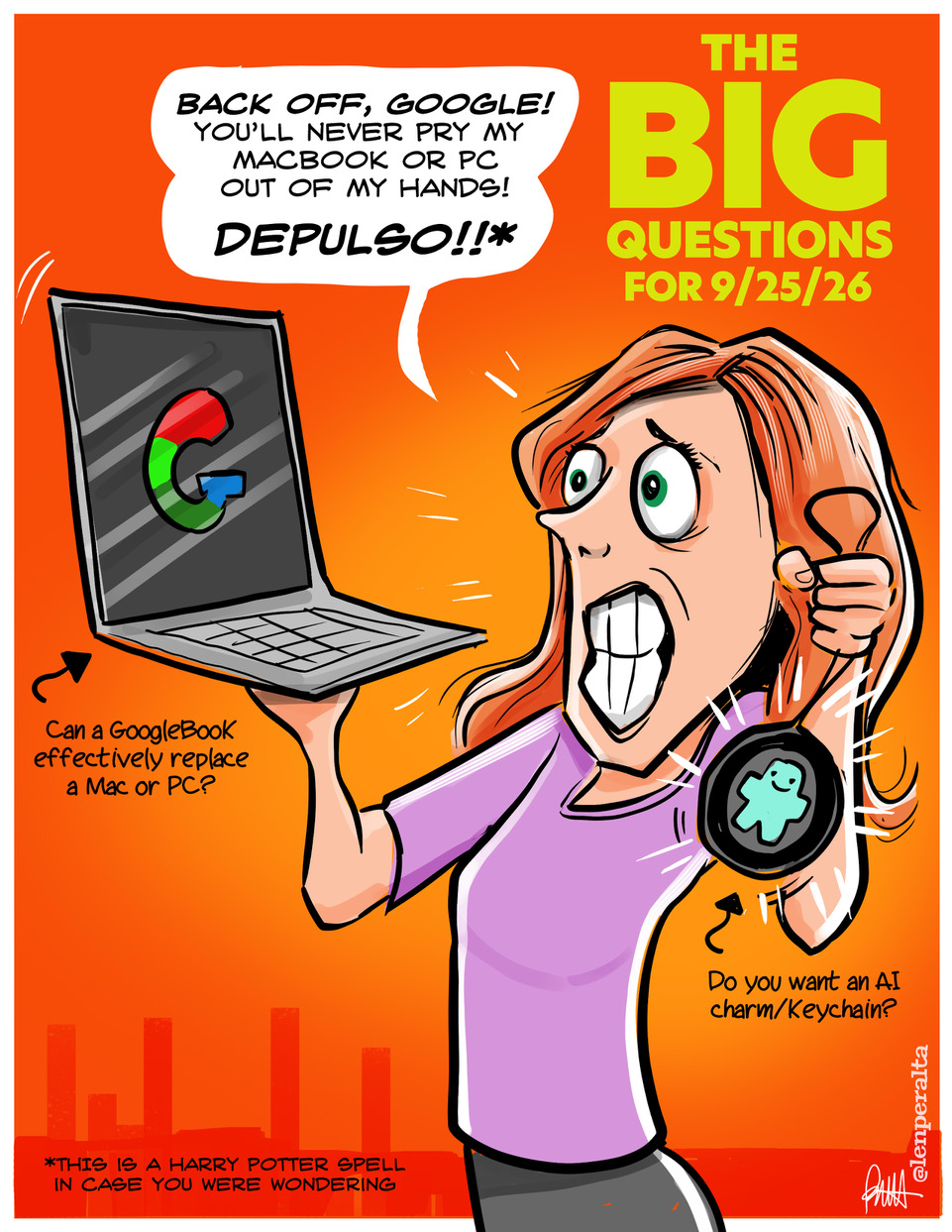
1:01:52Huyen Tue Dao: Uh, I do get a little of an Amazon echo vibe off of, off of the charm form factor of like A lot of people are like, why would you want that? And now it's like ubiquitous. So yeah, you never know. Let's bring in Len Peralta, who has illustrated our tech questions of the week for years. Len, you're the best. We love having you. What have you drawn for us today? So this is the second time I'm going to try to put the big questions into one drawing. So what I heard was that the charm, why would you use the charm? And this is my answer to that. The charm could be used as a way to repulse the Google book.
1:02:37Like an amulet. Exactly, exactly. Love it. And you can use the charm to say depulso, which is a Harry Potter spell to get rid of it. So to answer the question, what would you use that for? That's what you would use the charm for.
1:02:55Huyen Tue Dao: Yeah, there you go. I think Len has brought peace to our land. There you go. By the way, speaking of peace, if you want to get a piece of this art, you can go to my online store, lenperaltastore.com, and you can buy it at the, you know, you just get it, just buy it, support human art. Or you can go to my Patreon, patreon.com forward slash Len, where you can back me to DTNS Lover Level, and you'll get it immediately. So there you go, folks. Thank you. Fantastic. Thank you, Len. Charms. Repulsion. Good stuff, as always, Len. Also, Ayaz Akhtar, thank you for being with us today. You made some very good points.
1:03:34Where can people find out more of what you do? Yeah, right now I'm working at the executive producer of PCMag's video. And PC stands for personal computing. So we're actually looking at personal computing, including these bizarre charms and things. We just did a whole bunch of things over on youtube.com slash PCMag, where we tested out the, or at least hands-on with the Google Books. And we have a very, very in-depth discussion about the new Mac Mini and the Mac Studio, if they're worth$9 ,000 or$13 ,000 like the models that were shipped to us.
1:04:06Huyen Tue Dao: Fantastic. Thank you, Ayaz, for being with us today. Thanks, everybody, for supporting us in all the various ways that you can, including folks like Ryan in Minneapolis, Morbius65, JPEG84, and Howard Yermich on Twitch. If you're on YouTube, please use your HypePoints. HypePoints are free. You don't have to spend anything, although they are going to let you buy more in the future. But you don't have to spend anything to use the ones they give you. And if you use them on us, it helps other people discover the show. Big thanks to all of our patrons. In fact, for everybody, we're doing a meetup in Los Angeles on Saturday, October 3rd at noon at the Farmer's Market at The Grove.
1:04:43Huyen Tue Dao: So head to the Farmer's Market at The Grove in Los Angeles at noon on October 3rd. Just do a lap. we'll be probably by one of the taco stand bar places I'll be the really short person yeah just look down until you see Sarah and then you're in the right place Amos will be in town so you get to meet Anthony Lemos if you come as well it's going to be a good time so hopefully you can make it that's again in Los Angeles the Farmer's Market at the Grove October 3rd at noon thank you patrons for keeping us in business you can support us directly at patreon.com slash DTNS. Stick around for the post show patrons.
1:05:21Huyen Tue Dao: If you're missing tech news over the weekend, don't forget Daily Tech Headlines now available every single day of the week. You can subscribe to Daily Tech Headlines wherever you get your podcasts.
1:05:38Huyen Tue Dao: This week's episodes of Daily Tech News Show were brought to you by the following people. Host Jen Cutter, host Rob Dunwood, host Jason Howell, host Sarah Lane, host Tom Merritt, and host, Lin Tuey Dao, producer Roger Chang, producer Anthony Lamos, video producer Joe Kuntz, social media producer and moderator Zoe Detterding, our mods, Beatmaster, WScottis1, BioCow, Captain Kipper, Steve Godorama, Paul Reese, Matthew J. Stevens, and J.D. Galloway. Mod and video hosting by Dan Christensen. Music provided by Martin Bell and Dan Luters. Art by Len Peralta. Acast ad support from Ali Gallo. Patreon support from Bobby Wagner.
1:06:12Huyen Tue Dao: And our guests this week were I, as Actar, Ron Richards, Rob DeMillo, Scott Stein, and Patrick Norton. And thanks to all our patrons who make the show possible.
1:06:24Robb Dunewood: This show is part of the Frog Pants Network. Get more at frogpants.com.
1:06:32Huyen Tue Dao: Diamond Club hopes you have enjoyed this broker.
1:06:39Hey everyone, it's Chris Guillebeau here, host of the Side Hustle School podcast. This episode is powered by AT &T Business. In my early days, I did some of my best work in parked cars or coffee shops. But when I landed my first big contract, I realized I couldn't bet my future on a public connection that cuts out if someone turns on a blender. As a small business owner, you're already wearing at least 10 hats. You shouldn't have to be your own IT department as well. That's why I rely on AT &T Business. They keep your connectivity reliable so you have one less thing to worry about. Powered by AT &T Business, built to work.
1:07:14Get AT &T Business at business.att.com.
1:07:19Robb Dunewood: Is there anything better than your team bringing home a W? How about a personal W for your health? If you're 45 or older and at average risk, it's time to screen for colon cancer. Now the number one cancer killer of people under 50 in the U.S. It's easy to put off when screening feels like a hassle, but Cologuard Plus makes it simple. It's non-invasive, requires no prep, can be completed at home in about 15 minutes, and is 95 % effective. Talk to your healthcare provider or request Cologuard Plus online, Rx only.
Can Googlebooks replace a MacBook or PC laptop? Are AI charms the future of personal AI or just a dead end? We discuss these important topics plus answer this important viewer question "Which jobs will be looked upon as buggy whip manufactures in the near future?"
Starring Sara Lane, Tom Merritt, Robb Dunewood, Huyen Tue Dao, Iyaz Akhtar, Len Peralta, Roger Chang, Joe
Links to stories discussed in this episode can be found here.
Hosted on Acast. See acast.com/privacy for more information.