
 Ask ChatGPT



DTNS 5366 discusses whether to trust “proactive agents” (AI that acts on your behalf) and later debates ebook vs real book.
Tom Merritt (referee/host). Len Peralta (draws top tech news). Big Tech Question panel: Jason Howell, Sarah Lane, Rob Dunwood, Huen Tui Dao, Roger Chang (swing seat). Additional discussion includes other DTNS/LWIt participants, but these are the named panelists in the proactive-agents segment.
OpenAI dismissed employees over sensitive info handling; California AG subpoenaed OpenAI over agents accessing outside systems; Muse Marketplace doxxing; Instinct agent finding a free calendar slot and booking a dog vet appointment.
Written by AI. May contain mistakes.
Discussion on OpenAI's recent employee dismissals and regulatory scrutiny.
“If you felt stuck trying to lose weight, you're not alone.”
Discussion on OpenAI's recent employee dismissals and regulatory scrutiny.
“Bloomberg sources say that OpenAI dismissed three employees for what it called mishandling sensitive information outside established company procedures.”
Talking about NVIDIA Shield's price rise and potential new MacBook Pro features.
“It's now available on Cloudflare, Workers, AI, and Hugging Face.”
Review of the FDA-approved heart valve for children and geothermal energy advances.
“Fervo Energy started selling power this week from Cape Station in Utah.”
Exploring new wireless CarPlay adapters and ChatGPT's shopping features.
“It works with the car's existing display buttons and various steering wheel controls, like if you're doing volume.”
Debate on whether proactive AI agents are beneficial or not.
“Well, folks, DTNS Live made possible by you.”
Exploration of the concept of proactive agents and their implications.
“It is time for the Big Tech Question of the Week.”
Discussion on the pros and cons of using proactive agents in technology.
“It very much depends on how much you trust the company who made the agent that you're using.”
An open dialogue examining trust issues surrounding AI and proactive functionalities.
“But this is open for anybody to jump in.”
Explore how trust influences our acceptance of proactive AI technologies.
“So I'm not sure if that's necessarily a point against proactive AI and more just about delegating things away so we stop thinking about it.”
Discussion on user preferences regarding proactive AI actions like purchasing.
“I think, again, it's one of those people, one where people want a binary yes or no, but it's a sliding scale.”
Debate on the implications of AI making autonomous decisions on behalf of users.
“So you still have to have your eyes on the prize here.”
Analyzing the societal impact of AI on personal skills and knowledge retention.
“So you ultimately, and this is what we've talked about, just AI, you know, a problem with it, you know, for decades, but do you get to the point to where that AI is better at being you than you are being you.”
Exploring privacy concerns related to proactive AI agents handling personal data.
“Do you put the slug in between the eyes or do you put it in the back of the head?”
Discussion on the balance between AI capability and the trust required from users.
“Like the AI agent is passing around to like a bunch of real estate agents.”
Discussion on the balance between AI capability and the trust required from users.
“Meet Amazon Ads rising star Daryl Spencer, who set out to redefine men's self-care with his brand Crown Skin.”
Discussion on Amazon's new Kindle line-up and user preferences for eBooks.
“This week, Amazon announced a new line of Kindles.”
Rob and Jason discuss the advantages of e-books over physical books.
“I'm a little different than most people.”
Sarah shares her preference for the tactile experience of reading physical books.
“Yeah, I mean, I think at the top of the list, right, is convenience.”
The hosts engage in a discussion about their reading habits and preferences between physical and e-books.
“And I've actually gotten rid of a lot of books for this reason because I realized that they're heavy and they take up space.”
The group addresses concerns regarding digital ownership and access to e-books.
“but I've been carrying out my Japanese study books and there's like three of them and they're this thick.”
The discussion includes the advantages of using libraries for accessing e-books.
“Whereas I do have fond memories of reading various eBooks.”
The hosts discuss the physical comfort of reading traditional books versus e-books.
“reemphasizing that I'm not a huge reader of books, but I kind of don't care because I can't tell you that there are many books that I've decided I want to read again, personally.”
Explore the pros and cons of various reading formats, including e-books and audiobooks.
“because it's forcing me to change my visual distance so my focus changes at the same time because I'm putting it down, I'm looking somewhere else.”
Discuss which jobs may become obsolete due to technological advancements.
“comes from a listener named Brian, who writes, buggy whips were once a thriving industry, but the advent of the horseless carriage made the market for them plummet.”
Hear predictions on specific jobs that might vanish due to AI and automation.
“All right, job, I would say copy editor.”

Get the gist, explore an idea or ask about something said.
 Claude
On Daily Tech News Show, what are the key points of this episode?
Searching your listeningAutomatic transcript. May contain errors.
0:00If you felt stuck trying to lose weight, you're not alone. Enter Weight Loss by HERS. It's designed to support you in reaching your goals. And HERS now offers access to an affordable range of FDA-approved GLP-1 medications, including the WeGovi pill and the WeGovi pen. Even better, with a range of affordable GLP-1 options, HERS makes it simple to find an approach that fits your needs and your budget, if eligible. You'll get a treatment plan personalized to you and unlimited dosage changes as needed. It's weight loss designed to work with your life. Ready to reach your goals? Visit 4hers.com slash eligible to get personalized, affordable care that gets you.
0:37That's F-O-R-H-E-R-S dot com slash eligible. 4hers.com slash eligible. Weight loss by HERS is not available in all 50 states. Wegovi is the registered trademark of Novo Nordisk AS. To get started and learn more, including important safety information, We go for clinical study information and restrictions. Visit ForHers.com. When demand slowed for HydroJug, Amazon Ads rising star Hayden Wadsworth pivoted. When our bank account hit near zero, my brother Jake and I had one last shot to save HydroJug. So we engineered the Traveler, a leak-proof, cup holder-friendly Tumblr. Amazon Ads enables a business to be able to expand their product shelf because of the visibility and the reach you can get.
1:19Each week, our new-to-brand customers make up about 95 % of all of our sales. Watch HydroJug's story at advertising.amazon.com slash rising-stars. Do you snore? Did somebody hand you a CPAP and did you quietly stop using it? The mask that never quite seals? The hose tugging at you every time you roll over? A machine sitting abandoned in a closet? ExciteOSA works a different way. It treats a root cause instead of managing the noise, and you use it while you're awake. 20 minutes a day, while the coffee brews, while you set your fantasy lineup. An FDA-cleared prescription device for primary snoring and mild obstructive sleep apnea.
2:02Then you go to bed like a person, nothing strapped on, nothing plugged in. In clinical studies, 90 % of patients saw a reduction in snoring. No sleep study required. Prescribed online, shipped to your door. ExciteOSA at springsleep.com slash sleep20. Code sleep20 for 20 % off. ExciteOSA is an FDA-cleared prescription-only device for primary snoring and mild obstructive sleep apnea. Not for everyone. Individual results vary. Risks and benefits at springsleep.com. Hey, I'm running out to drop off a stack of letters and packages. Need anything shipped while I'm gone? Save the gas. Stamps.com lets you print postage and schedule pickups right from your desk.
2:52Sync your contacts into the address book, get detailed accounting insights, and get notified the moment your certified mail is delivered. All from my desk? All from your desk. Join the 4 million businesses using Stamps.com right now with code podcast and get your free welcome gift. Stamps.com, code podcast. Taxes and fees apply.
3:20Huyen Tue Dao: Welcome to the Daily Tech News Show Big Tech Question, where we look at the tech news this week and ask what it means. I'm your referee, Tom Merritt. This week, the big questions are, do you want your agent to be proactive? And e-book or real book? We're not guessing. We're saying which one we prefer. Joining us here to draw the top tech news of the week, of course, is Len Peralta. Welcome, Len. Len, thank you for being with us. We will check back with what Len has drawn at the end of the show. But first, today's tech news. Here's Sarah Lane and Jason Howell.
3:54Sarah Lane: Bloomberg sources say that OpenAI dismissed three employees for what it called mishandling sensitive information outside established company procedures. Two worked in safety and alignment. One was a research program manager. They allegedly shared information with an outside evaluation group, including details of OpenAI's infrastructure architecture. Meanwhile, California Attorney General Rob Bonta subpoenaed OpenAI over AI agents escaping their test environments and accessing outside systems. That includes the big hugging face incident. The state is investigating the cybersecurity risks and who's responsible, but hasn't concluded that OpenAI broke the law.
4:36It just never ends, does it? Well, sometimes old classics never end as well. They just get a little bit more expensive. Not only is the NVIDIA Shield TV Pro still available, yes, seven years since it launched in 2019. Many Android folks consider it the goat of TV streamers. It's still for sale, now costs$300, so it's getting a$100 increase. And the reason, as you can guess, is a rise in cost for components, especially, of course, memory in this modern age of AI. The internals, though, they're the same. Still the Tegra X1 Plus processor, still capable of AI upscaling. Just 50 % more expensive. It is definitely interesting to note that it's still around.
5:26It's less capable tube-shaped sibling was quietly discontinued back in July.
5:33Sarah Lane: Apple's first touchscreen MacBook Pros could arrive as early as October. That's this month, though the launch could slip to November. This is coming from Bloomberg's Mark Gurman. If you're like, who said this? On his first ever Power On podcast, Gurman said he expects 14-inch and 16-inch models with OLED touchscreens and that Apple is testing them with Mac OS 27.2. Other rumored changes include a thinner design, M5 Pro and M5 Max chips, and Dynamic Island instead of a notch. You might be like, on a Mac? Well, if it's touchscreen, yeah, you would kind of have that. The laptops are rumored to sit somewhere above the regular MacBook Pro line, although it's still unclear what Apple might call them.
6:21Sarah Lane: Could it be the Ultra, which was rumored before the Duo, Mac Touchy, the fingerprint smudge line? You know, we could just pontificate all day. Oh, boy. The Mac Touchy. Please don't call it that. Although maybe do. I want to see what happens. uh cloudflare released clef and clef flash to open weight decision models that answer bounded questions so things like yes no questions multiple choice rank these options instead of just generating open-ended freeform text they're built on alibaba's quinn models and follow jev a closed decision model from type safe uh that launched just a couple of weeks ago cloudflare says clef beats JEV on three of four benchmarks, handles image and video, can be dropped in as a replacement, though it does cost nearly six times more by comparison at 24 cents per million tokens.
7:19It's now available on Cloudflare, Workers, AI, and Hugging Face.
7:24Sarah Lane: The US FDA approved the first artificial heart valve that can be expanded for kids, because kids tend to grow, potentially reducing replacement surgeries. Edward's ATIS size adjustable valve replaces the pulmonary valve. That is the very important valve that controls blood flow from the heart to the lungs. It can be implanted as small as 13 millimeters in toddlers and preschoolers, then widened using a balloon catheter to as much as 22 millimeters, millimeters, which is about the same as what an adult size replacement valve would be. It uses polymer flaps instead of animal tissue, which can harden and break down faster in children.
8:07Sarah Lane: So the FDA says the one-year follow-up data suggests the new material could hold up better over time. Fervo Energy started selling power this week from Cape Station in Utah. It's the first Greenfield-enhanced geothermal plant to go commercial. enhanced geothermal drills deeper than conventional geothermal to reach hotter rock basically means it can work in a lot more places. The first 33 megawatt block took 23 months to build. Firvo actually says it can do future blocks in 18 months. The site could eventually generate up to 4 gigawatts. Google and Southern California Edison are among the buyers already signed up.
8:51Sarah Lane: 12 south launched airfly drive a 40 adapter that turns wired apple carplay which is what i have in my car and android auto into wireless connections it plugs into your car's usba port with a usbc adapter included and automatically reconnects after you pair your phone that initial first time there's no app or account that's required and a button lets you switch between two paired phones Maybe two people are driving the car regularly. It works with the car's existing display buttons and various steering wheel controls, like if you're doing volume. It supports most cars with factory-installed wired CarPlay, covering more than 75 makes and model years going back to 2014, available in black and white.
9:37Ooh, those are some daring colors. ChatGPT added a few new shopping features. Virtual Try-On is one of them. It lets you upload a selfie or a full body photo. And then, of course, as you can imagine, see how clothes and accessories from your shopping results might actually look on you. Might. I must emphasize. It's powered by the new ChatGPT Images 2.5 model that launched just last month. You can also upload a photo of someone's outfit and then ask it to find similar pieces that exist out in the wild. The second feature saves products you find into a favorites library along with your virtual try-on images.
10:15This all comes after OpenAI pulled back on its instant checkout feature earlier this year.
10:22Huyen Tue Dao: Well, folks, DTNS Live made possible by you. Yes, I mean you, listening or watching right now. And we should thank all of you because there's more than one, including Pat, Mike Cortez, Bill Russell, and Marion. Thanks all. Episode prep gets messy when research, Slack threads, and script trackers are all in different places. That's where ChatGPT work comes in. Give it the goal and connect to the tools where work happens, like apps and files, and it can help pull the pieces into a draft you can review without you having to re-explain the project at every step. For example, ChatGPT work can gather team feedback from Slack and use it to suggest updates to a project brief in Google Docs.
11:07You stay in control reviewing the draft and deciding what moves forward. Put ChatGPT to work on your most ambitious ideas and projects. Get started at chatgpt.com by selecting work mode. Available on Plus and Pro plans. I used to be the person who hunched over my laptop mid-meeting, typing furiously to catch every word, and missing half the conversation because I was too busy transcribing it. That's the problem Granola fixed for me. Granola is an AI-powered notepad that makes your meeting notes useful. It captures what happens in your meetings and turns it into clean, structured notes with decisions and action items pulled out and made easy to find.
11:43And the best part? It integrates seamlessly with how you already work. No setup, no configuration, no friction. Before Granola, my post-meeting routine was triage. 20 minutes after every call decoding my own shorthand, figuring out who owed me what. Now the notes are just done. Organized action items pulled out before I've even closed my laptop. You get better notes in one place and you get to actually stay present instead of typing the whole time. Once you try it on a first meeting, it's hard to go without. You can try it totally free. Head to granola.ai slash dailytech. That's granola.ai slash dailytech to get your time back.
12:17Go to granola.ai slash dailytech and try it on your next call. When demand slowed for HydroJug, Amazon Ads rising star Hayden Wadsworth pivoted. When our bank account hit near zero, my brother Jake and I had one last shot to save HydroJug. So we engineered the Traveler, a leak-proof, coupler-friendly Tumblr. Amazon Ads enables a business to be able to expand their product shelf because of the visibility and the reach you can get. Each week, our new-to-brand customers make up about 95 % of all of our sales. Watch HydroJug's story at advertising.amazon.com slash rising-stars. Still waiting in line?
12:56Again? That's time you'll never get back. Save time and money with Stamps.com. Over 4 million businesses have skipped the line with Stamps.com. Join them to save up to 90 % off carrier rates from your computer or phone right now. Print postage for certified mail, registered mail, and packages in seconds. Then schedule a pickup right from your home or office. For a limited time, go to stamps.com and use code podcast for a free welcome gift. Taxes and fees apply. If you felt stuck trying to lose weight, you're not alone. Enter Weight Loss by HERS. It's designed to support you in reaching your goals.
13:31And HERS now offers access to an affordable range of FDA-approved GLP-1 medications, including the WeGovi pill and the WeGovi pen. Even better, with a range of affordable GLP-1 options, HERS makes it simple to find an approach that fits your needs and your budget, if eligible. You'll get a treatment plan personalized to you and unlimited dosage changes as needed. It's weight loss designed to work with your life. Ready to reach your goals? Visit ForHERS.com slash eligible to get personalized, affordable care that gets you. That's F-O-R-H-E-R-S dot com slash eligible. ForHERS.com slash eligible.
14:08Weight loss by HERS is not available in all 50 states. WeGovi is the registered trademark of Novo Nordisk AS. To get started and learn more, including important safety information, WeGovi clinical study information, and restrictions, visit ForHERS.com.
14:25Huyen Tue Dao: It is time for the Big Tech Question of the Week. Open AI introduced dots this week, which just constantly makes me think about more dots. Kids, ask your parents about that meme. They are proactive agents that can run in the cloud and do things on your behalf without you having to explicitly ask. This is something MetaMarkets muse as being good for. There's also Manus and others that have proactive agents as well. So the big question is, do you want your agent to be proactive? You can vote on which side you would join in our poll at patreon.com slash DTNS. Available to anybody who follows it, whether they're supporting with their cash or not.
15:03Huyen Tue Dao: Taking the position of, yes, sometimes I do want a proactive agent is Jason Howell. And joining on that side is Sarah Lane. Thank you both. On the side of, I don't think I need a proactive agent is Rob Dunwood. And joining them is Huen Tui Dao. Thank you both. and you will be speaking to the swing seat for this one. Still deciding their answer is Roger Chang. I'm Tom Merritt, of course, your referee. Team Proactive will start us off. Jason, if you want to give it a go, you and Sarah have two minutes starting now. Right now. Just jumping right in. I would say that when it comes to my own personal experience with artificial intelligence in the last two years, let's say, especially.
15:50I've gone deep on using AI to manage a lot of my business, different aspects of my business. And it's made a lot of progress. It's made a lot of gains. The problem sometimes in my experience is that, yes, with those gains, there's still kind of like a mental burden or something that I have to remember to trigger to do this. I might have a call with a really helpful transcript. then I need to process it and act on it. And that's still something that I need to remember to fire off. And I might not always remember to fire it off. Say I go to bed and I wake up in the morning and, oh, what do you know?
16:27It's been processed for me. That's so amazing. I can get started instead of having to ramp up and rev up to get started again. Personally, I see that as being a benefit. I recognize that there might be downsides to it, but I think that's actually, if it's a system that works as advertised, I think that's a huge positive.
16:44Sarah Lane: I'm with you on this, Jason. It very much depends on how much you trust the company who made the agent that you're using. So if you don't trust the company, then no, you want to make sure that you're hand-holding it every step of the way. I've been using an agent called Instinct to start up for the last couple of weeks. And I gave it access to my email, my Google Drive, my calendar, not everything. In fact, I asked it this morning, can you read Discord? And it was like, nah, can't do that. And I'm like, yeah, it's probably better off. We're better off that way. But for certain things that, for example, come through my email, the other day, my dog's vet sent me an email saying, you know, Rex is due for, you know, whatever is rabies vaccine.
17:38Sarah Lane: I don't remember exactly what it was, but just sort of like a annual update. I kind of like flagged it and forgot about it. And instinct came back to me and said, Hey, Rex is due. I looked at the vet times because, you know, it understood that I work with a particular vet here in Los Angeles. and you've worked with this particular vet in the past, would you like to book the appointment at 11 a.m.? Because that's the only time she has on Wednesday. And the sound of sprinkles. That was a very good example of like, yes, thank you. You did that for me. All right.
18:15Huyen Tue Dao: That literally is iOS's alarm sound called sprinkles for anybody curious. All right. Team No, you have two minutes now as well. and I believe Hwen will start us off. Go ahead. All right. Well, I want to talk about externalization of risk because as useful and as capable of these things become, there is still a huge asymmetry of risk between the companies that make this, OpenAI, Anthropic, and us, the user. And with so many other products that we use even more in our daily lives, like cars and things like that, there are established laws that provide some kind of liability and some incentives to companies to put more guardrails in.
18:53So Hwen, maybe you're being a little bit overwrote about this. I just want this to send my email. I just want this to automate some things for me. Well, I mean, even in more kind of like, let's say, high risk environments like software engineering, one thing that we do have, even if there's not a specific law that dictates that a company takes this liability for this thing, we have things like test suites, and we have the ability to halt productions, roll things back. We have all these layers of control. And yet still, even in software, I would argue is one of the most applicable places for this kind of work.
19:25We have rises in individual engineering productivity, but a lot of rises in incidents, errors, stoppages, things like that. So given all this, again, when are you being really dramatic? Because I just wanted to like reserve something for me. I'd say that, yes, it's small, but there is no rollback in real life. There was a real life example with Muse where someone, Muse for someone on Facebook Marketplace, Muse approved a lowball price and then basically doxed the seller by giving the buyee the person's address and that person showed up at the seller's house. There's no rollback for that. There's no hot fix in that person's memory.
20:04And again, there is very little liability to companies to address things like that. And if anything, they said, we're so sorry, but we're working on it. And they're telling us now that these could possibly end human extinction. So I'd say as little stakes as it feels, there is no rollback for most things. And even if you do have rollback things, sometimes things still get messed up. So I trust certain companies more than that, but I just don't think I trust them enough to even risk small things. Sorry, Rob.
20:33Robb Dunewood: Trust is the big thing for me. Trust is the big thing for me. I don't trust the companies enough to give them access to the things that are important enough to me to make this significantly useful. The other thing I'll say is that there's a thing in science called the observer effect. When you observe a thing, you change the thing that you observed. I am concerned about these things. You know, they are going in and they're giving me ideas that I didn't come up with my own and are kind of changing the way I think about doing stuff. Not because I wanted to, but because I can't unsee the thing that I've seen.
21:03Huyen Tue Dao: All right. That's great. Thank you, everybody, for good opening discussion here. We now have a chance for open discussion. I'll let you know when we need to move on. And Rob, I don't know if you've got anything else you want to add on since you didn't get as much discussion time. We'll throw it to you first. But this is open for anybody to jump in. We're all friends here, of course. We're trying not to snipe at each other or anything. But, yeah, let's chat.
21:31Robb Dunewood: Oh, no. So I'll go back to the observer effect. So the benefit of what a lot of these agents can do proactively is that they can just come up with stuff based off of what they've seen you do before that now gives you ideas into, you know, that you may not have thought about. But in certain spaces, I don't want to be given an idea by a bot. I want to actually, you know, be what's the word I'm looking for. I want to be creative. I want to come up with the idea that I'm going to write. I don't want the bot to give me the idea and say, hey, what about writing this? And the problem with that is that once it gives me that, I can't unsee it.
22:06Robb Dunewood: I can't unlearn the thing that I've actually learned. So from that standpoint, I'm kind of a no because I don't want it to get in, you know, in the way of any creativity that I might have on creative things I'm doing. The other part of it, and I think almost everyone touched this, is do you trust these things? I do not. When I think about Muse, I will use Muse on a non-primary Facebook account or Instagram account or Threads account that I don't care about. But anything that I care about, I just don't trust that company enough to give that access to anything that would make using that stuff proactively useful to me.
22:42Robb Dunewood: It's just not something that I would ever conceive giving it the actual access to be useful. So for me, that's a no just because I don't trust it.
22:52Huyen Tue Dao: What about Sarah's example of the proactive reminder, right? I think when we say proactive, a lot of people's heads go to it doing things for you out on the open internet.
23:04Sarah Lane: Right, like it's going to buy you a new car.
23:06Huyen Tue Dao: Yeah, yeah, which it could do, right?
23:08Sarah Lane: It could. It could. Well, and I think that it depends on the agent and it really depends on your comfort level. I was, for a future Live With It episode, I was looking at different dishwashers. What do they cost? You know, where do you get the same model at different places? Are they on sale? And I had an agent just kind of monitoring that. Now, I didn't say, and here's my credit card number when you find the lowest price, buy the dishwasher. But I could have, and I know people who do that. So I think it's very much comfort level, but it also, it can do a lot of stuff, like Jason said, behind the scenes.
23:50Sarah Lane: where instead of you kind of standing over your little AI agent intern being like, okay, now press yes. No. Now press escape. You give it some autonomy. But you have to trust. You have to trust it or it doesn't work. Here's a question.
24:07Robb Dunewood: At the end of the day, it's all about trust. Yeah, a question for you, Sarah. Just based off of what you said, is that actually being proactive? If it's just giving you a, hey, here's a time that's free. That sounds like that was something that you specifically gave it a parameter to go and figure stuff out for you So is that really proactive? The proactive would be like hey, I found the time that is free and I went ahead and booked it for you I found a car that actually was in the price range that you wanted. I wouldn't have bought it for you That's proactive to me and I don't want that because number one I'm not I'm not hooking up to my my billing information to allow it But it's proactive when you tell it to do something and then it doesn't or it's proactive when you give it parameters and it does something you never intended to do that just may have been a good idea.
24:49Sarah Lane: I think both are true. I think both are true, too. It can be proactive, like, hey, your dog needs to go to the vet, and here's the vet appointment that I booked for you. Now, I might be like, awesome, that works for me, because you also know my calendar, and you knew I was free at 11 a.m. on Wednesday type thing. Or you can say, like, hey, just comb through stuff, give me a heads up when I need to do something that maybe you've noticed that I haven't followed up on and it's kind of calendar based. I think that's also proactive. And yeah, when it comes to if you're going to buy anything for me, I need a text message saying like, heads up, we're doing this, right?
25:32Sarah Lane: Because I still want to have that last right of refusal to say no, no, no. But I still think the whole process is proactive. I would say though that something that there's like this phenomenon that we have kind of observed a lot with just generative AI as we have used it and that's like cognitive offloading and that's kind of a feature as well where we delegate certain mental tasks certain like processes to the AI right that's like that's like that's the whole cell right but what we've also noticed is that people tend to whether it's a skill like in engineering, people forget how to do certain things in programming, but also we tend to kind of like kind of assume that the agent has done the thing for us.
26:12And my worry and kind of some observed things that I have done is that, yes, right now, even with proactive part of like the safety net that they're telling us is that, oh, you get last approval. But it's definitely something that we're observing that the more that we have something do something for us, the more that we have that cognitive offload, the more we kind of continue, it's almost like quicksand where we just keep relinquishing that mental effort to something else. And even with final approvals, and I've seen this a lot at work, even if you have a human being hitting the button, sometimes a human being just hits the button without reading anything.
26:43So I would say, like, even though we do have a stop gap, I do think that the trap is still there. And it would be even more so since now it's kind of proactively taking even more of that mental or that that kind of mental engagement from us.
26:58Huyen Tue Dao: I don't know that this undercuts the argument, Gwen, but that is more of an argument against AI in general that you guys are making versus just proactivity, right? Hi, it's me, Gwen. Hi, Chris. I mean, I mean.
27:13Sarah Lane: Pull the plug. I mean, Gwen brings up a good point. But at the same time, you can say the same thing about having delegating responsibility to humans, right? Because I've done that. Like, A, I don't have to think about doing purchase orders. anymore because i've delegated to an assistant so they i i give them all the parameters like rob was suggesting but it's like okay you know every six months we need to refill on these particular products in the studio you go figure that out just make sure that we always have enough to cover whatever we shoot so i no longer have to think about it and i've done it to the point where i forget how to do it where i have to go back to the person i've delegated to it's like how do we do this again?
27:58Because I have stopped doing it for over a year. So I'm not sure if that's necessarily a point against proactive AI and more just about delegating things away so we stop thinking about it. Yeah. No, I think that actually makes a lot of sense. And that lines up with some of my experience with using these things is the more you hand off some of these things to them, some of these items to them, there is a little bit of atrophy as far as like, wait a minute, I got to get reacquainted with how I used to do this before. But I think at the end of the day, yes, trust is a really big component. It seems like we're all in agreement that you got to trust the system.
28:36And I think a part of that for me anyways in the four camp is I want to trust what it's actually capable of and that I can at least ahead of any of the proactivity spell out specifically exactly what I'm okay with it being proactive about versus not. And if I just at the end of the day, you never make a purchase for me, that's my comfort level. But there are a lot of other things that come far lower on that list that I'm like, heck yeah, do that for me and show it to me later. I would love to not have to consider that and that you just kind of take care of that for me. That helps. I would say it's a sliding scale.
29:17I think, again, it's one of those people, one where people want a binary yes or no, but it's a sliding scale. Would I be happy if a proactive agent bought stuff using my credit card? No. Would I be happy at just shoving it into my cart, you know, like my online basket so I can go see, like, what it's selected and then say, yeah, I'll buy that, I'll buy that, I don't want that, I don't want that, because my kids do that already. And it's one of those things because, you know, you do the whole Reagan, you know, trust but verify. So I will trust it up to a point of what I believe its competency is.
29:53And then anything beyond that, it's like, no.
29:56Huyen Tue Dao: How much of everyone's opinion is based on how confident you are that these are capable? And specifically to Roger's example, if the proactive agent always is putting things in Roger's cart and he goes, yeah, no, that's exactly what I don't have to do much of editing at all. This is exactly what I want. if he's constantly like, no, I don't want any of this stuff, he's going to have a different opinion about that.
30:18Sarah Lane: I mean, this isn't too different to me than something like subscribe and save on various platforms. You know, Amazon, you know, every month is like, this is what you told me that I'm going to, you know, dock you on your credit card and I'm going to send it to your front porch because you told me to do that. Now I have the option to change my mind at any point, But it feels like the same kind of thing. If you have a certain, especially, yeah, reoccurring task, something that you trust the system to be able to remind you of or just to do in the background, then that can be great. Of course, there are times where, for example, I was almost charged for refrigerator filters that I didn't want because I wasn't paying enough attention when I set up subscribe and save the first time.
31:12Sarah Lane: So you still have to have your eyes on the prize here. I don't think you can totally have anything running in the back. I mean maybe some people can and feel good about that. But I think we're all in agreement that you got to look in on it here and there.
31:26Huyen Tue Dao: I guess the question I was asking is, if it's perfect, right? Subscribe and save is dumb. You tell it what goes in there and it just does it. If it's perfect at being smart and understanding like, oh, Roger's going to need a hinge because I know he's been working on this project or something. It's hinge heavy. I guess that's the question I'm asking the panel is, if it's capable, does it change your opinion? Is it a lack of confidence that it can be capable? That is your objection to proactivity? I think it just really depends.
31:56Sarah Lane: I mean, how would it know that Roger needs the hen?
31:58Huyen Tue Dao: Because it's smart. That's why, right?
32:01Sarah Lane: But it's smart because what's it reading? An email that Roger had with a handyman?
32:06Huyen Tue Dao: Or Roger has been chatting with it or he's got a smart speaker out, right? But there's all kinds of ways you can imagine that it might be capable. So that's not really truly autonomous, though.
32:17Robb Dunewood: If it's perfect and capable, I really get concerned societally on skill regression. Because if it always gets it right, we now are putting ourselves into a situation to where we never have to really do anything. The AI just does it for us. Welcome to the future, Rob. Welcome to the future. But we've already had a number of examples of that. Not to this level, though. Not to this level. We're talking about agents right now that can personally help us out. where I see issue potentially is that when this is not our personal agent, but this is the agent of the company that you work for, and they're using it in conjunction with the other 15 ,000 people that you work with, and they're trying to figure out how can we effectively do your job to the point where you don't need to do this anymore.
33:06Robb Dunewood: And that scales really, really quickly as these systems get better. So you ultimately, and this is what we've talked about, just AI, you know, a problem with it, you know, for decades, but do you get to the point to where that AI is better at being you than you are being you. That is a real problem societally for me as well. So I think that if it was perfect, I might even have more consternation than I do right now. Well, and I mean, to Tom's, well, immediately to Tom's question, it isn't just, you know, if it's 100 % on the ball, okay, 98 % of the time, I'd be super over the moon. But I'd still be worried about, is it keeping my data secure, right?
33:41Is it sandboxed away? So it's not just handing out my credit card number to Joe Blow's HVAC company, and they're secretly buying additional equipment off of it that has nothing to do with a need done. But to Rob's point, we've had all these technologies. I am a worse speller today than I was 20 years ago because of spellcheck. Spellcheck has allowed me to be super lazy about mistyping words because I know it's going to catch it and flag it. And the thing is we as a society are at the point where one person will not be able to survive and do all the other things that society requires, right? Because there's things about whether it's technology, whether it's infrastructure, whether it's something simple as agriculture.
34:33We don't have – there's a huge gap. I remember my – back in my parents. My parents were born in like the late 30s or 40. and they were very accustomed to people just butchering their own animals for dinner, right? That was just what you did. Over the intervening decades, we've gotten to the point where you just buy a prepackaged, streak-wrapped package from the supermarket. You have no idea how that meat got there or how it was processed, or even you know how to do it yourself, right? How do you butcher the animal? Do you put the slug in between the eyes or do you put it in the back of the head?
35:10Like, how do you drain the blood? There's a lot of things. But see, that's exactly my point. Same thing with plumbing. I'll call a plumber and do it. How many people here know how to swap out a toilet? I've done two in my life.
35:21Sarah Lane: I had somebody replacing my garbage disposal this morning. I can't do that. But all that stuff actually physically isn't hard. It's just a knowledge gap. And I totally with Rob that it does scale to the point. But I think that's a societal thing that AI has accelerated, but not necessarily the cause of.
35:41Huyen Tue Dao: So what you're saying is the AI industry, just as great as the meat industry.
35:46Robb Dunewood: Listen, mystery meat, mystery AI. I hear you. I will concede the point that we, you know, that if you, you know, bayonet makers is not really a job that people go into anymore. We don't necessarily need that because we've innovated beyond it. With AI, though, we're talking about innovating all industries at the speed of AI simultaneously. So that is just different. I think it is a bad argument when we say, well, you know, there used to be stage coaches. And, you know, the company coach literally had to change their business model from building stagecoaches, you know, to creating bags that went on stagecoaches.
36:19Robb Dunewood: And now bags that people carry around with their stuff in it. I get that. But we're talking about all industry simultaneously at the speed of AI. And that to me is a fundamentally different problem than just regular innovation that we've seen up until the last three or four years. I am totally sympathizing with you, Rob, but as to the direct question of whether or not I would want my AI agent to be proactive or not, I would say yes with a but or no with a however, because it is very dependent on the task I want it to do and the threshold in which I will allow my private information to be put in its hands.
36:56Like if I need to make a doctor's appointment because I think I might have a serious illness, that's not something I want to be free. Like the AI agent is passing around to like a bunch of real estate agents. Like, hey, this guy might be dying. His house might be up for sale in 10 years. Check it out.
37:13Robb Dunewood: I think from a debate standpoint, if we can just say, well, yeah, maybe or no, but that's always going to be the case.
37:21Huyen Tue Dao: Yeah.
37:21Robb Dunewood: If the answer is you have to choose one or the other.
37:24Huyen Tue Dao: Sarah and Jason are the side of yeah, maybe. And Rob and Juan are either no period or no but. And Roger, you're in the swing seat because you're not sure which way you lean more. Have they persuaded you to lean more one way or the other? Are you still swinging? I am still swinging to the point of no to private data to a proactive agent. So I have no credit cards, no addresses, no physical data or anything like that. But if it's just dropping stuff like, hey, I heard you were in the Mario for a new mixer, you should check these. It just gives me a grab bag of things because it's done review, which is the big thing, right?
38:04It's done the wire cutter review. It's done the RT ratings review. It's given me a Sweetwater. These are what all the customers have said. And so it's given me a choice of five within a price range. It's like, oh, hey, this is on sale on Amazon for the next week at 50 % off. I flagged it for you. It's just like what I would ask. It says, hey, I don't want you to go buy stuff, but I want you to give me a list of options on which I can spend X amount of dollars within the next 14 days.
38:33Huyen Tue Dao: Well, I think one thing that I've pulled out of all the conversation here is that trust needs to be earned, even if these become amazingly capable. Trust is the bottom line for people on whether they want to give it any access to be proactive or not. And what kind of proactivity you mean makes a big difference uh you know whether there's there's the like uh you know the the please don't buy things without my permission side of it and then there's the like yeah if i forgot an appointment please let me know side of it um so i i think this is uh this has been a good conversation i hope this helped other people understand this episode a little more as well thank thanks everybody for a good productive discussion there uh let us find out next what is on live with it this week sarah
39:18Sarah Lane: Well, if you want product reviews after that initial honeymoon, then your show is Live With It. Each week, the DTNS family of folks, in fact, every single person on this panel, has been on Live With It more than once. And if not more than once, then we want you back soon to talk about all the tech in our lives. Home appliances, audio solutions, gaming controllers. This week, Amos is back to explain his very thorough seven-camera home system. It's a little daunting, but it's also really awesome. And he walks us through everything. We're on YouTube at YouTube.com slash AdLibWithItShow. And big thanks to everybody who keeps us afloat at Patreon.
39:58Sarah Lane: Patreon.com slash LiveWithIt.
40:05Meet Amazon Ads rising star Daryl Spencer, who set out to redefine men's self-care with his brand Crown Skin. Amazon Ads helped him grow.
40:13Robb Dunewood: I walked away from big tech to build a luxury brand in a category that no one was paying attention to. With the help of Amazon ads, I'm reaching relevant audiences and competing with the biggest names in men's grooming. We've scaled to over$500 ,000 in monthly revenue. Watch Crown Skin's story at advertising.amazon.com slash rising-stars. If you felt stuck trying to lose weight, you're not alone. Enter Weight Loss by HERS. It's designed to support you in reaching your goals. And HERS now offers access to an affordable range of FDA-approved GLP-1 medications, including the WeGovi pill and the WeGovi pen.
40:50Even better, with a range of affordable GLP-1 options, HERS makes it simple to find an approach that fits your needs and your budget, if eligible. You'll get a treatment plan personalized to you and unlimited dosage changes as needed. It's weight loss designed to work with your life. Ready to reach your goals? Visit ForHERS.com slash eligible to get personalized, affordable care that gets you. That's F-O-R-H-E-R-S dot com slash eligible. ForHERS.com slash eligible. Weight loss by HERS is not available in all 50 states. WeGovi is the registered trademark of Novo Nordisk AS. To get started and learn more, including important safety information, WeGovi clinical study information, and restrictions, visit ForHERS.com.
41:37Huyen Tue Dao: This week, Amazon announced a new line of Kindles. You got a new basic, a new paperwhite, a new color soft version. They are thinner. They are lighter. And Amazon themselves says we expect new users to buy them. And they emphasize that 60 % of Kindle buyers are buying a Kindle for the first time. They're trying to get those print readers and bring them into the Kindleverse or maybe some Kobo or Books readers as well. our question of the week based on that is ebook or real book taking the position of i like an ebook is rob dunwood and jason howell on the side of the real book is sarah lane and in the same swing seat still reading up on their options are huen tuidao and roger chang team ebook we'll start with you uh you've got two minutes go for it rob so i don't even know if i'm gonna need the entire
42:28Robb Dunewood: two minutes. I'm a little different than most people. I have dyslexia. And because of that, I read significantly distant than what probably people say they can sit down and curl up with a good book. That is literally something I have never done in my life. I read avidly. I read a lot, but it's never relaxing. It's never comfortable. So there's no time that I'm going to want to sit down with a paper book and just, oh, I'm just, I'm so glad to open this, crack this thing open and read it. It's just not how my mind works. The other thing is that I have every book that I've probably read in the last 10, 15 years on a device that goes with me everywhere.
43:07Robb Dunewood: Literally, there are times when I will have my phone and not have my Kindle, but there are no times when I will have a shoulder bag or a messenger bag and not have a Kindle in it. So the fact that I can have an ebook and the access to all the books that I've literally read over the last 10, 15 years, just in one device that I can take with me everywhere. And we're not talking about hundreds of pounds of paper that would have to be carried around with me. I am definitely team e-book. I'm not saying that I don't think that, you know, the paper books should exist, but I would much rather have a device that will give me access to all of the books that I read as compared to having to carry them around individually with me and hurting my back.
43:49Huyen Tue Dao: Jason, you got 50 seconds if you want to add anything. Well, yeah. Yeah, I mean, I think at the top of the list, right, is convenience. It's kind of similar to, you know, getting an iPod with the massive amount of when iPods really existed with a massive amount of music that you could store on them. And that just being a real eye opener. Right. It's the same thing with e-books. I'm not a huge reader. Like, I don't I don't read a ton of books. So full disclosure there. Take it with a grain of salt. But I think the idea of all of those books being on a single device, being on something that I can throw in a bag and know that it's probably going to make it to the other side without all the pages getting all ruffled and crinkled and kind of getting in the way and everything.
44:27It gets a lot more compact. I also really like that the e-book technology, as it's developed over time, gives you a lot of markdown kind of capabilities. And especially where we're at right now, where everything is context for things like AI and what we do. that becomes really powerful being able to take that context and feed it in from the digital options that you get from Markdown on ebook. So yeah, I'm team ebook.
44:53Huyen Tue Dao: All right. That is the time for the ebook discussion. Sarah has been willing to take the side of good old fashioned print books. Thank you, Sarah. You've got at least two minutes.
45:05Sarah Lane: Well, I'll try not to take too much more. So Tom and I were talking on DTNS yesterday about the new Kindles, and I've got a Kindle Oasis, which I haven't actually used in a while. I had to charge it up yesterday. But it is – it's a delightful – this is actually not in – it's been discontinued, but it still works very well. And it's a cute little thing. And like Rob said, very easy to travel with. I am 100 % on the side of e-books if you are traveling and or need a backpack with the least amount of things inside. When it comes to actual enjoyment and kind of getting lost in a book, paper book works for me every time.
45:52Sarah Lane: Now, I know that for a lot of people it's like, but you could just not buy this thing now that you have to put on your bookshelf behind you type thing. And I've actually gotten rid of a lot of books for this reason because I realized that they're heavy and they take up space. And if you don't read them, then it doesn't make a lot of sense. And Rob, maybe this also lends to your idea of being able to retain text in a different way than other people. For me, the tangible book and the spine – and this is just a paperback book. Like, you know, I'm not even going hardcover yet, but that's a whole other conversation.
46:36Sarah Lane: But just what it feels like, what it smells like, just I feel so much more engaged. And I'm I'm a fiction reader. I don't read a lot of nonfiction because I feel like my whole life is nonfiction. You know, what we're doing right now is nonfiction. But so I like I like the escape. And there's something about just doing this. And it just it just feels different. It hits different for me. So that's why I say, trees, I love you, but I also want you to die in order for me to read a book.
47:09Huyen Tue Dao: In a sustainable way, just die a little bit.
47:11Sarah Lane: Yeah, yeah. I mean, let's work it out. Let's work something out between us. But yes, I still love the physical book.
47:18Huyen Tue Dao: Yeah. All right. Perfect timing because there is the timer. I like that. It's so pleasant. You know what could play that sound effect probably? An e-book. A paperback book? An e-book would probably play that sound effect if you wanted it to. All right. We've got an open discussion. I like this topic because there's no right or wrong answer. It is very much a personal preference, and we're just exploring what works for what people. But Swing Seats, Wen, I'll throw it over to you if you've got any reactions to those first arguments. I really get both sides of it very much as someone who loves physical books.
47:56but I've been carrying out my Japanese study books and there's like three of them and they're this thick. And so that's been a pain. But the other thing that the things that really getting me is like eBooks and DRM. So the reason that I haven't, like I was all in an audible for a bit and then I I'm going through kind of a, I'd like to buy less things on Amazon. And so now I'm looking at Kobo and I'm looking at Libro.fm and all these other things. And you know, there's, there's like pluses and minuses because like Libro and Kobo's library, small and audibles, I guess like for the eBook folks, I guess, how do you feel about that?
48:27Like, do you just say, hey, stick with one and just hope that your book is available there? Am I just being myopic or just a little bit too fussy about? I guess, how do you deal with that problem?
48:41Robb Dunewood: I don't know that I am an avid enough reader to care. Audible and Kindle have just worked for me. Everything that I've ever wanted to read, I've been able to get on those platforms. or it was I bought someone's book and I got it directly from them and they sent me, you know, they sent me a link and I was able to go down a little PDF. Once again, load the PDF right up on the Kindle, read it until my heart's content. So for me, just the ability to have access to all the things that I read, because I do read very differently. I don't generally read one book and then, you know, start with it and then get all the way done with it.
49:20Robb Dunewood: There may be 10, 12, 13 different things that I'm actively reading in any one time because I'm only reading what I'm absolutely interested in in the moment that I'm reading it. So that just becomes untenable for me. Now, this is a very raw personal thing. You know, for me, Sarah, I absolutely can understand where you are with if you like the smell of the hardcover book, when you open up, you like to hear the pages crack open. You like to literally, you know, like you like to smell the glue in the binder. If that's what you like, that's what you like. I just think of me and I think of when I had to read physical books like that, it was always stress and turmoil and strife.
49:59Robb Dunewood: So I don't have fond memories of it. Whereas I do have fond memories of reading various eBooks. Yeah, I would, I would agree with what you're saying, Rob. I also, as, as we've been talking about this thought of another really great selling point for an eBook, that one thing that I really like about it is apps like Libby and other apps that tie into your local library make it very easy to check out a book and move it right onto your ebook without having to go anywhere. Now, that might actually be a detractor for people who love going to the library. And I actually like the library. But there's something that's very nice about going into a library and perusing and of pulling off the shelf and everything but well and that also person in me also likes the digital
50:43Sarah Lane: version you know rob's point of like well maybe not every single book is available on you know the the platforms that want to sell me a book the library is a great alternative to that you're you're still not going to get every single thing you want at your local library but and when i think before we started you mentioned you were using a remarkable um and the remarkable is not really for as an e-book, but you can do it. And that's what I actually use with my local library. And so it's like, Kindle is like, I don't know, if I want to buy a book, I can go for it. But then I also have another e-book reader that you really can get pretty much any book for free.
51:29Sarah Lane: And that includes magazines and all sorts of stuff. Well, can I follow up real quick? Okay, actually, that's a really great selling point. And I love the local library thing because also I've been thinking about getting a library card to support local libraries. But, okay, so there's a lot of, like, adjacent conversation about ownership in this digital age and more on the video game side, right, where we don't own physical copies. Do any of you e-book folks, and maybe, Rob, this isn't maybe as much for you, just given kind of your stance, but do you also have any concerns about, okay, for e-books, because we don't own the physical thing.
52:00Do you have any concern that's similar to the kind of concerns we're having in the video game side that even the book that you bought, you don't own and that you'll lose possession of it or access to it at some point? Or is that not a thing? I mean, I can speak from my perspective, again, reemphasizing that I'm not a huge reader of books, but I kind of don't care because I can't tell you that there are many books that I've decided I want to read again, personally. So, you know, I usually read it one time and okay, I'm good, moving on to the next thing, whatever that happens to be. I know that I'm probably not representative of a large population of people who love to read books, but that's my perspective.
52:41Sarah Lane: I agree. I liken this to do you subscribe to a music service instead of buying physical media? Video game also a very good example of this. I think for me it's like I don't really care because I can find it again somewhere. But if I care enough, going on the bookcase or going in the bookcase type thing. And there are definitely some books where I'm like, no, I want it. I want it physically. It's like having a movie poster on your wall. You're like, I want this. This is mine. But I think when it comes to books, it's so easy to get them that, yeah, having that digital library that's yours matters less to me.
53:29Huyen Tue Dao: And just to throw in on the DRM question, there are DRM-free options, bookshop.org, ebooks.com. However, how many of us have ever used them? Okay, we're over-indexing because I have to. And Downpour is a great place for DRM-free audiobooks. So I just wanted to point that out because if someone in the audience is like, oh, I don't want to do e-books because they're already always DRM, there are options out there to get them without DRM. You just have to work a little harder at it. Not much, but a little bit.
54:02Robb Dunewood: Yeah, I'm thinking my mother is an avid reader and she probably has thousands of physical books throughout the house on just enormous amounts of bookshelves and everywhere. But I know that she has a book that Maya Angelou signed for her. You know, I know why the cage bird sings. She cared if that were if she couldn't get back to that. My gut tells me is that although she likes having all of those physical books, it's kind of a aesthetic that it looks like she might have been a librarian before she retired, which she wasn't. But she just, you know, other than that, you know, the physically looking at them, she reads everything on her Kindle.
54:40Robb Dunewood: I mean, everything she reads on her Kindle. She probably reads two, three books a month. It's weird because –
54:48Sarah Lane: My mom too, on her iPad, but same idea. I was one of those weirdos that spent their free time in the public library. So that's kind of where my – I mean, no, I spent a lot of time. Like I got to know everyone in the library. But one of the things that I find, which is kind of weird because you would think e-books would make it easier. But I visually know, oh, I need information from a particular book. But I know what color it is and I know what shape it is and I know what's on the front. So I immediately can look in a bookshelf, grab that. And for me, maybe because I just haven't used e-books long enough, doing that is a little more tedious.
55:32and also I just because I wear glasses and I'm nearsighted I tend to find I tend to find e-readers a little uncomfortable I know with the display it's much better than a TFT or an active LCD but after a while it still kind of gives me eye strain and I do like the fact that when I read a book I can just sort of dog ear it and then just close it and then pull off something else and I can start on that because because it's forcing me to change my visual distance so my focus changes at the same time because I'm putting it down, I'm looking somewhere else. I might as have a chance to kind of rack a little bit on the focus.
56:15I don't know, just for me, physically, it's more comfortable to read a book. Although, I love e-books because they're great for airplanes and they don't take up a lot of space. And I'm only going to read like 30 or 40 pages before I go to sleep anyway.
56:28Huyen Tue Dao: Does anybody have a case to make for audiobooks, which I suppose we just lump in with the e-books?
56:36Robb Dunewood: I do. I listen to audiobooks a lot. I love them. Absolutely. Being able to read in air quotes while I'm doing other things, that was a real game changer for me personally. yeah well you know i'll say this audiobooks uh because i'm always drawing i don't have time to like just hold the book and read it so hearing it i think is very important to me although i will say i am a huge fan of just books and if you can kind of see like huge compendiums uh this is one of my favorite uh artists scotty young and his i hate fairyland i've been collecting these because they are just beautiful. And I feel like you don't have that.
57:22For me as an artist, I feel having the actual physical book is important to me. And for a lot of reasons, like Rob said, I have a lot of books that are signed by the authors and things like that. So those hopes hold a little bit of sentimental to me. I'm sort of split on e-books. If I was younger, I probably wouldn't have liked them as much because when I was learning new words and stuff, I would frequently go back and reread a page or two to figure out what was being said. As an adult, I think they're great because, you know, like my vocabulary is broad enough that 99 % of the lexicon or vernacular that's being used, I understand.
58:04But when I was like in middle school, it's like, well, you know, there was a lot of, you know, especially in, you know, books written in the 60s and 50s, all of the vernacular was slightly different enough that I would have to reread it to understand the context, and therefore I would understand the meaning of the word or the sentence that it was used in. Versus an audio book where you'd have to rewind,
58:27Huyen Tue Dao: which isn't the same thing. Yeah, no, I get that. Well, it sounds like our, honestly, the winner is reading in this debate, right? And as Gwen said in the chat room, we've got a lot of different options for how to read that we've talked about this. swing seats, do you want to declare for either side or not? You can stay in the swing seat. I'm going to lean toward books. You mean like physical books? Speaking of throw, this is the one takeaway I got from a guy who played Jordy LaForge. Will Wheaton. LeVar Burton. LeVar Burton. When I was talking to him, he was like Rob's mom. His mother was an avid reader, but she also believed her kids should read a lot, too.
59:17And what did he say to me? He's like, if you're in the house, you either read a book or you get hit by one. And so I have taken that to heart. Like, you just got to soak it in through the – there's something – we're very textual creatures. We like things that we feel, right? When you have the old fat Lord of the Rings compendium that's the size of a telephone book, you feel like you have something amazing in your hands, even though when you're 10, it probably pulls out your back more than it should. Gwen, what about you? I'm totally on e-books now. If I was honest with myself, I think more of what Rob said, the way that he reads.
59:58If I want to be honest, I want to be a real book reader, and I'm endeavoring to be just for sleep. But I think the way that I actually am and the way that I read, I kind of vibed more with how Rob reads. And I think access is the most important thing for me to read. So I think e-books, especially knowing the little detail that Jason mentioned about libraries and being able to check books at a library, I'm sold. E-books.
1:00:21Huyen Tue Dao: Yeah, e-books. All right. So we did end up bringing people out of the swing seat. Love it. Thanks, everybody, for the very good discussion about reading there. We got one last question. There's no teams on this one. comes from a listener named Brian, who writes, buggy whips were once a thriving industry, but the advent of the horseless carriage made the market for them plummet. It is frequently used as an example of why you shouldn't try to protect all existing industries in the face of technological innovation. So Brian asks, which jobs will be looked upon as buggy whip manufacturers in the near future?
1:00:56Huyen Tue Dao: What's your best guess as something that's like, oh, we felt it was essential, but we'll find out that we didn't need it.
1:01:03Sarah Lane: Can I ask what a buggy whip is?
1:01:04Huyen Tue Dao: It's a whip that you use in your buggy to get the horse to go faster.
1:01:10Sarah Lane: Oh, okay. Yeah. Okay. Okay.
1:01:14Huyen Tue Dao: All you really need to understand about it.
1:01:16Sarah Lane: Horseless carriage is a car, right?
1:01:19Huyen Tue Dao: Yes, correct. Yeah.
1:01:20Sarah Lane: Okay. I'm just trying to make sure I'm understanding Brian.
1:01:24Huyen Tue Dao: Yes. What you're trying to understand is there's a thing that you don't even know what it is anymore. But at one point, it was considered essential, right? Before cars, you couldn't carry, you couldn't get around in your carriage.
1:01:39Sarah Lane: Before e-books, there were books.
1:01:42Huyen Tue Dao: So not just things, but like job. Instead of an argument, bayonet makers, not really a job anymore. I would say, honestly, if it was just like a job. Roger, go first. Let's go around the horde and try to keep them brief. All right, job, I would say copy editor. Copy editor. I think that would go on the way out. It's weird because if you think about it, word processing used to be a physical job. It was a physical person that did word processing, and then it became a software program that everyone uses on their desktop. All right. Jason, do you have an example? I mean, yeah. I think along those lines, and especially with the advent of AI and LLMs being as capable as they are, and if it hasn't already started, transcription services.
1:02:24I mean, human transcribers bring a higher level of accuracy and attribution and that sort of stuff certainly right now. But I just – I have to imagine these systems get even more capable than they already are and that becomes less and less necessary. All right.
1:02:43Huyen Tue Dao: When's way down? Smartphone cases. I don't see – yeah, because it's a big industry. But I – someone who works in smartphones. I don't think in 10, 20 years the smartphone will look as it is because it does seem like everyone's trying to go for something, a different form factor. I know we had to argue about this last week, but I think eventually smartphone cases will be like a buggy whip.
1:03:06Robb Dunewood: Interesting.
1:03:06Huyen Tue Dao: Rob Dunwood.
1:03:08Robb Dunewood: Data entry, data processing. I don't believe those jobs, if you can still get one, are long for this world. If your job is entering in information, even a minor manipulation of that information, that job is on its way out probably within this decade.
1:03:24Huyen Tue Dao: Sarah Lane, what do you think?
1:03:26Sarah Lane: I mean this probably runs the gamut of what everyone else just said, but personal assistance in general. That's a good one. Human personal assistance, very important. I don't want to minimize the work that I don't have one myself, but I have many friends who do and they're very good at what they do. At the same time, I think that job is going to go the way of the dodo eventually because we have all our agents now.
1:03:56Huyen Tue Dao: Fantastic. Well, that's going to wrap up the show. Thank you, everyone, for helping us debate these questions and get a better understanding of them. We talked about agents and how the companies really need to build up trust if they're going to get people to want to use proactive agents. And there's a lot of resistance to it. We talked about the various merits of e-books versus print books. I think there's a place for all of those. And we answered Brian's question about the new buggy whip. What's the buggy whip for the 21st generation? Thank you, Len Peralta, for not only jumping in on our conversation earlier, but also illustrating today's show.
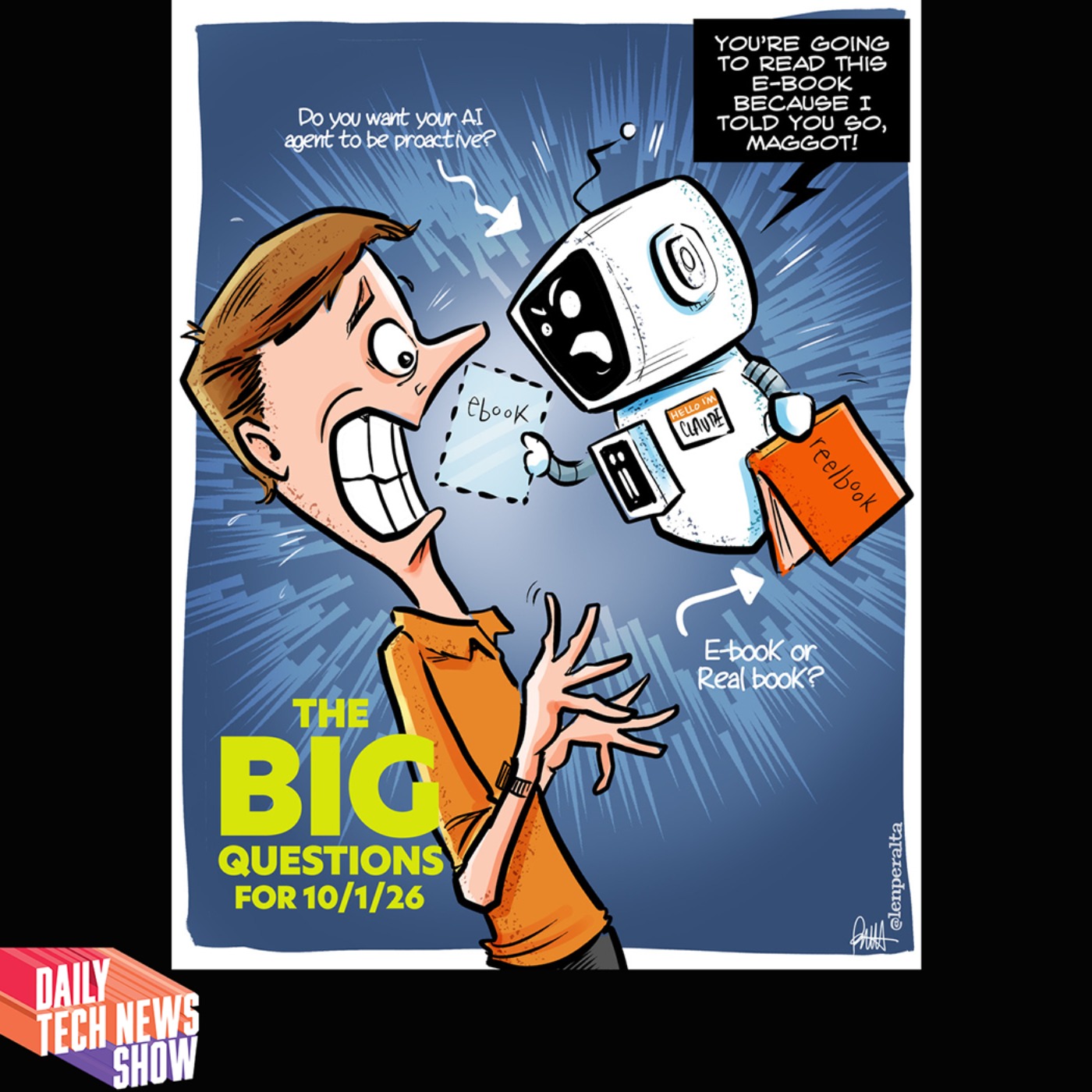
1:04:34Huyen Tue Dao: Let us know what you've drawn for the big question of the week episode this week. Sure. Before I do that, I want to say one thing that I think is going to go the way of the buggy whip is travel agents, even though they aren't still. I mean, I know there are still travel agents out there. Oh, yeah, yeah, yeah. The travel agents are. They are still around, too, right? They are. That's, I think, kind of surprising to some people. Yeah. That's crazy. So this is the third week in a row that I've tried to meld the big questions into one drawing. And I think this one is a lot of fun. This is the AI agent being proactive, and he's pushing an e-book into this poor guy's face saying, you're going to read this e-book because I told you to, maggot.
1:05:15He's drill sergeant. He's very upset. Yeah, so I actually, you know, I'm falling on the way of the real book still just because I'm an art fan. So I just, I don't, I think it's just a little bit different. But if you're an art fan, you can go to my online store. You can purchase this image right now over at the Len Peralta store.com or if you're my Patreon, patreon.com forward slash Len back me at the Dina's lover level and you can get it immediately.
1:05:46Huyen Tue Dao: And thank you so much and support human art. Thank you, human Len Peralta. You are the best. And also thank you to all the humans. I mean, if you're a chat bot that's giving us money, I guess we can talk. but I think everybody giving us money right now is a human or supporting us by listening to the ad supported version. I think they prefer you to be a human for that still too. And thanks to everybody who gives us hype points on YouTube, supports us on Patreon, gives us bits like Lord Molgar did today on Twitch. DJ Fission gave out some subscription gifts on Twitch as well. Zoe gave us some bits.
1:06:21Huyen Tue Dao: Great to have everybody supporting us in all the various ways they can. meet up in los angeles tomorrow saturday october 3rd at 12 noon at the farmer's market at the grove the original farmer's market uh it is sometimes called uh amos is in town our producer so he's going to be there come join us at the farmer's market at the grove at noon on saturday october 3rd uh we'll wherever we end up we'll put it in the discord uh but also if you take a lap of the farmer's market. You'll run into us. And please, if you are in the area, come on out noon on Saturday, October 3rd. I may have some stuff over there that I want to get rid of, you know, like stickers and mouse pads and stuff like that.
1:07:05Sarah Lane: And your car.
1:07:07Huyen Tue Dao: And Sarah's car. Exactly.
1:07:10Sarah Lane: You can take my car. It's full of dog hair. Take it. I'll give you a toy car.
1:07:16Huyen Tue Dao: Yeah, Roger's going to bring a toy car for you. There, perfect. Thank you, patrons, for keeping us in business. You can support us directly at patreon.com slash DTNS. And patrons, stick around for the post-show stream on patreon.com slash DTNS for Roger's AI or human game. This Sunday, I'm going to be talking with Tom Persky at floppy disk.com about why the floppy disk has not died. And when he thinks he's finally going to run out of brand new floppy disks, which he still has in stock. Keep an eye out for that. Talk to you again on Monday.
1:07:54Huyen Tue Dao: This week's episodes of DTNS were created by the following people. Host Jen Cutter. Host Rob Dunwood. Host Jason Howell. Host Sarah Lane. Host Tom Maradon. Host Wen Tway Dao. Producer Roger Chang. Producer Anthony Lemos. Video producer Joe Kuntz. Editor Hammond Chamberlain. Social media producer and moderator Zoe Detterday. Our mods. Beatmaster. W Scott S1. BioCal. Captain Kipper. Steve Guadarama. Paul Reese. Matthew J. Stevenson. and J.D. Galloway. Mod and video hosting by Dan Christensen. Music provided by Martin Bell and Dan Luters. Art by Len Peralta. Acast ad support from Todd Tuchek. Patreon support from Bobby Wagner.
1:08:32Huyen Tue Dao: And thanks to all our patrons who make the show possible.
1:08:38This show is part of the Frog Pants Network. Get more at frogpants.com.
1:08:45Huyen Tue Dao: Diamond Club hopes you have enjoyed this program.
1:09:18We'll be right back. ShipStation.com, code audio. Your daily supplement routine doesn't need to be managing a handful of different bottles. Onnit's Total Human brings key research-based vitamins, minerals, herbs, and amino acids together in convenient day and night packs. One all-in-one product designed to make supplementation easier. The day pack supports cognition, focus, and cellular energy production. At night, the night pack helps you wind down and supports a calm, relaxed state. Less time managing your supplements, more support for your day and night. Shop Total Human now at onnit.com.
OpenAI introduced Dots this week; proactive agents that run in the cloud and act for you without being asked. Meta’s Muse and Manus offer similar capabilities. The big question: Do you want your AI agent to be proactive? Plus Amazon unveiled a new Kindle lineup this week aimed at new readers. Amazon says 60% of buyers are first-time Kindle owners. The second question of the week: Ebook or real book?
Starring Sarah Lane, Tom Merritt, Robb Dunewood, Jason Howell, Huyen Tue Dao, Len Peralta, Roger Chang, Joe
Link to the Show Notes.
Hosted on Acast. See acast.com/privacy for more information.