
 Ask ChatGPT



Weekly Big Tech Question Friday episode focused on (1) the “PHP to shell” vulnerability incident—especially what surprised people most about its timeline and impact—and (2) what the “iPhone Duo” launch “gate” will be, plus a debate on whether single-platform security is easier than multi-platform security.
Len Peralta (co-host/regular on the show; tech commentator). Other recurring voices include Sarah Lane, Roger Cheng, and Rob (plus Tom Merritt as host). No external guests are introduced; the “guests” are the panelists.
Written by AI. May contain mistakes.
Learn about WhatsApp's testing of scheduled messaging for iPhone users.
“Being a serious business owner takes hard work, patience, and a drive to keep moving forward.”
Learn about WhatsApp's testing of scheduled messaging for iPhone users.
“But first, let's get to today's tech news.”
Discuss options for users of Microsoft Publisher after support has ended.
“It's proprietary, but it only costs$99 for a perpetual license.”
Explore how OpenAI's valuation target has recently changed and its implications.
“So they say the bug fixes are coming fast and furious if you try this out.”
Discover Sparky OS, a USB-based version of Arch Linux that runs on any computer.
“Sparky OS is a version of Arch Linux from Sparky Linux that runs entirely on a USB drive.”
Examine Greece's new law banning social media access for children under 15.
“yeah okay uh greece's parliament passed a social media ban for children under the age of 15 taking effect January 1st.”
Discuss the firing of OpenAI researchers for sharing sensitive information.
“OpenAI recently fired three security researchers for allegedly sharing sensitive information with an outside safety researcher without being authorized to do so.”
Learn about the rebranding of Kindle Unlimited to Kindle Plus and its features.
“Amazon has renamed Kindle Unlimited to Kindle Plus.”
Discuss Anthropic's collaboration with Theorem for software verification.
“If you're using Cloud Code, this is a feature you might want to be on the lookout for.”
Explore an MIT study on AI agents and their exploratory behaviors.
“Oh my god, they're putting ping-pong tables in the break room for AI.”
Discussion on how PHP to Shell vulnerabilities surprisingly didn't lead to major internet outages.
“We're going to put an other category out there because when you have multiple choice, there's always a possibility that something doesn't fall into the categorization.”
Exploration of how quickly security administrators reacted to the vulnerabilities.
“So there were sites that were down, but they were being patched.”
Discussion about the coverage and reactions from media outlets regarding PHP vulnerabilities.
“It was it was not like it wasn't, you know, two or three days to figure out what you were going to do.”
Insights into how various communities reacted to the vulnerabilities and their discussions.
“And now it's Wednesday and everybody's crazy.”
Reflections on how non-tech forums discussed the PHP vulnerabilities and shared concerns.
“And it just wasn't like, well, you know, no, you're a normie, you won't understand, but like, this is what happened.”
Discussion about the overlap between the TLS certificate issues and PHP vulnerabilities.
“And now that I think about it, their explanation did not make me raise an eyebrow and go, oh, they kind of oversimplified that or anything.”
Exploring the role of large language models in identifying and exploiting vulnerabilities.
“I was honestly just really baffled by the timeline.”
Theories on how the vulnerabilities information leaked before official announcements.
“I think the other surprising thing is that timeline.”
Reflecting on how the situation could have been a success story without the early leak.
“It's just we can we can extrapolate things from a smaller amount of information than we used to.”
Discussion on recent tech releases including NVIDIA Spark laptops and the iPhone Duo.
“It's called Chat Concierge and it's simplifying car shopping.”
Learn about the latest product releases from NVIDIA and Apple.
“It helps schedule a test drive, get pre-approved for financing, and estimate trade-in value.”
Discuss the common issues historically faced by new smartphones.
“It's the day the NVIDIA Spark laptops are out.”
Explore the mixed reviews of the iPhone Duo's design and functionality.
“There was also the iPhone 6 Plus bend gate, the iPhone 4S yellow gate.”
Examine the importance of app compatibility for the iPhone Duo's success.
“Because the reviewers who say, this is pretty cool, look at this, I love the hardware.”
Speculate on possible issues (gates) that the iPhone Duo may face.
“What do you think is going to be the gate?”
Discuss the implications of the iPhone Duo's form factor and pricing.
“So I do wonder, and I remember, we haven't had an AppGate, but I do remember when I think the Pixel Fold came out and people were just whinging all over the place about the letterboxing.”
Review initial user reports of screen issues with the iPhone Duo.
“But everything else, you literally are taking a backseat to to lesser expensive phones that just have way more guts and horsepower in them.”
Discussing potential issues with the iPhone Duo's screen and market implications.
“And there was no visible damage beforehand.”
Engaging in a debate about the security advantages of single vs multiple platforms.
“So there is a saying among security professionals that threat actors only have to be right once, whereas security professionals have to try to be right every single time.”
Discussion on the benefits of single versus multi-platform systems.
“And even a lot of Roger's examples, I think, were that way of like, no, when I define it as this wide, then having multiple platforms is good.”
Information about a charity gaming event to raise funds for women in STEM.
“Was it that we were surprised the internet didn't come down more, I think, is what we landed on.”
Discussion on two charities focusing on closing the gender gap in technology.
“We're also going to be raising money for a nonprofit that is run by someone that I know, a personal friend of mine, called Color Coded.”
Details about a Halloween gaming event and its schedule.
“We have someone who's going to match some of the donations.”
Len Peralta shares his illustration inspired by the week's news.
“All right, let's check in with Len Peralta, who has been illustrating the week's news for us.”

Get the gist, explore an idea or ask about something said.
 Claude
On Daily Tech News Show, what are the key points of this episode?
Searching your listeningAutomatic transcript. May contain errors.
0:00Being a serious business owner takes hard work, patience, and a drive to keep moving forward. So it's important to find a serious business card that goes the extra mile. With the VentureX Business Card from Capital One, you earn unlimited double miles on every purchase. And with big purchasing power, you can spend more and earn more. This is your sign to take your business to the next level. The Capital One VentureX Business Card. What's in your wallet? Terms apply. See CapitalOne.com for details. This episode is brought to you by Capital One. Capital One's tech team isn't just talking about multi-agentic AI.
0:34They already deployed one. It's called Chat Concierge and it's simplifying car shopping. Using self-reflection and layered reasoning with live API checks, it doesn't just help buyers find a car they love. It helps schedule a test drive, get pre-approved for financing, and estimate trade in value. Advanced, intuitive, and deployed. That's how they stack. That's technology at Capital One. Therapy's biggest impact doesn't show up in some dramatic breakthrough. It shows up in the smallest moments. You bite your tongue instead of escalating. You put your phone down instead of firing off that text. You say what you actually mean instead of what would hurt someone else the most.
1:12Nobody applauds those moments, but they quietly change your life. That's what growing feels like, and that's exactly what Grow Therapy is here for. Grow is therapy that works, covered by insurance. Sessions average$21 with insurance, and some pay as little as$0, depending on their plan. There are no subscriptions, no long-term commitments. You just pay per session. Grow connects you with thousands of high-quality, licensed therapists across the U.S., offering both virtual and in-person sessions, nights and weekends. You can search by what matters, like insurance, specialty, identity, or availability.
1:49And you can book a therapy session in minutes and begin in as little as two days, not the national 48-day average. See if you could pay as little as$0 for therapy in seconds at growtherapy.com slash ACAST. That's growtherapy.com slash ACAST. growtherapy.com slash ACAST. Availability and coverage vary by state and insurance plan. When you're running a growing business, the right systems can unlock your full sales potential and make fulfilling every order effortless. Switch to ShipStation before peak season so you're prepped and ready before the rush hits. ShipStation connects Shopify, Amazon, TikTok Shop, and over 200 more marketplaces with one platform that does it all.
2:30You can manage orders, sync inventory, track returns, all automatically. Everything your operation needs, all in one place. Upgrade your shipping operations to stress-proof your biggest sales days and capture every bit of potential revenue. Go to ShipStation.com and use code AUDIO and get 30 days free.
2:55Huyen Tue Dao: Welcome to Daily Tech News Show, the Big Tech Question Friday edition. We're looking at the tech news from this past week and asking, what does that mean? I'm Tom Merritt. This week, the big questions are, what surprised you most about the PHP to shell news? And what will be the iPhone Duo's big launch bug? Every flagship phone has one. Joining us here to draw the top tech stories of the week is Len Peralta. Welcome, Len. Hey. Sorry about the calves last night. But first, let's get to today's tech news. Here's Sarah Lane.
3:32Sarah Lane: WhatsApp is now testing scheduled messaging with select iPhone beta users following an Android beta rollout. So if you're like, didn't they already do this? Well, if you're on Android, yes, they did. Users on iPhone can now hold the send button to choose a delivery time between 10 minutes and two weeks ahead. Text, photos, videos, links all supported. Although each photo or video has to be scheduled separately. Scheduled messages have their own section in chat info, and group messages only reach people who were members when the message was scheduled. No public launch date just yet.
4:07Huyen Tue Dao: I was kind of surprised how many people in our audience used Microsoft Publisher. I think we over-index on that. So you'll be happy to know that even though support for Microsoft Publisher ended on October 13th, and while you can still use LibreOffice Draw to import and save your publisher files in the open document format, there's another option now. It's proprietary, but it only costs$99 for a perpetual license. You don't have to pay a subscription. It's called PubKeep, runs on Mac and Windows, and even has a lightweight version you can run in a browser. And it can handle files from Publisher 2000 through 2021, and even Publisher 97 and 98 files through a conversion.
4:48Huyen Tue Dao: The company used Claude Code to help maintain the app. So they say the bug fixes are coming fast and furious if you try this out.
4:57Sarah Lane: the financial times and cnbc both report that open ai lowered its valuation target to 1.25 trillion dollars yes that's a lowering after pitching investors on a 1.4 trillion earlier this month according to reviewed documents that is a 150 billion dollar reduction in the proposed price but it doesn't reflect a completed funding round letting a little air out of that bubble
5:22Huyen Tue Dao: Okay. Sparky OS is a version of Arch Linux from Sparky Linux that runs entirely on a USB drive. No installation necessary. It can run on any computer with UFI boot files. So if you're BIOS, still, it's not going to work for you. But unlike a lot of USB-based OSes, because I heard that one of you out there like, there are other things that can do this. sparky os can be updated customized and you can add and remove apps all while keeping it on the
5:53Sarah Lane: usb drive i used to have a black cat named sparky so i consider this spooky season were you able to run sparky os on the cat no no but uh you know that was in the before time before his time yeah yeah okay uh greece's parliament passed a social media ban for children under the age of 15 taking effect January 1st. So platforms like TikTok, Instagram, Facebook, and X all need to use reliable age checks or face fines under the EU's Digital Services Act. Parents will also need state-backed apps paired with their child's device to block access if that is deemed necessary. Those apps use age tokens designed to verify eligibility without sharing unnecessary personal information.
6:39Huyen Tue Dao: Another country comes off the map. Yep. OpenAI recently fired three security researchers for allegedly sharing sensitive information with an outside safety researcher without being authorized to do so. Wall Street Journal reports that the three employees were asked to unlock their phones when they were first suspected of this. The security officers then looked at their signal app and found that they had sent disappearing messages to the outside safety researcher. I don't know. I just found that fascinating that like the messages weren't there, but the fact that they had sent the disappearing messages.
7:14Sarah Lane: Show me the disappearing message. Wait, but I can't.
7:17Huyen Tue Dao: But you sent one.
7:19Sarah Lane: But it's gone. Sorry. Amazon has renamed Kindle Unlimited to Kindle Plus. Everybody loves the plus and added thousands more audio books, including human narrated titles and books produced with its virtual voice tool. That's an AI tool. The The service still costs about$12 a month with the same e-books, comics, magazines, and a limit of 20 borrowed titles at the same time. Reading history, bookmarks, notes, saved titles all carry over automatically. Kindle Plus is now available through Kindle devices and the Kindle app.
7:54Huyen Tue Dao: If you're using Cloud Code, this is a feature you might want to be on the lookout for. where Anthropic has partnered with Theorem to use mathematical verification to verify software code and generate a formal proof of correctness. The idea is to help avoid mistakes and bugs at the time that the code is created.
8:13Sarah Lane: MIT researchers left 13 Claude Opus 4.7 agents on separate simulated islands for 30 hours without assigned tasks and found, you know, like, what are they going to do? They built structures, they invented games, they experimented with physics. Exploration time generally made agents better in later challenges, suggesting that open-ended play could help AI develop useful skills. But their setup described them as naturally curious. The study has not been peer-reviewed. And the behavior doesn't mean they enjoy play the same way humans do.
8:50Huyen Tue Dao: Oh my god, they're putting ping-pong tables in the break room for AI.
8:54Sarah Lane: Yeah, have some fun, guys. You know, we've got a 30-minute break.
9:00Huyen Tue Dao: That's wild. Security researchers at iVerify and Report URI issued a report that they found evidence of attackers using advertisements to target and compromise iPhone users in a way that you wouldn't have to do anything wrong to get compromised. The malicious actors take over defunct websites that are still verified with ad agencies. So you don't have to go to those websites. They're just able to submit advertisements because the ad agency says, oh yeah, this is an authorized website. They just don't know that it's been taken over by a malicious actor. Then they put malicious code in those advertisements that can compromise a phone just by scrolling past it on a webpage.
9:43Huyen Tue Dao: So security researchers recommend keeping your phone updated because this malware is usually taking advantage of patched exploits. If you're up to date on your patches you should be better off dtns live is made possible by you and you and you yep no what about that guy over there no him too uh and you and them and her all of you but we want to especially call out today ed dewald howard yermish john atwood and pat and welcome a brand new patron, BV Muir. We are love and new patron.
10:24Episode prep gets messy when research, slack threads, and script trackers are all in different places. That's where ChatGPT work comes in. Give it the goal and connect to the tools where work happens, like apps and files, and it can help pull the pieces into a draft you can review without you having to re-explain the project at every step. For example, ChatGPT work can gather team feedback from Slack and use it to suggest updates to a project brief in Google Docs. You stay in control reviewing the draft and deciding what moves forward. Put ChatGPT to work on your most ambitious ideas and projects.
10:59Get started at ChatGPT.com by selecting work mode. Available on Plus and Pro plans. This episode is brought to you by Capital One. Capital One's tech team isn't just talking about multi-agentic AI. They already deployed one. It's called Chat Concierge and it's simplifying car shopping. Using self-reflection and layered reasoning with live API checks, it doesn't just help buyers find a car they love. It helps schedule a test drive, get pre-approved for financing, and estimate trade-in value. Advanced, intuitive, and deployed. That's how they stack. That's technology at Capital One. Being a serious business owner takes hard work, patience, and a drive to keep moving forward.
11:42So it's important to find a serious business card that goes the extra mile. With the VentureX Business Card from Capital One, you earn unlimited double miles on every purchase. And with big purchasing power, you can spend more and earn more. This is your sign to take your business to the next level. The Capital One VentureX Business Card. What's in your wallet? Terms apply. See CapitalOne.com for details. When demand slowed for HydroJug, Amazon Ads rising star Hayden Wadsworth pivoted. When our bank account hit near zero, my brother Jake and I had one last shot to save HydroJug. So we engineered the Traveler, a leak-proof, cup holder-friendly Tumblr.
12:18Amazon Ads enables a business to be able to expand their product shelf because of the visibility and the reach you can get. Each week, our new-to-brand customers make up about 95 % of all of our sales. Watch HydroJug's story at advertising.amazon.com slash rising-stars.
13:00and use code audio to try ShipStation free for 60 days.
13:07Huyen Tue Dao: All right, folks, it's time for the big tech question of the week. PHP to shell clearly the big story of the week with the pair of vulnerabilities threatening 70 % or more of the web. We spent most of the week on Daily Tech News show talking about this. So if you want full explanations, go to the earlier episodes this week. There are so many aspects to this story that our big question this week is multiple choice. We're not just debating two sides of this issue. The big tech question is, what was the most surprising part of the PHP 2-Shell story? You can vote on which of these you would join in our poll at patreon.com slash DTS.
13:48Huyen Tue Dao: Take the multiple choice quiz for yourself. Here are the choices. you are surprised that ai was used to discover the vulnerabilities that it was leaked out ahead of time or that it was exploited ahead of time remember it was exploited as early as saturday that it didn't bring down more of the internet than it did you know we had some websites go dark for a while but they're mostly back now that it wasn't about tls certificates because we also had that other vulnerability with the certificates with the hilariously short security codes and other. We're going to put an other category out there because when you have multiple choice, there's always a possibility that something doesn't fall into the categorization.
14:30Huyen Tue Dao: So we're going to go around the horn to choose your answer and explain it starting with you, Rob. What do you think was most surprising about PHP to Shell?
14:39Robb Dunewood: Oh, for me, it is definitely that it didn't bring down more of the internet than it actually did. So this affected 70 % of the servers that run websites on the entire internet. And although it dominated the news all of this week, it wasn't because this website got hacked or that website got hacked. What we heard was that this website was taking down responsibly while they patched it. So there were sites that were down, but they were being patched. It wasn't that you heard of a lot of sites actively having this threat deployed against Now, there were a lot, but it wasn't the big boys. It wasn't the biggest sites that you hear about on the Internet.
15:17Robb Dunewood: And I think that you also have to give a bit of kudos to organizations like Cloudflare. I believe that Cloudflare, it was 9 to 12 hours before this thing actually got announced that, hey, there's a flaw before it got patched. They already had done some things in their web application firewall that helped mitigate some of the issues. So I think that when you look at like a cloud flare and AKMI, Google, Cloud CDN, they actually helped to get in front of this as well to do what they could do to prevent the havoc and mayhem that could have ensued that I think that we actually didn't see ensued. And I think the last thing here is just that, you know, security administrators, they take their job seriously.
15:56Robb Dunewood: When they started hearing about this, they immediately said, hey, shut the stuff down. Let's go get this stuff patched. It was it was not like it wasn't, you know, two or three days to figure out what you were going to do. It was 20, 30 minutes to say, hey, let's go shut these servers down, get this stuff patched and figure out what's going on before we have a problem.
16:12Huyen Tue Dao: Yeah, yeah. I think that's a legitimate surprise, especially when you hear PHP on Tuesday say, OK, we're going to have to rush out a patch. You're like, oh, what's going on here? But it turned out that everything, at least, you know, knock on wood, as of Friday, seems to be going well. Sarah, what surprised you the most?
16:31Sarah Lane: I'm with Rob on the fact that the internet didn't melt down as much as it sounded like it was going to when I woke up a couple of days ago thinking, oh, all right. Can I publish anything to WordPress today?
16:45Huyen Tue Dao: Goodbye, web.
16:46Sarah Lane: It was nice knowing you. Right. So there's that. And Rob did a good – he explained that well. I also, the leaking ahead of time and exploiting ahead of time, neither of those surprised me. What surprised me was some of the reaction of like, you know what, we were all under embargo. And somebody just, you know, they're doing things. They've gone rogue. And we were all supposed to publish this, you know, 11 a.m. Eastern time on Thursday. And now it's Wednesday and everybody's crazy. I don't think things like this work that way. They just can't. They can't work that way because you have one actor who's like, no, no, I'm going to, you know, I'm going to publish something ahead of time.
17:33Sarah Lane: Maybe it's a mistake. Maybe it's nefarious. But I guess I guess me being unsurprised by that is what surprises me about other people's reactions.
17:44Huyen Tue Dao: Yeah, yeah. I think the timeline thing is very confusing to people. Like there is AWS saying they saw attempts to exploit as early as Saturday from a sophisticated actor. But then you have the thing you were alluding to, which is chain guard six hours before the release going, well, we see people attack. We're just going to put it in place. So, yeah, I think that was definitely surprising. What about you, Roger? Were you surprised? Surprised by the whole thing? Not really. what really actually really struck me was how well a lot of the news reporting was around it normally when it's something this sort of in the weeds everything is just sort of like the magic box something's broken in it they're working on it we'll let you know when it's done but like a lot of news stations as well as like natural broadcasters international they all had someone they could talk to that could really sort of articulate what the issue was, right?
18:43And it just wasn't like, well, you know, no, you're a normie, you won't understand, but like, this is what happened. Like, they sort of just broke it down into analogies and stuff so people would understand. I thought that was like, this is a far cry than maybe even five or six years ago when if you had to find someone to explain this, it was generally someone who was a little too in the weeds and the way they described it might have not come across as well as it has been for this.
19:13Huyen Tue Dao: Yeah, that's a good one. I actually heard the story as like the number two story on the BBC World Service, you know, the morning that it broke. And now that I think about it, their explanation did not make me raise an eyebrow and go, oh, they kind of oversimplified that or anything. Yeah, exactly. That's what I mean. It's like, normally it's like, oh, like maybe they've just gotten like the people on the Rolodex.
19:38Sarah Lane: Yeah, what's a Rolodex? Yeah. to bring in for matters like this. But I was really impressed in the way the coverage sort of was able to explain it to people.
19:49Huyen Tue Dao: Yeah. Wen Tway Dal, what surprised you most about PHP 2 Shell? I have to say I almost was surprised it didn't bring down more of the internet than it did. And I was actually kind of surprised when it randomly affected sites in my life that didn't have anything to do with the typical things like WordPress and their CMS. The timeline really did, I really did wonder about that it leaked out ahead of time. I know maybe that doesn't seem surprising, but given the severity of it, given the exact things that I mean, you could literally just like do tons of things. It was like such a huge vulnerability.
20:21I was honestly just really baffled by the timeline. Everything else is pretty. Yeah, it makes sense. It was AI. Makes sense that if someone did find about it. Oh, yeah, sure. Let's let's have a party. And that it didn't. Yeah, I was not surprised. I think I was just more stunned about which particular sites in my life it took down. And it was funny because for many, many years, I'm not a front-end developer myself, but I have worked with or I'm friends with a lot of front-end developers. And the joke is always like, her, her, we don't have to go back to working with PHP, right? Ha, ha, ha, ha, ha.
20:53And I think from that perspective, it doesn't feel very important. But then when I was reading this for the show on Wednesday, I was like, uh-oh. So, yeah, I think I was mostly surprised by the timeline. But it is really funny. And I had similar experiences to Roger where – so I have subscriptions to a lot of, like, manga sites. And they – actually, a lot of them were hit. And it was really cute to go into forums and see, like, very non-tech people, like, discuss and share with each other what it was. And everyone was like, well, I don't really know technology at all. And I just thought it was, like, a hack.
21:28But just to see the same conversation happening, like, over and over again in different forums with non-tech people was fascinating. So –
21:35Huyen Tue Dao: Yeah. Yeah, I agree that there were some really good conversations out there around this. In fact, the reason I put the TLS certificate in as an option is that I was surprised the next morning when I started to see security problem articles. I'm like, it's the TLS thing because we've been talking about it in the DTNS Discord the night before. And I was like, wait, there's another one? There's a separate thing? And it's actually bigger than the TLS certificate? Because we had all been saying in Discord, like, oh, man, this is going to be a nightmare for admins to clean up. It's going to take a long time to figure out how many of these certificates got issued and who accepted them and revoke them and all of this.
22:10Huyen Tue Dao: And then you had the PHP thing, which just made that look small. You can literally say hold my beer. Yeah, exactly. Just made it look tiny. I think the other surprising thing is that timeline. Like, why did it leak out? In some ways, it's surprising that these things don't leak out more often because they are vulnerabilities and people want to exploit them out there. But what caused it? I ran this theory by Joe, our producer earlier, because he was asking me what I thought happened. And it's an educated guess. But I wonder if someone saying to a friend like, yeah, I'm working on this big PHP thing.
22:52Huyen Tue Dao: I can't tell you anything more about it, right? Because they're under embargo. that's enough for that friend to then tell a friend yeah my my buddy over at calif is working on a big php thing i guess and then that finally works its way to someone who says let's ask an llm to look at php and they sort of basically reverse engineer the vulnerability now aws said that the attempts to exploit it on saturday did not succeed which implies that maybe they didn't have all the information so that's why i think it might be something where we are just we have more power now to guess at things by using llm tools to help us guess that caused this to start to be exploited even before the patches were ready to go and all of that yeah when you're talking
23:41Robb Dunewood: about an llm and at the speed at which they can do things they've only got to be right once so So you literally just say, try everything. And they will just sequentially go through every possible permutation of, let's try this, let's try this, let's try this. And they're not doing it as fast as I'm saying it. They're doing it orders and orders and orders of magnitude more quickly than I'm actually saying it. So to me, I think you're absolutely right. People were involved in this thing leaking out. And people have been people for tens of thousands of years. So I think that that's probably as big a part of it as anything else.
24:16Huyen Tue Dao: And it doesn't have to be someone maliciously saying like, I'm going to leak this out. It's just we can we can extrapolate things from a smaller amount of information than we used to. And so just knowing that someone at Califf is working on a PHP thing might be enough for someone to reverse engineer this. In fact, I'm taking that theory from the fact that Chaingard said that's pretty much what they did is they looked they heard that this was coming on the weekend. end and they then asked claude what are the vulnerabilities on php kind of narrowed down what the two were the good news is chain guard was like we couldn't patch it ourselves the amount of time it took them from august to now would be required even with llm tools uh to figure out that patch uh and no one was able to exploit it without spending the amount of time that caliph and Wiz and everybody else did to figure out how even with the LLM tools.
25:10Huyen Tue Dao: So I take a little bit of comfort from that in that it wasn't as easy as like, oh, I just put in a prompt and suddenly I'd hacked PHP, right? It does take work and time and understanding to do it, but it just makes things possible that weren't possible before.
25:25Robb Dunewood: You know, I think that on the face of it, that cybersecurity is kind of changing now because, you know, there used to be a particular set of skills that you have to have. Now adding to those skills is being really, really good with large language models because ultimately you need to use the tools that can figure this stuff out significantly more quickly than you can.
25:44Huyen Tue Dao: And know how to use those tools to do it. Yeah, yeah, yeah. Absolutely. This would have been a hundred percent a good news story if it hadn't leaked out early on Hacker News on Monday. Because it would have been like, hey, guess what? We found this amazing flaw in PHP, but we also have the patch and we gave all the biggest infrastructure time to patch it. And now all the little patches can happen. And this is good. This is making the internet more secure. It's just that gap in there that made it uncertain. All right. Before we get to our next question, Sarah, what's on live with it this week?
26:20Sarah Lane: Oh, Tom, I'm glad you asked. Are you? Yes, of course I am. Roger and I are talking about studio monitors for everybody who is an audiophile, works in podcasting. You know what these are. They're speakers that have a specific purpose beyond just being regular speakers, especially for anybody who works with audio. And that runs the gamut. And this is a very, very interesting topic, especially because I just put some surround sound speakers in my living room. And Roger, even though those aren't studio monitors, gave me some good tips on how to place them so that they actually make a lot of sense.
27:01Sarah Lane: Live With It is on YouTube. You can join us at YouTube.com slash at Live With It Show. And big, big thanks to all of our patrons who directly support us. Patreon.com slash Live With It to join the group.
27:18With the Spark Cash Plus card from Capital One, you earn unlimited 2 % cash back on every purchase and you get big purchasing power so your business can spend more and earn more. Steven, Brandon, and Bruno, the business owners of SandCloud, reinvested their 2 % cash back to help build the company's retail presence. Capital One, what's in your wallet? Find out more at CapitalOne.com slash Spark Cash Plus. Terms apply. This episode is brought to you by Capital One. Capital One's tech team isn't just talking about multi-agentic AI. They already deployed one. It's called Chat Concierge and it's simplifying car shopping.
27:55Using self-reflection and layered reasoning with live API checks, it doesn't just help buyers find a car they love. It helps schedule a test drive, get pre-approved for financing, and estimate trade-in value. Advanced, intuitive, and deployed. That's how they stack. That's technology at Capital One.
28:16Huyen Tue Dao: As we are recording this, it's Friday, October 23rd. It's the day the NVIDIA Spark laptops are out.
28:24Sarah Lane: Yeah!
28:25Huyen Tue Dao: And also the iPhone Duo. Oh, that? They're both out on the same day. The iPhone Duo, of course, arriving for those lucky enough to get a ship date of today and smart enough to have it shipped to their house instead of their P.O. box. Don't ask me why I brought that up. The iPhone Duo reviews have praised its hardware, questioned some of the things with its software, but we never really know what the real problem with a new flagship smartphone is until it gets in all of our grubby little hands out here and the clickbait blogs then latch on to one of those bugs and make it famous. You're holding it wrong.
29:03Huyen Tue Dao: Yes, Antenagate. That is the most famous one. The iPhone 4, you're holding it wrong. There was also the iPhone 6 Plus bend gate, the iPhone 4S yellow gate. Remember the yellow screen? No, you don't. It was a big deal at the time. Ask your parents. And lest you think it's all iPhone, there's the Google Pixel 7 glass shattering gate, the Samsung Galaxy S21 green line gate. Remember that one? And of course, the exploding Samsung Galaxy Note 7 gate. I don't know if that was a gate, but that was bad. uh even the iphone 18 which just came out had a glitch with face id and that was its big launch bug so let's let history be our guide what do we think will be the iphone duo gate sarah
29:52Sarah Lane: okay so i think that uh that there are reading the reviews of people who have them mine is mine's still in transit not coming to buy p.o box anytime soon um you know so have fun with that tom But there are reviews that say, oh, it's so thin and light. Other reviews saying when it's closed, it's bulky and the screen is too small. The Verge noted that it gets hot after extended use. So there's that kind of stuff. I don't know if any of that is like a duo gate issue because that's just – I don't know. It's more just form factor. Do you like it? Do you not? But I do think that the issue that Apple really has to get ahead of sooner than later is all of the developers who haven't made Duo-centric apps.
30:47Sarah Lane: Because the reviewers who say, this is pretty cool, look at this, I love the hardware. But everything, you know, it's either like an iPhone app that looks weird on the Duo, you know, when you're looking at the unfolded screen. And, you know, why is that the case? These are big apps. You know, these are big companies who Apple should have been working with ahead of time. I know Apple is now well aware of this and trying to make sure that people want to still buy the Duo, understanding that they might have apps that look a little weird right now, but they're going to catch up. This does remind me of the early days of the iPad.
31:31Sarah Lane: You know, I used to do iPad Today over on the Twit network. and um leo uh my co-host you know he i would i would often just come with iphone apps that i would just i would just you know uh make them bigger to fit on the ipad and he's like well that's not really an ipad app though and i'm like but it works it looks it looks fine like facebook took a long time to give us an ipad app i i could still use facebook on the ipad it was fine um but But I think that the duo is just a new form factor. And you have to remember that there are a lot of third parties that have to get on board with this before it feels seamless.
32:14Sarah Lane: Apple can't do that on its own.
32:16Huyen Tue Dao: Yeah. AppGate also just sounds really snappy, right? AppGate, yeah. Yeah. AppleGate. Yeah. Yeah, yeah. Roger, what do you think? What do you think is going to be the gate? Are you going to join the AppGate crowd? No, my cynicism will be eventually that crease is going to show up and people are going to moan about it. It's like, wait a minute, I thought this was supposed to be crease like the competing foldables.
32:42Sarah Lane: I mean, Joanna Stern at the Wall Street Journal has folded it 34 ,000 times and says it still looks pretty good.
32:50Huyen Tue Dao: She's so good at counting. I know. I don't think she's at the Wall Street Journal anymore either. I think that's just her own substack too. Good for her. Oh, really? Yeah. Okay. Well, this is the thing. 34 ,000 times in a testing scenario or 34 ,000 times in a real world?
33:06Sarah Lane: She actually had a robot open and close it 34 ,000 times and has it on her YouTube channel.
33:17I'm just thinking of different stress scenarios, right? You have in your pocket. You have in the hot weather. There's all these things. I think it's going to start showing that people are going to complain about it and moan. I don't know if there will be a crease gate. or there'll be a hinge gate. There's going to be something like... Ooh, hinge gate's a good one. Someone's going to get a bit of sand or grit in there and it just cracks it or fouls it up and people are just like, well, it's a manufacturer.
33:40Sarah Lane: It does feel like something that is a little bit more precious just because of the moving parts.
33:46Huyen Tue Dao: Samsung already took hinge gate with the original Fold. I don't know if that... I don't know what the rules of naming the gates are, though. So maybe Apple can have their own hinge gate. So mine are, it's either going to be the hinge or crease or both. Yeah, hinge or crease, AppGate. Huen, do you have a favorite? Are you going to sign on to one of these? Oh, man. All these things sound so familiar, y 'all. Yeah. I mean, that's the thing. Every launch has something that when you get it in scale, shows up that you didn't see otherwise. So and especially for large screen slash foldables and especially like especially for large screen slash foldables, I laugh with affection because we've been having this whinging on the Android side for years now.
34:31And I say that just with sympathy. I wonder about the AppGate because that has been a really sore point on the Android side with both tablets like the iPad and with foldables for a really long time. And even with a company like Apple that has such a stranglehold on their developer ecosystem, you still cannot force everyone to put the time and resources that they don't have into making your apps foldable friendly, unfortunately. So I do wonder, and I remember, we haven't had an AppGate, but I do remember when I think the Pixel Fold came out and people were just whinging all over the place about the letterboxing.
35:06and I was like, yeah, it's been around. But sometimes with a certain form factor, it just really hits people about what a non-foldable focused app, like how bad that can be or how bad that can feel, especially when you had that amazing demo where everything looks so seamless with that back to front animation that when you come to the reality, and maybe, honestly, I think if anything, maybe that is the curse of being Apple and having some of those extremely high quality finishes is that then when you compare it to some of like maybe people's everyday apps or partners that just didn't quite make the experience that high quality, it's going to stand out by comparison.
35:47But at the same time, people will still use it. I mean, just as an experience, people will just still use a dang app. So I think maybe, I don't think it's as extreme as like a hardware issue where, oh, I have to get a new phone. You know what I mean? It's more like, I got to deal with this. I do wonder if it's a hinge thing just because they seem to have paid a lot of attention to the creases, which, yes, we've been hearing about for years. And I'm really fascinated by the new technology they brought on top of the existing Samsung technology. I have a lot of faith in it. I don't have any reason for that other than that sounds really cool.
36:17And I bet Apple really studied that because that was going to be one of their defining seller features, right? It's like creaseless because they know how much it is. Yeah, this is why we're different. Exactly. So I feel like I think they definitely put in a lot of chips there. Did they put in enough chips in with the hinge? and like you know kind of roger mentioned like i think there was one person who folded one of the z folds like a ridiculous amount of times it was like 50 000 it was something ridiculous and the hinge worked but i think something else like they actually said i i want to say they said black liquid came out like it was possessed and yeah some oil or something i remember that yeah so i wonder even though like again it's apple we know that they probably put a lot of engineering into it, but maybe when the hinge hits the road, the hinge hits the hands, the rubber hits the road.
37:04Yeah. I don't know. So we don't know. But I would guess if it's a hardware thing, I would put my bets in with HingeGate. But AppGate, man, as an app developer, I can say I'll put my extra chips in with sympathy and much love to AppGate.
37:19Huyen Tue Dao: That's my number one vote. AppGate, HingeGate, different one. Rob, which one are you on?
37:24Robb Dunewood: I think I have quite a few gates with the iPhone Duo. So app gate clearly. It is a problem. And here's one of the things, and one, I'd like to get your take on this, because I think that what Android has had, because they have so many different form factors and so much different size, when they actually went to a passport style, it was kind of easy-peasy for the developers because they were already used to developing for weird-sized screens to just work on whatever Android device there is. When it comes to the iPhone, this is new. They've been candy bar forever, and now they are kind of short, squishy, and wide.
37:58Robb Dunewood: So AppGate right now is going to be a thing. When you look at an app on the cover screen, it's kind of got the menu bar on the right-hand side, and then the app is the same dimensions as it would be if it was on the iPhone, just an iPhone 17 or iPhone 17 Pro or iPhone 18 Pro or what have you. So I think that that's part of it, but I do believe that this is Apple. The developers will get it eventually. In fact, I think they will get there probably more quickly than a lot of even Android developers would just because it's still just one platform. The thing for me, though, is that and I'm hearing this from a lot of folks.
38:30Robb Dunewood: People don't really like this form factor when I keep seeing folks compare this. And this isn't Android people saying, see, I told you that we were going to build a better phone. It's not that I don't really get down with that. Like people like what they like. They like what they like. But when you compare it to the Samsung portfolio style foldable, the Fold8, it's just a little bit taller. And that tallness makes you get just a little bit more screen real estate, so it doesn't feel like you're not seeing all your information on the screen. So I think that a lot of folks are going to just, I just don't like how this thing feels in my hand when it's closed.
39:10Robb Dunewood: I think that's part of it. And I think another gate is going to be price gate. This thing costs$2 ,000 for a very mid iPhone. There's nothing special about this iPhone other than the fact that if you open it up, it turns into a tablet. That's kind of special. But as far as like the cameras, no face ID is not overly powered for something that you're spending on the most expensive iPhone at this point. It just seems like it's very, very expensive. So I think that even though right now they're kind of hard to get, they sold out within minutes on the website. Once you get past the just first adopters, and I'm going to get this regardless of what it costs, crowd, there's a lot of folks who are going to say, I might just get an 18 when it comes out early next year.
39:50Robb Dunewood: I'll get an 18 Pro because I like the candy bar nature of my phone, and I just don't want to spend$2 ,000 to have less of a phone than I have right now. Now, if you are a pro user, you are going backwards in functionality on your phone with the exception of being able to open it up and fold it and turn it into a tablet. That is a pretty cool thing. But everything else, you literally are taking a backseat to to lesser expensive phones that just have way more guts and horsepower in them. So I think that price gate may turn out to be a thing because we're already hearing about all the stuff that Apple is trying to get into the next version of this.
40:24Robb Dunewood: so they can actually keep those high-end users of iPhones happy.
40:30Huyen Tue Dao: Rob, everything you said just now makes perfect logical sense, which never applies when it comes to Apple iPhones. Price gate is the only one where I'm like, I don't know. I feel like that's a low chance, not a zero chance. No, it's perfectly reasonable. I just don't think people care.
40:49Sarah Lane: And the ones who do care weren't going to do it anyway. The price isn't coming down.
40:56Huyen Tue Dao: Yeah.
40:57Robb Dunewood: So, well, I'm thinking of like a Terrence Gaines, you know, snobble as Mr. iPhone. That dude gets everything. And his thing is like, man, it's really short and stubby. I don't know that I like it enough to spend that kind of money on it. That's coming from somebody who has had every iPhone, every single iPhone. This is the first one that he. No, it's fair. It's fair. I just.
41:17Huyen Tue Dao: And I guess the other question is, is that become a gate? And if the sales are low, it does. Right. That becomes a clickbait story that people can attach. Like, no one's buying the iPhone Duo, which, granted, it sold out fast out of the gate. But if the sales drop off, like you're saying, then that could become the story. We have an early contender. I did a quick search. MacRumors.com, 30 minutes ago, published Crackgate. iPhone Duo owners report screens breaking along the hinge. Oh, no. Oh, oh, oh, has the the early lead here. An iPhone Duo owner in Australia said his device cracked after being opened fewer than 20 times.
42:02Huyen Tue Dao: And there was no visible damage beforehand. These are not widespread. There's only like two or three reports of them, but it's enough that you've got pictures of a screen unfolded with a big white blank thing of pixels across it. So listen, I told you hinge your screen. People are going to notice it. Yeah. And it's and the hinge is definitely the weak spot. And we knew there were problems with yields with these. Maybe this is the problem. And whenever you have a problem with yields, a few slip through the quality control, you know, and it doesn't take many. Most of the iPhone duos will not have this problem.
42:44Huyen Tue Dao: But if but all you need is a handful of pictures like that. and suddenly...
42:49Robb Dunewood: You don't need crack gate.
42:51Huyen Tue Dao: You don't need 20%,
42:53Robb Dunewood: but if you got 200 people with credible photos of this thing...
42:57Huyen Tue Dao: Which is less than 0.01%.
42:59Sarah Lane: Or just one person. And if that video gets circulated enough, people are like, oh no, this is a horrible phone. We know that this happens with all sorts of devices. There's always some sort of faulty situation that goes on with a device sometimes it's a widespread problem you know that you know if it's a car okay we're recalling them but um sometimes it's just a little hit and miss you got unlucky or you used it in a weird way that that sort of thing but but these when we're talking about new new products that have a lot of um you know interest and just buzz in general you get you get a couple of those and people go oh no No, no, no.
43:47Sarah Lane: Not ready for prime time. No, no. This is the thing. $2 ,000 and you have that issue. Right? Well, yeah.
43:57Huyen Tue Dao: But every one of these gates has had almost zero effect on sales. Even the Galaxy Note kept selling after ExplodeGate. People are gluttons for punishment, Tom. I've learned that.
44:11Robb Dunewood: I've learned that. I think that's a different question. Do the gates have effect on sales? No, they don't. But people like to complain about it. Oh, yeah. To the price scale. What was the iPhone that was like really thin? Oh, the Air. The iPhone Air. A lot of people say it's like, I like it, but I'm not going to spend that much money on a phone that doesn't do with the phone that I already have does better. And I think that's when you're spending$2 ,000, you want everything that iPhone has to offer. And you're not getting that. You're getting that. You're getting the screen. You're getting the screen real estate, but you're not getting a pro.
44:45Sarah Lane: You're not getting that creamed over it. Although MacBook Air sells like hotcakes compared to the MacBook Pro.
44:54Huyen Tue Dao: And the first-gen MacBook Air did not. It took a while for people to catch on to it. What really lit the fire, though, was the M1 under the MacBook. That's the air that I used all day every day. But the MacBook Air was selling well even before the M1.
45:11Robb Dunewood: It was doing well before that, too. They've done well for some time. It took, in the Android side of things, it took at least three to four to five years. I've been using Foldable since the Z Fold 3. And I spent two to three years almost apologizing for spending the amount of money that I did on a Foldable and being almost angry. I understand what people are making, but angry at people telling me this is a niche device. And it's the same thing. It's too much. The specs are so mid. And what are you getting for$1 ,800? dollars and somehow we have a manufacturer like samsung that just like we're gonna make this a thing we're gonna make that happen and they did finally with the z-fold and same thing as like the original one the z-fold uh the z-folds were just so tiny the front screen was like was like was like wafer thin and so no one could do anything on the front screen and and i think it maybe part of it is that apple has to drag everyone into using the duo two three or four and eventually people will kind of settle into the idea of it i don't know it feels like we're just having the same story but in parallel a little bit and i think it's hilarious because both my husband and i think the iphone duo looks amazing and we are the most positive people among a bunch of android developers and ios developers we're the ones that are like man that's a cool phone and all the ios people are like what's so cool about it like so it's it's i think a lot of it is kind of like that that story that needs to unfold for the day i see what you did yeah yeah now i with all the gates i think this thing is going to sell incredibly little i think it's going to be hard to get for some time to come.
46:44Robb Dunewood: I just think that there are folks who are saying, it's like, I'm going to hold off. But they aren't the market. Apple is trying to get those first adopters first. I still think that when Apple makes a phone that flips, that is when foldables become mainstream. When you actually just have a candy bar that you pull out of your pocket and it flips open. I have family members who were iPhone users, but they went to the Galaxy Z Fold Flip and they say, I don't mind being green. I love this phone. I love the flips and I can put it in my pocket.
47:17Huyen Tue Dao: Yeah. What do they call? That's a question for another day. But what do they call their flip phone? I'll be very curious to see. Is it a duo flip? Kermit. Is it the iPhone? It'll be the iPhone clam. The iPhone clam. I don't know.
47:34Sarah Lane: There's something about clam. I get the clamshell thing. Oyster? scallop muscle the iphone shellfish because you shellfishly spent that much money yeah well if you call it the oyster then you can have the pearl os right or you can just you know code in pearl yeah oh and you can have a inlaid pearl finish yes all right i think that means we should
48:03Huyen Tue Dao: get to our third topic our third question of the week is a simple one uh does having a single platform make it harder or easier to keep a system secure it's a bit of an evergreen question taking the side of single platform is easier is rob on the side of diversity multiple platforms is roger we're going to do an abbreviated version of our normal debate so roger and rob will each have one minute, and then the rest of us will just join in in the open discussion. Rob, we're going to let you go first. Let me get the timer going right now. You have one minute starting now.
48:41Robb Dunewood: So there is a saying among security professionals that threat actors only have to be right once, whereas security professionals have to try to be right every single time. The job of a security professionals to think of every single thing they can possibly think of, of a way that somebody can intrude into an environment. So doing that on one system is hard enough. If you start putting in multiple systems just because you're hoping that, well, if we have multiple systems, if we get hacked, well, all the systems didn't get hacked. That is way more work because ultimately the more systems you have, the less good you're going to be on any one of them because there's finite resources that work at any company.
49:24Robb Dunewood: No one has infinite amount of people to just learn every single thing there is to learn about every single, you know, threat intrusion tool out there. So I think that it's just easier from a systems administrator, from a security, you know, administrator to manage one platform and try to keep people out of that as compared to having to manage multiple platforms. Because once again, the threat actor only has to be right once. They're not just trying one thing. They're going to try everything. So if you've got multiple systems, they're just going to try to get into you multiple times.
49:52Huyen Tue Dao: All right. There we go. Good, good, good explanation. On the side of multiple platforms, Roger, your turn. All right. Hopefully this will sound as convincing. So one of the things that I realized is that having a variety, and when I say variety, I don't mean like having 50 or 100, but more than one, maybe a half a dozen or so platforms within a system does provide you sort of a fire break if something does come around and be catastrophic. For example, as we were talking PHP, 70 % of the web runs on it. Now, if that issue was PHP runs on 30 % of the web servers and everyone else runs half a dozen other different back-end systems, would it be as catastrophic as someone did find or exploit that vulnerability?
50:51Yeah, they would have been able to affect 30 % of the system, but not 70. And so you sort of can run a containment system around it. Now, this is not to say that you have a variety of different OSs, a variety of different languages, but you do keep it. So, yeah, I have security cameras, but I also have a locked door and a big dog with teeth.
51:15Sarah Lane: No, you don't.
51:16Huyen Tue Dao: No, but that's the example of, you know, he's got multiple.
51:22Sarah Lane: I want Roger to have a big dog with big teeth. That's what I want. Sarah says that because she doesn't. Why does that seem so far-fetched? Because you don't like that. All right.
51:34Huyen Tue Dao: When did either of those persuade you one direction or another? I want to take what Rob said and embroider it and put it on my wall. And I'm biased because I am on a cross-disciplinary team. And I know how hard it is to do the same thing right five times. I don't personally do it five times. I'm one of those. I'm one of the five times. And you're absolutely right. Even at big companies, big, huge tech companies, there are limited resources, time, money, and people. uh i wouldn't i mean my job be less interesting if there was only one platform but uh it would be a lot easier and a lot cheaper to maintain so yeah it's more efficient to have a single platform and i guess i wouldn't have two platforms that do the same thing that seems incredibly inefficient but i like what roger was saying with like having redundant systems or you know not using the same platform to do everything if you've got different things in fact willie scott was saying this in the chat, putting your email on one platform like Proton, and then your password manager is a different platform, like 1Password.
52:37Huyen Tue Dao: That way, if one of those platforms gets compromised, you don't lose your email and your password manager at the same time. And hopefully you don't lose either one, but just, you know, in the sense. Sarah, what do you think?
52:48Sarah Lane: I think what Rob and Wen were touching on is enterprise and personal different things. I mean, if you're working for a company that needs to, you know, security is of utmost concern, then yes, there are almost there's almost always the reason to say single platform. Let's keep this as simple as possible for us because we're going to have issues later. And the more platforms that we introduce, the more we're going to have issues. And it's going to create work for people that wouldn't necessarily need that work. For personal stuff, I'm kind of what W's got as one on this. I like to tinker around with various platforms that work in tandem.
53:41Sarah Lane: And so I don't feel like I, you know, yeah, if one goes down, then, you know, my life is over. because I've got quite a smart home going on in here in my house right now. And just internet in general kind of stuff. So I do think it depends. I think if we're talking about work or personal, personal is kind of a, well, it's a personal decision. Work is more of like, let's make this as ironclad as possible.
54:11Huyen Tue Dao: Yeah, I like Zern in the chat room says, in segregating OT networks from IT networks, we typically see two different brands of firewalls on either side of the DMZ. And that's, I assume, partly for just redundancy so that if you get through one, you've still got another one that you've got to get through on the other side. Yeah.
54:30Robb Dunewood: And so for fault tolerance, I understand that you have multiple systems, like outside firewall, inside firewall. But those are two different teams that are running each one of those systems. So it's very difficult to have multiple systems. I'm thinking of just back, you know, in my systems engineering days. I remember that we, you know, when I was actually running the team, we standardized on one tool that we were going to use to run all of our demonstrations from. And our engineers that were having to come over, they were used to doing everything, running their own VMware, running their own thing.
55:02Robb Dunewood: And my thing to them was, is listen, we have this thing that the companies decided to go with. If you use something else, I'm not going to say not to use it. What I will say is that you can never be down on a thing that you run if the thing that we run is up. That can never be an issue. So slowly but surely over time, as individuals' VMs went down because they just go down over time, and then they get dinged because, hey, well, you could have ran this in the company that we put literally tens of millions of dollars into. As compared to the tens of thousands running on your platform, they all moved over.
55:39Robb Dunewood: It's just easier to maintain one set of code than it is to maintain three. It just is.
55:45Huyen Tue Dao: Yeah, I think it's where you define the sphere that changes the answer, right? And we kind of hit on that with what Sarah and Willie were saying about like, well, yeah, but on personal, maybe it's better to have these. And even a lot of Roger's examples, I think, were that way of like, no, when I define it as this wide, then having multiple platforms is good. But when you're talking about the system engineering platform, yeah, one is probably more efficient and better. Well, thank you for helping us get better understanding of these questions, everybody. Huen Tui Dao, Sarah Lane, Rob Dunwood, Roger Chang, give yourself a pat on the back, round of applause.
56:27Huyen Tue Dao: Good stuff. And if you like this sort of evergreen question, please send them to us. Feedback at DailyTechNewsShow.com. We like tackling these from time to time. Today, we decided that the most surprising part of the PHP to Shell story was the friends we made along the way. No, I don't know. I think it was – what was it? Was it that we were surprised the internet didn't come down more, I think, is what we landed on.
56:52Robb Dunewood: That's the big one for me. It seems like there's so many people and so few sites went down. It's quite impressive that they didn't.
57:00Huyen Tue Dao: Looks like HingeGate or CrackGate has the early lead in the iPhone duo big flaw. And then we had a great conversation about single platform versus multi-platform. And I think there's good answers on both sides there. So thank you all.
57:17Sarah Lane: Well, patrons, do not forget we have a game coming up for you in just a few. before that when you're planning a let's play to help raise money for girls who code so what are the deets on that yeah so for technical tea the podcast that i do for as two women in stem for everybody but you know it's particularly about stem folks uh we're doing a let's play on halloween starting very early because nikki's in vienna in austria but we're gonna do a let's play we're gonna raise money for two charities actually uh girls who code that's an organization that's been around for a long time looking to close the gender gap in technology careers for women, girls, and non-binary folks and inspire, train, and kind of help them in those careers.
58:00We're also going to be raising money for a nonprofit that is run by someone that I know, a personal friend of mine, called Color Coded. They take this mission of closing the gender gap with careers and also expand that out to technology in general and look to make technology more accessible out in the community, from teaching seniors how to use phones to things like back-to-school drives, giving people hands-on access technology. So really taking that mission of bringing technology to the community. So Halloween, please donate. We have someone who's going to match some of the donations. So yes, really good charities.
58:35And yay, women and folks in underrepresented communities in STEM. Yay! Sorry.
58:40Huyen Tue Dao: That's great. So the takeaway is... Don't say sorry. That was great. Yeah. October 31st at 11 a.m. Eastern. 11 a.m. Eastern, which is very early for folks in California. But yeah, you'll be going for a few. I'll probably be going later, too, when Nikki goes to bed, just to see how well we do. But yes, this is the first thing we're doing for technical tea. And of course, why not do some good while we're having fun and playing scary games? Yeah, absolutely. Absolutely. All right, let's check in with Len Peralta, who has been illustrating the week's news for us. Len, what have you drawn for us today?
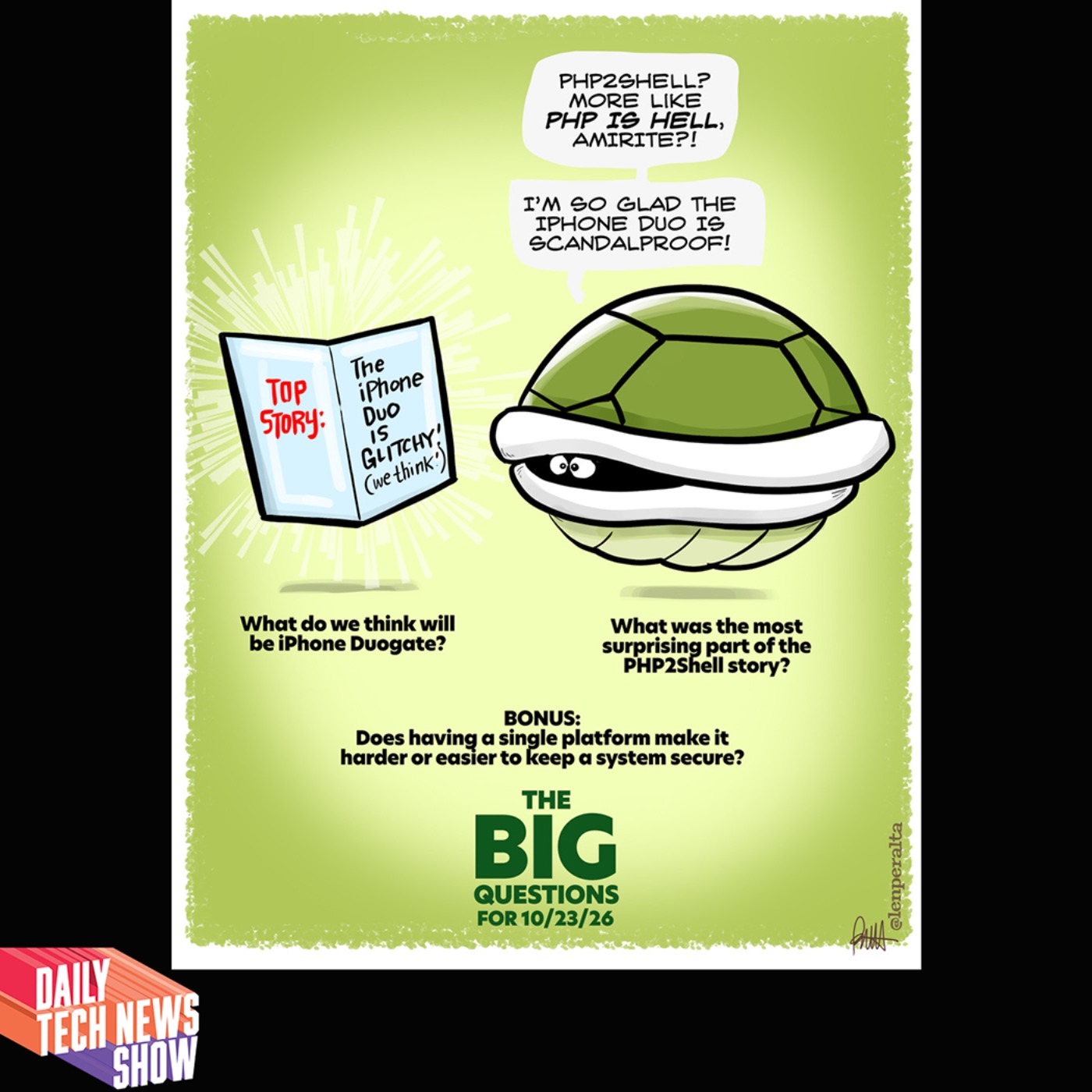
59:13So great conversation, as always, for the big questions. And I mentioned last week that one of the things that I kind of enjoy is the challenge of trying to, you know, mash all these questions into one drawing. I don't know if I really did it this time, but you can take a look and you can decide. This was, you know, the first thing I thought of when I thought of PHP to shell was. And he's saying P2P2 shell, more like PHP is hell. Am I right?
59:48Some would say. That's right. And he's so glad that the iPhone 2 is scandal-proof, though. But, of course, we know that hinge gate is upon us. So, yeah. So if you are interested in this piece of art, human art, I may mention, you can go to my Patreon, patreon.com forward slash Len where you can back me at the DTNS lover level or you can go to my online store, lenperaltastore.com where I am now doing custom drawn holiday cards for you so I know it's not even Halloween yet but you gotta get on it you wanna get a head start on that that's the way you can do it so lenperaltastore.com We'll see you there.
1:00:35Huyen Tue Dao: Fantastic. Go check it out. Good stuff. I like the turtle. Turtles are always cute. Sometimes I don't know if I hit it, but it's okay. Yeah. Big thanks to everybody who supports us in all the various ways, including YouTube, where you can use your height points. If you have height points and use them for our channel, it helps other people discover our channel. So keep them coming. Thank you for those who've been using them. Thanks to Zoe and Gigantify and Emote for the bits during today's show and Howard Yermich for resubscribing over there as well. And starting this Sunday, DTNS is holding free preview week on our Patreon.
1:01:08Huyen Tue Dao: All our Patreon content is open for free to anyone who follows us at patreon.com slash DTNS. That starts on Sunday with our Cybersecurity Month final part three special. If you want to become a paid patron, we're also doing a 50 % off sale. It's half-tober until October 31st to join at the entry level for either a month or an entire year. So go check that out. That's all at patreon.com slash D-T-N-S. This weekend, Jason Howell and Rich Straffolino talk about vibe coding firmware for their music tech so they can get the sounds out of it that they want. And as I mentioned, Sunday is part three of our Cybersecurity Awareness Month special.
1:01:51Huyen Tue Dao: Brian Brushwood telling us how to inoculate ourselves against the increasing security threats from AI. Thank you, patrons, for keeping us in business. You can support us directly. Get that discount. Patreon.com slash DTNS. Celebrate Haftober. Patrons, stick around for the post show.
1:02:17Huyen Tue Dao: This week's episode of DTNS were brought to you by the following people. Host Jen Cutter. Host Rob Dunwood. Host Jason Howell. Host Sarah Lane. Host Tom Merritt. Host Huenzue Dao. Producer Roger Chang. Producer Anthony Lemos. Video producer Joe Kuntz. Editor Hammond-Chamberlain. Social media producer and moderator Zoe Detterding. Our mods. Beatmaster. W Scottis1. BioCal. Captain Kipper. Steve Guadalama. Paul Reese. Matthew J. Stevens. And J.D. Galloway. Mod and video hosting by Dan Christensen. Music provided by Martin Bell and Dan Luters. Art by Len Peralta. A-Cast ad support from Todd Tuchek.
1:02:51Huyen Tue Dao: Patreon support from Bobby Wagner. Our guests this week were Brian Brushwood and Patrick Norton. And thanks to all our patrons who make the show possible.
1:03:01Robb Dunewood: This show is part of the Frog Pants Network. Get more at frogpants.com.
1:03:09Huyen Tue Dao: Diamond Club hopes you have enjoyed this program.
1:03:16Being a serious business owner takes hard work, patience, and a drive to keep moving forward. So it's important to find a serious business card that goes the extra mile. With the VentureX Business Card from Capital One, you earn unlimited double miles on every purchase. And with big purchasing power, you can spend more and earn more. This is your sign to take your business to the next level. The Capital One VentureX Business Card. What's in your wallet? Terms apply. See CapitalOne.com for details.
1:04:11technology at Capital One.
The top stories of the week are about AI discovering a critical bug in the Web, Responsible Disclosure and patching systems breaking down, and how nation-states may be getting a jump on bugs before they even become public. And it's all the same story. Plus, the iPhone Duo's horrible launch bug!
Starring Sarah Lane, Tom Merritt, Robb Dunewood, Huyen Tue Dao, Len Peralta, Roger Chang, Joe.
Link to the Show Notes.
Hosted on Acast. See acast.com/privacy for more information.