Ask ChatGPT

 DeviceTalks Weekly
23 Oct 2026 · 1h 2m · 26 chapters
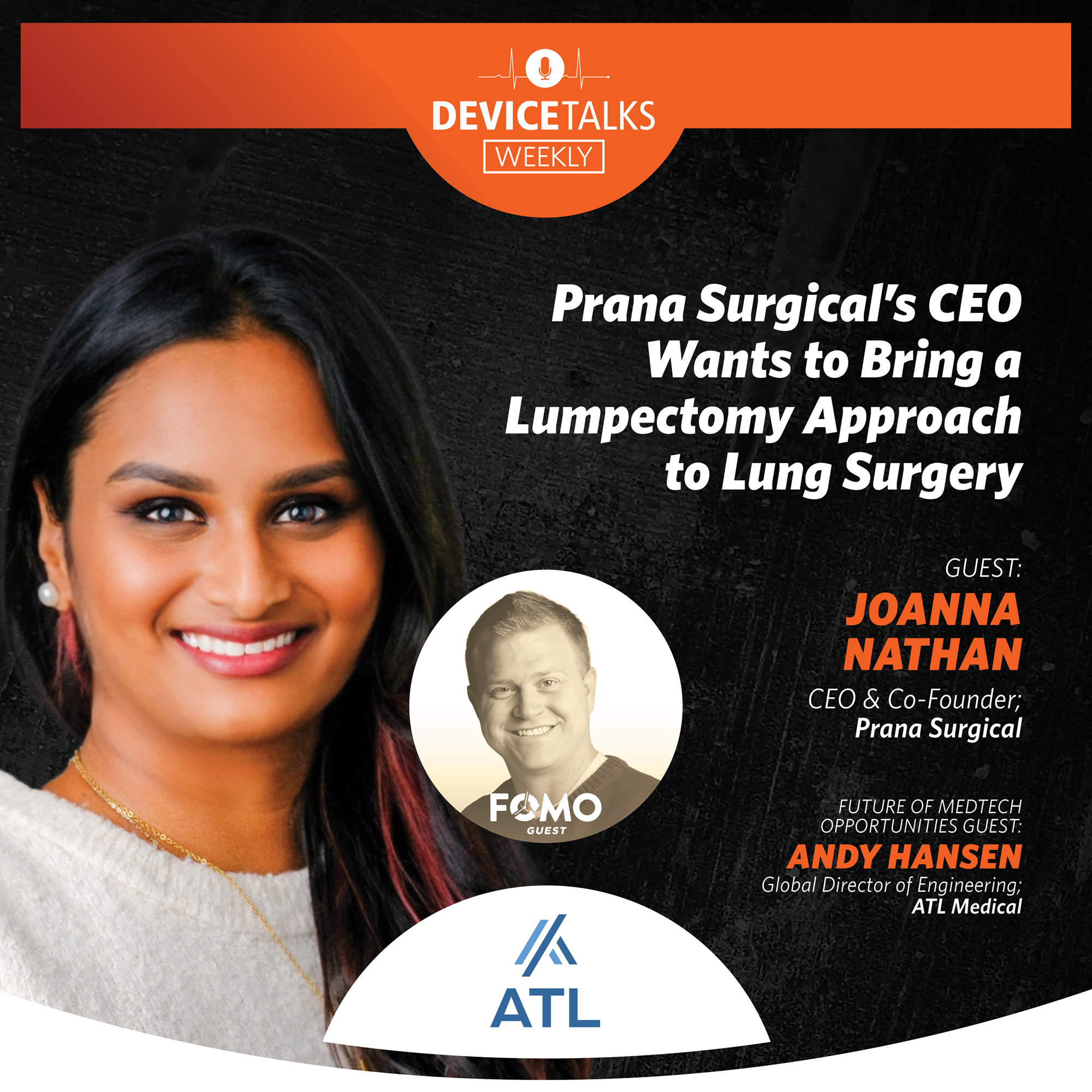
Episode topic: Device Talks Weekly Ep 307 covers (1) a “Newsmakers” roundup on medtech deals, antitrust litigation, and corporate restructuring, (2) FOMO on energy-delivery engineering for pulse field ablation (PFA) and intravascular lithotripsy (IVL), and (3) a keynote interview on Prana Surgical’s approach to early lung cancer “lumpectomy-like” surgery.
Written by AI. May contain mistakes.
Kayleen discusses the episode's content and introduces the next guest.
“dedicated to solving that exact problem.”
Kayleen welcomes Chris back and discusses the podcast's mission.
Chris shares his experience during MEA weekend and its significance.
“A new era, but an era that continues to maintain our mission.”
Kayleen and Chris dive into the Newsmakers segment discussing industry news.
“Well, you know, we had this news last week, so I'm kind of like pulling some top stories from, you know, the last two weeks, you know, just so that, you know, people don't miss out.”
Discussion on a significant partnership in robotic surgery and its implications.
“I mean, their Mako systems are like dominant in orthosurgical robotics.”
Chris analyzes the recent earnings report of Intuitive Surgical and its challenges.
“So this is like a major giant med tech now.”
Discussion on J&J's plans for their orthopedic business spinoff and merger rumors.
“They're going to pay, they're not admitting wrongdoing, but they're going to pay like$450 million.”
Discussion on the potential merger between Depew and Smith & Nephew and its implications.
“that they were all that, totally rumors, but that like J &J was near the end of getting a merger done between Depew and Smith & Nephew.”
Exploring Abbott's decision to spin off its nutrition division and its impact.
“You know, so this was like news that I caught at the start of this week that Abbott announced in their earnings report that they're going to spin out their nutrition business.”
Insight into Medtronic's promotion of a new president and its implications.
“But anytime I think that you can hyper focus, you just end up with better outcomes.”
Discussion about the future direction of Medtronic under new leadership.
“He's based in, he has a lot of roots in Boston, based in Boston.”
Detailed discussion with Andy Hansen about technology advancements in PFA and IVL.
“of pulse field ablation and intravascular lithotripsy.”
Explore the critical factors for scaling medical technology successfully.
“Scale is so critical because clinical success doesn't automatically become commercial success.”
Discuss the exciting opportunities in MedTech and the importance of innovation.
“Now, we can't have an episode of the future of MedTech Opportunities without looking toward the future.”
Andy Hansen shares insights on scaling production and meeting clinical needs.
“Thank you so much, Andy Hansen, Global Director of Engineering, ATL Medical.”
Joanna Nathan discusses her background and experiences leading to Prana Surgical.
“And I really should have said actually welcome back.”
Joanna highlights the importance of storytelling in MedTech and her experiences.
“And that's kind of culminated in where I am today with with Prana, but there were a lot of really interesting stops along the way.”
Joanna Nathan addresses the key problems with current lung cancer diagnosis and treatment.
“And, you know, at some point it kind of graduated from that model that was present within J &J.”
The speaker shares personal experiences with lung cancer and the hope in MedTech.
“We actually, or I actually lost my father to lung cancer.”
Discussion on the Prana Surgical system aimed at improving lung cancer interventions.
“If you are right-sizing, how do you right-size the option for intervention when you do have a finding?”
Exploration of design decisions and challenges faced in developing the Prana system.
“I want to dig in maybe more about the key design decisions.”
Insights gained from initial clinical trials and the importance of feedback for improvements.
“You hit the nail on the head when it comes to adapting to current workflow.”
Discussion on the appropriate use of AI in medical technology development and its limitations.
“I have a couple more questions for you about AI, and then we're going to look into the future.”
Explore the role of AI in med tech and the importance of human oversight.
“So I do think there is a distinction to be made there where you still really, really want human eyes along the way at every single possible check.”
Learn about Prana Surgical's vision for early intervention in lung cancer.
“is nodding their head emphatically right now and saying, yes, yes, yes.”
Discussing the impact of lung cancer interventions and resources to learn more.
“that entire shift of the disease state to something that is more manageable and treatable earlier on.”

Get the gist, explore an idea or ask about something said.
 Claude
On DeviceTalks Weekly, what are the key points of this episode?
Searching your listeningAutomatic transcript. May contain errors.
0:01Joanna Nathan: Hey everyone, I'm Kayleen Brown and welcome back to another episode of the Device Talks Weekly Podcast. I have a full episode for you today. Newsmakers is back! And we'll hear from Andy Hansen, Global Director of Engineering at ATL Medical, on the future of pulse field ablation and intravascular lithotripsy. I gotta tell ya, Andy has a future narrating audiobooks. I swear I could feel my autonomic nervous system regulate during that interview. from PFA and IDL, we'll talk about lung cancer, the leading cause of cancer death, and one that I am enormously impacted by. But this is why I do what I do, why I love this industry so much.
0:43Joanna Nathan: For every story of heartbreak, there are 10 stories of innovators who are dedicated to solving that exact problem. And luckily for me, I got to speak with one of those innovators. Joanna Nathan, CEO and co-founder for Prana Surgical, joins me in the studio to discuss Prana's approach for early lung cancer detection and right-sizing intervention in lung surgery. But before we get into all of that, just a reminder to join me on next week's Device Talks Tuesdays featuring Blue Star silicones. We'll walk through three, not one, not two, but three case studies where material innovation solved performance and manufacturing challenges without changing the device design.
1:24Joanna Nathan: So visit devicetalks.com to register for free. And of course, check out all of our other upcoming Device Talks Tuesdays episodes. We have Orthopedic Innovation Week starting November 10th. We have some great Device Talks Tuesdays for you. We have Device Talks Minnesota and Device Talks Boston coming up early in 2027. So a lot to check out, devicetalks.com. All right, we have a big episode today. So let's get this podcast started.
1:53Kayleen Brown: Are you ready for this? Ready.
2:25Joanna Nathan: Chris Newmarker, welcome. How are you doing, my friend?
2:27Kayleen Brown: Good to be here, Kayleen. Doing well. Doing well. Oh, my gosh. It's a new era. Here we are.
2:35Joanna Nathan: A new era, but an era that continues to maintain our mission. And our mission, as always, is just to help the industry build better devices. So I'm glad that we get to continue that mission together.
2:48Kayleen Brown: Me, too. I'm just so excited. And, you know, I feel like we, I mean, I know that this podcast has done, you know, just an incredible amount of good for the industry. And this is so exciting. We can, like, keep this going for everybody.
3:05Joanna Nathan: Yeah. I mean, I couldn't agree more. So it's going to be really fun. And I know that we already talked about having the other editors joining us on the pod here moving forward. So we're going to get a lot of great voices and we're going to just continue to bring that mission home to our device talkers and everybody in medtech. But I couldn't do it last week because somebody, not naming any names, but Chris Newmarker couldn't join me on the pod because you were. Yeah, you said M-E-A weekend. So I did tell everybody that that was the reason. But I also admitted that I had no idea what that stood for, what that meant.
3:46Joanna Nathan: but everybody in Minnesota would. So enlighten us. What's MEA weekend?
3:50Kayleen Brown: If you have school-aged children in Minnesota, you know what MEA weekend is, which is basically that the teachers all across the state take half a week off so that their union, the Minnesota Education Association, could have a big conference in St. Paul. And so this is a great opportunity in the late fall to basically, if you have the means, take the family on a vacation. So we were going on a vacation. And I tell you, I mean, like we went to Northern California for a week, had a great time in San Francisco, went down the coast. But it was like really funny, like the Saturday evening flying back after all that, like the plane was full of children.
4:36Kayleen Brown: So I mean, like a bunch of other people had the same ideas. It was just full of families coming back for vacations. My oldest son, two of his best friends were both at Disney World that week. So a lot of trips, a lot of vacations. So you hear a lot of, if you're at vacation destinations elsewhere in the country, you hear a lot of people overpronouncing their O's that week because a lot of Minnesotans are getting out of the state with their families and stuff. But now I'm rested and ready. And here we are. We can do the New Markers Newsmakers.
5:11Joanna Nathan: well i'm so happy to have you back uh let's start with the the countdown the final countdown dude i love that it's great i actually nailed it i was like i'll edit that out you nailed that no you keep that in you better keep that in that's gonna be my only claim to fame for this entire segment so with that sweet sentiment chris let's just start with number five so what do we you need to know about the CMR Surgical Stryker Robotics Partnership? Okay.
5:41Kayleen Brown: Well, you know, we had this news last week, so I'm kind of like pulling some top stories from, you know, the last two weeks, you know, just so that, you know, people don't miss out. This is like a$400 million deal with CMR Surgical for U.S. rights to sell its Versius Plus system. And, you know, Stryker also has an exclusive option to buy the robotics developer. I mean, this story would have been like a number one any other time. I mean, but we just have so much news to report today. But I mean, there has been speculation for years now, like when is Striker going to get into soft tissue surgical robotics?
6:24Kayleen Brown: I mean, their Mako systems are like dominant in orthosurgical robotics. And this is it. I mean, it looks like they've got this deal to distribute CMR Surgical System. I mean, CMR Surgical System has been kind of this, I hope they like me saying this, they've been kind of this feisty British company that's been kind of like, you know, looking to make plays in like, you know, the ambulatory surgery center space or whatever with, you know, this kind of like versatile, you know, Versius Plus platform. And obviously, Striker likes what they see. And this seems to be part of their story of how they're going to be, you know, competing in the space going forward.
7:00Joanna Nathan: Is that what you see it as, a play to be competitive in the robotic space?
7:05Kayleen Brown: Absolutely. I mean, Stryker's already, you know, huge when it comes to like orthopedic surgical robotics, like where you're using robots to, you know, basically reduce errors in like knee surgery or hip surgery. But, you know, like, you know, now this is like a soft tissue surgical robot. I mean, and Stryker definitely is like a lot more than just an orthopedic device company they're you know an orthopedic and surgical device company and so this is like yeah this is here they are they're they're getting exclusive distribution rights to like a soft tissue surgical robotic system um you know and and it's not something i mean it kind of it might compete a bit with it kind of competes with intuitive but it's also like something that can like play in places where intuitive wouldn't be because intuitive is like really big in hospitals.
7:54Kayleen Brown: So this is like a major giant med tech now. Like, okay, this seems to be like a part of the story of what they're going to do to compete in that space. And they've always been, I even saw some of the LinkedIn posts out of AdVamed were, you know, saying that, you know, we had, you know, Kevin Lobo, who's, you know, now going to be retiring at Striker. But I mean, even him, he was like, kind of like saying, oh, stay tuned about, you know, soft tissue surgical robotics, you know, what we're going to do in that. And yeah, this is it.
8:26Joanna Nathan: Do you see it being competitive to J &J MedTech's Otava?
8:31Kayleen Brown: Yes. Yeah. I mean, this could be, yeah, absolutely. I mean, and CMR has been kind of the smaller company. So, I mean, that has been kind of like a question, like, how are you going to compete against a Medtronic or J &J who are also trying to do, you know, have some similar strategic plays. and now it's like, oh, okay, you're going to have this strategic partnership with Striker that could, that has this option that Striker could even buy them down the road. So now it's like, okay, there we go. So I mean, I've always been a huge fan of competition. I think competition begets innovation. I mean, this is great.
9:13Kayleen Brown: It's just awesome to see even more competition down the space. I mean, this is just so fun to cover search core robotics right now.
9:19Joanna Nathan: It is fun. All right. Well, let's keep the fun going. I'm looking at number four and we have another development in what I would consider a trend. Walk us through what we need to know.
9:33Kayleen Brown: Yeah, absolutely. So we had intuitive earnings out. Our new senior editor, Connor Hale, covered intuitive earnings. They took a hit in their stock on, there's a little bit of a slowdown in the growth of their U.S. procedures with DaVinci. But, you know, I think another big thing that affected their stock was that they announced that they're going to settle a years long class action antitrust suit that was filed by health providers against them. They're going to pay, they're not admitting wrongdoing, but they're going to pay like$450 million. And this was about health providers claiming that Intuitive was, you know, stifling competition among, you know, aftermarket service providers.
10:19Kayleen Brown: that would basically making itself like the de facto exclusive repair provider for DaVinci machines and instruments. I mean, sure, there could be other companies that could try to compete in that space, but they were just basically claiming that Intuitive was just engaging in practices that was enabling it to pretty much make it the exclusive repair provider. But at this point, with the health providers, they're settling the suit, And there's more suits that are continuing to go on around intuitive. I mean, there was like a parallel suit that I've covered in the past that was filed by an Illinois outfit called Surgical Instruments Service Company.
11:00A federal judge in California ruled in favor of intuitive, but then it went to the U.S.
11:07Kayleen Brown: Court of Appeals for the Ninth Circuit and they reversed it. So now that's heading back to the, you know, to the U.S. District Court. And then we have another suit that was filed by an outfit called Restore Robotics Repair. And that's under repeal in the 11th Circuit. So, I mean, this is going to be ongoing. And then, yeah, it's definitely, it's, you know, three, I, you know, there's an old phrase from like all my years, you know, in journalism. Like, yeah, you know, three things make a trend. And, I mean, my gosh, I mean, Medtronic, you know, lost a, you know, an antitrust suit filed by Applied Medical Resources.
11:44Kayleen Brown: You know, so kind of saying that, you know, Medtronic was, you know, using bundling practices to monopolize, you know, U.S. market competition. and, you know, J &J's Biosense Webster. Like we had, you know, a story in 2025 about, you know, about a$147 million verdict against them. And that was another, you know, antitrust case. That one filed by a cardiac mapping catheter reprocessor saying, again, like J &J was using its size to engage in anti-competitive practices. So, I mean, it really seems like we've got this really, this trend going on of like kind of these David versus Goliath lawsuits where these like reprocessors and repair people and whatnot are, you know, they're being able to like success, you know, find some success with antitrust arguments against the really big medtechs.
12:41And it's going to kind of change, it could change the dynamic of how, you know, medtech
12:48Kayleen Brown: companies like operate like in you know in the United States maybe even elsewhere.
12:53Joanna Nathan: Wow.
12:53Kayleen Brown: Yeah.
12:55Joanna Nathan: I mean that's that's really interesting and we'll just keep an eye on it. I'm gonna back away from that story and I'm gonna move us into number three. Okay. So Johnson & Johnson MedTech let's talk about their ortho spinoff. What do we need to know?
13:09Kayleen Brown: Yeah yeah so I mean we had their earnings report you know report out as well. I mean we're now like in the thick of a quarterly earnings season. This is, it's always a, you know, four times a year we're like, like just getting through all these like earnings reports that are coming out. And, you know, J &J, they've now set a mid 27 target for a, you know, a spinoff of their Depew Synthese orthopedic business. You know, so we'll be, you know, watching out for what happens with that. But hot off the presses just today. Ooh, late on me. Yeah, I know. Connor, you know, we caught a Financial Times story.
13:48Kayleen Brown: I mean, it's gossipy. Who knows if it's true? But I mean, it's always fun. Like the, you know, the financial press, they'll like have like these anonymously sourced articles about what's going on with mergers and acquisitions. And the Financial Times was saying that, that they were all that, totally rumors, but that like J &J was near the end of getting a merger done between Depew and Smith & Nephew.
14:14Joanna Nathan: No.
14:15Kayleen Brown: And that, yes, that would have created this huge, I mean, Depew is already a huge orthopedic device company, but you would have had Smith & Nephew merging with it, and then it was just a disagreement over who should be the CEO, derailed it at the last minute. Which, who knows if it's true, but that's pretty wild. And Bloomberg a few weeks ago was saying, also anonymously sourced that it could have been a private equity deal, that there was some kind of private equity thing in the works. But I think this is going to be really interesting to follow. I mean, because I mean, like I'm wondering, what's next?
14:51Kayleen Brown: Like what are we going to hear next in the whole financial markets rumor mills about like what's going on with this deal? But I mean, we have like a multi-billion dollar orthopedic device company that's getting spun out in some way. Like what's, you know, where it's going to go? It's, yeah, it's going to be really interesting to follow and And fingers crossed. I mean, OK, if they actually do what they're now, what they were saying in the earnings report, like, OK, we're going to do a spinoff. It's going to happen in mid-2027. I mean, just here's to hoping that, you know, I mean, Depew's growth has been kind of slow in recent years.
15:24Kayleen Brown: Hopefully, it's like as an independent company that can kind of have some more focus and we can see them kind of like get some more mojo and grow more because they're such an iconic brand in the industry.
15:35Joanna Nathan: let's uh shift over to number two so abbott spinning out their nutrition business yeah
15:40Kayleen Brown: everybody's doing this it's like i mean it's almost like phases like i've been covering the industry like long enough like sometimes we have phases where everybody's like gobbling up things and growing and then now we're in this phase where everybody's like oh boy like uncertainty in the world you know we need to be more focused like why do we maybe this should be spun off so that we can focus more on some of these other core things. And Abbott now has decided to do this. You know, so this was like news that I caught at the start of this week that Abbott announced in their earnings report that they're going to spin out their nutrition business.
16:15Kayleen Brown: So, I mean, this is like a business that makes all kinds of like, you know, supplement drinks as well as baby formula. I mean, I don't know about you who used some Similac in the house in the past, you know, with the kids. So, I mean, yeah, I mean, so there's some iconic brands here, like Insure, Similac. Yeah, I was saying Insure. Yeah. I mean, these are all going to become an independent company now. And it's going to, like, Abbott's going to become much more focused on, like, kind of, it's, like, medical devices as well as diagnostics. I mean, they've brought exact sciences and those Cologuard tests under their tent now.
16:51Kayleen Brown: So, I mean, that's going to be a bigger part of what they do. So, yeah, we'll be following how things go with spinning off that nutrition business.
17:00Joanna Nathan: I mean, candidly, I didn't really even know the depth of the Abbott nutrition business until I learned about the spinoff. But anytime I think that you can hyper focus, you just end up with better outcomes. So I'm pretty encouraged by this.
17:16Kayleen Brown: Yeah, me too. I mean, at least the markets seem to be taking it well. The analysts seem to be taking it well. that, you know, that does seem like a good strategy for focusing.
17:28Joanna Nathan: Excellent. So our number one position is held by Medtronic. I'm not going to give anything away. Bring us home.
17:33Kayleen Brown: Yeah, number one on the list. Yeah, from Medtronic, I found over the years like that, like one way, you know, you can really like find out some interesting things if you just read through the financial filings with the SEC. In this case, this was me earlier this week. Like, you know, Medtronic File and AK had a number of different items in it, you know, and I'm just reading through it and like right in the middle of it's like, oh, we've promoted this executive to be president of the company. And I was like, wow, that's news. That's really news. And, you know, generally, I mean, nothing for Medtronic on this, by the way, but I mean, generally, when a publicly traded company, like, you know, promotes somebody up to a president's spot reporting directly to the CEO, I mean, that can generally, that's kind of an indication of where the company is, you know, what they're thinking succession-wise when, you know, when the CEO ends up, you know, retiring or leaving.
18:38Kayleen Brown: Like if the board decides to go the let's promote from inside for the CEO job spot. So, I mean, this is something that, you know, people pay attention to that, you know, like, okay, now somebody's been promoted up to the president role inside the company. And, you know, in this case, this is Mike Marinara, who, you know, has, you know, he's been, you know, with Medtronic now for, you know, he's a veteran of the company, started out as, you know, a Boston -based territory sales manager back in 2000, worked his way up in the company, you know, did a lot of roles in the cardio side of the business.
19:17Kayleen Brown: but most recently he was EVP and president of, you know, the MedTech Giants medical surgical portfolio, has been playing a role with, you know, managing what's going on with the Hugo Robotic Surgery System, which is, I mean, Medtronic has a lot of, you know, hopes pinned on, like, the system really enabling it to compete against Intuitive in that space. So, you know, so now, you know, Mike is, you know, going to be president of the company, you know, and it's kind of interesting, too. He's based in, he has a lot of roots in Boston, based in Boston. So, you know, I think it's going to make the, like, Minnesota versus Boston, that tech hub debate even more fun.
19:57You know, now they have kind of like a number two executive in the company
20:02Kayleen Brown: who's, like, you know, based in that Boston hub. So, you know, it'll be fun.
20:08Joanna Nathan: Well, maybe he's bringing you both together, Boston and Minnesota.
20:11Kayleen Brown: There you go. There you're right. just bringing the boss in Minnesota together and yeah and we have a request out with Mike trying to get Mike on this podcast at the future date and we'd love to have love to have him on here because I think it would just be really neat just to hear from him and you know his perspective on Hugo and you know really like where he sees you know the world's largest medtech company going in the future so he's playing a really big role in that company
20:38Joanna Nathan: well we love Mike here at Device Talk so we're excited for him and best of luck. And hey, Chris, we did it. We did. Yeah, we did this. Did the final countdown. We went five to one. I missed you last week. So very happy to have you back. And all I can really say is that I think what we do matters. I appreciate you more than I can possibly communicate.
21:00Kayleen Brown: Back at you. Yeah.
21:02Joanna Nathan: I hope we just can continue sharing these medtech stories and the timely news and why it matters for industry for as long as MedTech will have us.
21:12Kayleen Brown: Exactly, yeah. As long as they'll let us, we'll get, you know, some other people on the team too to, you know, stop by and do these as well. So we'll, you know, like we've built like a fantastic team here over at, you know, Device Talks and MassDevice. And it'll be great for people to hear from, you know, everybody on our team, you know, on this podcast. So thanks again, Kaylee. And we'll talk again soon.
21:34Joanna Nathan: All right, done deal. Have a great weekend.
21:36Kayleen Brown: You too.
21:38Joanna Nathan: Before we get into our keynote interview, I'm excited to bring you this episode's FOMO. Hello and welcome. I'm Kayleen Brown, Managing Editor for Device Talks, and this is another episode of the Future of MedTech Opportunities. Today, we're going to be talking about the future of pulse field ablation and intravascular lithotripsy. Today, my guest is Andy Hansen, Global Director of Engineering for ATL Medical, and thank goodness for that because I have a lot of questions. Andy, welcome to the podcast.
22:07Kayleen Brown: Thanks for having me. I'm really excited to be here today.
22:10Joanna Nathan: So we both know that pulse field ablation and intravascular lithotripsy have generated tremendous excitement. What I'm trying to understand, Andy, is why are these technologies getting so much attention right now? Can we start with PFA?
22:25Kayleen Brown: Yeah, I think the attention that PFA is getting in the market is it's changing the way that physicians are able to treat their patients. With PFA, physicians are able to treat difficult diseases more effectively. They're able to use short, high-voltage electrical pulses to create electroporation in cardiac cells rather than a historical way of ablating using heat and freezing the tissue. It's exciting because it allows physicians to create effective lesions quickly, much more quickly than what they have historically have been able to do. It's reducing the impact on nearby tissues, on the blood in the vessels.
23:11Kayleen Brown: It's also creating opportunities for different catheter designs and new ways of delivering the therapy.
23:18Joanna Nathan: What about IVL?
23:19Kayleen Brown: IVL addresses a different but equally difficult problem. heavily calcified coronary and peripheral vessels they just stay stuck but with IVL it's able to convert electrical energy into controlled acoustic pressure waves that are able to fracture calcium in the vessel before a balloon or stent is fully deployed making the tissue more pliable and able to expand. It's really exciting because it helps the device do what it's intended to do and not be blocked by the physical and physiological constraints that a particular patient may have. So while the technologies are different between PFA and IVL, the value is similar.
24:11Kayleen Brown: They give physicians a more controlled way to treat difficult anatomy with the potential to improve efficiency, consistency, and safety for the patient.
24:23Joanna Nathan: Let's talk about the fact that both technologies rely on sophisticated energy delivery. So what engineering challenges do you think manufacturers will need to solve?
24:33Kayleen Brown: I think the biggest challenge is getting that energy delivery, the electronics, and the miniaturization to work together in a device that has to perform the same way every time. With PFA, you're sending very precise, high-voltage pulses through a flexible catheter. So you have to manage the signal integrity, electrical isolation, and patient safety all at once. It gets harder and harder as electrode counts go up, as catheter profiles get smaller. You also have to think about the heat, the insulation, the cable performance, and how the generator, catheter, and mapping systems all interact together.
25:19Kayleen Brown: IVL presents a different set of challenges. You're converting electrical energy into acoustic pressure waves that need to fracture calcium without damaging surrounding tissue or compromising the catheter. That means carefully controlling the emitters, fluidics, balloon performance, material, and energy transmission. In both cases, strong test methods are essential at the component, subassembly, and finished device levels. So it's not really about designing one good catheter or one good generator. It's about understanding and verifying how the entire system behaves under real operating conditions and setting up your system and your manufacturing to do that consistently and not just building one or two, but building thousands and tens of thousands.
26:10Kayleen Brown: Because market adoption is coming. We will need to have a steady supply to meet the demands of the market.
26:17Joanna Nathan: So where do you see the greatest innovation opportunities in these markets?
26:21Kayleen Brown: In PFA, I expect to see more advanced catheter shapes, higher density electrodes, and better ways to assess tissue contact and confirm lesion formation. Over time, procedural data may also help physicians tailor energy delivery to the individual patient based on their specific anatomy. There's potential to move beyond AFib or atrial fibrillation into areas such as ventricular tachycardia and severe premature ventricular contractions. Although each new indication will require its own evidence and a careful optimized approach, I think there's plenty of opportunity in the market to expand those indications to better serve our patients and the user base.
27:05Kayleen Brown: With IVL, I think the opportunities include lower profile devices, better deliverability through difficult anatomy and broader vessel size coverage and a more precise control of energy delivery. Across both platforms, sensors, connectivity, device identification, software could provide real-time feedback that physicians do not have today. Materials innovation will matter too because it can enable smaller profiles and more complex assemblies without sacrificing reliability. Ultimately, the most valuable advances I see will expand what physicians can treat and give them better information during the procedure to have better clinical outcomes.
27:53Joanna Nathan: As these technologies mature, then how important is manufacturing scale to successful commercialization?
28:01Kayleen Brown: Scale is so critical because clinical success doesn't automatically become commercial success. Many companies fail because they can't scale. Early builds often rely on highly skilled technicians, specialized equipment, and a fair amount of manual adjustments. That may work during development or during an initial clinical study, but it becomes very difficult to sustain once demand starts growing. The challenge is to make the process more repeatable, measurable, and efficient without changing the performance that produced the early clinical results. At ATL, we help customers prepare for that transition through design for manufacturing, process characterization, validation, automation, and global production transfer.
28:54Kayleen Brown: I also look closely at needing to make sure that we have supplier readiness, tooling capacity, test systems, throughput, looking at our yields, our critical material availability. Because one constraint in any of those can limit the output of the entire program and impact the ability to get components and devices to a doctor to treat real clinical needs. So our vertical integrated footprint can simplify that coordination. And you have customers' options for regional production and business continuity as volumes grow. The real measure of successful scale-up is whether every unit performs as it's intended, even while the outputs increase, costs become more sustainable, and supply remains dependable.
29:51Joanna Nathan: That was really helpful. Now, we can't have an episode of the future of MedTech Opportunities without looking toward the future. So that being said, as you look toward the future of MedTech, Andy, what do you and ATL find most exciting about technologies like PFA and IVL?
30:08Kayleen Brown: Yeah, what's most exciting to me and ATL Medical is the opportunity to help turn a breakthrough therapy concept into a product that can reach more patients. You know, there's a lot of clinical needs out there, and I find it so exciting to be a part of meeting those clinical needs in how I design and how I build sustainable products that can impact patients, impact family members. technologies like PFA and IVL are changing what physicians can do. But moving from a promising concept to a commercially viable product, it requires a different set of capabilities. The OEMs, they own therapy vision and clinical strategy.
30:56Kayleen Brown: And we at ATL can help translate that vision into a device architecture and manufacturing approach that can be executed consistently. The earlier we're involved, the more opportunity we have to work through design trade-offs, identify production risks, and create a practical path through development, validation, launch. That collaborative role is what interests me the most. We're not simply waiting for a finished device and then building it. We want to help customers make the decisions needed to turn an innovative therapy and a reliable commercial product. Something that can really have impact in the market and have commercial outcomes that meet the investor's needs.
31:44Kayleen Brown: Being part of that process and ultimately helping expand patient access is what makes these technologies so compelling to myself and the organization I work for.
31:55Joanna Nathan: Thank you so much, Andy Hansen, Global Director of Engineering, ATL Medical. Thank you so much for joining us on the future of medtech opportunities.
32:03Kayleen Brown: You're so very welcome. Thanks for having me today.
32:06Joanna Nathan: And for our audience, to learn how ATL Medical can support the development and scalable manufacturing of advanced energy platforms, please connect with the ATL team at atlmedical.com. Please connect with Andy on LinkedIn. It was such a joy. Thank you again. And now I bring you our keynote interview. Joanna Nathan, CEO and co-founder at Prana Surgical. Welcome to Device Talks Weekly. Thanks so much for having me, Kayleen. And I really should have said actually welcome back. This is not your first time on the podcast. I know that I wanted to invite you back, but I'm so glad that you said yes. And Joanna, in addition to being, I'm going to call you now a regular, we have had many people actually recommend that I have you on the podcast.
32:53Joanna Nathan: Most recently, Features Capital's Jenny Barba. She said specifically in her interview that I have to get Joanna Nathan, a prana surgical, on the podcast. So Jenny, this is for you and to everybody else who said we need to get Joanna on the podcast. I'm giving you what you want and what I want, what we all want. So thank you for being here. It's the long-winded way of saying that. Absolutely. Yeah. And yeah, great to hear that people are recommending me, of course, but also great to be here. I think it was probably about three years ago, not to the day, but close that we were on here just as part of kind of MedTech Innovator and other things like that.
33:30Joanna Nathan: And at that point, I was getting ready to go to AdvoMed for MedTech Innovator. So yeah, great to have a full circle moment, I guess. I love a full circle moment, definitely. And I remember when we did get to learn about Prana Surgical right before the AdvoMed showcase, the kind of the final around it. So I'm really interested in what's happened in the last three years. Let's start maybe even before that, though, Joanna, because I've gotten a chance to know you. Our audience probably doesn't. So let's start with medtech. How did you become one of us? How did you find your way into medtech? Yeah, I, you know, I've been wanting to do something this world since I was like 14, 15 years old.
34:09Joanna Nathan: So, you know, 20 plus years of loving this field and wanting to help patients, not as a physician, because I knew quite early on that was not my calling, but as a technologist and innovator. So I, you know, I'm a bioengineer by training. I went to Rice University here in Houston, where I'm based now. And I've spent the last, you know, 15 years since my degree is really building early stage companies, building, helping build part of the life science ecosystem, you know, and spending most of my time, most of that time dedicated to advancing kind of medical technologies. And that's kind of culminated in where I am today with with Prana, but there were a lot of really interesting stops along the way.
34:51Joanna Nathan: Enlighten us. Tell us at least about a couple of those stops. Yeah, yeah. So my first job kind of out of school was really, you know, in the hallowed halls of Texas Heart Institute, you know, where Denton Cooley and, you know, huge, huge names like that that are so important to, you know, the history of kind of cardiac medical technologies in particular were developed. And I worked for an electrophysiologist by the name of Mehdi Razavi, who is a serial innovator and serial inventor, and, you know, worked developing technologies in his lab, and really fell in love with the concept of working on a medical device.
35:31Joanna Nathan: I think some of the reason I ended up in med device and not, let's say, biotech or pharma or something else, you know, was I was impatient, you know, impatient to get to impact. And I really, while in my undergrad days, you know, I spent some time at the bench and those kinds of things, like the interesting thing about medical technology is you could build something today that could be in a patient in three to five years, you know. And that piece really, really resonated with me. So went to Texas Heart Institute, helped spin out a company called Seranus in the kind of interventional cardiology vascular space, ran product development there in my 20s, which I don't know if I had any business doing or not, but the company made it all the way through patients and so on and ultimately was acquired, which was great.
36:18Joanna Nathan: But then I ultimately realized, even though my training was that of a bioengineer, I really loved the storytelling and strategy aspects of our world. You know, I really loved watching our CEO at Seranis take the same narrative and translate it to physicians or, you know, scientists or investors or, you know, and it's the same story, but you tell it differently, right? Depending on the stakeholders sitting across from you. And that was fascinating to me. And so I went back to business school and then spent some time, you know, on the other side of the table, first with a fund in town here called Mercury Fund, which was a great experience for me, just learning how kind of in a traditional VC setting, like how that works.
37:03Joanna Nathan: And then managing a small portfolio of medtech startups at a J &J, you know, innovation center, a device innovation center here in Houston. And that's actually where I met my co-founders for Prana is they had brought their idea to J &J. It was being co-developed. And, you know, at some point it kind of graduated from that model that was present within J &J. And I got to work with J &J to kind of spin it out into a new co and get it going in 2021, 2022. My gosh, I love all of that. I kept being like, oh, I want to follow up on this one. I want to follow up on this one. So I'm going to try in no particular order.
37:42Joanna Nathan: You had said that you were impatient to get to impact. I'm going to say that again, impatient to get to impact. Like, I love that so much. That really, I think, is a common denominator amongst us here in medtech that we are. And to be able to see that impact in not just our lifetime, but within a decade, it's really phenomenal. And then a couple of other things that you said, but the last one I'm just going to go to is, Are you talking about the Texas Medical Center, J &J CD? That's right. Yeah, I actually had the absolute pleasure. Early on in my career, one of the first series that I hosted was called Meet the Innovators.
38:20Joanna Nathan: And I was on site and I got to meet with all of the great innovators and Dr. Billy Cohn. And it was one of my all time favorite memories. That was, I think, what established me as knowing for the rest of my life, I want to be a storyteller. So that's like maybe a third thing that you said that really resonated with you is the storytelling aspect of the industry. So girl, girl, girl, this was awesome. Yeah. And you can do storytelling. I mean, it's really tough to beat the masterclass that is Billy Cohn when it comes to storytelling. You know, he he was like met for the stage and I think stuck being a cardiac surgeon or settled to be a cardiac surgeon because he does those magic tricks and all that other stuff.
39:02Joanna Nathan: But yeah, he, yeah, just, you know, being proximal to him through Texas Heart, through CDI, you know, I got to learn a lot about really the skill and kind of practice behind storytelling and just got to watch him and develop my own version of that. Right. No one can do what Billy does. But yeah. I'm going to agree with you, even though I think you're phenomenal what you do, but you're right. Like there's no other Billy Coe. Right. One of one. I feel like we could spend the next 40 minutes just talking about really, but we'll move on. Let's talk about the specific problem that I think Prana Surgical is trying to solve.
39:39Joanna Nathan: So let's just take a step back here. So what is the problem with the way that early lung cancer is being diagnosed and treated today? Let's start there and then we'll shift to Prana. Yeah, definitely. There's, you know, so many interesting issues with this clinical problem. And, you know, like I mentioned, I was more cardiac. I hadn't spent a lot of time in oncology or surgical oncology. So it was fascinating for me to like really learn about this disease state before diving in even to leading a company in this space. So, you know, lung cancer is the number one cause of cancer death. Early detection typically has not been on the table because, you know, for a variety of reasons, including stigma and other things like that, we have not screened for lung cancer like we do for breast, for colon, for prostate, right?
40:22Joanna Nathan: So we We're very, as a healthcare system, we are much more prepared and used to seeing lung cancer patients in later stages where there are fewer options. Now, what is really interesting about this time right now is that it's really shifting. And that is because lung cancer screening came online in 2013 and started being covered by Medicare and started being, you know, basically prescribed to specific high-risk patients. And those guidelines continue to expand. is a narrow age limit in smoking history. And now that's getting broader. And eventually, we think it'll eventually just be an age-based screening, right?
40:58Joanna Nathan: So that is one piece of it, is a screening. What is changing about the disease state is screening. The other is just much, much more widespread use of CT, right? So you are in a car wreck and you go to the ER and they're worried about internal bleeding. They're going to do an abdominal CT and something might light up in your lungs at that point. So those are called like incidentally found nodules, incidental findings, right? That is a large and growing market at about 10 % each year, just because again, CT is so much more built into our day-to-day practice of medicine than it used to be. So, you know, detecting and finding a nodule or detecting and finding suspicious, something suspicious of lung cancer now in the last decade has rapidly transformed this disease state.
41:44Joanna Nathan: And it's moved, you know, in just a few years, it's moved the survival rate. It's moved how many things we're finding early. And it's just, you know, we're watching the disease state transform in front of us, which is really encouraging and really, you know, important to the story of Prada and why now is the right time to work on what we're working on. That was some great history and a little bit of connection and history on my end. We actually, or I actually lost my father to lung cancer. So lung cancer has always been really personal to my family. And then my mother-in-law actually passed away from lung cancer as well.
42:21Joanna Nathan: The exact same kind, which is just kind of wild that it impacted my partner and myself so much. So to hear the hope and encouragement in your voice is another reason why I'm like, MedTech, one of us, never leaving, we're the best. Because I mean, that's all we have, right, is hope. And it's not just hope, it's hope plus action and solving a real problem. So that kind of in mind, I do want to talk about the prana system. I'm going to separate that from my question here because we're going to dig into the system here shortly. At a high level though, what is prana surgical trying to change about early intervention to the points that you could make?
43:02Joanna Nathan: So detecting a nodule is one thing. Obtaining a reliable diagnosis or going after that nodule and intervening it is a different challenge, right? So I think we've, you know, started to really solve the problem of detecting these nodules with screening, with incidental findings, with, you know, even blood-based tests, right? Liquid biopsy, things like that. However, once you find, have a finding, you have to go do something about it typically. So the problem space that we exist in is really how do we help figure out what exactly is going on in the lung of a patient that comes in with kind of a smaller earlier nodule.
43:44Joanna Nathan: Because again, the disease state is used to addressing things later stage. And so major interventions are more appropriate when a patient is sicker. But when you're still questioning whether a patient is even sick, you kind of have to right-size your approach there, right? So today's options, there's, you know, bronchoscopy, there's needle biopsy, there's more invasive surgical resection, or a lot of these patients get stuck in what's called CT surveillance, which basically means you might have had a finding, but it's not high risk enough or large enough or, you know, whatever it is enough to justify the interventions that exist today.
44:23Joanna Nathan: Or the intervention that exists today may not do a good job with determining what is going on. And so these patients get stuck in what's called CT surveillance, meaning they come in every six months for a CT and, you know, hope and pray it hasn't grown or progressed in any way, right? And so, again, these small nodules are really difficult to access, really difficult to sample accurately. Even if you do go in surgically, they're hard to palpate and find, right? So, what happens a lot is with, like, less invasive methods, you get non-diagnostic or indeterminate results from biopsy. And if you go in surgically, a surprising number of them end up being benign.
45:05Joanna Nathan: So now you've lost a substantial chunk of your lungs. So 15 to 20 % is typically benign. And so you've lost a significant chunk of your lung and the quality of life associated with that for a benign finding, right? So really, that's the problem space we're trying to solve is what's between these two options, because there's got to be a better answer than those two, you know, buckets. So, yeah. I have, again, like 8 ,000 questions that come from that. If you are right-sizing, how do you right-size the option for intervention when you do have a finding? Yeah. So, what I like to compare our procedure and our device to is lumpectomy, right?
45:46Joanna Nathan: So, in breast cancer, for example, for decades and decades, you had a mastectomy. Most of your breasts basically removed regardless of the size, type, or stage of what was found. And then once mammography became standard of care in the 70s, we very quickly found right-sized options like lumpectomy for the breast, right? Because again, we were shifting the disease to finding things earlier and smaller. That shift is happening in lung cancer right now. And so what Prana is trying to do is bring the option of a lumpectomy to lung surgery. So we've developed a way to precisely localize and excise the nodule while maximizing preservation of the surrounding healthy lung tissue.
46:30Joanna Nathan: So, you know, initially, we're primarily looking at supporting tissue diagnosis through removal of the lesion itself, right? But in the long run, we have a vision for this to be an option that could actually treat lung cancer as well. So our goal here is really to expand the tools available to clinicians as lung cancer detection shifts towards smaller and earlier stage lesions. That was a really great high level of sort of how it works. I want to dig in maybe more about the key design decisions. Can you take us through some of those design decisions and what the prana surgical system like looks like?
47:10Joanna Nathan: Yeah, definitely. So this is a single-use, image-guided, bipolar electrosurgical tool. So it's very similar, intentionally built to look and feel very similar to other electrosurgical instruments that thoracic surgeons are using in the OR every day today. The key difference is we build localization, access, and excision all into the same kind of tool, essentially, or same set of tools. So we use CT imaging initially to identify and localize the target nodule. And then once that procedure, part of the procedure is done, the rest of it can actually be done blind over a wire that has been localized to that nodule, essentially.
47:57Joanna Nathan: And so our device goes in and excises this core of lung tissue kind of containing the nodule. in terms of like kind of design challenges and design thinking, you know, the lung is a very challenging tissue and organ to work with is what I've learned. It's, you know, soft, deformable, extremely vascularized and filled with air, right? So think about like a balloon filled with like wet sponge, like and trying to cut into that. So there's the challenges of like just cutting and sealing that tissue. There's a challenges of targeting accurately in the lung, just because again, there's very few imaging modalities that can view the lung at appropriately high enough resolution that you can target with it.
48:40Joanna Nathan: And so we had surgeons and interventional radiologists from day one kind of helping inform the design thinking behind the system so that we could build something that worked within existing workflows and then maintained precision, again, because the whole value prop of our device is precision, right, throughout the procedure. So some of the trade-offs we had to think about were, you know, the same things everyone has to think about, like device performance versus manufacturability and cost, right? You know, larger sample, but that means a larger incision. How do we feel about that? You know, how many different features do we add versus ease of use?
49:20Joanna Nathan: So these are all the trade-offs we kind of have to think about. But they're largely, you know, for the most part, the same trade-offs that any surgical device kind of company is thinking about. So I think for us, the broader kind of lesson from the development process of the device has really been, you know, the best kind of technical solution is not necessarily the one that integrates most easily into clinical practice or workflow. And there's, you're going to have to find the right level of compromise between those things to make sure you are balancing kind of technical performance with ease of use.
49:52Joanna Nathan: And then, of course, cost and manufacturability. So, yeah. You hit the nail on the head when it comes to adapting to current workflow. What needs to be in place for the Prana system to become part of the standard care pathway or the standard care? Yeah, so there are still, even though we built the device to fit into existing workflows, there's still a decent amount of procedure development that needs to be done when you take those kind of two or three distinct workflows and put them all in the same procedure or same device or same, you know, setting. And so we learned a lot about this in our first in human.
50:28Joanna Nathan: We went around this time last year to Melbourne and worked with Dr. Gavin Wright at St. Vincent's Hospital, who was just the best possible, you know, first in human PI for us. And, you know, what we really learned, I think, through that process was there's a significant difference between controlled preclinical testing and, you know, doing things on the bench in a specific way and actual clinical use. And so we learned a lot about procedural refinements that we'd have to think about and institute that would really ultimately impact the performance of our device. So our initial clinical experience, I think, you know, provided invaluable information about how we combined those workflows into one, essentially.
51:16Joanna Nathan: I love that. I did want to dig into your first in humans. So first of all, congratulations. I mean, that's a huge milestone. Huge milestone. You talked a little bit about what you learned from that experience. How are you going to take, I guess, those lessons into the next iteration of Prawner? Yeah, so I think, you know, the importance of watching a clinician actually use your device rather than just kind of rely on their feedback after procedure is really important. So our whole team was actually present for like the first case. And then we always had a team member present there. So we had a lot of learnings, again, mostly on the procedure development piece and how we think about the, you know, the transition from localization to access to excision and what we can do to set the physicians and the physician kind of physicians broader teams up for success around that.
52:12Joanna Nathan: So I think for me, you know, the personal experience of watching that first patient undergo the procedure after years of development was huge. But there were also immediately the wheels were turning in the OR, right, as we were finishing up the procedure about, okay, here's what we need to do better. Here's where we can reduce time. Here's where we can provide better instruction to the tech on what to do. and, you know, here's how you might want to think about, you know, color coding this on the device so the usability is a little bit easier. So there were a lot of learnings around that and that are just impossible to know in advance of actually going and doing that clinical work, right?
52:52Joanna Nathan: But makes it even more important for your team, especially your product development team or clinical team or whatever, to be present and to be sending those learnings back home so that you are developing, you know, know you're getting as much clinical feedback as possible, but also an engineer sitting in the OR is going to give you different feedback than a surgeon using the device, you know. So it was a really great experience to pick up all these small learnings along the way, and our team is already starting to implement them now as we think about Gen 2 of our device. I love that so much, and it's exactly what I was looking for.
53:29Joanna Nathan: So at the very beginning, when you were talking about how you found your way into med tech, you have this the business brain and the business experience and the engineering brain and that experience coming together. So did you go into your clinical trials and the process that you still have ahead of you with a feedback loop strategy in mind? Yeah, definitely. So we definitely knew we would learn from these first 10 patients. We're also going to learn from the next 50 patients or 100 patients, right? Because we're going from a single site in Australia to multiple sites in the U.S., right, with this next phase of work for us.
54:05Joanna Nathan: And so we're going to learn what it looks like to do this in different settings, you know, like a community hospital versus an academic center. We're going to learn what it looks like to do this with different surgeons that may have different skills, different practices just based on their own personal practice. practice. But that feedback loop is very much built in. And it's just the easiest way to do that is to have a team member present at each case, right? And so that is going to be built into our plan for the foreseeable future, as far as making sure we're harvesting as much information as we can out of these early cases so that whenever we do put out the next generation of our device, that is going to be, you know, maybe the more broadly adopted one that's not just for the early adopters and the early believers, that that tool has been built for, you know, the broadest possible range of users.
54:56Joanna Nathan: I'll have a good feedback loop. I have a couple more questions for you about AI, and then we're going to look into the future. Sure. So I know that you have a lot of experience and a lot of thoughts when it comes to artificial intelligence, especially in med tech. So the first question, I just want it to be more broad, and then I want to go into how that applies to chronosurgical. From your perspective, when is AI appropriate during the development of a new medical procedure? And when is the human-led iteration still essential? You know, I think AI as a tool for medtech development, so, you know, maybe that's research, it might be engineering analysis, it might be supporting documentation.
55:41Joanna Nathan: You know, we used it a lot to learn for ourselves about reimbursement coding because that is a whole field unto itself that a lot of medtech innovators are kind of the pickup along the way. I think AI provides the opportunity for medtech teams to really increase productivity and learn across disciplines without having to substantially increase your reliance on specific experts or increase your teams to do things maybe more productively or have access to information in a more accessible way than they would have previously. That is different, though. I think the difference that I like to make is there's a difference between AI that supports our work on the engineering and scientific side and maybe even on the development side versus AI that independently makes clinical decisions or, you know, is going into regulatory submissions or things like that, going into quality systems, etc.
56:42Joanna Nathan: So I do think there is a distinction to be made there where you still really, really want human eyes along the way at every single possible check. And so, you know, Prana has an AI policy in place. You know, it's something actually investors are acquiring now, as we've noticed this year in kind of talks to investors. And so we have an AI policy in place that basically says what should be used, you know, for AI and what shouldn't be used with AI. And then even just guidelines around, even if you use AI, like make sure there's always a check in place or a human set of eyes, like looking at the final product or things like that.
57:23Joanna Nathan: Make sure we're not uploading proprietary information, you know, all of those kinds of things. we have to be thoughtful about. And so, yeah, so even as a relatively small and lean team, we do have that in place because we're not going back, right? We're not going to be using AI. And so I do think it's important for us as med tech leaders and us as med tech in general to be thoughtful about how we use it and build the appropriate guardrails around how we're using it. Because at the end of the day, what we work on affects patients and their lives, right? So it's really important that we set the right kind of guardrails around them.
57:58Joanna Nathan: I just feel like everybody who's listening is nodding their head emphatically right now and saying, yes, yes, yes. Let's close this out by looking ahead. What is next for Prana Surgical? A lot is next for us. I think, you know, it's an exciting time to be in this field of lung cancer because, you know, like we talked about, the growth in CT imaging and screening is just going to continue to identify more and more of these pulmonary nodules early on and create demand for more precise interventions. So I think, you know, my long-term vision for this space is really how can we move towards more precise, less invasive approaches that bring diagnosis and treatment closer together, move them earlier in the patient's kind of cycle, and do that, you know, wherever clinically appropriate.
58:48Joanna Nathan: So my hope for Prana is we can be a significant part of that story of enabling precise lung cancer intervention and future treatment options, just as more and more of these patients are diagnosed in an earlier stage. Our opportunity is really to contribute to a future where clinicians can intervene earlier on and shift entirely the disease state to being something that is primarily an early stage diagnosis that, you know, can be managed versus what it is today, which unfortunately for most patients is, you know, end-of-life treatment. So that is my vision for prana, is being a part of that entire shift of the disease state to something that is more manageable and treatable earlier on.
59:36Joanna Nathan: Well, again, on behalf of my family and my husband's family, we appreciate all you're doing, so it isn't an end-of-life sentence as we discussed. You know, it matters. So thank you, as usual, for being an amazing member of the medtech industry. Thank you for all you're doing for lung cancer and early intervention for lung cancer. Cannot wait to see what Prana Surgical does next. For our audience who wants to learn more, where can they go? They can go to pranasurgical.com or we're very, very active on LinkedIn. posting all of our updates and about our team culture and great things like that. And stay tuned for news about our U.S.
1:00:19Joanna Nathan: launch in the coming months. Well, I can't wait to follow along. Joanna Nathan, CEO and co-founder at Prana Surgical, thank you again for joining us on the podcast. Thank you for having me. And that's a wrap on another episode of Device Talks Weekly. I have to wonder, what did you think about Joanna's idea about right-sizing intervention in lung surgery? Find me on LinkedIn. I'm Keeling Brown, and let me know your thoughts. Who knows what could have been if Prana Surgical's approach was around when my dad was alive. Maybe he'd still be with us. So thank you, Joanna Nathan, CEO and co-founder of Prana Surgical.
1:00:56Joanna Nathan: I know that you said you were impatient to get to impact, and I know I'm not alone in thinking that you're exactly where you need to be. And thank you to ATL Medical's Andy Hansen for being exactly where I needed him to be and for giving us the skinny on the future of PFA and IVL. Huge thanks to ATL Medical for supporting this episode of Device Talks Weekly. Again, to learn more about how ATL Medical works with medical device companies, please visit their website at atlmedical.com. That's A-T-L-Medical.com. And if you haven't yet, make sure to click the subscribe button to the Device Talks Podcast Network and follow me, Kayleen Brown, on LinkedIn.
1:01:38Joanna Nathan: While you're there, follow Device Talks as well. Next week, I'm going to mix it up again and bring you another episode of the Women in MedTech podcast featuring Linnea Berman, president of Neurovascular for Medtronic. And for those who know Linnea, you know it's going to be a good one. Till then, thanks for listening.
In this episode of DeviceTalks Weekly, Host Kayleen Brown talks with Joanna Nathan, CEO and Co-Founder of Prana Surgical, about why catching lung nodules earlier requires a right-sized approach to surgical intervention.
Nathan explains Prana’s goal of bringing a lumpectomy approach to lung surgery and how the company is developing its technology to localize and remove nodules while preserving surrounding healthy lung tissue. She distinguishes its initial focus on supporting tissue diagnosis from its longer-term vision of potentially treating lung cancer.
Nathan also shares lessons from Prana’s first-in-human experience in Australia, including how observing clinicians using the device helped identify design and workflow improvements. Along the way, she discusses her path from bioengineering to entrepreneurship and how lean medtech teams can use AI while maintaining human oversight.
In the FOMO interview, Andy Hansen, Global Director of Engineering at ATL Medical, discusses the future of pulsed field ablation and intravascular lithotripsy.
We’ll open the episode with this week’s Newsmakers, covering CMR Surgical’s plans following Stryker’s investment, Intuitive’s U.S. procedure growth and quarterly results, Johnson & Johnson’s timeline for its orthopedics spinoff, Abbott’s planned Nutrition business spinoff, and Medtronic’s appointment of a corporate president.
Special thanks to ATL Medical for sponsoring this episode of DeviceTalks Weekly. To learn more about how ATL Medical works with medical device companies, visit: ATLMedical.com.
***
Enjoy the show? Follow DeviceTalks Weekly on all major podcast players + Follow us on YouTube.com/@DeviceTalks to ensure you never miss an episode.
Want access to the complete DeviceTalks Podcast Network (DTPN)? Follow us today at https://devicetalks.castos.com/subscribe