Ask ChatGPT

 DeviceTalks Weekly
13 Nov 2026 · 52m · 21 chapters
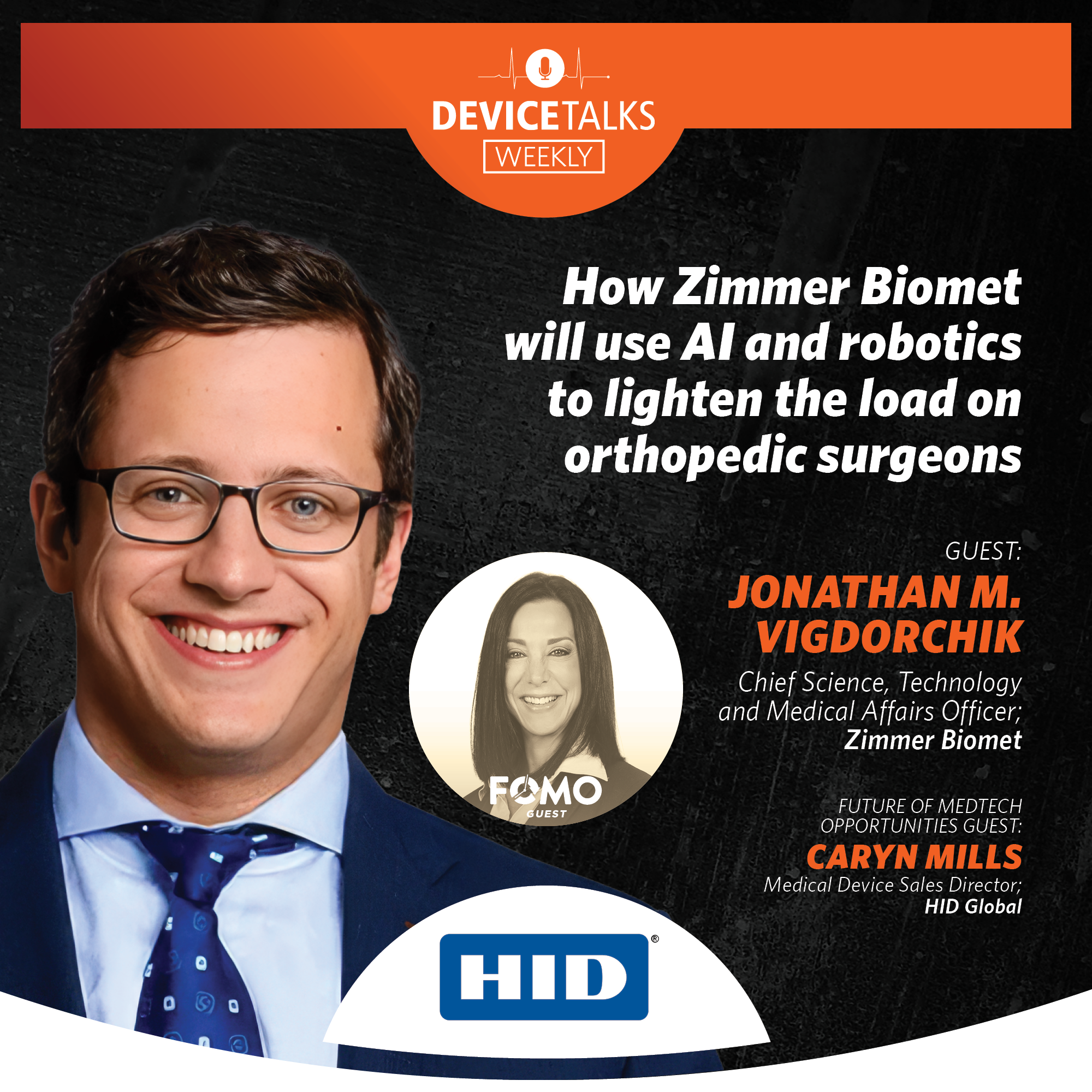
Device Talks Weekly Ep 308 combines (1) a “Future of MedTech Opportunities” RFID masterclass and (2) a keynote interview on Zimmer Biomet’s AI/robotics vision for orthopedic “surgeon-guided autonomy” to lighten surgeons’ workload and improve outcomes.
Written by AI. May contain mistakes.
Kayleen discusses the recent Orthopedic Technologies Week and highlights key themes and speakers.
“I'm so pleased to have been joined by Happy Spine, Ortholine, and Canary Medical.”
Kayleen introduces Karen Mills for a masterclass on RFID in medtech.
“So I actually asked Karen Mills, Medical Device Sales Director for HID Global, to join me in the studio again.”
Karen Mills explains RFID technology and its potential impact on healthcare workflows.
“Welcome back to the Future of Medtech Opportunities.”
Discussion on the future applications of RFID in medical devices and healthcare.
“We shouldn't just give clinicians another technology that they have to manage.”
Discussion on Dr. Vigjorczyk's transition from surgery to med tech.
“Jonathan Vigjorczyk, Chief Science, Technology, and Medical Affairs Officer at Simmer Biomet.”
Dr. Vigjorczyk shares experiences with technology in surgery and outcomes.
“Well, I've always been involved in startup companies.”
Exploration of how to integrate technology for better surgical planning and patient recovery.
“And right now, the tools that we have really just allow us to execute a surgical plan, right?”
Discussion on the concept of intelligent surgery and its three pillars.
“These, some of these things are happening very independently from each other.”
Dr. Vigjorczyk discusses the difficulties in connecting various surgical technologies.
“What are some real examples of how it's going to work?”
Importance of data collection in improving patient outcomes and surgical execution.
“What are the missing pieces that kind of kept all of these systems from connecting together in the way you're describing until now?”
How automation can relieve the mental workload from surgeons.
“Another part of how Zimmer is describing this intelligent surgery category is that it relieves a lot of the burden from, or at least some of the burden from the surgeon.”
Learn how automation enhances surgical efficiency and reduces mental strain on surgeons.
“So everything that can be automated around the surgeon's experience is ultimately going to help them.”
Discover the importance of planning and execution in preventing avoidable surgical revisions.
“And one thing we do know is that, and this goes back to one of your earlier questions about, why did I get into this?”
Explore how Persona IQ technology provides data to enhance recovery after knee surgery.
“We now have objective data on exactly how the patient's doing after surgery, and then that feeds back into the predict part, right?”
Learn how smart implants and apps can effectively monitor patient recovery and reduce costs.
“And not every patient postoperatively needs physical therapy.”
Find out how recent handheld robotic technologies are improving surgical procedures.
“in that entire connected care ecosystem.”
Understand the concept of surgeon-guided autonomy and its application in modern surgeries.
“So two companies, one is Think Surgical, and they came up with a T-mini device, and we have an exclusive partnership with them for our Persona implants.”
Learn about the shift from mechanical to kinematic alignment in knee surgery and its implications.
“Its title describes intelligent surgery as kind of the next step after kinematic alignment.”
Explore how kinematic alignment improves knee surgeries by personalizing surgical plans based on individual anatomy.
“It's really understanding how to understand the patient's knee anatomy And say, your particular knee's got 3 degrees of valgus in your femur 5 degrees of varus in your tibia And how do I execute that surgical plan?”
Learn about the transition from traditional knee replacement methods to modern technological approaches in orthopedics.
“in oncology and cancer treatments, there was a time where radical surgeries were the norm.”
Discuss the slow adoption of technology in orthopedics and the reasons behind it, including regulatory challenges and surgeon resistance.
“The product life cycle is several years.”

Get the gist, explore an idea or ask about something said.
 Claude
On DeviceTalks Weekly, what are the key points of this episode?
Searching your listeningAutomatic transcript. May contain errors.
0:00Jonathan Vigdorchik, MD: Hey everyone, I'm Kayleen Brown and you're listening to another episode of Device Talks Weekly. Last week I was the managing editor, but this week I'm the newly appointed head of live events and live media for Device Talks. I'm so excited about bringing you even more medtech conversations on the pod, on the stage, and in our webinar series. So if you're interested in speaking, make sure to connect with me on LinkedIn. I have the power. But that was last week. This week, we just finished a very successful Orthopedic Technologies Week. So thank you so much for joining us. During this week, we've heard from the chief technology officers, the chief medical officers, and the CEOs who are coming together to move the orthopedic industry forward.
0:43Jonathan Vigdorchik, MD: We discuss everything from new materials that support bone in-growth to innovations in total joint and smart knee implants. I'm so pleased to have been joined by Happy Spine, Ortholine, and Canary Medical. Now, if you missed us live, no prob, just go to devicetalks.com to catch all of those webinars on demand. And while you're there, check out the other webinars we have as part of our Device Talks Tuesday's portfolio. It's a fantastic full year of Met Tech Conversations. And then after you watch them all, let me know your thoughts. I'm behind the camera, behind the mic, but I never really get a chance to hear from you directly.
1:22Jonathan Vigdorchik, MD: So please, please remedy that. Find me on LinkedIn and let me know your thoughts. I have a big episode for you today, and it's quite unique. I promised you that I would bring you Device Talks Weekly. But a couple of other things that I promised you along the way is my commitment to diversity of perspective. I believe that the more voices we have, the more innovation we can move forward, build better devices for more diverse populations. So I'm so pleased that this episode of Device Talks Weekly brings in a brand new voice for you. Our senior editor at MassDevice, Medical Design and Outsourcing, and Device Talks, Connor Hale, sits down with Dr.
2:02Jonathan Vigdorchik, MD: Jonathan Vigdorkchek, the chief science, technology, and medical affairs officer at Zimmer Biomet. Connor and Dr. Vigdorchek, they talk about, of course, robotics in the orthopedics industry. They talk about Zimmerbaumit's surgeon-guided autonomy in robotic orthopedic procedures. They talk about the ecosystem around its robots, its implants, the analytics platforms that will allow clinicians to predict risks and outcomes and perform precise surgical plans and, of course, track patients' progress. Now, it's a great interview, but I have to say the most surprising part of that interview when I was listening back, besides, of course, being completely impressed by Connor, was the fact that Connor brings up to Dr.
2:42Jonathan Vigdorchik, MD: Vigdorchek persona IQ, which I learned about just yesterday during the webinar series Orthopedic Technologies Week with Canary Medical's CTO, Dr. Bill Hunter. I always love to find those surprise and delight moments, and I encourage you to listen back to the interview and look for your own surprise and delight moments. But before that conversation starts, I'm excited to bring you another episode of our FOMO series, our Future of MedTech Opportunities. So I actually asked Karen Mills, Medical Device Sales Director for HID Global, to join me in the studio again. You probably heard that I interviewed Karen on the Women in MedTech podcast, and Karen introduced RFID, or radio frequency identification, to me.
3:27Jonathan Vigdorchik, MD: And I felt like what would be really helpful would be a short sort of master class on what it really is and what does that mean for medtech and connected health and robotics. And boy, Karen absolutely delivered. So before we sit down with the keynote interview with Dr. Jonathan Vdorchak of Zimrow Biomint, I'm so pleased to introduce to you once again my friend and expert on RFID, Karen Riggs.
4:07Jonathan Vigdorchik, MD: Welcome back to the Future of Medtech Opportunities. You may remember an interview I conducted for an episode of the Women in Medtech podcast where I was gifted my first lesson in RFID or radio frequency identification and its impact on medtech. Well, since then, I've been hooked, and I even attended a webinar which did a technical deep dive into RFID. I learned so much that I had to bring back Karen Mills, Medical Device Sales Director at HID Global, back into the studio to give us a 10-minute masterclass on what we need to know about RFID now and, of course, the future. So with that, Karen Mills, welcome back to the podcast.
4:46Jonathan Vigdorchik, MD: Thank you so much, Kayleen. I'm so excited to be here again with you. Well, I can't wait. I will mention it again at the end, but I want to say at the beginning that I have dropped a link to our first interview together where I got to know you more and more about HID Global and then a link to that webinar for that technical deep dive. So for our audience, if you can't wait, pause the interview now, check those out, and then come right back. All right, Karen, for those who can't wait, can you give us just a high-level overview of what drew you specifically to RFID and connected medical devices?
5:20Jonathan Vigdorchik, MD: Sure. I mean, I started in medical device sales and pharmaceuticals. I think I shared that with you on our first podcast. And, you know, after I grew out of some of those roles, I worked for a startup RFID company. And then I've been with HID now for five and a half years. And what drew me to RFID in the medical device space was realizing that RFID can do so much more than just tell you where something is. At its core, RFID connects physical medical product and its digital identity. The product could be a medical device, a surgical instrument like a robotic arm or instrument, an implantable device like a breast implant, any consumables like that razor razor blade model, or another item that's moving through the healthcare ecosystem.
6:06Jonathan Vigdorchik, MD: So once you establish that digital identity, you start opening up so many more possibilities. You can potentially connect the product to the information through its whole life cycle from manufacturing and distribution through inventory management and ultimately to the clinical environment. So that's where I think RFID becomes particularly interesting for medtech. You know, what it can do differently once I know exactly where that item is, is unbelievable, right? So RFID is not just about tracking where something is. It's about giving the physical medical product a digital identity and asking what becomes possible once that identity is connected to the data.
6:47Jonathan Vigdorchik, MD: The digital identity is maybe what got me so hooked. You gave me a few illustrations in our first interview together. Again, that link is in the show notes here, and I highly recommend our audience take a look at that. There was one about the breast implant and a recall and how having this digital identity could really be a game changer. I loved it so much. Let's talk about RFID and the principal challenges that's facing it today and also data-driven connected medical devices. Sure. I think the biggest challenge is that healthcare is filled with physical products and data, but those two words aren't always seamlessly connected.
7:25Jonathan Vigdorchik, MD: We have medical devices, surgical instruments, implants, and consumables, like I mentioned a few minutes ago, but the challenge is connecting the physical product to the right digital information. in a practical and reliable way. That's where RFID has the advantage. Unlike technologies that require like direct visual presentation or visualization, RFID can support that automatic data capture and the information without requiring the same line of sight interaction. It also creates opportunities for identifying multiple tagged items within an appropriately engineered environment. So simply adding an RFID tag doesn't solve that business problem or the clinical problem.
8:09Jonathan Vigdorchik, MD: The entire solution has to work. The tag, the RFID reader, an antenna, software systems, and data infrastructure. And then the product materials, the physical environment, and more importantly, the entire workflow. So that's especially important in healthcare. We shouldn't just give clinicians another technology that they have to manage. We should be looking for opportunities where RFID can remove the manual steps from their workflow. RFID by itself doesn't create patient safety, but better identification, better traceability, and better information at the right point in the workflow can support safer clinical processes, in turn, creating better patient safety.
8:50Jonathan Vigdorchik, MD: So it's not just whether the RFID tag works. The question is whether the entire RFID-enabled workflow delivers that better information with less effort. I think the fact that you have touched on workflow is so critical. So that the digital identity and the workflow were the two things that brought the importance of RFID to me at the forefront. Can you help me understand what technical advances and achievements are making this possible? Sure. This is where the story really gets exciting because RFID itself has evolved considerably, but so has the technology around it. We've seen continued development in RFID tags, inlays, specialized form factors, miniaturizing these form factors.
9:34Jonathan Vigdorchik, MD: I mean, a glass tag is basically the size of a grain of rice at 1.25 by 8 millimeters. That's tiny. The reader infrastructures have improved antennas, software, AI, cloud connectivity, data platforms, and connected devices. So these advances expand the environments, the applications, where RFID can be potentially considered. But I think one of the most important developments is actually broader than RFID. Now we have better ways of doing something useful with all the data that the RFID generates. Can you read the tag? What data-driven workflow can I create? Because of automatically identifying this product, you have boundless opportunities.
10:20Jonathan Vigdorchik, MD: So in MedTech, the RFID read isn't the destination. It's the beginning of a connected data journey. I love that so much. So then how do you see the industry's response changing innovation in the near future? That's a great question. The next several years, I think we're going to see medtech companies moving from individual RFID use cases toward thinking more strategically about connected product identity. Today, a manufacturer might just start with one specific business problem. How do we improve inventory visibility? Or how do we identify an instrument? How do we authenticate that the product is our device?
10:59Jonathan Vigdorchik, MD: Or how do we improve traceability? But I think the next step is a bigger question. You know, if the product has an RFID-enabled digital identity from the very beginning, what else can we do with that identity throughout its lifecycle? That's a much more interesting conversation. And I think that that's where we start designing the product, the identity, the data, the connectivity, and the workflow altogether. Well, I love that so much. Okay, so then what about a decade from now? And I want you to think about the most hopeful expectation of what RFID can be. I won't hold you to it. I just want to know what it could be.
11:39Jonathan Vigdorchik, MD: So what is the future potential of RFID in medical devices? Wow, that's a great question. I think 10 years from now, I think some of the most exciting RFID applications may be the ones that we're not even considering today. I can envision an increasingly connected healthcare environment where many medical products have a persistent digital identity that begins much earlier in their life cycle. It correlates with post-market surveillance. It correlates with UDI information. Think about the possibilities if the appropriate products can carry that identity from manufacturing through distribution and inventory and eventually into the healthcare environment.
12:22Jonathan Vigdorchik, MD: Instead of repeatedly recreating information about this product or surgical instrument, the digital ecosystem could increasingly recognize what the product is. That can open up so many opportunities around traceability, inventory visibility, authentication, that workflow we were talking about, automation and lifecycle management. So they shouldn't have to think, now I'm interacting with a connected device. that technology should simply help provide the right information about the right product at the right time. I think the future of RFID and MedTech isn't about putting more tags on more things.
13:02Jonathan Vigdorchik, MD: It's about creating an intelligent connection between the physical medical device, the data, and the people who depend on that information at the right time. So, Karen, I cannot thank you enough. I think our audience is pretty clear as to why I invited you back into the studio and why I got hooked. So Karen Mills, Medical Device Sales Director at HID Global, thank you so much for joining us on the future of medtech opportunities. Thanks again so much, Kayleen. Now, for my audience, once again, in the show notes, I have included that link to the Women in Medtech interview where I learn more about Karen.
13:39Jonathan Vigdorchik, MD: I learn more about HID Global. And that's actually where I got my first terrific overview about the power of RFID. So I cannot encourage you to watch and listen to that interview more. It's fantastic. I also included the link to the technical deep dive webinar from MDO that I mentioned earlier. So make sure that you check that out so you can dig into RFID further. And of course, visit www.hidglobal.com to learn even more about how HID Global works with medical device companies. I suspect that if you're not already hooked, you sure will be. Thanks again for listening.
14:17Jonathan Vigdorchik, MD: Karen always delivers. Thank you so much for joining me on the pod. And now we bring you our keynote interview. Connor Hale, Senior Editor for Mass Device MDO and Device Talk, sits down with Dr. Jonathan Vigjorczyk, Chief Science, Technology, and Medical Affairs Officer at Simmer Biomet. Enjoy. Hi, my guest here is Dr.
14:39Conor Hale: Jonathan Vigjorczyk, Chief Science, Technology, and Medical Affairs Officer at Simmer Biomet. Welcome to the pod. Hey, thanks for having me. Looking forward to it. Absolutely.
14:49Jonathan Vigdorchik, MD: So one question we like to start out with here on Device Talks Weekly is, you know, how did you get into this industry? Kind of how did you start out in med tech? Can you kind of walk me through your steps to get here?
15:01Conor Hale: Yeah, I took an unconventional path, I would say, to get into med tech. Yeah, I started on the surgeon side. So I am a practicing orthopedic surgeon at HSS in New York City, specializing in hip and ear replacement surgery. And around six months ago, I took a dive into the med tech world by transitioning from full-time clinical practice to part-time clinical practice and now full-time at Zimmer Biomet. So why did I do that? Well, I've always been involved in startup companies. I loved being on the consulting side and development panels for different technologies. I've used robotics and technology since day one out of fellowship training and really decided that the time was right.
15:48Conor Hale: It's a great opportunity and an exciting time for Zimmer Biomet and to really change the future of what orthopedics looks like for the next 30 years.
15:59Jonathan Vigdorchik, MD: Let's dive into that a little bit more. Can you tell me about a time in your clinical practice, in your career, where maybe you felt like you had the right team, maybe the right understanding of the disease, the right knowledge, but the technology, the robotics, wasn't exactly where you wanted it to be or needed it to be.
16:17Conor Hale: It all started back in fellowship. We trained with a lot of different surgeons. Some used technology, some didn't. And after surgery, we would always have these case conferences looking at what we did throughout the day. How did all those six, seven, eight cases go? Were they successful? Did we like the x-rays or not? and we noticed that every time we would do something with technology, the post-operative x-ray was always perfect. It was just no variation, boom, boom, boom, boom, x-ray, x-ray, x-ray after x-ray, always perfect. And then you would look at the manual surgeries and you'd say, oh, those cups are a little bit different, the knees are a little bit differently aligned in each one.
17:00Conor Hale: And that was really the kind of light bulb movement that went off and said, hey, this was actually not that hard to do. and the x-rays are much more reproducible. And now is it translating into clinical outcomes? So fast forward the next 10 years, right? Starting to use these technologies, x-rays continue to stay perfect, but now there's a variation in clinical outcomes. Why do some patients who have perfect x-rays still don't do well after surgery? And right now, the tools that we have really just allow us to execute a surgical plan, right? I want to cut this knee bone at zero degrees. Okay, perfect.
17:40Conor Hale: The robot lets us do that. And it brings my variation down from, you know, a standard deviation of three degrees-ish, five degrees with manual instruments to really being able to hit the target. But we could never translate that into any type of clinical difference, right? Why is that? That's what we really need to figure out. So how are you going about doing that? Well, it's really about combining everything that we do. As a surgeon, my preparation for the operating room starts with reviewing the patient's chart. That's in the electronic medical record. Then I pull out their x-rays. I check out their anatomy, make sure their diagnosis is the right one, that they need surgery.
18:24Conor Hale: And then we start planning the operation, right? The preoperative planning piece. That's all done in my office or on some sort of PAC system. Then I need to figure out how to get that plan to the robot or the computer technology, execute that plan, and then the patient's released. And, you know, we don't really know what's going on with them until we see them back in the office at two weeks or six weeks after surgery. So the whole purpose and the whole vision of what we're trying to do here is connect the dots between all these different technologies. It's really how do we look at somebody's x-rays beforehand and predict what's going to happen during the operation or predict any risk that they could have and then do something differently.
19:06Conor Hale: How are we going to go execute that surgery to that preoperative plan? And then how are we going to track that patient's recovery to make sure that they're actually recovering well, they're not falling off the wagon and just, you know, forgetting to call? That's what we're trying to connect, that entire ecosystem, and then learn from it. I you know Connor comes in Connor is 64 years old he's got knee arthritis well we know that patients with the bones like Connor your age your anatomy the way your activity level we know how patients like you recover to the best of their ability let's learn from that and execute your surgery and the next one from those learnings and being able to inform the next preoperative plan right that's the vision we're trying to create yeah knock on wood but uh are you seeing
19:59Jonathan Vigdorchik, MD: patient satisfaction kind of match up with what you're seeing with these post-operative x-rays when they come back in maybe a month later well it's the patient satisfaction piece is really
20:12Conor Hale: right now we have to connect the dots between all these things and that's not what's happening worldwide, right? These, some of these things are happening very independently from each other. There's not really a system that allows you to build on this type of framework, which is why we created the surgeon guided autonomy category, right? Surgeon guided autonomy is really stringing the pieces together, translating what the surgeon wants to do into action, right? Predicting how they're going to do better, predicting that preoperative plan, executing the surgery, monitoring their recovery. Once you start putting all those pieces together, we absolutely see clinical outcomes differences.
20:51Conor Hale: But you got to remember, we're just launching this category now. The technology doesn't exist. That strings it all together yet. But the framework, the building blocks behind it all show signal towards, yes, it's going to affect clinical care.
21:05Jonathan Vigdorchik, MD: The company's kind of describing it as a new category of intelligent surgery. You talked a little bit about it, but kind of walk me through the details? What does it look like in the room? What are some real examples of how it's going to work?
21:17Conor Hale: Well, it really goes back to those three pillars, right? Predict, perform, and recover. So the predict piece, what kind of information can I get from the patient's record, from the information that I can predict what kind of risk that person's going to have? I can predict what kind of outcome they're going to have after surgery using all the available information from all the previous cases, How can I make the best surgical plan for this particular patient? Then you bring it to the operating room and it's connected to the robot. So the robot will then know that surgical plan. And with the robotics technology, you can execute that surgical plan with precision and accuracy.
21:59Conor Hale: And then when they go home, we can monitor their recovery. Whether it's a smart implant, whether it's a connected app, whether it's a smart watch that we can link into, We know exactly how that person is doing from the moment they leave the hospital to the moment we see them back in the office. And sometimes we need to intervene early. You may fall off the wagon there, not do your physical therapy, and I'm going to realize it. A smart, connected ecosystem is going to tell me that. My office will reach out, whether it's through AI or a real person, and say, Hey, Connor, why aren't you doing your exercises?
22:34Conor Hale: Why aren't you walking? well. Is it because you have too much pain? We can fix that. Is it because your knee doesn't bend? Well, maybe we need to see it earlier than six weeks. Right? Or maybe there's some signal there that shows us you're having an infection and we need to see it back in the office immediately. All these connected smart ecosystems. You can see the world just starts to expand as soon as you start connecting the dots here.
22:57Jonathan Vigdorchik, MD: Yeah, so a lot of these technologies you've been mentioning have been on the market for a couple of years now or at least has been developing them for a couple of years. What are the missing pieces that kind of kept all of these systems from connecting together in the way you're describing until now?
23:13Conor Hale: Yeah, you know, you bring up a really interesting point that a lot of these pieces are out there today, but none of them are connected, right? There's startups that do one piece here, one piece there. There are some of the larger medtech companies that have a robot. But nobody's ever connected the dots between them all. It's actually just commercial execution. How do you go and link all of these pieces together? And it takes a lot of effort. To get the best predict information, you really need access to the electronic medical record. You need the images there. You need all the data from previous cases that you can reference and see in these types of patients what's done well in the past.
23:59Conor Hale: It's not just about a single robot either. The robot is just an execution device for a surgical plan. So how do we string together that preoperative plan to the intraoperative part where you execute the plan? And then how are we connecting that to the recovery piece? How did those patients recover? Unless you connect that whole ecosystem, you need to know who the patient is, what do their bones look like, How was the surgery actually executed? Not just looking at some x-ray. How was the surgery actually performed? And then how do they actually recover after surgery? Right now, we look at all these different randomized control trials.
24:43Conor Hale: Robots versus no robots. Technology versus no technology. No differences. We have no idea what kind of patients came in. We don't know what those knee phenotypes look like. We don't know how they walked before surgery. All we have is a piece of paper PROM score. Then we don't really have any idea how that surgery was executed. Maybe we know what angles those bones were cut, but we certainly don't have what balance that knee was presented at, what's the ligament laxity of that profile of that patient. And then we definitely don't know how they recovered based on anything more than another questionnaire on, can you walk upstairs, how are you feeling today, how's your pain?
25:23Conor Hale: You really need objective data about who was that patient going into surgery, objective data on how you executed the surgery, and then objective data on how they did after the operation. And only then can you feed it back and say, in these types of patients, this is what has done well in the past. You should probably think about executing your plan like this. You know, obviously keeping the physician in the center of all to use their clinical judgment. But you can start augmenting that physician information. Another part of how Zimmer is describing this intelligent surgery category is that it relieves a lot of the burden from, or at least some of the burden from the surgeon.
26:04Jonathan Vigdorchik, MD: You talked a lot about how all these different systems present information to the surgeon who is then doing all of the reasoning, the thinking, the mental planning. How does this system kind of ease that mental workload?
26:20Conor Hale: that's a that's a really good point that you're making there it's not only thinking about it from the patient outcome perspective but really what's the burden on the surgeon right now like i told you prior to surgery i need to spend 45 minutes to an hour planning all my cases for the day there's a time burden there there's a mental energy burden there there's absolutely no reason why in the time of AI, we can't automate the majority of that surgical plan. Where it comes to me 99 % baked, I check and double check everything. Then in surgery, you have to preoperative plan again, and then execute the surgery.
26:59Conor Hale: Also, unnecessary to go through a learning curve, to have to know how to exactly the most efficient way to cut the bones and to use the robot, all that can be pre-programmed into an autonomous robot. And then postoperatively, why do I need to hire one or two FTEs to call patients, monitor everything, when an app can easily track their recovery? So we've taken a lot of the burden from what the surgeon needs to do and eliminated every pain point and delivered information just in time when they need it, alerts if the patients are not doing well, and then really strengthening that and let the surgeon operate to the maximum end of their license or other training, not doing administrative paperwork.
27:44Jonathan Vigdorchik, MD: It does sound like this program does go beyond simply bundling the robot and the implants and the analytics in a single commercial sale.
27:53Conor Hale: Absolutely. I mean, we're trying to really keep the surgeon in the center of this by eliminating the burden from them and really preserving their judgment and control. So everything that can be automated around the surgeon's experience is ultimately going to help them. We want them doing more cases per day, maybe, if you can do the surgery more efficiently. We want you to be done after the end of your day and go home to your family not completely mentally exhausted, right? It's kind of interesting. Even things as simple as your surgical team, if you do five or six operations with a surgical team you've never worked with, you notice that mental energy that's been expended.
28:38Conor Hale: As soon as you start standardizing how you do the operation where you're not asking for every single instrument, or you're not thinking about every case, just a double, triple, quadruple check to make sure you did it right. Once you start trusting in that efficiency in those steps and trusting in the technology that it's helping you, you go to double checking, knowing that you've got 99 % chance that you're going to do it right. It takes away a lot of that mental energy and that burden on the surgeon. Ultimately, it translates into good outcomes, you hope. And one thing we do know is that, and this goes back to one of your earlier questions about, why did I get into this?
29:19Conor Hale: How did I notice the technology was helping or not helping? 50 % of the revisions that we do are completely avoidable. That's 50, 5-0. Completely avoidable if the first surgery was done better. What's that mean, done better? Surgery planned better. So identifying some sort of risk where you could change what you're doing during surgery. Let's call it 80-year-old female, really poor bone. You probably should use cement. If you don't, she's going to have a fracture, the stem's going to subside, she's going to be back in the operating room. So how do you plan surgery better, and then how do you execute to that plan better to avoid that risk?
30:02Conor Hale: So putting it all together, that's how we're really going to attack the patient outcomes realm too. How do you prevent those avoidable complications? It's no different than what we treat in nuclear facilities, in the airline industry, about being high reliable organizations. right avoid preventable problems i want to talk a little bit more about the individual pieces of
30:24Jonathan Vigdorchik, MD: this system starting with outcomes maybe you can give us a little bit of background on the persona iq smart knee with its sensor built into the at the stem the company's working with worked with canary medical to develop that picked up the de novo clearance i believe five years ago tell us a little bit more about that how it kind of fits into the broader picture yeah so that broader
30:45Conor Hale: picture of predicting, perform the surgery, and then recover, Persona IQ fits into both the recover phase. We now have objective data on exactly how the patient's doing after surgery, and then that feeds back into the predict part, right? If we connect all the dots, we know who the patient is, we know how the surgery was performed, we know how they recovered, and then we can do the surgery differently in that group of patients next time if we need to. So persona IQ. Now a lot of the activity monitors after surgery are based around your smart watch or your smartphone. This thing is an implant, a smart implant that's inside your tibia.
31:26Conor Hale: So it's attached to the tibial component of the knee replacement. It's actually an implant that's inside the tibia. So the patient signs up for this. They sign a data privacy agreement, a data sharing agreement with us, but the patient retains the rights to their data, and we can track their recovery. There's an app that they have access to, so they can log into it every day. They can see how they're doing compared to thousands of other patients that have had a knee replacement. You know, from the patient side, number one thing that they care about is, am I doing okay? You know, how am I doing compared to everybody else?
32:03Conor Hale: So now you can take thousands of patients' recovery and compare this particular patient to how those other thousands of patients with similar profiles are doing. And it really gives a lot of peace and comfort to the patient knowing that they're recovering on track. Now, conversely, right, if they're not recovering well, the surgeon's got to know about it, and the surgeon's office, the surgeon needs to intervene. Why are they not doing well? Do they have an infection, too much pain, not doing their physical therapy exercises, really opens up to the realm of what you can do on the recovery phase.
32:39Conor Hale: Now, if you use this right, which we try to do, you can decrease cost of care. And not every patient postoperatively needs physical therapy. Not every patient postoperatively might need an ER visit when they just don't think they're doing well or they notice a little redness on their wound that's completely normal. right if they can't get an answer from the office they're going to show up in an emergency room somewhere you know what happens when they show up in an emergency room somewhere they get blood work they get an EKG they get a CT scan they got an orthopedic consult and you've just blown your entire bundle if that patient's in a bundled care environment all on a very simple you know take a picture of your wound send it to the office and say yep that looks fine completely normal you know well, how are you doing?
33:29Conor Hale: In some pain, let's change up your pain meds, go on with your day, right? There is a lot of that that's going on out there because the majority of patients are just sent off into the wild.
33:44Jonathan Vigdorchik, MD: Yeah, so this implant, it attracts range of motion, it attracts step count, walking speed in terms of the data that we were talking about. When it comes to like the FDA label, the indication that kind of data is still, the clinical usage of that is still limited, Right. So what's Zimmer Biomet doing to bolster its clinical use?
34:06Conor Hale: Well, it's really about the full ecosystem again, right? If the patient allows to share the data and they participate with the MyMobility app, that allows them to do virtual physical therapy so we can track exactly what exercises they're doing. We can track their exact range of motion and step count, so we know exactly how their recovery is doing. So it's really part of that entire complex. Just having a smart implant in their bone is a glorified pedometer. But once you look at all the different types of gait data, you can get signals of this patient was doing well, and now they're not. What happened?
34:50Conor Hale: We published a few papers and some abstracts that have been presented recently showing that you can prevent or predict somebody going on to an infection because they were doing well, well, well, and then, whoop, their step count and pain score, step count drops off, pain scores go up through the app, you know to reach out, something's going wrong, or maybe they had a fall at things like that. So in isolation, the smart implant alone doesn't do much. And once you connect it to the rest of the MindMobility app, which is the recover pillar, and then you can really start unlocking clinical data. You can unlock preventing problems before they start and to hopefully help in that entire connected care ecosystem.
35:33Conor Hale: What might be the most important thing to know about Persona IQ is that it's not really about the smart implant that connects the recovery piece. The smart implant is a piece of it. However, it's actually the whole ecosystem around it. You don't need a smart implant to achieve this surgeon-guided autonomy. If you know how the patient is before surgery, you know how the surgery was executed, and then you know how they're recovering, you can use any sorts of technology to monitor the recovery, whether it's your phone, whether it's a smartwatch, any type of device that's giving data. It's not really about the smart implant.
36:09Conor Hale: It's about the whole connected ecosystem.
36:11Jonathan Vigdorchik, MD: Let's talk a little bit more about what's happening in the operating room. There's been recent advancements in robotics, but with a handheld form factor. Can you tell me more about that?
36:22Conor Hale: Robots have always been thought of. These big apparatus take up a lot of space in the operating room, clunky, difficult to use. That's all historical now. So two companies, one is Think Surgical, and they came up with a T-mini device, and we have an exclusive partnership with them for our Persona implants. And then recently, Striker came out with our handheld version, the RPS. And these are designed for... The best way to explain this is really, the majority of surgeons don't use anything in the operating room other than manual instruments. So taking a full leap to a robot maybe was too big of a leap for them.
37:05Conor Hale: So could there be some cheaper, lower-cost option that they could use in their ASC as almost a gateway drug, for lack of a better term, to full robotics? You could still get the accuracy you want. Maybe there's less steps in the operation than the full-blown robot, and you could have this intermediary step. And that's been the strategy around that, and really taken off in terms of adoption. Smaller footprint, easier to use, great for ASCs, especially as we migrate more surgery to the ASCs, which is rapidly accelerated after COVID and will continue to rapidly accelerate with CJRX coming for the inpatient stays.
37:47Conor Hale: Maybe there's a role in the marketplace for the small form factor will. We want to give the surgeon options. Sometimes you want a CT scan. sometimes you want all the bells and whistles 3D planning and robotics to help you with the different boundaries to help do the surgery other times you just want to go through efficiently and do as many cases as you can safely then you can use a smaller handheld robotic platform different options, different ways surgeons look at these things in my view, once you get efficient with a large robot it's equally as efficient as a small handheld. It's really just about your workflow.
38:28Conor Hale: Surgical team, workflow, and that's where medical education comes in. How do surgeons go visit other surgeons who are utilizing these technologies to the fullest? How do we create courses where we can not only just certify them for use, but teach them the best in class techniques to get everything out of it without overburdening it? And that's where the surgeon guided autonomy comes in again. How do you not overburden the surgeon? How do you give them all the information that they need so that they can perform the surgery safely, translate their clinical intent into action? It's bigger than just any robot platform.
39:07Conor Hale: You can't just be tied to the robot.
39:11Jonathan Vigdorchik, MD: On that note, you're rolling out this surgeon-guided autonomy category at the symposium at the American Association of Hip and Knee Surgeons meeting in Dallas. Its title describes intelligent surgery as kind of the next step after kinematic alignment. Can you walk me through the relatively recent rise of kinematic alignment versus mechanical alignment in knee replacements?
39:36Conor Hale: So mechanical alignment is the way we've been doing knee replacements since the 1970s. And the fundamental premise is that it's targeting 0-0 for everybody. Everybody gets a perfectly straight leg. And when I say 0-0, I mean 0 degrees on the femur, 0 degrees on the tibia. Make the leg exactly straight. Now, if you walk around the street, walk around the airport, you can see that not everybody's leg is perfectly straight. Some people have some bowing, some people are knock-kneed, some people were bow-legged. That's where the fundamental philosophy around kinematic alignment comes in. It has to do with understanding the person's bone and cutting the bone in the angle of that particular bone for that particular patient.
40:19Conor Hale: In effect, not selecting zero-zero for everybody, but thinking about how is that person's bone, is it two or three degrees, five degrees this way, two degrees that way, and respecting that anatomy. Because when you respect the anatomy, the ligaments of the knee are happy as well. That's the fundamental thought around kinematic alignment. It's just turning a knee replacement procedure into resurfacing the knee, respecting what's there, just feeling, putting that knee back to how it started, how it began its life.
40:54Jonathan Vigdorchik, MD: how much of this shift is really being enabled by these new medical technologies that are coming on
41:00Conor Hale: the scene yeah absolutely so kinematic alignment is not new it was first described by stephen howell around 2008 maybe even 2006 and persona was actually the first total knee arthroplasty component or implant that was cleared for use with the kinematic alignment technique. So it's been around for quite a while. But to your point, are these techniques now enabled because of the technology? I think the one thing Stephen Hall did wrong was he showed these really crooked tibia x-rays and said, look what I can do. This patient is doing amazing and scared people. The reality is 95 % of the time, maybe even 98 % of the time, kinematic alignment is plus or minus 5 degrees.
41:55Conor Hale: There's only 2 % outliers that are going to be weird based on some weird bowing, some weird deformities. So what is kinematic alignment? It's really understanding how to understand the patient's knee anatomy And say, your particular knee's got 3 degrees of valgus in your femur 5 degrees of varus in your tibia And how do I execute that surgical plan? Now doing that manually with a plus or minus 5 degree opportunity You're going to make some mistakes technology now allows you to very accurately execute that one or two or three degree difference in your surgical plan so that you can now connect the dots there right it all goes back to the same thing understand the patient's anatomy you've got a joint line that looks like this somebody else has a joint line that looks flat somebody else has a joint line that looks this way Understand that anatomy beforehand.
42:56Conor Hale: Go execute that surgery to the best of your ability and then see how they do.
43:03Jonathan Vigdorchik, MD: So it's really fitting into, even more broadly across medicine, a shift towards personalized medicine, right?
43:10Conor Hale: I mean, kinematic alignment, it was personalized medicine before that term existed, right? That's really what Stephen Howell was doing. He was taking, I'm removing this many millimeters of bone from this medial side. I'm going to put back this many millimeters of metal from this side. And we tried this even in the 90s. In the 1990s, they came up with these anatomic reconstructions. However, they went with three degrees and three degrees for everybody. So no matter what you looked like, you got a three degrees valgus on your femur, three degree varus on your tibia. And the same thing happened as in implants, right?
43:48Conor Hale: There's certain implants out there that do the same thing. Three degrees, three degrees for everybody. Kinematic alignment now is understanding every single patient is different to the millimeter, to the degree different. So how do we execute that particular plan? There's different techniques to do it. You can do it manually with a caliper, but you have to really measure. You got to take into account cartilage, soft thickness, or you can use technology and robotics to do it. It's all in the way to simply say, what's the preoperative anatomy look like? How do you execute the plan? And then connect it with the third pillar.
44:28Conor Hale: How's that patient recovering afterwards? Is there truth to what Dr. Howell told us? KA patients do better. If you really talk to him, every single patient for a long time got a postoperative CT and he had a spreadsheet tracking every single alignment that he did. and he tracked every single outcomes measure on those patients postoperatively. So to be honest, like back in 2008, he was doing the same thing, understanding the patient's preoperative anatomy, executing the surgery with maniacal detail, measuring every single millimeter, every single cut, knowing if he made an error or not and then tracking postoperatively what he did, right?
45:10Conor Hale: It's that same thing now we're putting together with technology with Surgeon Guided Autonomy.
45:17Jonathan Vigdorchik, MD: That's fascinating. So it really just sounds like a natural evolution of it.
45:21Conor Hale: Yeah, and it's an exact natural evolution to that personalized medicine piece, right?
45:27Jonathan Vigdorchik, MD: This kind of makes me think about how, if you look back at the history of the 20th century in oncology and cancer treatments, there was a time where radical surgeries were the norm. Today we have, of course, laparoscopic procedures, targeted therapies, combination regimens. One of the things I like about covering the medtech industry in particular is you get to see technologies come along that make clinicians say, oh, I can't believe we used to treat this disease any other way. Right. What have you seen in orthopedics that has made you say that? And what do you think will make people say that in the future?
46:06Conor Hale: In orthopedics, a lot of things. for knee replacement, we used to cut everybody at zero, zero. And how did we cut everybody at zero? We literally looked across the wall and lined up your finger and said, yep, that looks like a right angle. Even before that, they used to look at the tiles on the wall, the tiles on the wall you hope were, you know, right angles to each other and line up a knee cut to that. But it's kind of crazy to me that that's how we did surgery on humans. Even today, I mean, in real life, what kind of things in real life do we do that, looking back, manually executing something is completely crazy.
46:47Conor Hale: Even the guys who are building our houses using lasers to level walls. Airplane pilots using technology for flying, for landing and takeoff. They used to fly that manually. That's the same place we are in orthopedics. It's kind of shocking to think that we're okay with all that stuff in our cars, but we're not okay with that with our surgeons in the operating room operating on humans. All right, that's kind of the mind-blowing thing is how slow as an industry we are to uptake technology.
47:19Jonathan Vigdorchik, MD: Why do you think that is? Well, why is it so slow?
47:22Conor Hale: Yeah, regulatory burden is one piece of it, right? The product life cycle is several years. so you can have an interesting idea today and then it won't hit a patient until 2030 probably depending on how fast we can get the r &d done and then the regulatory piece done and surgeons are just resistant to change right there's been this hubris of i don't need tech i'm good enough my patients do well enough um yeah i've never been under the mentality that a person could do well enough right why are we not striving every day to make the surgery as perfect as possible to understand who the patient is, how you do the surgery, and how they're doing afterwards, right?
48:05Conor Hale: You should always be on a continuous search for how to do things better in orthopedics and in life and everything that you do, right? That's kind of the quest that we're on. So I don't know. I think about it a lot, right? The rate of technology adoption in orthopedics lags behind every under industry, automotive, airlines, everything. We're operating on human beings, right? Take it back to the principle, 50 % of complications completely avoidable if you do the first one correctly, 50%. We have technology today, we've had it for 10 years, that allows you to do the surgery correctly, right? This is how we're we're now getting to the realm of understanding how to do the surgery.
48:52Conor Hale: Not just precision now, we're not just hitting targets. We're understanding what targets are needed for the particular patients.
48:58Jonathan Vigdorchik, MD: Well, thanks very much for taking the time. I really appreciate you joining us here.
49:01Conor Hale: Thanks for having us and looking forward to launching this category. We'll keep you updated on how everything's going.
49:10Jonathan Vigdorchik, MD: And that's a wrap on another episode of the Device Talks Weekly Podcast. I am so beyond pleased that I asked Connor Hale, our senior editor for Mass Device and Medical Design and Outsourcing and, of course, Device Talks, to do today's keynote interview. Connor had grace and elegance, and I think he guided the conversation in a way that made me so, so proud. And I actually learned a lot from his own interview style. Thank you so much to Zimmer Biomet, to Dr. Jonathan Vigdorchek for sharing your time and your insights with us. And of course, thank you so much to my FOMO guest, Karen Mills, Medical Device Sales Director at HID Global, for giving me and us a masterclass in RFID.
49:51Jonathan Vigdorchik, MD: I hope you've enjoyed that topic as much as I have. We will continue to bring you these FOMO interviews as part of our Device Talks Weekly podcast that will come to you every Friday, except we're going on a winter break. Next week, November 20th, will be the final episode of Device Talks Weekly for the 2026 calendar year. And why is that? I won't be here. I am actually taking medical leave for my second foot surgery. So if you've listened to me on the Women in MedTech podcast, I had my right foot done. I had a bunionectomy. I officially have a medical device in my body. I liked it so much, I wanted to make a matching pair.
50:30Jonathan Vigdorchik, MD: So I will be out for all of December so that I can recover from my left foot bunionectomy. But never fear. I promise that we will be back starting January with an uninterrupted cadence for Device Talks Weekly. It will come to your favorite podcast player every single Friday. I'm going all in on the weekly podcast here. And I'll be back. I'll be healthier. We'll bring even more voices on the pod. We'll keep expanding it. So I hope that you continue to join us. Once again, I'm Kayleen Brown. I have enjoyed every second of the podcast, of being on stage, of doing the webinars. I absolutely have the best job in the world.
51:14Jonathan Vigdorchik, MD: And I'm so grateful that you're listening. I'm so grateful for your support. Speaking of being grateful for support, thank you so much to HID Global for sponsoring this episode of Device Talks Weekly. To learn more about radio frequency identification and how HID Global works with medical device companies, please visit their website at HIDGlobal.com. And make sure to check out that October webinar from Medical Design and Outsourcing. Please make sure to jump on LinkedIn. Follow me, Kayleen Brown. Follow Device Talks and follow our guests, Karen Mills, Dr. Jonathan Vickdorchuk, our senior editor, Connor Hale.
51:50Jonathan Vigdorchik, MD: If you haven't already, follow Device Talks on your favorite podcast player. Don't miss next Friday's episode. It's gonna be the final episode, but I'm doing the keynote interview with Olympus. So that'd be a great ending to the season. Thank you. Thank you. Thank you for listening.
In this episode of DeviceTalks Weekly, Senior Editor Conor Hale sits down with Jonathan Vigdorchik, MD, the chief science, technology and medical affairs officer at Zimmer Biomet, we talked about the company’s new pitch for “surgeon-guided autonomy” in robotic orthopedic procedures.
The company aims to build an ecosystem around its robots, implants and analytics platforms that will allow clinicians to predict risks and outcomes, perform precise surgical plans, and track patients’ progress as they recover — with the goal of reducing the total administrative workload and mental burdens on surgeons.
We discussed Dr. Vigdorchik’s journey in medtech, how Zimmer Biomet expects intelligent surgery to shift patient outcomes and personalized care, and what’s next for the future of orthopedics operating rooms and surgical centers.
In the FOMO interview, Host Kayleen Brown invites Caryn Mills, medical device sales director at HID Global into the studio for a master class on Radio-Frequency Identification (RFID) and how that technology can improve outcomes on anything from connected heath to medical devices, such as surgical robotics.
We’ll open the episode with this week’s Newsmakers, covering CMR Surgical’s plans following Stryker’s investment, Intuitive’s U.S. procedure growth and quarterly results, Johnson & Johnson’s timeline for its orthopedics spinoff, Abbott’s planned Nutrition business spinoff, and Medtronic’s appointment of a corporate president.
Special thanks to HID Global for sponsoring this episode of DeviceTalks Weekly. To learn more about how HID Global works with medical device companies, visit: www.hidglobal.com.
Mentioned in the episode:
***
Enjoy the show? Follow DeviceTalks Weekly on all major podcast players + Follow us on YouTube.com/@DeviceTalks to ensure you never miss an episode.
Want access to the complete DeviceTalks Podcast Network (DTPN)? Follow us today at https://devicetalks.castos.com/subscribe