In short
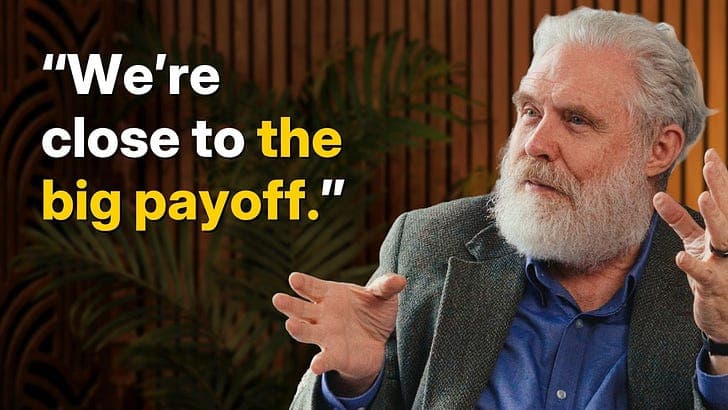
George Church — A Billion Years of Evolution in a Single Afternoon
Podcast Overview The episode features a detailed conversation with George Church, a prominent figure in synthetic biology. The discussion revolves around the potential of biotechnology to radically transform human life and health through advancements like gene editing, AI integration, and synthetic organisms.
---
Key Themes and Concepts
- Advances in Biotechnology
- Decreased Costs: Significant reductions in sequencing and synthesis costs have revolutionized the field.
- Gene Editing: Technologies like CRISPR have made precise gene editing accessible and practical.
- AI Integration: Tools like AlphaFold are enhancing our understanding of protein structures and functions.
- Future Possibilities
- De-aging and De-extinction: Church discusses the potential for biotechnology to reverse aging and bring extinct species back to life, citing examples like woolly mammoths and dire wolves.
- Biobots: The concept of hybrid biological and human-engineered bots that could efficiently replicate and perform complex tasks.
- Weaponized Mirror Life: A cautionary note regarding the potential dangers of synthetic biology, including the possibility of creating harmful synthetic organisms.
- The Concept of Escape Velocity in Aging
- Church believes that by 2050, advancements in biotechnology may allow for a situation where life expectancy could increase year-over-year, known as "escape velocity" for aging.
- Challenges in Biotech Revolution
- Despite rapid advancements, the industry has yet to achieve "huge industrial revolutions" akin to what has been seen in computing, due to:
- Regulatory Hurdles: Lengthy FDA approval processes can stall innovation.
- Funding and Research Gaps: Budget cuts to organizations like NIH and NSF might impact future research and breakthroughs.
- The Role of Genetic Counseling
- Church emphasizes genetic counseling as an underappreciated tool for preventing genetic diseases. This approach can be more effective than gene therapy for certain conditions, particularly when focused on future generations.
- Biodefense and Ethical Considerations
- The conversation touches on the ethical implications of synthetic biology and the potential for misuse, particularly regarding engineered pathogens.
---
Important Questions Addressed
- Is DNA the ultimate data storage?
- Church explores the potential of DNA for data storage, considering the immense capacity and longevity of genetic information.
- What are the implications of AGI (Artificial General Intelligence) on biological research?
- AGI could potentially accelerate biotech advancements, leading to improved health outcomes and hybrid systems of human-AI collaboration.
- What might a future with numerous biotech advancements look like?
- Church envisions a future where human health is significantly improved, and individuals can customize their enhancements and capabilities.
---
Conclusion The episode concludes with a strong vision for the future of biotechnology, emphasizing both the incredible potential and the necessary caution that must accompany these advancements. George Church’s insights underscore a pivotal moment in biotech history, where ethical considerations and safety protocols must evolve alongside technological capabilities.
---
Timestamps
- (0:00:00) – Introduction and overview of George Church’s contributions
- (0:07:37) – Discussion on finding the master switch for aging
- (0:19:50) – Exploration of weaponized mirror life
- (0:30:40) – Why sequencing has not led to a biotech revolution
- (0:50:26) – Impact of AGI on biological research progress
- (1:00:35) – Development and potential of biobots
- (1:09:57) – Questions around DNA as ultimate data storage
- (1:13:55) – The role of genetic counseling in curing rare diseases
- (1:22:23) – Discussion on NIH & NSF budget cuts
- (1:25:26) – How one lab has spawned multiple biotech companies
---
Call to Action Listeners are encouraged to share the episode and engage with the sponsors mentioned, as well as to consider the implications of these scientific discussions in their own lives and communities.
Written by AI. May contain mistakes. Listen to the episode to check what was said.
Transcript
Automatic transcript. May contain errors.0:00Today, I have the pleasure of interviewing George Church. I don't know how to introduce you. It would honestly, this is not even a exaggeration. It would honestly be easier to list out the major breakthroughs in biology over the last three decades that you haven't been involved in. From the human genome project to CRISPR, age reversal to de -instinction. So you weren't exactly an easy preff. Sorry. Okay, so let's start here by what year would it be the case that if you make it to that year, technology will keep in bio, will keep progressing to such an extent that your lifespan will increase by a year every year or more.
0:34Escape, velocity, sometimes what it's called for aging. Different people have estimates, and all those estimates are including mine are going to be take with a big grain of salt. I think that looking at how, mainly looking at the exponentials in biotechnology and the progress has been made in understanding, not just understanding the causes of aging, but seeing real examples where you can reverse subsets of the aging phenotype. You know, so you're getting close to all of aging, in other words, you're seeing, instead of just saying, oh, I'm going to fix the damage in this collagen, in this tendon, in this limb, you're saying, oh, I'm going to change a lot of things that are their comment age -related diseases.
1:27And I'm going to get more than one at a time. I think looking at those two phenomena, exponentials is biotechnologies and the breakthrough in general aging, not just an allosist, but synthesis and therapies. And a lot of these therapies now making in the clinical trials, I would not wouldn't be surprised if 2050 would be a point, if we can make it to that point, 25 years. Most people listening to this have a good chance of making it 25 years. And the thing is, it's not going to be some sudden point where you're going to be, you know, so sick 25 years from now that it's like hit or miss. It's more likely that you're going to be healthier 25 years from now than you thought you are going to be.
2:14There may be some, probably not some law physics, but some economic or complexity issue that we don't know about that becomes a brick wall. I doubt it seriously, but we'll have to see. Given the number of things you would have to solve to give us a lifespan of humpback whales. Go ahead, go ahead, whales. Yeah. 200 years, yeah. Is there any hope for doing that from somatic gene therapy alone or without have to be germline gene therapy? Probably there's a lot of forces pushing it towards somatic. For one, there's 8 billion people that have missed the germline opportunity, as to say, doesn't apply to us, the two of us, and everybody listening to this.
3:02And, you know, you have to be very cautious when you say something's impossible. It's safe to say it's impossible to do it this second, but you don't know what's going to happen tomorrow in the next decade or something. So I think there's a lot that could be done in particular since aging is a fairly cellular phenomenon with proteins going through the blood and other factors going through the blood that signalang and so forth. You could imagine if you replaced, let's say, every cell in the body, every nucleus in the body, I thought, you know, it would suddenly be young again, right? Without going all the way back to the embryo and forward again.
3:45And there's various other things that are just short of that. If you replace the cells, will they fit into that niche? They might displace the old cells. That's certainly within the realm of modern synthetic biology, is for cells to take over niches. I think the hardest part is brain, but even there, there's some evidence that if you even though the brain doesn't really use stem cells that much, you could artificially bring in stem cells and they could artificially fit into a circuit and learn the circuit and then displace the old ones in some way. Should we have the ECS kind of thing in the brain?
4:26Yeah, exactly. The SHIPFACTS is having, you know, trying to maintain the connections and the memories. But, you know, there's some fairly straightforward experiments that need to be done before we can really even estimate how hard that problem is. Or, you know, very often there's low hanging fruit that people just think is improbable, but it's there because biology has all these gifts that, you know, where the just hands over to us, uh, levers that we can flip, like vaccines is an amazing gift. Didn't have to exist, but they do. Is there an existing gene delivery mechanism which could deliver gene therapy to every single cell in the body?
5:10There is nothing close to that today, but there's nothing, no law, physics, that would prevent it. You know, there's going to be practical considerations, you know, like, you know, how many injections do you need to do to achieve that goal? But we're getting better at targeting tissues, you know, so for one of my companies, Dynatherapyutics, I'm going to show you the Higida 100 -fold improvement in targeting neurons in the brain, which is a big deal. Now, if, and that was just one little campaign that they did, you know, one experiment involves a lot of AI and a lot of testing of millions of different, uh, capsis.
5:55If you did that with cells, or capsis are fairly limited in the diversity and the structure that it can change to, but cells that have even more, uh, possibilities, I think you could probably get delivery to everything. You know, and the question is, how close to 100 % do you need to get, right? And it's going to vary from tissue to tissue. Um, you know, some, for example, for some therapies, you just need to get one percent, because that one percent can produce some missing enzyme. And the one percent doesn't have to necessarily be in this normal place, right? You know, you can, you can turn a muscle into part of the immune system, temporarily for a vaccine.
6:36You can, you know, and enzyme is normally made in, let's say, the brain, you could make a liver, right? If it, if the point is just to get it into the blood. So, um, I think we're, that's moving along quite well. Mm -hmm. You're one of the co -founders of Colossus, which recently announced that day, de -extincted a dire wolf, and now you're working on the woolly mammoth. No. Do you really think we're going to bring back, like a woolly mammoth? Or how, because like, the difference between an elephant and a woolly mammoth might be like a million base pairs. Yeah. So how do you think about what is the, how do you think about the kind of thing we're actually bringing back?
7:13Well, so, so I think, uh, I think people get worked up about, you know, whether we, whether we are trying to bring back or have already or will ever bring back a new species. And, and I think of it, if you think of it, rather than as a natural thing that we're trying to do, but as a synthetic biology with goals that have potential societal, and people also get worked up as the weather, this could possibly benefit society in any way. You know, can we really, you know, fix an environment to suit humans or fix the global carbon to suit humans? And the answers we don't know, but it's worth a try, isn't it, because it could be very cost effective.
8:00And the other thing, the other aspect that it is, there's a whole discipline within synthetic biology of asking what's the minimum, right? And so people often phrase it into what's the maximum, you know, like what can we do? And I'm interested in both, but, you know, it's like, oh yes, there's a millions of differences between mammoths and elephants. There are millions of different between elephant one and elephant two within, within Asian elephants and between Asians and African. But not all of those are definitive in terms of what we would normally call them, you know, you know, how we would normally classify them, what their functionality would be in an ecosystem, right?
8:39And so, so there's this exercise that people do, and we've done it, for example, with developmental biology. What's the minimum number of transmission factors it takes to make a neuron from a pluripotent stem cell, right? What's the minimum number of base fares it takes to make something that will replicate to something that, you know, it was done in microplasma originally. And these are in a way, these are more interesting than can we make a perfect copy of something, right? It's can we make what's the minimum things we have to do to make it completely functionally, or even functionally in a particular category, right?
9:18How do we make it bigger? We learn the rules for how to make things bigger, how to make things replicate faster, how to, you know, how to use new materials, et cetera. So I think the viral wolf, we clearly didn't make an exact copy of the viral wolf, but it helped illustrate kind of educated people around the world that what is the difference, we know a great wolf in a viral wolf, right? Because, you know, the virus, they're big, maybe they have a particular coloration, you know, the head components tend to be bigger than the leg components. And so how many genes do you need to do that? Maybe this was viral wolf, you know, 2 .0, we're going to go for 3 .0 and successive approximation.
10:08And we might want to develop the technology for making exact copy of something, because then we can, especially being able to make 100 variations on an exact copy, because then there won't be any argument about whether you could make a diorol, it's not of whether what should you make and what would be most beneficial for the species that you're making for the environment that lives in and for humans. Does this teach us something interesting about phenotypes, which you think are downstream from many genes, are in fact modifiable by very few changes. Basically, could we do this to other species or to other things you might care about like intelligence, where you might think like, oh, there must be thousands of genes that are relevant, but there's like 20 edits you need to make really to be in a totally different ball game.
10:54Yeah, I think it's, you're hitting on a very interesting question, and it's related to, you know, what's the minimum? So, for example, you almost said it, which was, you know, for take a very multi -genic trait in humans like height is something that's probably the most well -studied one simply because no matter what gene, or no matter what medical condition, your study, you collect information of height and weight and things like that. Anyway, they tracked it down to, on the order, 10 ,000 genes of which we have 20 ,000 protein -coding genes and some of them are RNA -coding genes, and they each have a tiny influence on height.
11:40But if you take growth hormone, a surmount of tropin, that you have extreme examples where you'll get extremely low, small stature, and extremely high stature, do that one alone, and in fact, it's used clinically as well in for seven different medical treatments. So, that's a perfect example of how much we can minimize something, sometimes called reductionism. Electionism is an all -bad. Sometimes it helps us bring a product into medicine. Sometimes it helps us understand or build a tool chest or a module that we can use in other cases and translate it to other species. So, you hit on it and just write is, is that not everything will translate, but we start accumulating these widgets.
12:37It's kind of like all the electronic widgets of accumulating over time. If you just want to slap it into the next circuit, you might be able to. What implications does this have for gene therapy in general? What is preventing us from finding the latent knob for every single phenotype we might care about in terms of helping with disabilities or enhancement? Is it the case that for any phenotype we care about, there will be one thing that is like HGH for height and how do you find it? Biology, we've got a real gift, which is it's both very much more complicated than almost anything we've designed from scratch.
13:18But it also is a lot more forgiving in a certain sense, is that you can have an animal or even a human that has two heads, which is not something that they evolutionarily, there was not evolution in selection specifically to have two heads. But just a little deviation from the normal developmental pattern during fetal development and they both function fine, they control subsets of the body and they have their own personality, their own life. So, there's all kinds of things you can do in biology, that, where you're working at a very high programming level, is a way of thinking about it. Pushing us to a new level of intelligence is going to be very challenging and maybe not even urgent.
14:16To some extent, actualizing the people that we currently have would be quite, just getting them all up to whatever speed they want to be up to within the range that's been demonstrated. So, like some people are going to want to be like Einstein, some people want. Some people want to be healthy all the time, unlikely, but some people might not. Some people might want to live 150. Some people might want to die at 80. But if you give them that range, that capability, what if we had a billion super healthy, don't need to worry about food and drugs, super healthy, Einstein level of intelligence, education level, best we can come up with, that would be a completely different world.
15:09But just getting everybody to the healthy level, how much gene therapy would that take? It sounds like it wouldn't take that much if you think that there are these couple of knobs, which control very high -level functions. So, do you find them through the GWAS, genome -wide association studies? Is it through simulations of these? I would say mostly GWAS for humans, maybe for animals in general, followed for animals with synthetic biology, and the smaller and the cheaper and faster replicating the more experiments you can do. So, I don't want to over -emphasize how single genes can do these amazing things, but there's also the possibility that multiple genes can be hypothesized and tested quickly.
16:06So, for example, I mentioned earlier, what's the minimum number of transgurative factors it takes to turn a stem cell into a neuron? Well, there's a bunch of recipes where you can do it with one. Maybe you want a specific neuron, you might need a few more. But then you can quickly go to the answer by looking at each target cell type that exists, and you can see what transgurative factors did it use to get, this is expressed at the time that it's the target. And then you say, well, let's just try those on the stem cells if they work. And that recipe is work quite well. It's the basis of GC therapeutics, company, and a bunch of the work that we do is you can almost, get a recipe for almost every cell type in the body.
16:56Now, that's not new cell types, but at least you can, you've learned to your point about reducing the number of genes we need to manipulate in order to get to a particular goal. Here's a whole series of goals, and we can get them with one, two, three, you know, maybe seven change transcription factors. So, that's an example, and there's room for lots of other examples of where you can do a reduction and do not just reductionistic virology, but then constructionistic where you take it back up and make a whole complex system and see what happens. And then you can do lots of those combinations, and you debug them, and so forth.
17:39Some of these things you can do, in vitro things, you can do probably on the order of 10 to the 14th, 10 to the 17th things that involve cells, or typically in the billions, but we have this, this is how we're going to get inroads into the biolot, very complicated biological systems. Most anti -fraud solutions focus on detecting and blocking bots, and that's fine if your product is just meant to be used by humans. But what if you actually want your product to be used by AI agents? How do you distinguish between automated traffic that you want to allow, and automated traffic that you need to block?
18:22Work -or -wise radar is built for this exact problem. Radar is a powerful human's -only filter that major companies like Kursar rely on to protect their product from bots. But it can also handle more complex and granular tasks, like distinguishing desired versus malicious agents, rather than just blocking all automated traffic. Even if you aren't building for agents yet, radar helps you future -proof your product roadmap. If you start using radar for traditional fraud protection, when you do shape your first feature intended for agents, you can just update radar's behavior with no engineering required.
18:59Learn more about AI native fraud prevention at workos .com slash radar. All right, back to George. Can I ask you some questions about biodefense? Could some of the stuff you guys work on, or you know, quite responsibly choose not to work on, can keep one up at night. Mirror life. Yes. Given the fact that it's like physically possible, why doesn't it just happen at some point? Like some days it'll get cheap enough or some people care about it in and off. That's how he just does it. What's the equilibrium here? Right. You know, I was a co -author on a paper that warned about the dangers of mirror life, just like, you know, I wrote a paper long ago about the dangers of having the synthetic capabilities we have for making synthetic viruses.
19:44And to some extent, having new genetic codes, they have in a few things in common. But the thing about the advance that we were recognizing in our science paper that was warning about mirror life is that we not only had to calculate what the possibility of error from, you know, escape or something like that. We don't want anything to escape that we made in the lab. Unless there's a general societal consensus, this is a good thing. And so far, there aren't too many examples of that. But aren't any examples of that. But mirror life, if it could be weaponized, that it, we took it to a whole other level of concern.
20:30And the concern was that if we got it to a certain point, it would be easy to weaponize it. And again, there's practical considerations that may be that most people who would consider weaponizing mirror life would probably be satisfied with weaponizing viruses that already exist, that are already pathogens. And they wouldn't want to destroy themselves and their family and their legacy and everything like that. But all it takes is one, you know, one group probably, or one person. But your question is, isn't it, is it inevitable? I don't know, could might be. It's quite possible it's already here.
21:08In other words, we already have mirror life in our solar system, or maybe even on our planet. It just hasn't been weaponized, right? And so it's just like what we were saying in the science paper is this seems like the sort of thing that could wipe out all competing life if we're properly weaponized. But there are probably a few things like that. And what we really need to do is reduce the motivation to do that. Maybe increase our preparedness for a variety of existential threats, some of which will be natural, some of which will be one disgruntled person who has essentially too much power because over history of humanity, the amount of things that a single person can do has grown very significantly.
22:05I mean, it used to be when you had your bare hands, there's kind of a limit to what one person could do. A large number of people could team up and get a, let's say a mammoth or something like that. But today, one person with the right connections, were right access to technology, you know, could pull up a city, right? And that's a huge increase in capability. And I think we need want to start dialing that back a little bit somehow. And what does that look like in terms of not just mirror life, but synthetic biology in general? You know, maybe we're at an elevated period of the ratio to offense and defense.
22:47But how do we get to an end state where even if there's lots of people running around with bad motivations that somehow there's defenses built up that we would still survive, that were robust against that kind of thing? Or is it such an equilibrium possible or will offense always be privileged in this game? Often, often, softly does have an advantage, but so far we haven't, you know, we made it through the Cold War without blowing up any hydrogen bombs as far as I know, accidentally or intentionally on enemies. We did two atomic bombs. But a lot of that is based on the difficulty of building hydrogen and or atomic bombs.
23:40The thing that's alarming to people like me is that biotechnology enables smaller and smaller efforts harder and harder to detect harder and more and more subtle to the stochastic variation between people. There's some people that are just so happy they would never want to do anything close to that, or they're so responsible or ethical or whatever. And then there are other people who, whenever they have a bad day, they want to take a lot of people with them. And maybe some progress in psychiatric medicine would help. Again, you don't want to force that on people you want to make sure that if they don't want to get cured, you can't force them, but you can make it available to them.
24:29That might help. Hopefully there's more technological solution or more robust solution than... Well, there will be technological solutions to the psychiatric problem. It could be even people who aren't sure whether they want to be helped or not can test, try it out. And it's reversible. And they say, yes, I like that better. Okay, let's try that. Then there's other things that cause you to have bad days. It's not just your psyche. It's also the environment. So if you're surrounded by your people being starved or infectious disease or being shot at or something like that, those are things that are subject to sociological and technological solutions.
25:16And if we could really solve a lot of that stuff, we could reduce the probability that one person... This is making me pessimistic because you're basically saying we've got to solve all the society's problems before we get on out of the synthetic biology. Which I'm not that optimistic about. I'm not sure. I'm not trying to reassure you, Andra. And we're having a conversation about what it takes and that might be as one scenario for what it might take. You had an interesting scheme for remapping the codons in a genome so that it's impervious to naturally evolve viruses. Is there a way in which this scheme would also work against synthetically manufactured viruses?
25:58Much harder. Again, the offense as the advantage, we could make a lot of different codes. Which will limit the transmissibility? Yeah, so one interesting thing is that there's only two chiralities. There's the current chirality and the mirror chirality. But there's maybe 10 to the 80th difference codes. Now some of them you might be able to take out all at once. Anyway, the coding space is a kind of more interesting space. And of course, it could get even more complicated than that because the 10 to the 83rd is based on triplet codons and that sort of thing. But if they're quite drooplet codons or the novel alphabet and so on.
26:49But we're sort of getting into a cycle of competition. It would be better than nip it in the bud, which is why did we spend so much societal resources building up to tens of thousands of nuclear warheads? And now we've dialed it back to mere thousand nuclear warheads. That's nice that we dial it back. But why do we whistle that time and money and energy? Now it seems very dual use. So the mere fact that you're like literally you are making sequencing cheaper will just have this dual use effect in a way that's not necessarily true for nuclear weapons. And we want that right? We want by acknowledging hard to pound nuclear weapons into plowshares as they say.
27:40I guess I am curious if there is some longer on vision where to give another example. In cyber security as time has gone on, I think our systems are more secure today than they were in the past because we found vulnerabilities and we've come up with new encryption schemes and so forth. Is there such a plausible vision in biology? Are we just stuck in a world where offense will be privileged? And so we just have to limit access to these tools and have better monitoring. But there's no there's not a more robust solution. You know, one of the things I advocated in 2004 is that we stop deluding ourselves into thinking that moratorium and voluntary signups to be good citizens is going to be sufficient.
28:32We need to also have surveillance and consequences and mechanisms for whistleblowers to make it easy for people to report things that they think are out of line. And we had essentially moratorium and disapproval for germline editing and nevertheless somebody did it. And a lot of people knew about it. So that was clearly a failure of the whole moratorium, voluntary and whistleblower components. I love for five years with only one defector. That's quite impressive.
29:11FMD have full. I'll give you that. But all it takes is one for some of these scenarios. Right. And that's and that's so it would have been nice if the whistleblowers could have saved him the three years in prison by getting an intervention. I mean, it's not like anybody died. Probably three healthy genetically engineered children in the world now. Yeah. Be teenagers soon. But it still shows it was a good test run. It shows a failure of the system. We need to have better surveillance of all the things we don't want and consequences that are well known. Over the last couple of decades, we've had a millionfold decrease in the cost of sequencing DNA, a thousandfold in synthesis.
30:04We have gene editing tools at CRISPR, massive parallel experiments through multiplex techniques that have come about. And of course, much of this work has been led by your lab. Despite all of this, why did the case that we don't have some huge industrial revolutions, some huge burst of new drugs or some cures for Alzheimer's and cancer that have already come about when you look at other trends in other fields, right? Like we have Moore's Law and here's my iPhone. Why don't we have something like that in biology yet? Yes. So we have something about the same speed a little bit faster than Moore's Law in biology.
Read the full transcript
30:39It's more recent is one aspect of it. But we could kind of stand on the shoulders of the electronics giants to go a little bit faster to catch up. I would say we do. I mean, we have the biotech industry, which has used that exponential curve to get better. It's also possible we're close to the big payoff as the other aspects or the beginning of the big payoff. Right now we have miraculous things like cures for rare diseases. We have vaccines. We have, you know, trillion dollars probably of various biotech related things if you go far enough apart. But we're kind of on the verge of really combining electronics and biology more thoroughly and AI and biotech.
31:41And I think that's the, it seems like we're on the same track as Moore's Law if not better. What exactly are we on the verge of? What does 2040 look like? Well, 2040, we're telling them only 15 years, which is like one and maybe two cycles of FDA approval. 2040s post -AGI. It's a long time. I hope it's not post -AGI. I think we're rushing a little bit to get the AGI. And there's lots of cool things we can do with just super AI. But we need to be very cautious, I think, that AGI. Anyway, we can get into that question. But, you know, I think that we are shortening the time of getting medical products approved in still in a safe way.
32:35So I think, but that's not going to completely change the exponential. It might reduce it from 10 years down to one year as our record so far for say COVID vaccines. So maybe they'll be 10 times shorter. Maybe that will multiply out a little bit. But I think the big thing is that our designs will become better. So there'll be fewer failures. The cost per drug will drop. There'll be things that we didn't classically consider drugs or instruments be kind of sort of a hybrid thing. But again, I don't think that'll be completely shocking. But it's just going to be so much of it. You know, this is going to be lots of diversity of solutions.
33:24How much more are we talking? Is that are we going to have 10 X? They might have drugs 100 X? I'm not even sure it's going to make sense. But yeah, 100 X would not be completely surprising. Combinations of drugs will be important. When you're using them intelligently, there'll be a lot more. Some drugs will affect everything. So for example, age -related drug that could impact every disease. It could be, I'm not sure the number is going to matter so much as the quality and the impact and intersection and software that helps physicians and other regular citizens make decisions. What's specifically changing that's enabling this is just existing cost curves continuing or is it some new technique or tool that we'll come about?
34:11Well, the cost curves are affected by new tools. I mean, it's not just some automatic thing. There was a big discontent of the between sanger sequencing and nanopores and fluorescent next -gen sequencing. That was. And so, you know, I think, sometimes it's a merger too thing. So clearly AI merging with protein design causes a step function. These step functions get smoothed out into a kind of a smooth exponential, but there are lots of them. Next, the next set will probably be a merger of AI with other aspects of biology, like developmental biology, merger of developmental biology with manufacturing and conquering developmental biology.
35:02There was actually knowing how to make any arbitrary shape given, you know, DNA is the programming material. I think that would be a big thing. Having just more materials in general, all the materials we use in mechanical, electrical engineering should be made better by biotechnologies. Why is that? Why is that? Well, that electronics is, you know, more so I wouldn't say is stopping, but it's kind of the, that what we would call the one nanometer process, which is supposed to come out in 2027 according to the roadmap. It's not really one nanometer. It's more like 40 nanometers, centers, centers, spacing, you know, in typically in two dimensions.
35:57Maybe a little bit of three dimensions, but biology is already at point four nanometer resolution and it is in three dimensions. And so, depending on how you count that third dimension, that could be a billion times higher density that biology is already at. And, you know, we just need a little more practice with dealing with the whole periodic table, even lecture, lecture engineering, and we can't, doesn't use the whole periodic table typically, but we, but especially not at the atomic level. So, I think biology is just really good at doing atomic precision. So then what's the reason that over the last many decades, and we have, we do have not atomic, but close to atomic level manufacturing with semiconductors.
36:4440 nanometers. Right. It's quite small. It's a thousand times bigger than biology, linearly. But the progress that you have made hasn't been related to biology, so far. It seems like the, we've made more stuff happen. I don't know, people in the 90s were saying, you know, ultimately we'll have these bio machines that are doing the computing, but it seems like we've just been using conventional manufacturing processes. What exactly is the changes that allows us to use bio to make these things? The few things that one is the arrival of synthetic biology, where you sort of, we were already kind of doing synthetic biology before, you know, we were doing recombinant DNA.
37:24It was kind of, you know, genetic engineering was called, this kind of in that direction, but synthetic biology really liberated us to think a little bit bigger, even though it started kind of focused on E. coli and yeast. It, it, it, it, it, it, it, it, it, it, it, it, it, it, it, it, it, it, it, it, it, it's a, maybe think, about new amino acids, for example. And I think new amino, if you start using the full periodic table with the amino acids or what amino acids can catalyze that breaks one of the major barriers. One of the major barriers between electrical and mechanical engineering and biology was the use of special materials, things that conduct electricity at a speed of light or conduct signals more generally.
38:15But there's definitely polymers, the biology can make that will conduct at the speed of light. And we could make a mixed neuronal system that has conventional neurons and processes that conduct at the speed of light that would be interesting. I think that our ability to design proteins was particularly difficult. Designing nucleic acids was great, whether we were doing, you know, you want two things to bind to each other. You just dial it up using Watson Crick rules. If you want to make a three -dimensional structure, you know, it's actually the one kind of the one thing where morphology is dictated by fairly simple rules.
38:59It's not how developmental biology works and we still need to figure out how that works. But DNA or GAMI, DNA nanostructures really worked. But doing it for proteins was really, really hard until, I don't know, maybe eight years ago, so we have that. And I think we're just now getting used to it. The use of chips for making DNA. I mean, you said that DNA synthesis come down a thousandfold with the pens and who you talk to. So that when we came out with the first chip -based genes in 2004 nature paper, you know, basically people dismissed it for about a decade. The only people they used that were, you know, collaborators in an alumni.
39:40And it wasn't even listed on the Moore's Locker for DNA synthesis, even that was like a thousand times cheaper, who was just like ignored. And now we have claims of 10 to the 17th genes, okay, that you can make libraries 10 to the 17th that aren't randomized in any real, in the usual sense where you just like do's air prone PCR or spiked in nucleotides, 10 to the 17th. That's a lot bigger than a thousandfold data. If it turns out to be practical, yeah. Publicly available data is running out. So major AI labs partner with scale to push the boundaries of what's possible. Through scales data foundry, major labs get access to high quality data to fuel post training, including advanced reasoning capabilities.
40:28Scales research team seal is creating the foundations for integrating advanced AI into society through practical AI safety frameworks and public leaderboards around safety and alignment. Their latest leaderboards include humanities, less exam, enigma, eval, multi -challenge, and vista, which test a range of capabilities from expert level reasoning to multimodal puzzle solving to performance on multi -turn conversations. Scale also just released scale evaluation, which helps diagnose model limitations, leading frontier model developers rely on scale evaluation to improve the reasoning capabilities of their best models.
41:05If you're an AI researcher or engineer and you want to learn more about how scales data foundry and research lab can help you go beyond the current frontier of capabilities go to scale .com slash the war cache. Okay, so speaking of protein design, another thing you could have thought in the 90s is when people were writing about nanotechnology, air, directional, or so forth. And now we have, we can go from a function that we want this tiny molecular machine to do back to the sequence that can give it that function. Why isn't this resulting in some nanotech revolution or will it eventually, like, why didn't alpha -phola cause that?
41:45I think part of it is that the nanotechnology as original, you know, the kind of the source of the inspiration Eric Drexler, he wanted to reinvent biology in a certain sense, but it already existed. And so, you don't need to design a diamond replicator because you already have a DNA replicator. And so the question of what was missing, what was motivating this reinvention of biology, it was materials, so the biologies, not that great, with, you know, materials that are, say, superconductors or conductors, periods, and conductors and light speed. But it's getting there. I mean, you know, rather than going the root of having everything has to be based on first principle nanostructures, you can meet in the middle where biology can build things.
42:45Now, of course, when you go down to you know, liquid nitrogen and colder temperatures, biology, as we currently know it, stops functioning. Now, it's not to say that you can't have things moving in liquid nitrogen, you can, but that hasn't been explored and doesn't really need to be because if biology can build things that can operate at low temperature, or maybe biology, now because you can make these big libraries of biology, maybe 10 to the 17th in vitro, and you can flip through them quickly and you can barcode them and you can, this is something you've just never been done in electronics.
43:29I'm not a billion different kinds of electronic materials, right? Just in an afternoon, barcode them all and see who wins, right? But we do the all the time in biology now, at least since 2004 we have. And so I think that's an opportunity, is that we use those libraries to make much superior materials, and we might even finally get room temperature superconductor that way. From bio? This is possible. I mean from libraries. We call it chemical slash biochemical slash exotic material libraries, but the point is they're libraries. They're essentially based in some sense on polymers, even though pieces of them don't necessarily have to be polymers.
44:14Do you have a prediction by when we'll see this material science revolution? What is basically standing between, because we've got, we've got off of photos right now, right? So what is the thing that we need? Do we need more data? Well, alpha -folds are a nice, but it's only part of it. So there are large language models that are different from alpha -folds. So give an example. Alpha -fold last time I checked, anyway, at least it's all changed. If you substitute an alamine for serine in a serine protease, it will have exactly the right fold. It will be precise to, you know, fraction of an angstrom overall average, but it won't function.
44:59It just won't function. And that's where you need either extraordinary precision or just knowledge of what happens evolutionarily or happens in experiments to say that no, an alamine won't work. Okay. And so I think there's all kinds of combinations of AI tools that can give you deeper insight into that. If alpha -fold predicting the structure doesn't tell you whether the thing will actually function. The mod is needed before I can say, I want a nano machine that does X thing or I want a material that does Y thing. And I can just like get that. I mean, I think the way it is working now, which will get us a long way, I won't get us the whole way, is we have something that kind of works and we make libraries inspired by that, make variations on it.
45:47And then whichever of those variations work, we make variations on that, and we could just keep going. It's kind of like a way evolution worked, except now we can do it incredibly high speeds. And in principle, you know, what might, you know, evolution might incorporate a few base -beard changes in a million years, now we can make, you know, billions of changes in an afternoon. And so, and it's all guided in such a way that you get rid of the wastefulness of having a bunch of neutral mutations and a bunch of lethal mutations. You can have things that are quasi -neutral and, but likely to be game -changing, have more of a focus on those.
46:32Another thing that's been missing and none of the AI protein design tools that I know of are particularly good at it yet, but we're trying to, we're, as we speak, trying to improve this, is non -standard amino acids. Because a lot of these tools depend on having libraries of 3D structures, which use 20 amino acids, and large language models that are you line up all the sequences of 20 amino acids. And we have very little experience with extra ones, but I think there's a revolution going on in generating non -standard amino acids, where the amino acids can either have as part, covalent part of them, or as easily liganded all the entire periodic table, stable elements.
47:20And that will, you know, each of those will have to blend in and train our models on, but as soon as that comes in, then we're going to have a whole series of new materials very quickly. And ultimately, you can think of the determination of the functionality of your library is a kind of computer, right? So you use AI to make, to design the library optimally. So you avoid things that are really neutral and really seriously damaged. But then the stuff in the middle, you actually play it out, not in a simulation, but in real life. But it's so inexpensive and it's so fast and it's so exact. I mean, it's 100 % precision because you're not simulating, right?
48:11You're not making assumptions, you know, you're not going from quantum electrodynamics, this is an assumption, quantum mechanics, this is an assumption, through, you know, molecular mechanics, which are full of assumptions. You're really doing the real thing. And so you're doing a kind of natural computing. And then you can take that data and harvest it in various ways very efficiently, pump it back into the, you know, the more conventional AI, and do another round of it. Yeah. It seems like if I listened to these words, it seems like I should be expecting the world to physically look a lot different.
48:42But then why are you only getting like a couple more drugs by 2040? Well, I didn't mean to stop there. I mean, I knew the conversation would continue. Right. I'm not pinning down a particular year either. But I think this is poised to go pretty quickly. There are very few practitioners as a thing that will stop it for a while. Since materials will actually go, should go faster though, because they don't require quite as much regulatory approval. So it's good. You know, it's one of these things where when you get the right idea, it's not hard to recruit people. I mean, for example, when Feng Zhang and my lab's product, Christopher, we just got 10 ,000 requests in the next two months for people that wanted to duplicate the system.
49:30And so that's that's what I hope will happen with the non -standard amino acids. And they're using AI for protein design and making new materials. Hopefully that will recruit tens of thousands of people overnight. Are you more excited about AI? I wish things in protein space or like capsid space or like just, you know, it's like predicting some biological or DNA sequences. Or are you more optimistic about just L and strain on language, which can like write in English and tell you here's the experiment you should run in English? Which of those two approaches or is this some combination that when you think about AI and bio is more promising?
50:08I'm much more excited about scientific AI than about language AI. I think languages were in pretty good shape already. And what worries me is that to get to the next level of language requires a GI or ASI, you know, artificial superintelligence. And that's very dangerous. I don't think we have quite figured out how to, there's a lot of safety organizations and a lot of safety rules and so forth. And I think what typically happens when there's an intense competition is those safety rules get undermined and pushed aside. But even if they weren't, I just don't think we, I don't think we understand our own ethics well enough to educate a completely foreign type of intelligence.
51:00I mean, barely know how to pass it on to the next generation of humans. So I think we need time to sort that out. And there's no rush. This is a completely artificial emergency. This is not like COVID -19 where we actually millions of people are dying if we delayed the science. This is something where if there ever is a crisis, it's because we created this not because we're trying to solve it. Yeah. Right. And so I think we need to go very slowly on AGI and ASI and double down on slightly narrower scientific goals. And even now we need to be very cautious about we need to have kind of an international consensus on what constitutes safe AI.
51:46I suppose we did, we'll save superintelligence. How much would that speed up bioprogress? There's a million George churches in data centers just like thinking all the time. Is it a 10x speedout? I think it was slow it down. I think it would eliminate it because the first thing would conclude is biology is not relevant to me because I'm not made out of biology. I mean, I suppose you could get them to care about it. There's a copy of you in a data center. How do you comment run experiments directly? They're just in data centers. They can just say stuff and think stuff. I don't think we have anything close to the assurance that we need that that would be safe.
52:26But let's put safety aside. It's not only hard to calculate the the bads, it's hard to calculate the goods. So I think it could be a complete game changer. But on the other hand, it's like if we said we could get instantaneous transport all over the earth, right? Well, we could say yes, that could be a game changer, but do we really need it? Is that really important? Maybe it would be more interesting to just have zoom calls and they're better or just learn how to get everything we want in our kitchen and we don't need to travel anymore. Be careful what you ask for, because you could tip our priorities towards something that we really don't care about.
53:20That we shouldn't care about or might wish we didn't care about. But I'm curious what you've still got to run the experiments. You still need these other things. So does that bottleneck the impact of the millionth copy of you? Do you still get some speed up? How much faster can biology basically go if they're just more smart people thinking, which is this sort of proxy for what AI do? These are great questions and I'm not sure I don't want to miss or present that I know the answers, but it's like the question of if you have nine women, can you do pregnancy in one month? No, not not not present.
53:57But you're working on that, right? No, no, no. But the same thing is there may be certain things that doesn't take a lot of people. We just don't know. We don't have that much experience with having thousands of Einstein -type levels of creativity and intelligence simultaneously in a generation. And in fact, it's probable that we're all capable of being a bit more efficient if we don't have distractions of mental illness, of taking care of other people. Now, taking care of other people may be a very good thing. Maybe if we have no one to take care of, there'll be something bad that happens to us socially.
54:51So these things are very complicated, hard to predict. I think right now, I think the baby step or actually the pretty big baby step is to eliminate diseases or at least make it possible for people to eliminate their own diseases as they see fit. You worked on brain brain connect home and so forth. That work, how has it shifted your view on fundamentally how complex intelligence is? In the sense of like, how are you like more bullish on AI because I realize that organoids are not that complicated or it's like very little information is required to describe how to grow it. Or are you like, no, this is actually much more gnarly than I realized?
55:35I think I always felt it was very gnarly. I also felt that there was something that we could engineer. Certainly, we have made a lot of progress at the broken end of the spectrum where the brain is severely challenged relative to average. There's thousands of a huge fraction of genetic diseases that have one of their consequences being that the child is developmentally delayed to such an extent that it's lethal or lifetime deficit. We know how to, we know the genes evolve and we know how to do genetic counseling in some cases gene therapy and other therapies to deal with it. At the other end, we have reduction of cognitive decline by cognitive enhancement, which is showing some promise.
56:51But again, that's kind of like this early stage severe impediment to cognition has a late stage component. But how much information does it take to encode a brain? I'm not sure that that much less genome is required than if you just wanted to make a brain because the brain is totally entangled with the body. You know, you need to, you have a 10 to the 11th neurons, 10 to the 14th synapses. If you wanted to reproduce a particular brain, let's say, it might be it's speculative as the weather would be easier to do that by making a copy of it in in solaco in some kind of an organic matrix or making a copy of it.
57:41Both of those are going to be hard. I would say that if you wanted to make a copy of a complicated book, it would be easier to take photographs of each of the pages and to completely translate it into another language, trying to get all the nuances and the poetry and so forth. If your goal is just to replicate it, and I think the same thing might be true of a brain. But replicating a brain probably involves a lot more information than synthesizing it. So I mean, you would have just defined the 10 to the 14 synapses is going to take a lot more bites than the genome, which is billions rather than 10 to 14th.
58:20But there might be reasons that you want to replicate a particular brain configuration rather than just make another animal that starts from scratch as an infant. Given how little I knew about biology, I might prefer this episode, basically look like one minute of trying to read some paper and then chatting with an LLM like Gemini 30 minutes afterwards and asking it to explain a concept to me using secratic tutoring. And the fact that this model has enough theory of mind to understand what conceptual holes a student is likely to have and ask the exact right questions in the exact right order to clear up these misunderstandings is honestly been one of the most feel the AGI moments that I've ever experienced.
59:11This is probably the single biggest change in my research process. Honestly, since I started the podcast for this episode, I think I probably spend on the order of 70 % of my prep time talking with LLMs rather than reading source material directly because it was just more useful to do it that way. And given how much time I spend with Gemini in prep for these episodes, improvements in style and structure go a really long way towards making the experience more useful for me. That's why I'm really excited about the newly updated Gemini 2 .5 Pro, which you can access in AI Studio at AI .dev. All right, back to George.
59:51Going back to the engineering stuff, often people will argue that look, you have this existence to prove that you co -elect and multiply it every or duplicate every 30 minutes and sexton duplicate really fast as well. But then with our ability to manufacture stuff with human engineering, we can do things that nothing in biology can do like radio communication or vision power or jet engines. So like how plausible to you is the idea that we could have biobots, which are like can duplicate at the speed of insects and you could be trillions of them running around. But they also have access to jet engines and radio communication and so forth.
1:00:30Are those two things compatible? Well, I mean, a certain thing seem incompatible, like the temperatures of a vision reactor isn't obviously compatible. But the possibility that once we that a biological system can make other things, for example, it can make a nest, a bird can make a nest. And you consider the whole nest as part of the replication cycle of the bird. So you can say biological thing that replicates at 30 minutes, doubling time, could make a clear reactor as that would be its nest. But you need to expand this range of materials. And as certain as we do this already humans are a biological thing that replicates not in 30 minutes, but in 20 years or less.
1:01:30And is that fundamentally limiting us, probably is. But yes, it's amazing to think about what if you could take a cornfield or a nuclear rapture and suddenly 30 minutes later you got two of them, right? And then four of them. And yeah, I mean, that's quite an interesting concept. But I think we should start with, I teach a course called how to grow almost anything. And I work with Neil Gershianfeld who had MIT who has a course called how to make almost anything. And we're trying to meet in the middle where we can, in his mechanical, electrical engineering, we'll meet with our biological. And in fact, neither of us can make or grow almost everything because there are all kinds of little gaps in things that are very hard to make in a small lab.
1:02:25Because there are things all over the world that depend on multi -billion dollar fabs to make things. But we're eating away at it. I think that we might eventually be, maybe a smaller, maybe a step than making a nuclear reactor is making a phone. You said radio communication. We should make a biolot. It should be a small challenge goal for the synthetic biology community, maybe Igem or something. Make bacteria make a radio. And I actually, Joe Davis is a artist who's been affiliated with my lab before the Alex Rich's lab. And he did bake a bacterial radio, but it was kind of more on the art and on the science.
1:03:10But I think that would be a good good goal. What would it take to do whole genome engineering to such a level that for even a phenotype which doesn't exist in the existing pool of human variation, you could manifest it because your understanding is so high that you can, for example, if I wanted wings, it's a bottleneck or understanding, it's a bottleneck or ability to make that many changes to my genome. So part of this has to do with just learning the rules of development biology, like I said. We can determine morphology at the sort of the molecular level now, proteins, nucleic acids, determining at the cellular multicellular level, there's a lot more things you can do and a lot faster, but we don't know the language yet.
1:03:58So we got to that, I think we're on the cusp of getting the tools to do that, like the transcription factor that I was talking about earlier, harnessing migration, gradients of diffusion factors, chemotaxis and so forth. That's one thing we need, but there's a bunch of things we need, really. What discovery in biology, not an astronomy or some other field, in biology, would make you convinced that life on Earth is the only life in the galaxy. Conversely, what might convince you that no, it must have arisen independently thousands of times in the galaxy? Oh, I figured you're getting at it. Astronomy might be, we would detect radio signals or light signals, but biology, what the kind of evidence would be that you show in a laboratory using prebiotic conditions, a really simple way to get life.
1:05:10Or it's a harder proof to prove that given, because we don't know what all the possible pre -coded bioconditions, and probably the number was vast. You have 10 to 20 liters of water, and it varies different solenities and drying up on the ocean, and the sun, and the lightning, and all this stuff. But yes, I think if you show reconstructed in the lab a very simple pathway from inorganics, cyanide derivatives, and reduced compounds all the way up to some cellular replicating structure, I think that might be the least life exists. Now, there are other parts of the Drake equation that might kick in, which is maybe it's hard to get intelligent life, because intelligent isn't necessarily in your best interest.
1:06:10And if you get intelligent life, it's hard to maintain that without societal collapse or without robotics taking over and then killing themselves. And that's hard to do experiments. But I think to your question, I think, an experiment that showed, you know, maybe multiple different ways of getting to a living system from non -loving systems spontaneously would be interesting. Again, I'm not sure it would be very hard to prove the negative. So I'm curious between intelligent life and some sort of primordial RNA thing. Yeah. What is the step at which, if there is any, where you say there's a less than 50 % chance, something like at this level exists elsewhere in the Milky Way.
1:06:57Yeah, I think these are very challenging problems. I'm not even sure we would be able to say within five words of magnitude, much less 50%. But I think it's more likely to come from exploration than it is going to be from simulation.
1:07:23The sad truth is that almost none of the missions that we sent outside of Earth have actually looked for life. They've had components that could have looked for life, but a sad number of those in a not enough components that could look for life and the ones that could look for life, not really looking for it. And when we get positive results, we dismiss them as tapped with the pioneer. And so I think if we just start looking at the, you know, the geysers that are coming out of various moons of super and Saturn, there's so much water, there's 50 times more water, liquid water, not frozen, more liquid water in our solar system than in Earth.
1:08:12Doesn't that seem likely that, you know, some of that would have been a good breeding ground. But it could be that we need sunny shores, you know, where you have a lot of dry land, right next to water. Maybe these are just giant oceans that are surrounded by ice, and maybe that's not an idea. But in any case, we need to look at those founts to see what's popping up. That's a high priority. And the same thing goes, you know, for, you know, there's a lot of water on Mars that's maybe even more accessible. But until we've exhausted those, I think those are probably the easiest, they're hard. You're still talking about multi -billion dollar experiments.
1:08:58But I think they're a little more convincing. And again, it'll be hard to prove the negative. If we find this negative on every, everything in the solar system, you know, there's so much more diversity out there that could have done it. Even a thousand years, we're still using DNA and RNA proteins for top end manufacturing, the frontiers of engineering. How surprised would you be? Would you think like, oh, that makes sense? Evolution designed these systems for billions of years. Would you think like, oh, it's surprising that these ended up being the systems that whatever evolution found just happened to be the best way to manufacture or to store information or.
1:09:37Yeah, I don't think I'd be surprised either way. I make an imagine it going either way. I can imagine making truly amazing materials using proteins as the catalysts, or maybe in some cases as a scaffold, as well as catalysts. I think one thing that's probably already happening, so we don't have to go a thousand years out is the number of amino acids is going up. It's going up radically from 20. I think pretty soon we'll have a system where we can have 33, 34 new non -staylorine amino acids being used simultaneously with all the standard ones in an E. coli cell. 34 plus 20 is a lot bigger than 20.
1:10:18I don't think we necessarily need more than four nucleic acid components. I mean, you certainly have plenty of modified ones. There's a bunch of alternative base pairs, some of which don't even involve hydrogen bonds, so we could have more. But I think the main thing is this information storage, and whether it's bits, digital binary is just zeroes of ones. That works pretty well for 99 % of what we do electronically. So having four is better than two maybe, but do we really need six? I don't know. So yeah, I wouldn't be surprised if we had another possibility is that we changed the backbone of DNA.
1:11:05So maybe keep the ACGT, but make it peptides now. A little bit smaller, a little bit more compatible. I don't know. Or maybe that'll just be just a slight, you know, it could be part of the new amino acid collection. And there'll be more. I mean, these are just things that my primitive 21st century brain is coming up with 1000 years from now, it'll be a whole new millennium. So it makes sense when evolution wouldn't have discovered like radio technology, right? But things like more than 20 million acids or these different bases so that you can have store more than two bits per base pair. Or for example, the code code on remapping scheme, this redundancy, which it seems like based on your work, you can, there was this extra information you could have used for other things.
1:12:02So is there some explanation for why four billion years of evolution didn't already give living organisms these capabilities? I think that the evolution has tendency to go with what works and the investment in making a whole new base pair would have been high. And we haven't even articulated what that, what the return on investment would be. What do you get from that? We have made systems like Floyd, Roinsburg and others that where you have replication and transcription and translation with this, with a second with a new base pair. But it hasn't clearly articulated what that gets you. Even in technological society, so in technology, you can jump to things where all the intermediates aren't incrementally useful with evolution as far as we know, generally limited to you have to justify every change.
1:13:04It's like some bureaucracies. You put this side walk in, you have to justify that before you've been built a city. What is one, so we've talked about many different technologies you worked on or are working on right now from gene editing to the extinction to age reversal. What is an underhyped technology in research portfolio, which you think more people should be talking about, but gets glossed over? It's hard to say because as soon as you say it, it becomes hyped. If I've ever been asked this question before, it's too late. I would say one thing I think is very ripe and is very well understood in a certain sense, but it's nevertheless ignored.
1:13:52It's kind of like the previous example I would have chosen was making genes out of arrays. Arrays were typically used for analytic, quantitating RNAs or something like that, the original aphometrics type of arrays, but we turn them into gene arrays. People weren't using it. It was in nature, it was hidden in plain sight. It was somehow underhyped. What I would say is genetic counseling is underhyped. It is clearly competitive with gene therapy in a certain sense. Clearly not for people that are already born, but for people in the future. Not even distant future in the next couple of years. We've got a chance of diagnosing them or diagnosing the potential parents and dodging.
1:14:48This has been in practice since 1985 in Doria Shureem. Perfectly reasonable community response to it, eliminated or greatly reduced all sorts of very, very serious inherited diseases. It's sometimes, depending on how it's presented, it's dismissed as eugenics. I think it's rarely that I heard Doria Shureem describe that way. And rightly so, what they're doing is standard medicine. Whether you cure these kids as soon as or newborns or whether you counsel the parents, so the same disease is missing. The problem with eugenics was that it was forced, the government forced it on people. It wasn't that it enabled people to make a choice.
1:15:40Is it it removed the choice from the people? That was what was wrong. And that's the confusion. But I don't think that's explanation for why this is underhyped. I think it's people, when they're dating, they're not thinking about reproduction necessarily. And when they're thinking about reproduction, they're not necessarily thinking about serious genetic diseases, because they're rare. I think it's difficult with dealing with rare things. It's like there was great resistance to seatbelts, because less than 1 % of people died in all of the old accidents, or even got hurt. Great resistance to stopping smoking.
1:16:21Really, it's hard even for some magic how great the resistance was for seatbelts and smoking. But eventually we got over it. I think this is a similar thing, which is that only 3 % of children are severely affected. My genetic disease doesn't actually feel like, well, I'm not that unlucky. I'm in the 97%. 97 % of those were your odds of winning at the horror races or the casino. You take them. 97 % of winning good. But with when a child's future is at risk, I think that's not the right solution. And the other thing is I think has to do with a trolley problem. It's like if you don't influence it, it's not your fault.
1:17:08But actually everything is your fault. Not doing something is a decision. And so I think it's like, if I just don't do anything and they come out damaged, well, it's not my fault. But it is. Yeah. Dude, right. We're talking about how in India, especially because of the long running history of caste and endogamous coupling, that they're having these small soft populations that have high amounts of excessive diseases. And so like there, it's especially valuable intervention. I think I said, yeah, I know what you're saying and what David is saying. But I think it's a dangerous dichotomy. You know, they'll say there's certain, there are lots of not just India, you know, all over the world.
1:17:50And in fact, and with fact, we all went through a bottleneck. No, but that changes the rate from say 3 % to 6%. But the point is 3 % is still acceptable. I mean, it's just it's just a tragic loss, not only of the human life directly affected, but the whole family. Is very often one or both parents have to quit their job and spend full time like caregiving and fundraising because it's very, these are very expensive diseases as well. And it's just we don't need to, we need to be careful not to stigmatize as well. So when if a bunch of families get fixed, we shouldn't point a finger at the ones that are unwilling to get fixed because that's their choice, you know.
1:18:43But I think as as word spreads and you see the positive outcomes, I think there will be it will be seed as as one of the simplest bits of medicine ever. I mean, it's in fact, it's something. It's vaccination. Yeah, it's like fine. It's very inexpensive. In fact, in fact, it's it's less than zero because you spend $100 per genome and it'll probably be less soon. And you get the whole thing analyzed. And you know, compare that to millions of dollars that would be lost opportunity cost and not being part of the workforce that taking care of them and so forth. So the return on investment is tremendous.
1:19:29It's at least a tenfold return on investments. It's not it's a no brainer from public health standpoint. We should be able to pay for this through, you know, national health services in England through insurance companies, United States. And it turns the insurance companies from being the bad guys that they're that they're like prup you're snooping in on your personal life and then raising your rates to, oh, they're giving you this free information and you can do what it is you wish. And you could if you take the advice, then you save them millions of dollars. Right. Do you think genetic counseling is a more important intervention or even in even in the future, we'll continue to be have a bigger impact than even gene therapy for these.
1:20:09I've actually counseled my gene therapy companies that that they should be investing in very common diseases because rare diseases have the genetic counseling solution with the exception of spontaneous mutations and dominance, which probably are IVF clinic type solutions rather than but but the rare recessives can be handled matchmaking at every level. I mean my counsel, my genetic therapy companies that they should invest in common diseases like age related diseases and infectious diseases. And in fact, you know, the COVID vaccine was formulated as a gene therapy and was, you know, the cost was in the, you know, $20 per dose range and 6 billion people benefited from it or 6 billion people took it and, you know, and it was, you know, proven over the whole population.
1:21:11So I think that's the more appropriate usage in therapy but I think for practical reasons, you know, getting FDA approval and so forth, you might go for the rare diseases and that's it's perfectly fine. But I think the cost effectiveness of the sweet spot for gene therapy is for age related diseases and the sweet spot for rare diseases is genetic counseling. All right. So I have some final questions to close this off. If 20 years from now, if there's some scenario in which we all look back and say, you know what, I think on net, it was a good thing that the NSF and the NIH and all these budgets were blown off and got doged and so forth.
1:21:59I'm not saying you think this is likely, but suppose there ends up being a positive story told in retrospect, what might it be? Would it have to maybe become up with a different funding structure? Basically, like, yeah, what is the best case scenario if this post -war system of basic research is upended? I have to preface this by you know, when scientists explore, answer a question, explore possibilities. It doesn't mean they're advocating it. In the past, people have asked me off the wall questions about Neanderthals, for example, and then it was described as if I was enthusiastic about it. So not enthusiastic about NIH and NSF budgets being cut.
1:22:44You could say, well, it forces us to think more seriously about philanthropy and industrial sponsored research. That could be a positive thing. It could be that that makes us listen more carefully to what society actually needs, rather than doing basic research. I'm a big proponent of basic research, but also maybe I'm more than average connecting the basic research to societal needs from the get -go. It does, I don't think it actually interferes with basic research to think and act on societal needs at the same time. So that could be a positive. It could be that it creates another nation state that now is the dominant force, like China could now become the next empire after.
1:23:34This is a positive story. What could be for China? He didn't specify who it's a positive story for. The US displaced Britain, which was displaced, Spain and Portugal, it keeps moving. Fresh blood is sometimes a good thing. Again, I prefaced a saying, I'm advocating this. What else could go well? There's just certain things that the society is fairly good at doing collectively that we're not good at doing individually. Building roads, schools, and science, or examples of that, doesn't mean we couldn't learn how to do that. Something said, when you build a gated community, a lot of that is done with private funding.
1:24:23It's possible we could figure out how to build roads and schools. Just about everything, it means we're going to run into some kind of hyper capitalism that might mean there's all kinds of pathologies that come along with that. What is it about the nature of your work, maybe by all the way, generally, that makes it possible for one lab to be behind so many advancements? I don't think there's an analogous thing in computer science, which is I feel that I'm more familiar with where you could go to one lab and one academic lab. Yeah, sorry, one academic lab. Then a hundred different companies have been formed out of it, including the ones that are most exciting and doing a bunch of groundbreaking work.
1:25:11Is it something about the nature of your academic lab? Is it something about the nature of biology, research? What explains this pattern? First of all, thank you for being so generous in your evaluation, which may be taking with great assault. But I think that what it is being in the right place at the right time, so boss it is unique culture. It attracts some of the best and brightest students and postdocs automatically. It is dense enough. Sometimes people want to spread the wealth out evenly all over the universe or the planet. There's advantages to having it clustered. If you have spouses can find other jobs in the same field.
1:26:01So having a concentration of biotech and pharma and MIT and Harvard and BU and so for all in one, pretty walkable distance, not spread out all along the east or west coast, but actually walkable city is one thing. That's the starting point. Then a lab that chooses from an early stage to keep this dynamic between basic science and societal needs going at all costs, causing great trauma when the lab starts. But then getting a couple of wins and it starts building up a positive feedback loop where just like the building of Boston was a positive feedback loop, the more Harvard's and MIT's and high tech startups than pharma.
1:27:04So you get a couple of wins in the literature and people start coming that are a whole other level up on it and maybe they're already aiming for entrepreneurship while before they weren't. It evolves in a way that you can't just jump start from. You couldn't suddenly create Harvard and MIT in the middle of the desert and suddenly create a lab that is taking these risks early in a career.
1:27:39Also the timing is good because the exponential is starting to show up. The exponential is pretty much the same in the beginning of the hockey stick and the end of this happening is both the computing AI biotech. They're all peaking at this point. So whichever lab happened to already have that positive feedback loop going with the academic industry technology transfer would asymmetrically benefit from that exponential. To some extent, exponential, you can really look like you're very productive when really you're just kind of sliding down hill. It's like, yeah, looking out productive, I am, I just jumped out of a plane and I accelerated steadily.
1:28:36So yesterday I had a dinner with a bunch of biotech founders and I mentioned that I was going to interview you tomorrow. So somebody asked, wait, how many of the people here have worked in Georgia's lab at some point or worked with them at some point? And I think 70 % or 80 % of the people raised their hand. And one of the people suggested, oh, you should ask him, how does he spot talent? Because it is the case that many of the people who are building these leading companies or doing groundbreaking research have done, have been recruited by you, have worked in your lab. So how do you spot talent?
1:29:09I'm glad you framed it as spotting talent. I've heard at least one meme that, oh, you have to do a show up and you'll get into my lab, which is definitely not true. First of all, there's a lot of self selection. Frankly, we're an acquired taste. You know, technology development is not at all the same skill set as regular biology, where you, you know, you pick a gene, you pick a disease, you pick a phenomenon and you hammer away at it for your whole life. This is more you make a library where you have, you know, a million members of the library are going to fail and maybe one or two will succeed.
1:29:51Very different attitude. You know, it's much more engineering, but it's even different from most engineering, where, you know, engineering doesn't usually use libraries that way. Millions and billions of components that are, you know, non -random, but many of them will fail. Yeah. So the question is selection criteria. So of that, there's a self selection, and the next thing is in the interview, I typically tell them, I'm looking at people that are nice. I'm not in the solo looking for geniuses. We end up with a lot of geniuses. It's wonderful, but nice, I think, is highly predictive of how well you will do in the lab and afterwards.
1:30:38And as a cusp, once I think we have a, you know, kind of international set of alumni, they're quite nice to each other, even though they're supposedly in cutthroat fields. And I think they're nice to other people as well. So that's nice is one criteria. Multi -disciplinary is hard to build in a multi -disciplinary team from disciplinarians. So if you have two people that each know two languages or two skills, even if they don't have anything in common, they have shown that they can learn a new skill, and then they'll each add a new, the skill that connects them as a third thing. So those are the three main things I would say.
1:31:24Final question. Given the fast pace of AI progress, your point taken that we should be cautious of the technology, but by default, I expect it to go quite fast, and they're not being some sort of global moratorium on AI progress. Given that's the case, what is the vision for we're going to have a world with, we're going to very plausibly have a world with like genuine AGI within the next 20 years. What is the vision for biology given that fact? Because if AI was 100 years away, we could say, well, we've got this research for doing with the brain or with gene therapies and so forth, which might help us cope or might help us, you know, stay on the same page.
1:32:06Given how fast AI is happening, what is the vision for this biotei co -evolution or whatever it might look like? I think one scenario, unlike if we handle the safety issues and that has to be a top priority, if we handle that properly, then we're probably going to have almost perfect health. Why, why, why wouldn't we? You know, it's going to go so fast. And I mean, it's going to go pretty fast with just regular AI without AGI, but if you add to it AGI, and it'll be a positive feedback loop because the more people they get fixed, you know, or get access to good health care, the more people will be helping prompt the AI if that's necessary.
1:32:51And I think it probably will be and the more hybrid systems will have of people and and machines working together in harmony. Hopefully. In this very positive scenario. Yes. Well, that's a good vision to end on. Okay. George, thank you so much for coming on. Yeah, thank you. I hope you enjoyed this episode. If you did, the most helpful thing you can do is just share it with other people who you think might enjoy it. Send it to your friends, your group chats, Twitter, wherever else. Just let the word go forth. Other than that, super helpful if you can subscribe on YouTube and leave a five star review on Apple podcasts and Spotify.
1:33:29Check out the sponsors in the description below. If you want to sponsor a future episode, go to doarkesh .com slash advertise. Thank you for tuning in. I'll see you on the next one.
From the publisher
George Church is the godfather of modern synthetic biology and has been involved with basically every major biotech breakthrough in the last few decades.
Professor Church thinks that these improvements (e.g., orders of magnitude decrease in sequencing & synthesis costs, precise gene editing tools like CRISPR, AlphaFold-type AIs, & the ability to conduct massively parallel multiplex experiments) have put us on the verge of some massive payoffs: de-aging, de-extinction, biobots that combine the best of human and natural engineering, and (unfortunately) weaponized mirror life.
Watch on YouTube; listen on Apple Podcasts or Spotify.
Sponsors
* WorkOS Radar ensures your product is ready for AI agents. Radar is an anti-fraud solution that categorizes different types of automated traffic, blocking harmful bots while allowing helpful agents. Future-proof your roadmap today at workos.com/radar.
* Scale is building the infrastructure for smarter, safer AI. In addition to their Data Foundry, they recently released Scale Evaluation, a tool that diagnoses model limitations. Learn how Scale can help you push the frontier at scale.com/dwarkesh.
* Gemini 2.5 Pro was invaluable during our prep for this episode: it perfectly explained complex biology and helped us understand the most important papers. Gemini’s recently improved structure and style also made using it surprisingly enjoyable. Start building with it today at https://aistudio.google.com
To sponsor a future episode, visit dwarkesh.com/advertise.
Timestamps
(0:00:00) – Aging solved by 2050
(0:07:37) – Finding the master switch for any trait
(0:19:50) – Weaponized mirror life
(0:30:40) – Why hasn’t sequencing/synthesis led to biotech revolution?
(0:50:26) – Impact of AGI on biology research progress
(1:00:35) – Biobots that use the best of biological and human engineering
(1:05:09) – Odds of life in universe
(1:09:57) – Is DNA the ultimate data storage?
(1:13:55) – Curing rare diseases with genetic counseling
(1:22:23) – NIH & NSF budget cuts
(1:25:26) – How one lab spawned 100 biotech companies
Get full access to Dwarkesh Podcast at www.dwarkesh.com/subscribe