
In short
Dwarkesh Podcast - Episode Summary
Episode Title
The Surprising Economics of the Meat Industry – Lewis Bollard
Episode Description
In this episode, Lewis Bollard, the director of Open Philanthropy’s Farm Animal Welfare strategy, discusses the economics of the meat industry, focusing on factory farming, animal welfare, and the potential for technological advancements to improve conditions for farm animals.
Key Themes and Discussions
- Efficiency of Factory Farming
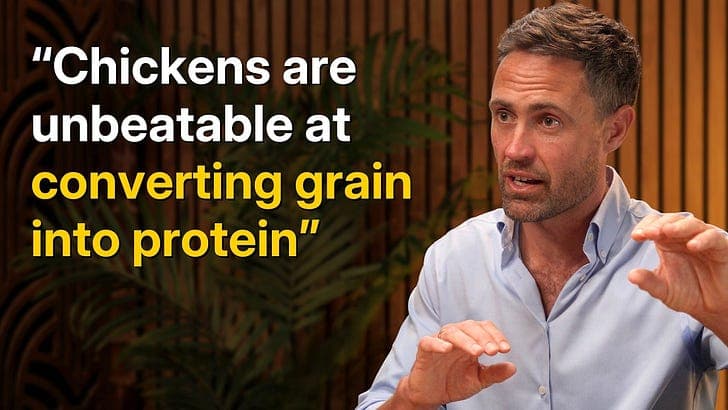
- Inherent Efficiency: Factory farming is highly efficient due to evolutionary adaptations of animals, particularly chickens, which convert grain into meat very effectively.
- Cost Reduction: The industry has cut costs by removing humane treatment, making it challenging to compete against such low prices.
- Future of Animal Welfare
- Technological Advancements: Discussion on innovations like brainless chickens and cultivated meats. While they hold potential, there are cultural and political barriers that may hinder their adoption.
- Cultural Resistance: A significant portion of consumers still prefer traditional meat, limiting the market for alternative proteins.
- Historical Context of Animal Farming
- Evolution of Practices: Over decades, advancements intended to improve animal welfare have led to worse conditions. For instance, male chicks are routinely killed due to breeding practices.
- Innovations Like InovoSexing: This technology can potentially eliminate the need to kill male chicks by identifying the sex of embryos early in the incubation process.
- Political Dynamics
- Meat Industry Lobbying: The meat lobby has significant political influence, making it difficult for animal welfare reforms to pass. The industry's lobbying often overshadows the needs and voices of farmers advocating for better practices.
- Corporate vs. Legislative Change: Corporate campaigns have been more successful than legislative efforts, with many companies pledging to improve animal welfare due to consumer demand.
- Animal Welfare Economics
- Funding and Impact: Currently, less than $300 million is allocated globally to animal welfare initiatives, with a significant portion being effective spending. This creates a unique opportunity for impactful donations, where $1 can prevent 10 years of animal suffering.
- Corporate Accountability: Advocates are focused on holding corporations accountable for their animal welfare pledges, which have already spared millions of animals from cruel practices.
- Global Perspective
- Animal Welfare in Developing Nations: Countries with growing meat consumption but less entrenched factory farming systems have the potential to adopt humane practices and alternative proteins without significant political backlash.
- Moral Progress: As global awareness of animal welfare increases alongside economic development, there is optimism that better practices can take hold in developing countries.
Important Takeaways
- Neglected Opportunity: The animal welfare space is significantly underfunded compared to other areas like climate change or healthcare, providing unique philanthropic opportunities.
- Consumer Power: There is a growing demand for humane treatment of animals that corporations are responding to, although political systems often lag behind.
- Incremental Reforms: Focusing on achievable reforms within the existing system may lead to significant improvements in animal welfare.
Call to Action
- Listeners are encouraged to contribute to animal welfare initiatives, particularly through platforms like FarmKind, which re-grants funds to effective charities in the space.
Timestamps
- 00:00:00 – The astonishing efficiency of factory farming
- 00:07:18 – It was a mistake making this about diet
- 00:09:54 – Tech that’s sparing hundreds of millions of animals/year
- 00:16:16 – Brainless chickens and higher welfare breeds
- 00:28:21 – $1 can prevent 10 years of animal suffering
- 00:37:26 – Situation in China and the developing world
- 00:41:41 – How the meat lobby got a lock on Congress
- 00:53:23 – Business structure of the meat industry
- 00:57:42 – Corporate campaigns are underrated
Conclusion This episode provides a comprehensive look at the complexities of the meat industry, the ethics of animal welfare, and the potential for change through technology and advocacy. The conversation invites listeners to consider their role in contributing to a more humane food system while highlighting the systemic challenges that still exist.
Written by AI. May contain mistakes. Listen to the episode to check what was said.
Transcript
Automatic transcript. May contain errors.0:00Today I'm chatting with Lewis Ballard, who is Farm Animal Welfare Program Director at Open Philanthropy. And Open Philanthropy is the biggest charity in this animal welfare space. So, Lewis, thanks so much for coming on the podcast. Thanks for being on me. Okay, first question. At some point we'll have a GI. How do you just think about the problem you're trying to solve? Are you trying to make conditions more tolerable for the next 10 years until AI solves this problem for us? Or is there some reason to think that the interventions we're making in terms of improvements like an OVA sexing or cage free eggs, et cetera.
0:32We'll have an impact beyond this transformative moment. I think that the end of factory farming is far from inevitable. Every year, we're factory farming about 2 % more animals globally. I think there are two possible trajectories we could go down. One is the trajectory that we have been on for the last century, which is technology has made factory farming ever more efficient, resulted in ever more animals being abused and ever more intensive way out. There is a trajectory where we reduce the number of animals on factory farms, where we reduce the suffering of each of those animals. So even if we get AGI, I am really optimistic that that will accelerate forms of technological progress.
1:12It will bring us better alternative proteins. It will improve the human technology. But there are still huge cultural and political obstacles to alternatives. So the cultural obstacles are that most people want real meat. I mean, most people have the option already of plant -based meat that tastes as good as real meat. That's it. I don't know. So this is the debate. This is the debate. But I don't think that's just the obstacle that people have. I think there are a lot of people who say, I'm just not interested in the alternative. I want the real thing. And then there's also the political obstacle.
1:43So let's say that AGI solves cultivated meat for us. Well, cultivated meat is already illegal in seven US states. It might soon be illegal in the entire European Union. So by the time we get a GI, will they even be able to sell it anywhere? So again, I think there's a huge amount of good that technology can do in this space, and I'm optimistic that aGI can accelerate that hugely, but at the same time, I think we should prepare for the significant possibility that aGI does not end in factory farming. That actually this is an incredibly efficient system that has persisted for all kinds of technological changes, and that could persist through this technological change.
2:16What is it that makes it so efficient? So the basic efficiency is the animal and the chicken in particular has evolved over a very long time to be a being that can take in a relatively small amount of grain and convert it very efficiently into a form of protein that people like to eat. So the feed conversion ratio for chickens, the amount of grain you put in to get meat out is like 2x and that grain is incredibly cheap. And the rest of the production process is incredibly cheap because they've removed everything that costs money around like treating the animals well and providing comfortable stuff.
2:53They've just gotten rid of it all. So they've gotten down to this point where it's insanely cheap. So you're trying to beat the price of grain times two plus a few extra costs. And that is actually a really hard, really hard target to meet. And that's why I factory found chicken is so insanely cheap today. Maybe an intuition pump here is we've been spending on the order of hundreds of billions of dollars a year in order to replicate human intelligence. And human intelligence has been developed, I don't know, it depends on when you start counting intelligence has started evolving. But like on the order of hundreds to tens of millions of years ago, evolution has been trying to optimize for this intelligence thing.
3:31And we've had to spend all this effort in order to replicate it. Converting calories into meat has been something that evolution has been optimizing for billions of years, right? So everything from the immune system to growth factors to delivering nutrition, et cetera, texture, whatever. This is like, this is what evolution is working on the entire time. So it makes sense why this is actually such a tough problem. Are you ready to throw some cold water on your friends? How far away it's cultivated in me, Dashley? I think it completely depends on what we do from here. So, and it also depends on what you mean by code of aid mate.
4:08I mean, there are companies right now that are selling cultivated meat in very small volumes at very high price points, which is incredible. The challenge from here is how do you scale that and bring the price point down to compete with the incredibly low price point, a factory farm checker? And I think how long it takes to get there and indeed whether we get there really depends on what happens from here. We are not on a path right now. When it comes to the amount of venture capital funding available, when it comes to the current startups available, we're not on a path to reach cultivated meat that is cheaper than factory -found armed chicken, I think we could get on that path.
4:41So, ever. Well, I mean, depends. Contention on AGI and contingent on what happens with AGI, right? Like, I wouldn't rule it out, but I don't think it's the default path. I don't think it's the most likely outcome. Maybe, eventually, we'll have like nanotack or whatever, right? At that point, raising chickens can't be the thing to do. Well, you think, like, nanotack and bringing robotics and all these things, but like, in less the cost of all those things goes down to close to zero. Chickens are just going to be so insanely cheap. And so, yeah, maybe. Like, I think it is totally possible that these AGI technologies introduce incredible new proteins that help solve this problem for us.
5:11But I don't think we should rely on it. First, because they might not be able to solve some of these problems to the point that it is as cheap as chicken. But second, because you still have these cultural and political barriers. So the reason I think this is a very interesting example is because whenever people think about the use of technology to improve animal welfare, they're thinking about cultivated meat, lab meat, They're thinking about these extremely far -off solutions. And then it makes sense why even people who are especially concerned about the space, the first thought is not to just find ways to make the existing regime more tolerable, but to come up with some moonshot that changes the whole paradigm.
5:51If you look at how much VC investment is going towards cultivated meat, I don't know if you know, but probably on the, yeah, do you have some sense of how much it goes into the year versus how much VC investment goes into. Okay, we've already got the farms. What is it that we need to do to make, come up with more things like, let's put the eggs through MRIs. Let's do these other small improvements in welfare. Yeah, there's a huge difference. So I mean, it's probably the venture capital on the humane technology is probably less than $10 million a year. 10 million, that would be my guess. Whereas the venture capital on the alternative proteins has been in the billions over the last few years.
6:26Which has probably been motivated, at least partly by the sense of we're gonna make things more ethical, And people might not realize that in the near term, to actually make things more ethical, it might be just better to increase that 10 million poor. I think it's good to do both. Like I think both of these are important. I think that I can see why alternative proteins have a more promising allure to invest as first that could be higher margins. But second, it feels more like the electric vehicle or the solar that just totally replaces the old practice. It's something totally new that places it.
6:57And I think it has that potential for some portion of the market. But what I don't see happening anytime soon is the entire market switching over to these alternative proteins. And so I think we need alternative proteins to meet the world's growing demand for protein so that we don't just have ever more factory farming. And we need humane technology to reduce the suffering within the factory farming that does the cost. So whenever a discussion like this comes up, it's often phrased in the context of personal behavior. I think people will be assuming that what we're going to get up to is like this push to make you vegetarian.
7:27And I happened to have been vegetarian. I grew up a Hindu and so I've never eaten meat. And then I just stayed to vegetarian after I was no longer a Hindu. But then I started prepping to interview you. And I'm like, fuck this might. I don't know how valuable this is. Especially if you look at some of these online charity evaluators and you're just like, a dollar of your donation will offset this much meat eating and you're like, what What are we doing here? But anyways, vegetarianism overrated. I think we made a mistake as a movement, making this about personal diet. I think it's great when folks wanna make a personal diet a session whether that is eating less meat or meat for more humane sources.
8:12But the focus should not be on the individual. This is not how large scale social change occurs. I think we need government reform, I think we need corporate reform. And people can be a part of that regardless of what they eat, regardless of what their diet is. I think that we need people to be advocates and funders and supporters of this course. So how did we end up in this position where so much, I think when people think about animal welfare, they think PETA, they think of like protestors who are encouraging individuals to give a me consumption. At the same time, these charities which are so effective at corporate or policy change or just like so neglected, how did this end up being the landscape of?
8:56animal welfare, activism and funding. Yeah, I think it's a puzzle. I mean, it seems so obvious that you can have far larger scale change at the level of governmental change and corporate change. And instead, we get fixated about whether someone is completely vegan or vegetarian or like, and I think what happened is when people started learning about this issue initially, it was just a few people and they felt totally powerless to achieve larger scale change. And so they understandably focused on themselves. And then it started to become a self -fulfilling prophecy. It started to become an end in itself, where it was about personal purity as much as about the impact you're having on the issue.
9:36And it's much easier to measure your own personal purity than it is to measure your total impact on reforming, factory farming. And so I think it just became this kind of inward focus. And the good news is, I think that has changed tremendously in the last decade. I think the movement has gone from being one that was obsessed with personal purity, obsessed with dietary choices, to one that is much more obsessed with impact. Okay, so this is why I really wanted to do this episode, which is I think people will be aware that there's a general problem here But the actual politics and the actual economics the actual state of the technology landscape here There might be interventions which are stupendously effective Which would overlook just because people are not aware of what's actually happening in this space So on that point to use an analogy from global health and poverty the against Miller or a foundation estimate that has saved on the order of 180 ,000 lives or something, which is a lot.
10:27And, but then you compare it to China liberalizing, brought a billion people out of poverty. That just like, many, many orders of magnitude bigger impact. In animal welfare, do you have some like big take about what the China liberalizing equivalent in this space is? Yeah, I think there have been three large scale drives of progress. So the first has been government policy. So advocates got the European Union to set basic animal welfare standards. That is billions of animals every year, billions every year. Then there's corporate reforms. And we see the same thing that this is just incredible scale across these corporate supply chains.
11:03I mean, McDonald's just implemented that's pledged to go cage tree in the US. That alone is seven million hands every year out of cages just in the McDonald's supply chain. And then the third believer is technology. One example would be inovosexing as a new technology that can get rid of the need to kill male chicks in the egg industry. The unwanted chicks are killed at birth and inovosexing has already speared about 200 million chicks from that fate. So there are these giant drivers and the good uses were just getting started with them. There is the potential, I think, to help tens of billions of animals through these drives.
11:38Okay, I want to go into Innovo sexing. Yeah, just the fact that you could have a new technology and you can have basically a per -auto improvements where things aren't getting more expensive. Maybe in the future they'll actually get cheaper because of their technology. At the same time, you're having improvements in animal welfare. The problem, of course, with this industry has been that in the past, increases in efficiency have been coupled with increases in cruelty. So I want to understand whenever the trend goes in the opposite direction, what causes that to be the case? So what is the history of the technology?
12:09How does it work? Why did it take so long for it to come into common practice? Sure. Yeah. So I mean, the historical basis is a story of technology doing harm, which was we initially the egg industry and the meat chicken industry separated because they realized they could grow meat chickens to be optimized for weight gain and laying hands to be optimized for laying eggs. That meant that the laying egg industry had no need of the male chicks because they couldn't lay eggs and they couldn't grow fast enough to be meat chickens. And so what they decided was to just kill them on the day they were born.
12:43And so the standard practice, and this is about 8 billion chicks globally every year, just thrown in a giant meat grinder or suffocated and bags the day they're born. Crazy. This new technology is basically the application of existing technologies to scan the eggs in advance and work out whether they're going to be male or female. And then you can just get rid of the male eggs very early in the incubation phase. And this technology went from 10 years ago just being a vague idea to today, it's already a third of the European egg industry. It just got introduced to the United States. We've got the first eggs coming out in the United States now.
13:22So this is a technology that is growing rapidly, and I'm really optimistic that can ultimately end this problem globally. And how much was this driven by policy versus the tech being mature enough for it to be economical? I think it was both. So first there was some policy upfront which was because advocates had drawn attention to this practice of killing male checks There was real impetus by governments and philanthropists to support Kickstarting this technology and my estimate is it was about 10 million dollars very little amount of public and and philanthropic money That kicks out of this technology got it to a point where startups could start to implement the technologies I'd be curious to understand exactly because MRIs have existed for a while, PCRs existed for a while.
14:01So why took this along for this to be economical? What did the nature of that cost curve was? And I'm especially interested to understand this because it seems to imply that, look, I mean, we didn't have to come up with some brand new tech in order to enable this. So are there other things where somebody who is somewhat familiar with the technological landscape? People are always looking for startup ideas, right? Should they just spend a couple days at a big poultry farm or pick farm or something and see if things can't be improved. Yeah, I think there's huge potential for technologists here. I mean, there is a lot of low hanging fruit because this is primarily a commodity business that has only done things that reduce the price or increase production levels.
14:47Yeah. It has not invested in animal welfare. And as a result, you find these things that's doing that just see my kayak. Like the way that it is castrating piglets is with a blunt knife and like no pain relief. And so in that case, there was a new technology of immunocastration, an injection that achieved the same effects and it was very easy to develop. And so I think there are a whole lot of other practices like that out there, the whole lot of these, I care practices being done, where someone could come in and with a little bit of smart work around this and an actual focus on animal welfare, bring in solutions that could potentially help billions of out.
15:20I think one important dynamic to this industry The youth pointed out is that we have to, whenever we have to really optimize for efficiency in one domain, it causes all kinds of other problems that we have to then make up for with even more cruelty. I mean, think of what we've done to pigs. So when we took pigs inside from outdoors, and we selected them to grow faster and to have this inadvertent greater regression, the first thing they started doing was getting bored and biting each other's tails. And that was a problem. So then we said, we'll cut the tails off. Well, they didn't work. So then we had to start clipping the teeth and cutting part of their teeth off.
15:59And then that still wasn't enough when it came to the cells. So then we had to put them in crates to protect them from any other animal. And that wasn't enough. So then we gave them antibiotics and other drugs. At each step, there is a new solution that can't solve the fundamental underlying parts of the problem and sometimes just makes it worse. Could we make chickens or pigs with no brains, right? because there's a suffering we care about. So to the extent that their bodies are just these incredibly well -evolved bio -reactors we're converting grain into meat, whereas optimization has led to more and more cruelty in the past.
16:37In this case, this is the ultimate optimization, right? They're not moving around at all. They're literally just a machine for producing more meat. Yeah, and then the suffering is in some sense inefficient, right? It causes them to, if they're pegging at other animals, if they're creding caught in wires, et cetera. This is something that would be better even economically to eliminate. I think you're right. The suffering is un -economical at the level of an individual animal. So the animals that we have selected for and the way we've treated them result in more of those animals dying, more of them having all kinds of welfare problems.
17:13The problem is that it is collectively more efficient. So like if you can cram twice as many animals into a barn, it doesn't matter if 10 % more of them die. And so that's been the underlying model of this industry, is that the reason welfare gets neglected is, yeah, it has like a slight cost, but the efficiency gains are so much greater. So I agree we should try and find things to reverse that. I mean, I am personally more optimistic about these kind of incremental reforms. Like I think the average person listening to this is not thinking like, oh yeah, I'm really pumped for like the chicken, the brainless chickens to come along and like just persuade me.
17:43But they're not pumped about the cultivated media, right? Yeah, sure. And like this, but this is why you need a whole bunch of different approaches, right? This is why because like there's no one solution that is gonna satisfy everyone. And what I would say on genetics is what feels way more chiefable to me in the near term is to get rid of the genetic physical problems that I owe these animals. So for instance, we've bred these chickens to be mutants that like collapse under their own weight. We know that we can breed for far higher welfare birds that are still commercially viable. And indeed, there are companies and there are places like Denmark where the industry has already moved entirely toward these high welfare birds.
18:17They have way better welfare outcomes. They suffer way less. What's different about them? So the first thing about them is they are more balanced overall. So where the industry has just selected for rapid breast meat growth and for really efficient feed conversion, these birds have been bred to have robustness. So they have brought in legs, so like their legs don't collapse. They have better cardio systems, so they don't develop all these cardio problems. And in general, they've just been bred for well for our comes. Like, we're just like, let's just breed a bunch of birds and find the ones that die less and like generally, so are they less economical?
18:50They're slightly less economical. I mean, this is why because they haven't been ruthlessly selected for those two variables of breast meat yield and feed conversion. So they cost a little bit more. And this is why you need advocacy to get people to adopt them, right? And so there has been huge advocacy in France, in Germany, in Denmark to get this. And in fact, just last month, the largest French chicken producer, the LDC group, committed to moving its two main brands to these high -well -fetched genetics. Why not think that they will just be eaten up in terms of their welfare impact? To the extent that the economics in the industry for a century have been cram -morth things in, you know, figure out how to optimize along axes which just make the animal incredibly unhealthy and emisorated for longer and in more extreme ways.
19:37is like, okay, we'll come up with an Innova -Sexing, but then there'll be another thing which is the equivalent of gestation crates. Why think that even technologically, the thing that is favored is the suffering free optimizations? Yeah, I mean, I think you're right. This is the story of a lot of the industry's efforts to improve welfare. So for example, there was a study back in the 90s where they taught chickens how to select pain relief laced fate. And they found the broiler chickens were all selecting the pain relief late -speed, suggesting they're all in chronic pain. And the industry said, like, don't worry, we'll address it, like, we'll strengthen their legs.
20:14So they went away and they, like, strengthen their legs for a bad. And then they were like, wow, it's great. Like, the chickens have stronger legs now. Like, they can, like, go and eat more stuff and we can put more weight on those legs. And so then they made them, like, bigger and essentially undead those gains. And in recent years, we've seen the mortality rate in the industry rising again and getting worse. So presumably they have just pushed so far again that direction. So I think that's a major risk. I think this is why you need government or corporations involved. This is why you need government sending down a baseline standard, saying you can't go below this welfare floor.
20:44For instance, in Denmark, the government is strongly encouraging the move toward these high welfare breeds and looking to ban low welfare outcome breeds entirely. And you need to maintain those high welfare outcomes. And I think this is what you need in corporate supply chain. So, this is also what you see with the French retailers moving away from these low welfare breeds, you need them to maintain those standards because you're right. The industry left to its own will always find a race to the bottom. So potentially we could find ways to make animals even bigger with the future forms of biological progress that some of my guests talk about.
21:24It's already the case that it's better to eat beef than chicken because cows just have so much more meat per brain. What if we just got rid of the myostatin inhibitor genes or whatever, and now that there's even more meat per cow? Is that better because you have more meat per cow or is it worse because it's potentially going to lead to the same dynamic of these overgrown, more suffering animals? Which way does that tilt? I think it probably tilts toward more suffering. This is what you see with the history of breeding these chickens to be the kind of mutants they are today. Where they've achieved a 4x gain in growth rates since the 1950s.
22:07That has led to a 2x drop in price and that has led to a 3x increase in consumption. And because consumption has gone up so dramatically and the suffering per bird has gone up so dramatically, that has outweighed the benefits of these birds being big. But the consumption might have gone up regardless. So actually then it's not clear. They would have to be, to the extent that we hold consumption constant, maybe we shouldn't, they would have to be suffering for acts as much as a chicken in the 1950s for it to be and not be an net improvement. I don't know if you disagree with that. No, no, so I think there is a, there is a in -between ground solution now, which is the higher welfare breeds that we are advocating for producers to adopt.
22:52are not 1950s growth levels. They grow almost at 2025 growth levels scaled back slightly in a way that enables much larger welfare improvements. And so I think you don't have to go backwards to the level of these incredibly slow growing animals. Some people want that. I mean, there'll be a market for like heritage check -ins and people who are willing to pay for these like extremely slow growing animals. But the more realistic thing at scale is gonna be these ones who still grow fast and still get big, but do so in a way that doesn't totally destroy their bodies and cause them to suffer so much.
23:24It's just striking me now that the way to think about what we're doing to these animals is not even, and this is already be just incredibly immoral, is finding creatures in the wild and then caging them up and then putting them through awful tortures. Rather, we are manufacturing creatures basically optimized for suffering, right? It's not even that like we found this chicken and now we're gonna put this in this like little cage. It's like we have designed this chicken to basically suffer as much as possible. We have like literally genetically changed it as much as we can plausibly change it given the technology available to us today.
24:07And like this, in this Frankensteinian way, to suffer as much as possible. I don't know, that framing just makes it like, yeah, especially gruesome. I agree. I mean, this is the story of the chicken meat industry. Is they have just bread and bread so these animal suffer more and more? I'll give you another example of that, which is the breeding birds. So the birds that they have that are raised for meat are optimized to only survive until about seven or eight weeks of age. And even by that age, a lot of them are keeling over, getting lame, collapsing. But they're not a puberty yet. So they need to raise some of these birds past puberty to raise the next generation of birds.
Read the full transcript
24:46For those birds to not totally collapse under their genetics, they have to starve them. And so what they do is they give the breeding birds about 30 % of the feed that the birds would eat on their own. So they're like starving them 70%. Because that is the only way to stop these birds from completely collapsing under the genetics that they've inflicted on them. In just reading about the accounts of, for example, pays ingestation crates. And the medical symptoms, swollen ankles, broken bones, obviously from chewing the iron bars, all the bruises that causes, ulcers, tumors, cancers, posters, et cetera.
25:29These not being rare medical emergencies, but the regular anticipated, expected outcomes across populations of pigs, which individual farms will house like thousands of them. And of course, around the world, a billion. I'm sure you've visited many of these places yourself where I had friends who've done so, right? Yeah, I mean, I've visited factory farms and I will say it is every bit as bad as it looks on the videos you can find online. It is every bit, I mean the addition you see is, well first you hear the noise, the distress, the ups from these animals, you smell, smells awful. But the other thing I noticed I visited one egg factory farm and it's impossible for farmers to provide individual care to each of these birds.
26:18This was a relatively well -run farm and yet I still found a whole lot of hens stuck in the wire. And those hens are just going to slowly starve. Like there is no, and indeed many had, there were a lot of dead birds in with the live birds and other cages. And that's just because of the scouts. Like one farmer is trying to look after like 200 ,000 hens is like the only thing they can actually do is check the feed lines and check the water lines and like remove some of the dead birds. And in fact that is the work of a factory farmer is largely removing dead animals. And so it is just this dystopian and you think we're like, the industry presents this picture of like, oh, we have like individual care for our animals.
26:52And it's like the scale at which you were doing it has totally prohibited, having any kind of individual care. Right. And this is an issue where a scope sensitivity is just, it is like so insane the magnitude, right? If this one battery cage farm was the only thing that existed in the world, right? There was like this one farm in India that had a hundred thousand chickens, which were each just experiencing weeks upon weeks of pain through their life. That would already be a moral emergency, but it's so easy to forget that if there's 10 billion chickens that are alive at any point in the world, the whole problem is five orders magnitude of magnitude bigger than this one farm itself.
27:37So 100 ,000 times bigger than this one farm, And it's just like stupendous to comprehend the scale of the problem. It's crazy. And you see this total confusion in the laws we pass. So for instance, dog fighting, which is a real evil, it's horrific, but we're talking about thousands of animals and Congress has passed multiple laws. Every state's made it a felony. It has been regulated correctly out of existence. Meanwhile, the factory filing of pigs occurs on this far greatest gap. I mean, we've even done the same thing with cock fighting, which is literally chickens. And it's literally, again, thousands of chickens, and we have rightly banned it.
28:12We've rightly made it felony animal cruelty. And yet, when factory farmers do far worse, to far larger number of chickens, we call that commerce, right? Yeah. Okay, so the positive spin on that can be that because of how big the problem is and how neglected it is, the ability of any one person to have a big impact might genuinely shock them. So let's get into that. You are the biggest funder in this space, but cumulatively between you and the others, What is the amount of smart money that is being allocated to this problem? Yeah, so we think less than $300 million is being devoted to all work globally around every possible solution, the factory farming across every country.
28:54And less than 200 million of that is what you would probably consider smart money going to evidence -based, effective interventions. So to put that into perspective, Filmthropic climate advocacy alone is 50 times bigger than that. The work of cat and dog shelters and rescue groups in the US alone, 25 times bigger than that. There are individual conservation and poverty charities that are 5 to 10x bigger than that. So this is a tiny amount of money for the purpose of social reform and yet it has achieved a huge amount impacting hundreds of millions billions of animals. But what would happen if the amount of funding in the space doubled from the 200, 300 million you mentioned that is being spent smartly?
29:37I know you'll say there's a bunch of things we could optimize around, right? There's so many neglected issues, but is there an immediate thing, was there like this is this is the thing that is directly at the margin, the next 100 million or the next 10 million we're able to this? I think additional funding would be transformative, I mean, we have a playbook that works on a number of these issues. So one of the first things would be holding companies to account for animal welfare policies they've already made. We've got huge numbers of companies that may equip them to getting rid of battery cases and are now trying to back out of them or ignore them.
30:07With additional campaign funding, we could hold them to those and as a result, immediately improve the conditions of millions of animals. For years, the industry used these battery cages that are these microwave oven -sized cages. They cram as many hens and as they can, and they leave them there for years. We know consumers don't think this is acceptable, but the industry doesn't disclose. They're used to them. It's not like when you pick up a pack of eggs and has a big thing saying, from cage tens or like an image of where they came from. Advocates went to the largest retailers, the largest fast food chains and said, you need to move away from this because your consumers already expect this a few.
30:42This is what your consumers clearly want and clearly don't accept this practice. And they got pledges from almost all of the largest food companies, not just in the US, but globally to move away from these practices. And we're already seeing that this transition has already spared over 200 million hands a year from these battery cages. So the US has gone from less than 10 % cage free to 47 % cage free. The European Union is now 62 % cage free. This is a huge transition. How do they do this? So I mean, they captured this basic divide between what consumers expected was already happening and what was actually happening.
31:19I love to this specific example of, like, there's a super tractable thing that is like immediately available with the next millions of dollars in funding. Is there a particular charity which works on these campaigns in particular? Well, I think that one great way to support them is to support a diversified portfolio of groups. So there's a group farm kind that allows people to donate to a variety groups and two of those groups That you can donate to through that platform the humane league and synergy or animal are both working on exactly this I think people just might not be aware of the ratio of dollars to suffering averted in this space Yeah, if you're gonna give some sense of what we're talking about Dollar to suffering here sure So the work to get hints out of cages has already spared over 200 million hints from cages.
32:09The work to improve the lives of broiler chickens has already benefited over a billion animals. That's just every year. And so, sorry, it's 200 million a year. 200 million a year. Oh, sorry, I missed that. I thought it was a cumulative of a cross. No, no, no, no. So the cumulative number, we're already well -known off of 500 million hints or into the billions of broiler chickens. And if you assume these things weren't just around the corner, they weren't just going to have an anyway. If you think you probably sped up progress by years, decades, maybe it would never have happened. Right. Then that's cumulative impact over those years and decades is giant.
32:44I mean, we're talking billions, we're talking tens of billions. Now, the amount of money spent just on those corporate reforms, that was less than $100 million a year over a couple of years. And so we're talking about a ratio that is far less than one to 10 of a dollar per year of animal Well being improved. Okay, so one dollar You're saying one dollar can do more than 10 years of a better A more humane life that is stupendous right like a couple hours of pain is just Awful and terrible. You're saying 10 years For a dollar, the reason why that's so shocking is that on its face it's shocking. But in other areas where you're trying to do global health or something, first the problem is improving on its own, second, the Gates Foundation, et cetera.
33:37There's tens of billions of dollars already being poured into the problem, same with climate change, et cetera. So the idea that you would find an intervention that like a single dollar can go this far is just genuinely crazy. I think it's very unique. And I think the reason this philanthropic opportunity exists is because this area has been systematically neglected, which is to say that most people when they think of philanthropy do not think of found animals. It's most people pile into the popular areas, like education and healthcare and climate. And as a result, you end up with these outsized opportunities that no one has taken advantage of.
34:15Like, it's like if the space had billions of dollars in it, as other phone's normal areas do, you would not see opportunities like this. So I won't bury the lead any longer. I've always been interested in this issue. I lost track of it for a little while, to be honest, but I encountered you on Twitter and I started learning more about the issue. We tried it a few times in person and that motivated me to have you on the podcast. And also to donate myself. So as you mentioned, farm kind of giving is this re -granter. They don't keep any of the money themselves. They just re -granted to the most effective charities in this area.
34:53They're basically like an index fund across the most effective charities in animal welfare. And it motivated me to donate to them. So I'm giving $250 ,000 and I'm doing this as a donation match. So this is to say that you, the listener, if you contribute to this donation match, we can double each other's impacts. and between the two of us we can allocate $500 ,000 to be saturated, and I really wanted to saturate this. $500 ,000 to the most effective charities in this area. And remember how neglected this area is. Lewis, as you were just mentioning, $1 that is donated in this area corresponds to 10 years of animal suffering that is averted, which is just stupendous to think about.
35:37There's no other cause area in the world which has such a crazy ratio, and that has to do with how neglected this area is. And of course, the positive connotation of that neglectedness is just how big an impact any personal listening to this podcast can have. So that's the donation match, and the way you can contribute to it is to go to farmkind .giving slash dwarkech. Now, I also recognize that there's people in the audience who can do much more than this amount, and given how neglected this issue is, right? Like remember, there's over in the order of 100 million or 200 million that are being spent wisely on this topic, one such person listening could double the amount of money that is being spent effectively in this area.
36:22That's crazy to think about, right? And if you are one such person, just think about that. And even if you can't double the amount of money that's being spent in the area, you could cause a double digit increase in the amount of funding that these effective causes are receiving. So for those people in the position to contribute much more, at least want to get their foot in the door and explore contributions of 50K or higher. Lewis, what's the best way they can reach you? Yeah, and that case would love to hear from you. So people can message me on X or they can reach out to my colleague Andreas.
36:55That is Andreas was 1A, so it is A in DRES at OpenFelanthropy .org and he would love to work with you and I'd love to work with you to help you spin that money as effectively as possible. Okay, but if you're like the rest of us, and you need to start off on a more humble basis, I think your donation would already just have a huge impact given how neglected the spaces. So again, the link is Farmkind .giving slash the work hash. Okay, so let's talk about other countries because you are not only the biggest funder in this cause area in the United States, but globally. And then obviously an animal suffering in Sri Lanka or China is just as bad as an animal suffering here.
37:42So what is especially promising, especially given that more people in these countries will start eating meat and this problem is getting worse over time, it's getting worse because people are getting wealth here and eating more meat. What seems like the most useful intervention or the useful thing to understand about what to do about that? Yeah, I think there are a couple of things. So the first is countries where the approaching consumption is rapidly growing and there is not yet a deeply entrenched animal agricultural industry. Have the ability to do things differently. And in particular, they have the ability to support alternative protein work without that being politically toxic.
38:21And so for example, we see China investing very heavily in cultivated meat research. The majority of patents coming out globally on cultivated meat now are coming out from public universities in China. So this is, I mean, this is a case where it's just like the US is being overtaken because we have this entrenched industry that is that is furiously lobbying. I also think there's the potential to extend animal welfare policies globally. So we're seeing multi -nationals like Unilever and Nestle and even Burger King saying we shouldn't have cages in our supply chain globally. And this creates the potential to spread best practices just in the same way that factory farming spread from the United States globally.
38:58But factory farming spread because it was cheaper. Right. Not because there were some wildfires that everybody else felt the need to copy here. That's right. That's right. So we had essentially the economic efficiency spread factory farming. Right. And in some cases, that can spread higher welfare tech. So for example, in over -sexing technology, once that is being de -risked enough, once it has been scaled up in the Europe and the US, I'm optimistic it will become cheaper, and then it will just be scaled out globally for a number of reasons. But there's also, we can spread moral progress. So I mean, we know that people in these countries also care about animal warfare.
39:34And I had a fascinating conversation. I went to a trade show and I talked with a company that manufactures crates, manufactures gestation crates. And I was like, you know, what do you think about the future sales of these crates? and they're like, well, we already have stopped selling them in Europe and the US. And I was like, yeah, do you think you'd be able to be able to sell them in Asia forever? And they're like, no way. As Asia gets richer and is on social media and sees the images of these things, they're not gonna be cool with this either. We know there is a limit to how long we're gonna be able to sell these things for.
40:02And I think that gives me some optimism that I think as countries get richer, they generally get more concerned about this issue and that then enables them to adopt animal welfare forms as we've seen in the West. on net is there a Kudznet's curve here where initially they get wealthy or wealthy enough to have afford the most economical forms of meat, which are battery cages, et cetera. And then they get even wealthier so that they can afford the potentially slightly more expensive versions of meat, which are more humane. Or on net is just like, you keep eating more meat through this whole process.
40:36So even if it gets slightly more ethical, the amount of meat consumption will have like two extra three acts. So, um, wealth always correlates with more suffering, basically. Yeah, it's mixed. So far globally, wealth has heavily cartled with more suffering. I mean, the drive of people getting richer has led to them eating fomal meat and fomal of that coming proffectory farming. And we have overwhelmingly seen that trend across all countries. In a few European countries, we are starting to see the dynamic. where once countries have reached a certain degree of wealth, they are able to bring around reforms that actually reduce the total amount of suffering.
41:11Like I think it is quite likely that Germany has passed the top of that curve and is now on the other side of diminishing total animal suffering. The critical thing to bear in mind is this does not happen on its own. Like in Germany this happened because there are very talented advocates who harnessed that public opinion and concerned to drive corporate reforms with the retailers and to drive government policy reforms. And I think we need to do that. I don't think you can just count that people are going to get to a certain degree of wealth, and this is going to happen. I think it only happens if there is advocacy to mobilize that public opinion.
41:42So a difficulty that these animal welfare policies have had is, even if you outlaw a practice domestically, to the extent that it's cheaper to produce meat that way, people will just import meat produced that way that is made elsewhere. And so states in the US who have tried to do this have had this problem, countries in Europe that I've tried to do this, I've had this problem. How do you solve the lowest common denominator problem in animal welfare standards? Yeah, it's a huge problem. Advocates in the US passed ballot measures in Florida and Arizona to ban gestation crates, and then the pork industry just imported crated pork from other states into those states.
42:24So advocates then went to California and Massachusetts and passed ballot measures that extended the same standards to the sale of pork within the states. said you can't sell pork from crated pigs anywhere. I think that is a critical move. And we're seeing the European Union now considering doing the same thing, imposing animal welfare standards equally on imports. I think that policy is critical to not just ensuring that you're not getting these laws undercut, but also to changing the political dynamic. Because domestic farmers, local farmers are going to be very opposed to any law if they realize they're just going to get undercut by out of their competition.
42:58Right? So, and so I think this is a chance to also change that political dynamics. so they can actually support the law, knowing that they are not at a relative disadvantage. Right? And potentially reversed by an upcoming bill, right? This is right. So the poor industry, unfortunately, has looked at these laws in California and Massachusetts and wants to do everything it can to undermine them. I mean, it knows this is the only way it can be effectively regulated, given it has an absolute hold on the legislature and Iowa and North Carolina, which are the main states for poor production. it knows that it needs to stop any other state from setting production standards or sales standards.
43:34And so it first went to the Supreme Court. At first, here, this is unconstitutional. The states can't do this. And the Supreme Court does a great, we want it, the Supreme Court. And so now it has gone to Congress. And it's saying to Congress, you need to wipe out these state laws. You need to stop them from doing this. And the unfortunate thing is the Senate and the House are both on track to do that. So in the upcoming Farm Bill, there is language that would ban states from passing laws on the sales standard, on the animal welfare sales standards on goods. And right now the default path is that that will pass as part of the farm bill in the next few months.
44:09Okay, so if these advocates are able to pass these laws or balance at the state level, and it's popular enough that they're passing, why is it at the national level, they can't make a request about this and prevent this from getting added to the full farm bill? The first problem is structural. So at the state level, they've had to use ballot measures to get around entrenched lobbies. In this case, things start out in the House and Senate Ag committees, which are heavily dominated by agricultural interests. Yeah. The majority of House members, I think, signed a letter against us in the last Congress, but the vast majority of them are not on the Ag committee.
44:45And so the Ag committee gets to decide what's in this bill, and if you're on the Ag committee, I mean, they're just the House Ag committee just hosted a hearing on this. They only invited lobbyists for the industry. They didn't bother to invite a single opposing witness to their hearing. We're also seeing that the industry is much better organized and funded on this effort than advocates are So the industry is constantly flying out a bunch of big industrial pork farmers Claiming they speak for the entire industry telling the legislators as their number one priority and absolutely has to be done By contrast animal welfare groups are not getting the same hearing so legislators are not taking them as seriously as they take these as they take these aggro We shouldn't there be some political constituency that's formed by the pork producers who are using more ethical standards and who are themselves being undercut by these Iowa farmers.
45:34Why aren't they getting flown out to these congressional hearings? Exactly right. There is a large constituency of family farmers who support these laws because it is created a new market opportunity for them where they can sell their already high welfare meat and not be undercut by the industrial stuff. The problem they have is that they are far less wealthy and organized than the industrial pork interests. And so they don't have the money to just fly themselves to DC. They can't stop farming. The people who are actually doing family farming can't just go to DC and hang out for a week because they need to be farming and looking after the pigs on their farm.
46:12But the meat lobbyists also, given that it's a commodity business, you think that there wouldn't be that much surplus that they can dedicate to political of a lobbying. So everybody here is like not doused in cash. We can't subsidize a couple of plane tickets for these family farmers. So what's going on? I mean, there are people who are funding some of these family farmers to go to Washington DC, but we could see a far bigger effort. I think that voice is being hugely in the fight to the debate. The other thing I'll say on the money the poor chemistry has is yes, it's commodity business, but it's also an oligopoly.
46:46And so you've got a very small number of firms that process the vast majority of pigs, and they do seem to make outsized profits. So they don't make the kind of profits you would expect. And across these industries, we constantly see price fixing scandals and other antitrust scandals, because there's very small number of companies on only requires minimal coordination for them to make greater profits than you would think they could. Hmm. There may be a good for animal welfare. In the sense that if they can extract greater surplus, it makes it more possible for them to potentially invest in animal welfare.
47:16Not that they're necessarily doing it, but it would make it possible. Completely makes it possible. That's right. I think, I mean, this is the absurdity of this, is that the egg industry has been saying, we can't possibly afford this transition to cage free eggs. They, over the last few years of high egg prices, they've made insane profits, because this is a good, well, so like, Kellman, which is the biggest egg producer, I think it's share prices like doubled over the last few years. And it's because the price of elasticity for eggs, it's very enelastic. So like you can just keep cranking up the price on even a very small Rejuction and supply and you can then take all that surplus And so they they've been doing that and as a result you see a whole lot of these industries They are actually flush with cash the problem is but is it under 100 million billions?
48:02depends on the depends on the on the company right so a lot of the egg producers are actually relatively smaller It's the Tyson foods and things that are on the billion on the billions But no, they have the money to do these reforms. I mean that is not the that is not the constraint the constraint is the willingness to do the reforms So if the majority of House members have written this letter apparently saying that they should be taking out the Farm Bill, why is it still like there are the people going to vote on this, right? So why is it still going to pass? Well, the problem is, so this bill stopping states from regulating Farm and the Wall for meaningly, this bill could not pass on its own.
48:38So if it was put on the floor of the House and the Senate, it would lose. This is why they're putting it in the Farm Bill. So the Farm Bill is this huge piece of legislation that includes all the farm subsidies, it includes all the food assistance. And so this is a bill that is considered a must -pass piece of legislation and is decided based on issues that most politicians consider far bigger than the issue of where the state laws are wiped out. And so what the industry is banking on is that once they've got this in the text of the bill, people aren't going to sink the bill over this one provision and it will sail through even though it's a deeply unpopular policy.
49:13Okay, I want your guide on how to corrupt the political process in the opposite direction. What insights do you have on how to actually have an impact on how Congress people or state legislatures vote? Yeah, I mean, I think the good news here is we have public opinion overwhelmingly on our side. Right. So, like, that's good. He's the foot in the mouth I caused by saying the word corrupt. That's right. We don't need to be corrupt, right? It's like the industry needs to be corrupt because they are trying to get politicians to do something that their voters strongly disapprove of. And so I think what we need to do is mobilize that base of support and show how real it is.
49:51And so I think we need, for instance, to mobilize animal welfare advocates, we need to mobilize farmers who benefit from higher welfare standards, and we need to provide them with an equal footing to the footing that the industry has provided to the very small number of factory farmers who have a stake in the system. And that requires the same thing as the industry doing. So I mean, it requires flying people to DC. It requires getting people to go and talk to their politicians and their local district. And yes, it also requires money because the industry is putting up so much money. Politicians need to see that there's also money on the other side of this issue.
50:23And when we actually take to, I don't know, I hear this and I'm like, it's not clear what exactly you would do if you wanted to get this message in front of, Like, abstractly, you can give money or whatever, but like, how does that actually transfer to political influence? My sense of what the industry does is they get a whole bunch of their executives to max out on donations to politicians. The politicians then give them meetings. And I wish this wasn't the way the system worked. Like, I wish instead that politicians were actually just responsive to what the voters want, but given this is how the system works, I think that what people need to do is to buy on together with a couple of other friends who care about this issue, max out on your donations to a politician, and then meet with the politician and say, I really care about this, and I'm watching what you do on this issue.
51:13And I think that if enough people did that, and frankly, you don't even need to just start donating. A lot of people listening to this, who probably already donate significant amounts to politicians. And if they started saying to those politicians, by the way, this is something I really care about, and I'm watching what you do on this issue, I think you would start to see the political dynamic change. You wrote about on your recent blog post that the meat lobby spends on the order of $45 million at any given election cycle. And they seem to be able to have influence on the topics they care about, which would be astounding and make jealous all of us in tech.
51:46Like, there are probably people listening to this podcast who could spend on the order of that kind of money on politics, but the ability of tech to have an impact on the kinds of issues that they care about is quite minuscule compared to the meat industry. So what's going on here? what's the political economy of meat here? Yeah, it's a real puzzle. I mean, this is an industry that accounts for less than 1 % of Americans is trying to defend wildly unpopular practices. And doesn't even get that much money. And yet somehow they have this total lock on the legislative process where they can stop any animal welfare legislation from passing.
52:20I think there are a couple things going on. So I think the first thing is, it's not just them. They are fighting alongside of the entire agriculture industry. They're allied industries like the insurance industry the farmer industry that have a big stake in factory farming They also it's not just the money so they appeal to this myth mythos of the American farmer people think The American farmer is the good hardworking soul to the earth person They saw the image at this person out in the fields tending to their chickens and their pigs I don't realize these are factory farmers and they're extremely well organized I mean they have a very formidable lobbying presence in Washington DC and across state capitals and they have effectively used that to block any kind of regulation.
53:01You're telling me that tech bros aren't that's politically sympathetic as with the Sulta Vial farmer. You know, there's this children's kid's book Rule of Politics, which is you should never miss with a character in a children's book. And you know, that's the police, that's the doctors, that's the farmers, and I don't think there are any tech bros in the kids' books yet. The front end developers have yet to grace the covers. That's right. So you should describe the sort of franchise hierarchy type structure of a lot of these meat companies, but you would anticipate that yes, the produce and Tyson's of the world would want a particular thing to happen in terms of political processes, but the farmers who are indebted to these companies often have an adversarial relationship, why are they able to form an effect political coalition with them?
53:46Yeah, this is a great point. I think most people don't realize that the way these factory farms is you have these giant corporations like Tyson Foods or Smithfield. They mostly don't own their own farms. Instead, they have these contract farmers who are essentially indentured laborers. I mean, they have a huge loan hanging over their head and they're farming into why would those people support this? The answer is they often don't, and I think the Agribusiness Loving Associations have done a very good job of pretending they don't. So they present themselves as representing the farmers. But if you look at their boards, if you look at the people who are actually leading these organizations, it's made up of people from the giant ever businesses and the very largest industrial farmers.
54:27They do not have small contract farmers on the boards of these organizations. And so I think it really is a bit of a bad and switch where they claim to be representing those family farmers, but they're not. And what is the reason that these contract farmers are willing to work with these large businesses? Because people will often say things like, oh, Uber is bad for Uber drivers. And I'm just like, I trust Uber drivers and know what's best for them. Why would these more farmers be working with these companies in the first place if it's un -economical for them? Yeah, so it depends. I mean for some people it is just their the the least bad option they have, right?
54:58And especially if someone just has a little wee bit of land and they want to preserve that land and they don't have other skills they can use But you know, I mean I was chatting with this guy Craig Watts who was a chicken contract farmer for Purdue And he told me that when he got into the business they made all these exorbitant claims to him. I mean, they said you're gonna be making over $100 ,000 within years, they said, just get out this loan and it's gonna be incredible to talk about all the things that could go right. And then he got into the business and they slowly started eroding the payments to him.
55:27So they slowly started paying him less and less. They slowly got to a point where he was making less and less money and he wanted out, but by that point he couldn't get out because he had this giant loan hanging over his head. And so I do think you've got a bunch of people who are stuck in the situation. And there aren't easy alternatives because normally in one area, there will only be one processor that has a slaughterhouse in that area. So there's not a fact of competition going on. Also often you're locked in these long -term contracts as well. So there is an element of people being locked in this, and then there's an element of people just not having better choices.
55:54And what is the alternative use of that land? So if you didn't work with some centralized processor, is the alternative use of that land for farming? They give you inherited some land, and you want to figure out what to do with it. What can you do with it? I mean, I think ideally we would see pasture -based farming in those places. And it doesn't require that much land, for instance, to have a pasture -based chicken farm. The problem is, you would need to find a processor that you could work with. And normally, that just doesn't exist. So normally, you've only got the giant players in an area, and they say, we just want commodity production.
56:26We don't want to fund you to do this pasture -raised stuff. And so you get locked into that contract. And so oftentimes, people who are doing pasture -raised production have to create their entire supply chain that by themselves. They literally have to build their own slaughterhouse and create their entire supply chain around that, which drives up cost massive life. Why is that? Because there must be enough consumers, even if it's not a majority of consumers, there must be enough that there's some economic incentive to set off the economies of scale and supply chains that would make it easier to set up such a farm, right?
56:55So why doesn't that exist? So there were people who were trying. So Niamen Ranch, for instance, has done this with independent pork farmers. There was a big effort to do this by cooks ventures with pastorized chicken. And unfortunately, they just went out of business. And I think the reason they went out of business is because there is such huge mislabeling across the industry that it's very hard to separate out what's actually better. So for instance, much factory -farmed chicken in the US is sold with the label All Natural. And we know from surveys that people think All Natural means the chickens were outside.
57:25It actually means nothing. But if you're trying to sell your product as like pasture raised next to a product that says All Natural and people think it means the same thing. And your product costs $2 more. You're not gonna get very far, right? And so I think so long as we have this rampant mislabeling, it's very hard for the other players to get ahead. Yeah, I guess I was wondering. So if you, there's like normal bananas and there's organic bananas. And people are willing to pay quite a bit more for organic bananas. I feel like pastorace should be in the similar embedding space. It's like organic where like, organic is a huge industry, even though it has dubious medical benefits, et cetera.
58:02So then the problem is not that if there was accurate labeling, you think there might be consumer demand to make this available much larger industry, just that it's very hard for consumers to identify which is which. Yes. I think you actually see that in the egg sector in the US. Within eggs, there is clearer labeling. Cateri actually means something. Posterase actually means something. You can't put the own natural label on. What we see is that the Posterase egg sector is growing rapidly. Even then, it is still handicapped by the fact that supermarkets it's useless as a price differentiation tool.
58:34So they know that wealthier consumers prefer posture -based eggs and are also less price -sensitive and so they mock them up heavily. So the price you see is way inflated beyond the actual cost difference and yet still that is a rapidly growing sector. Okay, so this is one thing I wanted to ask you about. One point you've often made is you have to understand that meat and agriculture generally is a commodity business. In a commodity business, you'd expect all margins to be computed away. I think it's been one of your blockbuster. It doesn't exit costs in 19 cents more to have them be cage free, but often chains will charge on the order of $1 .70 more for our cage free eggs.
59:09So if it's commodity business, why is it possible for supermarkets to extract this extra margin? I think this is the non commodity part of the industry, but I mean the broader context on those retailers is US retailers Almost all the top US retailers have made pledges to stop selling eggs from cage tins What they are now saying, a lot of them were meant to do that by this year and a lot of them have not done it. Walmart, Kroger have not followed through. And what they say is, well, our consumers don't want the K -Tree eggs because they're way more expensive. And it's true, they're way more expensive.
59:42They're selling them for like $1 to $2 more per dozen. When you look at the underlying production costs, it's only 19 cents difference. And so what we see is these retailers are using this as an opportunity to get a big mark up with less price -sensitive consumers and earn the process massively hampering their ability to fulfill their commitments, by contrast, Costco went 100 % KTRE. They followed through on their promise. And what we see is they are now selling KTRE eggs for the same price as Walmart sells its KTRE eggs. So there is that competitive pressure. Once KTRE becomes the new baseline, it does become the commodity market.
1:00:14And you do see those margins compete the way. Same thing in states where they've banned the sale of KTRE eggs. KTRE eggs now cost the same thing as the KTRE eggs cost next door. So you do see that competed away once it becomes the commodity. it's until it reaches that point that you're seeing these crazy margins. Interesting. If these companies are already making these commitments, in many cases following through on them, to move towards more ethical ways of procuring me, procuring eggs, et cetera, I think I learned from you, then McDonald's, has made these commitments, or that Chipotle has made these commitments.
1:00:48I didn't learn from McDonald's. What is the reason that this is not a more prominent part of their own advertising, given how much consumers, how universally popular animal welfare is? So the very best companies are advertising this, like vital farms or nest fresh eggs, like they are out front focusing on the animal welfare benefits because they're posturized and it looks amazing. The fundamental problem for the large scale companies is they have just made things less bad. and it's still really good what they're doing. Like moving from cage to cage free is incredible, but I think there are two problems.
1:01:24So one is their consumers already thought they weren't using cage dicks. So if they advertise like, hey, we're cage free now, everyone's like, what were you doing all this time? Like you didn't tell us you were using cage dicks and people still might think that even the new reality is not as good as what they thought they should be. Like they still would rather the animals were going outside, which they're not. And in a lot of cases, there are these phasms over time. So like McDonald's is like in 10 years time, we're gonna get rid of the KJigs. It's like, we don't wanna advertise that too loudly, because in between the next 10 years, I'm eating KJigs and I didn't know that previously.
1:01:55So I think that is just the unfortunate dynamic is because this dissonance is so great between current practices and the reality that merely getting rid of the worst practices is not enough to create an advertising claim. It seems like given how fast we're able to secure these commitments from different corporations, from retailers to restaurants, et cetera, It seems like corporate campaigns are even more successful than policy or even it's like corporations are much more receptive. They're actually like a, I mean, there's obviously, I don't know, they're doing ties in corporations as well. But the rest of like the actual industry of getting food to consumers just seems incredibly receptive to these kinds of pressure campaigns and maybe that's a lever of change that's especially salient.
1:02:40I think it has been phenomenally successful with these consumer -facing brands, like the retailers, the fast food chains. Advocates have been out of secure over 3 ,000 corporate animal welfare pledges now, globally, including from all the biggest retailers, all the biggest futures food chains affecting hundreds of millions of atoms. And I think the reason for that is twofold. The first is there's a totally different structure from the structure in place on the legislative side. On the legislative side, if you want to pass an animal welfare reform in Congress or in any state legislature, it goes to the agriculture.
1:03:10The Agriculture Committee, the Agriculture Committee, is dominated by a bunch of people who are in the pocket of big ag, and they kill the bill. And they never even get out of that committee, let alone getting to the whole legislature. If you go to a company, you go to someone who has a decision maker who is not being lobbied by industry, or if they are being lobbied, is far less susceptible to that lobbying than they are. I also think companies have just proven more responsive to consumers than politicians are to their voters. I think politicians have decided that they need to be responsive on the 10 issues their voters care most about.
1:03:42Maybe it's fewer than that. But that on low salience issues like this, they can just ignore what their voters want and do what their donors are telling them what to do or what's easier to do. Whereas I think what corporations are finding is actually if consumers are really outraged about this, then we need to act. And maybe this is higher on the list of salience for consumers. At a retailer because they're not worried about what's their taxation policy. It's like for a retailer actually, what is the quality of the goods you were selling? Or we don't like, that is a pretty critical factor. And we know, one of the else is, we know from surveys that when it comes to sustainability, animal welfare is the top thing people care about.
1:04:17So for all this talk we see from companies about climate change and prioritizing climate change, both the McDonald's and the Tyson's and so on, they've all said like, this is the thing that consumers actually care about. Wait, so then what is the reason that the animal welfare movement has gotten so wrapped up with, you go to most landing pages for animal welfare stuff and it'll be like, we're improving animal lives and we're making farming more sustainable, we're addressing climate change. And that just seems really strange to me. We're torturing tens of billions of animals a year, but then also we're reducing emissions.
1:04:51We'll figure out some other way to reduce emissions. How did this become the same issue in the first place? Yeah, I mean, there's been this weird conflating, and there's even been this very cynical exploitation of the climate issue by producers to not do animal welfare forms. So something that like Tyson Foods will say is, we can't move to these higher welfare breeds because they would have a slightly bigger carbon footprint because they eat like a little bit more. And like also if you let the animals move around a lot, like they expend more calories. And that's got like a bigger carbon footprint, right?
1:05:20Like it's this total absurdity. I had a conversation with the SVP for sustainability. one of the largest meat companies. And what they told me was, yes, we know from internal surveys, that animal welfare is actually more important to consumers, but we have far more responsive to what the fast food companies and the investors are telling us. And the fast food companies and the investors are obsessed with climate. Like ESG stuff? I think ESG stuff. I think they've all made these targets that they need to implement. And those targets are getting much higher for our items than the targets they made in animal welfare.
1:05:53But then why do animal charities, it's not just a cynical attempt by the meat industry. If you go to animal charity websites, they'll often also emphasize sustainability on their landing page. And I understand other people's psychology are different, so I don't wanna project the way I think about it. At least whenever I see that, I'm like, oh wait, are you actually optimizing for the thing that makes this a really salient issue for me? Or are you just gonna optimize for carbon footprint? rather than this incredible amount of suffering that this industry produces. So yeah, why are they doing this?
1:06:30Like why have your friends like roped in sustainability into this area? I think a lot of people care about multiple things, right? They care about animal welfare and they care about sustainability. And it is true that in certain cases these things go hand in hand. So like alternative proteins are both better for animal welfare and have a smaller environmental footprint. So like they are more sustainable. This is not always the case. And I think for instance, one thing that is wild to me is where you have people out there telling people to switch from beef to chicken because it's better for the climate.
1:07:00Like literally that switch is 23 more animals per year. You'll be consuming, costing several years worth of suffering in these factory farms for a pretty marginal climate impact. And so I do think there is often this tendency that climate just gets total presence. It's just seen as like, well, obviously that's more important than like any number of animals suffering. And I actually think that that is more of like an elite narrative than it is what regular people think like I actually think regular people are just pretty horrified by animals suffering and do prioritize that Lewis, thank you so much for coming on the podcast and also Thank you for the work you do you are allocating the largest amount of philanthropic funding in this space and I'm sure look you're a cherry fellow But I'm sure day in and day out.
1:07:42This is not Pleasant work to do to learn about these gruesome details and how we can make the situation better about it's awesome that you're doing it. So thank you for coming on and thank you for your work. Thank you very much. And thank you for both being willing to take on this tough topic on your podcast and for making such a generous donation match. I'm really excited about the impact you can have there. Cool. Awesome.
From the publisher
A deep dive with Lewis Bollard, who leads Open Philanthropy’s strategy for Farm Animal Welfare, on the surprising economics of the meat industry.
Why is factory farming so efficient? How can we make the lives of the 23+ billion animals living on factory farms more bearable? How far off are the moonshots (e.g., brainless chickens, cultivated meats, etc.) to end this mass suffering? And why does the meat industry have such a surprising amount of political influence?
For decades, innovation in the meat industry has actually made the conditions for animals worse. Can the next few decades of tech reverse this pattern?
Watch on YouTube; listen on Apple Podcasts or Spotify.
Donation match fundraiser
The welfare of animals on factory farms is so systemically neglected that just $1 can help avert 10 years of animal suffering.
After learning more about the outsized opportunities to help, I decided to give $250,000 as a donation match to farmkind.giving/dwarkesh. FarmKind directs your contributions to the most effective charities in this area.
Please consider contributing, even if it’s a small amount. Together, we can double each other's impact and give a total of $500,000.
Bluntly, there are some listeners who are in a position to give much more. Given how neglected this topic is, one such person could singlehandedly change the game for 10s of billions of animals. If you’re considering donating $50k or more, please reach out directly to Lewis and his team by emailing andres@openphilanthropy.org.
Timestamps
(00:00:00) – The astonishing efficiency of factory farming
(00:07:18) – It was a mistake making this about diet
(00:09:54) – Tech that’s sparing 100s of millions of animals/year
(00:16:16) – Brainless chickens and higher welfare breeds
(00:28:21) – $1 can prevent 10 years of animal suffering
(00:37:26) – Situation in China and the developing world
(00:41:41) – How the meat lobby got a lock on Congress
(00:53:23) – Business structure of the meat industry
(00:57:42) – Corporate campaigns are underrated
Get full access to Dwarkesh Podcast at www.dwarkesh.com/subscribe