
In short
Economist Podcasts - Episode Summary: Fat Layer of Humans
Podcast Overview Title: Economist Podcasts Description: A daily podcast that interprets global news stories, trends, and insights across various sectors, including current affairs, business, finance, science, and technology.
Episode Title: Fat Layer of Humans Episode Description: The episode focuses on the integration of AI in workplace routines, highlighting its implications for employees and employers while preparing them for future advancements in technology.
---
Episode Highlights
Introduction
- Host: Andrew Palmer, Senior Writer at The Economist.
- Theme: The impact of AI on work and management, particularly through personal experimentation in AI usage.
Andrew's AI Experiment
- Andrew introduces Claude, a generative AI based on his writing and voice.
- The AI is designed to simulate Andrew's style and respond to management-related queries.
- Claude's creation involved uploading Andrew’s writings into ChatGPT, showcasing the rapid development of AI.
Key Themes Discussed
- Integration of AI in Daily Work:
- Andrew's journey in using AI for tasks traditionally done by humans.
- Questions raised about AI's potential to transform the workplace.
- Predictions About AI's Future:
- Tom Blomfield's Perspective:
- AI's potential to automate extensive areas of work, including that of software engineers.
- The belief that AI will increasingly outperform humans in many job roles, leading to a thinner layer of human oversight.
- The Jagged Frontier of AI:
- Ludwig Siegeler's Insights:
- The uneven performance of AI (the "jagged frontier")—strong in some areas but lacking in others.
- The importance of understanding AI's capabilities and weaknesses within organizations.
- AI and Job Transformation:
- Ethan Malek's Perspective:
- Emphasizes the need for companies to rethink their processes rather than simply using AI as a cost-cutting measure.
- AI can enhance productivity if integrated thoughtfully into workflows.
Personal Reflections
- Andrew conducts a blind test comparing his writing to AI-generated content.
- Mixed feedback from colleagues on the quality of both writings, highlighting the nuances of creativity versus AI output.
- The experience leads Andrew to reflect on the identity of his work and the potential areas where AI can complement rather than replace human effort.
---
Key Takeaways
- AI as a Tool: AI should be viewed as a tool to enhance human productivity, not merely as a replacement.
- Workplace Adaptation: Companies need to adapt and explore how AI can be integrated within their workflows to remain competitive.
- Personal Experimentation: Engaging with AI involves trial and error; individuals must experiment to find how it can best serve their work needs.
- Embrace Confusion: Feeling confused about AI's capabilities is normal; companies and individuals should welcome this ambiguity and explore it further.
---
Conclusion The episode sets the stage for a broader exploration of how AI is reshaping the workplace and the necessary adjustments that employees and employers alike must consider as technology continues to evolve. The series aims to unravel the complexities of AI integration and its implications on future work dynamics.
Written by AI. May contain mistakes. Listen to the episode to check what was said.
Chapters
Tap a time to open that second in VOThe AI Clone Experience
1:20 to 4:10
Andrew discusses the creation and capabilities of his AI voice clone.
“According to my Bartleby column, the workplace, day by day, is a theatre of mild agitation.”
AI's Impact on Work
4:10 to 6:28
Exploring the potential transformations AI could bring to the workplace.
“Plenty of people believe AI is going to transform the future of white-collar work, that machines will outperform people in job after job.”
Tom Blomfield's Insights on AI
6:28 to 8:00
Tom shares his perspective on AI's influence on various industries.
“He made a fortune co-founding Monzo, an online bank with a clever app that's now used by one in five adults in Britain.”
Automation and the Future of Jobs
8:00 to 9:58
Discussion on how AI will automate knowledge-based work in the future.
“And so people are dropping out at much, much, much higher rates and thinking they need to start a startup now because all the ideas are going to be gone when the super intelligent AI is out in X years.”
Ludwig Siegeler's Perspective on AI
9:58 to 13:56
Ludwig discusses The Economist's approach to integrating AI tools.
“You go into any business in the world, and the level to which they're run on, basically Microsoft Excel, is sort of astonishing.”
Navigating the Confusion of Gen.AI
14:00 to 15:10
Explore the challenges and mixed feelings surrounding the adoption of Gen.AI in organizations.
“For some tasks, the technology has already climbed to high altitudes.”
Insights from Ethan Malek on AI
15:10 to 17:08
Ethan Malek shares his perspective on using AI effectively and the importance of adapting to technological changes.
“There's days where I think this is really great.”
Rethinking Work with AI
17:08 to 19:57
Discussion on how AI can be utilized to enhance productivity rather than as a cost-cutting tool.
“It's like, where's the giant productivity gains?”
Innovative Organizational Structures
19:57 to 20:52
Examples of organizations experimenting with new structures to leverage AI capabilities.
“Which brings us to his second worry, a failure to reimagine how work gets done.”
Homework for the Unsophisticated User
20:52 to 21:44
Ethan encourages a hands-on approach to using AI in everyday tasks for better understanding.
“The ways in which AI will change the work of managers and the shape of organizations are going to be a big theme of this series.”
Show all 16 chapters
Integrating AI into Daily Tasks
21:44 to 22:57
The host documents his attempt to use AI for various tasks, sharing successes and frustrations.
“I took Ethan's advice and begrudgingly, I also took my producer's advice to record my progress in an audio diary.”
Comparing Human and AI Writing
22:57 to 26:25
A creative experiment comparing the writing of the host with that generated by AI, revealing distinct differences.
“rather than trawling Google Scholar, brainstorming ideas for potential interviewees with Anthropics chatbot, Claude, and using a Google product called Notebook LM to summarise proofs of business books.”
Editing Discussions and Initial Evaluation
28:00 to 29:22
Explore the dynamics of editing and how different styles impact writing.
“Next up was Catherine Nixie, who I used to edit when I was running the Britain section.”
AI vs. Human Writing: Insights and Revelations
29:22 to 31:32
Discover the nuances between AI-generated content and human writing styles.
“I'm feeling very put upon here because if I guess it's wrong, Andrew's going to hate me.”
Reflections on AI in the Writing Process
31:32 to 33:33
Learn about the benefits and challenges of integrating AI in creative work.
“I was a little funnier, but less coherent.”
Engagement and Future Directions
33:33 to 35:34
Find out how listeners can engage and what to expect in future episodes.
“Third, keep a list of any colleagues who mistake you for a robot.”
Transcript
Automatic transcript. May contain errors.0:00This episode is presented by Depop. We all have pieces in our closet that deserve a second life. That jacket you loved for a season? Someone out there is literally searching for it. And that's why I love Depop. It's a fashion resale app where your personal taste actually has value. Selling is quick, simple, and genuinely worth it. You can list an item in just a few taps on Depop. Just snap a photo and their AI-powered listings fill in the details. Plus, make money easily with no selling fees on Depop. No seller fees means what you earn is yours. Even selling one item is a win. So if you've been thinking about clearing out your closet, this is your sign.
0:38Download the Depop app and list your first item today.
0:48The Economist. Hi, who is this? Who am I talking to? Hello, I'm Andrew Palmer, a senior writer at The Economist and the host of the Boss Class podcast. Hello, Andrew. This is totally weird. This is totally weird. I'm Andrew Palmer, senior writer at The Economist and host of the Boss Class podcast. That is my digital clone. It's been trained on my writing and my voice to answer questions about management and the world of work. According to my Bartleby column, the workplace, day by day, is a theatre of mild agitation. I wrote that suspense can come from the smallest things, like entering and exiting meetings or presenting when the clicker doesn't work.
1:32It's a bit of an Andrew-only Google search. Yes. It only has a knowledge base of what you've written or spoken. Ruth Berry created this monster. She's a colleague here at The Economist and is part of an internal team experimenting with artificial intelligence. How long has it taken you to do this? This was an afternoon. Right, OK. Very fast. Yes. Okay. To make the clone, Ruth uploaded dozens of my columns into ChatGPT and then hooked it up to an AI-powered voice generator, which had been trained on recordings of me. Thanks to this podcast, there are quite a few of those. This is what makes you a very good subject.
2:12Subject. Subject. Object. Labra.
2:20Having fed it samples of my writing, she also asked the AI to come up with a prompt describing my general vibe. So warm, dry, British wit, lightly ironic, never gag heavy, apparently, is what is put down there. Never gag heavy. Normally, this would be a good point for a gag, but now I'm not so sure. Time to ask my doppelganger a loaded question. Can you tell me what most irritates me about office life? Hello, I'm Andrew Palmer. According to a recent article in The Economist, one of the most common irritations is when colleagues take credit for other people's ideas. Turns out it's also pretty annoying when your replica does it.
3:00Although, in fairness, it's hard to stay angry with this particular robot for very long. Have you got any advice about how I could negotiate myself a raise? I'm Andrew Palmer when negotiating a raise with your boss Jim Sabinius from Harvard Business School suggests doing your homework to find salary ranges My voice clone is a party trick it took Ruth an afternoon to put together it only has one topic of conversation it introduces itself a lot but think about that for a moment after just a few hours work I am talking to a version of myself. It's definitely not me, but with more work and better technology, it might be much harder to tell.
3:49Because if AI was just a party trick, then nothing about this moment would make sense. The trillion-dollar highs of the biggest tech firms. The fear of a jobs apocalypse as the machines become ever more capable. the efforts that firms everywhere, The Economist included, are putting into understanding AI. That is the strange backdrop to this third season of my podcast on work and management. Plenty of people believe AI is going to transform the future of white-collar work, that machines will outperform people in job after job. But back in the present, that transformation can feel a very long way off.
4:32Do you have many concerns about the voice cloning and the use of AI? So I think it's so obviously like not if I if I started every single response to a person with I'm Andrew Palmer, then I'd be more worried. I'm Andrew Palmer. For the past few months, I've been in search of people who are at the frontier of generative AI in the workplace. I've spoken to entrepreneurs, academics, engineers and managers from around the world. People who are testing its strengths and discovering its weaknesses. And with their help, I've been trying to answer two big questions. What's the best way for bosses and employees to use the technology at work right now?
5:17And what should we be doing to prepare for the future that's barreling towards us? Over the course of the next six episodes, I'll be sharing what I've found with a warm, lightly ironic British wit that's never gag-heavy. From The Economist, this is Boss Class, Season 3, Episode 1, Fat Layer of Humans.
5:55With a long enough time horizon and a good enough AI, I just don't think there are that many situations where you prefer humans. Tom Blomfield is paid to think about the future of AI, and he thinks that it's coming for almost everything. Medicine is a really good example for me. I just turned 40. I've become more health conscious. Every blood test I get, I put into AI. Every doctor's prescription, I put into AI, and I'm way more informed about my health. It's just, I want the right answer. I don't care whether it comes from a human or an AI. I just want to access the best information possible.
6:28I want the best advice. Forget bedside manner. Enter bedside scanner. Tom has some pretty solid credentials. He made a fortune co-founding Monzo, an online bank with a clever app that's now used by one in five adults in Britain. He left Monzo in 2021. These days, he's a partner at Y Combinator, a famed startup accelerator in Silicon Valley. Companies that have come through its doors include Airbnb, Reddit, Stripe and Twitch. Over half of the current intake are AI startups. If you want to know what the true believers think is going to happen with Gen AI technology, this is a good place to come.
7:13So I was primed for some dramatic predictions when I pitched up at YC's new campus of converted factories and warehouses in a trendy waterfront neighbourhood in San Francisco. Even so, I was surprised by what he told me.
7:31The big change for us in the last two years is that very, very high-achieving young people have got it into their heads that this AI thing is real and therefore they only have a limited period of time in which to accrue wealth, to position themselves in the strata of society they want, which I think is a dystopian, weird thing to think. I don't think it's true, but it is this kind of mind virus that's got into university students, especially in the US. And so people are dropping out at much, much, much higher rates and thinking they need to start a startup now because all the ideas are going to be gone when the super intelligent AI is out in X years.
8:12Wow. I hadn't heard that before. Okay. So there's a sort of five years to become a billionaire, basically. Wow. Yeah. Yeah.
8:22Tom himself doesn't think we'll be living out brave new world by the turn of the decade. But he does believe that a sea change is already underway. I come from the perspective of I'm working with these tiny startups who started with zero revenue a year ago. And they are targeting that 1 % of problems that could be solved in enterprise right now. And they're going from zero to 10 million of revenue faster than I've ever seen companies grow in my 20 years in this industry. and their deployments are getting very high engagement and then expanding. And from the perspective of a big enterprise, maybe they are only solving 1 % or 2 % or 3 % of the problems right now, but I just bet on that expanding much, much faster.
9:04Last year, Tom stirred up some controversy with a prediction. He tweeted that software engineers are like farmers, while AI is like a combine harvester. The world is going to have a lot more food and a lot fewer farmers in very short order, he wrote. So what did you mean by that? Basically that AI is going to automate vast swathes of the job that software engineers used to do. And you'll have a human overseer probably, but I think the requirement for human input will go down very, very dramatically. And I think the overall output of software will go up very, very, very dramatically. And I think that will create a huge surplus for the world.
9:47Writing computer code is one of the things that Gen.AI systems can already do very effectively. And that has implications for white-collar workers everywhere. You go into any business in the world, and the level to which they're run on, basically Microsoft Excel, is sort of astonishing. You know, just like huge, huge lists, and humans are filtering and sorting and copying and pasting from PDFs into Excel, back into email. I think AI coding tools will enable anyone to take those very, very repetitive operational tasks and just automate them end to end. In the short term, Tom thinks that ought to be great news for anyone working as a desk jockey.
10:28AI tools will take drudge work off their hands. But over time, it'll do more than that. I have very, very high certainty that almost all knowledge-based work will be done at a higher level by AI. within our lifetimes for sure. Think of everyone you know whose work is done on a computer. That's who Tom's talking about. Instead of humans, agents, autonomous AI workers, will be turned loose on complex tasks. And I think we'll get vast improvements just by layering multiple agents on top of each other. Yeah. And presumably right at the top somewhere, there's some thin layer in this future. There's some thin layer of humans applying a judgment about like, this works, this is good, this is not.
11:16I don't know. Yes, right now there's a very fat layer of humans. And I guess my argument is just that layer gets thinner and thinner and thinner. And does it ever go to zero? Like, yeah, I don't see why not. What is the timeframe over which that happens and how thin does that layer of humans get? And what do the rest of us do?
11:37Okay, I have to tell you. I was just looking on eBay where I go for all kinds of things I love. And there it was. That hologram trading card. One of the rarest. The last one I needed for my set. Shiny like the designer handbag of my dreams. One of a kind. eBay had it. And now everyone's asking, ooh, where'd you get your windshield wiper? eBay has all the parts that fit my car. No more annoying. Just beautiful. Millions of finds, each with a story. eBay. Things people love.
12:13Meeting Tom left me feeling unsettled. According to him, AI is on a trajectory to put us all out of work. But even he admits his view is bound to be conditioned by what he does and where he lives. In the here and now, and away from the sunshine of Silicon Valley, it's hard not to feel much more confused. Because if Gen.AI is so powerful, why does it so frequently disappoint? I needed someone to give me a different perspective, and I knew just where to turn. I mean, the first thing you have to know is kind of the economist. We embrace change. I mean, that's part of our ideology, kind of. We think technology is good and should be used.
12:57Ludwig Siegeler is a seasoned tech editor who's been at The Economist for over 25 years. He's an unusual blend of sensibilities, part Californian, part German. In 2023, he was put in charge of a new editorial initiative at the paper to figure out how to implement generative AI tools across our newsroom. It's the same team that Ruth, who made my voice clone, works on. Their work has been driven by a question that will also be helping to guide this series. So what we needed to do is to figure out what is the skill frontier of these models? How can we use them? How can we not use them? I think experts talk about the kind of the jagged frontier of AI.
13:44They're very strong, very good at certain things, and other times they surprise you in how weak they are. The jagged frontier. Keep that phrase in mind. It's a helpful one. because the border between useful and useless AI is not a straight line. It's a mountain range. For some tasks, the technology has already climbed to high altitudes. For many others, it's still putting on its boots. This can make the experience of engaging with Gen.AI somewhat trying. I would say with Gen.AI, you always teeter at the edge of disappointment. It's not an easy process. Actually, it's the nature of the technology to be imperfect.
14:26And human workflows or human organizations are difficult. They're set in their ways. Inertia is kind of the default. Ludwig's experience is not unusual. Plenty of firms have failed to see any returns on their Gen.AI projects. Disappointment is common. But so is the fear of being left behind. Some companies are managing to extract value from the technology. News of major AI breakthroughs keeps flooding in, and everyone is racing to learn from their failures. We'll be hearing more from Ludwig later, but if you take one piece of advice from him, let it be this. It's normal to feel confused about AI.
15:10Desirable even. There's days where I think this is really great. It's going to change, and the opportunity is bigger than the threats. There are other days where I think it's just crap and it's never going to work because I'm torn in this way. And I think that's a pretty good thing to have. This is where Ludwig's blend of Silicon Valley optimism and Saxon realism really comes into its own. If I were just kind of the German skeptic here, that wouldn't work. But if I'm kind of the hipster or hypster that thinks this is the best thing since sliced bread or something, it wouldn't work either. I think it's very healthy to be torn with this type of technology.
15:47Healthy, maybe, but also disorientating. After speaking to Tom and Ludwig, I was reassured that my sense of confusion about AI is normal. But that left me with a lingering question. I'm a white-collar professional with no background in technology. And although I use AI once in a while, I also occasionally forget that it exists. I've never properly got to grips with it. So what should I do next? I can tell you as a writer myself, if you're not using deep research tools in writing, you're making a mistake. And on that front, who better to sit down with than one of the most influential thinkers in the field?
16:32A man who helped coin the term, the jagged frontier. Hi, I'm Ethan Malek, a professor at the Wharton School of the University of Pennsylvania and author of co-intelligence and someone who studies and thinks about AI. And yes, a man who also speaks very fast. If you listen to podcasts at higher speeds, you may want to slow things down a tad. Like Ludwig, Ethan also thinks that it's okay to be confused about AI. It's early days. I mean, this technology hit the world in a way that people noticed in 2023, essentially. And we're a couple of years in. So it's always weird to me. It's like, where's the giant productivity gains?
17:10I'd be very surprised if we saw... It's a mess everywhere, right? We're all trying to figure all this stuff out. Ethan's best-selling book, Co-Intelligence, isn't about machines replacing jobs. It's about the disruption happening within jobs and how to capitalize on that disruption. It's about joining the bots. I think you don't get AI unless you've had three sleepless nights of sort of anxiety, right? So I actually, you know, stayed up a night being like, what does this mean? I mean, this is producing human-seeming language. So what does this mean for me? What does it mean for my kids? What does it mean for the careers I teach people to do?
17:49And so there's a moment I think everybody has when you work with these systems that they're deeply unnerving in some way. Ethan has clearly got past this phase. So I wondered, how exactly does he use AI in his own work? And how does he decide what not to use it for? I do a lot of writing. I never have the AI write first drafts of anything I do. And in fact, don't engage with an AI until after I write a draft. but then engage a lot with the AI as an editor. And I've never thought having an editor was a negative thing. But on the other hand, for a task I care less about or that's important but less interesting, like if I have to fill out a form, I'll have the AI do the first draft of that because that scatters my attention and I can focus on things I care about.
18:31So your kind of red line, your threshold is things that you regard as being sort of more integral to your identity and or things that you are better at. Or things that help me succeed, right? As somebody who writes a lot, if I don't write drafts out, I don't think through a problem. And then I guess one other problem is just the performance of the AI. Can you trust it to do a good job or is actually the upfront investment in sort of checking the work worth using it? So what I can tell you is hallucinations are dropping over time overall. And the question is, what's the threshold at which you stop worrying so much or when do you stop checking?
19:06And I don't think we have answers on that yet, but we're still figuring it out. It's good at some stuff, bad at some stuff. and their only way to know what the frontier is is to use an area of expertise because then you can start to figure out that shape.
19:22People may also be wary of embracing AI in their work in case bosses jump to an unpleasant conclusion. I worry about management a lot with AI and I worry about it for a couple of reasons, one of which is what do you do with an efficiency gain over the last 20 or 30 years? You fire people, right? That is the incentive to do that. That is not what you do in the middle of an industrial revolution. What you do is you have a capacity gain. You use that capacity gain to gain an advantage because you have new capacities you didn't have before. In Ethan's view, companies that see AI as a cost-cutting tool are fundamentally misreading the moment.
19:56Rather than replacing employees with Gen.AI systems, managers should be thinking about how to reinvent their organizations. Which brings us to his second worry, a failure to reimagine how work gets done. To step back, I think this is an R &D problem. And I think organizations are going to have to spend money on organizational R &D, which may include not cutting people the way they thought they would. Do you have examples of organizations which are starting to think through those sort of innovations in form? Yes, I have seen a very large organization which has started to experiment in some of the divisions with taking their most senior engineers, pulling them out of the IT department, and then having groups of three that do the work, a senior subject matter expert, a senior engineer, and maybe a marketer or a strategy person.
20:41And they literally build new products from scratch in a week that would have taken six months and a team of 20 to do. So playing with organizational form and moving the boundaries of the organization closer together is something I'm seeing a lot of. The ways in which AI will change the work of managers and the shape of organizations are going to be a big theme of this series. But I still had a burning question for Ethan. one concerning a certain individual. We obviously don't know each other, but based on this conversation and my self-confessed status as an unsophisticated user, what homework would you set me?
21:16So I would, first of all, ask you, are you using it for everything? Have you tried using it for every part of your job? No, it's completely sort of sporadic and scattershot at the moment. So tomorrow, when you go into work, use it for everything. Literally try and have it do every task, but actually have a try and see how far you get and you'll find that jagged frontier. It's going to be really good at some stuff, bad, some stuff you don't expect. And if nothing has freaked you out, you're not being ambitious enough. All right. Just testing that this is working. Sounds a bit noisy. Hold on. I took Ethan's advice and begrudgingly, I also took my producer's advice to record my progress in an audio diary.
21:59And what I thought I would do while I'm sitting here in my perch at the Adelphi in the Economist's mothership is a first go at integrating AI into my weekly column tasks. So it captured an exchange that may come back to haunt me when the super intelligent machines take over. I'm afraid I already hate ChatGPT's persona. I might ask if I can change it. Hold on one sec. Right, oh, sorry, ChatGPT, I think you were listening. Absolutely, I'm here and ready to roll with whatever you need. If you'd like to tweak how I chat or change up my persona a bit, just let me know. I'm all ears. Oh my god, that was embarrassing.
22:44With my fate already sealed, I figured I might as well press on.
22:51And as the hours went by, I clocked up several small-scale wins, using ChatGPT to do a first pass at a review of academic research rather than trawling Google Scholar, brainstorming ideas for potential interviewees with Anthropics chatbot, Claude, and using a Google product called Notebook LM to summarise proofs of business books. So, you know, I guess the sort of characterisation of AI as a sort of very competent research assistant rings true, and that is amazing, given the speed and thoroughness of a lot of what it's done. but I also had several interactions which were less impressive. My request is, I am the host of a podcast about management.
23:38We are producing a Siri. Sorry about that. The system didn't pick up what you said. Sometimes the models hallucinated, confidently telling me things which turned out to be inaccurate. At others, they glitched out, as Claude did during this exchange. Yes, I am the host of... Go ahead, I'm listening. What are you producing for your management podcast? I shouldn't really lose my temper with a non-sentient being. I will try again. Up to this point, it was all more or less as I expected it to be. Helpful in some areas, frustrating in others. And then, just as Ethan predicted, I had my freak-out moment.
Read the full transcript
24:23A few days earlier, I'd written my weekly column. A satire poking fun at a mainstay of office life. Brainstorming. The piece was 700 words long, structured as a kind of mini stage play. It featured a group of people in a conference room, throwing out names for a new product. Here's a short excerpt, read by synthetic voices from the same service that created the I'm Andrew Palmer clone. Let's get going. We've all had a chance to think of some fresh names for our new value-added membership service. So let's write our favorite ideas on the whiteboards and then we'll review them. Sound of breathing, sharpies, and paper.
25:08Okay, let's take a look and see if any themes emerge. I can see a few metals and minerals here. Iridium, osmium. What's californium? I put that down. It's the most expensive metal. It's also highly radioactive. It's much funnier in print, I promise The piece took me about half a day to write and I was reasonably happy with it But as an experiment, I decided to fire up Claude and give it the idea that I'd begun with myself The prompt is, can you have a go at writing a parody of a brainstorming meeting so it is written as though the reader is listening to a conversation between colleagues It should capture the attempts of a group of people to think of names for a premium service at a car rental company.
25:55The system thought for about 30 seconds and then spat out an article. Feeling like an emeritus professor about to grade a young grad student, I read through what it had done. It is a conversation. The funniest thing about it is the title, The Premium Plus Platinum Circle Elite Experience. That's not bad. The rest of it is pretty clunky. It's not funny. It doesn't feel unexpected. Here's a sample of what Claude wrote, voiced by some more synthetic actors. I'm thinking we start with something that screams luxury, but also accessibility. What about Drive Elite? Hmm. Elite feels a bit exclusionary.
26:42We did a focus group last month, and millennials associated it with country clubs their parents couldn't afford. Right. Right. Okay. What about road rewards? Simple. Clean. I actually ran that through chat GPT this morning, and it flagged 17 similar programs already in the market. The AI suggested we need more differentiation. Put these two pieces next to each other, and it seemed completely obvious that one was written by me and the other by an AI. Why? Expecting a swift confirmation of this, I decided to conduct a blind taste test with a few of my colleagues.
27:24OK, the first one's quite funny. I'm going to go for the second one now. First up was Lawrence Knight, who's one of the producers on this show. He recorded himself reading both columns. The first is mine. Of the two, I think the first one is funnier. That might be because I just read it first. But the second one's obviously a lot wordier and a lot more explained and clearer, I suppose, than the first one. Lawrence cast his vote and got it right. Humans won. AI nil. Next up was Catherine Nixie, who I used to edit when I was running the Britain section. We got off to a bad start when I walked in holding a recorder.
28:10What's it? Isn't that you're pretending to be a journalist? Well, I am pretending to be a journalist. I mean, we're all pretending to be journalists. What are you talking about? But when it came to the column, she restored my confidence, though only slightly. So I think this one has to be you. Sound of breathing sounds very like you. I often felt that we had that in the Britain meeting. Sound of breathing. Without a feast. Gentle snoring. That's 2-0. But then things started to get weird. Here's Sam Colbert, another of the producers of this show. Now, Andrew, I know to be a very good writer. Punchy, funny, as listeners to Boss Class will know.
28:50And as I read version one, I'm not getting so much of that. What? Then Sam turns his attention to Claude's version. Yeah, much more clever. Much tighter ending. Okay. Andrew, I'm going with the true U as option two. We'll be discussing this in Sam's upcoming performance review. To calm my nerves, it was time to turn to one of the paper's most experienced editors, Ollie Morton. I'm feeling very put upon here because if I guess it's wrong, Andrew's going to hate me. But like Sam, Ollie was also charmed by the work of the robot. OK, the second one I'm very strongly of a mind is Andrews. It reads like a conversation.
29:37It doesn't read like a sequence of gags. In fact, it doesn't have as many gags in it so far. In fairness to Ollie, my writing is famously light on gags. Actually, the circle of trust. Legal says we can't use trust because of fiduciary implications. I'm pretty sure that Chachi Biki did not come up with that one. He's right. It didn't. Claude did. The second one does actually flow like a conversation, but at the same time, it's not as funny, but it's more coherent. Thanks, Ollie. So that's 2-2. To break the tie, I went to Ludwig. If anyone should be able to tell an AI from a human, it's him. After reading them both, he zeroed in on a single sentence in my version.
30:31OK, the giveaway for me is sound of briefing, sharpies and paper. Catherine had picked this out too. An AI wouldn't do that. Why? Because, I mean, he didn't prompt it. It wouldn't come up with that. So I think this is you. Draft one, not draft two. You are right. Ludwig could have stopped talking right there. But this is going to hurt you. This sounds more like you. The second draft sounds more like me. Yeah. Ludwig said some of the jokes in draft two just sounded more like my jokes. So the bottom line is, without this giveaway, I probably would have picked the wrong one.
31:15This exercise left me feeling genuinely despondent. I could argue that a parody of a conversation was easier for an AI to get right than a normal prose column would be. But I also thought it was glaringly obvious which was written by me. There's a link to both in the show notes, so you can judge for yourself. My straw poll was horribly close. Three for me, two for Claude. I was a little funnier, but less coherent. My joke about the noise of breathing in meetings was idiosyncratic, and I was less good at sounding like myself. I'm terribly shaken by this. You know, what is the point? What is the point?
32:05I'll just put the prompt in, send it off, I'll probably get a pay rise. I started feeling around for the jagged frontier, and my hand came out bloodied.
32:21But over the days that followed, my sense of personal injury eased off, because the experience had actually taught me some valuable lessons. First, as Ethan advised, experiment widely. There isn't a manual for working out how AI can help you in your job. You have to gain an intuition for its strengths and weaknesses, one surprise at a time. Second, reflect on what you find. My first reaction to the AI writing test was to throw up my hands in despair. But its real value was in forcing me to be much more introspective about my work. Working with AI inevitably makes you think harder about which parts of a job have to be done by you, and which parts can be outsourced.
33:17In my case, I'm certain I'll never get an AI to write my column. But asking one to help me with research, or providing feedback on a draft, now feels like a useful option, not cheating. Third, keep a list of any colleagues who mistake you for a robot.
33:42Next time on Boss Class, we journey to the far reaches of the jagged frontier. To a realm where AI is already changing the kind of work that people can do. I mean, it's kind of amazing, right? Yeah. See? Even you can code. Even I can code! And stick with us throughout this season to learn the secrets of people and organizations that are making AI work for them. What we've seen is a greater than 50 % increase in productivity. That is not something I have ever seen from any tool before in my career. To think of AI first as a human replacement, you're wrong. But if you think it replaces your newcomers, you're not just wrong, you're out of your mind.
34:26I genuinely think the people who are going to be the most successful in the coming years are the people who can resist just hitting the easy button. And I'll be continuing my own AI quest and hitting a few more roadblocks along the way. Oh my God. All right. Sorry, I'm trying to not panic. This is absolute nuts. I have no idea who I've applied to. To listen to the rest of the series, you'll need to be a subscriber. If you haven't signed up yet, it's easy to do. Just search Economist Podcasts Plus for our best offer. And we'd love to hear from you. Email us on podcasts at economist.com and put boss class in the subject line.
35:14Even better, record your message on the voice recorder app on your phone and email that. We'll answer some of your questions about generative AI at work on a special bonus episode, hosted by The Real Me.
35:34Boss Class is produced by Lawrence Knight, with support from Alicia Burrell. The series editors are Sam Colbert, Pete Norton, and Claire Reid. Our sound designer is Weidong Lin, and Darren Ung composed our music. Our executive producer is John Shields. I'm Andrew Palmer. Oh, God. I'm Andrew Palmer. This is The Economist.
36:02This episode is presented by Depop. We all have pieces in our closet that deserve a second life. That jacket you loved for a season? Someone out there is literally searching for it. And that's why I love Depop. It's a fashion resale app where your personal taste actually has value. Selling is quick, simple, and genuinely worth it. You can list an item in just a few taps on Depop. Just snap a photo and their AI-powered listings fill in the details. Plus, make money easily with no selling fees on Depop. No seller fees means what you earn is yours. Even selling one item is a win. So if you've been thinking about clearing out your closet, this is your sign.
36:40Download the Depop app and list your first item today.
From the publisher
How should employees and bosses be using the technology right now? And how should all of us prepare for the future?
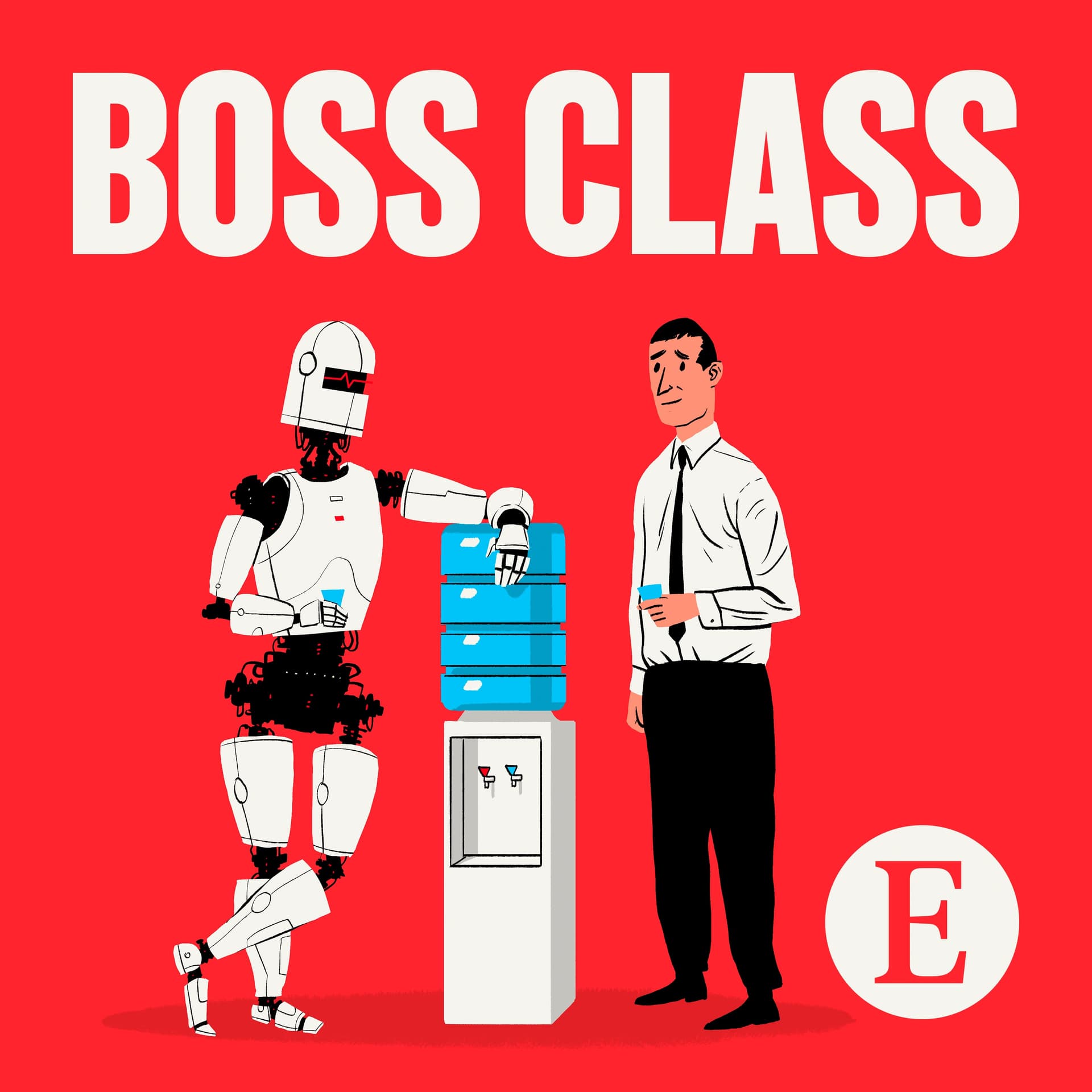
Andrew Palmer returns for a third season of Boss Class. This time it’s all about AI. In the first episode, he starts introducing AI into his daily work routines, and receives a nasty shock.
To listen to the full series, subscribe to Economist Podcasts+.
If you’re already a subscriber to The Economist, you have full access to all our shows as part of your subscription. For more information about how to access Economist Podcasts+, please visit our FAQs page or watch our video explaining how to link your account.
In this episode, Andrew asks Claude, a generative AI programme, to write his management column for him. You can find Andrew’s column here and Claude’s version here.
Hosted on Acast. See acast.com/privacy for more information.