In short
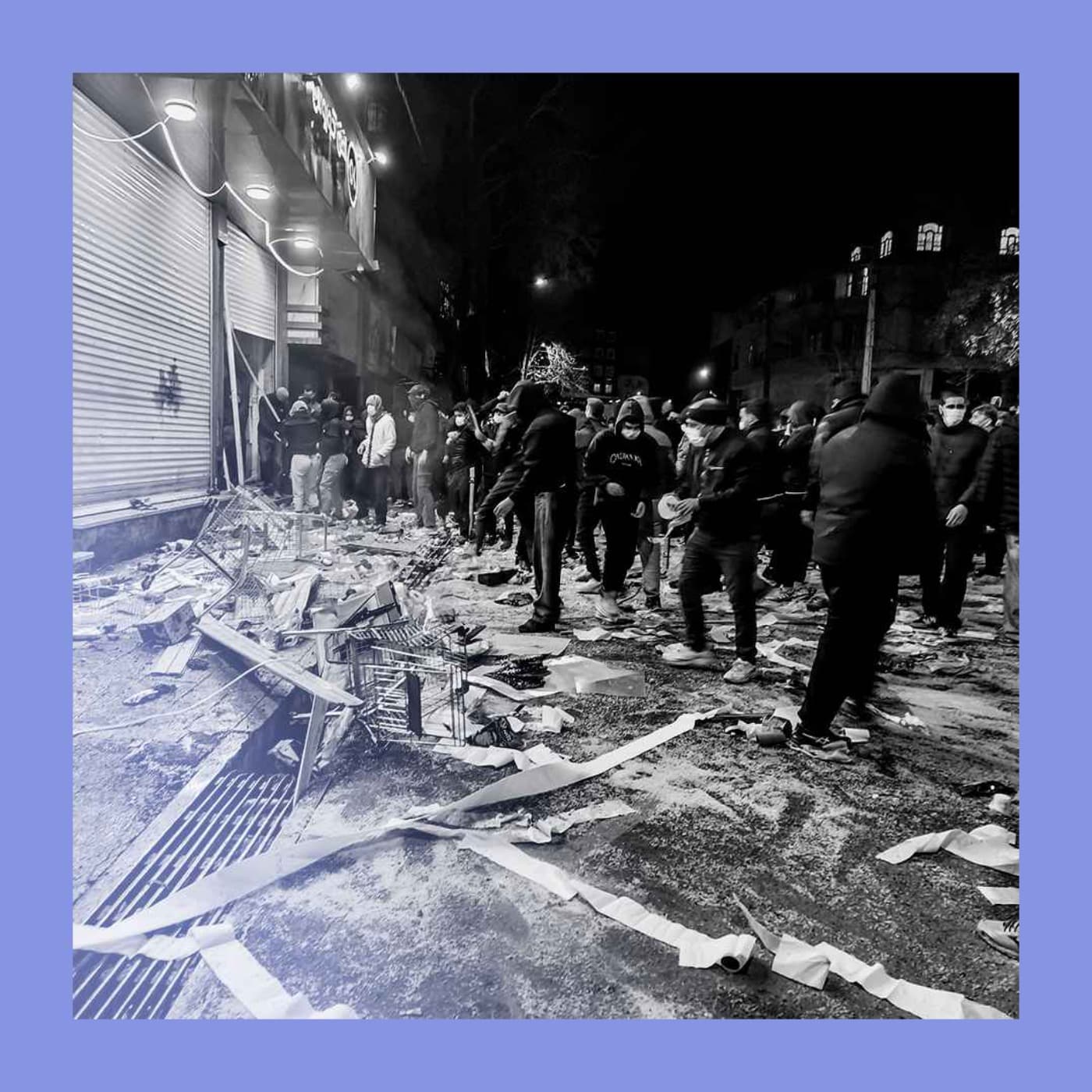
Iran protests after Dec 28 Tehran electronics vendors strike over a collapsing currency; crowds chant “Death to the Ayatollah” and “Long Live the Shah,” with fires and attempts to breach government buildings. Episode contrasts these protests with 2022’s “Women Life Freedom” movement, arguing today’s unrest is driven more by economic grievances and jobless young men, not women-led social demands. It also discusses Iran’s economic crisis (rial collapse, inflation, sanctions plus regime corruption and military/clerical control), limited government response via subsidy reform and small cash transfers, and internal regime debate about replacing Supreme Leader Ali Khamenei. Notable example: calls for Reza Pahlavi’s mobilization inside Iran.
Guests
Greg Karlstrom, Economist Middle East correspondent; Shashank Joshi, Economist defence editor (China/Taiwan segment); Nuno Loredu background is covered via obituary by Anne Rowe, Economist obituaries editor.
Key claims
state can’t offer concessions like in 2022; U.S. threats may sharpen internal regime succession debates.
Written by AI. May contain mistakes. Listen to the episode to check what was said.
Chapters
Tap a time to open that second in VOOverview of Current Global Concerns
1:27 to 2:13
Gain perspective on tensions in Asia and the significance of plasma research.
“As part of our World Ahead series, our correspondent explains what we might expect to see in the country's behavior this year, towards Taiwan, Japan and beyond.”
Protests Erupt in Iran
2:13 to 3:17
Understand the recent protests in Iran, sparked by economic grievances.
“The unrest in Iran started on December 28th, when electronics vendors in Tehran went on strike to protest a currency that was in freefall.”
Differences in Protests: 2022 vs. Today
3:17 to 5:26
Explore how current protests differ from previous ones in Iran, both in demographic and state response.
“We have spent quite some time on the show, Greg, talking about protests in Iran and the degree to which they may or may not change the facts on the ground.”
Economic Challenges Facing Iran
5:26 to 7:50
Delve into the economic issues fueling protests and the government's inadequate responses.
“Well, what are the economic problems that, in particular, these jobless young men are railing against?”
Leadership Crisis in Iran
7:50 to 10:29
Examine the role of the supreme leader in the current unrest and the calls for change.
“biggest unrest in years, this is all the government can come up with.”
Impact of American Politics on Iran
10:29 to 11:00
Discuss the implications of U.S. foreign policy on the situation in Iran.
“about or to Iran matters at this point or even the worry about it?”
Military Concerns Regarding China
13:23 to 14:02
Investigate China's military posture towards Taiwan and broader regional implications.
“Many American military officials reckon 2027 is an important date in China's calendar.”
The Intensifying Pressure on Taiwan
14:02 to 21:56
Explore the escalating military and political tactics China is employing against Taiwan.
“is not fully-fledged conflict, but a steady increase in political, economic and military pressure against Taiwan and other foes.”
A Tragic Tale of Ambition and Violence
21:57 to 28:00
Learn about the life and tragic end of scientist Nuno Lurero amidst academic pressure.
“When Nuno Lurero was growing up in the central Portuguese city of Visu, he knew from very early on that he wanted to be a scientist.”
Exploring Turbulences in the Universe
28:00 to 28:24
Discuss the presence of unexplained turbulences and explosions in the universe.
“but his very own work suggested a different thought.”
Transcript
Automatic transcript. May contain errors.0:00If your eyes are the windows to your soul, and your glasses are the windows to your eyes, then it's pretty important to find your perfect frames. That's why at Warby Parker, we've made shopping for eyewear as easy and fun as can be. Peruse endless styles in our stores, or use our app to virtually try on frames and get personalized recommendations. To find your next favorite pair of glasses, sunglasses, or contact lenses, or to locate your nearest Warby Parker store, head over to warbyparker.com. That's warbyparker.com. If you work in university maintenance, Granger considers you an MVP because your playbook ensures your arena is always ready for tip-off and Grainger is your trusted partner.
0:40Offering the products you need all in one place, from HVAC and plumbing supplies to lighting and more, and all delivered with plenty of time left on the clock so your team always gets the win. Call 1-800-GRAINGER, visit grainger.com, or just stop by. Grainger, for the ones who get it done.
1:05The Economist
1:12Hello and welcome to The Intelligence from The Economist. I'm Rosie Bloor. And I'm Jason Palmer. Every weekday we provide a fresh perspective on the events shaping your world.
1:26Tensions between China and its near neighbors are a perennial concern. As part of our World Ahead series, our correspondent explains what we might expect to see in the country's behavior this year, towards Taiwan, Japan and beyond. And Nino Loredu spent a career studying plasma, that mysterious fourth phase of matter, hoping to harness it for clean fusion energy. Our obituaries editor recounts how that effort was cut short by a long-ago classmate.
2:03First up, though.
2:13The unrest in Iran started on December 28th, when electronics vendors in Tehran went on strike to protest a currency that was in freefall. And last night, those protests grew in size significantly. Greg Karlstrom is a Middle East correspondent for The Economist. Despite a countrywide internet shutdown, videos have emerged of huge crowds on the streets, not only in Tehran, but in cities across the country.
2:45Protesters chanted things like, Death to the Ayatollah and Long Live the Shah, referring to the deposed monarch of Iran.
2:57There were videos of protesters setting fires in city centers, attempting to break into government buildings in provincial cities.
3:09These are not the biggest protests we've seen in Iran, but they do seem like the largest ones since 2022. And they come at a moment when the Iranian regime looks more fragile than ever.
3:24We have spent quite some time on the show, Greg, talking about protests in Iran and the degree to which they may or may not change the facts on the ground. How are these different from the ones, in particular, the 2022 riots that you mentioned? I think they're different not only in size, but in the nature of the protests. Those demonstrations in 2022, they began after a young woman was arrested for failing to observe the state-mandated dress code and subsequently died in police custody. And so the demonstrations that followed had a large presence of women, particularly middle class women. The movement was called Women Life Freedom.
4:04And the focus, at least initially, was predominantly on social issues. Whereas what we're seeing now with these protests over the past two weeks, they are driven more by economic grievances. The people who are coming out to protest, at least in the beginning, it's not middle-class women, it's jobless young men. And this is a constituency that traditionally has been fairly pro-regime, but it hasn't been able to deliver for them. And so those people are angry enough that they are now coming out to protest. That's one difference. And then I think the second big difference is how the state is trying to respond to these protests.
4:43Of course, in both cases, it's pulled out its usual repressive toolkit, shutting off the internet, sending armed thugs into the streets, arresting people, intimidating people. It did that in 2022. It's doing that again today. But during the protests in 22, it was also able to make some tactical concessions. It stopped enforcing the law around mandatory headscarves for women, pulled the morality police back from the streets. They'd let people feel like they had won some gains. This time, they can't do that. The state doesn't have any quick fixes for Iran's economic problems. And so it's really in a bind right now.
5:22Aside from trying to just repress its way out of this, it's really not sure what to do. Well, what are the economic problems that, in particular, these jobless young men are railing against? We could fill an entire episode with those. But if you look at the headline numbers, the currency has collapsed. The real has lost almost 50 % of its value just in the past year. It's trading near 1.5 million on the dollar, which is an all-time low. That has obviously fueled inflation, which has been in the double digits for years. It's above 40 % right now, and it's higher for food. It's 70 % or more. Some of this is, of course, due to the U.S.
6:00sanctions that have been imposed on Iran, particularly on its oil industry. But a lot of it is also structural. It has to do with the political economic model of this regime, which is shot through with corruption. Large parts of the economy are dominated either by the military, the Revolutionary Guard, or by clerics who own large foundations that buy up companies and oversee big chunks of the economy. And so it's not just an issue of sanctions or the West, as Iran's leaders like to say, it's also a problem of how they've set up the country's economy. So apart from clearing out the rock, then, what could Iran's leaders do to address these problems?
6:39They don't have many good options in the short term. I think it's telling to look at what Masoud Pizashqian, the president, has tried to do over the past couple of weeks. The big economic policy that he's announced is basically an effort at subsidy reform. He's doing away with a system where Iran offered a preferential exchange rate to companies that imported food and other essential goods. It's scrapping that system and it's using the money that it saves to do direct cash transfers to Iranians, 10 million rials per person per month, which in principle, it's a fine idea. Direct cash transfers are usually the best way to get money to poor people.
7:19But what we're talking about here, 10 million rials a month, that is worth between seven and eight dollars at today's exchange rate. It's enough to buy a few liters of cooking oil or a not much else. So it's a pittance. And at the same time, by overhauling the subsidy system, the government is going to trigger even more inflation for food prices. We've already seen prices for a few staples jump over the past few days. So it's not going to make a difference for ordinary people. And some of them find it laughable or insulting that in the face of the biggest unrest in years, this is all the government can come up with.
7:57So you've talked there about some economic approaches that the president, the government essentially is making. What about the supreme leader? And you're right, that's really the person that matters in the Iranian system. The president himself has essentially said, I'm powerless, don't look at me, I don't call the shots. Ali Khamenei, the supreme leader for almost four decades now, he is the ultimate authority in Iran. And he's the one that is being pointed out in these protests, unlike prior ones, down with the Ayatollah and back with the Shah. That's a confusing message. Right. We're hearing these calls from people across Iran.
8:34You've heard those chants in previous rounds of protests as well, but I think particularly the ones that are focused on the Shah, there are more of those this time. It seems as if Reza Pahlavi, the 65-year-old son of the previous Shah, the deposed monarch, does have a bit more support now inside of Iran. He urged people to protest last night at 8 p.m. and he's called for similar action tonight.
9:00It's the first time that he's made such a call for Iranians to mobilize inside of the country and people seem to have responded to his call. Some people genuinely support him. Some people probably just think he's the only brand name opposition figure that I can think of and so I'm going to chant in support of him. And some people just think that chanting his name is a way to poke a finger in the eye of the regime and upset them. So it's not monolithic. And so is it working as a finger in the eye of the regime talking about the return of the monarchy? It's not just protesters who are talking about trying to bring down Ayatollah Khamenei.
9:35It's also people within the Iranian regime who are beginning to talk about this. There is a conversation about, should we get rid of the supreme leader in order to save the system? You know, should the Revolutionary Guard, for example, try to seize power? Or should they find another figure from the Iranian political system who might be able to sweep aside the Ayatollah, implement some reforms to appease protesters, but keep the foundations of the regime intact? And interestingly, I think that debate has picked up over the past week since that American raid in Venezuela to capture Nicolas Maduro, which looked like a very similar sort of thing, right?
10:15Removing the president in order to leave the rest of the system intact. You have some people in Iran wondering if they should try something similar in their own country, push the supreme leader aside and find a new leader for the system. I mean, given last year's bombing raids and what have you, do you think what do the Americans do about or to Iran matters at this point or even the worry about it? Or is this really an internal concern that will shake itself out internally? I think on many levels, it is an internal concern. Iranians are not out in the streets protesting because they want Donald Trump to do something or because they are counting on American support.
10:53They are doing it because after half a century of misrule by the Islamic Republic, they're fed up and they feel like they have nothing left to lose. But I think for the calculations of the regime, what America will or will not do does matter and does affect those calculations. We've heard Trump now several times issue threats saying that if Iran kills protesters, that America is locked and loaded and ready to come to their rescue. It's not at all clear what that means, but I think the specter of American involvement, given that America did bomb Iran about six months ago, given what America just did in Venezuela, I think it is sharpening these debates within the regime.
11:37They want to keep the edifice of the Islamic Republic intact somehow. And if there is a risk that America is going to act, that it's going to do something that will bring down that edifice, that might accelerate this talk of trying to replace the supreme leader and replace him with somebody who can keep the foundations intact. Greg, thanks very much for joining us. Thank you, Jason.
12:17We'll be right back.
12:32so you can keep your facility stocked, safe, and running smoothly. Call 1-800-GRAINGER, click grainger.com, or just stop by. Grainger, for the ones who get it done.
12:46There's one place for the newest drops in wellness and performance and the biggest sale of the year. It's The Drop by GNC, curating the best of what's new, handpicked by the pros who know what works. And right now, get it all, buy one, get one, 50 % off during the semi-annual LiveWell sale. From crushing workouts to leveling up your nutrition and everything in between, get the best deals on the latest innovations. All the newness is all on sale right now during the LiveWell sale on The Drop by GNC.
13:23Many American military officials reckon 2027 is an important date in China's calendar. That will mark a centenary since the creation of the People's Liberation Army. And some think it's the time by which China's leader Xi Jinping wants to be ready to invade Taiwan. All of which could mean that this year may be a crucial one. China's certainly been churning out a lot of kit. An extraordinary military display by China to commemorate... China appears to be expanding its military arsenal at a historic pace. But as part of our World Ahead series, Defence Editor Shashank Joshi discusses whether the more likely scenario is not fully-fledged conflict, but a steady increase in political, economic and military pressure against Taiwan and other foes.
14:15The People's Liberation Army, the PLA, China's armed forces, have escalated air and maritime pressure all around Taiwan steadily for several years. In 2025, they conducted live fire drills in the Taiwan Strait. They simulated a blockade of the island. And so the result of all of this is that China could pivot from an exercise or a drill to a real blockade in much, much less time than it would have taken just a few years ago. Now, Shashnik, there's a lot of attention on what happens in the next year, partly because American military officials seem fixated on the idea that Xi Jinping wants to be able to retake Taiwan by 2027, which is the centenary of the People's Liberation Army.
15:05So the interesting thing, Rosie, is that if you go to Washington DC, you'll hear this date a lot. No Chinese official has ever said it. The last director of the CIA, Bill Burns, did say that Xi Jinping had ordered the PLA to be ready by 2027. So it's sort of an American intelligence claim. Now, it's not pulled out of thin air. It is partly, as you say, the centennial of the PLA's founding. That's probably part of it. But it's also linked to some of the very specific and detailed military timelines the PLA has set for itself. So, for example, it wanted to be a mechanized force with proper armored vehicles and things by 2020, and it achieved that target.
15:45It wanted comprehensive modernisation by 2035. And 2027 was a middle target for what they called, and forgive me for the jargon here, they called it intelligentised warfare. What that means really, Rosie, is AI, information networks, data, lots of the same thing you see in Western armies. That's the date by which they wanted all that stuff to be ready in the PLA. So what does all of that mean on the ground? What sorts of tactics might we see the PLA use in the year ahead? Well, I think one of my colleagues called it an anaconda strategy. And essentially, the idea is, instead of conducting a full-scale amphibious invasion, or instead of conducting strikes, you squeeze Taiwan, you intensify the pressure economically, politically, militarily.
16:31And there's all manner of examples of that. So, for instance, China continues to send weather balloons over Taiwan's outlying islands. It continues to send drones over the main island. These are presumably conducting surveillance, but they're also in a way exposing Taiwan's weakness. They're showing its inability to respond. I think this year we're also going to see China's aircraft carrier strike groups increasingly travel around the island, circumnavigating it, going east of it, something they never did in the past, and that will wear down Taiwan's air force. And I think the most interesting thing is something we've seen in Europe, which is undersea data cables being cut for mysterious reasons.
17:12We have also seen a little bit of that in the waters around Taiwan. So undersea cables, I think, around Taiwan suffered unexplained damage at least 11 times since 2023. I can't tell you for certain, Rosie, the PLA did this or Chinese ships did this, but it wouldn't surprise me if there was some Chinese involvement in experimenting with severing Taiwan's communications from the rest of the world in a way that would paralyze them in a conflict or in a blockade. But it's not just Taiwan that's being targeted with these sorts of tactics, is it? It definitely isn't just Taiwan. So when I think of this jockeying in the grey zone, that whole space under the threshold of full-scale armed conflict in Asia, and I think of 2025, really think of the Philippines and the South China Sea.
18:01And what we saw is a confrontation around this place called Scarborough Shoal. It's a contested outcrop. And a vessel from China's Coast Guard collided with another Chinese PLA warship during a confrontation with the Philippines. That's just how rough these confrontations were getting. And I think it showed you China's increasingly aggressive naval tactics. What it tells you is that a risk reduction pact that they signed with the Philippines back in August of 2024 just isn't working as it should. And I think as the Philippines takes over from Malaysia as the chair of ASEAN, this club of 10 Southeast Asian countries, they're going to use that as a platform to put much more pressure on China to sign on to something called a code of conduct.
18:45But this will, of course, also drag the Americans in because the Philippines is a treaty ally. And Shashank feels like a perennial on the show that we've talked about tensions between China and Japan. What kinds of things might we see from the PLA there? There's been a fairly serious diplomatic spat between Japan and China at the end of last year. Japan's new Prime Minister, Takeichi, talked publicly about Japan's potential role in a Chinese invasion of Taiwan. That made the Chinese very angry, and they've responded in some very aggressive ways. At the end of last year, Chinese fighter jets locked their radars onto Japanese planes.
19:29And that is a very hostile act when it comes to plane-on-plane encounters, because it can signal that you're about to have a missile fired at you. There's also a long-standing Sino-Japanese dispute over what Japan calls the Senkaku Islands, islands that it controls in the East China Sea. In 2025, China's Coast Guard set a record for the longest ever intrusion into the Senkaku's territorial waters. They stayed something like 92 hours after pursuing Japanese fishing boats. And the Japanese and experts are concerned that this year, if China wants to put the pressure on, they could, for example, establish a permanent naval presence in the Senkakus.
20:07They could try to exploit resources near the disputed waters in those islands, as they have done elsewhere in the China Sea. And Shashank, you watch this all the time. You're watching this steady change in PLA activity. What are we ultimately going to see at the end of this? Well, I think the answer, Rosie, is we don't know, but it gives the Chinese options. It doesn't preclude them from launching a full-scale amphibious assault over the Taiwan Strait to take the island by force at some point before the end of the decade. They are churning out barges on this show, amphibious ships. But the point is, by also putting the pressure on below that threshold, they give themselves options, options to harass the island, options to make the island's population feel as if it's unable to defend itself and it has no choice but to unify with mainland China under coercive terms, or indeed a blockade that would effectively cut the island off from supplies of fuel, from supplies of food, from communications, and that would ultimately lead to its capitulation, the Chinese may hope, without major blood having to be shed.
21:16I think the challenge in all of this is America's military is preparing for a potential war over Taiwan. It's building up munition stockpiles. It's changing its posture in Asia. And it would know how to respond to a conflict. It's not so easy to respond to surreptitious cable cutting. It's not so easy to respond to harassment by aircraft and ships. And that's the point of this kind of pressure. It's too limited to warrant a military response, but over time it can sap the morale and the strength of the Taiwanese people. And I think that is what makes it such a difficult challenge to be dealing with.
21:56Shashank, thank you very much. Thanks for having me, Rosie.
22:18When Nuno Lurero was growing up in the central Portuguese city of Visu, he knew from very early on that he wanted to be a scientist. Anne Rowe is The Economist's obituaries editor. That was odd. In his primary school, most little boys wanted to be policemen or firemen, but he knew from the very start, and by the time he got to the end of secondary school, he knew he wanted to specialise in physics. All this time he was carving out a particular corner of physics that fascinated him, and this was plasmas. Plasma is the fourth state of matter after solid, liquid and gas. In plasma, the electrons and ions make up a sort of soup.
Read the full transcript
23:07that's super hot and always on the bubble. It's always turbulent. And this, he decided, would make a fine branch of study because there was always the possibility that if scientists could manage to effect fusion in plasma, fusion energy could provide the world with cheap continuous power. This was, however, an incredibly difficult thing to try to do because plasma goes its own way and does its own thing. The plasma we're most familiar with is the solar wind and the solar flares from the sun which just burst out, sometimes quite sharply, and cause auroras like the northern lights and the southern lights and disrupt communication satellites.
24:03But also, we're familiar with turbulence just by looking at the sea and the way the waves move with the water. This is something that is incredibly hard to harness to make energy. And in fact, the only way to do it in a laboratory is to use a device called a tokamak, which is a vessel which can be heated to millions of degrees inside and uses magnets to try to keep the plasma steady. By keeping it steady and at one controlled temperature, there's always the hope that fusion might occur. But in fact, plasma has a mind of its own and does its own thing, so that it's extremely difficult to track it.
24:46And most of Professor Lurero's life was spent trying to construct mathematical models, kinetic codes, that would help him track how the plasma was behaving and see if they were making any progress towards keeping it steady.
25:08He fitted right in at MIT. He was rather an elegant character. He didn't wear jeans and a T-shirt like a lot of the researchers there. He wore rather stylish jackets and looked quite owlish in his glasses and still had traces of a British accent from the time he'd spent at Imperial. And he was well known as a teacher because he was absolutely fizzing with energy and love of his subject. He'd walk into a class and immediately start chalking numbers on the board. And he would challenge his students to try to be the best they possibly could be and not to simply tackle easy problems, but to tackle the hardest possible things.
25:53because with plasma physics, that's what they were going to have to do. And he was especially keen on an essay by Albert Camus called The Myth of Sisyphus, which told the story of the Greek king in Greek mythology who was condemned by Zeus to push a boulder up a hill and see it roll down every time. He felt that Sisyphus, even if he kept failing, was still aiming for the heights and was still a happy man and a model to be emulated.
26:29In his class, there was another student who no one knows whether he particularly noticed, who was called Claudio Manuel Neves Valente. He was a brilliant student, rather a quiet chap. He was there the whole time that Professor Lurero was there. And he was the top of the class. Nuno Lurero graduated with a 16 out of 20 average. But Valente graduated with a 19 out of 20 average, an extraordinary amount. And he went on to Brown University. But then after a few months there, he seemed to drop out and disappear. Meanwhile, of course, Nuno Lurero was taking MIT by storm with his experiments. When Valente next appeared, it was on December the 13th last year, when he suddenly appeared at Brown University, killed two people and injured nine.
27:29After that, still on the run, he appeared in Brookline, Massachusetts, which was where Nuno Lurero was living and pumped several bullets into him and then fled away and eventually killed himself in another state.
27:51There were many motives suggested for the killing of Nuno Lurero. Perhaps it was just professional jealousy, but his very own work suggested a different thought. all over the universe, wherever plasma was, and it was almost the entire universe. There were bound to be turbulences and explosions which could not be explained and which could not be controlled.
28:24Anne Rowe on Nuno Loreiro, who's died aged 47.
28:46The End
29:03and producer is Kinal Patel, with extra production help this week from Emily Elias and Benji Guy. We'll all see you back here tomorrow for the Weekend Intelligence. This week, we'll be looking at how much has changed when it comes to how nations honor their fallen soldiers. The idea of no man left behind and everyone getting a proper burial is kind of new. From Vietnam to Washington, we look at the ever-evolving efforts to pay respect to those who have paid the ultimate price.
30:03We'll be right back. safe and running smoothly. Call 1-800-GRANGER, click grainger.com, or just stop by. Grainger, for the ones who get it done.
30:15There's one place for the newest drops in wellness and performance and the biggest sale of the year. It's The Drop by GNC, curating the best of what's new, handpicked by the pros who know what works. And right now, get it all, buy one, get one, 50 % off during the semi-annual LiveWell sale. From crushing workouts to leveling up your nutrition and everything in between, get the best deals on the latest innovations. All the newness is all on sale right now during the Live Well Sale on The Drop by GNC.
From the publisher
Demonstrations are growing once again—but this time the message is notably different, and the regime has little means available to calm tensions. Where will it end? Our World Ahead series lays out what to expect this year in China’s dealings with Taiwan, Japan and beyond. And a tribute to Nino Loureiro, a pioneering fusion physicist slain by a former classmate.
Get a world of insights by subscribing to Economist Podcasts+. For more information about how to access Economist Podcasts+, please visit our FAQs page or watch our video explaining how to link your account.
Hosted on Acast. See acast.com/privacy for more information.