In short
The episode of The Intelligence from The Economist is about three current stories: (1) the US federal government shutdown and what could end the impasse, (2) why Ghana has stayed relatively peaceful despite jihadist violence spreading across the Sahel, and (3) how bottled water is being marketed as a premium, “luxury” drink amid climate and sourcing pressures.
Guests
Sam Beale (Economist international correspondent; reports on global affairs, interviewed about the US shutdown). Tom Gardner (Economist Africa correspondent; traveled to northern Ghana to assess jihadist spillover and stability). Zannie Minton-Bedos (Economist editor-in-chief; hosts segment about The Insider). Carla Zuburana (Economist news desk; researched bottled water industry “premiumization”). Key claims/examples: shutdown stems from expiring Affordable Care Act tax credits and a constitutional fight over budget power; costs may hit GDP and deadlines like SNAP; compromise idea is healthcare subsidies only after reopening. Ghana’s stability is attributed to politics (entrenched two-party duopoly), professional security forces, community trust, and jihadists allegedly treating Ghana as a safe haven/market (e.g., fuel smuggling near Paga). Bottled water: climate change and contamination (e.g., Nestlé destroying 2 million Perrier bottles after fecal bacteria) and water scarcity push brands toward flavored sparkling “bougie” products (e.g., Perrier with Lily Collins ad), aiming to sell fewer bottles at higher prices.
Written by AI. May contain mistakes. Listen to the episode to check what was said.
Chapters
Tap a time to open that second in VOUS Federal Shutdown: Impacts and Insights
0:57 to 7:11
Explore the ongoing US federal shutdown and its implications.
“In recent years, jihadist rebels have swept through many countries of the Sahel.”
Jihadist Threats in Ghana
14:00 to 17:09
Gain insights into the jihadist threats facing Ghana and its regional implications.
“My suspicion is a lot of this is illegal smuggling of fuel to the jihadist groups.”
Trends in the Bottled Water Industry
17:35 to 22:56
Explore the shift towards luxury bottled water and its environmental impact.
“Carla Zuburana works on The Economist's news desk.”
Taste Test and Reactions
22:57 to 23:26
Engage in a taste test of the new drink with humorous reactions.
“So it's not clear whether it's going to pay off in the long term.”
Transcript
Automatic transcript. May contain errors.0:00You want to get your backyard summer ready, but you don't want to break the bank? Wayfair gets it. Planning on dining al fresco or relaxing poolside? Wayfair has everything you need to prep your space. Shop now and save up to 70 % off during Wayfair's 4th of July clearance. Score huge deals on outdoor furniture, area rugs, and more. We're talking thousands of products for every style and budget. Plus, surprise flash deals July 6th. Don't wait. Shop Wayfair's 4th of July clearance now through July 6th at Wayfair.com. Wayfair, every style, every home.
0:35The Economist
0:42Hello and welcome to The Intelligence from The Economist. I'm your host, Rosie Bloor. Every weekday we provide a fresh perspective on the events shaping your world.
0:57In recent years, jihadist rebels have swept through many countries of the Sahel. So why does neighbouring Ghana remain a sanctuary of relative peace and stability? Our correspondent travelled there to find out. And when you live in lovely London, you're lucky enough, in my view, to have delicious water literally on tap. But those folk whose job it is to sell bottled water think they can do better, and are apparently trying to turn their product into a luxury good.
1:36But first...
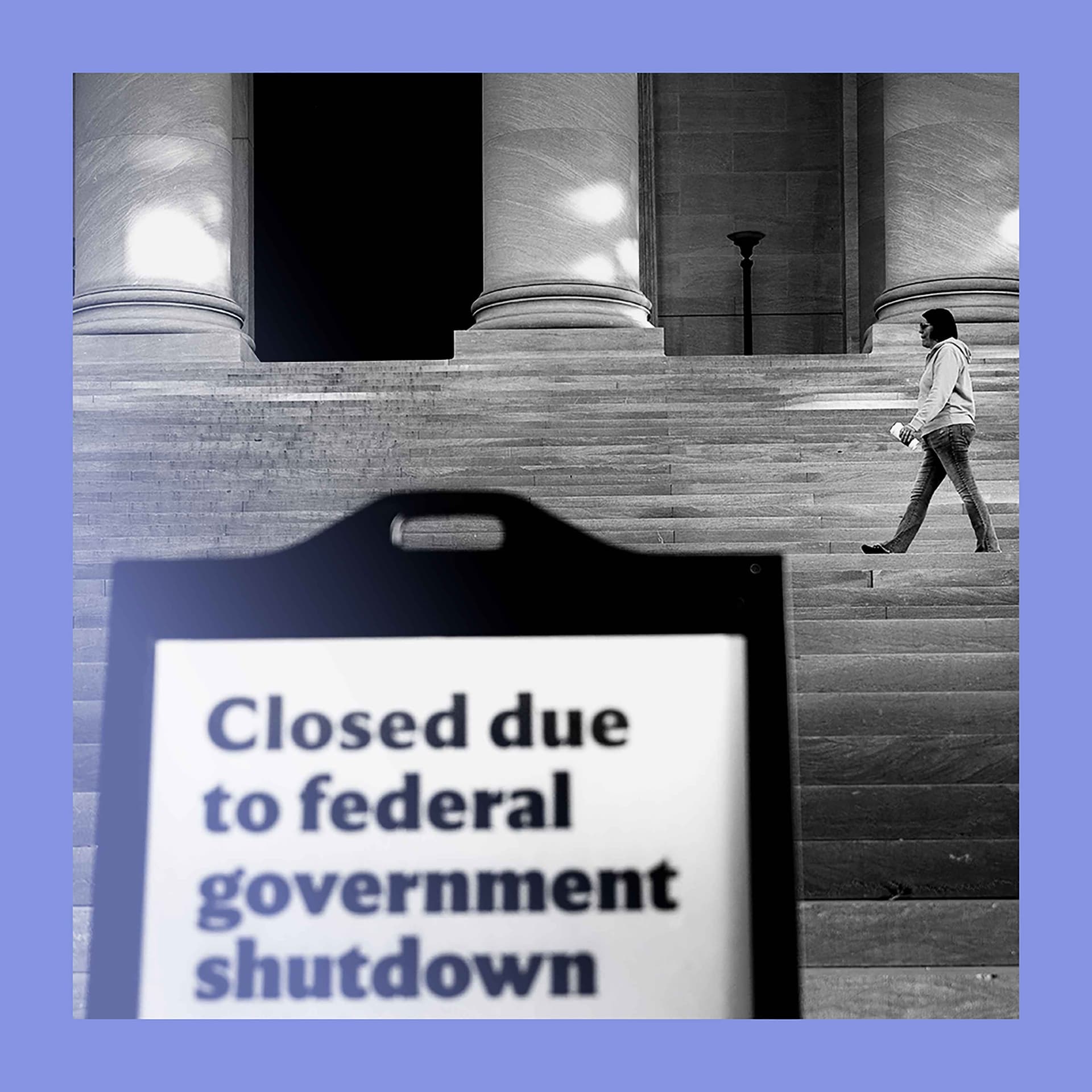
1:43The government shutdown in America is now the second longest on record. Yesterday, it surpassed the 21-day suspension of federal services under President Bill Clinton in 1996. Hundreds of thousands have been furloughed, many others are working without a paycheck, and some may be out of work permanently. The Census Bureau stopped work. So has the National Oceanic and Atmospheric Administration. What happens if we have another hurricane outbreak and some wildfires in the West, severe drought in the Midwest? All of a sudden, you're stretching that workforce so very thin. Most staff at the Department of Education have been sent home too.
2:22And as Republican Senator Ted Cruz noted, even air travel is affected. There are delays. We're seeing flights being cancelled. there are 50 ,000 TSA employees who are going into work and they're not getting paid. There are 14 ,000 air traffic controllers that are going into work and they're not getting paid. In Donald Trump's first term, play stopped for 35 days, the longest in history. This shutdown could soon beat even that. So is there any sign of a deal being brokered? We're 23 days into the shutdown now and it shows no sign of ending. Sam Beale is an international correspondent for The Economist.
3:07Both Democrats and Republicans don't seem likely to budge at all on their budget demands. But despite initial fears about the economic harm that a shutdown would cause, it's been oddly tolerable in Washington DC, at least for now. So Sam, before we get to what's going on now, just remind us what they're fighting over. Really, it comes down to two issues. One is a narrower policy issue which relates to health care. There are tax credits from the Affordable Care Act that expire at the end of this year, and that could send health premiums spiking for most Americans if those aren't renewed. Democrats want to renew them.
3:44Republicans are a lot more reluctant to do that. But there's also a bigger constitutional question here at play, which is who has power over the purse. Democrats want firmer guarantees from Republicans that the president can't just callback funding that's been appropriated by Congress. But that's a much, much harder issue to deal with during a budget negotiation. Republicans have tabled a short-term funding measure, which would keep government funding at current levels. Democrats don't like that, because once you factor in inflation, that's a cut. And you say that the shutdown's been surprisingly tolerable.
4:18What impact has it actually had? The most visible issue so far has been the 750 ,000 federal workers that have been furloughed so far. Most of them work for agencies that aren't necessary to the daily functioning of government, but that's still a big chunk gone. But in many ways, the shutdown is weird because the Trump administration has engaged in all kinds of budgetary chicanery to keep some workers paid. The president has repurposed funds to pay the military. That's 1.2 million active duty service members who have been paid. Some agents at ICE or the Department of Homeland Security are also being paid.
4:56The president has also pledged to use revenues from tariffs to fund welfare programs for the needy, as well as pass on more loans to farmers. So in some ways, it sounds like there hasn't actually been a shutdown at all. But presumably, the longer this goes on, it will have a bigger impact. Most policy wonks say that the economic costs will start to pile up. Oxford Economics A consultancy reckons that 0.1 to 0.2 percentage points will come off GDP each week as the shutdown goes on. And there are also some deadlines to keep an eye out for. So next week, funding for SNAP, which is more commonly known as Food Stamps, a federal program which helps top up those on low incomes to pay for their groceries, that will expire in several states, which could affect millions of Americans.
5:44And that's what most congressional aides say could put a lot more pressure on Democrats or Republicans to come to the table and try and finally solve the impasse. And how's all this going down in the US at large with ordinary people? Well, from Washington DC, most people seem a little bit jaded and they've seen this happen many times before. But if you look at polling, it seems that most Americans for now are narrowly blaming the Republicans for this shutdown. But in recent weeks, our polling suggests that that has also now started to be blamed on both sides a little bit. So that might also push the Democrats to try and get this solved.
6:21And this just can't go on forever. So how will it end eventually? There are some feelers for a compromise. John Foon, who's the Republican leader in the Senate, has basically told Democrats that he'll offer them a vote to extend those healthcare subsidies, but only after they vote to reopen the government. For most Democrats, that's a non-starter. trust that Republicans will stick to their word. Is that an all-time low among Democrats? So from their point of view, they don't understand why they're being asked to vote on a budget deal, which even if it passes, the president could simply just ignore or Republicans might vote to rescind it.
6:57Unfortunately, I think what this really shows is this is the new reality in Washington, DC. It's very hard to get even the most basic appropriations bill passed without hyper-partisan rancor. Sam, good to talk to you. Thank you so much. Thank you very much, Rosie.
7:25Hi, I'm Zannie Minton-Bedos, Editor-in-Chief of The Economist. Join me and my deputy, Edward Carr, on The Insider, tonight at 6 p.m. Stephen, welcome to The Insider. Last time I tangled with you was the 175th. Indeed. I think we kicked it off. Back in 2018, Steve Bannon and I had a heated debate at an Economist event. Now, seven years later, he's not in the second Trump administration, but he's still an influential leader in the MAGA movement. We're a political war. I say that every day. So what's the end point of a war? The end point is we are in charge. As classic English liberals, we at The Economist agree with very little of the populist nationalism Steve Bannon stands for.
8:08But part of the point of The Insider is to speak to influential people with very different worldviews, however jarring those views might be. Trump is going to be president in 28, and people just ought to get accommodated with that. So what about the 22nd Amendment? There's many different alternatives. At the appropriate time, we'll lay out what the plan is. But there's a plan, and President Trump will be the president in 28. Whether you agree or disagree, to hear his arguments, watch The Insider on our app or website at 6 p.m. or afterwards on demand. Know thy enemy.
9:00off during Wayfair's 4th of July clearance. Score huge deals on outdoor furniture, area rugs, and more. We're talking thousands of products for every style and budget. Plus, surprise flash deals July 6th. Don't wait. Shop Wayfair's 4th of July clearance now through July 6th at Wayfair.com. Wayfair, every style, every home.
9:25Recently I travelled to the far north of Ghana to the border areas alongside Burkina Faso and Togo. These are two countries currently experiencing significant jihadist violence. Tom Gardner is our Africa correspondent. I went there to find out why Ghana, despite the jihadist violence that's billowing across these border countries, remains relatively stable. I mean, it's been completely spared violence. And I wanted to go there to find out the secret behind Ghana's apparent invulnerability to the crisis on its doorstep. so Tom before you spill all the secrets put this into context for us you report all over West Africa how is Ghana different from those countries that surround it so these core Sahelian states that's Burkina Faso Mali and Niger they today constitute the global epicenter of jihadist violence in fact more than half of all terrorism related deaths last year occurred there.
10:41Now, the most powerful of the Sahel's militant groups, that's the Al-Qaeda-linked Jainim, has been pushing south recently into West Africa's more prosperous coastal states, in particular Togo and Benin, but also, to some degree, Ivory Coast as well. Now, Ghana shares a nearly 600-kilometer-long border with Burkina Faso, but unlike any of these countries, it has not had one terrorism-related death. My hunch is that figuring out why could be useful in preventing the violence from spreading further. And so why is it, Tom? Why is Ghana so stable? That's exactly the question I put to all my interviewees in the far north.
11:29And there is an optimistic explanation for sure, which is that Ghana's politics insulates it to some degree against violent extremism. Ghana is sometimes touted as Africa's model democracy. It has very competitive elections. I went to dinner in the capital Accra just before the start of my trip to the north with Bright Simons. He's a prominent Ghanaian intellectual. And he argued, for instance, that the existence of what he called an entrenched duopoly of two hyper-competitive political parties with large youth wings, that provides a powerful force for stability. It means the frustrations of young Ghanaians, even those in the far north, which is pretty marginalised, are channelled through votes rather than violence.
12:19Plenty of people I spoke to up in the north agreed with that assessment. The 1992 multi-party democratic constitution, for instance, that cropped up frequently in my conversations. And people also pointed to the Ghanaian military and the armed forces there are seen as pretty professional and well-organized, certainly compared to some of its neighbors. And interviewees across the north talked to me about mutual trust between local communities and security forces, which means people are willing to hand over suspects, for example, to the security. Okay, so you're saying stable government and a professional army are the optimistic explanations.
13:05What are the other ones? I think, unfortunately, maybe the most important reason Ghana has yet to be attacked is probably quite simply that the jihadists have decided not to. Something I heard a lot across the north is that they really prefer Ghana as a market and a safe haven, one where they, in the words of a local journalist, can regroup, grab resources, and gain some respite before going back over the border to carry out a tax. Indeed, some are said to own houses in Ghana where they leave their families. And then there's fuel, for example. And I saw just a 10-kilometer stretch of road south of a border town called Paga, as many as 25 fuel stations.
13:54Locals told me that motor bikes loaded with petrol cross into Burkina Faso every day. My suspicion is a lot of this is illegal smuggling of fuel to the jihadist groups. And then finally, there is a widespread perception in Ghana that there is some sort of tacit agreement really between officials in Ghana and the jihadists across the border. For sure, local leaders and government officials allow fighters be as long as they do not cause trouble on Ghanaian turf. So if Ghana is essentially being used as a safe haven for the jihadists, what does that say about Ghana's prospects longer term? Well, I should say most people I spoke to there were really strikingly phlegmatic about the future.
14:42They did acknowledge it's impossible to rule out the calm one day breaking. One local security expert told me, for example, about recent attacks pretty close to the Ghanaian side of the border. And in September, Ghana's military said it had ramped up patrols in a town called Bongosho, which I visited. Those were in response to recent reports of cross-border infiltration. Stepping back a bit, yes, certainly Ghana is richer than its neighbours, particularly those in the Sahel, but the far north of Ghana feels quite a lot like much of the Sahel. Certainly parts that I've visited, it's very poor still, and there are quite a lot of local communal conflicts of exactly the kind which jihadists are often skilled at exploiting.
15:36So if you've got a region wracked by jihadist violence, and then one country being used as a market for the funds and the families, that doesn't exactly sound like a recipe for peace. Yeah, so that's why I came away not convinced that Ghana is really a model for the region when it comes to dealing with the threat of jihadist violence. The government hasn't invested as much as neighbouring Ivory Coast, in particular when it comes to job creation programmes in the north to discourage young men from joining militant groups. And ideally, regional governments need to be banding together to tackle the crisis.
16:16But that's become really difficult in recent years. Since 2020, military junters have seized power in Mali, Burkina Faso and Niger. And in January, those countries quit the region's main trading and security block, the economic community of West African states. Now Ghana has a new president since January. He's tried to patch things up with neighbours to make common cause against the jihadist. But my sense is there is a dilemma here because so far the jihadists have spared Ghana. But that's primarily because Ghana's taken a pretty hands-off approach to their presence on their soil. If that changes, well, that could aggravate the jihadist groups.
17:04But if in the long term, if Ghana does nothing, that may strengthen them. Tom, thank you very much. Thank you, Rosie.
17:34So, Rosie, I brought you something very exciting. Carla Zuburana works on The Economist's news desk. Volvic's touch of fruit, strawberry flavor, which is a sort of sparkling water. You buried that headline, it's water, isn't it? It's water. You wouldn't tell from the can. No, you wouldn't. You really know how to have fun, Carla. You know me. I'm wild. And how much did this cost? It was£1.30. Okay, so roughly the price of a Coke? Yeah, it's not too bad, but this is on the cheaper end of the spectrum. There are much more expensive products out there. For the sake of podcasts, we're going to have to try it.
18:19It smells like strawberry sweets, Carla. Oh, it's actually very sweet. that is like a that's a soft drink yeah it's not water um Carla why did you bring me such a delightful thing to drink today well because over the past few months I've been looking into the bottled water industry and this product sort of embodies the change that the industry is going through so it sounds like bottled water is moving into drinks into luxury so basically all of the big companies like Nestle and Danone, which owns Volvic, are selling their mass market brands and investing into premium ones. And another example of this is Maison Perrier.
19:06Perrier, which is owned by Nestle, recently created a product similar to the one we tried, which is essentially flavored sparkling water. But it's very bougie. You may have seen the ad with start Lily Collins in a villa in the south of France and it was directed by Damien Chazelle, the director of La La Land. And the whole thing kind of reminded me more of a trailer for a romantic film than for not for flavoured water. And the packaging looks sort of like a cocktail in a can. So yeah, essentially the industry is just becoming more and more luxurious. Why is the bottled water industry trying to become more romantic, more luxurious?
19:47The main reason is actually climate change. Natural mineral water must be bottled and treated under EU laws. But there have been lots of cases where torrential rains have flooded aquifers, which contaminates the springs. And then pollution is making things worse. So natural environments are more and more polluted. And so pesticides, fertilizers, and microplastics are contaminating even the most remote springs in the Alps. And last year, for example, there was this big scandal in which Nestle had to destroy 2 million bottles of Perrier after fecal bacteria was found in one of its springs. And then water shortages are an issue too.
20:30So droughts are more and more common, especially in southern Europe. So basically, sourcing clean natural mineral water is becoming harder and harder for these companies. Carla, the cynic in me says that we should turn on the tap and drink the water there, which is treated and cleaned. Won't this idea of making mineral water bougie, luxurious, more sexy, just add to the stress, the environmental stress? Yeah, it is a good point. Environmentalists are always accusing the bottled water industry of being very polluting. Essentially what you're doing, as you said, is you're extracting water from the Alps and then flying it around the world bottled in plastic.
21:11And there's more than one million bottles are sold every minute. So it is a very polluting industry. And Danone, for example, has faced lawsuits over its environmental impact. So essentially, the idea is to sell fewer bottles at higher prices. And those bottles typically come in glass or cans, which also reduces plastic pollution. And do people actually want to drink this surprisingly sugary, sweet water substitute? Yes. So consumer demand is also in part driving this shift because younger people are drinking less and less alcohol. So there's more demand for soft drinks. Essentially, people want healthy, low calorie alternatives to alcohol.
21:52And so Nestlé and their rivals have spotted an opportunity and are pushing flavoured waters. and those waters have the advantage of not being regulated as mineral water and sales are rising quite fast. So during the first half of this year, sales in Nestlé's water and premium beverage division rose by 4.7 % year on year and Maison Perrier, which I mentioned earlier, was a huge success. Sales are close to matching the original brand, Perrier. So it seems to be going quite well. I should note that this flavoured water also contains artificial sweeteners, which seems the opposite of drinking water.
22:33Carla, is this strategy going to work? Is it going to pay off in the long term? It's actually not clear. There's a lot of new flavor water products that are coming, and not only from the big players. There's Dash in the UK, for example, which has become very big. And also selling this water is actually very expensive. Nestle has spent a lot of money on automated bottling lines. Obviously, on the marketing, it's not cheap to get Lily Collins in a commercial. So it's not clear whether it's going to pay off in the long term. And you see it in the numbers. So Nestlé's operating margin are falling.
23:10So during the first half of the year, they were around 9%, whereas a decade ago, margins for its water division were closer to 12%. So essentially, they will need to sell a lot of cans for this strategy to pay off. All right, Carla, let's give this a go. Bottoms up. That is disgusting. It's so disgusting. Thank you so much, Carla. Always a delight to party with you. Thank you, Rosie. That was fun. Thank you.
24:34We'll see you next time. Plus, surprise flash deals July 6th. Don't wait. Shop Wayfair's 4th of July clearance now through July 6th at Wayfair.com. Wayfair, every style, every home.
From the publisher
The government shutdown in America is now the second-longest on record. Yet there is no apparent urgency to end it, either from Republicans or Democrats. Why Ghana has escaped the jihadist violence of its neighbours in the Sahel. And bottled water is going upmarket.
Listen to what matters most, from global politics and business to science and technology—Subscribe to Economist Podcasts+
For more information about how to access Economist Podcasts+, please visit our FAQs page or watch our video explaining how to link your account.
Hosted on Acast. See acast.com/privacy for more information.